In 1904, a game designer named Elizabeth Magie patented a board game called The Landlord’s Game. It came with two sets of rules. Under the first, players competed to buy up land and drive one another into bankruptcy. Under the second, the rent of land flowed into a common treasury, and everyone prospered together. Magie’s hope was that people who played both would feel the difference in their bones — that a game could teach what a lecture never could.
Only half of her invention survived. The competitive rule set was copied, repackaged, trademarked, and eventually sold to the world as Monopoly — it’s no small irony that The Landlord’s Game itself was monopolized into a new game called Monopoly. The game that was designed to expose the problem became a celebration of it, and the second rule set — the one with the lesson — was forgotten.
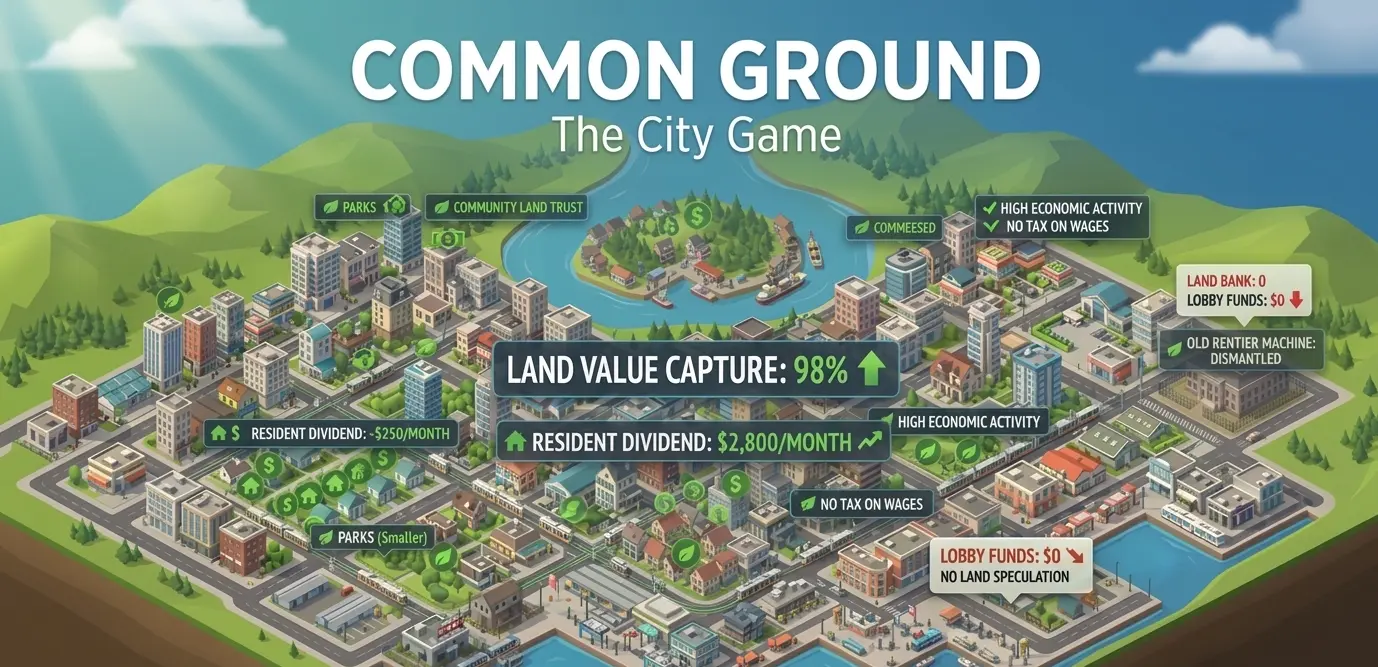
Today we’re picking up where Magie left off. We’ve released Common Ground — The City Game, a city simulation you can play free in your browser. The premise is simple: run a city, choose how it pays for itself, and watch the economics play out.
You take office as mayor of a young city with room to grow. You zone the land, set the tax code, and commission parks, transit, and community land trusts. People move in, buildings rise, rents respond. Every four years you face an election — and you can lose it. Tax paychecks and storefronts, and you’ll watch wealth quietly vanish from your city. Leave the rising value of land in private hands, and you’ll meet the speculators: a lobby whose war chest grows with every dollar of land value you fail to collect, and who will spend it on attack ads to keep things exactly as they are.
That last part matters to us. It would have been easy to build a game where the right answer wins automatically. But in the real world, knowing the answer has never been enough — the private capture of land’s value is defended by those who profit from it, and any honest simulation has to include that fight. In Common Ground, the politics is part of the economics.
Underneath the game sits a real model. Every mechanic is calibrated to findings from peer-reviewed urban and public economics — how cities form around access and opportunity, how bigger cities become more productive, how taxes on work and trade destroy wealth while a tax on land value destroys none. We didn’t hide the homework: throughout the game, small info markers link each mechanic to the research behind it. And at the end of each act, a report card shows you the counterfactual — the same city, run under the tax code you inherited — so you can see exactly what your choices created, and what they avoided.
The campaign unfolds across five cities, each posing the land question in a different form: a river town learning its first reforms, an island where land is truly scarce, a boomtown where speculators are fencing off the future, an old metropolis strangled by a hundred-year rentier machine, and a final act where you complete the transition — funding the whole city from the value of its land and paying every household a dividend from the wealth they create together.
The game is now called the Land Value Game. Play it at landvaluegame.com.