Explore the Circuit Breaker Tax Credit for 2026. Learn about eligibility, designs, and implementation, comparing it to land-value capture for fiscal reform.
July 23, 2026
Circuit Breaker Tax Credit: Eligibility & Benefits 2026
Explore the Circuit Breaker Tax Credit for 2026. Learn about eligibility, designs, and implementation, comparing it to land-value capture for fiscal reform.

A homeowner gets the letter in the mail, opens it at the kitchen table, and sees the same problem that keeps repeating in cities and suburbs alike. The house hasn't changed, the income hasn't jumped, but the property tax bill keeps climbing until the numbers feel out of sync with daily life. For a senior on a fixed income, or a renter whose rent is effectively taxed through the landlord's carrying costs, that's when a circuit breaker tax credit stops being policy jargon and starts looking like the only thing standing between stability and displacement.
The case for this tool is straightforward. When property costs rise faster than household income, a tax system can begin to punish people for staying put in the homes and neighborhoods they already support. A circuit breaker tax credit doesn't solve every housing problem, but it can prevent a tax bill from overwhelming a household's cash flow, which is exactly why policymakers keep returning to it as a targeted relief mechanism. For a broader property-tax reform lens, see this property tax reform overview.
Table of Contents
- Introduction The Need for Property Tax Relief
- What Is a Property Tax Circuit Breaker
- Key Designs and Eligibility Rules
- Circuit Breaker Examples in Practice
- Implementation and Administrative Challenges
- Broader Context Relief vs Fundamental Reform
- Conclusion An Integrated Approach to Tax Fairness
Introduction The Need for Property Tax Relief
A long-time resident can own the same modest home for decades and still struggle with the property tax bill. The pressure usually does not come from one sudden shock. It comes from a steady gap between local assessments and household income, and that gap can be hardest on older residents whose income is fixed or only rises slowly.
A circuit breaker tax credit is designed for that kind of strain. It treats the tax bill as an affordability problem, not only as a property problem. Massachusetts' senior circuit breaker is a refundable relief tool for residents age 65 and older, with income limits and a benefit tied to when property taxes exceed a set share of income. The structure matters more than the headline. Relief goes to households where the tax burden has become disproportionate, rather than being spread across every taxpayer in the same way.
That approach captures a broader policy point. A circuit breaker protects a senior who is house-rich but cash-poor, and it can also help a renter whose housing costs leave little room for tax passed through in the rent. The common thread is ability to pay, not just ownership status or market value.
A local tax system that is pushing pressure onto households with limited room to absorb it raises a basic question. The first response should not be a general tax cut for everyone. It should be whether the relief reaches the households under the most strain.
A circuit breaker also belongs in a wider discussion of land and tax fairness because it is targeted relief, not a structural fix. Officials may need a tool that works now for households already under pressure, while still weighing whether broader reforms should address the forces that push bills upward in the first place. For a related discussion of property taxation and reform choices, property tax reform analysis helps place the credit in context.
What Is a Property Tax Circuit Breaker
Think of an electrical circuit breaker. When the load gets too high, it trips so the system doesn't burn out. A property-tax circuit breaker works the same way in public finance, it limits how much of a household's income can be consumed by property taxes before relief kicks in.
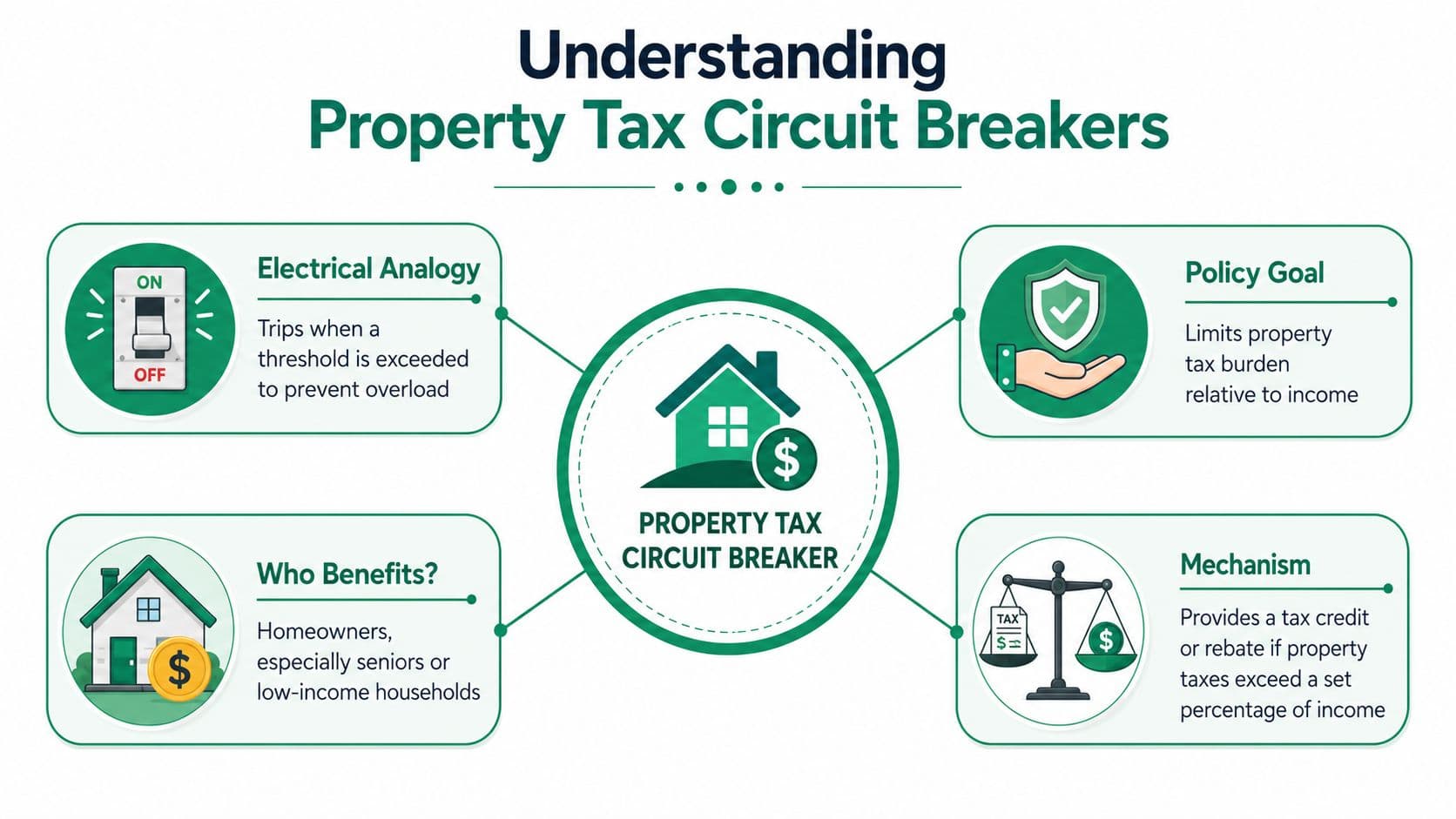
The widely used policy definition is simple. A circuit breaker refunds property tax paid above a threshold share of income, and the term was coined in the 1960s by John Shannon of the Advisory Commission on Intergovernmental Relations (policy history and definition). That idea has endured because it's easy to explain and hard to misunderstand, even when the administrative details get complicated.
The core mechanism
The policy asks a single question. Did property taxes exceed a set share of household income? If the answer is yes, the credit returns part of the amount above that line. That means relief is tied to ability to pay, not just to homeownership or market value.
That logic is why circuit breakers are used in different forms across states. Some are delivered as income-tax credits, others as direct rebates, and some offset future property tax bills. The delivery route matters because it affects who can claim the benefit and how quickly the relief reaches the household.
Why the metaphor matters
The circuit-breaker image is more than a catchy label. It signals that the policy is designed to stop overload, not to reprice the whole system. That's important for officials because it sets expectations correctly. A circuit breaker can reduce strain on vulnerable households, but it doesn't change the value of the underlying real estate or the mechanics of the local tax base.
A good circuit breaker is targeted. It protects the household before the overload becomes a crisis, but it doesn't pretend to rebuild the whole electrical grid.
For officials comparing design options, a useful starting point is the Real estate developers' tax tool, which helps test how tax burdens change across property scenarios. For a practical municipal comparison, this D.C. assessments resource is also worth reading.
Key Designs and Eligibility Rules
A circuit breaker only works as intended if the trigger is set carefully. The design choices determine who qualifies, how much relief they receive, and whether the program targets genuine payment stress or tracks a property's market profile. That is why the main policy split is between income-based thresholds and fixed-rate thresholds. In an income-based design, relief begins when property taxes exceed a share of household income. In a fixed-rate design, the trigger is tied to property value or a preset dollar rule, so the benefit is less responsive to the household's actual capacity to pay.
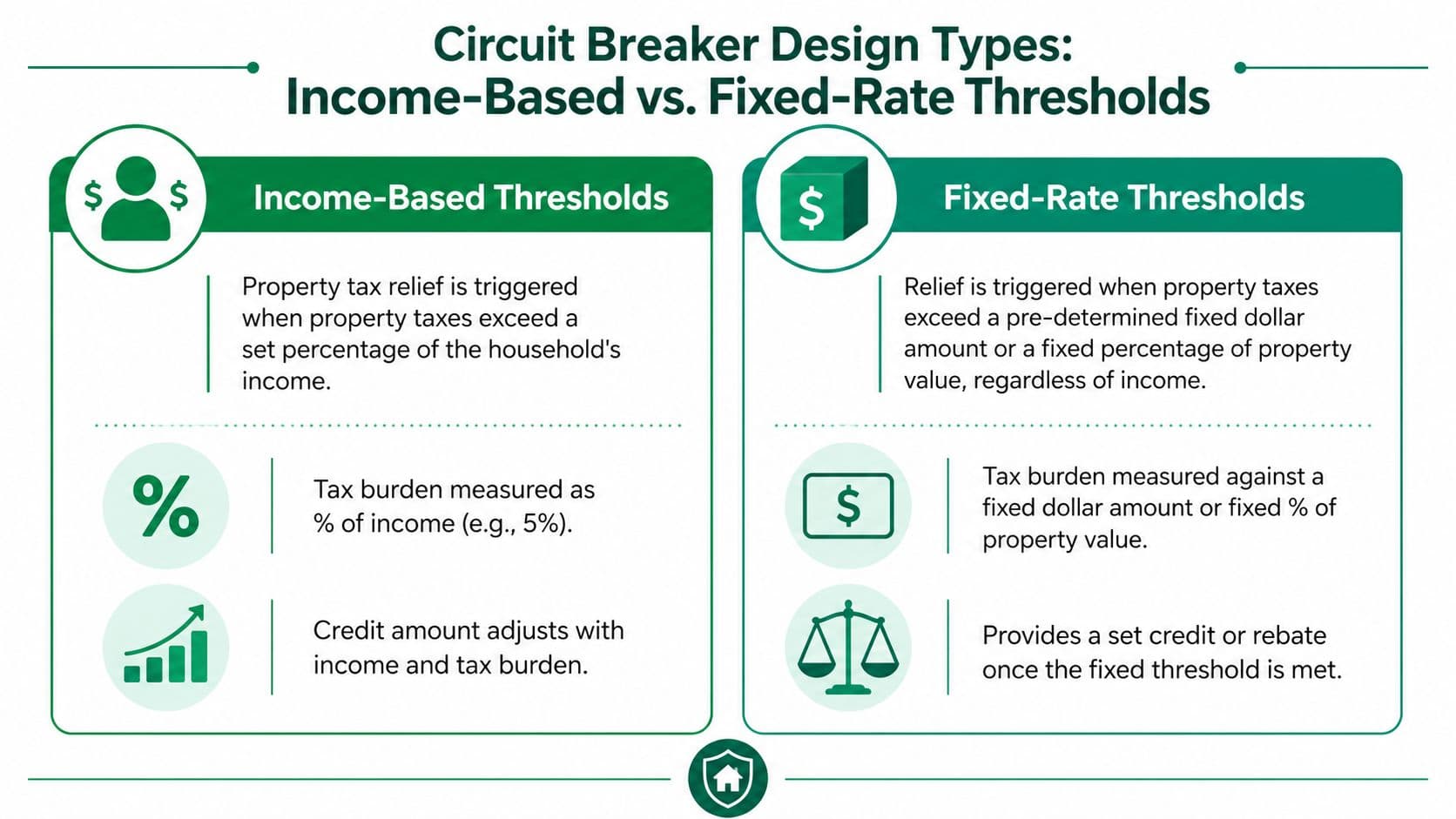
Income-based thresholds versus fixed-rate thresholds
Income-based thresholds are the cleaner fit for a tax relief tool meant to protect households under strain. They tie help to ability to pay, which makes them especially relevant for seniors, renters, and lower-income homeowners whose tax bills may be manageable on paper but difficult in practice. Fixed-rate thresholds are easier to set up in some systems, yet they can miss households with weak cash flow because the rule is anchored to property value or a flat cap rather than to income pressure.
The contrast matters for land policy because it shows what a circuit breaker can do, and what it cannot do. It can soften the burden on households facing tax stress. It does not reprice land, change assessment method, or alter how the local tax base is structured. For officials comparing design options, a useful starting point is the Real estate developers' tax tool, which helps test how burdens shift across property scenarios. For a local comparison point, this D.C. real estate assessments resource is also worth reading.
Texas adopted a distinct property-tax “circuit breaker” for 2024 that is not income-based. It applies only to real property with an appraised value of $5 million or less and limits annual taxable-value growth to 20% (Texas property-tax circuit breaker article). That example shows how broadly the label can be used once policymakers apply it to different forms of relief.
Eligibility filters that shape who gets help
The main eligibility filters work through different channels, and each one changes the policy's reach.
- Income caps: These preserve targeting, but they also shape where the phaseout begins and how quickly relief disappears as earnings rise.
- Age limits: Senior-only programs direct aid to households where fixed-income pressure is visible and persistent.
- Tenure rules: Some programs apply only to homeowners, some extend to renters, and some treat part of rent as a proxy for property tax burden.
- Property-value limits: These keep the credit focused on lower- and middle-value holdings rather than high-value properties.
A program can also be narrowed by the way the tax burden is measured. Massachusetts' senior circuit breaker is a good example of a tightly targeted rule set. It is a refundable income-tax credit with income caps, and the benefit is linked to the relationship between tax burden and income rather than to property value alone.
A policymaker should also examine how the rule fits local administration. If the credit depends on filing status, income reporting, or assessment records, those inputs have to match the way residents already interact with the tax system. Otherwise, the program looks generous in statute and weak in practice. That is why a housing-policy comparison with this D.C. homestead exemption resource can be useful.
Circuit Breaker Examples in Practice
A circuit breaker is easiest to evaluate when it is tied to a real administrative structure, not a theoretical one. Massachusetts provides that test case. For tax year 2025, eligible filers age 65+ can receive up to $2,820 if they meet the program's income limits, which are $75,000 for single filers, $94,000 for head-of-household filers, and $112,000 for married couples filing jointly. The benefit applies when property taxes exceed 10% of income.

How the Massachusetts structure works
The Massachusetts rule is useful because it shows the mechanics plainly. For homeowners, the eligible amount is tied to property tax payments in the current tax year, including water and sewer use charges and stormwater fees, minus 10% of total income. For renters, the calculation uses 25% of rent paid minus 10% of total income, subject to a maximum credit cap. That gives the program a clearer link to burden rather than to ownership status alone (technical information release).
The policy value here is not just generosity. It is precision. The credit narrows relief to households facing a measurable strain, while also recognizing that renters absorb property-tax pressure indirectly through rent. That distinction matters in states where relief rules still treat ownership as the only channel through which local tax burdens show up.
The same example also shows why a circuit breaker fits within a broader land economics framework. It relieves pressure after the tax bill has already reached the household, but it does not change the underlying distribution of land value or the way local tax systems capture it. A more structural approach, such as land-value capture, would work on the revenue side instead of compensating households after the fact. For policymakers, that means the circuit breaker is best understood as a targeted correction, not a substitute for reform.
Why the example matters for policymakers
Massachusetts is persuasive because the rule is tied to an observable burden threshold, so residents do not have to guess whether they qualify. That makes the credit easier to explain and easier to defend politically than a vague hardship program.
The design also makes room for renters without pretending they hold title to property. For a policymaker comparing relief tools, that is a practical advantage. A related example is the District of Columbia homestead exemption explanation, which shows how another jurisdiction uses property-tax relief in a different way, with different targeting choices.
One more feature matters for budgeting and fairness. Massachusetts allows qualifying households to claim credits for prior years by filing amended returns, and one explainer notes taxpayers can go back three years, giving a total of four years of potential benefit when the current year is included (Massachusetts filing explainer). That retroactive feature helps households that missed the credit at first, but it also shows the limit of the tool. A circuit breaker can reduce tax stress after the fact, yet it leaves the underlying tax base unchanged.
Implementation and Administrative Challenges
The biggest weakness of a circuit breaker is rarely the policy idea itself. It's the path from eligibility to payment. A household can be fully entitled on paper and still miss out because the application is hard to find, the instructions are unclear, or the person never files the return that makes the credit available.
Why take-up is the real test
Administrative friction is where relief programs lose effectiveness. Some systems require an income-tax return, some require paper forms, and some depend on local administration that isn't equally strong everywhere. That's a serious barrier for eligible renters and seniors, especially when the benefit is spread across agencies instead of delivered in one obvious channel (Local Housing Solutions on property-tax relief administration).
Policy reality: a credit that exists in statute but doesn't reach eligible households is a budgeting assumption, not a relief program.
The mechanism matters because each delivery model creates a different user experience. A direct rebate may be easier to understand, but it still needs accurate outreach and a reliable mailing system. An income-tax credit can be efficient for households already filing returns, but it can miss the people most likely to need help if they don't file. A credit against future property taxes can be visible and simple for owners, but it may leave renters outside the design unless the state explicitly builds them in.
What officials should watch for
The administrative challenge is not abstract. It shows up in who can ask for help, what paperwork they need, and whether the government has already matched taxpayer records with property records. When that infrastructure is weak, the households with the greatest need are often the least likely to capture the benefit.
A simple way to evaluate a proposed circuit breaker is to ask four questions:
- Can the resident claim it without specialist help?
- Does the program work for both homeowners and renters where intended?
- Is the benefit delivered in a way that aligns with how people already file taxes?
- Does the administration have a reminder and outreach process, or is it left to chance?
A fiscal note should also include the cost of under-enrollment, not just the statutory cost of the credit. If eligible households don't claim the benefit, the official estimate may look tidy while the policy impact remains partial. For a broader budgeting lens, this fiscal impact analysis guide helps frame the actual administrative trade-offs.
Broader Context Relief vs Fundamental Reform
A circuit breaker can keep a family in place this year. It can't, by itself, fix the tax base that keeps pushing the bill higher. That's why the policy should be read as targeted relief, not as a substitute for structural reform.
Why relief is not the same as reform
The contrarian critique is persuasive. Circuit breakers soften tax burdens without addressing the underlying driver, which is rapid land and home-value inflation. Salt Lake County's discussion of circuit breaker relief makes that point directly, noting that these programs can ease the burden without solving the deeper affordability problem (Salt Lake County circuit breaker page).
That matters because a local government can become too comfortable with relief tools. Relief handles the symptom. It doesn't change the incentives that reward speculative holding, underuse of land, or tax systems that lean too heavily on buildings and improvements.
Where land-value reform enters the picture
A land-value tax shifts more of the tax burden onto the value of land itself rather than on the structures built on it. In policy terms, that matters because land is fixed in supply, while buildings, investment, and work are productive activities officials usually want to encourage. A more direct land-value approach can also fit with land-use rights, which are land leases repriced annually with no expiration dates. Because they're repriced annually, people can buy and sell land-use rights for a low cost, which gives governments a different way to manage access and value capture without treating land like a conventional permanent private asset.
That doesn't make a land-value tax a replacement for every relief measure. It means officials need to separate two questions that often get blurred together. One question is how to protect a household from immediate tax overload. The other is how to design a tax base that doesn't keep generating overload in the first place.
A circuit breaker belongs in the first category. Land-value taxation, land-use rights, and related land-value capture tools belong in the second. For a comparative framework, this land-value tax versus property tax analysis is the cleanest next read.
Conclusion An Integrated Approach to Tax Fairness
A circuit breaker tax credit is a smart policy because it respects household affordability. It recognizes that a tax system can become unlivable even when the property itself is valuable, and it gives officials a way to protect seniors, renters, and other strained households without giving a broad windfall to everyone.
But it shouldn't be mistaken for the whole answer. The strongest public finance strategy is layered. Use circuit breakers to prevent overload, then pair them with reforms that address the land-value dynamics and housing pressures behind the overload in the first place. That's how relief becomes fair, durable, and fiscally honest.
A CTA for Unitism® is to treat circuit breakers as part of a broader land-fairness strategy, not as the final destination. If you're evaluating tax relief options for your jurisdiction, start with the relief design, then test how it fits alongside land-value reform, administrative capacity, and long-term housing affordability goals.