Learn how a community land trust works, from governance and financing to resale formulas and land-value policy. A practical guide for cities and residents.
October 17, 2026
Community Land Trust Explained: A Practical Guide
Learn how a community land trust works, from governance and financing to resale formulas and land-value policy. A practical guide for cities and residents.

By the end of 1992, about 2% of Burlington's housing was within its community land trust system, evidence that a locally supported trust could become part of a city's housing supply rather than remain a small demonstration project (Institute for Local Self-Reliance). The result points to a practical idea: a community can keep land in shared stewardship while households own or rent homes on it.
A community land trust, or CLT, is not a discounted home-buying program. It's a way to separate the value of land from the homes built on it, preserve affordability when a property changes hands, and give a nonprofit long-term responsibility for the land. To understand what the model can do, it helps to follow the chain from its origins to the legal agreements, financing choices, and citywide land policies that support it.
Table of Contents
- How a Southern Farming Experiment Became a Housing Model
- What a Community Land Trust Actually Is
- How Affordability Survives the Second Sale and the Third
- CLTs, Public Housing, and Land Leases Compared
- Financing, Acquisition, and the Land-Value Connection
- International and U.S. Evidence on Scale and Stabilization
- Where the Model Breaks Down
- Reading the Model as a Whole
How a Southern Farming Experiment Became a Housing Model
The modern urban community land trust grew from a land-rights struggle, not a housing program. In Georgia during the 1960s, the New Communities project used collective land ownership to support Black farmers and shared economic opportunity. The underlying idea was that control of land could help a community build economic self-determination.
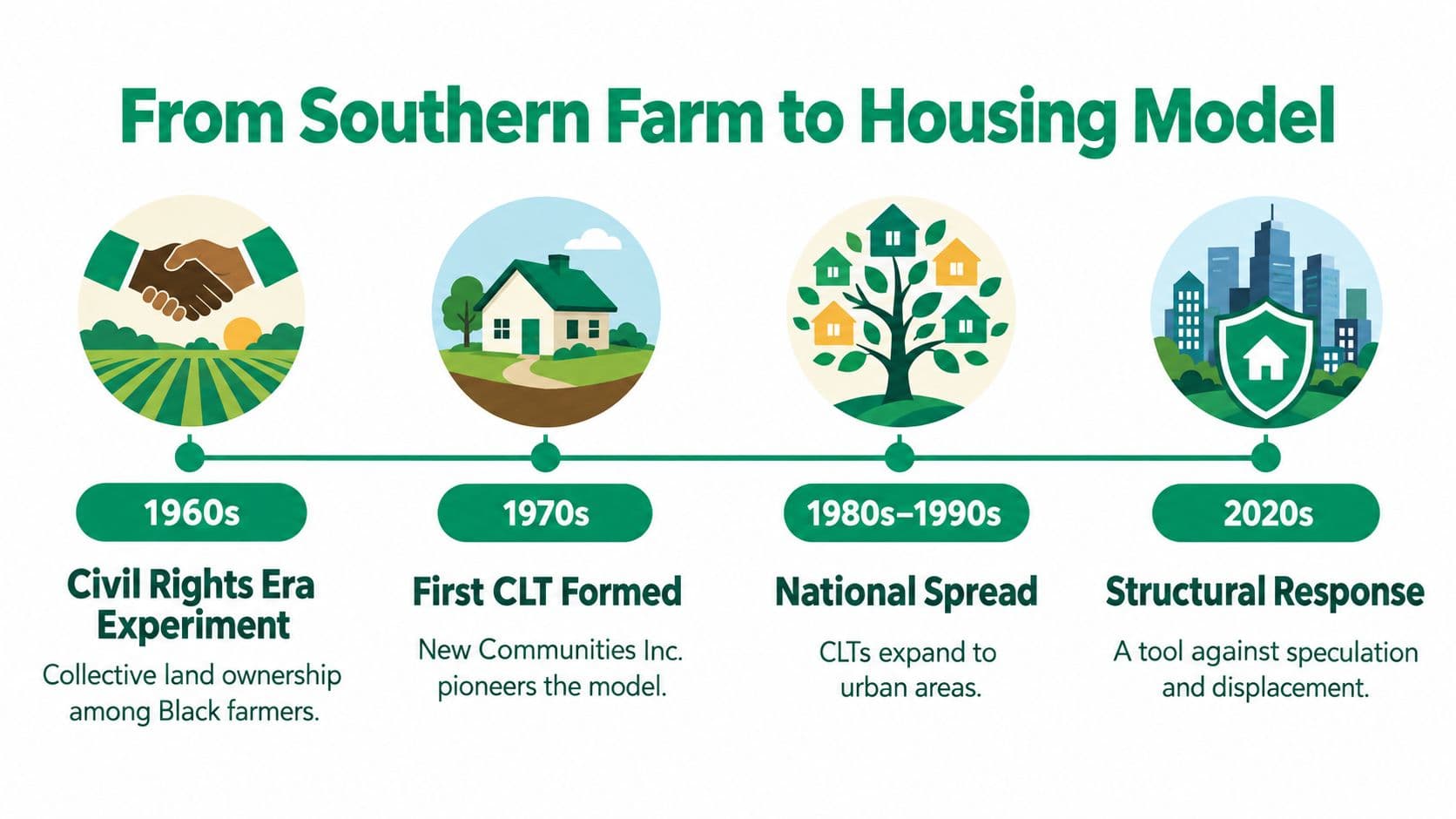
Burlington, Vermont, later adapted that principle to urban housing. In 1984, the city established the Burlington Community Land Trust, the first widely recognized urban CLT in the United States. Burlington provided a $200,000 seed grant and staff support, making it the country's first municipally funded CLT. Public backing helped the nonprofit gain a foothold, while the trust provided a lasting structure for community stewardship.
A durable local formula
Burlington's approach separated land ownership from ownership or rental of the homes built on it. The nonprofit retained the land, while households lived in the buildings under agreements designed to preserve affordability for future residents. This arrangement connected a household's home to a wider public purpose: land remained under shared stewardship rather than passing entirely into private ownership.
After voters approved a one-cent property-tax increase in 1989, the city created a dedicated housing trust fund in 1990, giving housing investment a durable local source (Institute for Local Self-Reliance). The sequence shows how a city can pair a nonprofit land-holding institution with public revenue. A ground lease shapes the household's rights to a particular home; public land policy and funding help sustain the model across a wider housing system.
In 2006, the Burlington CLT merged with the Lake Champlain Housing Development Corporation to form the Champlain Housing Trust, serving three Vermont counties. Its history links collective land ownership and Black economic self-determination with an urban tool for keeping housing affordable. The Rondo Community Land Trust's work in neighborhood stewardship offers another example of community ownership shaping local futures.
What a Community Land Trust Actually Is
A community land trust is a nonprofit organization that retains ownership of land and gives households the right to use it through a long-term ground lease. The household may buy the home built on that land or rent a dwelling there. In either case, the key distinction is that the trust owns the land, while the resident's ownership or tenancy concerns the building.
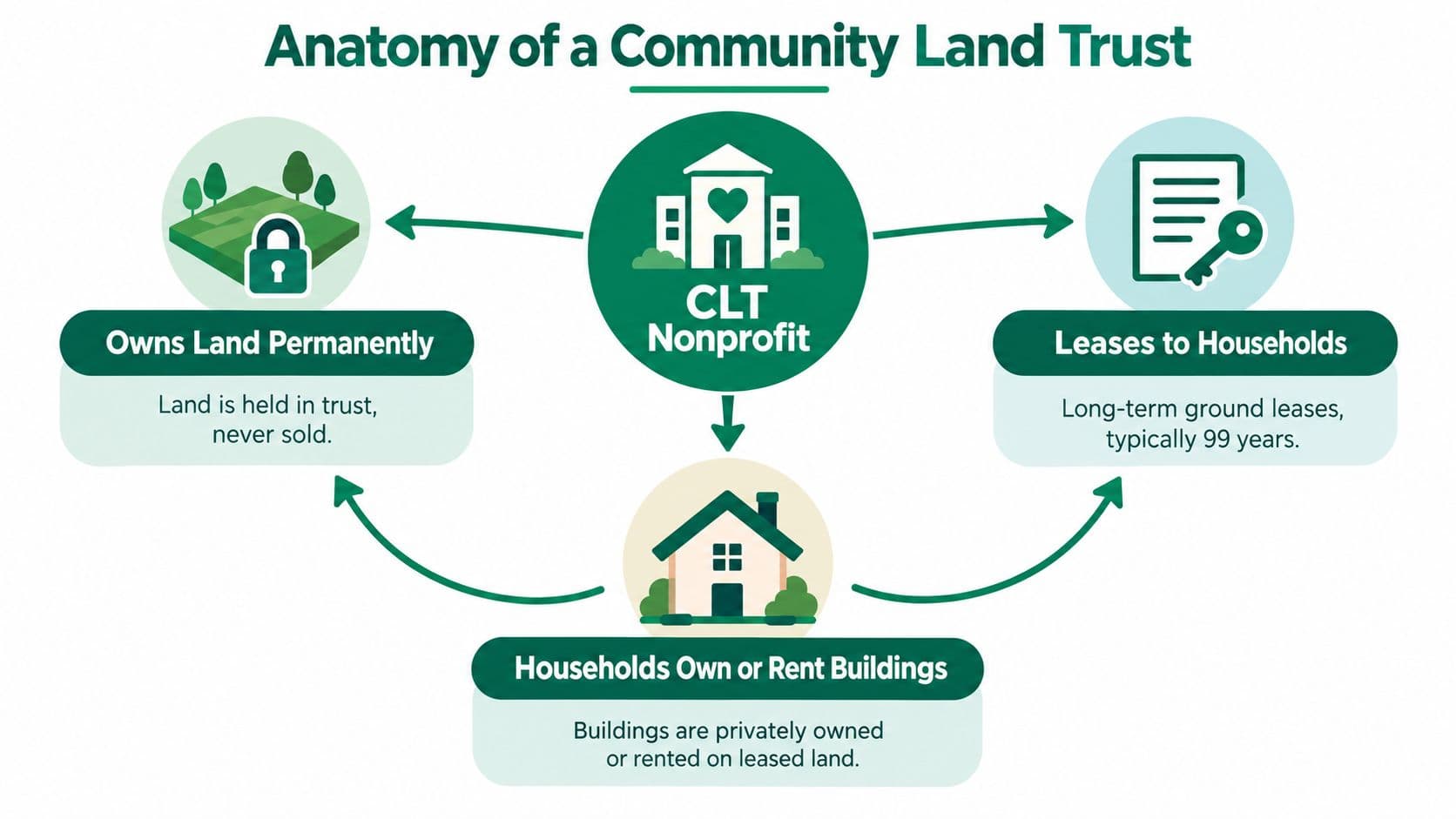
Three pieces work together:
- The nonprofit trust holds the land for a community purpose and oversees the program.
- The ground lease gives a household the right to occupy and use the land under agreed conditions.
- The resale rules govern who may buy a home and how its price is set when the current owner leaves.
A ground lease is not just a rent bill. It's a legal agreement that can specify how the property may be used, who qualifies to buy, how the home's resale price is calculated, and whether the trust can purchase the home before it goes to another buyer. The exact terms vary, so the lease itself, not the CLT label, determines what a household can do.
A simple purchase example
Suppose a home's total value would be $250,000 if it included both the building and the underlying land. In a CLT purchase, the buyer pays for the home rather than buying the land, which stays with the trust. The household then pays any ground-lease charge required by its agreement. The price, lease charge, and resale terms depend on the specific program, so the example describes the structure, not a standard CLT price.
At resale, the departing owner doesn't automatically receive the full market value of the combined land and building. The lease's formula limits the resale price, and the next eligible household can buy under the same affordability structure. A CLT is usually a private nonprofit, not a government agency, though it may work with public bodies and receive public support. Its public-purpose role comes from how it holds land and administers the agreements. The guide to land-use rights clarifies why the legal form of a land interest matters.
How Affordability Survives the Second Sale and the Third
A CLT's affordability isn't secured just because the first buyer receives a lower-priced home. It must be carried into later transactions through the ground lease, a resale formula, eligibility rules, and ongoing stewardship. If those parts are weak or poorly administered, the land may remain in trust while the intended affordability slips away.
The resale formula sets a limit on how much the owner can receive when selling. It typically allows the homeowner to build some equity, but it prevents the full rise in land value from being added to the resale price. That balance is central: the owner has an asset and a route to sell, while the next household doesn't have to pay the unrestricted market price.
The rules that carry affordability forward
Eligibility provisions can reserve homes for buyers who meet the CLT's requirements. The trust's purchase option may allow it to buy the home or arrange another qualified buyer if the household decides to sell. These provisions are not interchangeable. A purchase option without a reliable process for finding eligible households may leave a home vacant; a resale formula without clear enforcement may not protect affordability.
Stewardship continues after the keys change hands. The trust may help residents understand lease obligations, coordinate repairs, monitor compliance, and prepare for resale. That work takes staff time and consistent administration. It also helps prevent the model from becoming a one-time transfer of a discounted home with no long-term support.
Practical rule: Judge affordability by what happens at resale, not only by the price the first household pays.
Evidence on resident experience offers a useful corrective to the assumption that affordability necessarily comes at the cost of wellbeing. In a survey of CLT homeowners, comparable market homeowners, and renters, CLT owners reported no disadvantage relative to market owners in financial well-being, housing stability, or sense of home. They also reported more time and resources for desired activities than market owners, while their demographic profile was closer to renters than to market owners (Journal of Housing Research).
The policy trade-off is explicit: owners may receive less appreciation than they would under unrestricted market resale, but the home remains accessible to later households. For a broader discussion of the forces behind affordability pressures, see this analysis of the housing affordability crisis.
CLTs, Public Housing, and Land Leases Compared
A community land trust is one tool among several. Governments choosing a housing strategy need to consider who owns the property, how residents gain access, and whether public investment benefits only the first household or remains available to people who follow.
| Instrument | Who owns the land | How affordability is preserved | Who runs it |
|---|---|---|---|
| Community land trust | A nonprofit trust | Ground lease, eligibility rules, and resale limits | CLT nonprofit, often with public or community partners |
| Public housing | A public authority or government entity | Public ownership and program rules | Public housing agency |
| Inclusionary zoning | Usually private owners | Local rules require or incentivize affordable homes in covered development | Local government administers the rules; private owners manage buildings |
| Direct buyer subsidy | Usually the household after purchase | Upfront assistance reduces the buyer's cost; affordability after resale depends on the program's terms | Public agency or nonprofit program administrator |
| Fixed-term land lease | A public, private, or nonprofit landowner | Contractual rent and term, with price consequences at renewal or expiry | Landowner and leaseholder under the contract |
| Land-use right | A landowner retains the site; the right holder uses it | Indefinite use with annual repricing of the land charge | Right holder and landowner under the applicable system |
Fixed-term land leases can be renewable or non-renewable, but both have a set term and fixed price. A renewable lease offers certainty only until renewal. At that point, the accumulated gap between the contractual lease price and current market value may be settled through a major repricing. A non-renewable lease can become increasingly difficult to refinance or sell as expiry approaches. Fixed leases don't remove risk; they postpone it.
Don't confuse duration with the right itself
A genuine land-use right, as used in the cited framework, has no expiration, requires no renewal, and is repriced annually. Annual repricing avoids tying the interest's value to a fixed expiry date or a terminal payment. A holder can transfer the right without negotiating the remaining years of a fixed lease, and the recurring charge reflects current site value.
That distinction excludes ordinary long leases. A 99-year Hong Kong building lease fails the indefinite-term and annual-repricing criteria. A 50-year Estonian residential right fails the transferability criterion in the cited comparison (Unitism on phased implementation). Calling a fixed lease a land-use right doesn't change its legal features.
CLTs and land-use rights aren't substitutes for every other tool. A CLT focuses on land stewardship and affordable housing over successive occupants. Land-use rights describe a different kind of interest in land, while public housing and inclusionary zoning rely on other ownership and regulatory arrangements. A policy choice should match the problem: who needs secure housing, what capacity the public or nonprofit operator has, and how the affordability commitment will be maintained.
Financing, Acquisition, and the Land-Value Connection
A CLT needs land before it can offer homes, but buying a site is only the first financial hurdle. The organization also needs money for planning, construction or rehabilitation, property management, and ongoing stewardship. Grants, low-income housing tax credits, revolving loan funds, and foundation capital can help fund projects, but they don't automatically provide reliable operating revenue or patient capital.
Patient capital matters because housing and land stewardship often take time to produce stable returns. If an organization must repay its acquisition funding on a schedule that doesn't match its cash flow, it may struggle to maintain affordability or expand its portfolio. Cities and funders therefore need to assess not only the purchase price but also staffing, long-term maintenance, reserves, and the cost of administering resale restrictions.
Connect acquisition to land-value policy
Land-value capture asks how a city can collect some of the value created by public investment, community activity, and local development, then direct it to public purposes. A city might use site-value taxation or payments tied to publicly owned land to help fund affordable housing acquisitions. A CLT can then serve as a delivery mechanism: it acquires land and keeps it out of the resale market for future households.
Land-value taxes, land leases, and land-use rights are distinct instruments. A land-value tax is a recurring public charge on site value. A fixed-term land lease is a contract with a defined duration and a price that is generally set for the term, exposing the parties to a possible repricing at renewal or difficulty as a non-renewable term runs down. A land-use right, under the definition used here, doesn't expire, needs no renewal, and is repriced annually. The instruments therefore distribute payment, risk, and decision-making differently.
Lenders also need clear rules for leasehold mortgages. USDA lending guidance indicates that affordability covenants or resale restrictions may need to end after foreclosure or a deed-in-lieu, and lenders require protections before accepting mortgages on CLT leaseholds. Public agencies and trusts should agree in advance on who bears losses and whether subsidy will be recaptured or replaced. For households comparing a CLT purchase with other routes to homeownership, this guide to down payment aid for veterans explains one form of buyer assistance. For city officials, a guide to land-value capture outlines how land-based revenue tools can connect to public investment.
International and U.S. Evidence on Scale and Stabilization
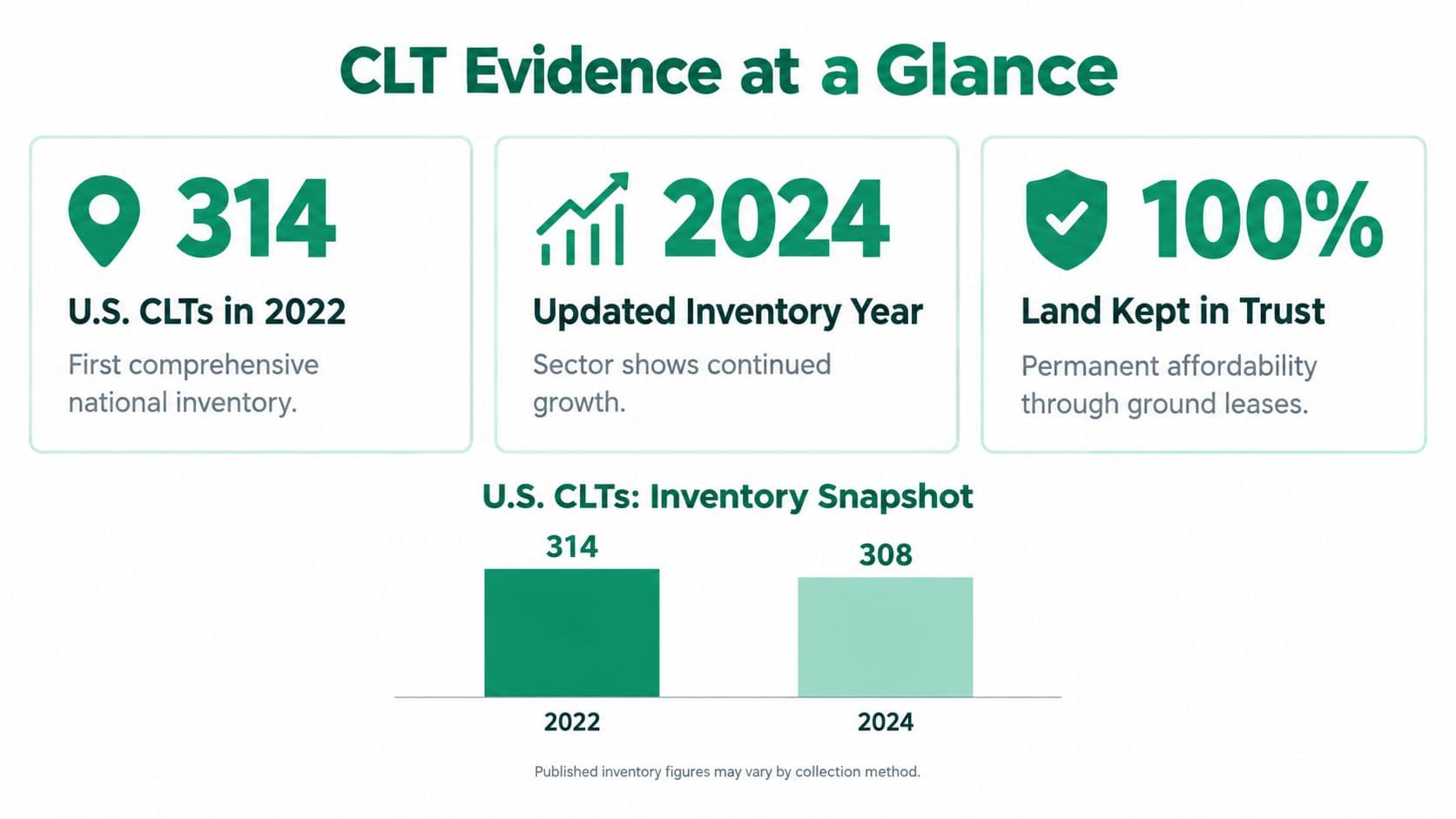
A 2022 census identified 314 U.S. community land trusts and shared-equity organizations, with a projected 43,931 residential units at year-end 2022 (Municipality of Anchorage CLT report). The inventory included shared-equity homes, rentals, manufactured homes, and lease-to-purchase units. That range matters: CLTs are not a single housing product, but organizations serving both owners and renters.
A separate survey reported 308 CLTs operating across 48 states, the District of Columbia, and Puerto Rico in 2024 (Journal of Regional Science). These counts describe different inventories and should not be treated as evidence that the number of CLTs fell. Coverage and definitions can differ.
Scale and neighborhood effects
Champlain Housing Trust illustrates the range a mature organization can manage: it holds roughly 565 homes in the land trust and manages about 2,100 additional rental and cooperative units. In the wider 2022 inventory, 15,606 shared-equity homeownership units, 19,545 rental units, 925 manufactured homes, and 933 lease-to-purchase units were counted. Organizations that supplied detailed records directly documented 23,183 units, including 10,560 shared-equity units and 9,326 rental units. These figures show why organizational totals and verified unit counts can differ: inventories may include estimates as well as detailed reporting.
A study of acquisition records from 15 major CLTs, property transactions, demographic information, and migration histories covering 2000–2016 found that nearby house prices stabilized or increased around CLT acquisitions, even where broader neighborhood prices were declining. It found no detectable increase in resident displacement. The relationship was strongest locally, while citywide estimates became statistically insignificant under a spatial-error specification. The evidence therefore supports a measured conclusion: CLTs may contribute to neighborhood stability near their properties, but a consistent citywide effect has not been established.
Household security and citywide land policy connect through this local work. A CLT can preserve an affordable home for a buyer while keeping the underlying land under shared stewardship. For households needing immediate support, HELP Now AZ family stability offers a service-oriented resource. The wider role of housing and neighborhood conditions in community stabilization helps frame why the effects of a CLT may extend beyond individual homes.
Where the Model Breaks Down
Permanent land ownership is an anchor, not an operating budget. A CLT still needs the income and capacity to administer its ground leases and support residents. Organizations differ in age, location, type, and how much of their work involves shared-equity housing. Financial datasets overrepresent older, Western, and more established organizations, so their results cannot confidently describe the whole sector.
Mortgage default tests the connection between a household's security and the community's investment in land.
As noted in the financing section, lender protections can force affordability covenants to end after foreclosure. The default plan therefore needs to be settled before the mortgage is written. Agreements should specify who absorbs losses, what happens to the public subsidy, and whether the trust can restore affordability or provide another affordable home.
A resale covenant is only as durable as the default plan that sits behind it.
Stronger documents alone cannot resolve competing interests. Lenders need a workable way to recover loans secured by homes on leased land; CLTs and public agencies need procedures for foreclosure and subsidy recapture. Without coordination, financial distress can put both the resident's housing and the community's retained land value at risk.
Proof of concept is not broad supply
UK movement data show that twenty-six CLTs completed 333 affordable homes over three years, serving an estimated 783 residents (Journal of Urban Affairs). These completions demonstrate that the model can operate in another setting, while offering limited evidence about its ability to meet wider housing demand.
Organizational capacity sets another limit. Short-term grants, volunteers, and committed local leaders may get a project built, but mortgages, maintenance, resident support, and resale enforcement continue long afterward. Land stewardship works like maintaining a bridge: securing the asset leaves an ongoing obligation to keep it functioning. Public backing therefore needs to cover acquisition, professional staff, operating revenue, and default planning. Without that support, holding land for shared benefit can remain a project-level achievement rather than a dependable citywide institution.
Reading the Model as a Whole
A community land trust changes who owns the ground beneath a home and what happens to land value when the home is sold. For a household, that can mean a more affordable route to a stable home, with the opportunity to build equity under defined resale terms. For a city, the trust can preserve a public or community investment for later residents instead of allowing the entire subsidy to be absorbed into one sale.
That's a real contribution, not a complete housing strategy. CLTs don't remove the need for construction, rehabilitation, public housing, rental assistance, or other approaches to meeting housing needs. They also depend on land acquisition, sound leases, lenders willing to finance homes on leased land, and a capable organization that can steward properties and support residents.
The practical test: Back a CLT where the acquisition plan, lender arrangements, resale administration, and long-term operating budget are designed together.
The citywide land-value connection broadens the question beyond individual homes. If public decisions and community activity create value in land, local governments can consider how to capture part of that value and invest it in lasting public benefits. A CLT can be one institution for holding land in common purpose, while taxes, leases, and land-use rights remain distinct policy tools with different legal and financial consequences.
For policymakers, the strongest case for a CLT is a local strategy that treats land stewardship, household stability, and financing as connected tasks. For neighborhood groups, the key questions are who controls the trust, how residents shape its decisions, and whether resale rules preserve access without denying homeowners a meaningful stake. Unitism® offers policy design, valuation, distributional analysis, and implementation support for land-value reforms, alongside research on how land policy relates to housing affordability. Explore its resources and advisory work at Unitism®.
Talk with Unitism® about how land-value policy and community land trusts can fit into a practical local housing strategy. Visit Unitism® to explore its guides, policy tools, and implementation support.