Land Value Tax Pennsylvania explained: where split-rate taxes apply, what Allentown and other cities found, and what a statewide shift would require.
November 5, 2026
Land Value Tax Pennsylvania: Where It Stands in 2026
Land Value Tax Pennsylvania explained: where split-rate taxes apply, what Allentown and other cities found, and what a statewide shift would require.

Pittsburgh taxed land at a rate averaging 5.77 times the rate on structures between 1913 and 2001, according to the Chicago Federal Reserve review of Pennsylvania split rate taxation. That long run is unusual, but it is not the hardest part for a town considering the change today. First, officials need land assessments current enough to make a higher land rate fair. Without them, a new rate can place more weight on old mistakes.
Table of Contents
- Where Pennsylvania Stands on Land Value Tax Today
- How Split-Rate Taxation Shifts the Tax Burden
- Land Leases and Land-Use Rights Compared
- Construction After the Shift
- Business Formation and Land Prices Across Municipalities
- Distribution Under Current Assessment Gaps
- Steps to Move a Municipality Toward Land Value Tax
- Deciding Whether Your Municipality Should Act Now
Where Pennsylvania Stands on Land Value Tax Today
The widest land-to-building tax ratio in Pennsylvania's recorded municipal data runs to 24.24 to 1. That figure belongs to DuBois, which ended its split-rate system in 2018. It is not a statewide rate. Pennsylvania has no statewide land value tax.
What the state has is permission. Since 1913, state law has allowed local governments to use split-rate property taxation, and the Federal Highway Administration guide to land value tax describes Pennsylvania as the U.S. state with the longest history of this approach.
A conventional property tax usually applies one rate to the combined value of land and improvements. A split-rate system separates those two parts, taxes land at the higher rate, and taxes structures and other improvements at a lower rate. The same federal guide reports that Pennsylvania is the only state whose government specifically enables local split-rate property taxation.
A split rate is two dials on the same bill. One dial sets the charge on the ground. The other sets the charge on buildings. Moving weight to the ground dial changes incentives without creating a new tax.
What the ratios tell you
A land-to-structure ratio tells you how much heavier the land rate is. At a ratio of 5.10, the rate on each assessed dollar of land is 5.10 times the rate on each assessed dollar of buildings. It does not mean the landowner's whole bill is 5.10 times larger, because the two assessed values also affect the result.
| Municipality | Land to structure ratio | Period covered | Status or note |
|---|---|---|---|
| Steelton | 1.67 | 1990 to 2020 | Lowest ratio in the reviewed record |
| Allentown | 4.46 (4.07 in one study) | 1990 to 2020 | Split rate since 1997, phased |
| Harrisburg | 5.10 | 1990 to 2020 | Split rate since 1975 |
| McKeesport | 4.10 | 1990 to 2020 | Split rate since 1980 |
| Pittsburgh | 5.77 average | 1913 to 2001 | Citywide split rate for most of the century |
| Clairton | 11.41 | 1990 to 2020 | Recorded in municipal dataset |
| Washington | 17.76 | 1990 to 2020 | Recorded in municipal dataset |
| DuBois | 24.24 mean | 1990 to 2020 | Ended split rate system in 2018 |
The spread shows why land value tax in Pennsylvania is not one statewide policy. It is a local choice made under state authority, so neighboring places can run very different systems. Steelton at 1.67 and Clairton at 11.41 sit in the same state record because each municipality set its own rate.
The ratio is only as fair as the land values beneath it. A higher land rate applied to stale values multiplies old errors. If a property's land assessment is too high, the split rate raises its bill. If the land assessment is too low, the owner is undercharged. Appeals make that risk concrete: when owners challenge valuations, the taxable land roll can shrink after the rate is set and after the budget depends on it. Whether an owner pays more or less under a split rate depends on that owner's land-to-building value mix and the ratio. Assessment capacity, not the ratio alone, decides whether the tax is fair and workable.
Before you judge a proposal, check your municipality's ordinance, its current ratio if it has one, and the date of the assessments underneath it.
First question to ask: Is this a new split rate, a change to an existing ratio, or a move toward taxing land only?
How Split-Rate Taxation Shifts the Tax Burden
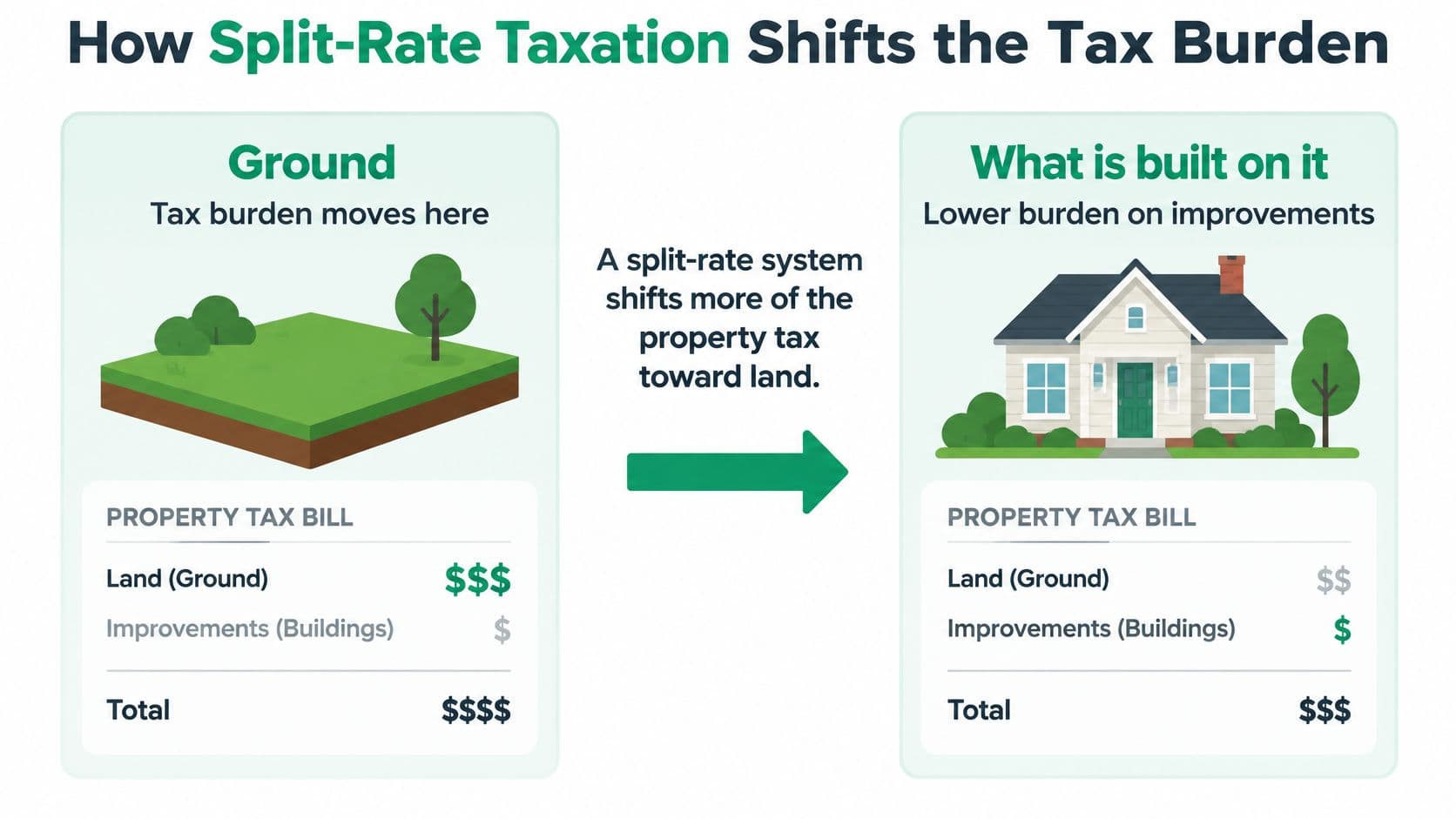
A split-rate property tax bill has two line items. One covers the ground. The other covers what's built on it. A split rate keeps both lines but moves more of the total onto the ground, and the two lines trade off so the municipality can collect roughly the same revenue from a different mix.
The shift changes the price of improving a site. If you renovate a rundown building and its assessed improvement value rises, a heavier building tax penalizes the work. When less of the burden sits on improvements, building and upgrading become less tax disadvantaged. An owner who leaves a valuable site vacant cannot reduce the land charge by doing nothing.
Allentown as the phase in example
Allentown adopted its two-rate system in 1997, with a reported land-to-structure tax ratio of 4.07 in the Lincoln Institute working paper on Pennsylvania two-rate taxation. The city did not jump to a pure land tax in one budget year. Its land share rose in annual steps over more than a decade, giving owners and assessors time to adjust. That gradual path is the useful lesson, not the endpoint.
A phased split is not the Pennsylvania norm. In most discussions, land value taxation is a public charge on the value of land itself, not on the buildings or improvements on it. A split-rate system is only partway there while buildings still face a positive rate. You can also explore the mechanics of moving tax weight away from productive activity without treating every split rate as a pure land tax.
When the building line is taxed more lightly, an owner has less reason to leave a site lightly used. Building or expanding does not trigger the same tax penalty that a heavier improvement rate would. The land line is only as fair as the assessment behind it. If site values are stale or uneven within a municipality, the burden can move in directions the rate table does not predict.
Check two things on any local proposal:
- Building rate: Is it still above zero? If yes, it's a split rate, not a pure land value tax.
- Phase in: Does the ratio move over several years, giving owners and assessors time to adjust?
Land Leases and Land-Use Rights Compared
A land value tax, a fixed land lease, and a land use right are three different mechanisms. People often use the labels as if they're interchangeable. They aren't, and the Unitism explainer on tax reform terms separates them by duration, pricing, and expiry.
A Pennsylvania split rate land tax is a recurring public levy based on assessed site value. You owe it because a local government taxes the land you own. It isn't rent paid under a private contract, and it doesn't grant you possession, because ownership already does that.
A fixed term land lease is a private contract granting possession for a defined period at a fixed price. If it's renewable, you get certainty only until the term ends. At renewal, the accumulated gap between the contract rent and market rent can close all at once in a major repricing. If it's non renewable, the property can become progressively harder to refinance or sell as expiry approaches, because lenders and buyers discount the shrinking term. Fixed leases don't price risk as conditions change. They postpone it.
What makes a true land use right different
A true land use right resembles a lease because it grants use of land, but it's indefinite. It requires no renewal, it doesn't expire, and it's repriced annually. Annual repricing avoids a renewal cliff and can make transfers less costly, since a buyer isn't purchasing years of possibly mispriced rent. Land use rights price land appropriately and don't burden entrepreneurship or other productive enterprises with a looming reset. The problems built into long fixed leases illustrate why the distinction matters.
| Mechanism | Term or duration | How the price is set | What happens at expiry or transfer |
|---|---|---|---|
| Renewable fixed term lease | Fixed term, renewable | Fixed price for the term | Accumulated gap to market closes in one major repricing |
| Non renewable fixed term lease | Fixed term, no renewal | Fixed price for the term | Harder to refinance or sell as expiry approaches |
| True land use right | Indefinite, no expiry or renewal | Repriced annually | No renewal cliff; low cost buying and selling |
| Land value tax (Pennsylvania split rate) | Recurring public levy | Local rate applied to assessed site value | Not a contract; applies each year while the land is owned |
A fixed lease doesn't become a land use right because someone calls it one. It must be repriced each year, require no renewal, and not expire.
Construction After the Shift
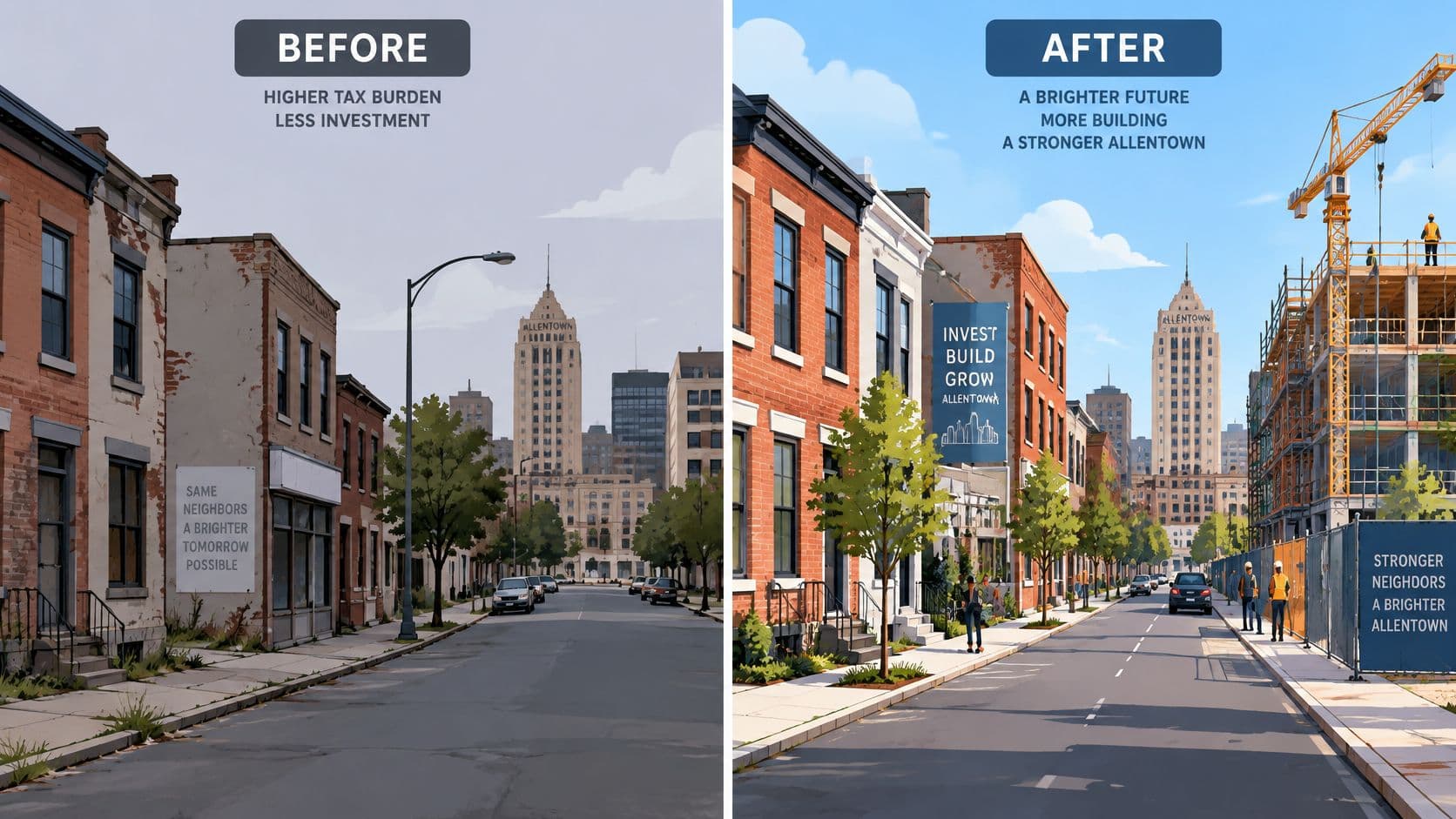
Allentown's private construction and renovation rose 32% in dollar value in the three years after its shift compared with the prior three, and that increase was 1.8 times Bethlehem's over the same period, according to the Strong Towns account of the Pennsylvania land tax experiment. Bethlehem offers a nearby comparison because the two cities were described as broadly comparable in size and economy.
A split rate changes the arithmetic of a site. Renovating or building more intensively carries less tax cost, while holding an underused parcel becomes more expensive. That is the incentive the policy is supposed to create. The construction response only means something if the land values underneath the rates are credible. If assessments lag or appeals knock down site values unevenly, the same nominal ratio can land as different effective rates on similar parcels.
Why this is evidence, not proof
The Allentown comparison was not a randomized experiment. Grants, market conditions, permitting, and redevelopment programs may explain part of the divergence. It is useful because it controls roughly for the regional economy, not because it isolates tax policy perfectly. If you're testing whether a project becomes feasible after an improvement rate falls, you'd also budget for hiring a construction estimator and model materials, labour, finance, and permits, not just millage.
A city that cannot show credible parcel-level land values should do that assessment work before it points to construction activity as proof. For a council, the practical work comes before any claim about growth. Use the framework for testing construction incentives before changing rates, then run these checks:
- Revenue neutrality: Model the levy parcel by parcel at the proposed ratio.
- Separate assessments: Check land and improvement values independently.
- Stress tests: Include vacant lots, low-improvement commercial sites, homeowners, and capital-intensive properties.
Business Formation and Land Prices Across Municipalities
A split rate can change the arithmetic of holding a site, but it cannot by itself tell a town whether new businesses will appear. Pennsylvania municipalities that have shifted toward land taxation differ in millage ratios, assessment practices, and local economies, so a simple before-and-after count of business establishments mixes tax policy with everything else happening on the ground.
The plausible mechanism is straightforward. When the annual charge on a valuable site rises relative to the charge on its buildings, an owner has more reason to build, renovate, lease, or sell to someone who will. A lower relative penalty on improvements also makes a shop fit out or an upper floor conversion look less costly over time. That logic can support business formation, but it is a reason to expect a relationship, not proof that a tax change caused every new establishment.
Comparisons need context. A municipality near a 4 to 1 ratio is not applying the same pressure as one above 20 to 1. A serious comparison lines up each place's establishment trend with its own ratio history, then asks what else changed: a highway project, a major employer opening, a downtown grant program, or a shift in the regional labour market. Without that context, a gain in one town and a loss in another can look like tax policy when they may reflect demand, permitting, or timing.
Land prices are where the assessment question becomes impossible to ignore. A shift toward land taxation should capitalize into lower site prices, because buyers pay less upfront for a parcel when they expect higher annual land charges. A well located site still has underlying value, and the size of the price effect depends on how accurately the land share is assessed and how quickly the charge phases in. If two similar sites carry inaccurate assessments today, a heavier land levy can magnify that error. That is why business formation and land price comparisons across municipalities are only as useful as the assessment rolls beneath them.
Distribution Under Current Assessment Gaps
The familiar fairness claim is that land can't move, so taxing it must be fair. Mobility solves one problem, avoidance, but it doesn't solve valuation. If two similar sites carry inaccurate assessments today, putting more weight on land can magnify that error.
Allegheny County shows the scale of that risk. Appeals since 2020 were estimated to cost county, city, and municipal governments about $25 million in 2025, another estimated $10 million was lost in 2025, and more than 5,000 appeal cases had removed over $150 million from the tax rolls, according to the Pittsburgh Post Gazette report on Allegheny County property tax appeals. A study cited in that coverage found that lower valued properties were over assessed relative to higher valued properties in Pittsburgh and six of the county's ten other largest municipalities.
Fairness needs three parts at once
A land shift can reduce the reward for holding valuable sites underused. It won't automatically be progressive. Assessment accuracy, relief programs, and revenue neutrality have to be designed together, and a structured incidence analysis by household and parcel type is where that work belongs.
Before adoption, ask for published answers to these questions:
- Transition: Who pays more during each phase in year, parcel by parcel?
- Cash flow: How are low income owner occupiers protected from sudden bill increases?
- Renters: How would benefits reach them, through more supply, lower building taxes, or another route?
- Revenue: How much revenue remains after reassessment driven appeals?
Revenue exposure deserves scenarios, not a single optimistic forecast. Test low, central, and high appeal loss cases before and after reassessment, and publish the revenue each option yields. At parcel level, residents can start by checking their assessed land and building split against similar neighbouring parcels, and they can compare property valuation methods to understand why sales comparison, cost, and income approaches may give different answers. Large unexplained gaps are a warning that the valuation base isn't ready for more weight.
Practical rule: Don't raise the land share on assessments you wouldn't defend in an appeal hearing.
Steps to Move a Municipality Toward Land Value Tax
Pennsylvania does not require a regular statewide reassessment cycle. Franklin County's last countywide reassessment took effect in 1961, according to reporting on Pennsylvania reassessment and Franklin County. That gap matters because a land value tax depends on credible, current site valuations. A county can keep total property assessments roughly consistent while land and building values inside each parcel drift far from market. The tax base looks stable on paper and is uneven underneath.
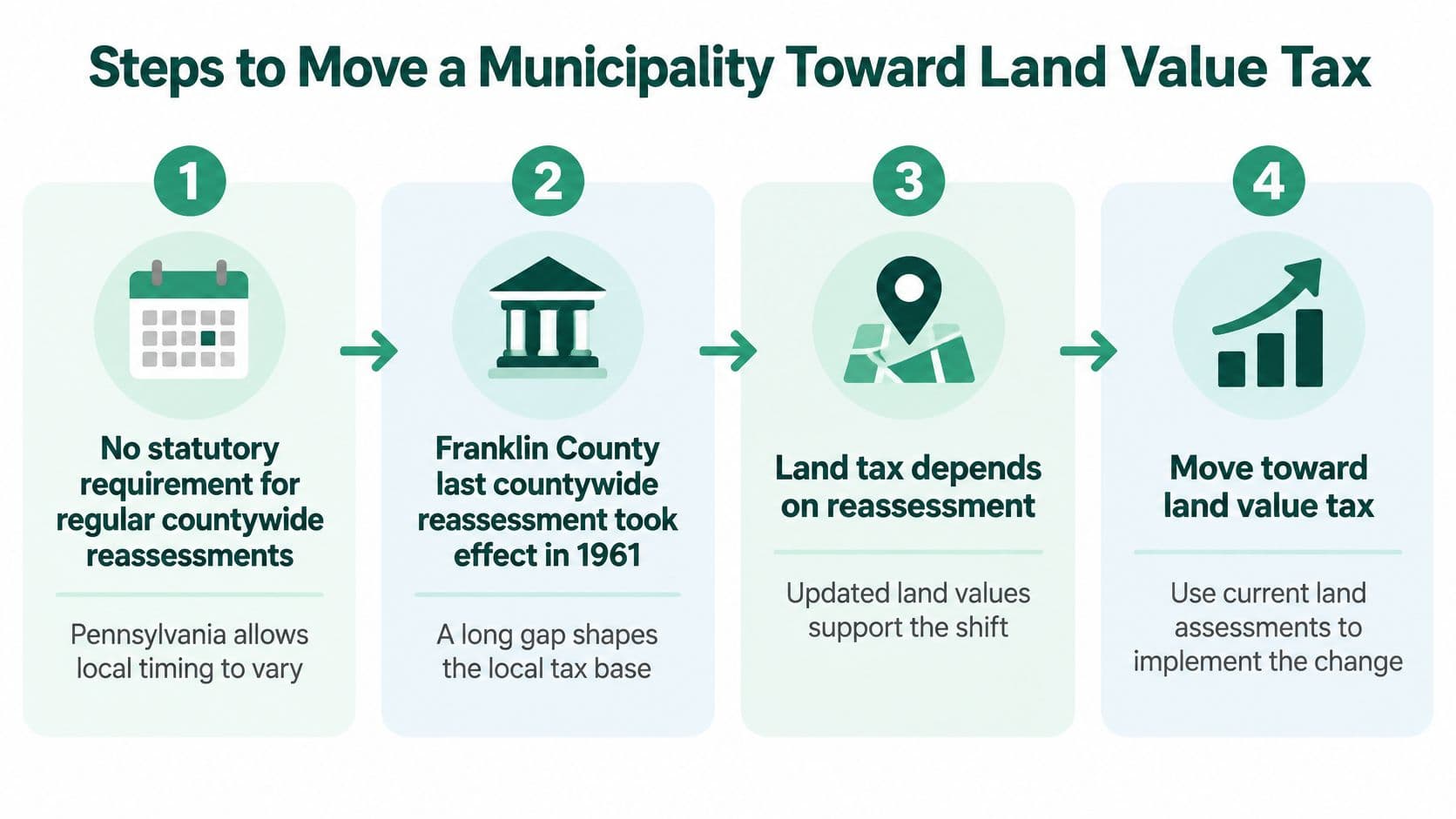
Recent county reassessment work has been uneven. Some counties have completed a new roll, others have announced projects that are still years from completion, and a scheduled project is not a finished reassessment. A reassessment that separates land from buildings supplies the basic fields a split rate needs, but the values still have to be current and defensible before they carry more weight. Appeal results are one place that drift becomes visible.
A workable sequence
- Confirm legal authority: Check the municipality's power under Pennsylvania's split rate enabling framework for local governments. Assign the responsibilities of local government in design and administration clearly, including who signs off on values and who hears appeals.
- Build the dataset: Create separate land and improvement values for every parcel using a common valuation date. Without that date, comparisons across neighborhoods drift, and a house in one township can look cheaper than an identical house next door for reasons that have nothing to do with the property.
- Classify mixed parcels: Decide in advance how you will handle residential, commercial, agricultural, and exempt uses on the same parcel. Ambiguity here becomes appeal volume later.
- Start moderately: Pick a starting land-to-structure ratio that shifts incentives without creating avoidable bill shocks. Model revenue neutrality parcel by parcel so the levy target is explicit. A ratio is a dial; the first setting should be one the assessor's office can defend in an appeal hearing.
- Publish simulations: Show typical bills and the distribution of gains and losses before the vote. Residents should see vacant lots, homes, apartments, and capital-intensive properties separately.
- Fix appeals and updates: Design an appeals process that does not reproduce existing inequities, and set a reassessment schedule that keeps site values current. Track appeal outcomes by value band, not just total cases. If high-value parcels win reductions while low-value parcels stay over-assessed, the roll is moving in the wrong direction.
Only after those pieces work should the land share rise further. Check collection rates, appeal volumes, construction response, and distributional outcomes at each step. If appeal losses are concentrated among high-value parcels while low-value parcels stay over-assessed, pause and repair the roll.
A municipality needs a transparent valuation infrastructure that residents can inspect, challenge, and trust before it adds more weight to land.
Deciding Whether Your Municipality Should Act Now
Use this short checklist before supporting or opposing a shift:
- Current system: Does your municipality already use split rate taxation, and at what ratio?
- Assessment date: When were land and buildings last assessed separately, and is a county reassessment scheduled?
- Neighbour comparison: Do similar parcels nearby carry similar land assessments?
- Simulation: Have officials published who gains and who pays under a phased, revenue neutral change?
- Appeal risk: Would likely appeals leave enough revenue for county, municipal, and school services?
Acting now is most defensible when valuations are current, the starting ratio is moderate, relief protects low income owner occupiers and addresses renters, and the transition schedule is public. Waiting is more defensible when the roll is stale, appeal volume is already high, or officials can't show parcel level effects.
For readers who want help with that modeling, one option is Unitism, whose support for clients includes assessing land values, designing the policies that collect them, and modeling who gains and who pays. Start with the checklist anyway. It tells you whether you're debating a tax idea or a valuation system that's ready to carry it.
If your municipality is weighing a land value tax Pennsylvania shift, Unitism® can help you assess land values, design a split rate or site value policy, and model the revenue and household effects before a rate is adopted. Visit us to turn your parcel data, reassessment timetable, and fairness goals into a clear, phased plan.