Land value theory explains site rent and how land taxes, fixed leases, and annual land-use rights differ for housing, tax design, and planning.
November 2, 2026
Land Value Theory Explained for Tax and Planning
Land value theory explains site rent and how land taxes, fixed leases, and annual land-use rights differ for housing, tax design, and planning.

Land value theory says a site's rental value comes from location and community, not from the owner's labor or buildings, so public revenue can fall on that rent rather than on work. Why, then, do most tax systems do the opposite, charging people more when they build, repair, or earn, and charging very little for holding a valuable site empty?
That question exposes the gap the theory was built to explain. A house wears out and needs labor to replace it. A corner beside a station, a school, and busy shops doesn't wear out in the same way, and its price can rise even if its owner does nothing. Land value theory separates those two things so you can see who created the value, who collects it, and what happens if public policy collects it instead.
You'll meet three different contracts for the same site rent below. One is a recurring land-value tax. One is a fixed lease that stores up expiry risk. One is an indefinite land-use right repriced every year. They sound similar, and they're often confused, but they handle price, term, and risk in opposite ways.
Table of Contents
- What Land Value Theory Actually Claims
- Why Some Sites Earn Rent and Others Do Not
- Land Taxes Leases and Land-Use Rights Compared
- The Classical Line from Smith to George
- How Governments Can Measure Land Fairly
- Choose a Charge That Prices the Site
What Land Value Theory Actually Claims
Why can two similar houses command different prices when one stands beside a station and the other is far from transit, jobs, and shops? The difference is not the bricks, timber, or labor in the houses. It is site value, the value attached to where each house stands.
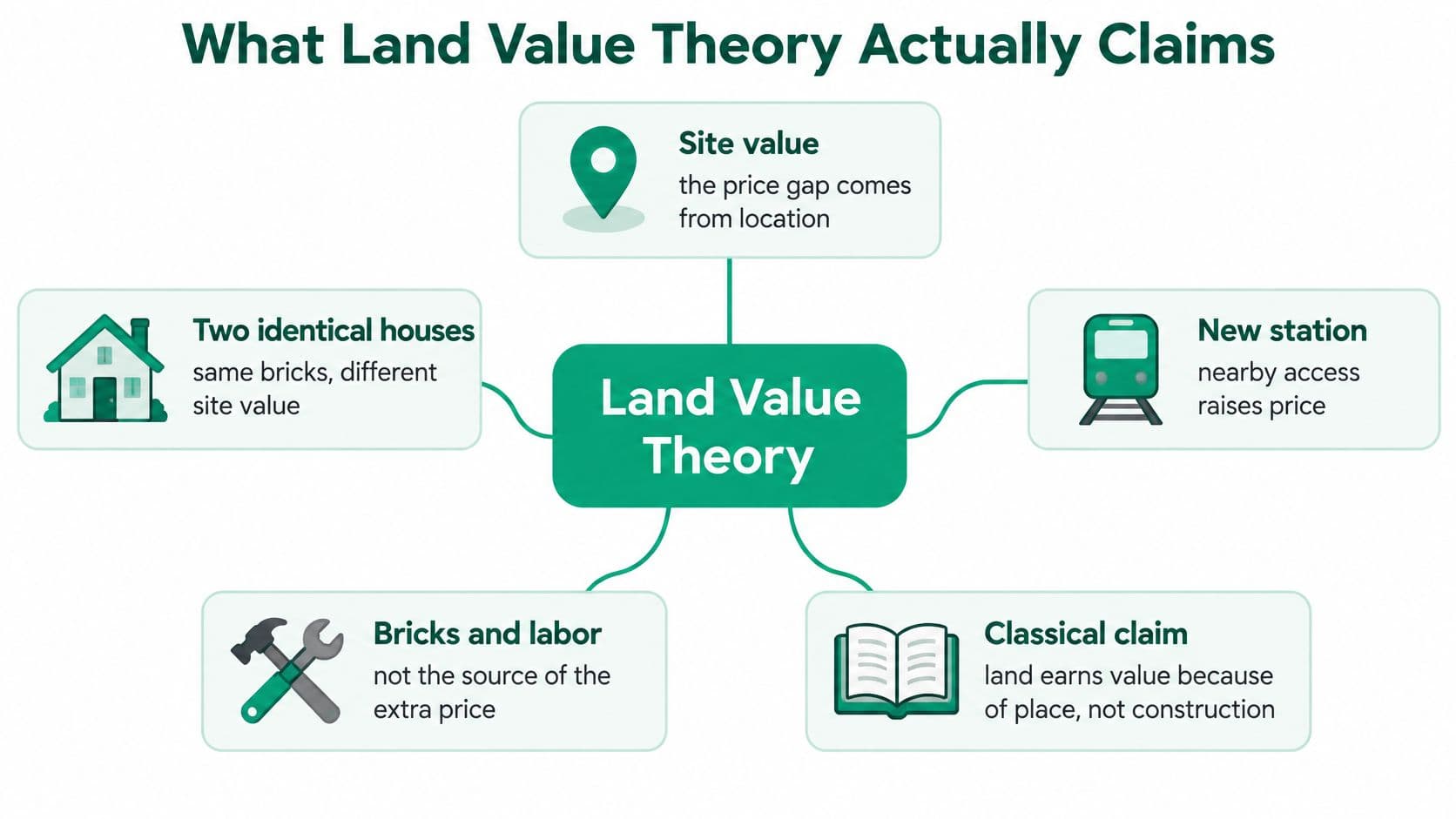
Land value theory starts by separating land, or nature, from labor and produced capital. People create buildings and tools through work. They do not create the location itself. The diagram above illustrates how location and other external factors can affect property prices beyond construction costs.
From Rent to a Public Finance Claim
Adam Smith, David Ricardo, James Mill, and John Stuart Mill treated land as a distinct factor and examined taxing it without directly penalizing productive activity, as the Chicago Fed letter on land value taxation summarizes. Ricardo argued that sites earn economic rent because they differ in fertility, location, and accessibility. As population and activity grow, people compete more for superior sites, bidding their value above that of marginal land.
Henry George developed this idea into a public finance program in Progress and Poverty, first published in 1879. Population growth, infrastructure, public services, and social coordination can raise a site's value. Since that increase is not produced by the owner alone, George argued that the community could collect land rent for public purposes while reducing taxes on labor and improvements.
A tax on unimproved land shouldn't make land disappear, because the quantity of land is fixed and can't be withdrawn from the market.
That is the efficiency claim, not a guarantee that every policy will work well. Evidence about real-world effects remains limited, and results depend on how land is valued, how the charge is administered, local market conditions, and rules for moving from one system to another.
A site's rent can be collected under different arrangements. A recurring land-value tax charges for the site's value over time. A fixed lease holds the payment steady and leaves the parties to handle the risk that value changes before the lease expires. An indefinite land-use right can instead be repriced each year. These are different ways to define who pays for the same site rent, and when.
Unitism uses tri-factor economics, recognizing labor, capital, and land (nature) as three sources of wealth. Keeping land distinct from capital helps clarify what a public charge applies to: land value, not buildings or improvements.
A Short Reading Path
- Ricardo's Principles: Read Principles of Political Economy and Taxation for the rent argument.
- George's program: Read Progress and Poverty (1879) for the move from rent theory to public finance.
- Modern policy checks: Read the Chicago Fed's account of U.S. adoption for a policy perspective on land value taxation.
Why Some Sites Earn Rent and Others Do Not
Economic rent is payment for a wanted place or natural resource, not for labor or for a new building. Start with fields. The most fertile field can produce more with the same work than a poor field at the edge of cultivation. As population grows, farmers bid more for the better field, while the marginal field earns little or no rent.
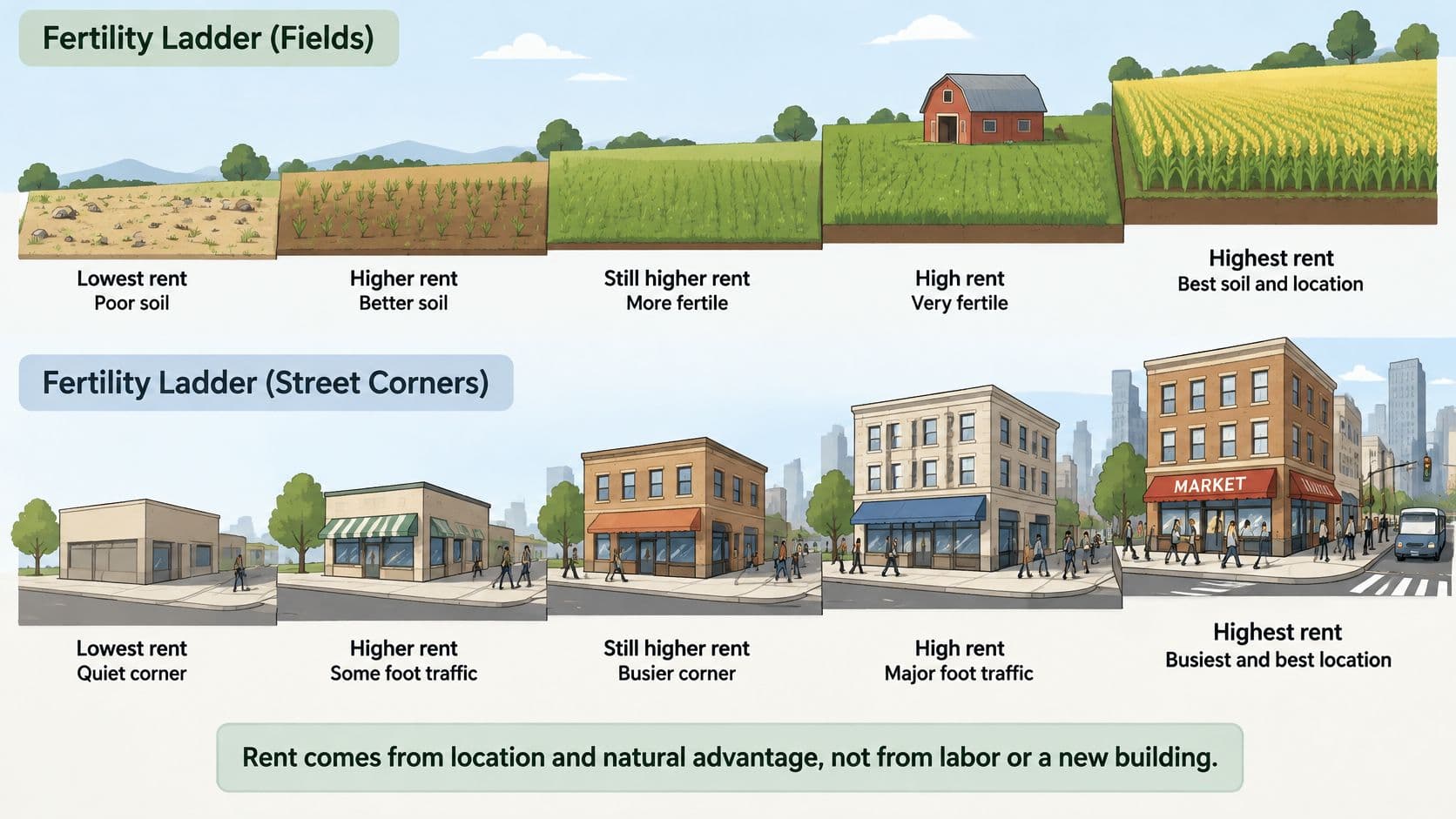
Cities work like a different ladder. The best corner isn't more fertile. It's closer to people, roads, schools, and businesses. A location's value comes from the people, roads, schools and businesses around it, not from anything its owner did. Unlike labour and capital, the market value of nature is created by the surrounding community, not by its owner. You can trace that ladder in more formal terms through the law of rent explained in plain language.
Why Taxing Land Differs From Taxing Buildings
Because the physical supply of urban land is highly inelastic, a tax on unimproved value is expected to be capitalized into a lower land price rather than shrink the amount of land offered, according to the OECD analysis of bricks, taxes and spending. A building tax does the opposite. It raises the user cost of construction and can discourage investment, maintenance, and redevelopment.
That contrast helps explain why housing remains so expensive even when building methods improve. The OECD reports that housing land prices have outpaced construction costs, particularly in the United Kingdom, France, and Canada, and recommends shifting away from transaction taxes and taxes on structures toward recurring taxes based on current land values.
- Tax the site: The charge falls on location value, and owners can't reduce it by leaving land idle.
- Tax the building: The charge rises when owners build or improve, so it can punish exactly the activity a city wants.
- Tax the transaction: The charge hits people when they move, which can lock households and firms into the wrong places.
The Planning Caveat
The efficiency mechanism does not automatically create homes. If zoning, permitting, infrastructure capacity, or density limits remain restrictive, a land charge may primarily redistribute existing rents rather than generate additional dwellings. Owners may want to build, but the rules prevent them.
So the practical design has two linked parts. Use an annual, market-value-linked land base, with improvements valued separately and capitalization effects monitored. Pair that base with planning rules that permit building. A charge that prices the site can't overcome a ban on using the site well.
Land Taxes Leases and Land-Use Rights Compared
| Instrument | Term | How price is set | What happens to risk |
|---|---|---|---|
| Land-value tax | No occupancy term; a public charge on unimproved site value | Recurring assessment of land, not buildings | Charge tracks site value; land supply stays fixed |
| Renewable fixed lease | Fixed term, then a separate renewal decision | Fixed price until the term ends | Accumulated gap closes in one repricing at renewal |
| Non-renewable fixed lease | Fixed term, then the right ends | Fixed price while the residual term shrinks | Harder to refinance and sell as expiry nears |
| Land-use right | No expiry and no renewal | Repriced every year | Site value updated continuously; right trades at low cost |
Land value taxation is a public charge on the value of land itself, not on the buildings or improvements on it. It isn't a contract that gives you a site for a set number of years. It isn't an occupancy right either. It's a recurring public charge on unimproved site value.
A land lease is different. It's either a renewable or a non-renewable fixed-term lease at a fixed price. That fixed structure is the source of its main downside. Readers who confuse the parties in that contract will find understanding landlord and tenant obligations useful for separating who grants the right from who holds it.
How Fixed Leases Postpone Risk
A renewable lease feels certain only until the term ends. While it's running, market land values can move far away from the lease rate. At renewal, that accumulated gap closes all at once in a major repricing, and renewal isn't guaranteed.
A non-renewable lease runs down toward expiry. As the residual term shrinks, it becomes progressively harder to refinance and sell. A buyer isn't just buying use of the site today. They're buying fewer remaining years, and lenders price that shrinking term too.
Central problem: Fixed leases don't correctly price risk. They postpone it, either to a renewal negotiation or to an expiry date.
Singapore shows that pattern at scale. Residential leasehold titles usually run for 99 years, while industrial leases commonly last 60 or 30 years, with some lasting 20 years, and at expiry ownership returns to the state, according to Singapore's official leasehold valuation table. That table assigns a 99-year lease approximately 96% of freehold value, while shorter residual terms receive progressively lower percentages.
Public housing makes the timing problem concrete. The Housing and Development Board has sold apartments on non-renewable 99-year leases while the state retains the underlying land and its future reversionary interest, as described in an academic analysis of Singapore's leasehold titles. The residual value of that leasehold estate becomes arithmetically zero at the end of the term when it reverts to the state.
Singapore's Land Betterment Charge is another distinct instrument. It applies when a specified planning or land-use consent increases land value, and for state leases with residual tenure of 99 years or less it's adjusted by a leasehold factor, according to the Singapore Land Authority guidance on the charge. It captures an increment inside a finite lease when consent is granted. It isn't an annual recurring tax, and it isn't annual repricing of an indefinite right.
What Counts as a Land-Use Right
A land-use right is like a land lease in one respect only. It gives a person use of a site. After that, the mechanics reverse. It's indefinite, meaning it has no expiration, and it's repriced annually. Because it's repriced annually, people can buy and sell land-use rights for a low cost, unlike fixed term leases where years of site value get bundled into the price of the remaining term.
Annual repricing prices land appropriately and doesn't burden entrepreneurship and other productive enterprises. The charge follows current site conditions each year, so there's no maturity date when a large accumulated gap must close and no cliff where the right runs out.
A useful test comes from the scholarly distinction between land-use rights and fixed leases, which reserves the label for arrangements with annual repricing, no renewal requirement, and no expiry. Sometimes fixed leases are called “land-use rights”, but they're not. They're still just fixed leases. Don't use the label unless all three tests are met.
- Repriced each year: The price updates annually to current land conditions.
- No renewal required: Continuation doesn't depend on a separate renewal decision.
- No expiry: The right doesn't end on a contractual date.
If a local scheme fails even one test, name it by what it does. Call it a renewable fixed lease, a non-renewable fixed lease, or a betterment charge. Precise labels matter because each contract assigns risk to a different person at a different time. For the full mechanics in one place, see what a land-use right is and how annual repricing works.
The Classical Line from Smith to George
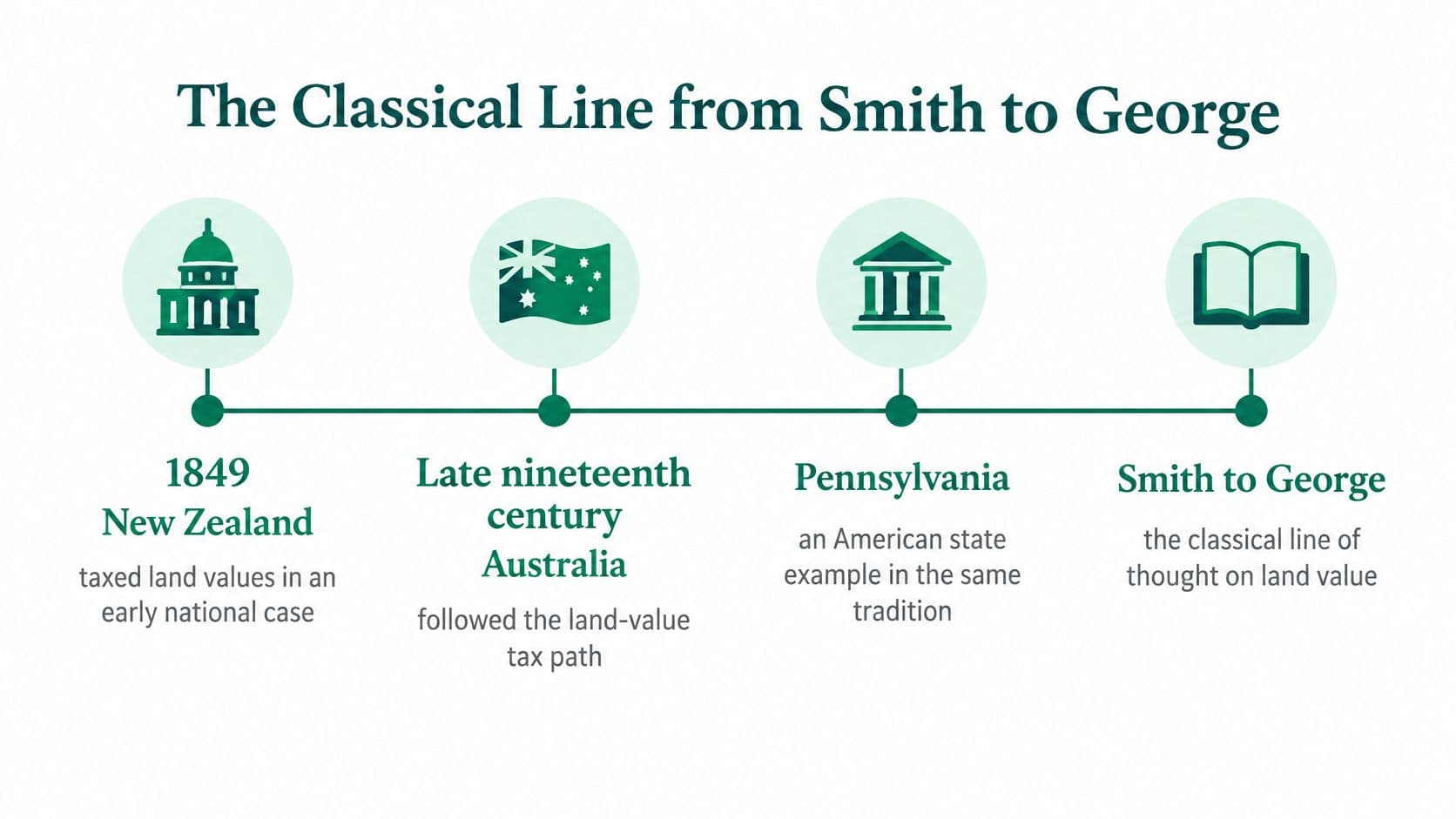
How can a theory about site rent become a working public policy? Its history offers examples of different ways governments have tried to collect land value, while also showing why the details of the charge matter.
| Place | When | Form | What the record shows |
|---|---|---|---|
| New Zealand | Historical precedent | Taxation of land values | Early modern national precedent |
| Australia | Historical precedent | Land-value taxation | Part of an early wave of adoption |
| Pennsylvania and South Africa | Historical precedent | Land-value taxation | Documented historical experience |
| Pittsburgh, United States | 1913 to 2001 | Citywide split-rate property tax | Land-to-structure rate ratio reported at 5.77 to 1 |
| Estonia, Fiji, United States | Contemporary | Land-value tax or related systems | Implementation confirmed; Chicago Fed describes U.S. adoption as relatively scarce |
What Pittsburgh's Ratio Means
Pittsburgh adopted a citywide split-rate property tax in 1913, taxing land at a higher rate than structures. Between 1913 and 2001, the reported ratio of the land-tax rate to the structure-tax rate was 5.77 to 1, according to the Lincoln Institute chapter on land value taxation. A split rate keeps the familiar property-tax framework but shifts more of the charge toward site value and away from buildings.
This approach can make a change in tax policy more gradual. It also illustrates why the label alone is not enough: a small shift toward land and a much larger shift create different incentives, even though both systems tax land more heavily than structures.
New Zealand, Australia, Pennsylvania, and South Africa all provide historical precedents for land-value taxation. Contemporary examples in Estonia, Fiji, and the United States show that land-based charges have also been used in more recent settings. The historical record supports practical possibility, not a promise that every version will produce the same result.
Two Qualified Lessons
First, governments have administered land-based charges at national, state, and city levels in different jurisdictions. These systems have required governments to value sites, collect revenue, and handle appeals. A tax on land value is therefore a policy instrument that can be put into operation, not only an abstract proposal.
Second, results depend on design. Assessment quality, political acceptance, exemptions, reassessment practices, and treatment of improvements can all affect how a charge works. If assessments become outdated, or exemptions narrow the tax base, the incentive to use land productively may weaken. The same site rent can be collected through a recurring land-value tax, a fixed lease that places expiry risk into the remaining term, or an indefinite land-use right repriced each year. Each arrangement assigns the timing and risk of payment differently.
Historical precedent shows feasibility, while the contract chosen determines how site value is collected and who bears the risk. For the original argument behind George's program, the guide to Progress and Poverty and its central claim explains how land rent sits at the heart of the case.
How Governments Can Measure Land Fairly
How can a government tax a site fairly when land is rarely sold apart from buildings? A sale price combines the two, so the land value must be estimated. That distinction matters because a land value tax applies to the site itself, not to buildings or improvements.
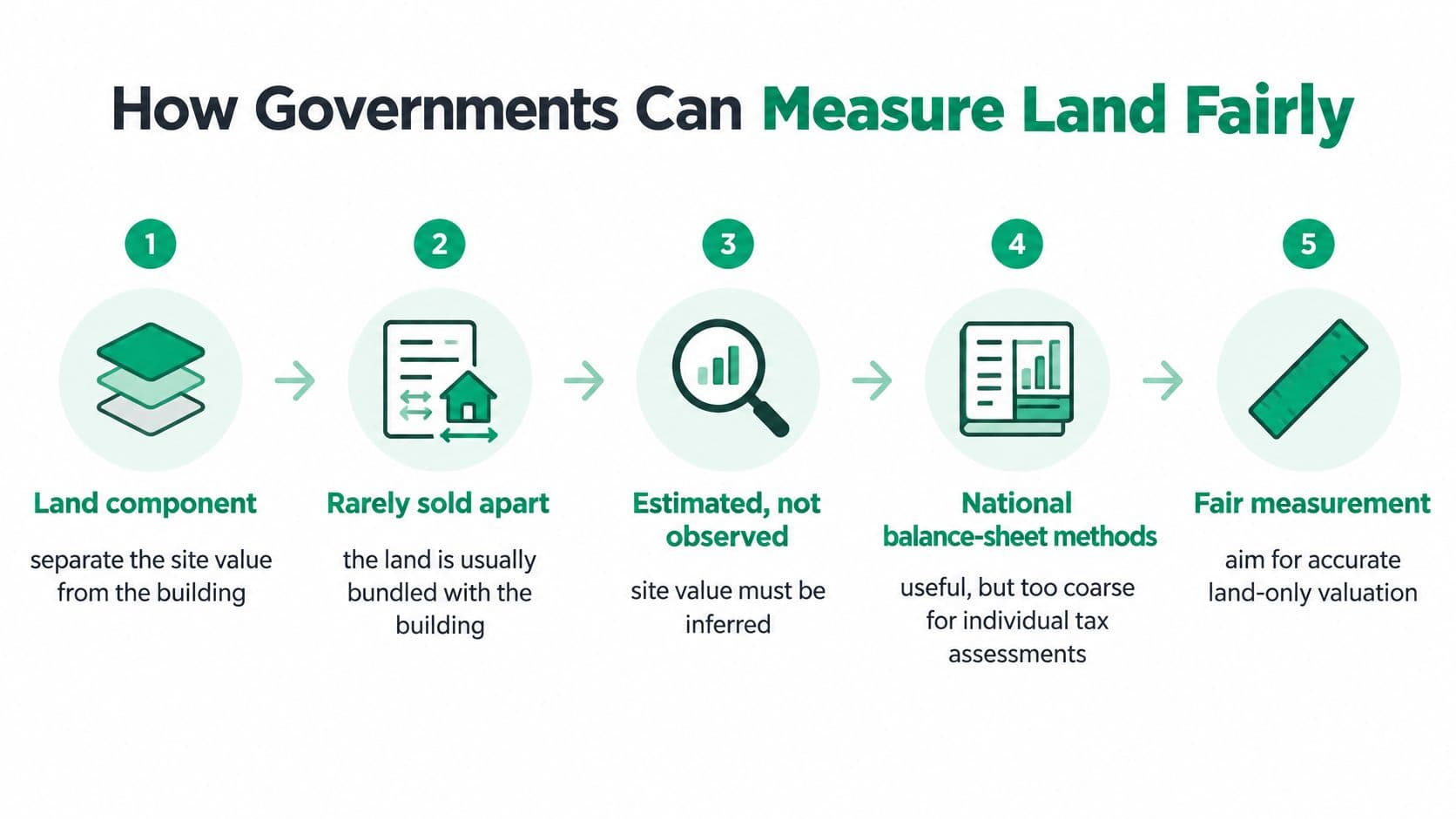
The appropriate method depends on the purpose. National balance sheets need not meet the same requirements as individual tax assessments. Cadastral systems remain incomplete in some countries, and vacant or agricultural land may fall outside existing property-tax coverage, as the OECD report on property-level land measurement explains. A national average cannot show whether one parcel has been assessed fairly relative to its neighbor.
| Estimator | Data needed | Strength | Main risk |
|---|---|---|---|
| Residual valuation | Sale price and depreciated improvement cost | Market-based site value | Reliable depreciation of buildings is hard to establish |
| Hedonic models | Sales, GIS, zoning and permitted use | Scales across many parcels | Errors in thin or fast-changing markets |
| Self-assessment with audit | Owner declarations checked by sampling | Low cost and fast | Relies on audit capacity |
Choose an Estimator by Its Failure Mode
Residual valuation subtracts the depreciated cost of improvements from a sale price. The logic is straightforward, but a small depreciation error can greatly distort the land remainder, especially for older buildings.
Hedonic models use sales, GIS, zoning, and permitted-use data to estimate how location affects prices across parcels. They can cover many sites, yet may misprice thin rural markets, informal settlements, or fast-changing urban areas where comparable sales are scarce or outdated.
Self-assessment with audit asks owners to declare a value and checks declarations through sampling. This approach can be inexpensive and quick, but it depends on audit capacity, penalties, and published methods that make under-declaration risky. Uncertainty in state land-value data can also justify discounts in valuation-based reviews.
Errors do not affect every parcel equally. They matter most for high-land, low-building parcels, where the site accounts for most of the value. They can also burden retirees and low-income households who own valuable land but have limited cash, even when a reform is efficient in aggregate.
A study of Tarrant County, Texas, used parcel data over 1997–2006 to examine how burdens shift when a uniform property tax is replaced, as described in the Lincoln Institute working paper on distributional effects and administrative feasibility. Parcel-level modeling makes the effects concrete: it estimates who gains, who pays, and where deferrals or circuit breakers may be needed before bills arrive.
Go or No-Go Safeguards
Set safeguards before separating land from improvements in the tax base. State accuracy as ranges, not false precision, and publish model documentation so owners can understand how assessments were reached.
- Independent valuation audits: Compare sampled assessments with sales and field evidence.
- Periodic revaluation: Keep values close to current market conditions, allowing smaller annual changes to replace sudden jumps.
- Appeal rights and hardship deferrals: Give owners a way to correct errors and protect people facing liquidity problems.
A fair assessment process also makes clear which contract a site is under. A recurring land-value tax reprices the site through public assessment; a fixed lease stores expiry risk in its end date; an indefinite land-use right can be repriced each year. The valuation method helps determine how credible and predictable each arrangement will be. For a comparison of residual, hedonic, and related approaches, see the guide to methods of land valuation.
Choose a Charge That Prices the Site
For the same site rent, a government can choose three different contracts: a recurring land-value tax, a fixed lease, or an indefinite land-use right repriced each year. The tax charges the value of land itself, not buildings or improvements, and returns revenue to the community. A fixed lease sets terms for a period, leaving the parties to handle the risk when it expires. An indefinite right avoids an expiry date but needs a recurring process for setting the site's price. The comparison of land value tax and property tax helps clarify what each charge means for owners.
For communities seeking public revenue from land value without taxing work, a recurring charge on land is Unitism's core proposal. Where time-limited leases are already used, governments can retain them and address expiry risk, or consider a right with no end date and an annual price. The contract differs, but the key question remains: how will the site's value be assessed and collected?
Four Steps Before a Citywide Rate
- Map site values: Assess parcels using published methods, uncertainty ranges, audits, and appeals. A rate is only as defensible as the valuations beneath it.
- Model incidence: Estimate effects on owners, tenants, landlords, developers, farmers, lenders, and the city. Distinguish immediate changes in land prices from longer-term effects on construction and rents.
- Pair the charge with planning reform: Allow building where demand is strongest. Otherwise, the charge may redistribute existing rent without making room for more homes or workplaces.
- Phase the transition: Publish the rate path, provide deferrals where people face liquidity risks, and report results openly. A clear timetable gives those affected more time to adjust.
The intended effects are straightforward. When speculation is unprofitable, homes can cost closer to what it takes to build them. Idle sites become more costly to hold, giving owners a reason to use them or sell them to someone who will. Public revenue then rests more on site value created by the community and less on work.
Start with a parcel pilot in one district. It can test valuation appeals, billing, deferrals, and incidence estimates on real parcels before a citywide rate is set. Unitism, coordinated by Martin Adams, author of Land: A New Approach for a Thriving World, supports governments and cities with land-value assessments, policy design, and modeling who gains and who pays.
If your city or ministry is weighing a land-value tax, fixed lease, or annually repriced land-use right, Unitism® can help map site values, model distributional effects, and design a phased charge. Explore its valuation, policy design, and implementation support, starting with a parcel-level pilot that can be explained publicly.