Explore rent seeking in economics, from regulatory capture to land speculation. Learn its impact on growth & inequality, and discover effective policy
June 23, 2026
Rent Seeking in Economics: Impacts & Solutions
Explore rent seeking in economics, from regulatory capture to land speculation. Learn its impact on growth & inequality, and discover effective policy
One estimate should make any finance minister pause. In 1988, David N. Laband and John Sophocleus estimated that rent-seeking activity in the United States reduced total national income by about 45 percent relative to a world without those distortions, an upper-bound figure that has remained influential in debates about the macroeconomic cost of political favoritism and market distortion. 1
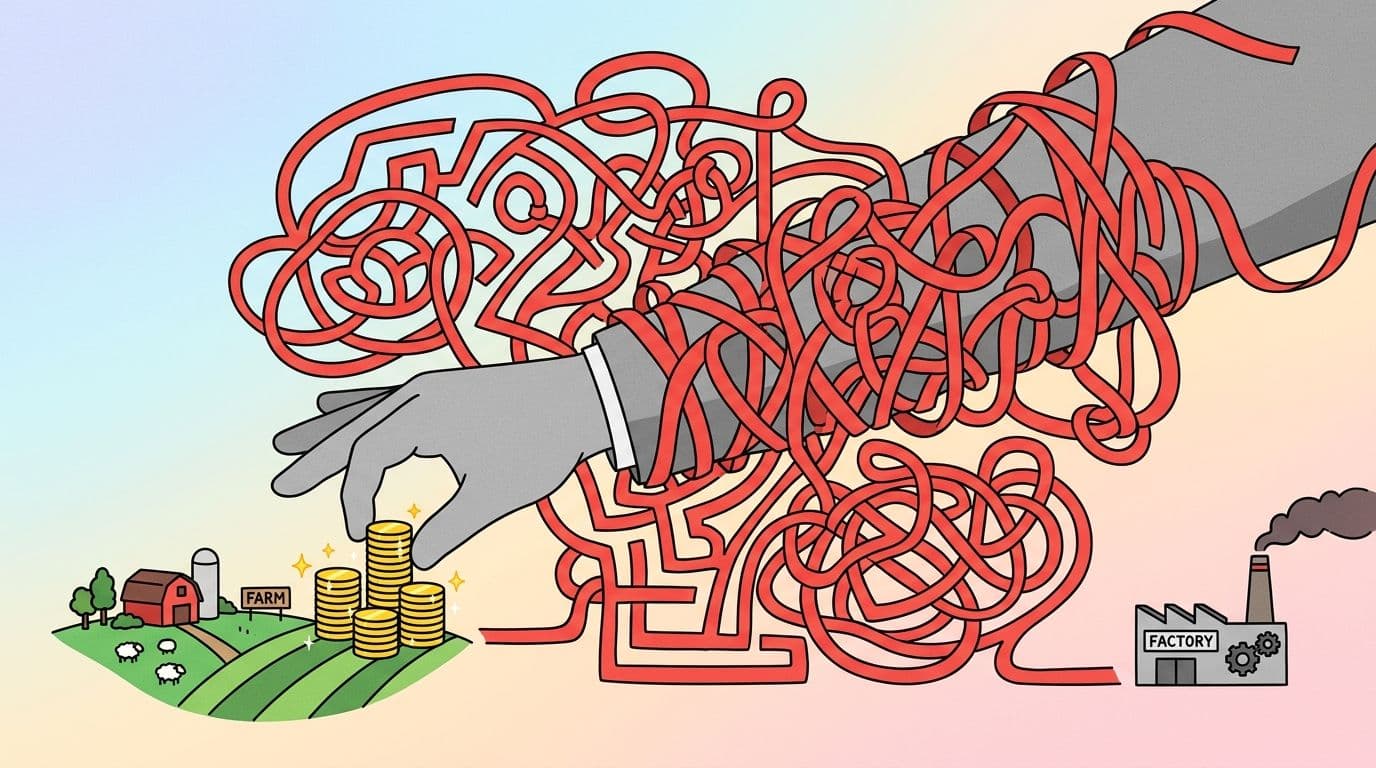
That number is so large that many readers initially assume rent seeking must be a narrow academic term for corruption. It isn't. In economics, the idea is broader and more important. It captures all the ways people and firms try to capture income without creating matching value. Sometimes that means lobbying for a tariff. Sometimes it means securing an exclusive license. Sometimes it means using zoning rules to block new homes so existing landowners enjoy rising site values.
That last example matters because rent seeking in economics isn't just about abstract efficiency. It's tied directly to housing affordability, weak productivity growth, and chronic pressure on public budgets. If you'd like a simple companion tool for thinking about who captures value in an economy, Where Does Wealth Go is a useful way to frame the question.
Table of Contents
- The Hidden Drag on Your Economy
- Defining Rent Seeking Wealth Capture vs Wealth Creation
- Common Arenas for Rent Seeking
- Land and Zoning The Ultimate Rent-Seeking Frontier
- The True Costs Economic Stagnation and Social Inequality
- Policy Solutions to Discourage Rent Seeking
- Conclusion Building a Value-Creating Economy
The Hidden Drag on Your Economy
Rent seeking looks harmless when seen one transaction at a time. A subsidy here. A licensing exception there. A planning delay that conveniently protects incumbent property owners. But taken together, these actions operate like a hidden tax on productive effort.
The central idea is simple. Wealth creation adds output, improves products, lowers costs, or uses resources better. Wealth capture tries to redirect income toward a favored group without increasing the size of the pie. Entrepreneurs build a better bridge. Rent seekers try to own the only legal bridge.
Practical rule: If income rises because someone improved production, that's usually productive profit. If income rises because someone secured protection from competition or control over scarcity, that's usually rent.
This distinction matters because governments often end up taxing what they want more of, such as work, building, and enterprise, while leaving large pools of economic rent lightly touched. That weakens growth twice. It discourages production, and it rewards extraction.
A cabinet minister doesn't need jargon to see the pattern. When developers spend more time negotiating permissions than building homes, when firms hire lobbyists to shape sector rules rather than engineers to improve products, or when prime urban land is held idle because owners expect policy-driven appreciation, the economy is allocating talent toward capture rather than creation.
Three questions usually clarify the issue:
- Who created the value: Did labor, investment, and innovation produce it, or did regulation and scarcity protect it?
- Who pays the cost: Consumers, tenants, taxpayers, and would-be competitors usually carry the burden.
- Can policy change the incentive: If the gain exists mainly because the state limits access or confers privilege, the state can redesign that system.
Defining Rent Seeking Wealth Capture vs Wealth Creation
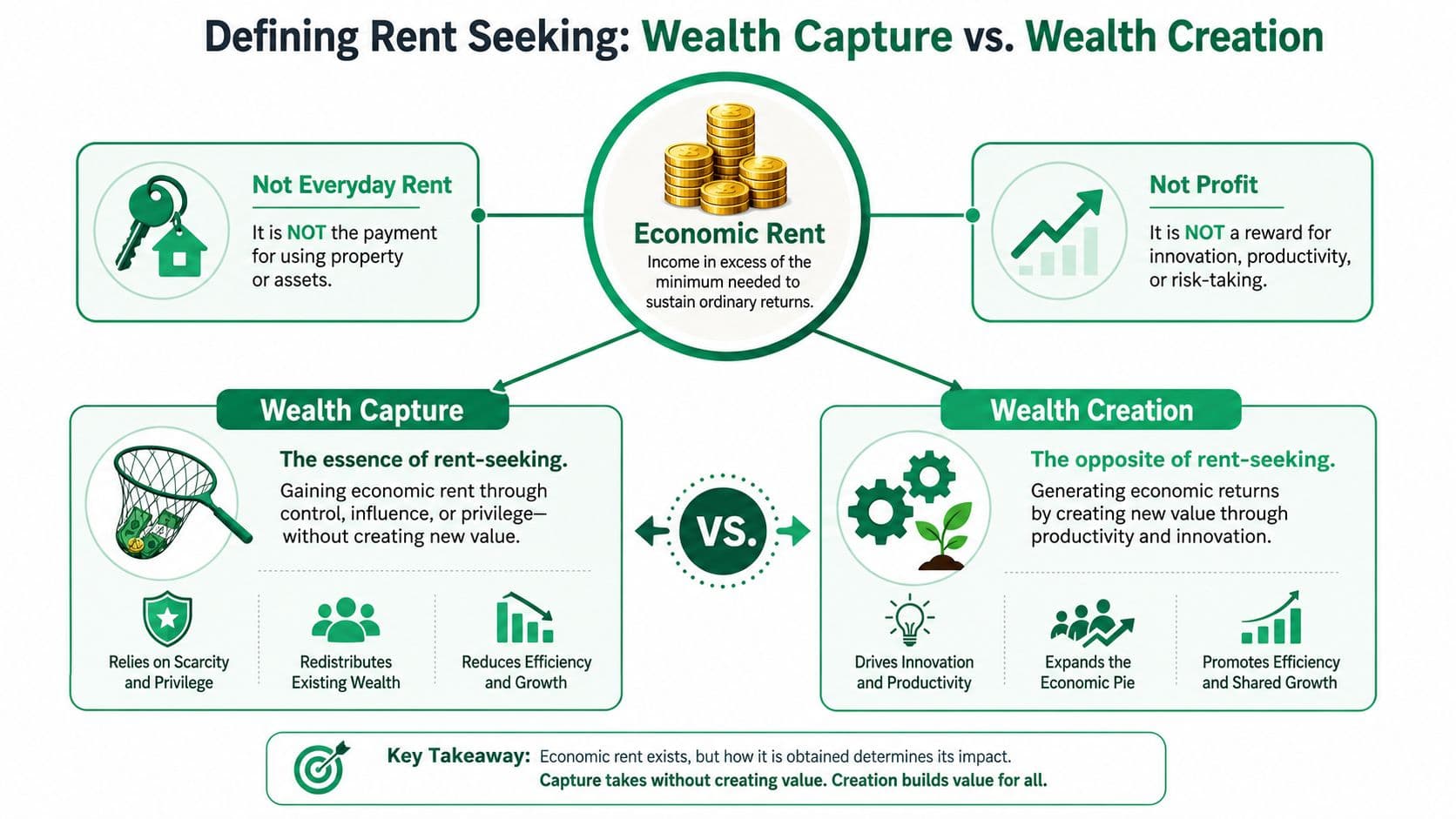
Economists use the word rent differently from everyday speech. In ordinary language, rent is what a tenant pays a landlord. In economics, economic rent means a return above what is needed to keep a resource in its current use. That's why the term appears in discussions of land, monopoly power, licenses, quotas, and political privilege.
A beach food stand makes the distinction intuitive. If ten vendors can compete freely, each must attract customers through price, quality, and service. Profit comes from doing the job well. If the city issues only one permit for the whole beach, the permit holder may earn far more than a normal competitive return. That extra return is economic rent. If firms then spend money lobbying city hall to keep the permit cap in place, that's rent seeking.
Profit isn't the same as rent
Many readers struggle with this point. Profit isn't suspicious by definition. A business that invents a better battery, organizes a supply chain more efficiently, or takes real risk in a new market can earn profits as a reward for useful activity.
Rent is different. It arises because of scarcity, exclusivity, legal protection, or control over a valuable asset whose supply doesn't expand in response to demand, especially land. The margin of production is a helpful way to think about where normal returns end and surplus capture begins.
A short comparison helps:
| Term | What generates it | Social effect |
|---|---|---|
| Profit | Innovation, coordination, risk-taking, efficiency | Can expand output and productivity |
| Economic rent | Scarcity, exclusivity, or privileged access | Often redistributes value without creating more |
| Rent seeking | Effort to preserve or enlarge rents through politics or regulation | Diverts effort away from production |
Two forms that policy should treat differently
One of the biggest gaps in public discussion is that people lump all rents together. Yet policy should distinguish between natural-resource rents and artificial regulatory rents. Notably, analysis of national income shares suggests that the long-run rise in capital's share of income in advanced economies is concentrated almost entirely in housing, tying growing wealth concentration to land and housing rents rather than to produced capital. 2
That distinction changes the policy response:
- Natural-resource rents: Land and subsoil resources are scarce. Governments usually shouldn't try to make land less scarce. They should capture part of its rental value for public use.
- Artificial regulatory rents: Quotas, protectionist rules, and needless barriers should usually be dismantled because they restrict competition without a public-interest justification.
Rent seeking in economics isn't one problem with one cure. Some rents should be taxed transparently. Others should be competed away.
Common Arenas for Rent Seeking
Rent seeking doesn't live in one ministry. It shows up across trade policy, sector regulation, local permitting, procurement, tax exemptions, and occupational rules. That breadth helps explain why the macroeconomic costs can become so large. Laband and Sophocleus's estimate treated rent seeking broadly, including lobbying, subsidies, tariffs, quotas, and other forms of political favoritism, which is why their upper-bound estimate remains so striking. 1
Subsidies and targeted privileges
A classic case is the industry-specific subsidy. A firm or trade association argues that its sector is strategic, fragile, or socially necessary. Sometimes that's true. Often the design of the support matters more than the slogan attached to it.
If support is narrow, opaque, and designed for incumbents, it can function less like industrial policy and more like protected income. The beneficiary gains. Taxpayers fund the transfer. Potential entrants face a tilted field.
A useful test is whether the policy rewards output and capability, or whether it protects existing players from pressure.
Regulatory capture and barriers to entry
Regulatory capture is less visible than a subsidy, but often more durable. Incumbent firms learn the rulebook, cultivate access, and influence how standards are written and enforced. The rules may still sound technical and neutral. Their practical effect is to make entry harder.
That can happen in finance, energy, telecommunications, transport, or health services. The mechanism is familiar. A rule that seems to protect quality can also freeze market structure if only large existing firms can comply easily. Consumers then pay through higher prices, fewer options, or slower innovation. If you need a quick definition of market power in this context, this explanation of monopoly is a useful reference point.
The political question isn't whether regulation exists. It's whether regulation serves the public or the protected incumbent.
Licenses tariffs and quota protection
Some forms of rent seeking are easy to recognize because the restriction is explicit.
- Occupational licensing: Sensible licensing can protect safety. Excessive licensing can restrict the number of providers and raise prices without clear public benefit.
- Tariffs and quotas: These can shelter domestic producers from competition. In some cases governments may justify them on strategic grounds. But they also create strong incentives for lobbying because the gains are concentrated and the costs are dispersed.
- Exclusive permits: Taxi medallions, route permissions, stall permits, import licenses, and similar approvals can all become rent-bearing assets if supply is tightly constrained.
These arenas differ in detail, but the economic logic is the same. Government-created scarcity generates surplus returns. People then invest resources to keep that scarcity in place.
Land and Zoning The Ultimate Rent-Seeking Frontier
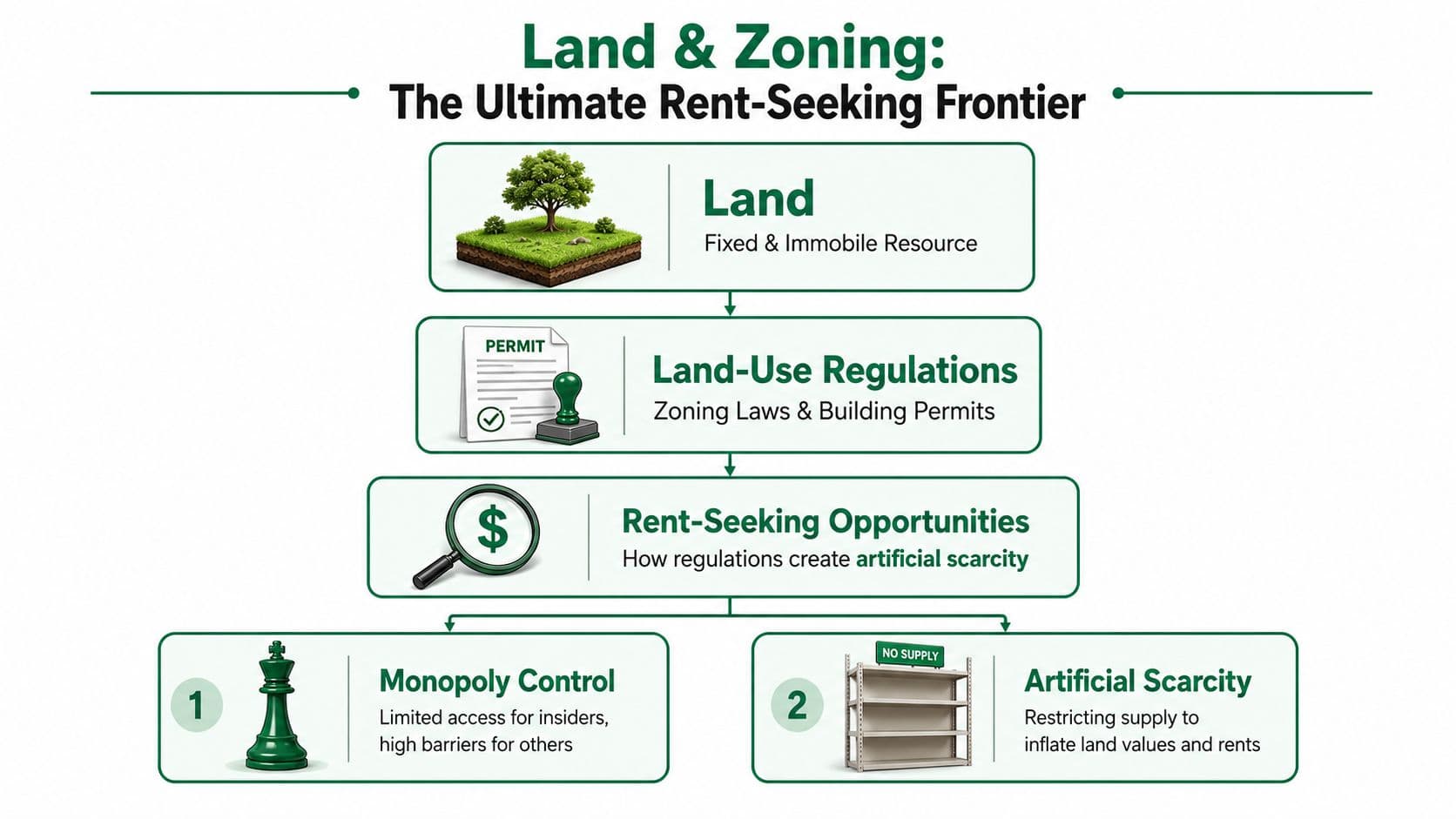
Land is where the theory becomes concrete. Unlike produced capital, land isn't made by human effort. Its supply is fixed. Its value depends heavily on location, infrastructure, surrounding activity, and legal permission. That makes land uniquely vulnerable to rent seeking.
Why land invites rent seeking
A firm can build more machines if demand rises. A city can't create more central locations in the same way. So the fight over land value often shifts from production to control. The political battle isn't just over who can build, but over who gets the uplift created by public decisions. The value of access to high-productivity locations is large: studies of metropolitan land find that land values are highly concentrated in and around the most productive cities. 3
That is why planning systems become magnets for rent-seeking behavior. Height limits, density caps, parking mandates, minimum lot sizes, long approval chains, discretionary waivers, and project-by-project negotiation all create choke points. Once those choke points exist, landowners, incumbent residents, and well-connected developers have reasons to influence them.
The result is a politics of scarcity. Existing owners gain from restricted supply because their sites become more valuable. New households, younger workers, renters, and new firms lose because access to high-opportunity places becomes more expensive.
How zoning turns scarcity into private gain
The evidence here is unusually important. Empirical studies of urban land markets find that land-use regulation, rather than construction cost or physical land scarcity alone, accounts for much of the gap between house prices and building costs in expensive markets. 4 More broadly, housing-supply constraints in the most productive cities misallocate labor across space and measurably lower national output. 5
That finding changes how a minister should read a housing market. Rising home prices aren't only a story about construction costs or population growth. They are often a story about land values capitalizing restricted permission. Where building rights are scarce, the value of permission gets folded into the land price. Comparable patterns of stretched affordability across major markets are documented in international affordability surveys. 6
For analysts trying to compare local housing trajectories with market-level data, Zillow Home Value Index data can be a practical benchmark alongside planning and zoning information. It helps separate movements in housing values from assumptions about construction cost alone.
A simple chain captures the mechanism:
- Planning rules restrict supply in valuable locations.
- The scarcity premium gets capitalized into land prices.
- Owners of already-entitled or strategically located sites gain windfalls.
- Renters and first-time buyers face higher housing costs.
- Governments face political pressure for subsidies, exemptions, and emergency spending.
That final step is where housing affordability becomes a fiscal issue.
Why this matters for budgets as well as housing
When land rents rise privately and the public doesn't capture them, governments often chase the consequences instead of the cause. They subsidize access, expand housing allowances, build costly transport outward to cheaper peripheral land, or offer tax concessions to stimulate development that restrictive rules have already slowed. Public infrastructure itself feeds back into private land values; for example, proximity to new rail stations raises nearby residential and commercial property prices. 7
A more coherent approach starts by recognizing land rent as a policy-created and community-created value. Land value capture explained is useful background on that logic. The key point is straightforward. If public action and artificial scarcity raise site values, allowing those gains to accrue entirely as private windfalls invites more lobbying for scarcity.
The True Costs Economic Stagnation and Social Inequality
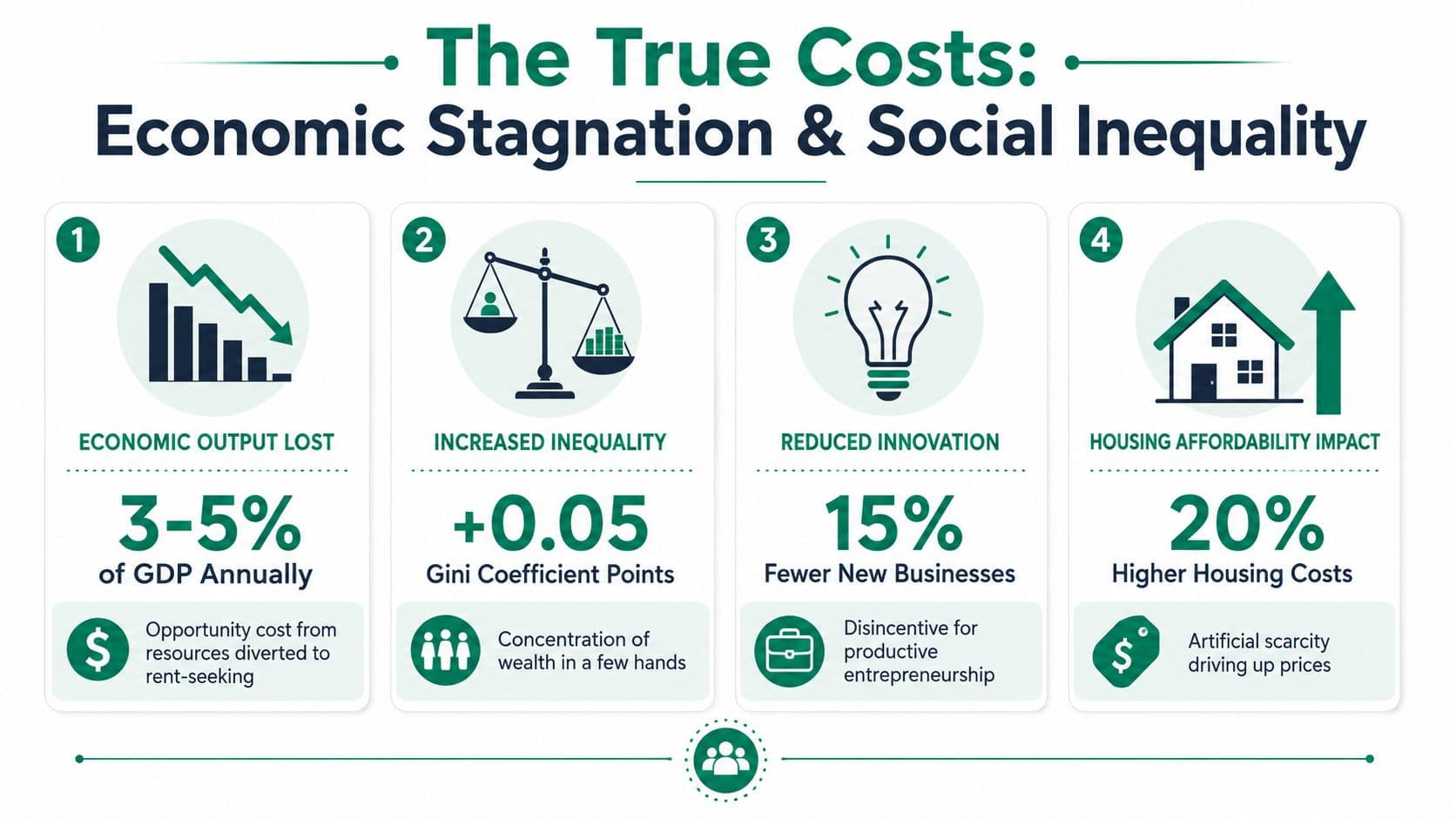
The most common mistake is to treat rent seeking as unfair but economically minor. It isn't minor. It can reduce growth, distort investment, and shift talent toward unproductive competition over privilege.
Deadweight loss is only the start
Economists use the term deadweight loss for value that disappears rather than being transferred. That matters because rent seeking doesn't just move money from one pocket to another. It consumes real effort. Lawyers draft protective rules. Lobbyists press for exemptions. Firms build compliance strategies aimed at preserving privileged positions. Landholders delay development while waiting for rezoning gains.
The broader literature finds that rent-seeking tends to be associated with weaker economic performance, and that economies receiving large natural-resource windfalls have often experienced slow growth and weak institutions, a pattern commonly described as the resource curse. 8
Those losses aren't abstract. Lower growth means weaker revenue growth, tighter budget choices, and less room for infrastructure, health, and education spending.
Why the losses compound over time
Rent seeking also changes who advances in the economy. In a productive system, firms win by serving customers better. In a rent-seeking system, firms can win by mastering permission, access, and influence. Over time that changes business behavior.
A slow permitting system doesn't just delay one project. It teaches the whole market that political access matters more than productive speed.
That is one reason inequality often becomes more entrenched. Owners of scarce assets, especially well-located land or protected market positions, see values rise. Households without those assets face higher costs. Younger entrants must borrow more, save longer, or accept exclusion from the best locations. Public frustration grows because the system appears rigged, and often is.
For policymakers tracking how inequality and urban form interact, Gini vs density is a useful conceptual tool. Dense, productive places can support broad prosperity. But when access to those places is rationed through privilege, their gains are captured narrowly rather than shared widely.
Policy Solutions to Discourage Rent Seeking
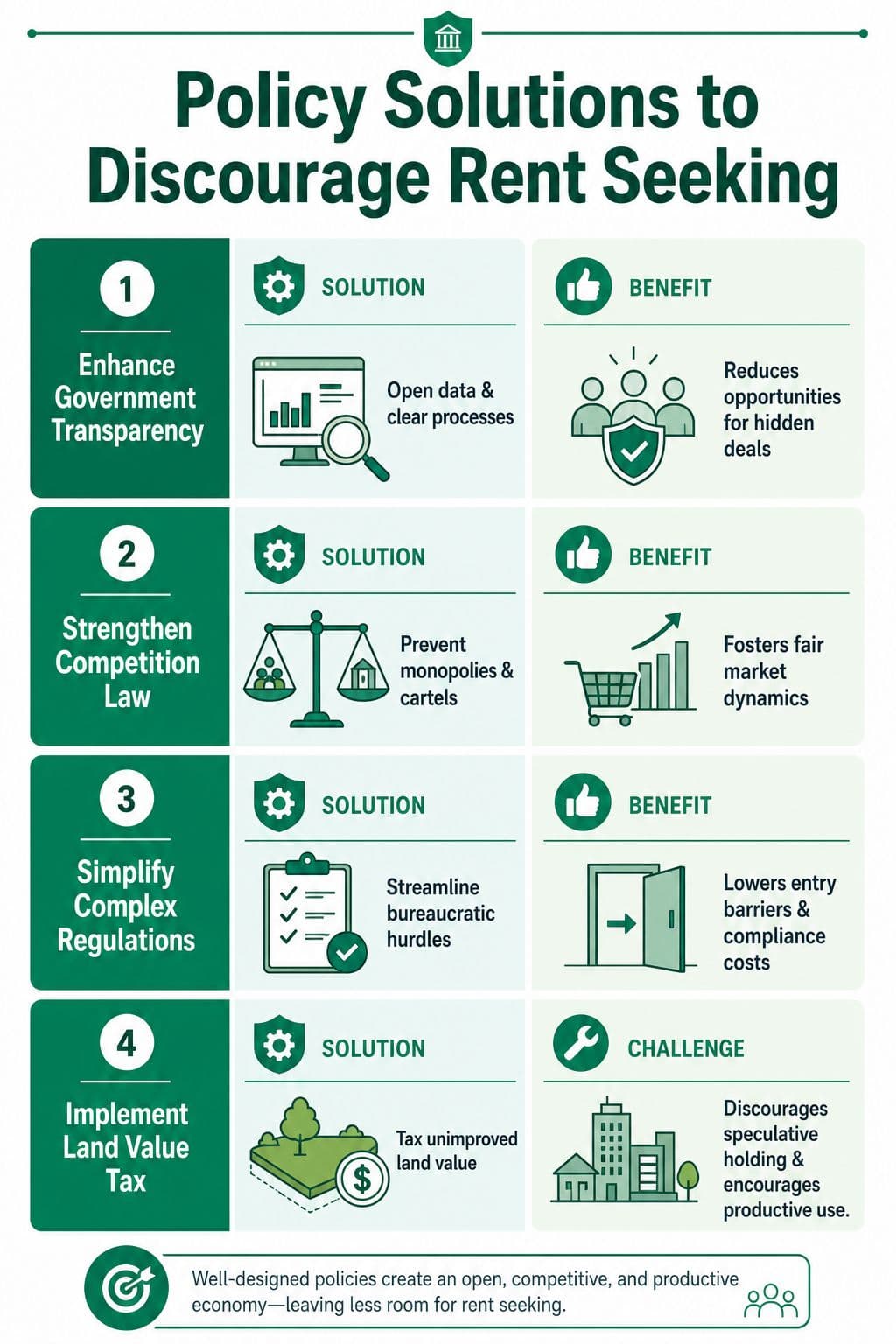
Governments usually respond to rent seeking with ethics rules, anti-corruption drives, and procedural reforms. Those matter. But they often leave the underlying rent stream intact. If the prize remains large, people will keep competing for it.
Clean up the rules of the game
Some reforms are basic and indispensable.
- Increase transparency: Publish zoning decisions, tax exemptions, procurement awards, and beneficial ownership data in forms that outsiders can inspect.
- Strengthen competition policy: Review rules that shield incumbents without a clear public-interest case.
- Simplify discretionary regulation: Long, negotiable approval chains create bargaining power. Clearer rules reduce the value of insider access.
For ministers focused on governance practice, this expert perspective on fighting corruption is a useful complementary read because it emphasizes institutional design rather than moral appeals alone.
These measures reduce opportunities for hidden deals. Still, they don't fully solve the land problem. A planning system can be transparent and still manufacture scarcity.
Use land-value capture as structural reform
Policy often becomes sharper in this context. If land rents arise from location, public investment, and legal permission, then taxing or capturing part of that rental value does more than raise revenue. It changes incentives.
Studies of resource-rich economies find that a substantial share of potential resource rents can be dissipated through rent-seeking and related distortions, with larger leakage where governance is weaker. 8 Land-value capture instruments such as site-value taxes rest on a long economic lineage: in an optimally sized city, aggregate land rents are equal to spending on public goods, the result known as the Henry George theorem. 9 Bridging that theory to practice, recent work examines where and how land-value taxes are most likely to work well. 10
A land value tax is especially powerful because it targets the part of value the owner didn't produce. A tax on pure land rent can lower land prices and falls on landowners rather than tenants. 11 It doesn't punish construction, renovation, hiring, or output. It falls on the site value itself. That means it can:
- Discourage speculative holding: Owners of prime vacant or underused sites can't wait for public action to raise values at no carrying cost.
- Support infill and redevelopment: Because the tax falls on land rather than buildings, adding productive improvements doesn't trigger the same penalty that conventional property taxes can create. Evidence from Pittsburgh's shift toward taxing land more heavily than buildings is consistent with a stronger building boom, and simulation and panel studies likewise find that higher land-value (two-rate) taxes stimulate construction and curb sprawl. 12 13 14
- Broaden the fiscal base: Governments can rely less on taxes that penalize work, transactions, and productive investment.
Build administrative systems that reduce discretion
Structural reform also depends on implementation. Good tax design fails if valuation is opaque and exemptions are negotiable.
A practical anti-rent-seeking agenda in land and property usually includes:
| Administrative priority | Why it matters |
|---|---|
| Modern cadastres | Clarify who owns what and reduce room for selective enforcement |
| Transparent valuation methods | Narrow the space for ad hoc bargaining and favoritism |
| Digital records and public portals | Make decisions visible and easier to contest |
| Stable rules with limited exemptions | Reduce the payoff from lobbying for bespoke treatment |
None of this requires hostility to markets. It requires a better distinction between returns earned through production and returns captured through scarcity and privilege.
Conclusion Building a Value-Creating Economy
Rent seeking in economics matters because it reveals a choice every government makes, whether consciously or not. A country can organize its tax and regulatory system around value creation, or it can leave wide openings for wealth capture.
The practical stakes are clear. When rules protect incumbents, housing gets more expensive, productive investment gets crowded out, and fiscal pressure rises. When governments distinguish profit from rent, and especially when they treat land rent as a public revenue base rather than a private windfall, they can reduce those distortions at the source.
For policymakers, the question isn't tax versus no tax. It's what to tax. Taxing wages, buildings, and enterprise suppresses what the economy needs more of. Capturing unearned land and resource rents shifts the burden toward value that society and location created.
That is how you move from an extractive economy to a productive one.
Frequently Asked Questions
What is the difference between profit and economic rent?
Profit is the reward for genuinely useful activity such as innovation, efficient coordination, or taking real risk in a new market, and it tends to expand output and productivity. Economic rent is different because it arises from scarcity, exclusivity, legal protection, or control over an asset whose supply doesn't grow with demand, especially land. The practical test is simple: if income rises because someone improved production, that's usually profit, but if income rises because someone secured protection from competition or control over scarcity, that's usually rent.
Why is land considered the ultimate frontier for rent seeking?
Land invites rent seeking because, unlike machines or factories, its supply is fixed and its value depends heavily on location, infrastructure, surrounding activity, and legal permission rather than on the owner's effort. A city can't manufacture more central locations, so competition shifts from producing value to controlling access and capturing the uplift created by public decisions. Planning systems with height limits, density caps, discretionary waivers, and long approval chains create choke points that landowners and well-connected developers have every reason to influence, turning artificial scarcity into private windfalls.
How can governments reduce rent seeking without harming productive markets?
Governments can start with transparency, stronger competition policy, and simpler rules that shrink the value of insider access, but those measures alone leave the underlying rent stream intact. The structural fix is to capture part of the land and resource rents the owner didn't create, through instruments like a land value tax that falls on site value rather than buildings or labor. This approach discourages speculative holding, encourages infill and redevelopment, and broadens the fiscal base, all while leaving genuine profit from production untouched, which is precisely the distinction between an extractive economy and a productive one.
If you're exploring how to redesign tax systems around land and natural rents instead of work and productive capital, Unitism® offers research, policy design, valuation support, and educational tools for governments and organizations working on housing affordability, fiscal reform, and land-value capture.