Learn what a single land tax is, how it differs from land leases, land-use rights and building taxes, and what it changes in practice.
November 20, 2026
Single Land Tax Explained: How It Works and Why It Matters
Learn what a single land tax is, how it differs from land leases, land-use rights and building taxes, and what it changes in practice.

A single land tax is a public charge on the value of the land itself, not on buildings or improvements on it. Henry George set out the case for it in Progress and Poverty in 1879, and the longest-running American test of the idea began in 1913, when Pennsylvania let Pittsburgh and Scranton tax land at a higher rate than buildings.
Look at your last property tax bill. It gives one number for your place, and that number blends the house, the driveway, the extension you added and the ground underneath. If the ground under it is worth more than the structure on top, and on a busy street it often is, your bill never tells you so. That bundling is the reason the single land tax argument is so hard to follow at first. Separate the two components and a lot of tangled policy language resolves itself into a simple question: who should collect the value that a location creates, and how should that value be priced over time?
That question gets sharper once you notice that three arrangements are constantly confused with each other. A single land tax is a charge. A fixed-term lease is a contract with an end date. A genuine land-use right, strictly defined, is an indefinite interest repriced every year. They behave differently when a deadline approaches, and the difference is where most of the money sits.
Table of Contents
- What a Single Land Tax Is and Where It Came From
- How a Single Land Tax Differs From Leases and Land-Use Rights
- Why Fixed Lease Expiry Carries Risk, with a Hong Kong Case
- The Economic Rent Logic Behind Taxing Land Value
- Valuing Land Separately and Choosing a Workable Model
- What Land Value Taxation Changes for Housing and Public Budgets
- Deciding Whether a Land Tax Fits Your Jurisdiction
What a Single Land Tax Is and Where It Came From
Two plots on the same street. Same size, same zoning, same walk to the station. One carries a bakery; the other carries gravel and a padlocked gate.
A single land tax charges both owners the same amount, because the charge attaches to the site's value and ignores what sits on it. The baker is not punished for having built. The owner of the gravel is not rewarded for having waited. Land value taxation is a public charge on the value of land itself, not on the buildings or improvements on it, which is why leaving a site idle stops being a cheap strategy. It works like a parking meter for ground: the meter bills the space, not the vehicle standing in it.
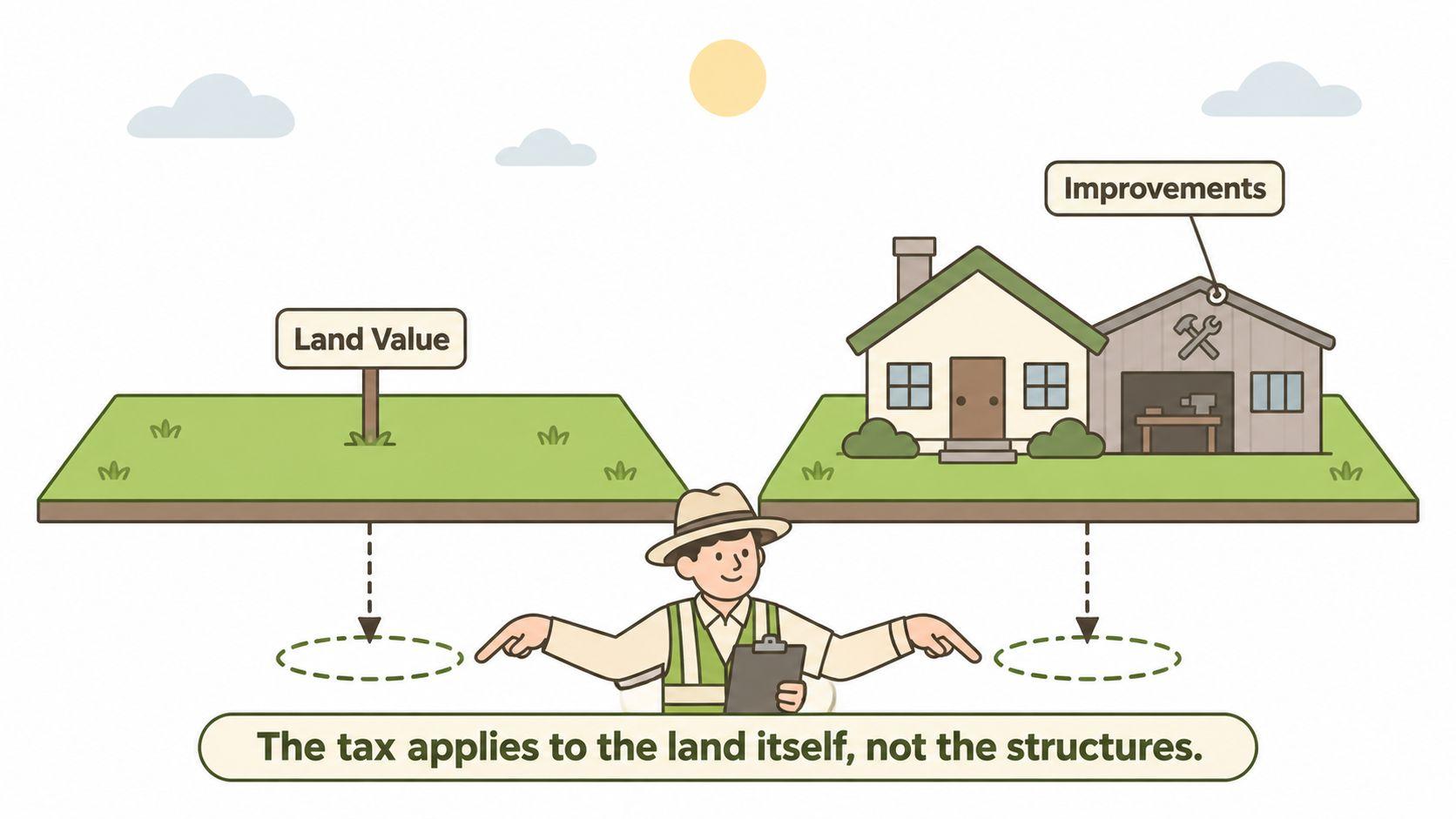
Henry George, an American economist, published Progress and Poverty in 1879. He argued that the socially created rental value of land should be collected for public purposes while taxes on labour and productive capital came down. The Chicago Fed's history of the policy explains that George's proposal targeted land value rather than buildings or improvements, which is what separates it from a conventional property tax, and that the case rested on two pillars at once: an ethical claim about unearned land rent, and an efficiency argument. Because the quantity of land is fixed, taxing its unimproved value should not reduce the supply of land. George's reasoning is set out step by step in this guide to Progress and Poverty.
Theory turned into municipal administration in the United States. Pennsylvania cities later adopted split-rate taxes that charged land at a higher rate than buildings, a partial version of the single land tax that gave those places years of local experience with shifting the tax weight from improvements onto sites. Anyone arguing about the idea in practice is arguing about those partial versions, not about a pure system running anywhere at full stretch.
The narrow takeaway is this: a single land tax is a rule about what gets taxed. Everything else, who pays more, who pays less, what happens when a lease runs out, follows from that rule. It is not a general property tax, which reaches land plus buildings together. It is not a lease, which is a contract with a term and an expiry date. And it is not a land-use right repriced annually, which prices access to ground rather than taxing its owner.
How a Single Land Tax Differs From Leases and Land-Use Rights
| Arrangement | What is charged | Term | Repricing | Renewal or expiry |
|---|---|---|---|---|
| Single land tax | Site land value only, buildings excluded | No contract term | Revalued on the valuation cycle | No lease event |
| Fixed-term land lease, renewable | Fixed price or rent for the term | Set term, renewable | Fixed until renewal | Accumulated gap closed in one repricing at renewal |
| Fixed-term land lease, non-renewable | Fixed price or rent for the term | Set term, no renewal | Fixed until expiry | Harder to refinance and sell as expiry nears |
| Land-use right (strict definition) | Annual charge on current site value | Indefinite | Repriced each year | No renewal, no expiry |
| Conventional property tax | Land plus buildings and improvements | Ongoing | Reassessed periodically | No expiry event |
Start with the fixed lease, because it's the arrangement most readers have met. A renewable lease holds a price for its term. It buys certainty, but only until the term ends, and at that point the accumulated gap between the lease rate and the market rate is closed in one major repricing. A non-renewable lease behaves the same way fiscally and worse financially: as expiry approaches, lenders shorten their horizons and buyers discount what they can't renew, so the asset becomes progressively harder to refinance and sell. Fixed leases don't correctly price risk. They postpone it.
A land-use right, in the strict sense, is indefinite, repriced annually and requires no renewal. Because the price resets every year, no gap accumulates and no end-date negotiation has to be survived, so the interest can be bought and sold at low cost. Land is priced appropriately, and entrepreneurship isn't carrying a lump of speculative risk that has nothing to do with the business.
Now the caveat that causes most of the confusion in real policy debates. Fixed leases are sometimes called land-use rights. They aren't. An interest qualifies only if it is repriced each year, requires no renewal and does not expire. China's system shows how far the label can travel from the mechanics: a legal analysis of Chinese land tenure reports maximum terms of 70 years for residential land, 50 years for industrial land and 40 years for commercial land, with users paying the state a granting fee for a specified number of years. Those are fixed-duration interests, not annually repriced ones, whatever the statute calls them.
The test: if an arrangement has an end date and a renewal step, it's a lease, whatever the paperwork calls it.
A single land tax sits beside all of this rather than replacing it. It's a charge on site value with buildings excluded, while a conventional property tax covers land plus buildings and improvements. Three questions will classify almost any arrangement you meet: Does it expire? Is renewal required? Is the price reset every year?
Why Fixed Lease Expiry Carries Risk, with a Hong Kong Case
Two flats in the same block, same view, same fittings. One lease has decades left and a clear renewal path. The other carries an expiry date close enough that a buyer must guess what the government will do when it arrives. That guess has a price.
Hong Kong offers unusually clean evidence on that price because all land there is held through government leaseholds granted for fixed terms. A study of property transactions compared leases with an earlier expiry date against otherwise comparable properties whose leases ran decades longer. The earlier-expiring properties traded at a 14.1% discount, and the researchers put the expected renewal penalty at about 25% of value, as reported in this analysis of political uncertainty and long-term property rights.
Same buildings, same districts, same printed terms apart from the end date. What differed was what buyers believed would happen next. A fixed term creates certainty while it runs, then concentrates repricing and renewal risk near the end. The risk does not vanish; it waits.
That is the practical difference between a fixed lease and an annually repriced land-use right. The latter is priced every year and needs no renewal step. A lease with an end date is a different instrument, and calling it a land-use right does not change the negotiation waiting at the horizon. The evidence here is a single market, so treat the size of the discount as a warning rather than a universal constant. Administrative design still matters: who decides renewal, on what criteria, and whether the rules are fixed in advance. A realistic path is staged reform: valuation capacity and transition rules have to be built first.
Four checks sort most leases quickly:
- The end date. Find it in the document, not the marketing summary, and compare the remaining term with your financing horizon.
- The renewal conditions. Identify who decides, on what criteria, and whether those criteria are set out in advance.
- Compulsion or discretion. A discretion is a negotiation; a compulsion is a formula.
- Annual reset. If the rate resets every year, the first three checks lose their force because there is no end date to reach.
For the mechanics of long dated ground leases, see this explanation of 99-year land leases.
The Economic Rent Logic Behind Taxing Land Value
Economic rent has a precise meaning here, and it's narrower than the everyday word. Written evidence submitted to the UK Parliament defines annual rental value, or ground rent, as the surplus income achievable from a site after the costs of labour and capital have been paid, which isolates the return attributable to the land or location rather than to buildings, machinery or workers, per this submission on land value taxation.
The logic is easier to follow as a map:
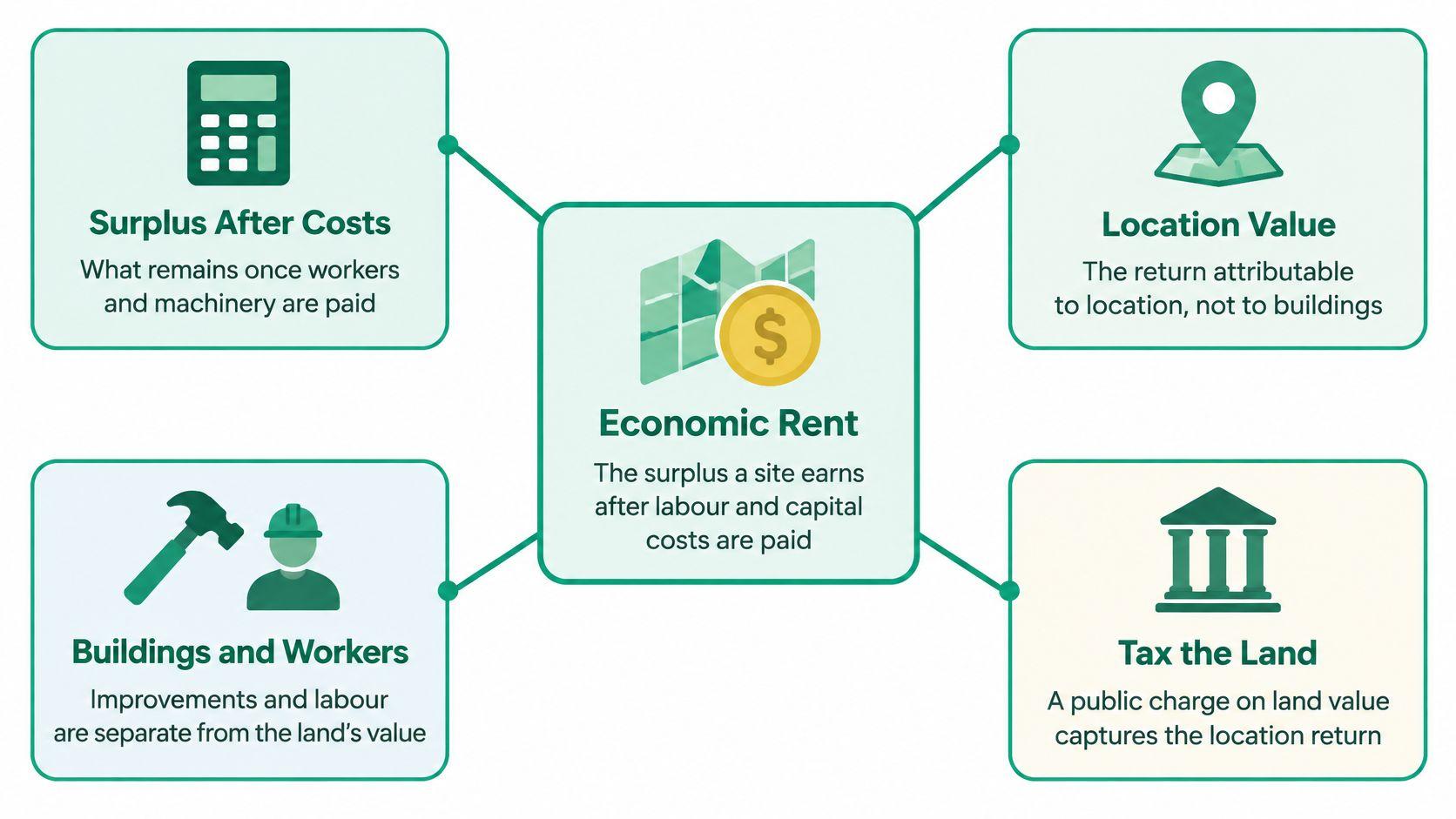
That surplus reaches landowners by two routes today. One is direct, through an occupation rent or a lease. The other is indirect, capitalised into the freehold sale price, so a buyer pays upfront for decades of location value. Either way, the money tracks the site.
Three steps carry the argument. Land supply is fixed, so a charge on unimproved value shouldn't shrink the supply of land. Redirecting the recurring site surplus to public purposes lets taxes on labour, construction and productive capital fall. And value created by the community as a whole is shared back to the public that made it. Unitism identifies three sources of wealth, labour, the gifts of nature and land, and keeps them analytically separate, as set out in this explanation of the factors of production.
The same charge on two very different sites
Say Site A and Site B both sit on locations worth 50,000 a year in ground rent, but Site A carries a modest two-storey office and Site B carries a twelve-storey tower. Both sites face the same land charge, because the charge depends only on location value. The owner of the tower keeps the full return on the construction, the lifts, the cladding and the fit-out. Nothing about building tall is penalised. The owner of the modest building can't free-ride on a prime corner.
Annual rent and annual repricing are the same mechanism seen from the fiscal side. MIT course material on China's public leasehold system identifies annual land rent as a basis for valuing land for tax purposes and recommends taxing land more heavily than buildings. Paid yearly against current rental value, the charge tracks the site; locked into a fixed price for a term, it drifts and then corrects violently. The land charge tracks location, not the owner's effort.
Valuing Land Separately and Choosing a Workable Model
An assessment roll works like an aerial photograph of every parcel. It shows boundaries and buildings, yet it does not by itself tell you what the ground under those buildings is worth. A land tax forces that second number into the open. The table below sets out the main models, from the pure version to narrower charges aimed at one behaviour.
| Model | What is taxed | Administrative demand | Example |
|---|---|---|---|
| Pure single land tax | Unimproved land value only | Separate land from buildings in every assessment | No country has fully implemented it |
| Split-rate property tax | Land at a higher rate than buildings | Two rates applied to one assessment roll | Pittsburgh and Scranton, Pennsylvania |
| Vacant-land charge | Unused or underused land | Identify vacancy, inspect, and enforce the charge | Washington, D.C.'s vacant property tax |
| Zoning-linked tax | Land zoned for housing but not yet activated | Maintain zoning records and land maps | Ireland's charge on zoned land held idle |
The hard part is the assessment roll. An assessor has to separate unimproved land value from buildings and infrastructure on every parcel, and existing assessed land values may be poorly aligned with location and parcel size. Irregular parcels make the job messier still. A Royal LePage Brookside Realty on valuations comparison makes the gap plain: an official figure can sit far from what a buyer would pay. Land is the component where that gap is widest, because a vacant lot has no sale price to anchor it.
The evidence problem deserves the same plain treatment. The Scottish Land Commission found that no country has implemented a pure single tax and reported limited unequivocal empirical evidence that land-value taxation delivers all the benefits commonly claimed for it. That finding does not weaken the case for capturing land value. It sets the standard for how a government should move, with evidence at each stage rather than a leap of faith.
Four questions any government has to answer before it sets a rate:
- Fair valuation. How will every site be valued consistently, including the awkward ones?
- Updating. How often will assessments change, and who signs off?
- Irregular parcels. What rule handles corner sites, split titles and land under infrastructure?
- Appeals and capture. How are disputes resolved quickly, and how is the process protected from political manipulation?
Practical rule: the strongest case is for staged reform rather than an overnight switch.
The sequence that works is unglamorous. Build better cadastres first, so the parcel data exists before the rate does. Add transparent mass appraisal second, with published methods and comparable evidence. Run pilot jurisdictions third. Shift rates gradually fourth, replacing existing taxes only as the evidence accumulates. Site value rating and its administrative requirements are explained further in this guide to site value rating.
Ireland shows the incremental direction in practice. Its charge on zoned land held idle aims at one behaviour, activating land already designated for housing, rather than replacing the whole tax system. A narrow instrument like that builds administrative capability without betting a national budget on an untested roll. It also keeps the political question honest: each step has to prove its value before the next one is attempted.
What Land Value Taxation Changes for Housing and Public Budgets
The common assumption is that changing the tax fixes housing. It doesn't, on its own, and saying so plainly is more useful than overselling it. What land value taxation changes is the incentive to sit on land.
The housing claim, tested
When land cannot be hoarded for speculation, homes cost closer to what it costs to build them. That's the mechanism, and it runs through holding costs rather than through construction. A site left idle becomes expensive to keep idle, which pushes owners toward infill, conversion and redevelopment instead of waiting for the neighbouring plot to be assembled. The supply response is real but indirect: it works on the decision to build, not on the price of bricks.
The honest counterweight is that land values move. They rise and fall with the wider economy and with local decisions about transport, zoning and migration. A revenue source tied to land value inherits that volatility, even if it sheds the boom-bust amplification that comes from speculative land holding.
The budget side
Revenue shifts toward land value, which broadens the base and eases the burden on wages and investment. Because land value reflects what a location offers, the revenue base grows when the community invests around it, rather than when a company hires or a builder builds. Land cannot be hidden, moved abroad or smuggled out, which makes it the most honest source of public revenue available. On the revenue side, see this analysis of land value tax revenue.
Three trade-offs deserve a place in any serious design. Valuation errors land directly in people's bills and generate appeals, so the appeals process has to be fast and predictable. Households and firms holding high-value land with modest buildings can end up paying more, and a transition has to plan for them explicitly rather than discovering them at the first billing cycle. And targeting high-value property is not the same as targeting high-value land, a distinction that shows up in instruments such as the 2028-29 council tax surcharge bands, where the trigger is the property rather than the site.
The environmental effect follows the same logic. When land use has a fair price, compact development beats sprawl on the numbers, and land nobody needs stays wild. How strong each of these effects is depends on the local context, and the evidence is thinner in some places than advocates admit.
Deciding Whether a Land Tax Fits Your Jurisdiction
The decision comes before the design. Consider a pure single land tax only where all three tests below are passed. Where any one fails, choose a split-rate system or the staged reform path instead, and say so publicly before a consultation opens.
- Can you value land separately from improvements at acceptable accuracy? If the valuation roll can't distinguish site from structure, the charge will be arbitrary and the appeals will be relentless.
- Do you have a cadastre, an appeals process and staff for regular revaluations? A one-off assessment is a photograph. A tax needs a film.
- Is the land-value base large enough to replace revenue without shifting a heavy burden onto homeowners? Run the arithmetic before the announcement, not after.
Then take the first actions in order, and take them slowly. Commission a valuation pilot in one district, chosen because its parcel data is decent and its market is active enough to test the method. Model who gains and who pays using distributional data, including the households and firms holding high-value land with modest buildings, since they're the group that will organise against you if you haven't counted them. Publish the results before extending the scheme, because credibility compounds and concealment doesn't. Unitism's support for clients includes assessing land values, designing the policies that collect them, and modeling who gains and who pays, which is the order that keeps a reform defensible.
For the compliance layer that any new charge inherits, it's worth seeing how existing land taxes are administered and contested in practice. EndureGo Tax's land tax guides give a useful view of that machinery from the taxpayer's side.
First step: audit the existing leases and charges in the pilot district, so the reform starts from accurate data rather than from an assumption about what the paperwork says.
That audit tells you something no model can: how many of your current arrangements are indefinite and annually repriced, how many are fixed leases wearing the wrong name, and where the first repricing event will land.
If you're weighing a land-value reform and need the arithmetic before the argument, Unitism® can help. We assess land values, design the policies that collect them, and model who gains and who pays across a phased transition, so the first rate you set rests on evidence rather than hope. Visit Unitism® to see how the work is structured and what a pilot would look like in your jurisdiction.