Learn how transferable development rights work, from sending and receiving sites to market design, and how cities use TDRs
October 4, 2026
Transferable Development Rights Explained
Learn how transferable development rights work, from sending and receiving sites to market design, and how cities use TDRs

A planning committee may be hearing the same proposal from three different groups. Conservation advocates want to keep a farm, heritage building, or wetland from being developed. Developers want more floor area in locations with infrastructure and market demand. Residents want growth managed without blanket upzoning. Transferable development rights, or TDRs, are designed to address that tension by moving development potential from one parcel to another.
The mechanism sounds simple until officials must decide which land can send rights, where those rights can be received, how many credits a project needs, and who records the transaction. TDR is not just a preservation technique. It's a market design problem, and the program's success depends on whether the legal rules create a functioning market rather than a pile of unusable credits.
Table of Contents
- What Transferable Development Rights Are and Why Cities Use Them
- How the Sending and Receiving Sites Work
- The Two-Tier Zoning Structure Behind TDRs
- Common Design Variants and How They Differ
- Why TDR Programs Succeed or Stall in the Market
- Evidence From Real Programs and What It Teaches
- TDRs, Land Leases, and Land-Use Rights Compared
- A Practical Path for Municipal Adoption
What Transferable Development Rights Are and Why Cities Use Them
Consider a historic farm beside a growing urban corridor. The owner faces pressure to subdivide the land, while a developer across the corridor wants to add homes in an area where roads, transit, and utilities already exist. A conventional response might be to approve development on the farm or grant broad additional density across the receiving district. A TDR program offers another route.
The city identifies the farm as a sending parcel. The owner keeps legal title but separates some of the parcel's unused development potential from the land itself. The city then permits a designated receiving parcel to use that potential as additional floor area or density above its base zoning. The developer buys the transferable credits, and the farm owner receives compensation for accepting a permanent restriction on future development.
This arrangement doesn't transfer ownership of the farm. It transfers a legally recognized development capacity. The underlying land remains with the original owner, while the receiving site gains an approved increase in what it may build. The land-use policy framework helps place this distinction in context, because zoning controls the use of land while separate instruments can allocate or capture the value created by those controls.
The public purpose
Municipalities commonly use TDRs to protect farmland, forests, open space, heritage buildings, and other public-purpose land while directing growth toward urban nodes. The receiving project gets a predictable path to extra floor area, and the sending owner gets a tradable compensation instrument instead of relying only on a public acquisition program.
The policy bargain has two sides:
- The sending site accepts a lasting constraint. A conservation easement, deed restriction, or comparable instrument prevents the owner from using the severed potential later.
- The receiving site gets conditional capacity. The developer can exceed base zoning only after acquiring and retiring the required credits.
- The public sets the geography. Officials decide which parcels may send rights and which locations can receive them.
- The market sets the transaction. A developer buys only when the extra density creates enough value to justify the credit price and administrative costs.
TDRs therefore differ from a general upzoning. Upzoning creates additional development capacity across eligible land, whether or not a particular owner preserves another parcel. TDRs tie additional capacity to a corresponding restriction somewhere else. The sending parcel is permanently constrained, while the receiving parcel gains legally sanctioned density without changing either parcel's ownership.
How the Sending and Receiving Sites Work
A farm owner may want to keep land undeveloped while a corridor developer needs more floor area than base zoning allows. A TDR transaction connects those two decisions through a sequence of legal, administrative, and commercial steps. The local ordinance determines the eligible land, the credit calculation, and the permitted transfer ratio, but the basic chain is consistent.
Step one on the sending site
The farm owner applies to participate in the program. The planning authority confirms that the parcel lies within the designated sending area and calculates how much development potential may be severed under the ordinance.
The owner then records a permanent easement or deed restriction. This document runs with the land and limits future development. That restriction prevents the owner, or a later buyer, from using the same development capacity after it has been converted into tradable credits. Without an enforceable restriction, the program could count one preservation benefit twice.
After the restriction is recorded, the authority issues a credit certificate or comparable document. The certificate identifies the quantity and type of development right available for transfer. The legal route can differ. In some systems, a public authority issues a certificate for a defined amount of built-up area after the land is surrendered through a registered gift deed. In others, the owner keeps title and records a conservation restriction before receiving credits.
The form changes, but the order matters: the public restriction must precede or accompany the creation of the tradable right. A receiving developer values that right according to the additional value the project can generate after construction and other costs. The residual land value explanation helps clarify why a credit can have value even though it is not a physical part of the receiving parcel.
Step two on the receiving site
The corridor developer confirms that the project lies within an eligible receiving area. The ordinance identifies the base zoning, the higher density available through TDR, and the transfer ratio that determines how many sending credits the project must surrender.
The developer purchases the required credits from the farm owner, a broker, or a public TDR bank. The transaction is submitted to the program's registry, which checks the certificate's chain of title, confirms that the credits have not already been used, and records the new owner. This registry performs a role similar to a ledger: it shows who holds each credit and prevents the same unit from circulating after use.
The developer then retires the credits. The planning authority adds the approved floor area or units to the project's permitted envelope, subject to building, infrastructure, and safety requirements. Retirement closes the accounting loop. A credit that remains active after use could let multiple projects claim the same sending-site restriction.
Assume the ordinance uses a 1:1 transfer ratio and the developer seeks one square metre of bonus floor area. The project must acquire and retire one square metre of eligible sending-site development potential. Under a 2:1 ratio, the same bonus requires two square metres of sending-site potential. The ratio therefore affects credit consumption, available supply, and the density a receiving site can support.
Practical rule: A TDR certificate is not the preservation outcome. The outcome exists only when the restriction is enforceable, the credit is traceable, and the receiving project retires it.
The Two-Tier Zoning Structure Behind TDRs
TDR programs rely on a two-tier zoning structure. The first tier is the base zoning that applies without purchased credits. It determines what a property may build as of right, subject to ordinary planning and building requirements.
The second tier is conditional. It becomes available only when the developer acquires and retires TDR credits. The receiving zone therefore has a base development level and a higher ceiling that can be reached through the program. The sending zone has its own rules identifying how much potential may be severed and what restriction must be recorded.
This structure lets the city distinguish between ordinary development rights and rights created through a public policy exchange. A developer can't just claim the receiving area's upper tier because the site happens to be attractive. The developer must provide the consideration defined by the ordinance, usually the retirement of credits connected to a restricted sending parcel.
Why the ratio matters
The transfer ratio links the two tiers. At a 1:1 ratio, one square metre of sending-area potential provides one square metre of receiving-site bonus. At a 2:1 ratio, the developer must surrender two square metres to obtain one square metre of bonus. The second arrangement consumes credits more quickly and can limit the pace of receiving-site intensification.
A ratio is therefore not merely an accounting detail. It affects the scarcity of credits, the compensation available to sending owners, the price developers can tolerate, and the political impact of additional density. A generous ratio may leave too much receiving capacity available relative to the credits that developers need. A restrictive ratio may make preservation expensive or leave receiving projects unable to pencil out.
How Transfer Ratios Reshape the Two-Tier Zoning Deal
| Ratio | Credits Needed per 1 m² of Bonus | Effect on Credit Supply | Effect on Receiving-Site Density |
|---|---|---|---|
| 1:1 | 1 m² | Credits are consumed more slowly | More bonus floor area can be unlocked with each unit of supply |
| 2:1 | 2 m² | Credits are consumed more quickly | Bonus density is throttled because each m² requires more surrendered potential |
The right ratio depends on the local market, not on a universal formula. Officials should model the amount of eligible sending potential, the amount of receiving capacity, and the value developers can obtain from the bonus. A smart-growth principles guide can help frame the broader planning question, but the ordinance still needs a locally defensible conversion rule.
Common Design Variants and How They Differ
The label TDR program covers several designs. They don't distribute risk, administrative work, or bargaining power in the same way. A municipality should choose the variant that fits its land market and administrative capacity rather than copying a program from a jurisdiction with different conditions.
The main choices
A TDR bank buys credits from sending owners and resells them to developers. It can provide a buyer or seller when the private market is thin, but it also requires public capital, pricing rules, and careful exposure management.
An in-use sending area protects land that is already serving a public purpose. A working farm, occupied heritage property, or existing open-space parcel receives credits after the owner accepts a restriction. The easement usually runs with the property, so a later owner inherits the limitation.
An in-potential sending area begins with land that could have been developed under existing rules. The municipality changes the development framework, identifies the potential that can be severed, and uses TDR to compensate owners for accepting a lower future development path. This approach can create controversy because owners may view the restriction as a downzoning followed by partial compensation.
Agricultural-only and heritage-only programs narrow eligibility. That can make the public purpose easier to explain and defend, but it also limits the supply of credits. A density-bonus hybrid gives developers a choice between buying credits and paying a fee in lieu. The fee can provide a price reference and public revenue, though it may weaken direct connections between a specific receiving project and a specific sending parcel.
Common TDR Design Variants Compared
| Variant | Sending Site Treatment | Buyer Experience | Public Outcome |
|---|---|---|---|
| TDR bank | A public or nonprofit intermediary purchases and holds credits | A developer can transact through one visible counterparty | Greater liquidity, with public responsibility for inventory and pricing |
| In-use sending area | Existing farms, heritage buildings, or open spaces receive restrictions | Credits are tied to an already protected public purpose | Preservation is direct, but eligible supply may be limited |
| In-potential sending area | Undeveloped land accepts a lower future development path before rights are severed | The developer buys credits created by a planning restriction | Compensation can support growth management, but political resistance may be stronger |
| Agricultural-only program | Only qualifying agricultural land can send rights | Buyers receive a narrower credit product | Farmland protection is clear and targeted |
| Heritage-only program | Eligible historic properties retain restrictions on future development | Credits may be usable only in designated receiving areas | Heritage conservation gains a private funding channel |
| Density-bonus hybrid | Sending restrictions create credits, while a fee offers an alternative | The developer chooses credits or payment in lieu | The city gains flexibility, but the preservation link may become less direct |
Each variant changes the supply curve and the coalition behind the program. A value-capture and value-creation comparison can help officials distinguish compensation for restricted development potential from revenue generated by newly created public value.
Why TDR Programs Succeed or Stall in the Market
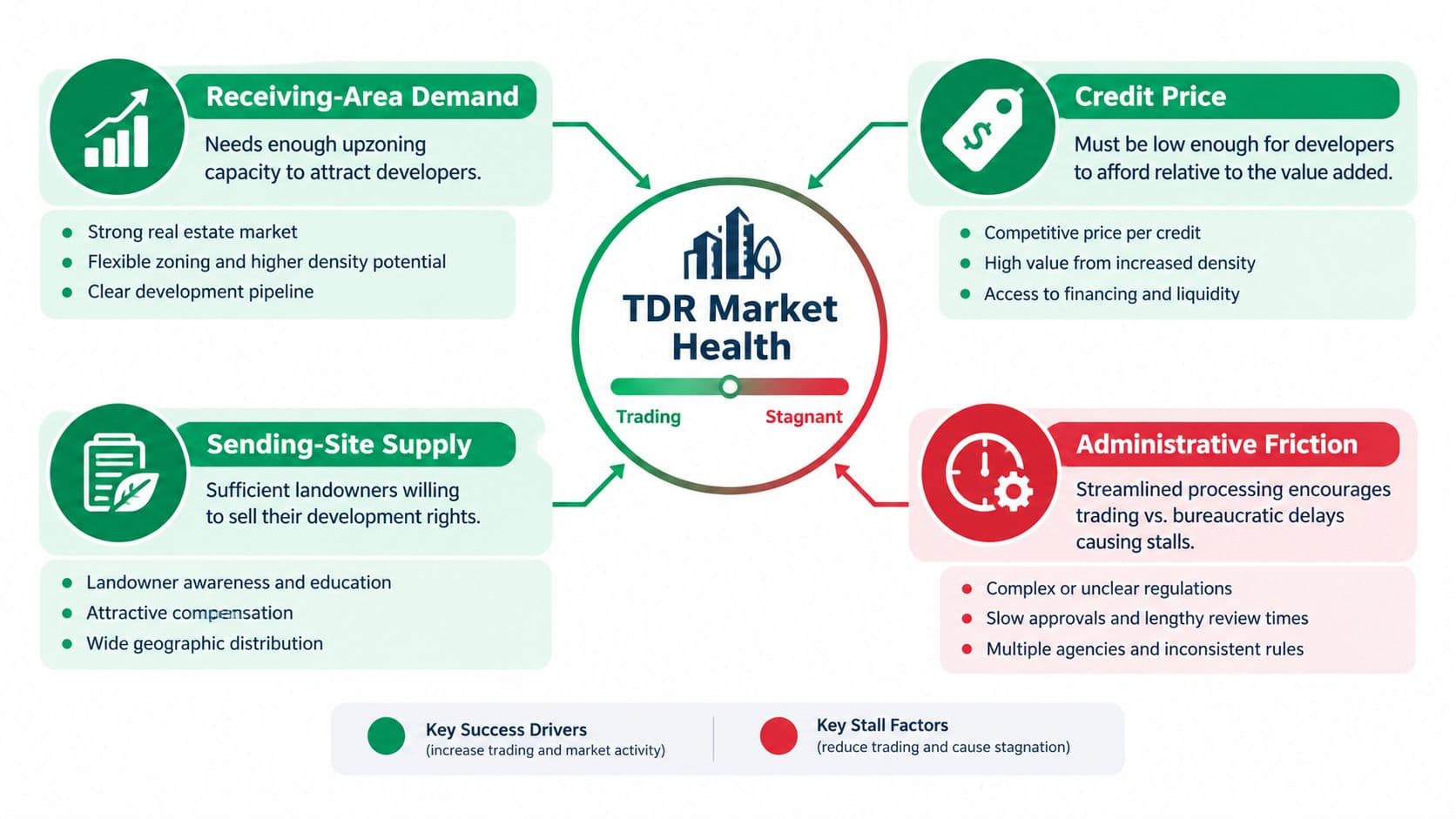
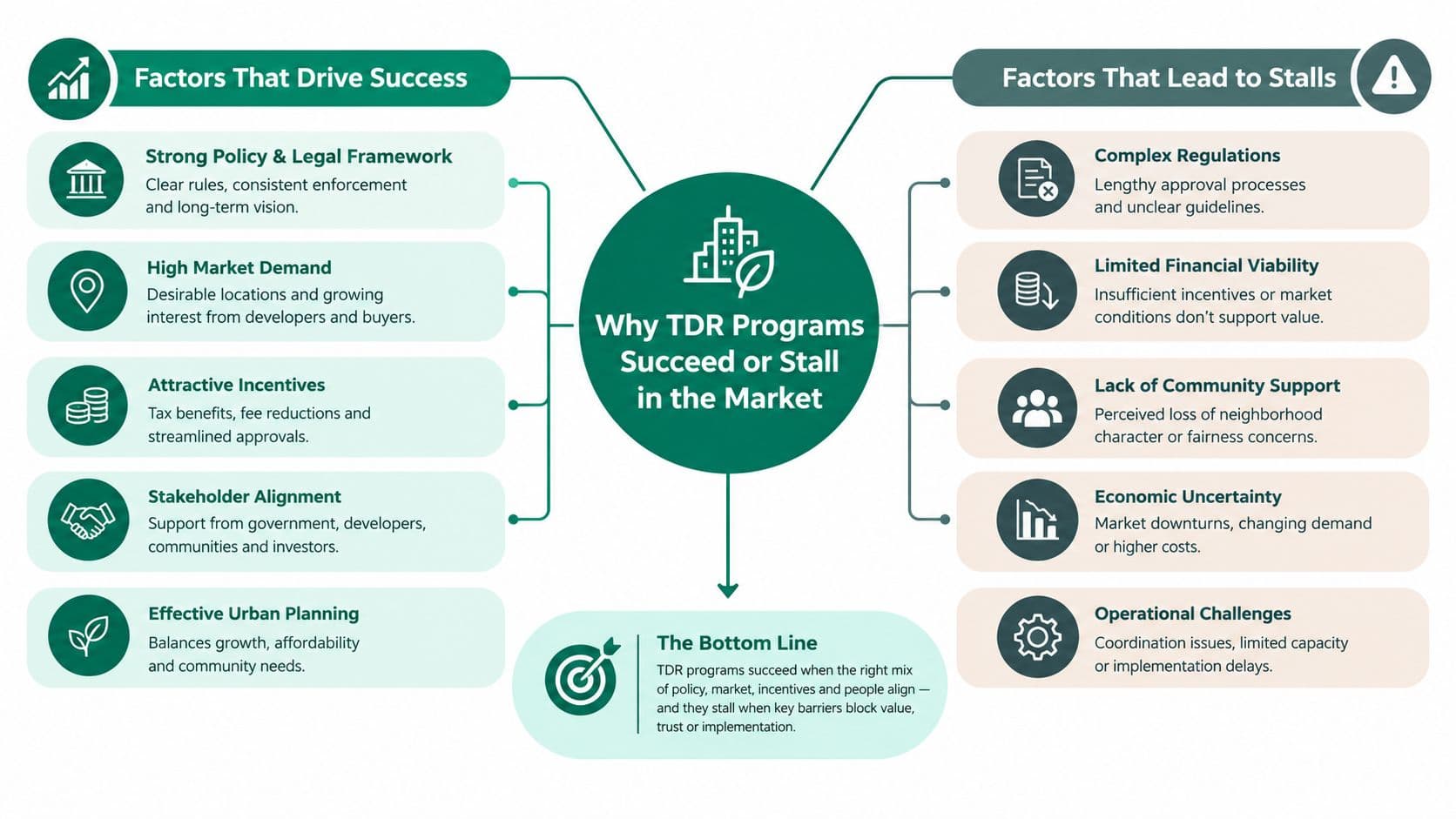
A TDR ordinance can be legally elegant and still produce no transactions. The first question is receiving-area demand. Developers need a location where extra floor area or density has practical value. If the receiving zone offers little market demand, or if infrastructure and approvals make additional construction difficult, developers won't buy credits just because the ordinance makes them available.
The second question is whether the receiving area has enough usable capacity. A receiving zone may be attractive, but the bonus must fit within height, setback, parking, infrastructure, design, and approval constraints. Nominal density on a zoning map isn't the same as buildable density in a project.
The supply and price relationship
The sending area must provide enough credits for a market to form, but not so many that credits become effectively abundant. The transfer ratio and sending-area boundary jointly determine scarcity. A broad sending boundary can create a large inventory, while a restrictive ratio can consume that inventory quickly. Officials need to test both variables together.
The credit price must also fit the receiving project's economics. A developer compares the value of the additional floor area with the credit price, construction and financing costs, approval risk, and transaction expenses. The residual land value method is relevant to this calculation because the credit can be paid for only from the value left after the project's other costs and required return.
Administrative friction creates another failure point. Surveys, easement recording, title review, registry fees, legal opinions, and agency approvals all add cost and time. If processing costs consume too much of the transaction's value, owners and developers may abandon otherwise viable deals.
Pressure-testing the market
Before launch, planners should ask:
- Where is the demand? Identify receiving sites where developers are already seeking additional capacity.
- Who supplies the credits? Confirm that eligible owners can participate voluntarily and understand the permanent restriction.
- What consumes credits? Define the receiving-area bonus clearly enough that developers can underwrite it.
- Who verifies the chain of title? Assign responsibility for certificates, easements, transfers, and retirements.
- What reduces friction? Use standardized documents, pre-certified credits, clear fees, and predictable processing.
- What prevents speculation from distorting the program? Set holding, disclosure, or bank-management rules where appropriate, while recognizing that market speculation can arise whenever a tradable asset has uncertain future value.
A bank, broker, or public registry can improve liquidity, but none can create demand where the zoning and development economics don't support it. Governance tools help a market operate. They don't substitute for a viable receiving area.
Evidence From Real Programs and What It Teaches
The available evidence complicates the familiar story that TDR preserves land while concentrating growth. A 2021 study of Montgomery County found that TDR encouraged preservation of agricultural land and forest, but also produced scattered development in the sending area. The lesson is not that the program failed. It's that preservation outcomes must be measured alongside fragmentation and settlement patterns.
A 2026 study of Tel Aviv examined large-scale heritage-led TDR and identified institutional strain, high transaction costs, delays, and weak matching between sending and receiving lots. That experience shows why a city can have a compelling preservation objective and still struggle to turn legal credits into usable development capacity.
The World Bank describes TDR as a mature policy tool used mainly in the United States, with more than 200 programs. Its technical note emphasizes the importance of a functioning receiving market, clear entitlements, balanced sending and receiving areas, and a credible registry. These conditions matter as much as the preservation objective itself. Indoor mapping for smart city development offers a related reminder that complex urban development depends on translating plans into coordinated, usable spatial systems.
What the cases reveal
The strongest common lesson is governance capacity. A program needs officials who can verify land records, enforce permanent restrictions, maintain credit inventories, resolve lot-matching problems, and explain the rules to owners and developers.
The evidence also warns against treating TDR as a one-way transfer from rural or historic land to urban density. A sending area can experience scattered development if the program protects selected parcels without managing the surrounding pattern. A receiving district can struggle if additional density arrives faster than infrastructure, public facilities, or administrative systems can accommodate.
A credit is useful only when the city can answer three questions at any time: where it came from, what restriction supports it, and whether it has already been used.
Digital registries and formal TDR banks are often discussed as ways to reduce friction. They can help, but the deeper requirement is institutional. Officials must design the market, monitor actual land outcomes, and adjust procedures when legal supply and practical demand fail to meet.
TDRs, Land Leases, and Land-Use Rights Compared
A city council may approve a TDR program, consider a ground lease for public land, and hear proposals for transferable land-use rights in the same planning cycle. These tools can all affect land value, yet they organize value and control through different market mechanisms. The practical question is how development capacity, possession, legal enforcement, and future pricing should work together.
A TDR credit represents development potential severed from a parcel and attached to a defined public-purpose restriction. For example, a conservation easement may prevent development on a sending site while its eligible development capacity becomes available to a receiving project. The credit is commonly transferred once and retired after that project uses it. The municipality sets the rules and verifies the exchange, but it normally does not continue repricing that credit each year after the sale.
A ground lease gives a tenant possession for a stated term and under agreed rent provisions. A renewable lease may provide certainty during the term, while renewal can expose both parties to a substantial adjustment if the contractual rent falls below market levels. A non-renewable lease becomes harder to refinance or sell as its remaining term shortens. A fixed lease therefore delays the question of changing land value rather than resolving how that value will be measured over time.
A true land-use right follows another structure. It is indefinite, requires no renewal, does not expire, and is repriced annually. Because the right can be transferred while the land charge is updated, users can buy and sell access at relatively low cost while the charge continues to reflect changing site value. Some fixed leases use the label “land-use rights,” but the label does not change the legal arrangement. A fixed-term interest remains a lease. The distinction is explained in this land-use rights valuation discussion.
Comparing TDRs, Land Leases, and Land-Use Rights
| Criterion | TDR Credit | Ground Lease | Land-Use Right |
|---|---|---|---|
| Exclusivity | Applies to a defined development capacity or credit | Gives the tenant possession under the lease | Gives the holder an exclusive use right |
| Duration | Exists until transferred and retired, subject to program rules | Fixed term, renewable or non-renewable | Indefinite, with no renewal requirement |
| Transferability | Tradable independently from the sending land | Transfer depends on lease terms and consent rules | Transferable without recreating a fixed-term tenancy |
| Enforceability | Supported by a recorded restriction and registry | Supported by the lease contract and property law | Requires durable legal recognition and land records |
| Repricing | Generally negotiated at the time of transfer | Fixed during the term, then potentially repriced at renewal | Repriced annually |
| Public value capture | Captures value through the sale of additional development capacity | Retains recurring control through rent and renewal terms | Retains recurring repricing and land-value access |
A receiving site's additional development capacity has value because it can support more floor area, units, or another permitted use. The LendingXpress valuation guide provides context for evaluating land-development potential. That valuation question supports the market side of a TDR program, while the public-purpose restriction supports the sending side.
TDRs fit best when a municipality wants a defined preservation exchange: restrict a selected parcel, create a verified credit, and let a receiving project purchase added capacity. Ground leases manage possession and rent over a contractual term. Properly designed land-use rights maintain transferable access while updating the land charge as site value changes. The choice should follow the city's intended duration, enforcement system, supply-and-demand balance, and capacity to administer repricing or credit retirement.
A Practical Path for Municipal Adoption
A council should begin with diagnosis, not ordinance drafting. Ask whether developers are genuinely seeking additional capacity in identifiable receiving areas, how much unused floor area or density the base zoning leaves available, and which sending sites residents will regard as legitimate public priorities.
Then test the legal foundation:
- Confirm enabling authority. Verify that state or national law permits the municipality to create, transfer, record, and enforce development credits.
- Create receiving capacity. The receiving zone must offer additional density that developers can utilize. A credit market can't operate if the upper tier exists only on paper.
- Define sending restrictions. Identify eligible parcels, the public purpose, the easement or deed restriction, and the development potential that may be severed.
- Adopt registry rules. Record credits against the deed, maintain chain-of-title information, track transfers, and retire credits after use.
- Calibrate the ratio. Compare likely credit supply with receiving demand, project economics, infrastructure limits, and political tolerance for additional density.
- Reduce first-year friction. Standardize applications, pre-certify eligible rights, publish fees and timelines, and consider a broker or TDR bank if the market lacks experienced private intermediaries.
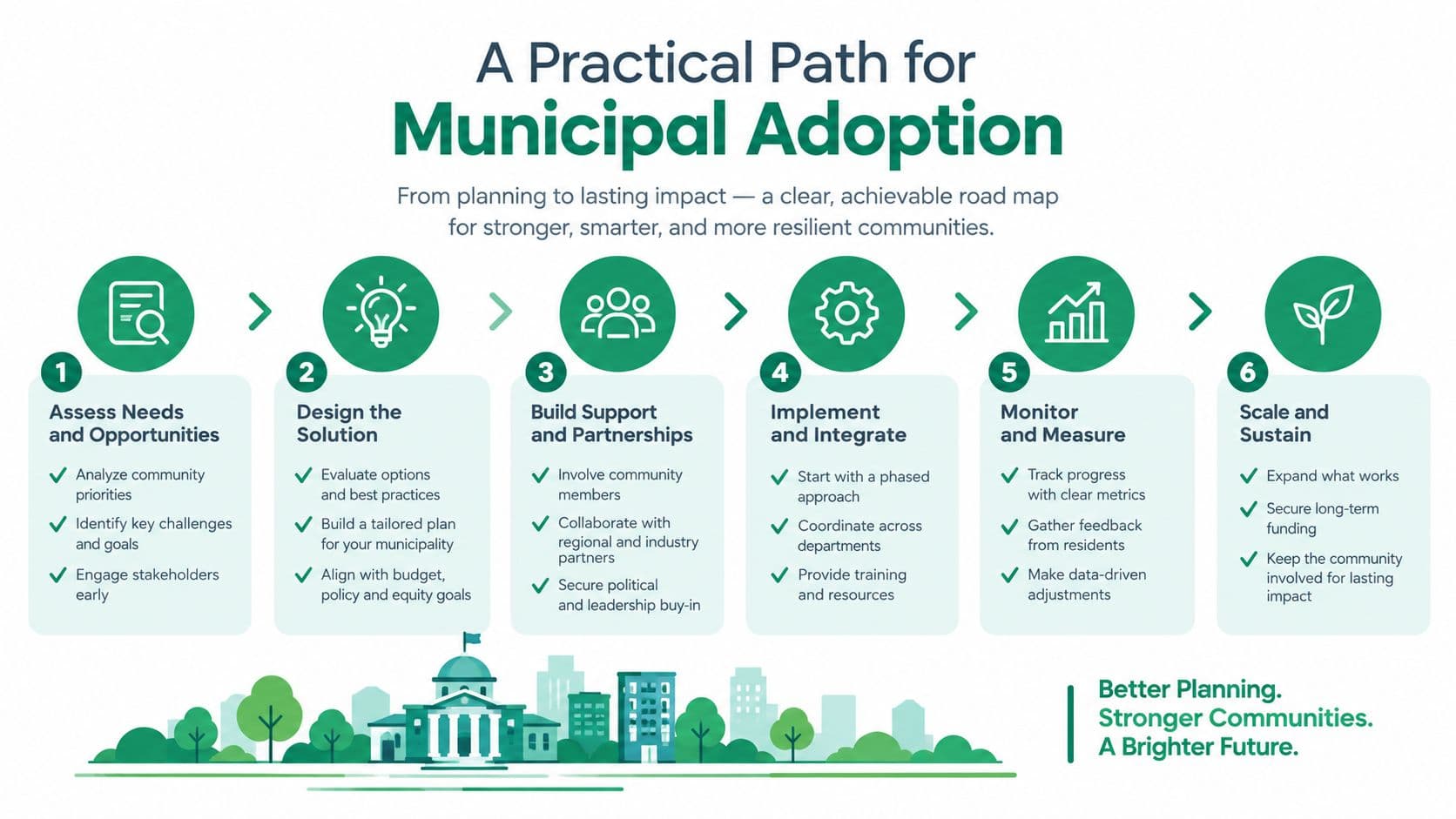
The first year should also establish monitoring. Track whether sending restrictions are recorded, whether credits trade, whether receiving projects use the bonus, and whether development patterns in the sending area match the public purpose. If transactions stall, officials should determine whether the problem is demand, price, supply, ratio, title clarity, or administrative delay before changing the entire program.
Unitism® offers research, valuation methods, policy design, and implementation support for governments examining land-use and land-value instruments, including the relationship between TDRs, leases, and land-use rights. Visit Unitism® to explore its practical resources for designing land policies that municipalities can explain, administer, and improve over time.