Value Capture and Land Policies explained: the main instruments, who pays, fiscal and distributional effects, and real examples from cities and countries.
November 19, 2026
Value Capture and Land Policies: How They Work and Who Pays
Value Capture and Land Policies explained: the main instruments, who pays, fiscal and distributional effects, and real examples from cities and countries.

By 2002, 90% of Singapore's land was publicly owned, according to a University College London study discussed by the Centre for Liveable Cities. That reframes the debate about value capture and land policies: governments aren't limited to taxing property transactions or asking developers for contributions. They can shape who receives land income, what rights people hold, and when land costs adjust. But the ability to collect revenue doesn't prove that public action created the value being collected.
Table of Contents
- Why Public Action Creates Land Value Worth Capturing
- The Main Instruments and What Triggers Each One
- Land Leases and Land-Use Rights Are Not the Same
- Fiscal Gains and Where Revenue Falls Short
- Who Gains and Who Pays Under Capture
- Lessons From Singapore and Detroit
- Confirm the Design Before You Adopt a Capture Policy
Why Public Action Creates Land Value Worth Capturing
A new metro line can act like a rising tide for nearby land prices. Say a shop occupies the same building before and after a station opens, but customers and workers can now reach it more easily. Buyers may pay more for that location even though the owner hasn't improved the premises.
The logic of land-value capture follows a simple sequence:
- Public action improves a location. A government builds transport, extends utilities, provides a park, or permits a more valuable use.
- Landowners receive part of the benefit. Buyers may offer more for access, services, or development opportunities attached to the site.
- The community recovers a share. A public charge or land arrangement returns some of that gain to infrastructure and services.
This isn't a marginal policy idea. The OECD's Global Compendium of Land Value Capture Policies examined 60 countries, finding that all except Uganda use some form of value capture at least occasionally; it also reports that land represented approximately 40% of total capital stock in eight OECD countries, equivalent to about USD 152 trillion using 2017 estimates.
Recovering value without confusing its source
The main mechanisms approach the same fiscal problem differently. Infrastructure levies charge beneficiaries of public works. Developer obligations attach requirements to development approval. Betterment charges target gains associated with public decisions. Negotiated contributions establish project-specific commitments, while land readjustment lets neighboring owners coordinate redevelopment and share its costs and benefits.
The public-finance case isn't that owners contributed nothing to their property's worth. An owner may have maintained buildings, assembled plots, or taken commercial risks. The case is that some location value comes from collective action, rather than the owner's investment.
Attribution comes first: A higher sale price is evidence of appreciation, not proof that a particular public project caused it.
Understanding the economics of infrastructure helps distinguish a project's service benefits from its effects on land prices. For a finance ministry, the practical questions are therefore linked: how much appreciation did public action create, and which instrument can recover an appropriate share without charging for unrelated gains?
The Main Instruments and What Triggers Each One
Value capture instruments by payer, trigger and example
| Instrument | Who pays | Trigger | Example from the research |
|---|---|---|---|
| Infrastructure levy | Landowners whose values rise from public works | Roads, transit, utilities or parks completed | A charge on land benefiting from a transport improvement |
| Betterment charge | Owners who gain from a public decision | Planning consent, rezoning or covenant variation | Singapore Land Betterment Charge |
| Developer obligation | Developers | Development approval | Infrastructure provision attached to permission to build |
| Land readjustment | Owners who pool neighboring plots | Coordinated redevelopment | Pooled plots reorganized to accommodate shared infrastructure |
| Negotiated contribution | Developer or owner | Case-by-case development deal | An agreed contribution toward infrastructure serving a development |
| Annual land value tax | Owners of the land's value | Yearly assessment of land value | A 1.05% site-value rate modeled in Bizkaia, Spain, in a 2025 regional study |
The unnamed examples describe how the instruments operate, not evaluated projects with documented revenue outcomes. That distinction matters: recognizing a tool doesn't establish what it will collect locally. The OECD–Lincoln Institute compendium provides the broader comparative framework for these policy approaches.
Charges tied to works or permission
An infrastructure levy connects a public improvement to the landowners who benefit. Officials need a defensible benefit area and a valuation approach, not just a boundary drawn around the construction site. Although completion can make the gain easier to observe, expectations may affect prices earlier.
A betterment charge focuses on a public decision that changes a parcel's value. Planning permission or a covenant change can create an identifiable assessment event. The central task is comparing what the land could support before and after that decision.
A developer obligation attaches to approval to build. It can require infrastructure, a financial contribution, or another specified provision. Officials should distinguish compensation for development-related costs from collection of land appreciation, even when the same agreement addresses both.
Shared arrangements and recurring charges
Land readjustment reorganizes neighboring plots rather than relying only on cash payments. Owners pool land so planners can accommodate roads, services, and usable development parcels. The terms must explain how participants share both the land contribution and the resulting development opportunities.
Negotiated contributions arise through individual agreements. They can accommodate unusual sites, but officials should publish the valuation basis and commitments so comparable developments don't receive unexplained differences in treatment. Land banking and development-rights fees also appear in policy discussions, but they require their own rules on acquisition, disposal, and permitted development.
An annual land value tax is different in kind: it's a recurring public charge on the value of land itself, not buildings or improvements. It doesn't require officials to attribute every change in value to a named project.
Nor is a tax a tenure arrangement. A fixed-term lease grants temporary occupation or use at a fixed contractual price; an indefinite, annually repriced land-use right combines continuing tenure with an updating land charge.
For officials comparing these tools with district-based financing, understanding what a TIF district does helps separate the source of revenue from the mechanism used to finance expenditure. Match the charge's trigger to the public action and the timing of payment, rather than choosing an instrument because its name sounds familiar.
Land Leases and Land-Use Rights Are Not the Same
Apply a strict test before describing an entitlement as a land-use right: it must have no expiration, require no renewal, and be repriced each year. Transferability alone doesn't qualify a fixed lease.
Fixed-term land lease versus land-use right
| Feature | Fixed-term land lease | Land-use right (as defined here) |
|---|---|---|
| Duration | Fixed term that expires unless renewed | No expiration |
| Renewal | Required to continue beyond the term, if renewal is available | Not required |
| Pricing | Fixed price for the whole term | Repriced each year |
| Buying and selling | Harder to refinance or sell as expiry nears | Low cost to buy or sell the land entitlement |
| Where the risk goes | Postponed to renewal or expiry | Priced in as it arises each year |
| Singapore example | Residential and industrial titles granted for finite terms | Not established by the fixed-term lease examples |
Fixed prices can concentrate future risk
Land leases are renewable or non-renewable fixed-term arrangements with a fixed price. A renewable lease offers a measure of certainty until the term ends. At renewal, the accumulated gap between the lease rate and current market conditions can close through a major repricing.
A non-renewable lease presents a different problem. As expiration approaches, a purchaser has fewer years of benefits to acquire, and a lender has a shorter period over which to secure repayment. Owners can consequently find refinancing and sale progressively harder.
Fixed leases don't eliminate land-price risk. They postpone it, concentrating the consequences at renewal or expiration.
An indefinite, annually repriced land-use right treats that adjustment differently. The holder retains the right without having to purchase a replacement term, while the annual land payment changes with assessed value. Because future land rent is collected through the recurring charge rather than fully capitalized into an upfront purchase price, people can buy and sell the land entitlement at low cost.
That doesn't mean buildings become free or transfers have no administrative expense. It means the price of access to land needn't include purchasing the entire expected stream of future land income. Properly designed land-use rights price land as its value changes without imposing an additional charge on entrepreneurship, construction, or other productive improvements.
Singapore illustrates the legal distinction
Under Singapore's State Lands Rules, the ordinary state-land title is a lease lasting at least 10 years and no more than 99 years; the accompanying tenure descriptions identify typical residential terms of 99 years and industrial terms commonly of 60 or 30 years. Those are finite entitlements, even when holders can transfer them.
Singapore also illustrates why annual valuation and indefinite tenure are separate matters. The Inland Revenue Authority of Singapore's property-tax guide explains that annual values are reviewed every year against market conditions. Reviewing a property's tax value doesn't change the expiration clause in its lease.
When evaluating 99-year land leases, inspect the legal term, renewal provision, and repricing clause separately. Sometimes fixed leases are called land-use rights, but under this definition, a title that fails any part of the test remains a lease.
Fiscal Gains and Where Revenue Falls Short
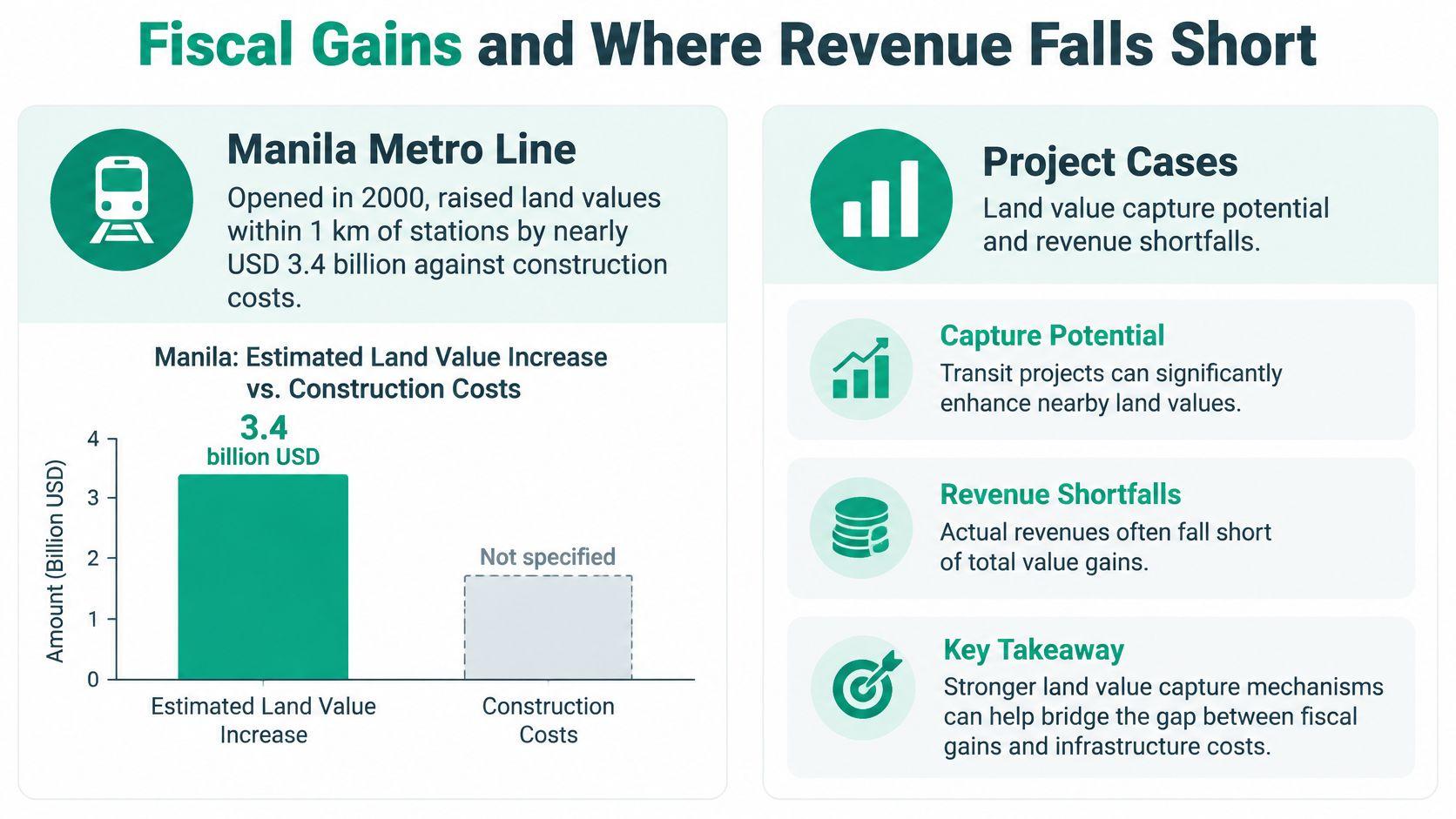
OECD-documented estimates summarized in the World Bank's evaluation of urban spatial growth put the land-value uplift around Manila's metro line at approximately 5.2 times construction cost, compared with approximately 1.2 times for New York City's Q-line extension, calculated from the reported amounts below.
Estimated land-value gains against construction costs
| Project | Estimated land-value gain | Construction cost | Gain relative to cost |
|---|---|---|---|
| Manila metro line, opened 2000 | Nearly USD 3.4 billion within 1 km of stations | About USD 655 million | About 5.2 times cost |
| New York City Q-line extension, 2017 | About USD 5.5 billion | About USD 4.5 billion | About 1.2 times cost |
These estimates make the opportunity visible, but they aren't revenue forecasts. Location, surrounding demand, development capacity, and project scale differ, so a finance team can't transfer either ratio to another railway.
Appreciation isn't cash available for construction
A city must move through several separate judgments before recording collectible proceeds:
- Estimated uplift: How much did land values change because of the intervention?
- Legally assessable value: Which gains fall within the instrument's statutory scope?
- Affordable liability: What payment schedule and protections are needed?
- Collectible revenue: What remains after exemptions, appeals, collection costs, and nonpayment?
The same World Bank evaluation reviewed 179 urban transport projects: only 27, or 15%, considered land markets in cost-benefit analysis, and just 5, or 3%, included them in results frameworks. This is an appraisal weakness, not evidence that the remaining projects produced no land effects.
For budgeting, timing matters as much as the eventual total. Contractors need payment while construction proceeds; assessed gains may emerge later, and owners may dispute them. Borrowing against optimistic future collections can leave general taxpayers carrying the shortfall.
Model the network, not just the station
A World Bank urban-economics model applied to Paris found that investments and development elsewhere could change estimated capture potential by as much as a factor of two. A station's accessibility advantage depends partly on what happens across the wider metropolitan system.
Officials should therefore model generalized travel costs, access to employment, zoning capacity, and plausible development intensity together. They should also test weaker demand and slower construction, rather than treating the expected development scenario as certain.
Budgeting rule: Commit expenditure against conservative collectible revenue, not the headline increase in land wealth.
A credible land-value tax revenue assessment distinguishes the tax base from actual receipts. The same discipline applies to project-specific capture: reassess periodically, retain other funding sources, and don't assume land gains alone can finance the project.
Who Gains and Who Pays Under Capture
The strongest case for land-value taxation is that governments can collect location rent without taxing a new building or an owner's productive effort. But capturing rent shouldn't discourage construction or push cash-poor households out. Those outcomes depend on assessment, rate calibration, credit conditions, and transition design.
The Bizkaia study modeled replacing existing real-estate taxes and partly displacing personal-income taxation through a site-value charge. It used a spatially correlated hedonic model, which estimates land value from property characteristics and location while accounting for relationships between nearby observations. Its result is a locally modeled fiscal possibility, not a universal rate recommendation.
Test behavior as well as revenue
A policy team should examine whether a proposed charge redirects investment toward productive use or creates liabilities that borrowers can't finance. Non-linear modeling raises the possibility that a charge within a workable range reduces inequality in land values, while an excessive charge can stall investment and contribute to contraction. The practical response is sensitivity testing, not assuming every increase produces proportionately better outcomes.
An overheated metropolitan market, a declining city, and a rural area present different conditions. Strong demand may support redevelopment where a weak-demand location cannot support construction even before a new charge.
Who pays also requires more care than identifying whose name appears on the assessment:
- Cash-poor homeowners may have valuable sites but insufficient current income to meet a new bill.
- Renters need protection against displacement and careful analysis of housing supply, rather than an assumption that owners can automatically pass through every charge.
- Credit-constrained developers face payment obligations alongside construction finance and other approval costs.
- Weak-demand regions need assessments grounded in achievable uses, not speculative redevelopment expectations.
A distributional analysis should compare households by income and tenure and examine how liabilities interact with existing taxes. Revenue neutrality across the whole jurisdiction doesn't mean each household is unaffected.
Before accepting a rate, officials should ask: Who pays at the margin? What happens to construction? What transition protects people with little cash? Deferrals, credits, and phased changes should answer identifiable problems, not conceal an assessment system that overstates land value.
Lessons From Singapore and Detroit
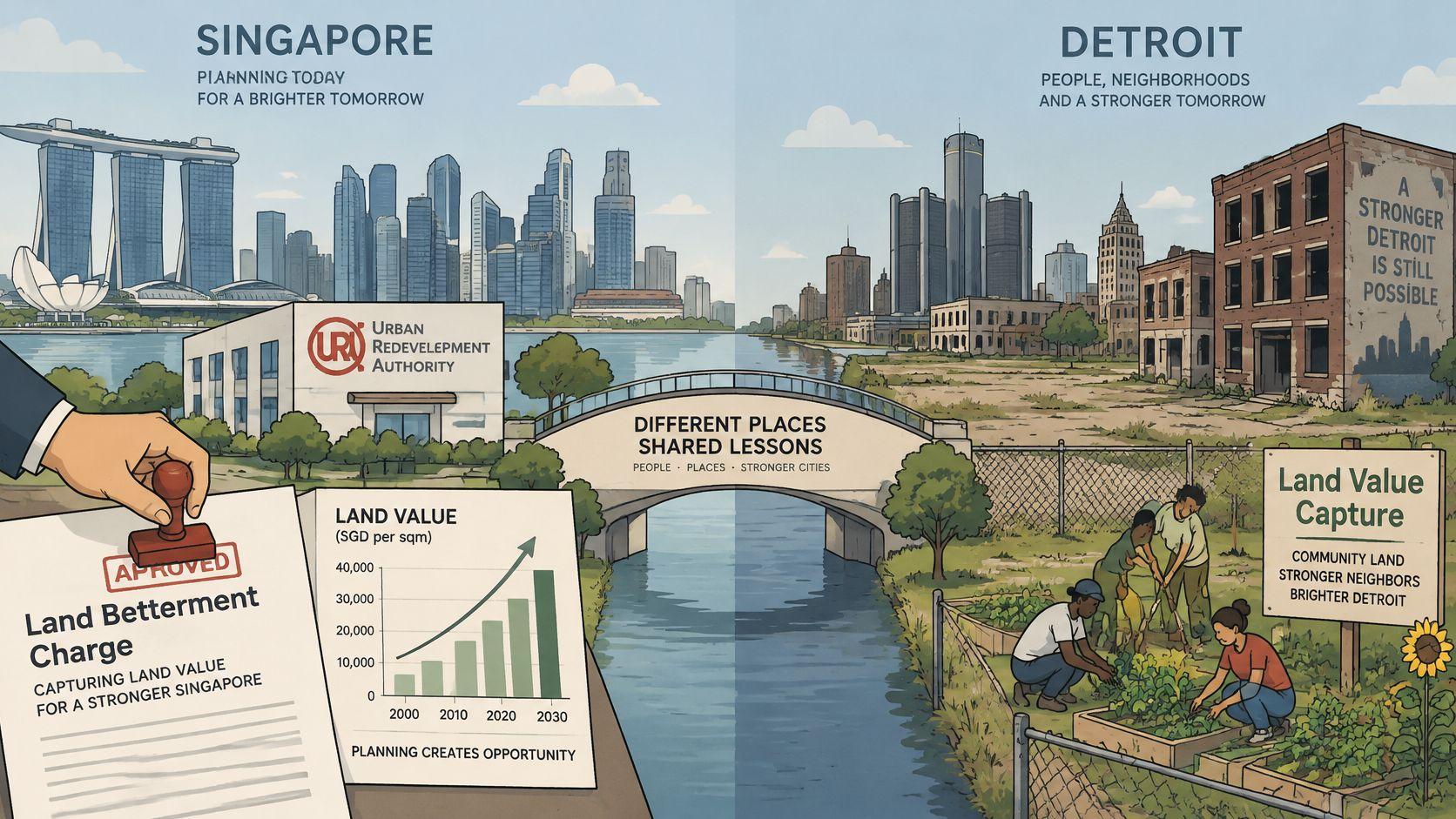
Singapore's Land Betterment Charge connects a public decision to a change in land value. The Singapore Land Authority's official FAQ describes it as a tax on increased value resulting from chargeable consent. This can include planning or conservation permission from the Urban Redevelopment Authority, acceptance of a lodged development plan, or variation of a restrictive covenant. The FAQ also explains an automatic leasehold-factor adjustment for state leases with 99 years or less remaining.
That link between permission and value identifies an event officials can assess. It does not, by itself, prove that public action created every part of the increase. A broader market rise may occur at the same time, so the charge's basis and the cause of appreciation should be considered separately.
Account for the entitlement being valued
A land right has a term, and that term affects the value of what its holder can do. A lease with substantial time remaining is not economically equivalent to one nearing expiration, even if both permit the same building. Adjusting for remaining tenure recognizes this difference. It also shows why the legal duration of a right matters when pricing land-value risk over time.
Detroit offers a different lesson. A citywide average gain can mask losses in particular neighborhoods. That makes a broad average an unsafe basis for assuming every affected owner benefited.
An intervention can produce an average gain while leaving particular neighborhoods worse off.
Combine an identifiable act with local testing
The cases answer different questions. Singapore shows how a charge can be tied to a defined planning or development event; Detroit illustrates why public action's effects need local examination. A value may be collectable under a policy without all of its increase being caused by that policy. Identify the public act, then test whether it created value and where the effects fall.
For a proposed redevelopment area, map estimated gains and losses by neighborhood before setting liability. If local evidence does not establish appreciation attributable to public action, a positive metropolitan average alone does not demonstrate a collectible windfall.
Confirm the Design Before You Adopt a Capture Policy
Administrative capacity belongs at the center of implementation, as the OECD's Global Compendium emphasizes. Neighborhood outcomes also vary, so simple valuation rules may miss who benefits or pays. Before adopting a charge, a ministry or city should complete these checks:
-
Build a credible counterfactual. Estimate land values without the intervention by comparing similar areas and pre-intervention trends. Separate public effects from general market appreciation.
-
Model the wider network. Account for changes in travel costs, access to employment, zoning capacity, and development intensity. A project's effects may extend beyond its boundary.
-
Publish conservative assumptions. Disclose valuation dates, market evidence, development scenarios, uncertainty, and expected collection losses. Potential revenue is not the same as revenue that can be collected.
-
Separate land from improvements. Estimate site value independently, so an owner's investment in a building is not mistaken for a publicly created land gain.
-
Prepare administration before billing. Integrate parcel records and the cadastre, identify liable parties, and establish accessible appeals procedures before assessments take effect.
-
Design the transition around people. Model effects by tenure and income. Consider phased implementation, deferrals, or credits where cash-poor owners could otherwise face unmanageable payments.
-
Test rates across tenures and markets. Examine high-demand, declining, and rural locations, including refinancing and lease-expiration risks. Schedule reassessment and monitor neighborhood outcomes over time.
Do not charge for an attributed gain that has not been demonstrated. Put that safeguard in assessment rules, not only in policy announcements.
A practical starting point is a pilot area. Prepare a counterfactual valuation, publish the assumptions, and assess household impacts before setting a rate. Unitism® supports governments, cities, and organizations by assessing land values, designing collection policies, and modeling who gains and who pays.
Its land-value assessment, policy design, distributional modeling, and implementation support can help turn a capture proposal into an administrable policy. A pilot should test attributable value and realistic revenue before adoption.