Learn what is a land trust and how these unique organizations protect land. Explore conservation, community, and charitable trusts, plus their 2026 policy role.
June 25, 2026
What Is a Land Trust? Your 2026 Guide to Conservation
Learn what is a land trust and how these unique organizations protect land. Explore conservation, community, and charitable trusts, plus their 2026 policy role.

A familiar local story keeps repeating. A neighborhood becomes safer, greener, and more popular. Then land prices rise, longtime residents struggle to stay, and the last open parcels attract buyers who see only redevelopment potential. At the same time, the community still wants a park, affordable homes, working farms nearby, and public revenue that doesn't punish wages or new construction.
That tension is where many readers first encounter the question, what is a land trust?
A land trust is often introduced as a legal device or a nonprofit structure. Both descriptions are true, but they miss the practical point. A land trust is really a way to separate control over land from speculation over land. That separation can protect a forest, keep housing affordable, preserve a civic asset, or, in more advanced policy design, help the public capture land value for shared use.
This isn't a fringe idea. The American land trust movement grew slowly in its early decades — fewer than 50 land trusts were in operation by the middle of the 20th century — before expanding rapidly alongside the modern environmental movement. 1 Today, US land trusts have conserved more than 61 million acres of land, according to the Land Trust Alliance's 2020 National Land Trust Census. 2 For readers interested in the broader economic logic behind treating land differently from labor and capital, this explanation of Unitism and Georgism gives useful background.
Table of Contents
- Introduction Beyond Private Ownership
- The Core Concept of a Land Trust
- The Four Main Types of Land Trusts
- How Land Trusts Function Legally and Financially
- The Policy Case for Public Land Value Capture
- Implementing Land Trusts A Practical Outlook
Introduction Beyond Private Ownership
When a town council debates a housing shortage, a threatened wetland, and a strained budget in the same meeting, those issues can seem unrelated. They aren't. In many places, the common thread is land. Who owns it, who benefits from rising site values, and who gets excluded when those values rise faster than local incomes.
A land trust offers a different institutional answer. Instead of treating land as just another asset to be traded to the highest bidder, a trust can hold it for a defined purpose. That purpose might be privacy for a family property, permanent conservation, affordable housing, or a public mission such as securing community benefit from rising location value.
Why land needs different treatment
Land isn't produced the way buildings, tools, or services are produced. A renovated shop, an added apartment floor, or a new factory wing comes from work and investment. The underlying site value usually rises for different reasons. New transit, better schools, nearby business activity, safer streets, and public infrastructure all increase the appeal of a location. Proximity to rail stations, for example, has been shown across many studies to raise nearby residential and commercial property values. 3
That's why communities often feel trapped. Residents and businesses help make a place valuable, but the gain from that value can flow mainly to whoever holds title at the right moment.
Practical rule: If the public creates a large share of location value, policymakers should at least ask whether public institutions should capture some of that value.
Why the trust model matters
The word “trust” can sound vague, but the institutional logic is simple. A trust lets one party hold legal title while another party benefits from the land according to a set of rules. Once readers see that split, many policy uses become easier to understand.
For a neighborhood group, that can mean land remains dedicated to affordable housing. For a conservation group, it can mean a meadow or watershed stays protected. For public finance reformers, it opens a more ambitious question: could a trust hold land so that its rental value supports the community that helped create it?
That question rarely appears in mainstream explanations of land trusts, yet it's one of the most important.
The Core Concept of a Land Trust
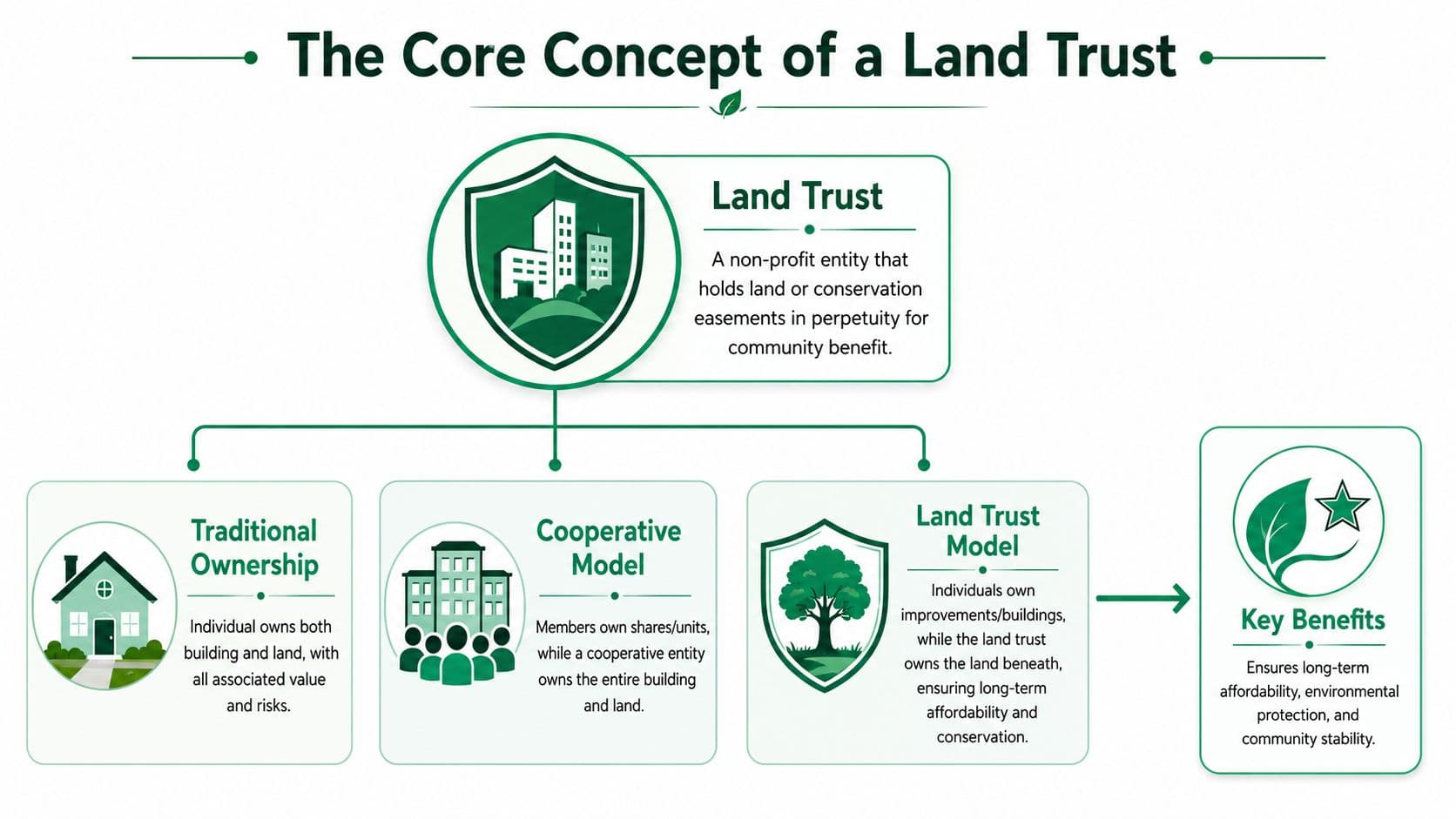
Most confusion starts with a habit many of us don't even notice. We tend to bundle three things together as if they were one: the land, the building, and the right to benefit from that location. A land trust works by unbundling them.
A simple analogy helps. Think about a flat in a cooperative building. You may have strong rights to occupy and use your unit, but the cooperative entity controls the larger property framework. A land trust uses a similar separation, though in different legal forms depending on the type of trust.
Why the split matters
In ordinary ownership, one owner usually holds everything together. They own the site, the building on it, and the upside if the area becomes more desirable. In a land trust arrangement, those rights can be divided.
That division is the whole point. It keeps the land itself from being treated purely as a speculative chip while still allowing people to use, improve, lease, inherit, or benefit from the property under agreed terms.
A useful related concept is usufruct in property rights, which describes a right to use and enjoy an asset without owning it outright. You don't need that term to understand land trusts, but it helps explain why legal systems can separate use from title.
The basic parties
The exact structure changes by trust type, but readers can keep a stable mental model by focusing on three roles:
- The trust or trust entity: This is the legal container that holds title or enforces a protected purpose.
- The trustee: This person or organization manages legal responsibilities and follows the governing terms.
- The beneficiary or user: This is the person, household, nonprofit, or community that enjoys the practical benefit of the land.
Here's the plain-English version. One party holds the steering wheel of legal title. Another party keeps the practical right to live there, farm there, conserve it, or receive the long-term benefit.
A land trust is less about “who touches the soil” and more about “who controls the rules for the site over time.”
That's why this structure can produce outcomes that normal ownership often struggles to protect. If a community land trust owns the land beneath homes, it can preserve affordability across multiple resales. If a conservation trust records permanent restrictions, future owners can't reverse course and develop the parcel. If a title-holding trust places legal title with a trustee, the public record shows the trustee rather than the beneficiary.
The mechanics differ, but the core pattern stays the same: split the rights, define the purpose, and lock in stewardship.
The Four Main Types of Land Trusts
When people ask what a land trust is, they're often using one label for several very different institutions. That's where misunderstanding starts. A private title-holding trust and a conservation land trust may share a name, but they serve almost opposite purposes.
One key distinction comes from WeConservePA's explanation of land trusts, which distinguishes a private title-holding land trust used for anonymity and financial strategy from a conservation land trust, a charitable nonprofit that records legal restrictions for permanent public benefit. That same confusion often spills into housing debates, especially when people are trying to understand why housing is unaffordable.
Comparing Four Major Land Trust Models
| Trust Type | Primary Goal | Key Mechanism | Typical Outcome |
|---|---|---|---|
| Title-Holding Land Trust | Privacy, estate planning, strategic property holding | Trustee holds legal title for a private beneficiary | More privacy in public records and a structured way to manage title |
| Conservation Land Trust | Protect habitat, farmland, water quality, or scenic land | Nonprofit ownership or recorded conservation easement | Long-term limits on development and active stewardship |
| Community Land Trust | Keep homes or community spaces affordable over time | Trust owns land, residents or users hold building rights through lease or similar agreement | Lasting affordability and reduced pressure from land speculation |
| Charitable or Public Purpose Trust | Hold land for a defined civic use | Land is dedicated to a mission such as a park, facility, or community asset | Stronger long-term protection for a public-serving purpose |
Where people often get confused
The first confusion is assuming every land trust is a nonprofit. That's not true. A title-holding land trust can be a private arrangement used by an individual investor or family.
The second confusion is assuming every trust is about secrecy. That's also not true. Conservation land trusts often do the opposite. They deliberately record restrictions so future owners are legally bound to protect the land.
The third confusion involves community land trusts. People sometimes hear “trust” and think residents lose control. In practice, the opposite can happen. The trust removes the land from speculative turnover, while households or community users retain stable rights to occupy and improve the property.
Consider the difference this way:
- Private title-holding trust: “Keep my name off the deed record and structure title efficiently.”
- Conservation trust: “Keep this land ecologically intact.”
- Community land trust: “Keep this land serving housing or community needs over time.”
- Public purpose trust: “Keep this land dedicated to a civic mission.”
The name tells you less than the mission. Always ask what the trust is trying to preserve, for whom, and by what legal mechanism.
For policymakers, that last question matters most. If the goal is affordable housing, don't borrow a model built for anonymity. If the goal is ecological protection, don't rely on a structure designed only for private title management. If the goal is public land-value capture, a different design again is needed, one that treats the public as the ultimate beneficiary.
How Land Trusts Function Legally and Financially
Legal language makes land trusts seem more mysterious than they are. At base, the structure answers two practical questions. Who holds title? And who gets the benefit of use, income, or long-term purpose?
According to the Barnes Walker legal glossary entry on land trusts, a land trust is a legal entity in which the trustee holds legal title and appears on public records, while the beneficiary retains equitable ownership rights, including management and control. The same structure can bypass probate and shield the beneficiary's identity. If you're comparing that idea with broader property systems, this overview of land use rights is a helpful companion.
The legal structure in plain language
The title-holding model is easiest to explain first. The trustee's name appears where the recorder of deeds expects to see an owner. But the beneficiary still keeps the practical interest. That beneficiary may control decisions, receive income, direct sale choices, or revoke the arrangement if the trust terms allow.
That legal split can matter for privacy and inheritance planning. Because the trust holds title, the property doesn't need to pass through probate in the ordinary way when the beneficiary dies.
Community and conservation arrangements often use different instruments, but the logic of separated rights remains. One document may transfer title. Another may impose a conservation easement. Another may create a long-term ground lease that lets a resident own the house while leasing the land beneath it.
How money and stewardship fit together
A trust also needs an operating model. Land doesn't protect itself, and affordable housing doesn't stay affordable by accident.
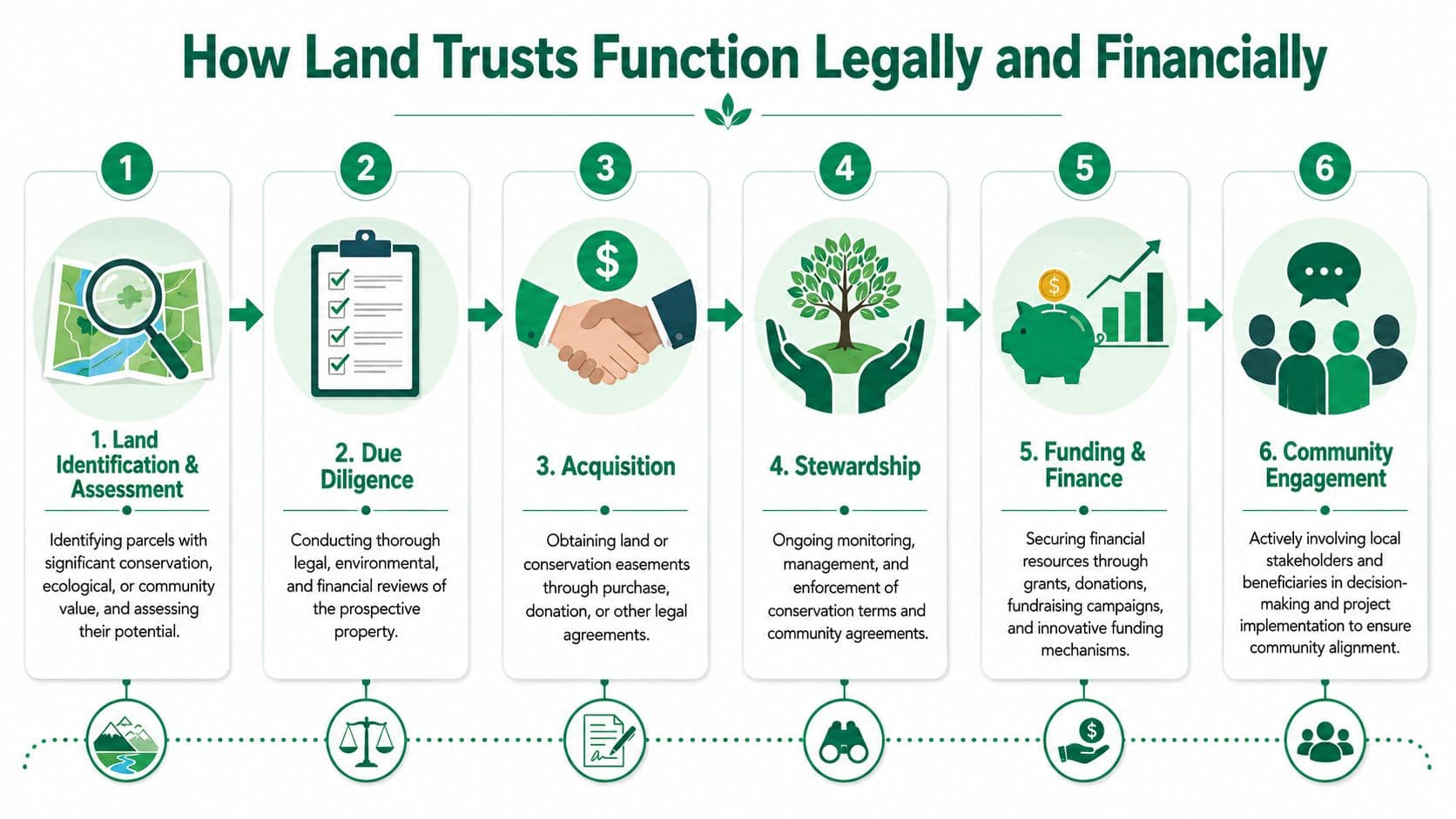
Trusts usually have to solve four ongoing tasks:
- Acquire land or legal rights through donation, purchase, public transfer, or negotiated agreement.
- Set the governing terms that define use, resale, stewardship, or development limits.
- Fund ongoing administration so someone monitors compliance, manages records, and supports occupants or conservation goals.
- Protect the purpose over time even when leadership changes, markets shift, or neighboring land prices rise.
The funding pattern depends on the model. A private title-holding trust is usually funded privately. A conservation trust may rely on donations, grants, stewardship funds, or membership support. A community land trust may combine public support, philanthropy, lease revenue, and resale rules that preserve mission.
Good trust design doesn't just acquire land. It assigns duties for the decades that follow.
That's the part many first-time readers miss. The trust isn't the outcome. It's the governance chassis that makes the outcome durable.
The Policy Case for Public Land Value Capture
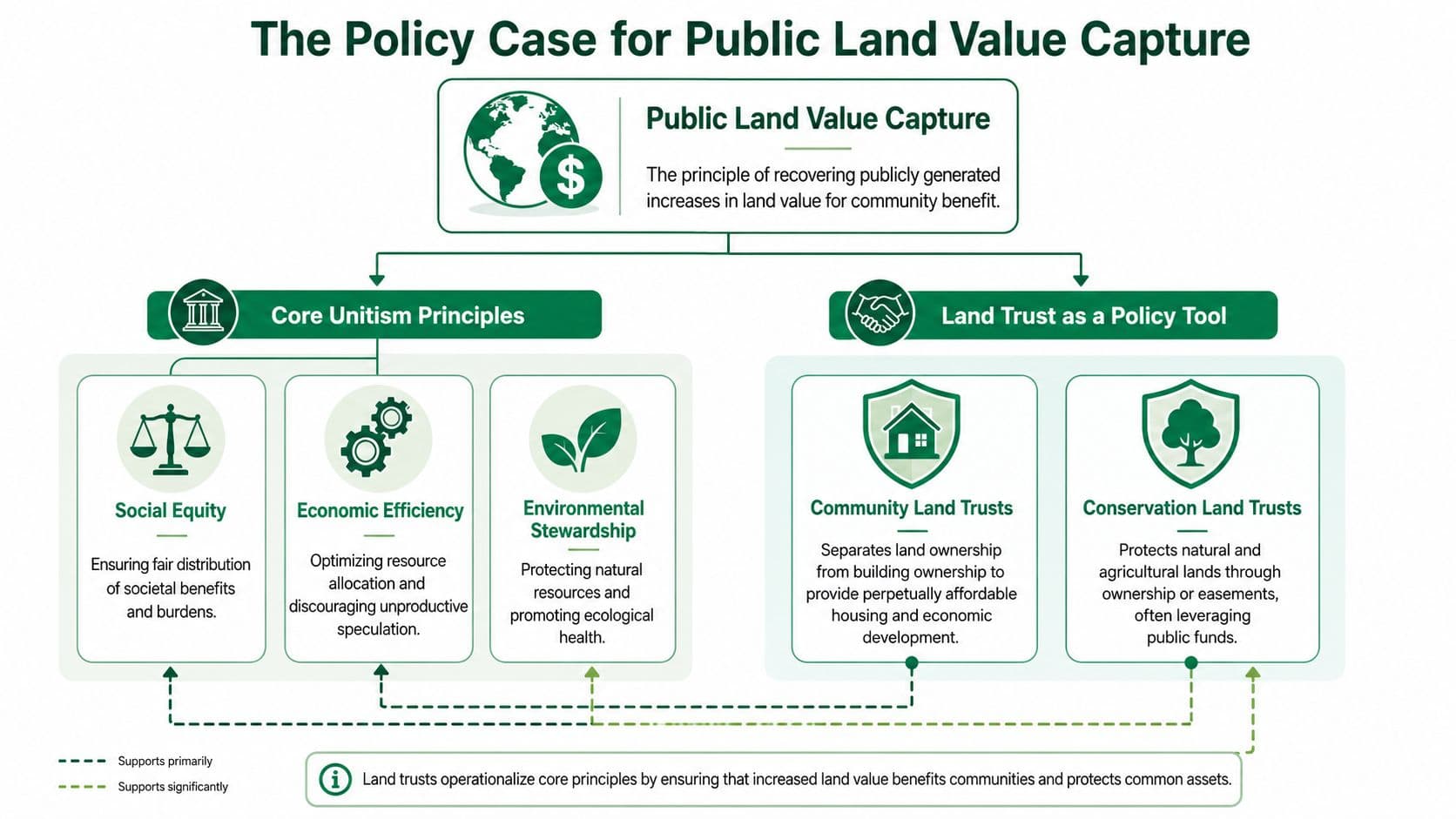
Most articles stop after two uses of land trusts. They discuss private title planning or conservation. Some also mention affordable housing. Very few ask a more structural question: can the trust model help governments capture land value for public use rather than letting it flow mainly into private windfalls?
That gap is real. SmartAsset's discussion of land trusts reflects how existing content overwhelmingly centers private benefits or conservation, while leaving a major blind spot around using the trust model as an institutional mechanism for public land-value capture. The underlying policy logic is well established: classic analysis shows that a tax on pure land rent falls on landowners rather than tenants and lowers land prices, making it an unusually efficient way to fund public goods. 4 Forms of recurring land-based taxation are already in place in countries such as Denmark and Estonia. 56 For readers who want the policy logic in plain terms, this guide to land value capture is the relevant background.
Why this idea is missing from most discussions
The usual framing treats trusts as niche legal tools. That framing is too narrow for public finance. Land values don't rise in isolation. Transit lines, schools, policing, zoning decisions, parks, and private business clusters all push site values upward. 3
Yet tax systems often lean hardest on work, transactions, or buildings. That means a city may tax construction, payroll, or sales while allowing a large share of location value to accrue privately. Theory and practice on land taxation suggest that shifting taxes toward land, rather than buildings, can encourage rather than discourage development. 7 A public land trust model invites a different arrangement.
Instead of asking only who owns the parcel today, policymakers can ask who should benefit from the location value created by the wider community.
What a public beneficiary model could look like
In a public version of the trust concept, the municipality or another public body becomes the effective beneficiary on behalf of residents. The trust holds or administers land rights under a statutory framework. Users still occupy sites, build homes, run businesses, or farm land, but the ground rent or land-based value stream is directed toward public purposes.
That can support several goals at once:
- More neutral taxation: Public revenue can rely less on taxes that discourage work or building. Higher land-value taxation has been found to stimulate, rather than suppress, construction activity. 8
- Less speculation pressure: Holding land idle becomes less attractive when the site's recurring value is publicly recognized.
- Stronger affordability tools: Public bodies gain a durable way to shape how valuable sites serve housing and community needs.
- Better fiscal alignment: The community captures more of the value it helps create. In an optimally sized city, aggregate land rents equal spending on public goods — a result known as the Henry George theorem. 9
This isn't a call to force every property into a single model. It's a reminder that the trust structure is flexible enough to hold land for a public mission, not only a private or charitable one.
If a trust can hold land for a family or a habitat, it can also be designed to hold land for the public interest in location value.
That's the underexplored insight. It turns the land trust from a specialist real-estate tool into a possible bridge between property law and sustainable public finance.
Implementing Land Trusts A Practical Outlook
The strongest reason to take land trusts seriously is that they already work across very different settings. The model has shown enough operational capacity that local land trusts in the United States have protected an average of roughly 500,000 additional acres each year, alongside a sharp rise in the number of land trusts. 10 That doesn't prove every trust design will succeed, but it does show the form can scale when institutions, mission, and stewardship align.
What public leaders should line up first
For policymakers, the first task isn't branding. It's legal clarity. The enabling framework must define who holds title, who benefits, what rights users retain, how disputes are handled, and what happens if the trust's mission drifts.
The second task is land assembly. A trust needs an entry point. That may come from public land already in inventory, donated parcels, negotiated acquisitions, or redevelopment sites where the public has influence.
The third task is durable administration. A trust without stewardship capacity is only a shell. Public leaders should think early about governance, valuation processes, lease administration, community representation, and enforcement.
A practical checklist helps:
- Draft the mission carefully: A trust for conservation, housing, and public finance won't use identical terms.
- Match the legal form to the policy goal: Private title tools and public-benefit models shouldn't be mixed casually.
- Build public legitimacy: Residents need to understand what rights they keep and what public benefit the structure protects.
- Plan for the long term: The trust should still function when elected officials, staff, and market conditions change.
Why the model deserves serious attention
Land trusts matter because they turn a broad idea, stewardship, into an enforceable arrangement. They can hold a forest outside the path of sprawl. They can keep homes tied to community purpose. And they can give governments a workable institutional frame for treating land value as a shared asset rather than a purely private windfall.
For readers who started with a simple question, the clearest answer is this: a land trust is a legal and governance structure that holds land, or control over land, for a defined purpose over time. Once you understand that, the door opens to much larger possibilities.
Frequently Asked Questions
What is the main difference between a community land trust and a conservation land trust?
A community land trust and a conservation land trust both separate control of land from speculation, but they preserve different things. A community land trust usually owns the land beneath homes or shared spaces and lets residents hold building rights through a long-term lease, which keeps housing affordable across multiple resales. A conservation land trust instead protects habitat, farmland, or scenic areas, often through nonprofit ownership or a recorded conservation easement that legally limits future development. The name they share matters less than the mission each one is designed to lock in over time.
Does putting land in a land trust mean the user gives up control of the property?
No, and this is one of the most common misunderstandings. A land trust splits legal title from practical use, but the people who occupy, farm, conserve, or improve the land typically keep stable rights to do so under the governing terms. In a community land trust, for example, households often retain the right to live in and improve their homes while the trust simply removes the land from speculative turnover. In a private title-holding trust, the beneficiary can usually still control decisions, receive income, and direct sales. The trust shapes the rules for the site over time rather than stripping users of their everyday control.
Can a land trust be used to capture land value for the public rather than private benefit?
Yes, and that is one of the most underexplored uses of the model. Because a trust can hold land for a family, a habitat, or a charitable mission, the same structure can be designed so that a public body becomes the effective beneficiary on behalf of residents. Users still occupy sites and build on them, but the ground rent or land-based value stream is directed toward public purposes such as more neutral taxation, reduced speculation, and stronger affordability tools. This approach treats the location value created by the wider community as a shared asset, and recurring land-based taxation has already been implemented in countries like Denmark and Estonia. 56
If your work involves tax reform, housing affordability, land policy, or public revenue design, Unitism® offers research, policy design, valuation support, and practical implementation guidance on land-value capture and tri-factor economics. It's a useful next step for governments and organizations that want to move from abstract debate to workable institutional design.