What is inclusionary zoning? See how set-asides, fees, and density bonuses create affordable homes, who pays, and when land-value tools do more.
October 31, 2026
What Is Inclusionary Zoning and How It Works
What is inclusionary zoning? See how set-asides, fees, and density bonuses create affordable homes, who pays, and when land-value tools do more.

Inclusionary zoning links approval of market-rate development to affordable homes, an in-lieu fee, or an incentive, and it isn't a single national rule.
The central question isn't just whether a developer delivers discounted apartments. It's whether the city gains housing overall, who can afford the new homes, and what households must accept to keep them affordable. A visible affordable apartment is a real benefit, but it doesn't tell you how many other homes would have been built under a different rule.
Table of Contents
- What Inclusionary Zoning Requires of New Housing
- Mandatory Set-Asides Versus Fees and Bonuses
- How the Cross-Subsidy Is Supposed to Work
- Units Gained Versus Market Homes Lost
- Pros and Cons Weighed Against the Evidence
- Rules That Follow a Household for Years
- Choose Land Value Tools When Zoning Falls Short
What Inclusionary Zoning Requires of New Housing
A Lincoln Institute of Land Policy national census identified 1,019 inclusionary-housing programs in 734 jurisdictions across 31 states and the District of Columbia in 2018–2019, with approximately 67% using traditional affordable-unit policies and 33% using linkage or impact fees. That scale matters because people often discuss inclusionary zoning as though every city uses the same ordinance.
Inclusionary zoning, also called inclusionary housing, is a local land-use policy connecting approval or construction of market-rate development with homes affordable to lower- or moderate-income households. The same census traces its U.S. origins to declining federal support for affordable construction during the 1970s, identifying Fairfax County, Virginia's 1971 program as the first.
The objectives come before the percentages: help lower- and moderate-income households live in market-rate neighborhoods, support mixed-income buildings, and direct part of the value created by zoning permission toward public housing goals. Cities can pursue those objectives without relying entirely on annual public appropriations.
A zoning bargain, not a national housing entitlement
Say a developer wants permission to replace an underused commercial property with apartments. The city allows residential development, perhaps with more floor area than the previous rules permitted, while requiring an affordable-housing contribution.
Think of that permission as a zoning dial. Turning it toward more valuable development can create room for a public contribution, but turning the affordability obligation too far can make the proposal harder to finance.
The details belong in the ordinance, not in assumptions about the label:
- Eligibility: Which households qualify, and how is their income checked?
- Project coverage: Which developments trigger the requirement?
- Tenure and duration: Are the homes rentals or ownership units, and how long must restrictions last?
- Compliance: Must developers build the homes, or can they contribute money instead?
A broader understanding of land-use policy helps distinguish permission to build from the conditions attached to that permission.
Affordability continues after construction
A restricted rent or sale price doesn't settle every operating question. Managers still need clear arrangements for billing, maintenance, and household expenses.
For property teams working through that practical side, Axis Meter Solutions' resource on affordable housing utility management is relevant to utility administration, rather than to deciding the zoning requirement itself. The distinction matters: producing a home and managing it affordably are related but separate responsibilities.
Mandatory Set-Asides Versus Fees and Bonuses
Inclusionary zoning models compared
| Model | Developer gives | City gives | Where homes land | Main risk |
|---|---|---|---|---|
| Mandatory set-aside | A required share of units, commonly 10% to 20% in the MIT-hosted review of U.S. ordinances, often without direct subsidy | Permission to build under the ordinance, sometimes extra density | On site in a mixed-income project | A high share can make marginal projects infeasible |
| Voluntary or incentive | Affordable units if the developer opts in | Extra floor area, less parking, or faster approval | On site when the incentive supports participation | A weak bonus produces few units |
| In-lieu fee | Cash instead of on-site units | Approval with the on-site duty waived | Off site, wherever the fee is spent | The fee can lag land and construction costs |
| Linkage or impact fee | A charge on new development | A route to satisfy the financial obligation without an on-site set-aside | Affordable housing funded elsewhere | Separates affordable homes from the market project |
These models differ first in what triggers the obligation. A mandatory program applies when a proposal meets the ordinance's coverage rules. An incentive program applies when a developer chooses the offered benefit. An in-lieu fee replaces an otherwise applicable unit requirement, while a linkage or impact fee creates a financial contribution directly.
Each model can include a project-size threshold. Don't assume that an apartment addition, a large subdivision, and a replacement building receive identical treatment.
Read the affordability terms alongside the trigger
For an on-site requirement, identify the household income limit, permitted rent or sale price, and restriction period. For fee-funded housing, identify who sets those terms for the eventual recipient project. A cash payment doesn't establish affordability by itself; someone still has to acquire, build, or preserve housing with the proceeds.
Mandatory requirements provide certainty about the obligation, not certainty about construction. If lenders won't finance the resulting project, the city won't receive the planned units. Voluntary programs face a different test: developers can decline benefits that don't compensate for the affordability commitment.
Fees require their own discipline. An outdated payment formula can leave the housing fund unable to purchase the land or construction work the city expected. Readers comparing these charges can use the distinction between inclusionary alternatives and broader development impact fees.
Practical rule: Judge the contribution and the compliance route together. A demanding requirement with no workable alternative can deliver less than a modest rule that projects can actually meet.
Permission must be usable
A density incentive isn't valuable if another rule prevents the developer from using it. Height limits, setbacks, lot coverage, and parking requirements can constrain the same site.
For a concrete example of how physical zoning limits affect smaller projects, Aureli Construction's explanation of Massachusetts lot coverage rules for ADUs helps readers separate a nominal development allowance from a buildable design. That resource addresses accessory dwellings, not inclusionary obligations, but the planning lesson carries over: check all applicable controls.
Before deciding whether your city's policy works, match its ordinance to a table row. Then identify its trigger, affordability terms, incentive, and alternative compliance route.
How the Cross-Subsidy Is Supposed to Work
The cross-subsidy is an exchange of development value for a housing discount, not a citywide rent voucher. A developer accepts lower revenue from restricted homes because the project's overall permissions, costs, and revenues are intended to make that commitment feasible.
The sequence is straightforward, even when the financial modeling isn't.
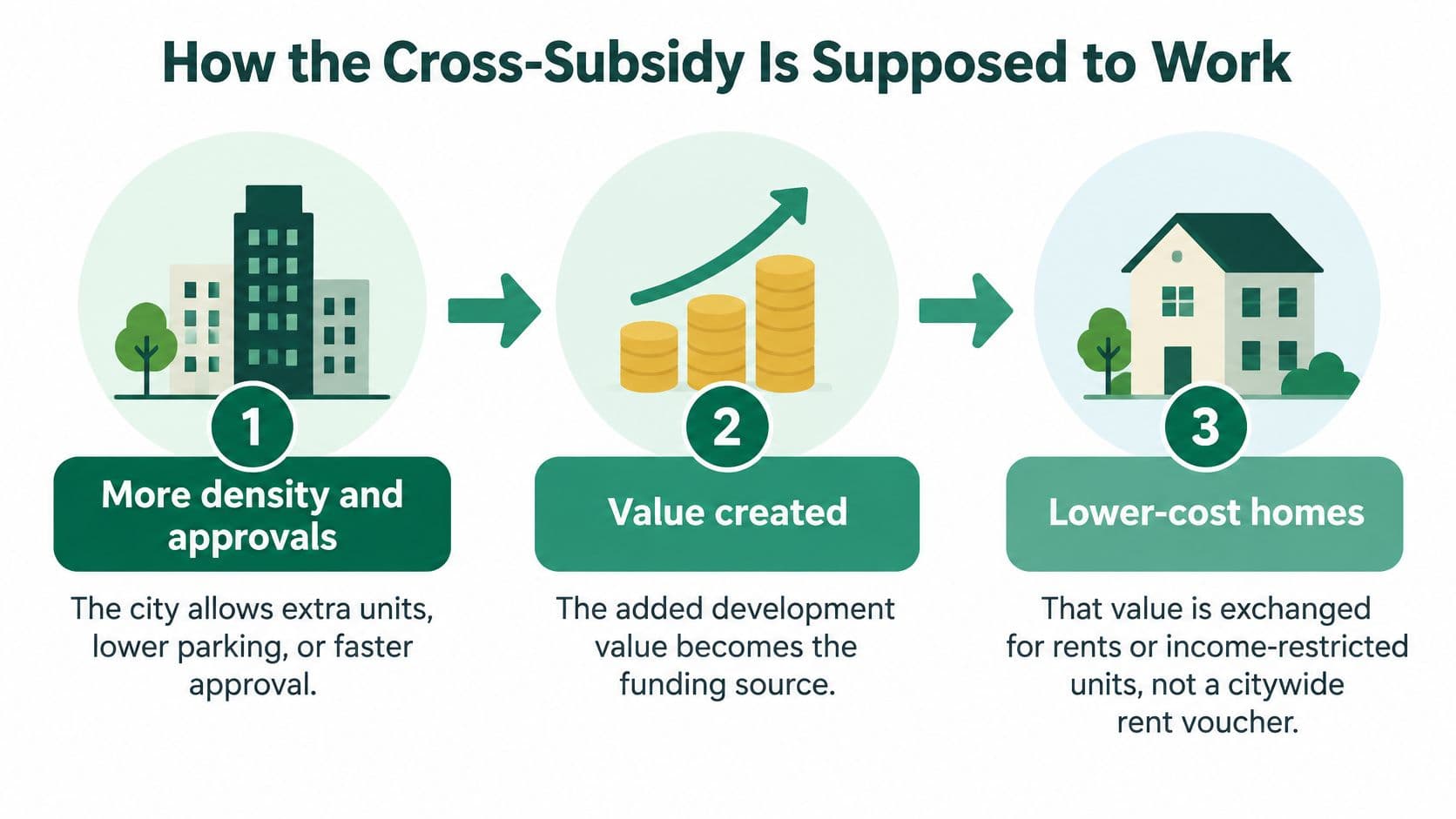
Start with the actual development entitlement
Washington, DC's FY2024 Inclusionary Zoning Annual Report describes coverage for new developments with 10 or more dwelling units, or added gross floor area resulting in at least that many units; qualifying projects generally devote approximately 8% to 10% of gross residential floor area to affordable housing and can receive a density bonus of up to 20% above base gross floor area.
Notice the measurement: residential floor area, not just the number of apartments. Unit sizes and building layouts therefore matter when translating an obligation into a design.
The intended offset is that additional permitted floor area generates enough value to absorb some of the restricted homes' revenue discount. But extra space also costs money to build. The relevant benefit is its contribution after added expenses, not its total sales or rental revenue.
Test the financial gap before adopting the rule
The Harvard Kennedy School analysis of Greater Boston emphasizes context-dependent feasibility and the potential value of density bonuses and parking reductions, while concluding that inclusionary zoning alone is unlikely to serve extremely low-income households.
A credible feasibility workbook should include:
- Construction and financing: Building costs, borrowing terms, and the cost of holding the site through approval.
- Achievable revenue: Market rents or prices, vacancy assumptions, and restricted-unit revenue.
- Restriction duration: The period over which the owner accepts reduced income or controlled resale proceeds.
- Land and incentives: Prevailing site prices and the usable financial value of extra density or regulatory relief.
Test those assumptions against less favorable conditions, not just a successful-project scenario. If a small change in borrowing costs makes a proposal unfinanceable, increasing its affordability obligation won't produce a proportional increase in affordable homes.
The cost first enters the calculation of residual land value, the amount a developer can pay for the site after allowing for construction, financing, other expenses, and a required return. A predictable obligation can reduce that land bid; a seller's refusal to accept it can prevent the transaction.
Units Gained Versus Market Homes Lost
At its most favorable tested requirement, the 2024 Terner Center model of Los Angeles's Transit Oriented Communities program identified a 16% extremely-low-income requirement as producing the most such housing relative to lost market-rate production, yet estimated roughly 4.3 market-rate homes foregone per extremely-low-income home gained. Raising the requirement from 11% to 25% was projected to add approximately 17,700 extremely-low-income homes over ten years, while reducing market-rate production by approximately 108,700 units.
That's a modeled comparison between policy designs, not a count of completed buildings. It concerns a particular transit-oriented program with density incentives and reduced parking requirements, not every inclusionary ordinance.
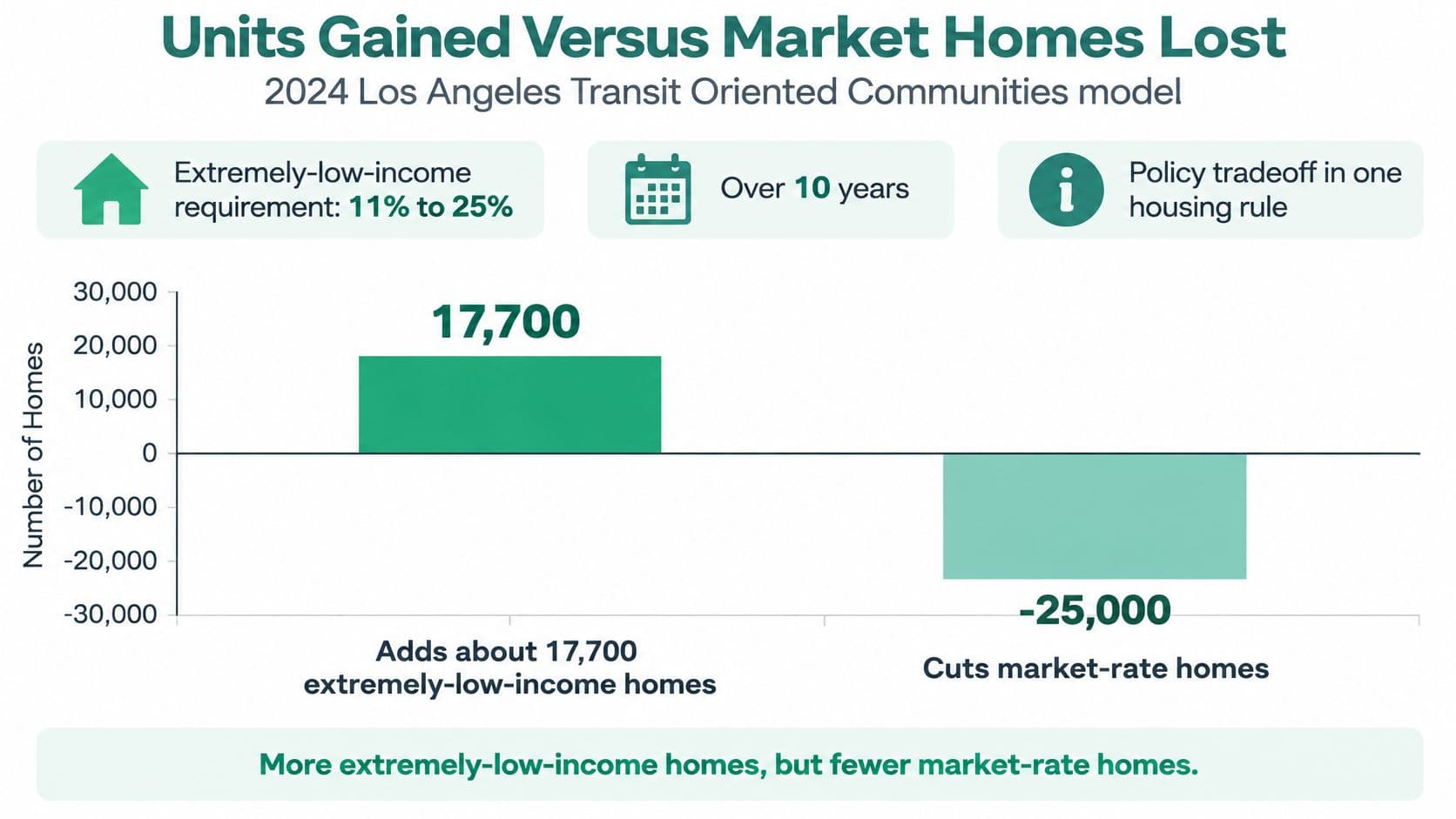
Use the study's market-rate loss stated in the text and table, not the smaller loss described in the illustration's alternative text.
Evidence doesn't support a universal supply verdict
The study of Los Angeles County and Orange County published in the Journal of Urban Affairs found no statistically significant evidence that mandatory inclusionary zoning reduced housing supply in the jurisdictions examined; it also describes a tier pairing a 20% affordable set-aside with a 25% density bonus and a historical calculation applying 15% to approximately 190,000 Los Angeles homes built between 1980 and 2001, yielding about 28,500 affordable homes.
Those findings answer different questions from the transit-program model. An empirical comparison of jurisdictions examines observed outcomes under actual programs. A simulation estimates how production might change when a particular rule changes, using assumptions about development behavior and economics.
Supply and unit findings from sourced studies
| Place or study | What was tested | Supply result | Price or unit tradeoff |
|---|---|---|---|
| Los Angeles Transit Oriented Communities model | A deeper extremely-low-income requirement | A substantial projected reduction in market-rate production | More deeply affordable homes, but fewer homes overall relative to the modeled alternative |
| Los Angeles and Orange Counties | Mandatory inclusionary zoning | No statistically significant supply reduction | Price effect not reported in the study summary |
Neither result should be dismissed because it complicates a preferred policy position. The useful task is to identify which program design, development market, and affordability target most closely resemble the city making a decision.
Gross affordable units aren't net additional homes
The historical Los Angeles calculation is valid arithmetic: multiply the total homes by the assumed set-aside and you obtain a gross affordable-unit estimate. It doesn't establish that the same total would have been built with that requirement in place.
That distinction separates an accounting exercise from a policy counterfactual. The counterfactual asks what developers would have built under a different rule, including which sites would have remained undeveloped.
For a hypothetical application of the studied bonus tier, start with a 100-unit base, increase permitted capacity by 25% to 125 units, then reserve 20% of the expanded total, producing 25 affordable units, not twenty. This is illustrative arithmetic using the program terms described in the county study, not a forecast of a specific building.
Count the affordable homes delivered, but also count the homes the city would otherwise have received.
Follow the cost, not just the ribbon-cutting
Land sellers may absorb an obligation through lower offers for their sites. Developers may accept a smaller return, but lenders and investors still impose financing constraints. Where projects don't proceed, households outside the restricted homes can face a tighter housing stock than under the alternative.
That doesn't mean developers can add any affordability cost to unrestricted rents. They can charge only what prospective tenants or buyers will pay. The broader concern is that reduced construction leaves households competing for fewer homes.
Cities can also bear costs through public subsidies or other support used to close the gap. Those contributions may be justified, especially for deeper affordability, but they belong in the evaluation.
Before copying a percentage from another city, write down the base capacity, usable bonus, denominator, and target income band. Then compare both restricted-unit production and total housing production against a realistic alternative.
Pros and Cons Weighed Against the Evidence
Inclusionary zoning is strongest as a calibrated instrument, not a substitute for an entire housing strategy. Its advantages depend on the market supporting development and on the city choosing obligations that fit the available value.
For a household that qualifies, a restricted home can provide access to a neighborhood otherwise beyond reach. For the city, integrating those homes into a private project can avoid having to assemble a separate site and development team. That makes the approach attractive where public budgets or publicly controlled land are limited.
Match each benefit to its condition
| Potential benefit | Condition that supports it | Corresponding risk |
|---|---|---|
| Mixed-income development | The project proceeds and restricted homes remain accessible to eligible households | An unaffordable compliance burden prevents construction |
| Less reliance on direct subsidy | Development value can support the required discount | The city mistakes a private obligation for a cost-free policy |
| Durable affordability | Restrictions are enforceable and administration is funded | Eligibility, resale, or monitoring failures weaken the benefit |
| Access to higher-cost neighborhoods | Affordable units are delivered on site | Fee-funded homes are built elsewhere |
The goal of mixed-income communities also requires attention to building operations and household access. Sharing an address doesn't, by itself, establish equal treatment or lasting inclusion.
A stronger requirement isn't automatically a better policy
In a strong development market with valuable permissions, an affordable-housing contribution may fit within a financeable project. Where projects barely cover their costs, the same obligation can discourage starts. Deeper affordability also requires more support than a modest discount for households closer to market eligibility.
Decision test: Prefer a rule that delivers useful, lasting homes over a higher headline requirement that developers cannot finance.
Measure administrative capacity alongside financial feasibility. Someone must maintain records, process household applications, enforce restrictions, and respond when circumstances change.
Before weighing the pros and cons locally, identify the matching model in the comparison table: mandatory units, voluntary incentives, replacement payments, or development fees. Each creates a different promise and a different delivery risk.
Rules That Follow a Household for Years
Washington, DC's official Inclusionary Zoning FAQ states that households may not sublet any part of an inclusionary home, while owners seeking to sell or refinance must obtain an official resale-price determination. These aren't minor closing documents. They affect how a household uses its home and responds to changes in work, finances, or family life.
The purpose is understandable: a controlled resale process helps prevent the initial discount from becoming an unrestricted windfall at the next transaction. A later eligible buyer should still have access to the affordability the city helped create.

A protected price can limit household flexibility
Consider an owner offered a job elsewhere. If the home can't be sublet, keeping it while trying the new job may not be an option. Selling requires following the controlled process rather than accepting the highest offer.
Refinancing raises another practical issue. The lender needs to understand the restrictions and the administratively determined value. Households should establish the required approval sequence before arranging a transaction, rather than discovering it shortly before closing.
Affordability and flexibility are both legitimate goals. A good program explains their tradeoff before someone commits to the home.
Evaluate the household experience, not just compliance
A housing agency should maintain a clear operating record:
- Access: How applicants enter the waiting list and receive offers.
- Turnover: How quickly a vacated home reaches another eligible household.
- Income changes: What happens when household earnings rise or fall.
- Ownership transactions: How resale pricing, refinancing approvals, and permitted appreciation work.
- Mobility: Whether restrictions create avoidable barriers to moving.
Income eligibility at move-in doesn't answer every later question. Nor should a household assume that earning more necessarily triggers eviction or forced sale; the applicable program documents determine the consequences.
The policy discussion also belongs alongside tenant protection, particularly clear notices, understandable obligations, and fair treatment when officials enforce rules. Preserving an affordable asset shouldn't depend on residents being able to decode technical documents without help.
Cities considering recalibration should examine both project feasibility and their ability to administer the homes already created. A reduced development obligation doesn't remove existing resale or occupancy responsibilities.
How do the staff costs and durability of restricted private homes compare with collecting land-value gains for housing without placing the entire obligation on an individual building?
Choose Land Value Tools When Zoning Falls Short
Keep a modest inclusionary rule when development is viable, the incentive supports the discount, and the city can administer the resulting homes. Don't expect a high set-aside alone to serve the poorest households or rescue a project that already lacks financing; provide public support or change the funding approach.
Land-value taxation is a public charge on the site's value, not on buildings or improvements. It can fund community services while reducing reliance on taxes on work and construction, and makes speculative landholding less attractive. A community land trust is different: residents own their homes while the community owns the land beneath them.
Fixed leases and indefinite rights aren't interchangeable
Under the fixed-price arrangements considered here, land leases are renewable or non-renewable fixed-term contracts. Renewable leases provide certainty only until the term ends, when the accumulated gap between the contracted rate and current market value can close in a major repricing. Non-renewable leases become harder to refinance and sell as expiration approaches.
Fixed leases therefore postpone risk rather than price it continuously.
- Fixed land lease: A price fixed for a defined term, with renewal or expiration risk.
- Annually repriced land-use right: No expiration, no renewal requirement, and a charge updated each year.
- Land-value tax: A public charge on site value rather than a contractual lease payment.
In this framework, land-use rights resemble leases but are indefinite and repriced annually. Buyers and sellers can transfer them at low acquisition cost rather than paying for a long, fixed rental advantage; annual repricing charges for land while leaving productive investment separate.
Annual repricing doesn't eliminate uncertainty. It replaces a large end-of-term adjustment with ongoing valuation changes. A fixed lease labeled a land-use right remains a fixed lease unless it meets all the stated criteria.
For the broader funding comparison, use the land-value capture guide. Our In-Depth Guides explain land-use rights and housing unaffordability in plain language; cities evaluating reform also need valuation and distributional modeling to establish who pays and who benefits.
Unitism® helps governments, cities, and organizations assess land values, design collection policies, and model who gains and who pays. Visit Unitism® to explore the educational guides and implementation support for comparing inclusionary zoning with housing funding based on land value.