Discover why are property taxes so high in Texas. Learn about the no-income-tax tradeoff, appraisal issues, school funding, and practical reform options.
September 24, 2026
Why Are Property Taxes So High in Texas? the Real Reasons
Discover why are property taxes so high in Texas. Learn about the no-income-tax tradeoff, appraisal issues, school funding, and practical reform options.
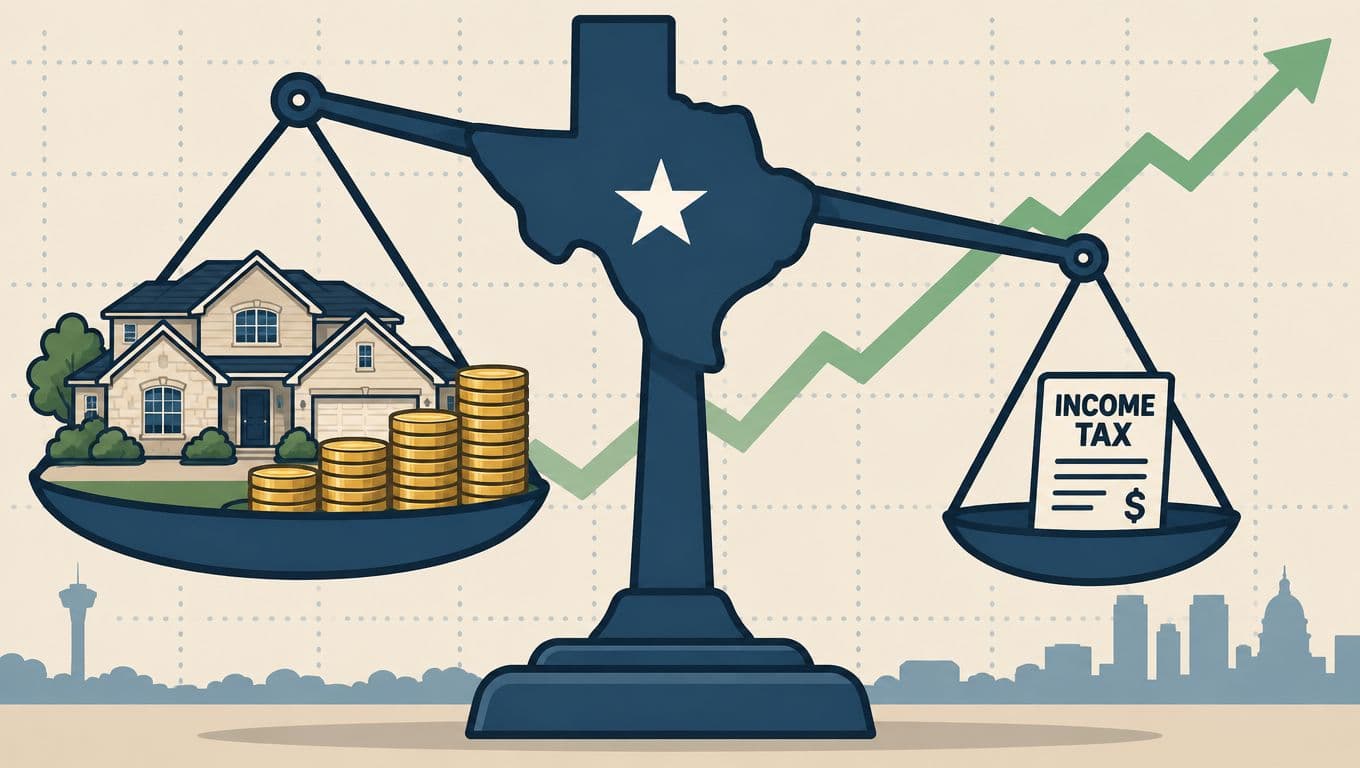
Texas property taxes are high because the state has no personal income tax, leaving local property taxes to fund more public services. The average Texas property tax rate is 1.86%, compared with a 1.19% national median, according to the Dallas Federal Reserve analysis.
That answer sounds straightforward, but it hides the mechanism. Texas hasn't merely chosen a high rate. It has built a revenue system in which property taxes perform work that other states distribute across income taxes and other broad-based revenues. At the same time, rising property values, new construction, school-finance rules, appraisal practices, and local debt can increase a bill even when a published tax rate falls.
The practical question, then, isn't only “Why is my rate high?” It's “Why does Texas place so much responsibility on property, and how does the system turn land and building values into a recurring public charge?” That distinction matters when evaluating exemptions, appraisal protests, homestead caps, and proposals to tax land value differently.
Table of Contents
- Understanding Why Texas Property Tax Bills Stand Out
- How the No Income Tax Design Shapes Your Property Bill
- Appraisal Cycles And Value Growth That Push Bills Up
- Land Leases, Land Use Rights, And True Annual Repricing
- Land Value Reform Options And What They Change
- Transition Paths, Equity Impacts, And Who Bears Costs
- Why Simple Relief Measures Often Fall Short
- Practical Takeaways For Homeowners And Policy Observers
Understanding Why Texas Property Tax Bills Stand Out
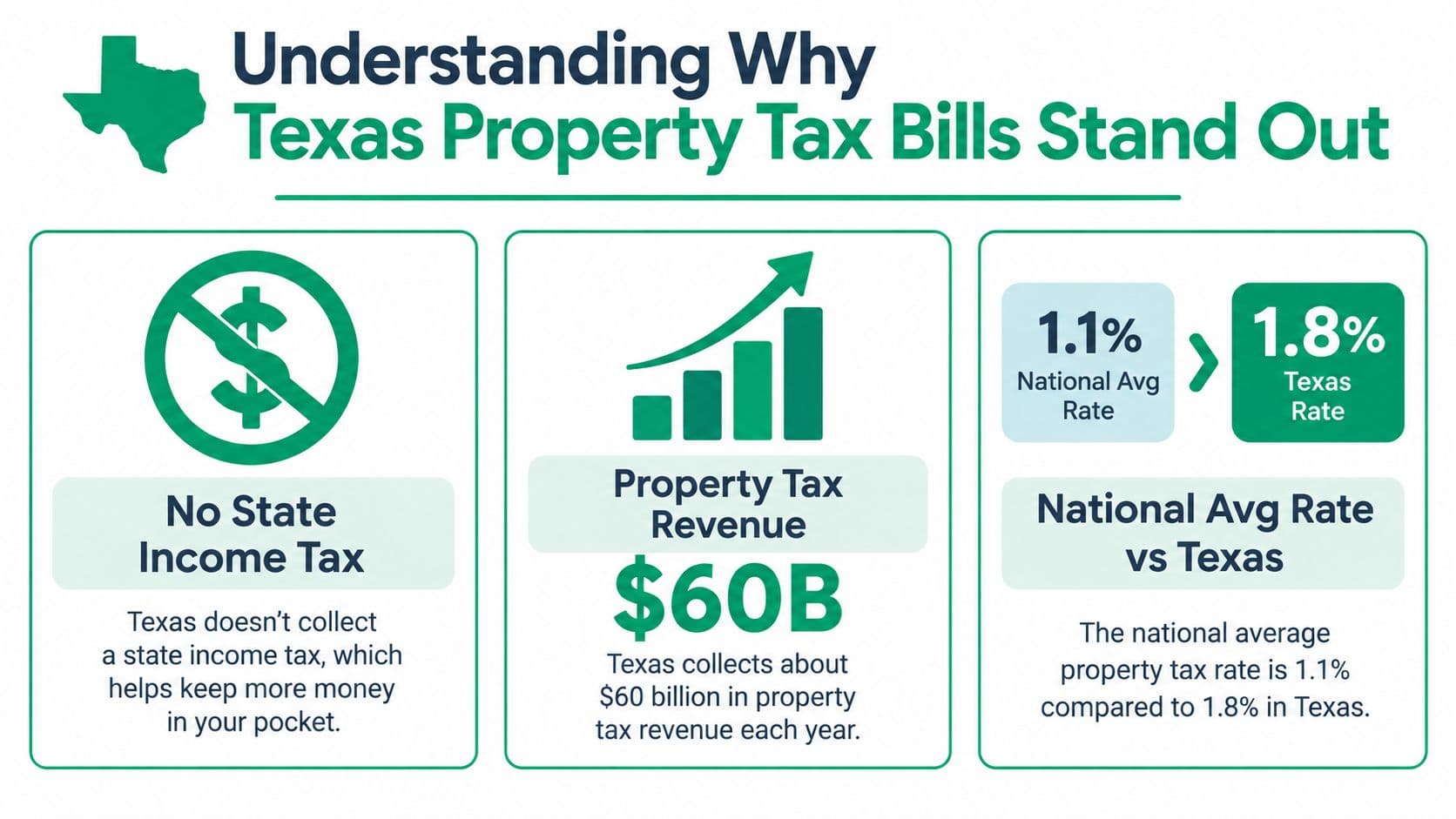
A homeowner comparing tax bills across states might start with the rate. That comparison is useful, but incomplete. Texas's 1.86% average property tax rate, cited by the Dallas Fed, stands against a 1.19% national median. The difference signals a heavier property-tax burden, yet it doesn't explain why the burden exists.
The deeper explanation is fiscal substitution. Texas doesn't levy a state personal income tax, so local governments and school districts depend more heavily on property-based revenue. The property tax is not just an aggressive local choice. It is one of the main channels through which residents finance schools, public safety, infrastructure, and other services.
The rate is only the visible part
Consider two households with similar homes but different income profiles. A state income-tax system can collect more from a high earner without tying the entire obligation to the home's appraised value. Texas places less of that responsibility on income and more on taxable property, so homeowners can face a substantial bill even when their cash income hasn't increased at the same pace as local property values.
That design also explains why a lower local rate doesn't automatically produce lower public costs. If a government still has to fund the same services, it may need a broader tax base, different revenue source, spending reductions, or a combination of these. The history of property taxation helps place this arrangement in a longer fiscal context.
For relocating households, local comparisons remain valuable, but they should be read as part of a complete budget rather than as a standalone ranking. A resource that helps families find low tax cities for families can narrow the search, but the underlying tax mix still deserves attention.
How the No Income Tax Design Shapes Your Property Bill
Texas property taxes carry a larger fiscal role because the state does not levy a personal income tax. Under the state constitution, property is taxed in proportion to value, while local appraisal districts determine taxable value each year. The Texas Comptroller explains this framework, in which valuation becomes a central part of funding public services.
That design makes a homeowner's bill sensitive to the value of land and improvements, even when household income changes slowly. Property taxation is not a recent response to one housing cycle. Texas first enacted a property tax in 1837, and historical figures show how thoroughly the system became embedded in public finance. In 2001, local property taxes represented 43% of the total state and local tax burden, while school taxes accounted for 59% of the property-tax levy.
Why schools matter so much
School districts need revenue that reflects the taxable capacity of their communities. Property offers an assessable base, but that base differs sharply across districts. A community with valuable commercial sites or rapidly appreciating homes can raise funds differently from one with a narrower tax base, even when both must pay for teachers, facilities, transportation, and other services.
Texas combines local property taxation with state funding formulas and valuation oversight. Certified property values can affect local rates and recapture adjustments when they do not align with the funding amounts used in the school-finance system. A homeowner's bill therefore reflects more than a city council's selected rate. It also reflects the distribution of taxable value and the rules governing education finance.
The wider range of municipal revenue sources clarifies the tradeoff. Sales taxes, fees, and other charges can contribute to government budgets, but they do not eliminate the need to tax land and improvements. Without state income-tax revenue, property levies carry a greater share of the funding responsibility.
Fiscal interpretation: Texas property taxes are burdensome partly because the state has assigned them a large job. A tax that supports more public services can remain costly even when officials restrain its rate.
The policy issue is therefore structural substitution. Replacing or reducing property taxes would require another revenue source, lower spending, or a combination of both. Land-value reform would change which property component bears the burden, while land leases or land-use rights would address different legal and economic relationships. The key question is not only how high the rate appears, but which base finances the obligation and who bears the resulting cost.
Appraisal Cycles And Value Growth That Push Bills Up
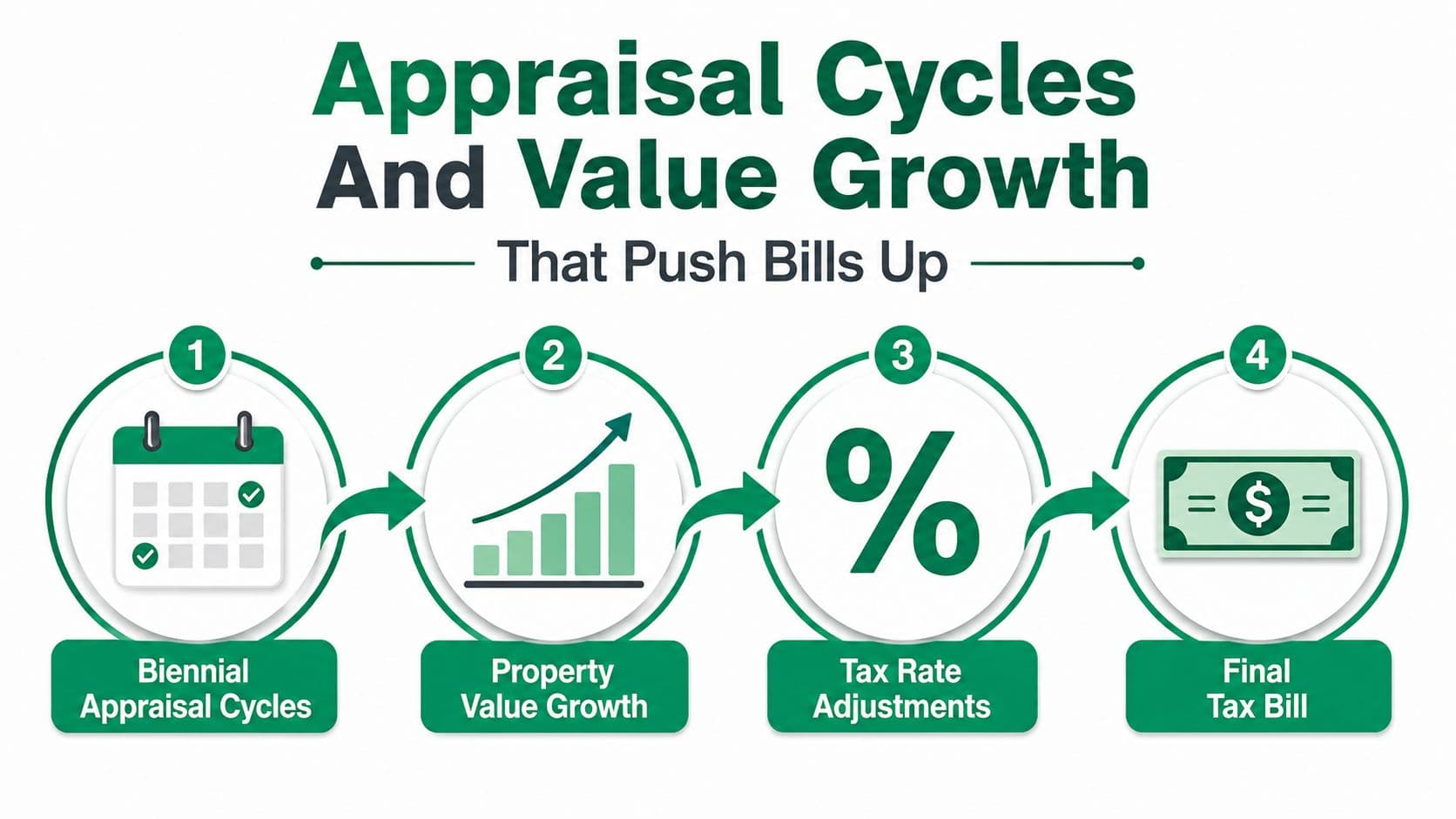
A property-tax bill can rise through two separate channels: the rate applied to taxable value and the value itself. Texas's fast-growing metro areas make the second channel especially important. The Dallas Fed reported that rising home prices pushed bills higher, while recent Texas Comptroller commentary attributes levy growth to both property-value appreciation and new construction, particularly since 2020.
The homeowner needs a simple sequence for reading the change:
- Market conditions alter value. Demand, sales, development, and new construction can expand the taxable base.
- Local appraisers estimate taxable value. Appraisal districts review property values, while state studies test whether district values align with market levels and are applied uniformly.
- Taxing entities set rates and account for debt. Rate compression can limit one component of the bill, but debt obligations and school-finance rules still affect the final calculation.
- The bill combines the result. A stable or lower rate can still produce a higher payment if taxable value grows enough.
What the state studies
The Comptroller runs a biennial School District Property Value Study to estimate taxable value for each district and certify it for state funding. Its Appraisal District Ratio Study evaluates whether local appraisals are uniform and at market level, as described in the Texas property value study materials.
These checks matter because an appraisal isn't merely a private estimate. It feeds into school-finance formulas and can affect how much revenue a district must raise locally. If valuations lag market conditions or differ across districts, funding adjustments can amplify the importance of the taxable base, local rates, and debt financing.
The appraisal process is also shaped by protections. Texas properties are assessed at market value and revalued at least every three years, while a homestead's taxable value increase is generally capped at 10% per year, unless new improvements are added, according to the Texas A&M Real Estate Center. A cap slows the adjustment, but it doesn't erase exposure when market values rise faster than household wages. It can also defer part of the increase rather than eliminate it.
For a homeowner, the key diagnostic is to compare the appraised value, taxable value, exemptions, rate components, and debt charges separately. The mass appraisal methods used by districts help explain why a bill can change even when the owner's house hasn't changed physically.
Land Leases, Land Use Rights, And True Annual Repricing
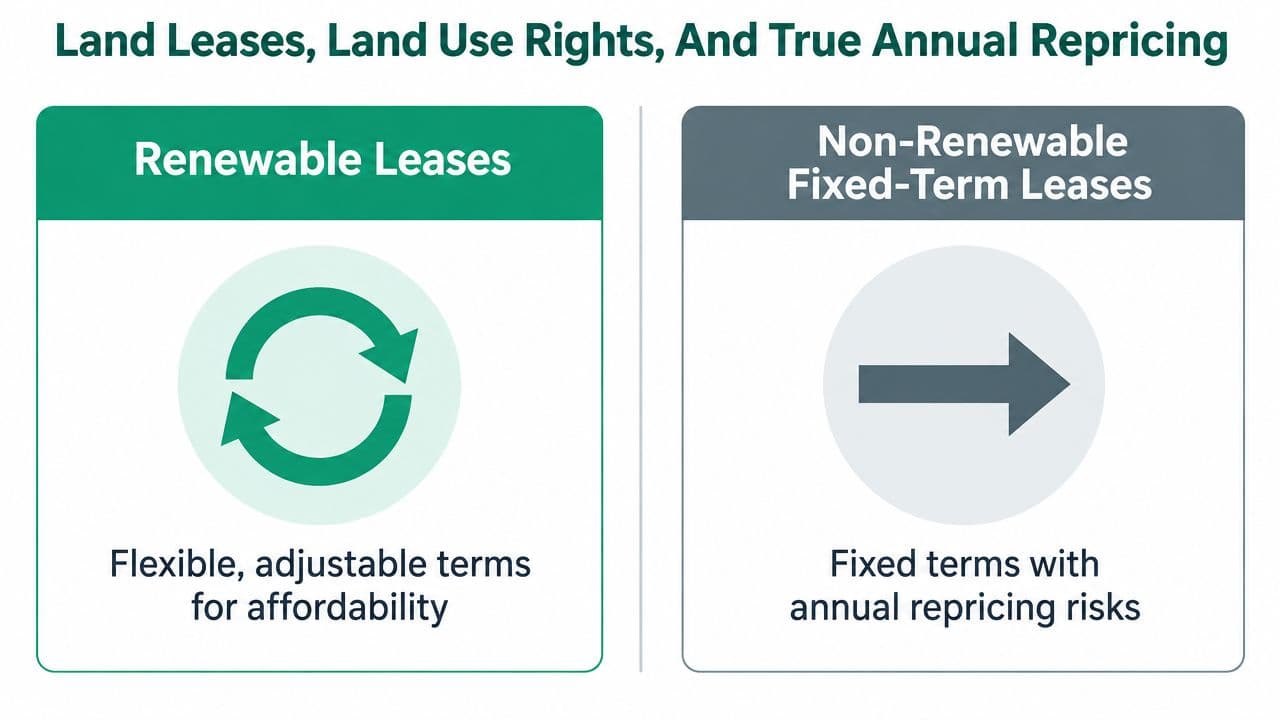
Land-value policy often gets confused with land leasing, but the payment structure is different. A land lease is a fixed-term arrangement with a fixed price. It may be renewable or non-renewable, yet in both cases the fixed term postpones the moment when the payment is reset to current land value.
A renewable lease offers some certainty until its term ends. At renewal, the accumulated gap between the old lease rate and the market can close in one major repricing. A non-renewable lease avoids that particular renewal event, but the remaining term becomes progressively harder to refinance and sell as its end approaches.
| Arrangement | Duration | Pricing pattern | Main risk |
|---|---|---|---|
| Renewable land lease | Fixed term, potentially renewable | Fixed until renewal | Sudden repricing when the term ends |
| Non-renewable lease | Fixed term, no guaranteed renewal | Fixed during the term | Reduced resale and refinancing appeal |
| True land-use right | Indefinite | Repriced annually | Payment changes track current land value |
Why fixed pricing postpones risk
Fixed leases can look affordable because they hold the payment steady. That stability doesn't correctly price risk, however. It postpones risk until renewal or transfers it into the asset's declining financeability. A business may plan around a known payment, only to face a sharp adjustment later or find that lenders and buyers discount the remaining term.
A true land-use right meets three conditions. It has no expiration, requires no renewal, and is repriced each year. Annual repricing keeps the payment connected to current land value instead of allowing a long gap to accumulate.
That distinction affects transaction costs and productive use. Because a true use right doesn't depend on renegotiating a fixed term, people can buy and sell it at low cost. The arrangement prices land appropriately without placing the same fixed-lease cliff in front of entrepreneurship, construction, or other productive enterprises.
The label matters. Some fixed leases are called “land-use rights,” but they aren't land-use rights unless they are indefinite and repriced annually. The definition of a land-use right makes the test clear.
Land Value Reform Options And What They Change
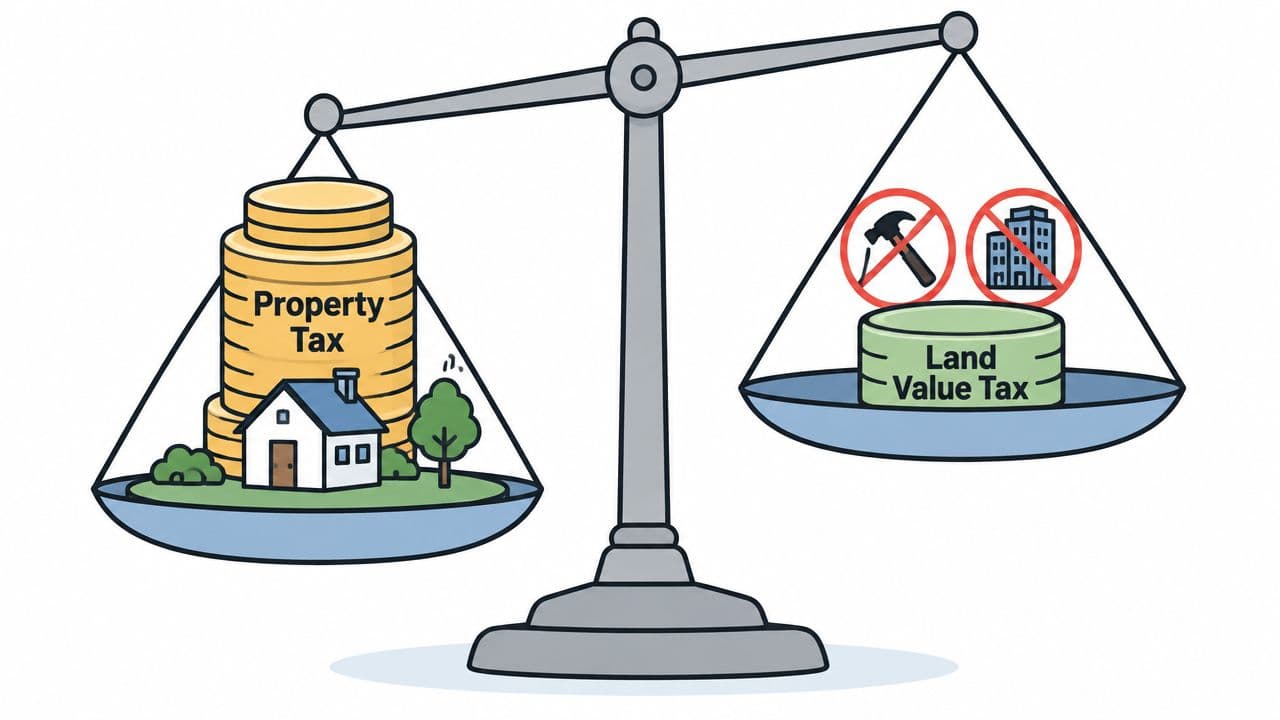
A land-value reform would change the tax base, not merely adjust the existing rate. Instead of treating the entire property package as the primary target, policymakers could place greater weight on the rental value of the site and reduce taxes on labor, construction, and productive capital.
The logic is straightforward. Owners don't create the underlying location, access, or community advantages that make a site valuable in the same way that builders create improvements or workers create services. A charge aimed more directly at site value can return part of that publicly supported advantage to the public, while reducing the penalty on building, renovating, or operating a business.
What the policy would require
A serious reform isn't just a new label for the current tax. It needs:
- Separate valuation: Assessors must distinguish land value from the value of buildings and other improvements.
- A reliable cadastre: Parcel records, ownership information, land characteristics, and surrounding value drivers must work together.
- Fiscal modeling: Officials need to estimate who gains, who pays, and whether proposed rates replace existing revenue.
- Clear administration: Appeals, payment rules, exemptions, and compliance procedures must be understandable.
Possible instruments include site-value taxation, resource dividends, and rate reform. These tools can pursue different goals, but they share a shift toward land and natural-value income rather than taxes that discourage work or construction.
The argument for this direction is strongest where underused land sits in valuable locations while nearby households face high housing costs. A land-focused charge can make passive holding less attractive and productive use more attractive. It won't solve every affordability problem, since construction costs, regulation, credit, and infrastructure still matter, but it changes an incentive that ordinary property taxation often leaves blurred.
The case for property-tax reform therefore depends on implementation, not slogans. Reform succeeds only when the valuation method, revenue target, transition rules, and distributional effects are visible.
Transition Paths, Equity Impacts, And Who Bears Costs
Changing the tax base creates winners and losers before it creates consensus. Owners of valuable land with modest improvements could face higher charges, while households and businesses investing in buildings might receive relief. Renters could experience indirect effects through changes in land prices, development, and landlord costs, but those outcomes depend on market conditions and policy design.
A phased transition can reduce sudden shocks. Officials could begin with parallel land and improvement assessments, publish distributional maps, and test several revenue-neutral scenarios before changing the effective burden. The important point is not to promise that every taxpayer pays less. It is to identify which taxpayers gain from lower charges on improvements and which need temporary protection as land values become more visible.
A practical equity framework
| Question | Why it matters |
|---|---|
| Who owns high-value sites? | They may bear more of a land-focused charge |
| Who has valuable improvements? | Lower improvement taxation may support construction and upgrades |
| Who has limited cash income? | Deferrals or targeted protections may prevent displacement |
| Which businesses depend on fixed occupancy costs? | Transition timing can affect investment and refinancing |
Revenue neutrality can limit the risk that reform becomes an unexamined tax increase. It doesn't remove distributional change, though. A neutral aggregate result can still shift costs between landholders, homeowners, businesses, and public agencies.
Administrative readiness is equally important. Assessors need defensible land estimates, elected officials need transparent fiscal scenarios, and residents need plain explanations of why a bill changes. Without those foundations, opponents can characterize a technical transition as arbitrary, while supporters may overstate the benefits.
Equity principle: A reform should show both the average fiscal effect and the household-level path from today's assessment to tomorrow's bill.
Temporary relief can protect households that are asset-rich but cash-constrained. The design must avoid turning a temporary safeguard into a permanent exemption that recreates the original imbalance.
Why Simple Relief Measures Often Fall Short
Rate cuts and larger exemptions can lower a homeowner's bill without lowering the cost of public services. Schools, emergency response, roads, and other local functions still need funding. The shortfall must then be covered by a broader tax base, another revenue source, reduced services, or delayed spending. Relief at the parcel level can therefore become a form of structural substitution rather than a reduction in the underlying fiscal obligation.
Texas has compressed school property-tax rates before, and the average statewide school-district rate later rose from $1.25 to $1.35 after compression was implemented, as noted in earlier material. The minimum maintenance-and-operations rate remains $1.00 per $100 of valuation, with a cap of $1.17. These figures show why a lower rate does not, by itself, settle how schools will be financed.
The homestead exemption presents the same trade-off. A Texas A&M Real Estate Center summary states that SB 2 reduced school-district property-tax rates by 10.7 cents per $100 of assessed value and raised the homestead exemption from $40,000 to $100,000, with an exemption of $110,000 for seniors. Eligible owners can receive meaningful relief, while appreciation and new construction continue to expand the taxable base and support levy growth.
Caps delay exposure
The homestead cap limits annual growth in taxable value, but it does not permanently remove exposure to market appreciation. When market value rises faster than the capped value, the gap can accumulate. Later adjustments, new improvements, or local budget decisions may then produce a higher bill without a dramatic rate change.
The INTELLI property tax relief bill guide summarizes current exemption options, but passing relief legislation does not reduce the underlying levy. It shifts revenue collection to other bases or requires deeper service cuts.
Texas-specific evaluation should focus on fiscal mechanics. Does the proposal preserve the $1.00 maintenance-and-operations floor without triggering additional debt? Does it limit homestead value growth below market appreciation, or merely postpone the increase? Does it maintain school-finance recapture neutrality while changing who supplies the revenue? These tests distinguish durable reform from a delayed bill or a transfer to less visible taxpayers.
Practical Takeaways For Homeowners And Policy Observers
The most useful way to interpret a Texas property-tax bill is to separate substitution, valuation, and school finance. Substitution explains why property carries so much weight without a state personal income tax. Valuation explains why growth in homes and new construction can raise the base. School finance explains why local rates and state formulas remain connected.
Start with the bill, not the headline rate. Look for the appraised value, capped value, exemptions, school-district charge, maintenance-and-operations amount, debt rate, and other taxing entities. Then compare the current figures with the prior appraisal notice to determine whether the change came mainly from value, eligibility, rate, or a combination.
Questions for evaluating reform
- Tax base: Does the proposal tax land value separately, or does it merely rename the existing property tax?
- Revenue: Does it replace revenue, add revenue, or assume services will cost less?
- Timing: Does the plan phase in changes, and does it protect households facing a sudden payment shock?
- Administration: Can appraisal districts measure land and improvements consistently?
- Distribution: Which owners gain from lower taxes on buildings, and which landholders bear more of the charge?
- Accountability: Will residents be able to see how assessments and rates produce the final bill?
For an individual homeowner, short-term protections still matter. Review exemptions, monitor appraisal notices, check whether the recorded property characteristics are accurate, and seek qualified advice when the valuation appears inconsistent with the property's condition or market evidence. Those steps can address an immediate bill, but they won't change the fiscal structure that produced the burden.
Policy observers should resist single-variable solutions. A lower nominal rate can coexist with a higher bill, and a larger exemption can coexist with service reductions or replacement taxes. The durable question is whether Texas wants to continue financing public value largely through property ownership or move toward a system that distinguishes land, labor, and capital more clearly.
Unitism® helps governments, cities, and organizations evaluate land-value reform through land valuation, fiscal-impact modeling, transition design, and implementation support. Visit Unitism® to explore how separating land value from buildings and productive activity can inform a fairer Texas revenue strategy.