Land holding costs cover taxes, financing, upkeep, and risk. See how leases differ from annually repriced land-use rights and how to design fairer charges.
October 24, 2026
Land Holding Costs and How to Price Idle Land
Land holding costs cover taxes, financing, upkeep, and risk. See how leases differ from annually repriced land-use rights and how to design fairer charges.
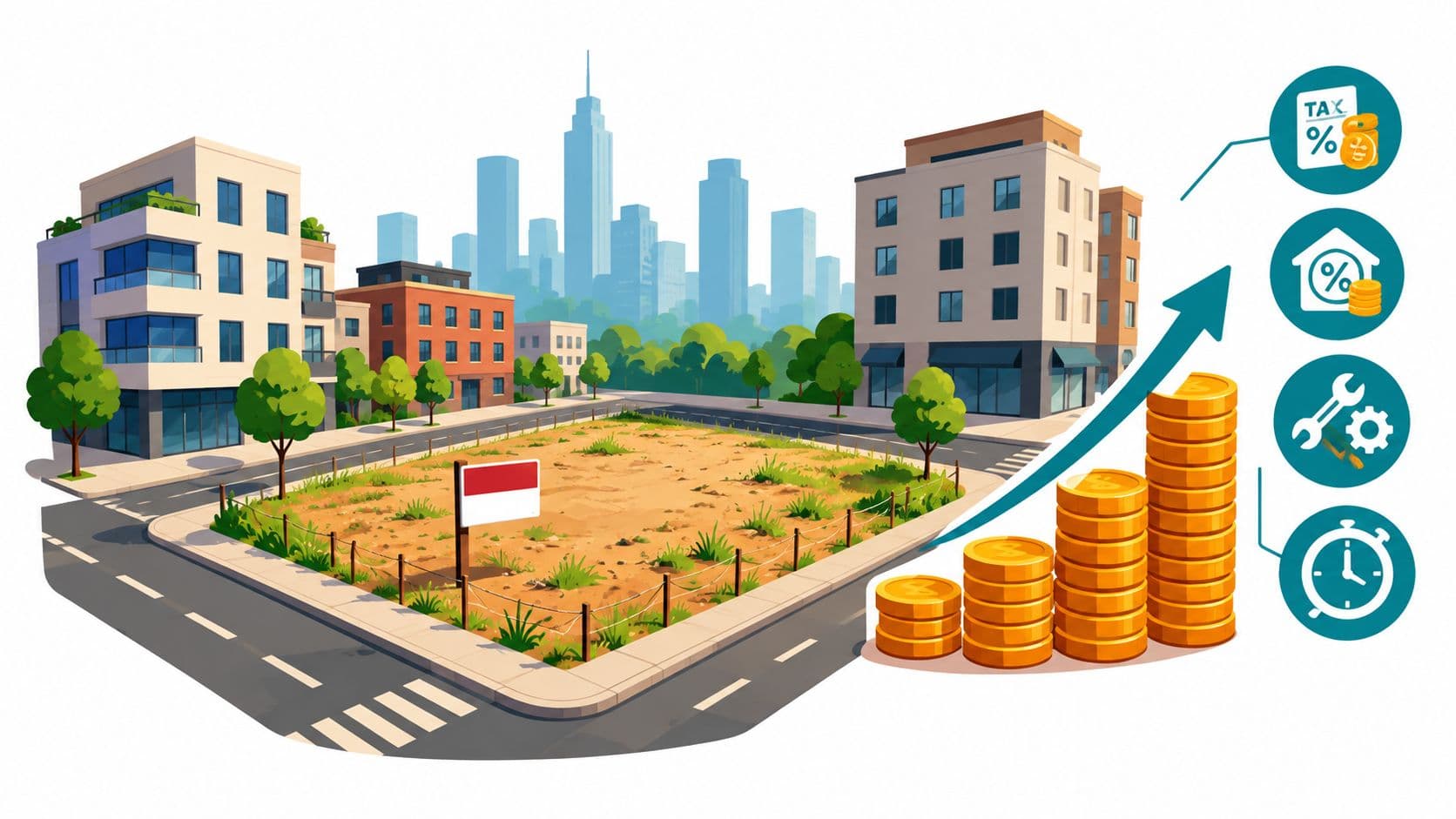
A serviced parcel can sit empty for years while nearby homes, shops, and public budgets absorb the consequences. That's the central problem with land holding costs. They're not just a private carrying expense for whoever owns the title. They shape when sites get built, whether owners wait for a higher price, and how much a city collects to pay for the services already reaching the lot.
Table of Contents
- Why Idle Land Is Never Free
- What Land Holding Costs Include
- How to Measure Land Holding Costs
- Land-Value Taxes Leases and Land-Use Rights
- What Precedents Reveal About Idle Land
- Choosing a Reform Path with Unitism
- A Practical Next Step for Reform
Why Idle Land Is Never Free
A vacant infill site with water, sewer, transit, and paved access looks inexpensive on an owner's ledger if taxes are low. The city sees a different ledger. It still maintains streets and emergency coverage around the parcel, forgoes revenue the site would generate in use, and risks weaker values on adjoining properties.
What the fiscal comparison shows
The scale is clear in a U.S. Environmental Protection Agency review of vacant property costs, which reports that a St. Paul vacant lot generated only $1,148 in property taxes over 20 years, compared with $5,650 for an unrenovated but occupied home and $13,145 for a rehabilitated property, a difference of $11,997 between the vacant lot and the rehabilitated property.
That gap matters because the underlying land is in the same serviced location in each case. What changes isn't the public network around it. What changes is whether anyone puts the site to productive use and whether the tax base reflects that use.
- Vacant lot: The owner pays little, while the municipality collects little from a parcel it still serves.
- Occupied home: Revenue rises even without major rehabilitation.
- Rehabilitated property: Use and investment together produce the strongest fiscal return.
Costs move beyond the parcel boundary
Neighbors pay, too. The same EPA review cited earlier also reported a Philadelphia finding that houses within 150 feet of a vacant or abandoned property suffered an average net value loss of $7,627.
Delinquency compounds the loss across a whole jurisdiction. It cited an estimate that cities and school districts lose approximately $3 billion to $6 billion annually when only 2% to 4% of property taxes go uncollected because of delinquency and abandonment.
A low bill for the owner doesn't mean a low cost for the place. It often means the cost has been shifted.
That's why a finance ministry or planning department shouldn't treat idle land as a neutral private choice. Slow turnover and land speculation can depress nearby assessments, weaken collection, and leave serviced urban land producing almost no fiscal return. The owner's carrying burden is real, but it's only half the account. Prolonged vacancy imposes a second, public carrying burden on neighbors and local government.
What Land Holding Costs Include
Owners don't face one charge. They face a stack of recurring costs that continues whether the site earns income or not. Separating that stack shows why some parcels move quickly and others remain idle for years.
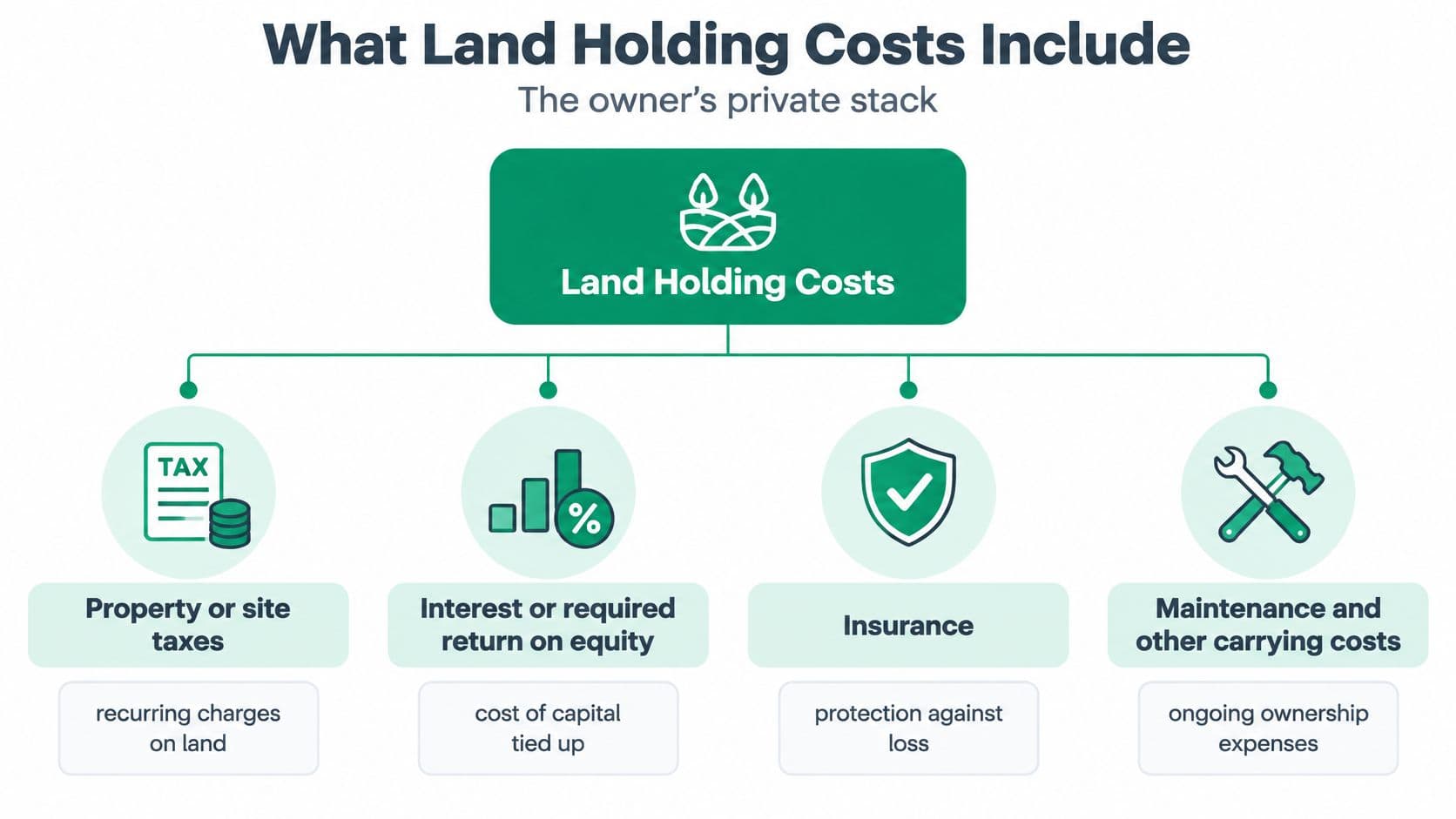
The owner's private stack
- Property or site taxes: Recurring public charges continue even when a parcel produces no rent, sales revenue, or operating income.
- Interest or required return on equity: Borrowed funds accrue interest, and equity tied up in land can't earn a return elsewhere.
- Insurance: Owners still need protection against liability and loss connected with the site.
- Maintenance and security: Fencing, clearing, inspections, and basic upkeep prevent deterioration and unauthorized use.
- Compliance costs: Permits, filings, professional advice, and code obligations don't disappear because development is paused.
- Opportunity cost: Capital locked in an idle site isn't available for construction, business investment, or another productive asset.
These items differ in form, but they share one feature. Time makes them larger. A vacant site doesn't generate operating income to offset them, so every additional year requires the eventual project or sale to recover a bigger accumulated burden.
The price of waiting
There's also a component that doesn't appear as an invoice. Owners may value the option to wait. Waiting lets them avoid irreversible construction spending today while preserving the chance that land prices or market conditions improve tomorrow.
Parcel-level evidence from Seattle illustrates that incentive, where a one-standard-deviation increase in house-price uncertainty was associated with approximately a 1.6% increase in vacant-land prices and an 11% reduction in the probability of development during a given period, as summarized in research on land speculation and option value.
Think of a low recurring charge as a cheap storage fee. If storing an empty site costs little, an owner can rationally keep the option open. OECD analysis cited in that research similarly points out that conventional property-tax incentives can have weak development effects when rates are low, while a recurring charge based on land value raises the cost of holding and pushes the site toward a higher-value use.
The policy question therefore isn't whether an owner has costs. It's whether the recurring stack is high enough, and targeted at land rather than buildings, to change the timing of a decision. When it's low, delay isn't necessarily irrational or malicious. It's the predictable response to prices that make waiting inexpensive.
How to Measure Land Holding Costs
A single purchase price tells a ministry almost nothing about timing. Measurement has to follow cash outflows year by year, then test what happens when approvals, construction, or sales slip.
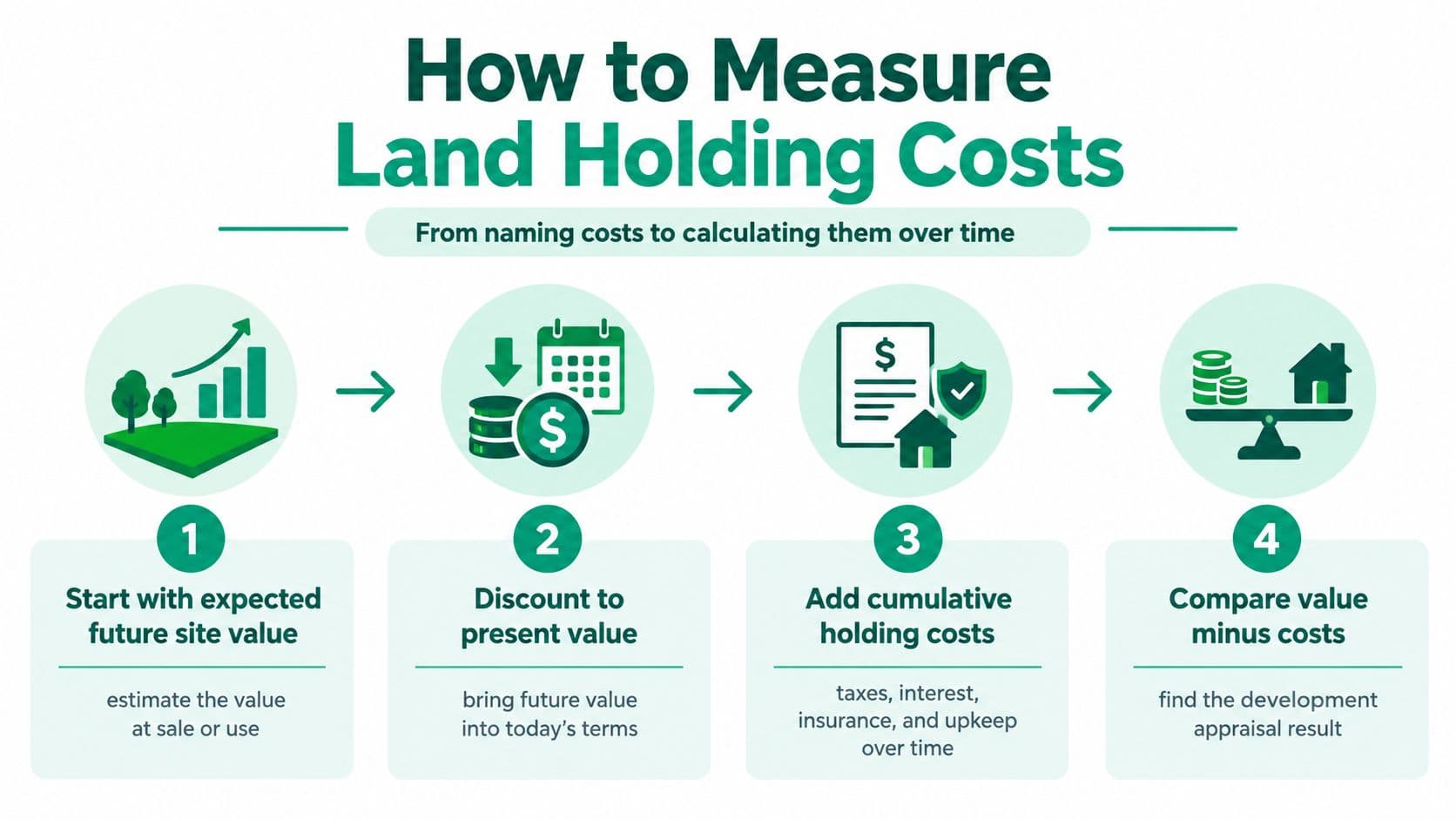
Build an annual worksheet
Start with the expected future site value at sale or productive use. Discount that value into today's terms, because money received later is worth less than money available now and carries more uncertainty.
Next, accumulate the annual carrying costs over the expected holding period. For projects that will eventually operate, analysts also need to calculate net operating income from Edinhart Realty and Property Management as a separate check on post-development performance, rather than confusing future operations with the pre-development period when the vacant site earns nothing.
Then compare the discounted value with cumulative holding costs and other project costs. The remainder indicates the residual land value the project can support under those assumptions. Change the holding period, and the answer changes even if construction prices stay the same.
- Estimate future site value: Use a defensible end use and timing assumption.
- Discount to present value: Reflect financing cost, required return, and risk.
- Add annual carrying costs: Record each year separately instead of using one static allowance.
- Run delay scenarios: Compare the base case with slower approvals, construction, and sales.
Time is the sensitive variable
A practical underwriting benchmark in research on calculating greenfield holding costs is that project funds may remain outstanding for roughly half of the development-and-sales period, while greenfield commitments can extend from approximately 4 to 12 years.
That range explains why delay is so damaging. Interest and required return keep accruing, taxes and maintenance continue, and the eventual revenue gets discounted over a longer period. Residual land value can fall materially without any increase in the cost of building itself.
Practical rule: Model land as a timed financial commitment, not as a one-off acquisition price.
A workable ministry dataset needs parcel boundaries, ownership and current use, separate land and improvement values, tax and delinquency status, expected holding period, financing assumptions, and at least one delay scenario. Those inputs connect naturally to methods of land valuation, but valuation alone isn't enough. Decision-makers need an annual holding-cost worksheet that shows when waiting stops being affordable and which public delays are destroying project feasibility.
Land-Value Taxes Leases and Land-Use Rights
These three instruments are often lumped together because all involve paying for land access or ownership. They don't create the same incentives, duration, or risk. Precision matters before a government chooses any of them.
A land-value tax is a recurrent charge on the value of unimproved land, rather than on buildings or other improvements. It doesn't transfer possession from an owner to a tenant. It changes the recurring cost of owning the site, which is why analysts need to distinguish it from taxes that also penalize construction. For a related legal distinction in rental property, The Law Office of Bryan Fagan explains how tax responsibility can be allocated between parties.
Fixed leases postpone risk
A land lease grants contractual possession or use for a specified term in exchange for rent or a fixed fee, while the landowner retains title. Academic analysis describes emphyteutic leases in Rwanda and Ethiopia lasting 20 to 99 years, with fees based on plot size and location and payable as a lump sum or installments, in research implementing a land value tax.
Renewable fixed leases provide certainty only through the current term. If the contract rate stays below market for years, the accumulated gap can close all at once in a major repricing at renewal. Research on public leasehold systems explains this timing problem and notes that perpetual rights resemble a property-tax system because they continue without another extension, as discussed in analysis of public land lease renewal and repricing.
Non-renewable fixed leases create the opposite deadline. As expiry approaches, buyers and lenders have fewer years to recover building costs and financing expenses, so the remaining contractual interest becomes progressively harder to refinance or sell. That finite-life problem is central to wider debates around 99-year land leases.
Fixed leases don't eliminate market risk. They hold the price still while site value moves, then force recognition at renewal or let the right run down toward expiry.
A stricter definition of land-use rights
A land-use right, in the precise sense used here, is indefinite and repriced annually. It must meet three tests:
- Repriced each year: The annual charge tracks current site conditions.
- No renewal required: Access doesn't depend on negotiating a new term.
- No expiration: The right doesn't diminish toward a contractual end date.
Because there's no looming expiry to price, people can buy and sell these rights at low transfer cost, while retaining value they create through buildings and productive enterprise. Annual repricing distributes adjustment over time instead of storing it up.
Sometimes fixed leases are called land-use rights. They're not. If a contract expires, requires renewal, or isn't repriced annually, it's still a fixed lease.
How Three Land Charges Differ
| Instrument | How long it lasts | How the charge is set | Where the risk shows up |
|---|---|---|---|
| Land-value tax | Recurring while land is owned | On unimproved site value | Valuation and rate decisions |
| Fixed land lease | Fixed contractual term | Fixed under lease terms | Renewal repricing or expiry |
| Land-use right | Indefinite, no renewal | Repriced annually | Annual valuation changes |
What Precedents Reveal About Idle Land
A charge on idle land changes the cost of waiting, but its effects depend on the instrument and the market around it. Precedents show why vacancy reduction, development, and housing affordability must be assessed separately.
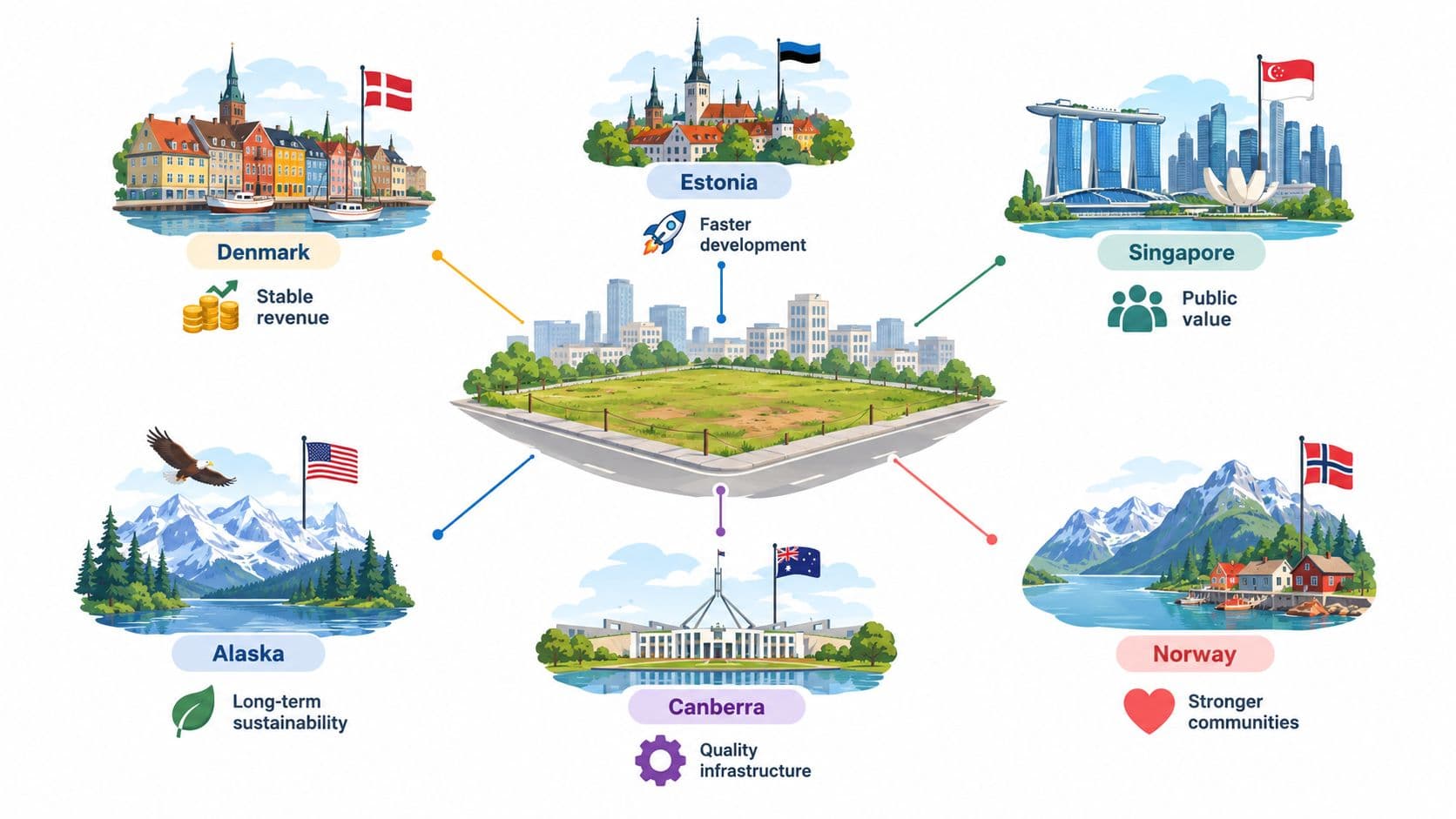
Utilization and affordability are different outcomes
Vancouver introduced an empty-homes tax in 2017. The tax reduced the overall vacancy rate, but the OECD report on affordable and social housing supply reports no observable change in average rents. The result illustrates an important distinction: a charge can change an owner's decision to leave a dwelling vacant without lowering rents across the market.
The OECD review also finds that vacancy taxes in Australia, Canada, France, Portugal, and the United Kingdom have not consistently improved both housing availability and affordability. Occupancy may rise while rents remain shaped by supply, incomes, credit conditions, and location-specific demand.
A vacancy charge can put property back into use without acting as a rent cure. These are separate policy outcomes.
Different instruments create different incentives over time. A vacancy tax targets non-use. A recurring land-value tax charges for site value whether or not a building is occupied. A fixed lease sets a payment for a contractual term, while an indefinite land-use right repriced annually adjusts the charge as site conditions change. These designs should not be treated as equivalent evidence about the effects of idle-land charges.
Read each precedent by instrument and outcome
A useful precedent identifies both the policy tool and the result it measured. Analysts should distinguish among vacancy, land prices, rents, redevelopment, and tax incidence. A fall in vacancy does not establish that rents fell, and a higher charge does not show who ultimately bears its cost.
Design also determines when owners face pressure to act. An annual charge makes waiting costly each year. A one-time penalty concentrates the incentive at a particular point, while exemptions for construction or renovation may protect active projects or leave room for delay. Vacant land and vacant dwellings require different tests.
United Kingdom brownfield research finds that higher holding costs can encourage owners to sell or develop sooner. Yet where remediation barriers make development difficult, higher costs alone may not bring sites into use; grants or coordinated support may still be needed. The research on brownfield ownership and holding costs therefore points to a practical limit: raising the cost of waiting has more effect when development is feasible.
The Olson & Sons Parker Ranch report provides a place-specific account of how land claims and institutional history shape control of land. Such context matters when comparing policies: the same charge can create different incentives where ownership rights, development constraints, and public responsibilities differ.
Choosing a Reform Path with Unitism
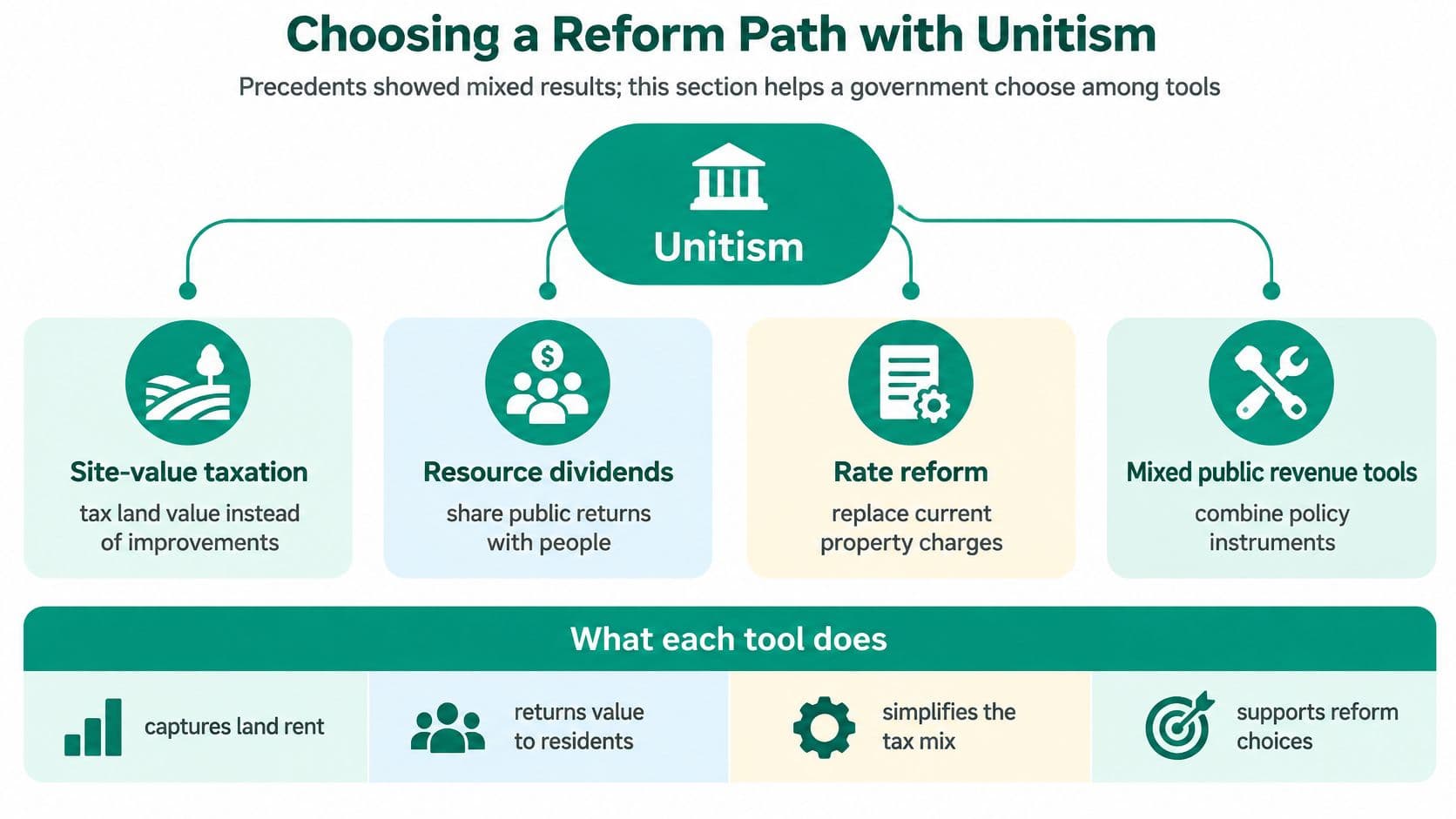
A government doesn't need one universal land instrument. It needs the tool that matches the problem it's trying to solve, and it needs to know who pays under each option.
Match the instrument to the diagnosis
Site-value taxation fits where the tax system penalizes buildings or lets serviced land sit underused. It shifts the recurring charge toward the site itself, so improving the property doesn't create the same penalty as a conventional tax on total property value.
Resource dividends address a different question. They determine how publicly captured value from land or nature is returned to residents. That's a distribution mechanism, not by itself a tool for deciding whether a particular parcel is idle.
Rate reform can replace transaction charges and taxes on buildings with land-based revenue. That matters where the existing mix discourages movement, construction, or productive investment.
Vacancy charges are narrower. They target identified non-use, but they can be hard to define and enforce. They shouldn't be sold as a complete affordability strategy when planning capacity and new supply remain constrained.
Unitism® organizes this choice through a tri-factor distinction between labor, capital, and nature. The point is practical. A charge on the rental value of a site isn't the same as taxing wages, machinery, or a newly built home.
Services that turn a concept into administration
Its advisory work includes land valuation assessments and data frameworks for site rental value, policy design, distributional and fiscal modeling, and legislative and administrative implementation including cadastre integration. It also provides education for officials and communities, public explainers, and interactive scenario tools that let decision-makers test transition paths.
Implementation capacity should drive the pace. A 2025 Mexico City study found that information technology has reduced the technical difficulty of land-value capture, while political barriers, separating land from building value, and taxpayer resistance to recurring reassessments remain decisive, according to research on land-value capture implementation in Mexico City.
Scotland's modernization work points to a related constraint in ownership, land-use, and emissions data. Governments reviewing transition requirements therefore need to assess data quality before announcing a rate. A theoretically elegant charge won't change behavior if the jurisdiction can't identify parcels, value sites credibly, bill owners, or defend assessments.
A Practical Next Step for Reform
Start smaller than a national rate announcement. A pilot area with transparent data will reveal valuation problems, hardship cases, and enforcement gaps while they're still manageable.
Build the baseline first
Commission a parcel extract for the pilot area covering ownership, current use, vacancy status, tax standing, and site boundaries. Publish the method used to separate land value from improvements. If owners can't see how the site value was estimated, they'll dispute the charge before they respond to its incentives.
Use mass appraisal and location-based models where individual valuation isn't practical. Audit a sample against market evidence, correct the roll, and document uncertainty instead of presenting modelled values as exact.
Phase the charge and protect against hardship
Introduce a modest recurring site charge, then phase it upward on a published schedule. Predictability gives owners time to develop, sell, lease, or reorganize financing. Sudden implementation invites avoidance and political backlash before the administration has proved it can value land fairly.
Use deferral for genuine hardship rather than broad exemptions. Deferral can delay payment without making indefinite idleness cheap again. Broad carve-outs, by contrast, reward owners who qualify for the label rather than owners who put land to use.
Protect people in hardship without recreating a subsidized option to wait.
Pair the charge with permission for new supply and enough infrastructure capacity to support it. If owners face higher land holding costs but can't build because zoning, utilities, or approvals block the project, the charge may be contested or passed through where market conditions allow. Reform has to make productive use both more necessary and more possible.
Measure separate outcomes
A readiness checklist should cover the following items:
- Parcel data: Ownership, use, vacancy, and boundaries are reconciled.
- Valuation method: Site and improvement values are separated and published.
- Distribution model: Likely payers, beneficiaries, and hardship risks are identified.
- Administration: Billing, appeals, collection, and audit responsibilities are assigned.
- Outcome dashboard: Vacancy, redevelopment, rents, land prices, and incidence are tracked separately.
That sequence fits the broader logic of land value capture explained, but the immediate task is narrower. Commission a site-rent baseline and distributional model before drafting a rate. Those two products tell a ministry whether it's ready to price idle land and who will feel the change.
If your ministry, city, or housing agency needs a site-rent baseline, distributional model, or training program before setting a land charge, Unitism offers valuation assessments, policy design, fiscal modeling, and implementation support. Visit Unitism® to start a valuation and impact scoping conversation and test a transition path with interactive scenario tools.