How the land value extraction method works: assess site value, compare taxes, leases and land-use rights, and see real project uplift numbers.
November 18, 2026
Land Value Extraction Method: How It Works in 2026
How the land value extraction method works: assess site value, compare taxes, leases and land-use rights, and see real project uplift numbers.

Manila's metro line, built in 2000, lifted land values within 1 kilometre of its stations by nearly US$3.4 billion, while the line itself cost about US$655 million, according to the OECD's guidance on land value capture. Private owners captured gains several times the public outlay, and they didn't pour the concrete.
That gap is what a land value extraction method is built to close. Public works, planning decisions, and the daily activity of a city raise the price of locations. A workable method does two jobs. It measures the site gain apart from buildings, and it collects a fair share through a legal instrument that fits the goal. Use a fixed lease where a true land-use right is needed, and the community locks in current value while future gains flow elsewhere.
Table of Contents
- What Land Value Extraction Really Means
- Land Value Extraction Methods at a Glance
- How to Assess Land Value Separately from Buildings
- Land-Value Taxes, Land Leases and Land-Use Rights
- How Much Value Public Projects Create and How to Measure It
- Design Choices That Make or Break Land Value Extraction
- Choosing and Launching Your Extraction Method
What Land Value Extraction Really Means
Open a metro line, rezone the blocks around two stations for mid-rise housing, and a vacant lot that sat idle for a decade becomes the obvious site for apartments. The owner did not build the line, write the zoning code, or create the customer base. The site is worth far more anyway. Public works and planning decisions lift nearby land values the way a tide lifts every boat in the harbour.
That practice is already ordinary public finance. The OECD's Global Compendium of Land Value Capture Policies examined 60 countries and found that every country in the sample except Uganda used some form of land-value capture at least occasionally. Developer obligations were the most frequently used instrument, and charges for development rights the least common.
Land value extraction, also called land value capture, is the family of methods for returning to the community part of the land value that public investment and community activity create. Betterment levies, development charges, negotiated developer contributions, public land assembly, and payments tied to extra floor area all belong to that family. Colombia has long used a legal infrastructure levy, and its large and intermediate cities have applied it to roads, public transport, utilities, and green space.
The income at stake is economic rent: income that comes from owning a desirable location or natural resource, not from work or investment. A clear account of what land value is starts from that split. Labour and buildings are produced. The location premium is not.
Why ministries bother
Collected well, the charge can pay for infrastructure, make speculative land hoarding less attractive, and give governments room to ease taxes on wages and buildings. The same idea has to be adapted to the legal system, income level, and project in front of you.
Every method in the family does two jobs at once. It measures the site gain separately from buildings, then collects a share through a legal instrument that fits the goal. A recurring tax, a fixed-term lease, and an annually repriced land-use right can look interchangeable on paper. The choice decides who carries the risk at renewal and who pockets the growth between reassessments, which is where the legitimacy of the whole arrangement is won or lost.
Land Value Extraction Methods at a Glance
Treat extraction as two halves that have to fit. Assessment is how you measure land value apart from buildings. Capture is the legal instrument that collects it. A sharp valuation with the wrong instrument still fails, and a popular instrument with a weak land figure becomes a dispute.
| Method | How it captures value | Best suited for | Main limitation |
|---|---|---|---|
| Land value tax | Recurring statutory charge on site value only, buildings excluded | Stable recurring municipal revenue | Needs credible mass valuation and a reassessment cycle |
| Betterment or infrastructure levy | One-off charge on the uplift created near a named public project | Financing a specific transport or utility investment | Requires defensible uplift measurement and baselines |
| Developer obligations | Negotiated land, infrastructure or fee contributions at permit stage | Funding infrastructure triggered by new development | Case-by-case deals can be slow and opaque |
| Development-rights charge | Payment for rezoning or additional floor area | Where entitlement changes create large value jumps | Least used instrument; needs clear entitlement rules |
| Public land leasing | Contract rent for the use of publicly owned land | Cities with large public landholdings | Fixed terms postpone risk to renewal or expiry |
| Land-use right | Annually repriced payment for an indefinite right to use land | Continuous pricing without renewal cliffs | Demands strong annual valuation administration |
A land value tax bills the unimproved site on a legal cycle and leaves the building out of the base. It suits a city that wants steady revenue rather than a one-project cheque. It fails if the roll is stale or if appeals have no real process.
A betterment or infrastructure levy is a one-off bill tied to a named project, such as a metro or a road upgrade. It fits when you can draw a catchment and show the uplift. It fails when the baseline date is fuzzy or the charge arrives years after the gain was spent.
Developer obligations take land, works, or fees at the permit stage. They match infrastructure that new building directly triggers. They drag when every deal is negotiated in private and neighbours can't see the bargain.
A development-rights charge prices the jump from a rezoning or extra floor area. It belongs where the planning permission, not the bricks, creates the windfall. It needs published entitlement rules, or the payment looks like a toll on whoever shows up last.
Public land leasing collects contract rent on land the city already owns. It is the natural tool for a large public estate, and a weak one where the city sold the land decades ago. A fixed term parks the price risk until renewal or expiry.
A land-use right prices an indefinite right every year. It keeps the payment current without a renewal cliff, but only if the annual valuation office can do the work.
Sensors, access systems, and energy metering change what a finished building is worth, which is a separate question from the site. Smart building technology use-cases from Waymap show how operators track that building performance. Keep those capital gains out of the land bill. The rest of this guide goes deep on valuation and on the recurring instruments, and the shortlisting guide is in the final section.
How to Assess Land Value Separately from Buildings
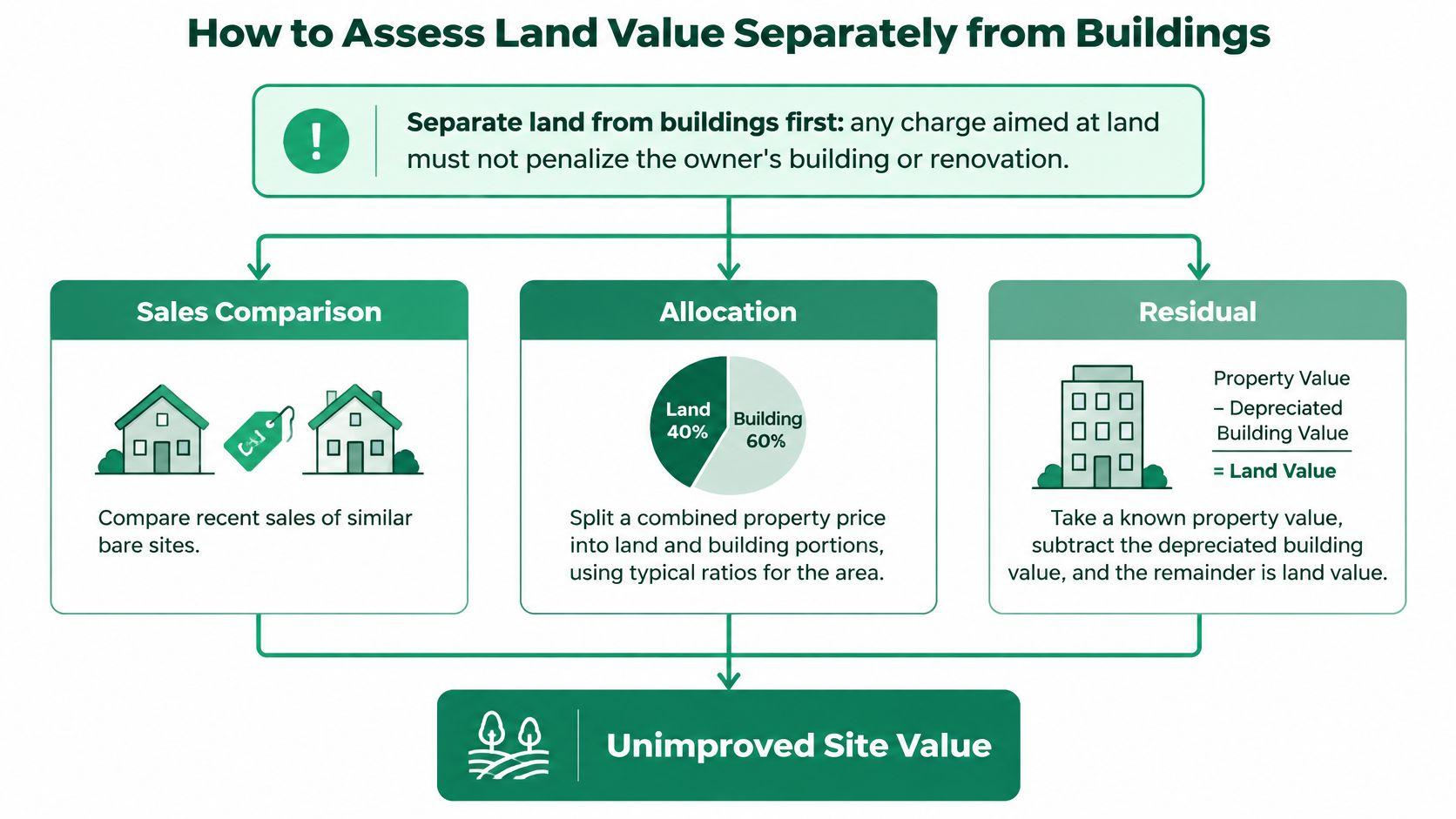
Any charge aimed at land must not penalize the owner's building or renovation. If the assessment rolls land and structure into one number, a household that adds a floor or a shop that refits a storefront pays more for being productive. The defensible land value extraction method isolates unimproved site value first.
Sales comparison and mass appraisal
In a market with enough bare-land deals, start with comparable sales. Model each parcel from observed transactions, adjust for size, frontage, services, and planning status, and calibrate the model against recent sales. Where sales are of improved property, allocation splits the price into land and building portions using ratios that hold for that neighbourhood, then checks the split against the next vacant sale. Publish an uncertainty range. A point estimate with no band invites a fight you will lose.
A site value rating is useful here because it ranks locations by the services and access around them, not by what the current owner chose to build.
Residual value, step by step
For a development site, use a residual land value model. The Maryland legislative testimony on residual land value sets out the arithmetic this way.
- Fix the legally permissible scheme: use mix and permitted floor area, not the owner's wish list.
- Estimate gross development value from rents or sale prices the market will pay, with a realistic absorption period.
- Deduct construction costs, professional fees, finance costs, operating expenses, developer return, and risk allowances.
- Treat the remainder as the maximum price a rational developer would pay for the site.
- Sensitivity-test every assumption. Small moves in rents, build costs, or the discount rate swing the residual sharply.
Write the assumptions down. If the residual collapses when rents fall a little, the levy should not pretend the optimistic case is the only case.
Highest and best use
For vacant or underimproved parcels, assess highest and best use, including unrealized development potential, rather than the current idle use. An empty lot next to a station should not sit in the roll at a garden-shed price while neighbours carry the base. Ground that potential in transparent zoning, infrastructure, and feasibility rules so you don't tax a tower the pipes can't serve.
Practical rule: Combine residual valuation on development sites with comparable-sales and mass-appraisal models everywhere else, calibrate both against observed transactions, and publish the uncertainty range.
Accuracy is a governance product. The figure should be appealable, updated on a known cycle, and explained in language a owner can contest.
Land-Value Taxes, Land Leases and Land-Use Rights
Three recurring tools get blurred in drafting, and the blur is expensive.
A land value tax is a recurring statutory charge assessed only on the value of the land, excluding buildings and other improvements, and reassessed on the legal valuation cycle. The government never becomes the landlord, and no lease event is required. It rewards good use of land, makes speculation unprofitable, and returns to the community the value it created. The bill is a public liability while the taxpayer holds the site, not a contract for possession.
A land lease is a contract that grants possession for a fixed term at a fixed price. Leases are either renewable or non-renewable. A renewable lease gives a measure of certainty only until the term ends. At that point the accumulated gap between the lease rate and the market closes all at once in a major repricing. A non-renewable lease becomes progressively harder to refinance and sell as the remaining term shrinks, because buyers and lenders have to price the approaching loss of access. Fixed leases don't price risk correctly. They postpone it to a contractual cliff.
A land-use right is different in kind. It has no expiration, it requires no renewal, and it is repriced every year. Payments track current site value continuously, so a large gap never builds up for one renewal day. People can buy and sell the right at low cost, unlike a fixed-term lease that buyers must discount for an end date. Because access doesn't run out, the charge doesn't burden entrepreneurship or other productive enterprises with an expiry countdown.
The three-test drafting rule
Sometimes a fixed lease is labelled a “land-use right.” It is still a fixed lease. Don't use the name unless all three tests are met: repriced each year, no renewal required, and no expiration. A long fixed lease, even one that runs for many decades, fails the tests if it expires or if the rent is reviewed only at set intervals. The legal drafting questions on that classification put the tests side by side, and the same trap shows up in 99-year land leases that wear a friendlier label.
| Arrangement | Legal form | How the price is set | What happens over time |
|---|---|---|---|
| Land-value tax | Statutory public charge | Assessed on land value only and reassessed on the legal valuation cycle | Payable while the land is held; no renewal or expiry event |
| Renewable land lease | Fixed-term contract | Fixed price for the lease term | Certainty lasts only to the term end, then one major repricing closes the gap |
| Non-renewable land lease | Fixed-term contract | Fixed price for the lease term | Progressively harder to refinance and sell as the remaining term shrinks |
| Land-use right | Indefinite right with no renewal requirement | Repriced every year to current market value | No expiry; low-cost transfer; risk priced continuously rather than postponed |
Call it a land-use right only when annual repricing, no renewal, and no expiration are all true. One of the three is not enough.
A land value tax is neither tenure nor a lease. Statute sets the base and the reassessment schedule. A lease, however long, sets a price for a term and then makes someone renegotiate.
How Much Value Public Projects Create and How to Measure It
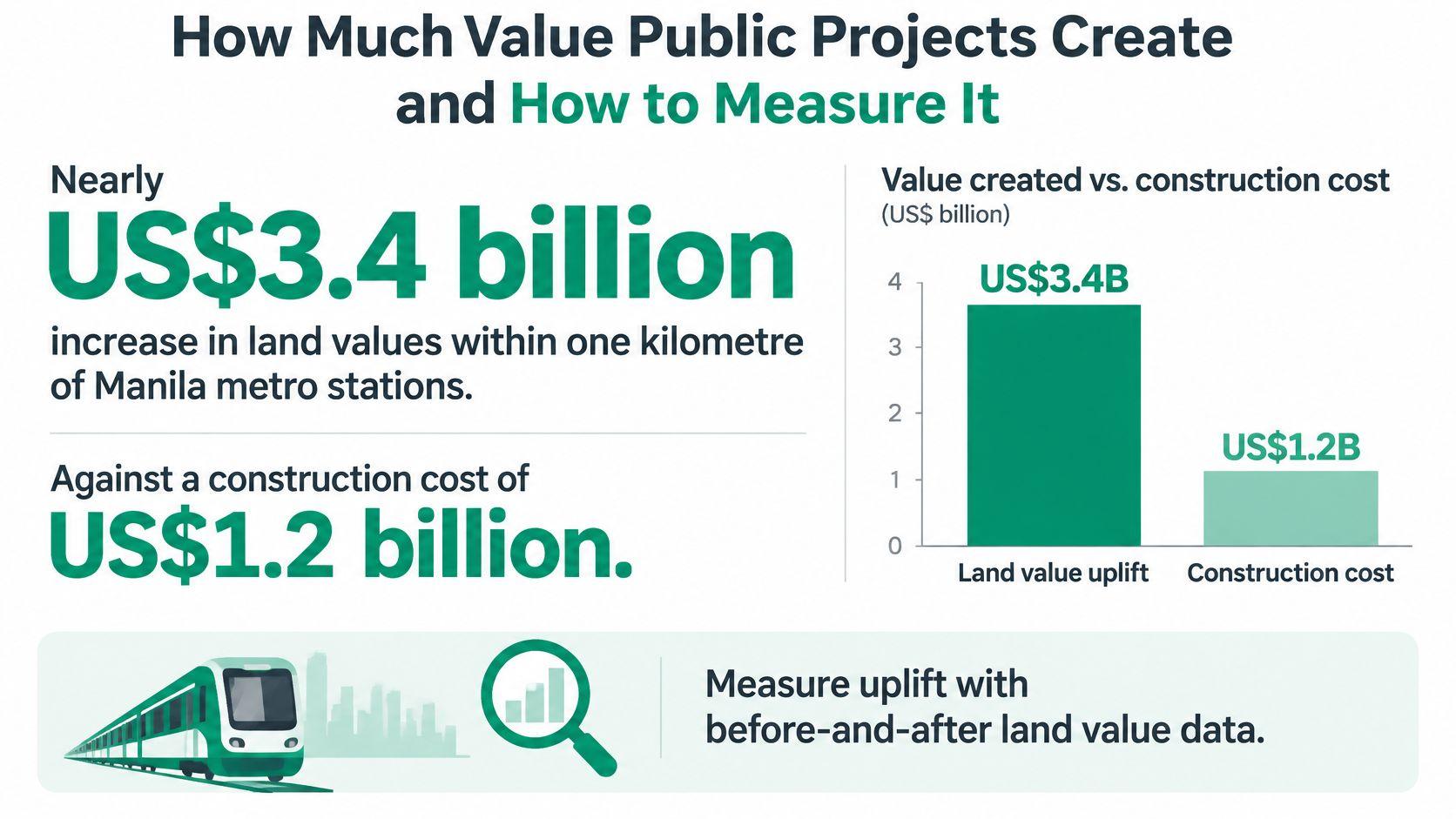
A single metro line can return several times its construction cost in land value alone. The OECD's land value capture note documents two cases where exactly that happened.
| Project | Land value uplift | Project cost | Uplift relative to cost |
|---|---|---|---|
| Manila metro line (built 2000) | nearly US$3.4 billion within 1 km of stations | about US$655 million | about 5.2 times cost |
| New York City Q subway extension (2017) | estimated US$5.5 billion | US$4.5 billion | about 122% of expenditure |
In Manila the project cost was roughly 19% of the measured uplift. In New York the land gain still exceeded what the city spent, at about 122% of expenditure. Public investment changed accessibility, development potential, and expected future rents, and nearby owners received gains they never paid for. A plain walk-through of land value uplift helps non-specialists see why the station, rather than anything the owner built, moved the price.
How analysts measure the increment
The capture target is the increment tied to the intervention. Charging against the entire post-project property value sweeps up value the owner created and invites a legal challenge.
- Draw a catchment and a control. Compare treated parcels inside a defined distance with similar parcels outside it.
- Fix the clock. Look before and after announcement, funding commitment, construction, and opening. Uplift often starts when the project becomes credible, not on opening day.
- Control the noise. Difference-in-differences or hedonic models can hold parcel traits, neighbourhood trends, spatial dependence, and pre-existing appreciation steady.
Timing decides both the measurement and the bill. A levy dated only to opening day misses gains that buyers already capitalized at the funding vote. A levy dated to a rumour taxes a project that may never be built.
These figures prove scale. Valuation boundaries, timing, ownership, exemptions, and administrative costs decide how much of the uplift you can actually collect.
Use the numbers to justify a complementary tool, such as a land-based charge, a betterment levy, or a development-right payment. Treating the full measured uplift as a collection target sets the program up to fail.
Design Choices That Make or Break Land Value Extraction
Every extraction system has two working parts: a defensible valuation of the site and a legal instrument that collects. Get either one wrong and the reform fails, even if the policy reads well. A defensible charge needs a current parcel-level registry, reliable ownership and development-rights records, a land-use baseline, and a model that estimates highest and best use separately from improvements. Skip any one of those and the bill becomes an argument about the map.
That data burden explains why infrastructure levies are so often announced and so rarely collected. Each disputed figure pulls in the same requirements: an up-to-date land registry, plot-level planning, skilled valuers, and a reliable method for separating land value from buildings. A 2025 study of Mexico City, discussed in the OECD's report on mobilising sustainable finance for regions and cities, adds a different warning. More computing power and more data have lowered the technical barriers, yet political obstacles still stop accurate assessments from being applied consistently. A good model in a drawer funds nothing.
The instrument matters as much as the valuation. Two tools can look identical on paper and behave differently over time. A lease with a rent fixed for decades works like a discounted sale of the freehold: the community-created gains flow to the leaseholder instead. A land-use right that reprices on a set cycle keeps those gains flowing back to the public. When officials compare options, the repricing clause matters more than the name printed on the instrument.
Who pays, and who gets pushed
Revenue isn't the same thing as a fair result. Where processes were obscure and citizen participation was weak, betterment levies and development charges produced overwhelmingly negative equity effects, while transfer taxes were more equitable but inefficient because they are volatile and have a limited base, as set out in the OECD's Netherlands housing-market survey. The captured value has to be attributable, visible, and reinvested in ways that protect tenants, small owners, and informal occupants.
Build these safeguards in before the first bill goes out.
- Incidence first: Show whether the charge stays with the landowner or gets passed into rents and sale prices in that market.
- Cash-poor owners: Use exemptions or payment deferrals so a long-time resident isn't forced to sell to pay a paper gain.
- Anti-displacement: Protect tenants and informal occupants when rezoning or a new line reprices the block.
- Visible earmarking: Spend the money on services residents can see, and publish the link between the charge and the project.
How accurate is accurate enough
What level of accuracy is sufficient for taxation, and how should errors be corrected without undermining legitimacy? Distinguish precision from fairness. A transparent, periodically updated estimate with due-process appeals tends to outlast an apparently exact valuation that nobody can inspect. A rough figure the owner can challenge on a known timetable collects more revenue, with less conflict, than a precise figure the owner can only fight in court.
Correct errors in public, on a known timetable, and publish the assumptions and the uncertainty ranges with the valuation product itself. Legitimacy survives an imperfect number. It rarely survives a secret one.
Choosing and Launching Your Extraction Method
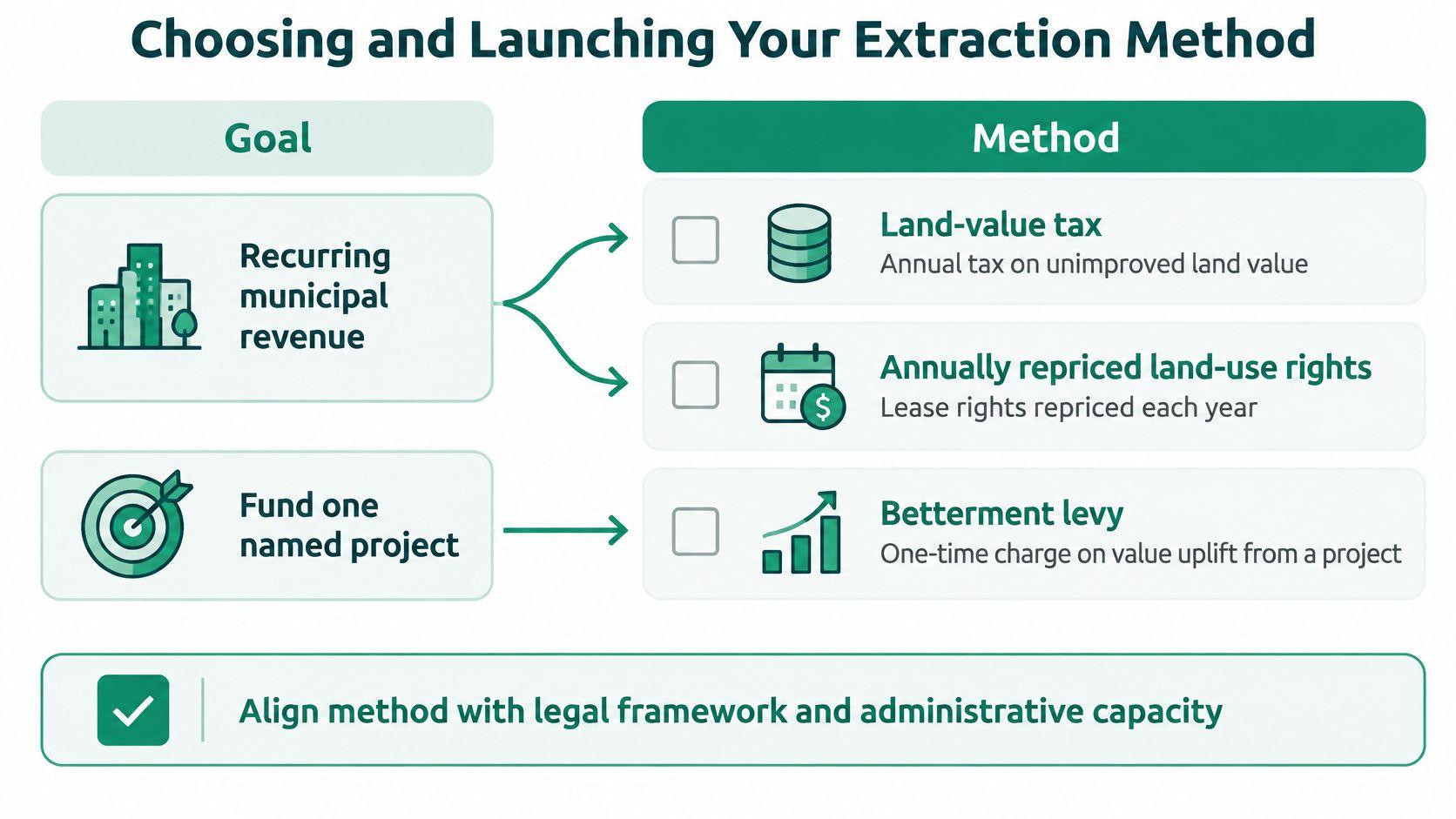
Match the instrument to the job, then to the office that has to run it.
- Recurring municipal revenue: Choose a land value tax or annually repriced land-use rights.
- One named project: Choose a betterment levy, developer obligations, or a development-rights charge.
- A large public landholding: Use leasing only with open eyes about renewal cliffs, or use land-use rights so the price stays current.
A launch sequence
- Map the land base and the value drivers with cadastre, ownership, and planning data.
- Calibrate the valuation models and publish the assumptions and uncertainty ranges.
- Match instruments to legal authority and to the revenue goal above.
- Model who gains, who pays, and what revenue is realistic before you lock a rate.
- Phase the transition, for example by starting with vacant or underused parcels. The transition requirements are mostly administrative, not rhetorical.
- Write appeals and the reassessment cycle into the law.
- Explain the reform in plain language to officials and to the public.
We work with governments, cities, and organizations on the concrete steps of putting a land-value approach into practice. That support covers assessing land values, designing the policies that collect them, and modeling who gains and who pays, alongside plain-language guides and interactive tools.
Capture the value the community created, and ease the taxes that fall on work and buildings.
Unitism® helps governments and cities measure site value, design the charge that collects it, and see who gains and who pays before a reform goes live. If you are choosing between a land value tax, a betterment levy, and annually repriced land-use rights, start with the plain-language guides and tools on Unitism®. Bring your cadastre questions and your legal constraints, and map a phased path that fits the city you administer.