Explore local economic development frameworks, land-value capture tools, and policy strategies for equitable, sustainable growth.
August 14, 2026
Local Economic Development: 2026 Policy Guide
Explore local economic development frameworks, land-value capture tools, and policy strategies for equitable, sustainable growth.

Local economic development gets oversold as a job hunt. A city announces a ribbon cutting, counts hires, and calls it success. That framing misses the harder question, which is whether the place is building economic capacity, improving quality of life, and keeping the gains local.
The stronger definition comes from the World Bank's LED primer, which treats local economic development as a process for organizing effort, defining indicators, collecting city-level data, analyzing that data, linking analysis to strategy, monitoring results, and keeping the work going (World Bank LED primer). That matters because local economies are granular, uneven, and full of trade-offs. OECD's regional and local statistics platform now covers over 225,000 municipalities and local areas with more than 100 indicators across 10 themes, which shows how serious this field has become as a comparative, data-intensive discipline rather than a slogan about growth (OECD regional and local statistics platform).
Table of Contents
- Redefining Local Economic Development Beyond Job Counts
- The Five-Stage Framework for LED Strategy
- Comparing Growth-Focused and Equity-Oriented Approaches
- Land-Value Capture and Land-Use Rights as Development Tools
- Designing Policy with Fiscal Impact and Stakeholder Engagement
- Real-World Case Studies and Measurable Outcomes
- Metrics Tools and Resources for LED Practitioners
Redefining Local Economic Development Beyond Job Counts
The default LED script still starts with attraction. Bring in a firm, celebrate the headcount, and assume the tax base will follow. That approach can work, but it often misses the harder question, whether a project strengthens the local economy in ways residents can feel.
A better test is whether development expands opportunity without pricing out the people who kept the place functioning in the first place. Brookings argues that many local strategies still lean too heavily on growth metrics, even when land-intensive projects fail to answer who benefits, who participates, and what gets measured (Brookings). That critique matters most in markets where a project can raise land values, intensify pressure on housing, and push benefits outward unless the policy design is deliberate.
how cities can harness positive urbanization to strengthen local outcomes only if the city treats growth as a means, not the finish line. In practice, that means looking beyond payroll announcements and asking whether wages are durable, whether ownership stays local, and whether public investment improves everyday access to work, services, and mobility.
Practical rule: if a project grows the tax base but weakens access, displaces small operators, or pushes workers farther away, it is not a clean success.
What should count instead
The evidence base points toward a broader scoreboard. The World Bank primer says practitioners should collect strategically important quantitative and qualitative data on production and employment, then set objectives that are time bound and measurable (World Bank LED primer). That fits the on-the-ground reality of local development better than a single headcount number.
A practical LED mandate should ask:
- Who gains? Residents, owners, renters, commuters, or outside investors.
- Who participates? New firms, incumbent businesses, workers, and community groups.
- What stays local? Land value gains, supplier spending, and public revenue.
- What improves? Access, stability, and service quality, not just gross output.
That shift matters because public policy often subsidizes growth that looks strong on paper but leaves the neighborhood economy weaker. Local economic development should be judged by whether it builds a place people can afford to stay in and invest in, not just a place firms can enter.
The Five-Stage Framework for LED Strategy
Local economic development works better when the sequence is disciplined. The World Bank's five-stage model keeps the work grounded, organize the effort, conduct a local economic assessment, develop the strategy, implement it, and review it (World Bank LED primer). Cities that skip that order usually end up with scattered initiatives, weak accountability, and a strategy that looks sound on paper but breaks down against land markets, permitting bottlenecks, or limited staff capacity.
The assessment stage carries the most weight. The primer is explicit about gathering strategically important quantitative and qualitative information, auditing the data already in hand, identifying gaps, and then setting objectives that are measurable and time bound. That is where many municipal strategies fall apart. Teams either rely on anecdotes, or they collect so much information that it never gets translated into decisions. A useful assessment also pays attention to land-use rights and the physical setting of development, including approaches such as designing with nature, because site constraints and environmental conditions often shape what can be built.
What to measure first
A serious diagnostic starts with a compact indicator set. The National League of Cities groups land use, zoning, land values, vacancy rates, and infrastructure condition as core physical-condition metrics for economic development analysis, alongside labor-market and business variables such as new business starts, closures, sector location quotients, shift-share changes, participation, wages, and commuting (National League of Cities). The point is not to assemble a giant spreadsheet. The point is to see what is holding growth back.
That same logic shows why industrial land, permitting, freight access, and workforce geography have to be assessed together. If land is scarce, approvals are slow, or workers cannot reach sites efficiently, development costs rise and expansion slows. A city can speak the language of growth and still block growth through its own land and process choices.
The OECD example of Prospect Leicestershire shows that LED organizations can be managed against key performance targets, not just mission statements (OECD LED organising volume). That kind of discipline matters. Local governments need a team, a scorecard, and a review cycle that changes behavior.
How the stages work in practice
The organize stage is about authority and roles. The assessment stage is about evidence. Strategy development should connect findings to a small set of interventions, not a wish list. Implementation needs named owners, and the review stage needs enough honesty to stop what is not working.
Local economic development fails fastest when no one owns the land questions, the data questions, and the follow-through at the same time.
Comparing Growth-Focused and Equity-Oriented Approaches
A city can post strong project announcements and still miss the point if the gains never reach residents who live with the consequences. I have seen this most clearly in places where a new district, transit investment, or redevelopment package looks successful on paper, while nearby households face higher rents, weaker local ownership, or limited access to the jobs created.
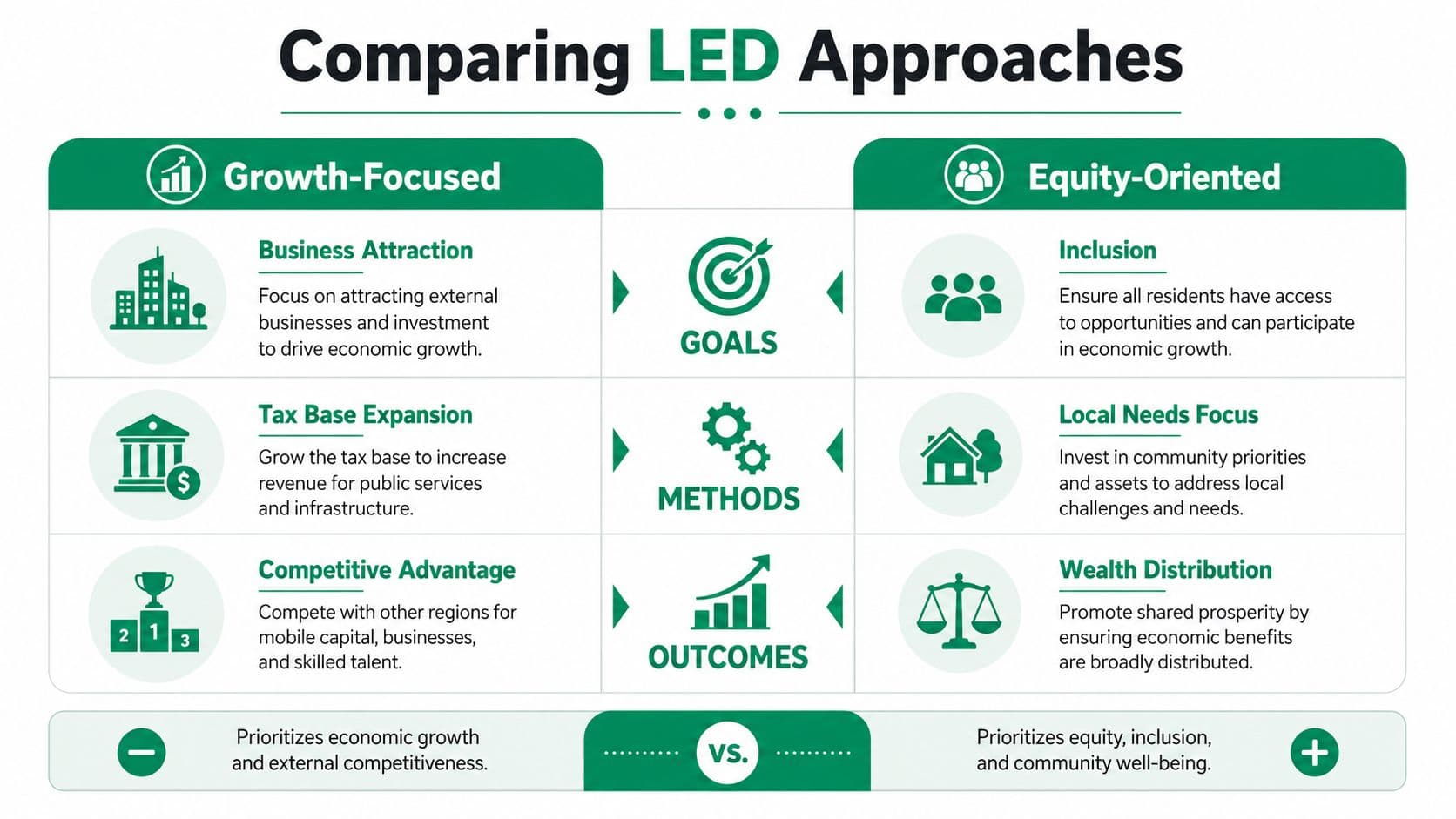
Growth-focused LED usually starts with attraction, expansion, and the tax base. Those goals matter, but they can hide a weak distributional result. Equity-oriented LED starts by asking who benefits, who is left out, and whether the public is building local capacity rather than only adding activity.
The practical difference shows up in the questions a city asks before it commits money, land, or zoning changes. A growth-first review often stops at jobs, permits, and private investment. An equity-oriented review also asks whether the project improves housing stability, local ownership, and community bargaining power. That is the harder test, but it is the one that tells you whether development is strengthening the place or just moving value through it.
Where the trade-offs show up
High-cost cities feel the trade-off immediately. A project can pencil out for the developer and still push out the people the policy was meant to help. That is why the Lincoln Institute's look in, lock approach is useful, because it keeps the focus on local assets, community-centered strategy, and stability rather than speculative extraction (Lincoln Institute). In practice, that means asking whether the project helps the existing community stay in place and participate in the gains.
Policy choices are sharper than they first appear. If a city measures only permits and payroll, it will reward projects that are easy to announce. If it also measures inclusion, housing access, and local retention, it will make different calls on subsidies, zoning, and infrastructure. That is not a philosophical point. It changes which deals get approved, which incentives are offered, and which sites get prepared first.
A practical comparison looks like this:
- Growth-focused metrics reward volume, speed, and tax-base expansion.
- Equity-oriented metrics reward access, local participation, and the distribution of gains.
- Growth-focused projects often assume benefits will spill over.
- Equity-oriented projects test whether those benefits stay in the community.
Distributional analysis helps local governments see who pays and who gains, which is the right lens when public land, zoning, and infrastructure shape the upside. Without that lens, cities can end up celebrating activity while missing who absorbed the costs and who captured the value.
Land-Value Capture and Land-Use Rights as Development Tools
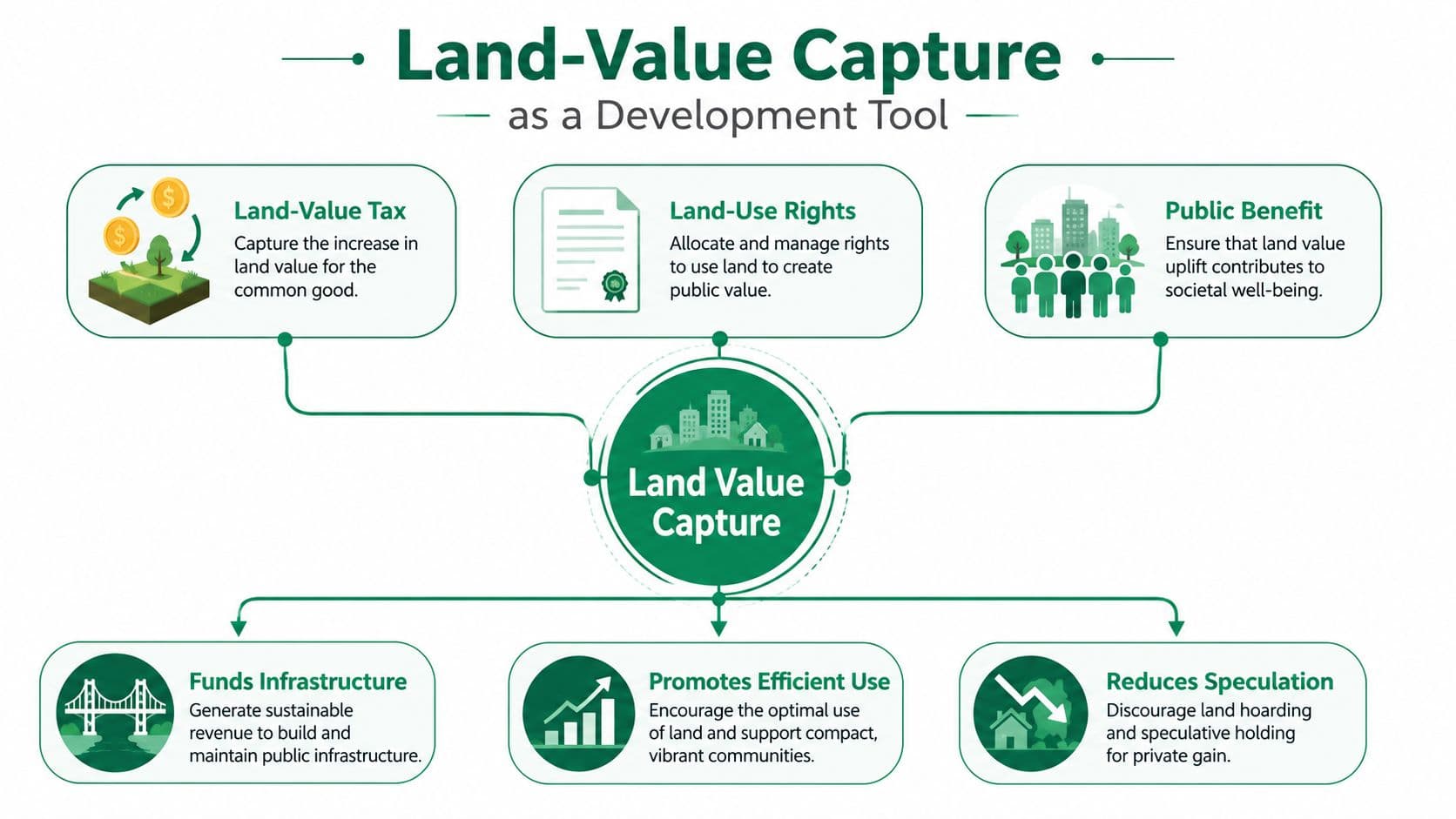
Local economic development gets stronger when cities stop taxing the very activity they want to see more of. If a municipality leans too hard on taxes that fall on work, construction, or productive investment, it can slow hiring, building, and reinvestment. Land-value capture changes that incentive structure by linking a larger share of public revenue to the value of location, not to effort or improvement.
Land-value taxes and land-use rights belong in the same discussion because they address related problems through different policy tools. A land-value tax charges for the site value of land. Land-use rights are land leases that are repriced annually with no expiration dates, and because they are repriced annually, people can buy and sell those rights for a low cost. The difference matters in practice. One is a tax instrument, the other is a tenure structure, and both can reduce speculative holding when they are designed with care.
The clearest use case is underused land in places where demand is real but parcels sit idle. When holding land becomes more expensive than putting it to work, owners have a direct reason to build, lease, or sell. That is how reform can support more infill and less land banking without relying on vague promises of growth.
If you are comparing policy options, read the Unitism guide on how land-value capture mechanisms work in practice. The design principle is straightforward, capture part of the value created by the community and direct it back into public benefit.
Why land and labor should not be taxed the same way
Tri-factor economics separates labor, capital, and nature, which helps policymakers see why a land-based charge can be less distortionary than taxes on wages or buildings. When a municipality taxes improvements more heavily, it can penalize construction and maintenance. When it taxes land value more directly, it shifts more of the burden toward the uplift that comes from location, infrastructure, and surrounding public activity.
That logic is not theoretical. The publisher's evidence base points to documented precedents from Denmark, Estonia, Singapore, Alaska, Canberra, Norway, and Allentown as part of the broader land-value reform conversation. The point of those precedents is not that one city can copy another's model. It is that cities can set up systems that discourage speculation, support infill, and provide a steadier revenue base for services.
A few practical effects usually follow:
- Idle sites become costlier to hold.
- Well-located parcels are more likely to be used.
- Public revenue can be tied more closely to place value.
- Taxes on productive activity can be reduced when reform is phased carefully.
The trade-off is political, not technical. Land-value reform changes who benefits from rising location value, and that always creates resistance. But if the goal is local economic development that improves access, affordability, and fiscal stability, the policy deserves serious consideration.
Designing Policy with Fiscal Impact and Stakeholder Engagement
Good policy design starts with the question officials often avoid, who pays, who gains, and how fast can the system move without breaking? Land-value reform, zoning change, or a new capture mechanism only survives if leaders can show the revenue effects, the groups affected, and the administrative load in a way that holds up in public.
The technical side comes first. Administrative teams need legislative drafting, process design, cadastre integration, and compliance workflows that match the policy intent. If the property register is weak, the valuation method is opaque, or collection rules are unclear, the reform will stumble even when the politics look favorable.
The public side matters just as much. Civil servants, elected officials, and community stakeholders need training that explains the policy in plain language. Public-facing materials, FAQs, visual aids, and short explainers narrow the gap between a policy memo and public trust.
Unitism® supports land valuation assessments, policy design, distributional and fiscal impact modeling, implementation support, and educational materials for land-value reform. That kind of support matters when a city wants the reform to be administratively real, not just attractive on paper.
Implementation rule: do not launch a land policy until the valuation method, appeals process, cadastre data, and public communication plan all line up.
What a workable transition includes
A phased transition should be built around administrative readiness, not just ideology. Some places can move quickly on valuation updates or fee structures. Others need a slower path because data systems are fragmented or public understanding is limited.
The safest path is to model several outcomes before adoption. That means testing how the policy affects different property classes, identifying where resistance will come from, and deciding what to simplify before rollout. It also means being honest about trade-offs. A reform that protects existing owners too aggressively may keep political peace but weaken the policy. A reform that moves too fast may trigger backlash and lose the chance to stick.
Stakeholder engagement works best when it is tied to decisions, not staged as a formality. Residents need to see how land-value capture can support streets, transit, drainage, or public space, and they need a credible explanation of how land-use rights will change. If the city cannot explain the benefit, people will assume the reform is only another way to raise revenue.
As noted earlier in the article's discussion of implementation design, the World Bank primer on local economic development and the OECD organizing volume on LED both help frame the institutional side of reform. The practical lesson from those sources is straightforward, policy design has to fit local capacity, and local capacity has to be built into the rollout plan rather than assumed.
The strongest transition plans also include a clear appeals process and a simple escalation path for disputes. That does not remove conflict. It gives property owners, staff, and elected officials a channel for handling it before frustration turns into delay.
The primary objective is durability. A local development policy is only useful if the city can explain it, collect it, review it, and adjust it without constant crisis management.
Real-World Case Studies and Measurable Outcomes
The strongest local development cases usually share a scale that can be governed. A detailed review of work in deprived areas found that successful change is most likely in communities of 5,000 to 15,000 people, when local people control decisions and resources, and when the effort is sustained for 10 to 15 years (Achieving local economic change). Larger places can still do the work, but the governance burden grows quickly as scale increases.
That same source points to a basic civic infrastructure, a meeting space, at least one community association, and a core of actively engaged residents. Those are not decorative features. They are the mechanisms that keep a place moving when leadership changes, funding is delayed, or a project runs into public resistance.
Why durable change needs local control
Communities that own the decision-making process are more likely to keep priorities aligned over time. Comprehensive and customized interventions also matter because local development rarely fails for one reason. Jobs, transit, land use, small business support, and external market access tend to interact, and a reform that ignores one of those links usually underperforms.
The OECD's discussion of Prospect Leicestershire is useful because it builds explicit performance targets into organizational management, which shows how local economic development can be judged against place-specific goals rather than generic aspiration (OECD LED organising volume). That kind of specificity changes the conversation. Once targets exist, staff can track progress, boards can intervene, and the public can see whether the strategy is working.
A few patterns show up in effective cases. Community infrastructure comes first. Local control prevents drift. Outside connections expand opportunity. Long timelines beat one-off projects.
The fiscal lesson matters too. The UK National Audit Office reports that between 2011 and 2020, the government committed about £18 billion of domestic funding to policies designed to stimulate local economic growth in England, including £12 billion through the Local Growth Fund and £3.2 billion through the Regional Growth Fund. It also says a further £10.3 billion went to the UK through EU structural funds during that period (National Audit Office). Those figures show the scale of public commitment, but they also point to the hard truth, money alone does not produce durable local change.
What separates stronger cases from weaker ones is usually not the headline grant or the ribbon-cutting. It is whether land-value capture is tied to visible public benefits, whether land-use rights are clear enough for private actors to invest, and whether residents can see that growth is being translated into better access, better services, and a fairer distribution of gains.
Metrics Tools and Resources for LED Practitioners
A usable LED dashboard is narrow enough to drive decisions and broad enough to show how the local economy works. Start with new business starts and closures, sector location quotients, shift-share changes, labor-force participation, wages, commuting, land values, zoning, vacancy, building activity, and infrastructure capacity. That mix shows demand, supply, access, and constraint without drowning staff in indicators they cannot act on.
A practical tool for separating site value from building value in land-value reform scenarios is a practical tool for calculating site-specific land values. Pair it with the OECD regional and local statistics platform, which covers over 225,000 municipalities and local areas and more than 100 indicators across 10 themes (OECD regional and local statistics platform). Used together, those tools support benchmarking, but only if the city keeps the indicator set disciplined and resists the habit of tracking everything.
What practitioners should keep on hand
A practical resource stack should include:
- Core indicators for labor, business, land, and infrastructure.
- Assessment tools for data audits and gap analysis.
- Valuation methods for site value and land-market comparison.
- Public explainers that help residents understand the policy logic.
- Scenario tools that show how different choices affect outcomes.
For the strategy side, the World Bank LED primer remains useful because it connects measurement, strategy, and review. The lesson for practitioners is straightforward. Data is not the point, decision quality is. If the city cannot use the numbers to change zoning, target infrastructure, or redesign fiscal policy, the dashboard becomes decoration instead of a management tool. That is also where the trade-off shows up most clearly, a city can build a detailed dashboard and still miss the political work of using it to justify land-use change and land-value capture.
If you are building a local economic development system that has to hold up in practice, the best resources are the ones that help you compare places, test assumptions, and explain why growth should show up in public benefits, not just private gains.