Learn how main street programs revitalize historic downtowns, what outcomes they achieve, and how land-value tools can support and scale their work.
October 19, 2026
Main Street Programs Explained: A Practical Guide
Learn how main street programs revitalize historic downtowns, what outcomes they achieve, and how land-value tools can support and scale their work.

Main Street America's network has worked with more than 2,000 communities and reports approximately $124.67 billion in local reinvestment over time (Main Street America's collective-impact figures). Those totals show the scale of the movement, but they don't tell a city official whether a particular program caused local growth, who benefited, or how a town can sustain the work after grants end. Understanding Main Street programs means looking at both the local organizing model and the fiscal choices that shape a downtown's future.
Table of Contents
- What Main Street Programs Are
- How the Main Street Approach Began
- The Four-Point Approach in Practice
- Evidence on Outcomes and Trade-Offs
- The Hidden Question of Who Benefits
- Land Leases, Land-Use Rights, and Land-Value Taxes
- Funding, Governance, and Scale Options
- Putting It All Together for Your Downtown
What Main Street Programs Are
A Main Street program is a locally managed approach to revitalizing a historic commercial district. It coordinates work that might otherwise happen as disconnected projects: supporting businesses, maintaining historic buildings, improving public spaces, and bringing people downtown. Main Street America provides a national network and framework, while state coordinating programs help communities adapt that framework and provide local support.
The distinction matters. A grant can pay for a façade upgrade or a street event, but by itself it doesn't organize the business owners, residents, property owners, and public agencies needed to keep the district functioning. A one-off beautification project may improve a block without addressing empty storefronts or weak business recruitment. A Main Street program works like a district's general contractor: it doesn't perform every task itself, but it makes sure the tasks happen in the right order under sustained local leadership.
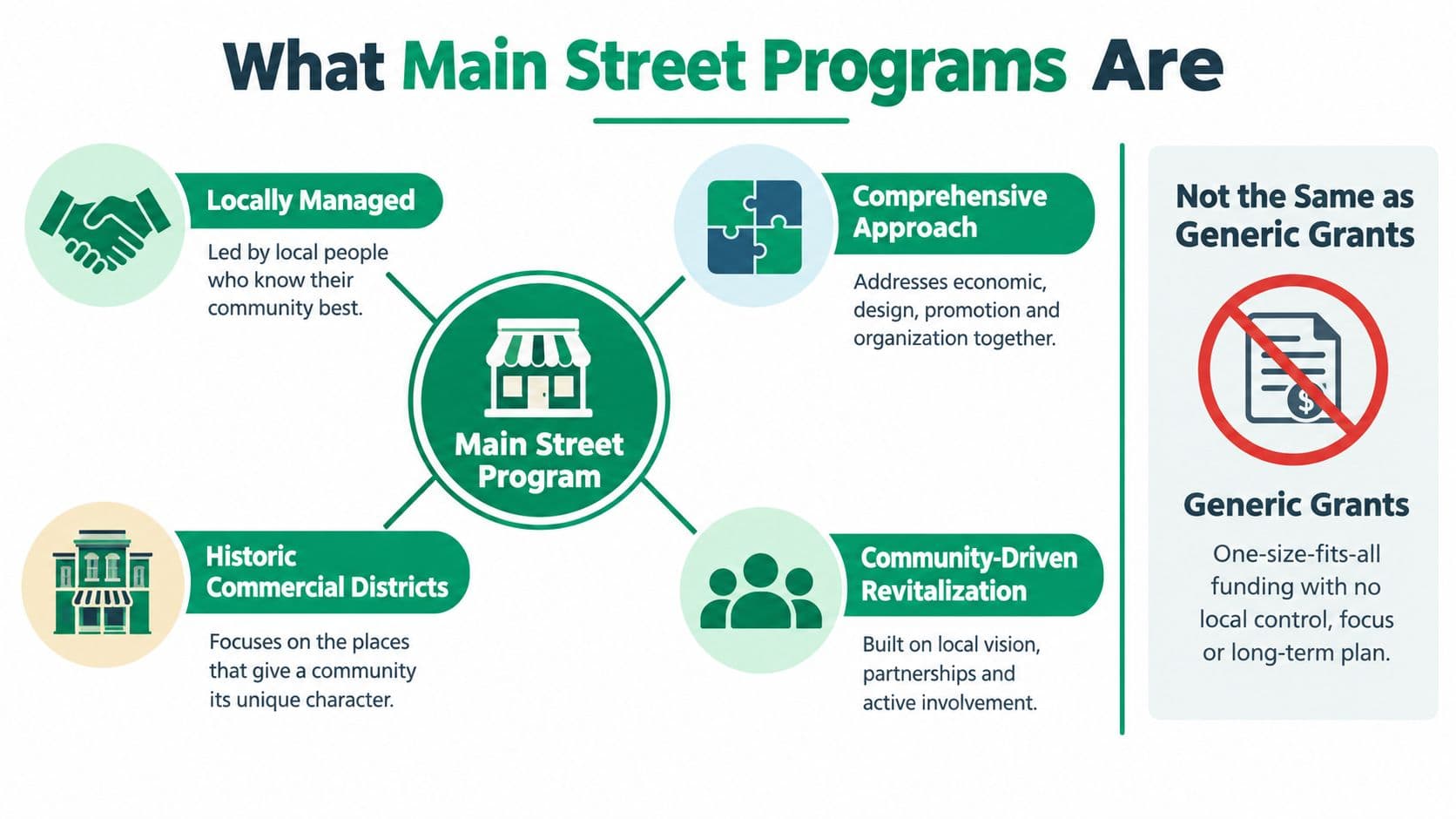
A local program is commonly run by a nonprofit organization, a municipal office, or a public-private partnership. Its board and committees may include merchants, building owners, residents, civic organizations, and local government. The program's job is to set priorities, coordinate partners, and turn broad goals into practical tasks.
You can recognize a Main Street program by its place-based focus and ongoing coordination. It works within a defined commercial district, brings local stakeholders into decision-making, and links preservation with business activity and public-space improvements. It doesn't promise that every storefront will succeed or that designation alone will create jobs. It offers a repeatable way to organize local effort, then leaves the community responsible for choosing goals and testing results.
The organizing model also has a boundary worth naming early. A Main Street program coordinates people, but it does not set the tax base, write the leases, or decide who holds land-use rights under the district. Those choices sit in municipal finance and land policy, and they shape whether rising downtown values strengthen the local revenue base or raise costs for the businesses the program helped recruit. Keeping that boundary clear shows a city official what the framework delivers on its own and where it needs a fiscal partner.
The useful question for a new city official isn't "Can we get a grant?" It's "Can we organize a durable local effort, measure who benefits, and pay for the work over time?"
How the Main Street Approach Began
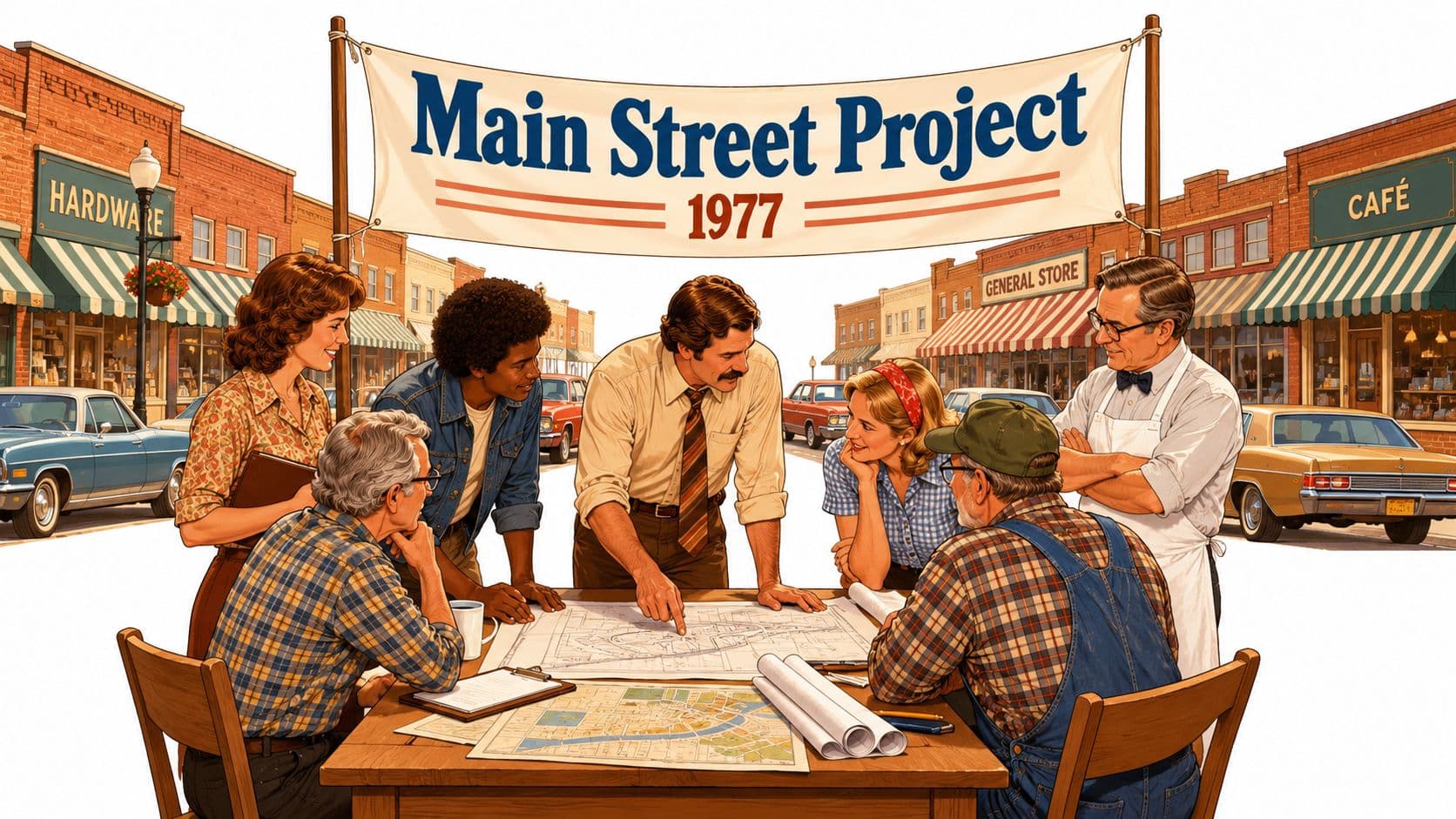
The modern Main Street movement began as a response to declining historic commercial centers. In 1977, the National Trust for Historic Preservation launched a demonstration project in three Midwestern communities: Galesburg, Illinois, with approximately 38,000 residents; Hot Springs, South Dakota, with about 5,000; and Madison, Indiana, with roughly 13,000 (the movement's history).
The range was intentional. The pilot asked whether locally managed downtown revitalization could work in places with very different populations and conditions, or only in large cities with extensive technical and financial resources. A demonstration of that size works like a field trial: small enough to watch closely, varied enough to test whether the method travels. Over three years, the communities combined historic preservation, economic development, local organization, and promotion into one coordinated effort.
Why the pieces were joined
The pilot's central lesson was organizational. A historic building doesn't become a thriving business just because someone repairs it. A marketing campaign can bring visitors to a district, but without active businesses and welcoming public spaces, those visitors may not return. Downtown revitalization requires complementary decisions made by people who can coordinate across property, business, civic, and government responsibilities.
The National Trust's history records substantial turnarounds in the three pilot communities, helping demonstrate that downtown revitalization could be approached as a repeatable framework rather than as a collection of isolated building projects. The lesson was narrower than a promise of identical results for every town. It showed that preservation could be connected to business recruitment, public-space improvements, local leadership, and reinvestment.
From demonstration to national network
After the pilot's success, the National Trust founded the National Main Street Center in 1980 and expanded the framework nationally. That institutional step gave local communities a way to learn from a shared approach while adapting it to their own districts.
The origin story explains why Main Street programs treat a district's historic fabric, businesses, public spaces, and local leadership as connected parts of one system. That combination remains the model's defining feature.
The demonstration also left a fiscal question open. The 1977 design organized people around buildings and businesses, yet it said little about who held the land beneath the district or whether rising site values would return to the public revenue that keeps revitalization funded. The mechanics of land leases and land-use rights sat outside the original framework, and they still shape whether a successful district strengthens its own fiscal base over time.
The Four-Point Approach in Practice
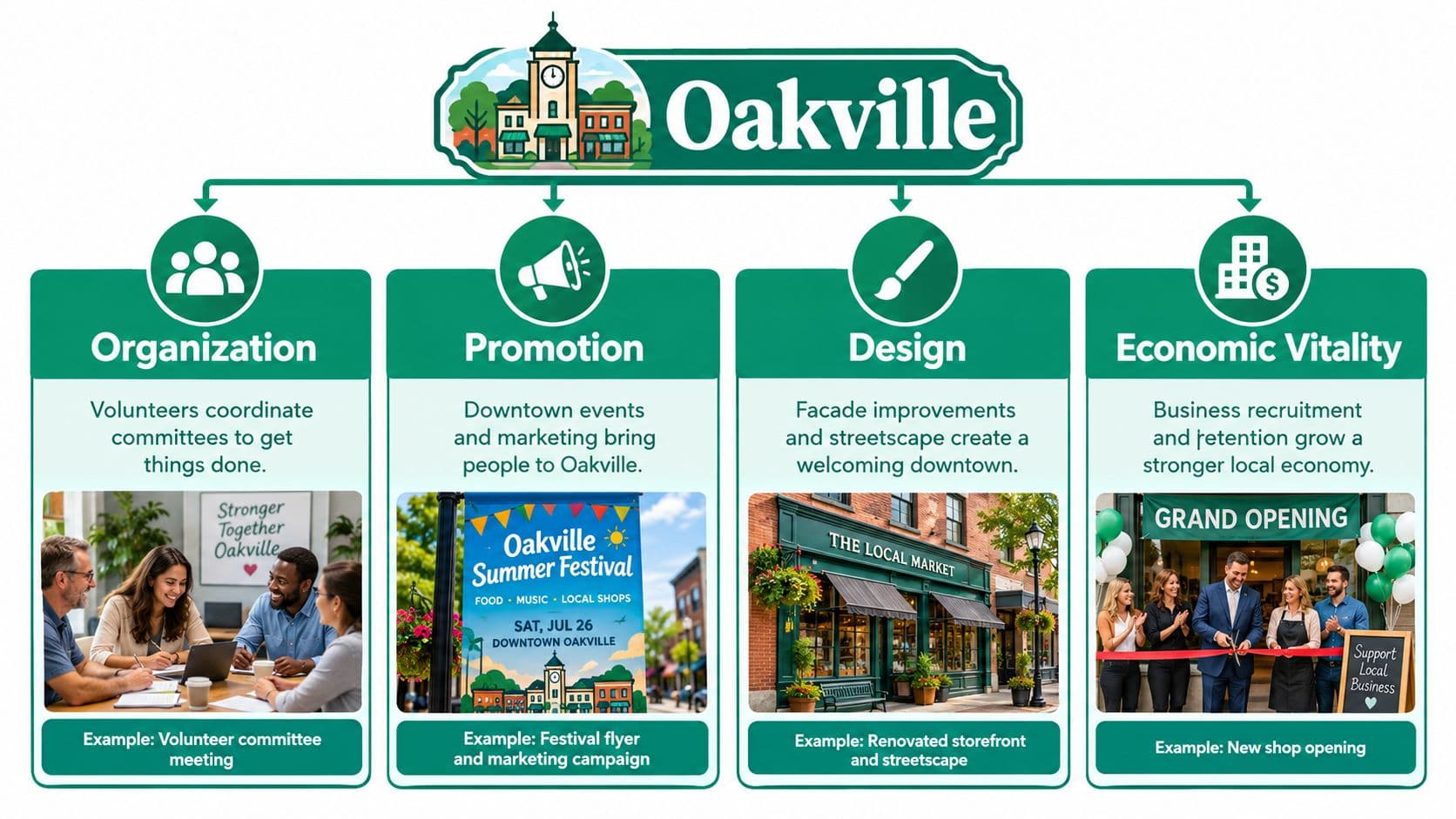
Consider Oakville, a fictional small town with a historic downtown, a few vacant storefronts, and residents who want the district to feel active beyond the workday. The Four-Point Approach gives local leaders a way to divide the work without losing sight of how the pieces fit together.
Organize people before projects
Organization is the coordination layer. Oakville's program manager might convene merchants, property owners, residents, and town staff, then establish committees with clear responsibilities. In the program's first year, the practical tasks include agreeing on the district's boundaries, setting priorities, identifying who can approve decisions, and making sure volunteers aren't carrying duties that require paid staff.
Promote a reason to visit
Promotion gives people a reason to spend time downtown. Oakville could build a seasonal events calendar around local shops, restaurants, and cultural spaces. A festival flyer is useful only if merchants know what to expect, visitors can find accurate information, and the program can tell whether events help businesses rather than just draw crowds.
For ideas on planning public-facing activity, a guide to downtown street activation strategies can help a town think through how events, seating, and other uses make a street feel welcoming. Promotion works best when it reinforces the district's businesses and identity instead of becoming a separate events operation.
Improve the setting people experience
Design covers buildings and public space. Oakville might create a façade program, encourage owners to repair storefronts, and identify pedestrian improvements with the town's public-works team. The program manager's early decisions include setting transparent design standards and making sure incentives support useful improvements rather than cosmetic work alone.
Strengthen business activity
Economic vitality focuses on business recruitment, retention, and adaptation. Oakville could maintain a pipeline of prospective tenants, learn what existing merchants need, and match vacant spaces with businesses that fit local demand. The principles of smart growth can help officials assess how downtown investment connects to broader land-use decisions.
A single strategy can't do all of this. A festival without business support may generate activity without lasting commercial strength. Façade work without organization may leave gaps in coordination, and recruitment without promotion may fail to bring customers through the door. The four points are most useful as a management tool: they help the program identify missing work and decide what to tackle first.
Evidence on Outcomes and Trade-Offs
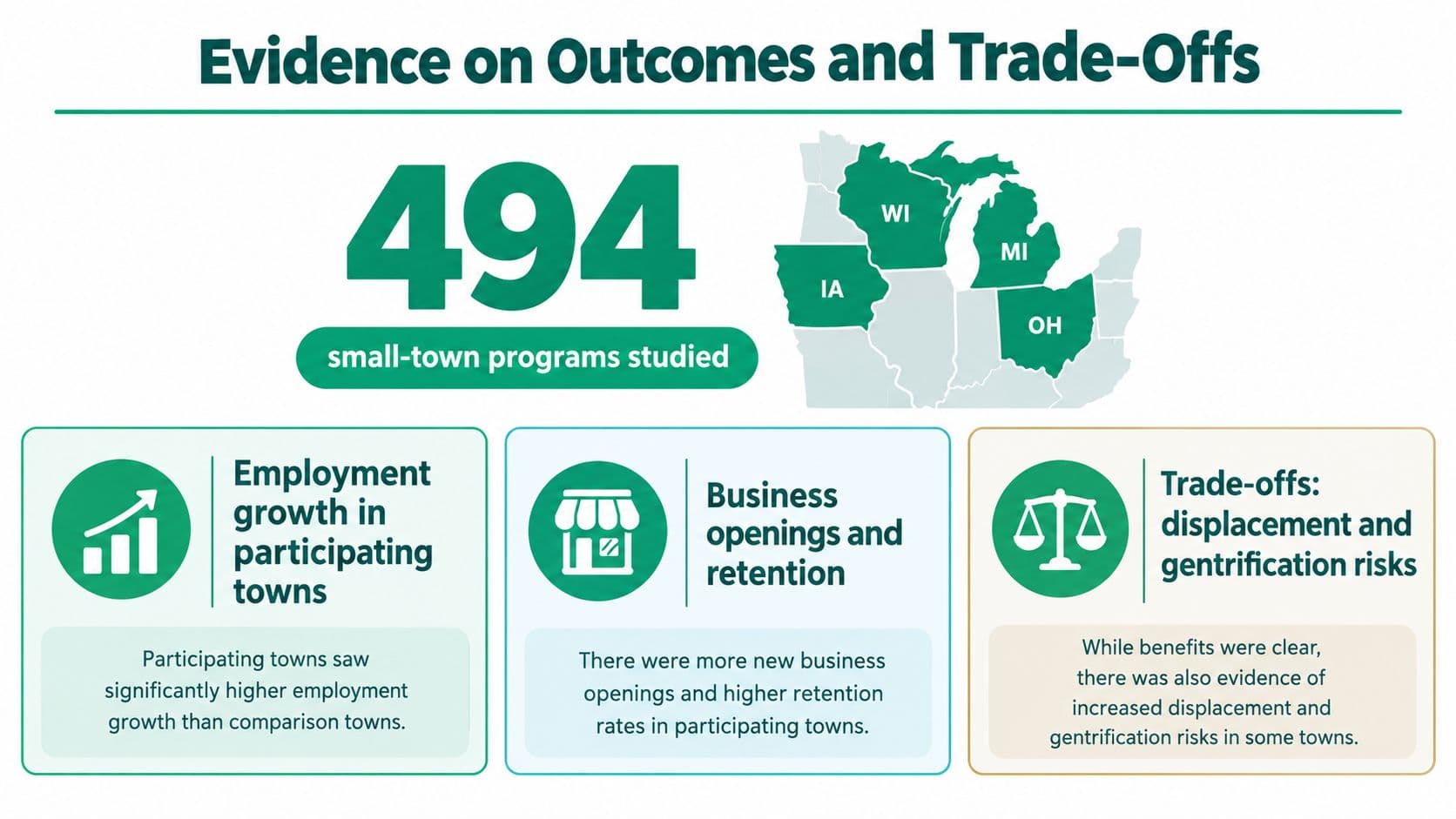
The strongest local evidence comes from a quasi-experimental evaluation of 494 small-town Main Street programs launched between 1997 and 2019 in Iowa, Michigan, Ohio, and Wisconsin (the evaluation's summary). Quasi-experimental means the researchers matched program towns with similar non-program towns and compared their paths, so the design tests cause rather than just recording activity. In the strongest reported result, participation was associated with approximately 20 additional downtown retail jobs per 1,000 residents, two additional downtown businesses per 1,000 residents, and about $650 more in taxable retail sales per resident during the five years after launch.
The same evaluation found no substantial effect on job creation or business formation in three of the four states. That contrast matters. If the designation itself did the work, results would look similar across states. The uneven pattern instead points to local conditions and implementation quality, and it cautions against promising a council a specific return.
Separate activity from causal impact
Main Street America publishes large cumulative totals for reinvestment, jobs, businesses, and building rehabilitation across its network (collective-impact figures). Those totals answer a different question. A program report is a ledger of what happened in participating communities; a controlled estimate tests what would have happened without the program. Reading the first as proof of the second overstates the evidence, even when the underlying work is sound.
For a local evaluation, set a baseline before launch and compare the district with a credible matched area. Track retail jobs, business births, taxable sales, vacancies, building rehabilitation, and public spending over several years, separating district-level change from regional trends.
Practical rule: Tell funders what the program did, then distinguish that from what the evidence shows it caused.
Street-level activity belongs in the same test. Cities piloting events, seating, and pedestrian changes can adapt downtown street activation strategies, and the evaluation should check whether that activity produces durable business outcomes rather than attendance alone. Public improvements can also raise nearby site values. Whether the public recaptures any of that gain depends on how the city prices the land beneath the district, which is why land-value uplift deserves its own line in local measurement, tracked separately from proof of program impact.
The Hidden Question of Who Benefits
A downtown can look healthier while some of its existing businesses struggle to stay. Main Street America's 2024 figures report $7.65 billion in reinvestment, 6,324 new businesses, 33,835 jobs, and a $21.73 reinvestment ratio (the 2024 collective-impact announcement). Those totals describe the scale of activity. They leave open who owns the new businesses, what the new jobs pay, and whether long-standing merchants can still afford their leases.
The reinvestment ratio deserves a careful reading. It divides total reinvestment by program operating costs, so it reads like a multiplier on the program budget rather than a causal return on public spending. Officials still need to ask whether grant access is equitable, whether commercial rents are rising, and whether public improvements make it harder for lower-income entrepreneurs or minority-owned businesses to enter or remain in the district. Where the gains land also depends on how the city charges for the ground beneath the storefronts. Public investment that raises site values can flow to landowners, to tenants, or back to the public, and the pricing arrangement decides which.
Measure distribution, not just output
A count of renovated buildings or new storefronts says little about who gains. A stronger local dashboard can track business ownership, worker wages, commercial rent burden, vacancy duration, business survival, public subsidy, and neighborhood demographics. These measures show whether investment is broadening opportunity or concentrating benefits among property owners and better-capitalized entrants. A framework for distributional analysis can help a city organize those questions before choosing what to measure.
Capacity is part of the equity question
Distribution has a second, quieter dimension: whether the program itself can keep working. Recent assessment data indicates that 49% of programs had a full- or part-time director, 56% had detailed action plans, and 79% had defined economic strategies, while 97% received municipal financial or in-kind support (the annual-assessment discussion). Staffing, planning, and municipal backing are equity questions in their own right, because a thinly resourced program tends to serve the businesses that already know how to find it.
North Carolina's 2025 program activity illustrates the role of technical support and public capital: rural planning work involved 35 communities, while 12 grants totaled $6.18 million. No single town can read its own staffing needs out of statewide totals, but the pattern explains why volunteer energy alone rarely sustains implementation. Before counting openings and construction, ask whether existing merchants can stay, who has access to assistance, and whether the local organization has the capacity to keep measuring results.
Land Leases, Land-Use Rights, and Land-Value Taxes
A land-value tax is a recurring public charge based on the value of a site, rather than a charge on the buildings or business activity placed on it. It's useful to distinguish that tax from a land lease, and both from a land-use right. The terms describe different arrangements, even when public discussion uses them loosely.
A fixed-term land lease gives the leaseholder use of land for a defined period at a fixed contractual price. It may be renewable or non-renewable. A renewable lease offers some certainty during its term, but when the term ends, a gap between the old rate and current market conditions may be closed in a single major repricing. A non-renewable lease can become progressively harder to refinance or sell as its expiry approaches. In either case, a fixed price doesn't continuously track changing site value. It postpones the repricing risk rather than eliminating it.
A land-use right, as used here, is indefinite and has no expiry. It requires no renewal and is repriced each year. Because the right doesn't depend on a fixed-term renewal event, holders can buy and sell it at low cost. Annual repricing keeps the charge connected to current land value, while the indefinite holding structure avoids burdening entrepreneurship and other productive enterprises with a looming lease expiry. A fixed lease doesn't become a land-use right just because someone calls it one. It must be repriced each year, require no renewal, and not expire.
A fixed-term example and the valuation problem
Hong Kong's government lease rules show the difference. Applicable leases are extended for 50 years after expiry without an additional premium, but owners then pay annual government rent equal to 3% of the property's annually assessed rateable value (Hong Kong's lease-extension rules). The annual rent is a separate feature; it doesn't erase the original fixed term or make the arrangement an indefinite land-use right.
A land-value tax, in contrast, depends on recurring assessment. A University of Reading study identifies annual revaluation as an ideal approach and discusses a compromise of five-yearly formal revaluations with annual indexation based on aggregate transaction data (the land-value-tax implementation study). The IMF's review describes a system with legal reassessments every five years and a practical rule of reassessment every three years, emphasizing the need to keep assessments current (the IMF review of land-value taxation).
For a city, the administrative issue is clear: site-value policies need credible, current valuation data. Officials considering charges tied to a district can also learn how special assessment districts for property owners are structured, while recognizing that a special assessment and a land-value tax are distinct instruments.
Funding, Governance, and Scale Options
A Main Street program needs an operating base as well as project money. A town can combine a municipal budget line, business-district assessments, state coordinating-program grants, façade incentives, and federal preservation funding. Each source has different conditions: grants may support a specific project, while ongoing staff coordination requires revenue that arrives predictably.
Governance should match the town's capacity and accountability needs. A nonprofit 501(c)(3) can draw on community participation and pursue eligible charitable funding, but it needs board oversight and reliable administration. A municipal department can connect the work directly to planning, public works, and economic development, though its priorities and budgets depend on city processes. A public-private hybrid can coordinate across sectors, provided its roles and decision-making rules are clear.
Match revenue to the job
Use one-time funds for defined improvements, such as a façade project or a streetscape upgrade. Use recurring revenue for staff, business support, data collection, and ongoing coordination. A site-value charge that is assessed regularly can offer a more stable basis for operations than transaction taxes that rise and fall with sales activity or grants that end when a project closes. Cities comparing options should also consider broader municipal revenue sources and how each affects local businesses and property owners.
| Instrument | Pricing Mechanism | Renewal Required | Risk Pricing | Best Fit For |
|---|---|---|---|---|
| Fixed-term land lease | Contractual price set for a defined term | Yes, if continued use depends on renewal or extension | Price risk is postponed until repricing or expiry | Defined-term occupancy where parties accept renewal risk |
| Land-use right | Site value repriced annually | No | Recurring pricing tracks changing site value | Indefinite use with regular site-value pricing |
| Land-value tax | Public charge based on assessed site value | Not a lease renewal | Depends on how often assessments are updated | Recurring public revenue tied to land value |
A funding plan should make the trade-offs visible. Ask which costs are recurring, which revenues can support them, who pays, and how the program will report results. Don't assume a new assessment or district charge is fair just because it is recurring. Define its purpose, valuation method, governance, and protections before implementation.
Putting It All Together for Your Downtown
A city official can turn the framework into a practical starting checklist:
- Confirm local fit: Identify the commercial district, its stakeholders, and the problems the program is meant to address.
- Agree on evidence first: Set baseline measures and choose a matched comparison area before claiming impact.
- Secure operating support: Plan for staff, data, and coordination across multiple years, not just project grants.
- Map who benefits: Track business ownership, rents, wages, vacancies, and whether existing merchants can remain.
- Choose a fiscal lever: Assess whether recurring site-value pricing could strengthen the revenue base and how the town would administer it.
Main Street programs organize, promote, design, and recruit businesses. Durable work also depends on a fiscal base that can continue when grants expire or land-market conditions shift. For business-location decisions that affect the district, a practical restaurant location guide can help local officials and prospective operators think through site fit. The larger lesson is to pair local coordination with credible evaluation and dependable public finance, then review the results openly. Further reading on local economic development can help officials connect downtown decisions to wider municipal goals.
Unitism® helps governments and civic organizations assess land values, design land-based revenue policies, and plan practical implementation. If your city is weighing how recurring site-value pricing could support downtown revitalization, explore Unitism® for research, policy design, and advisory support.