Explore municipal revenue sources from taxes to land value capture. Compare options, trade-offs and implementation steps for resilient city finance.
September 8, 2026
Municipal Revenue Sources Explained and Compared
Explore municipal revenue sources from taxes to land value capture. Compare options, trade-offs and implementation steps for resilient city finance.
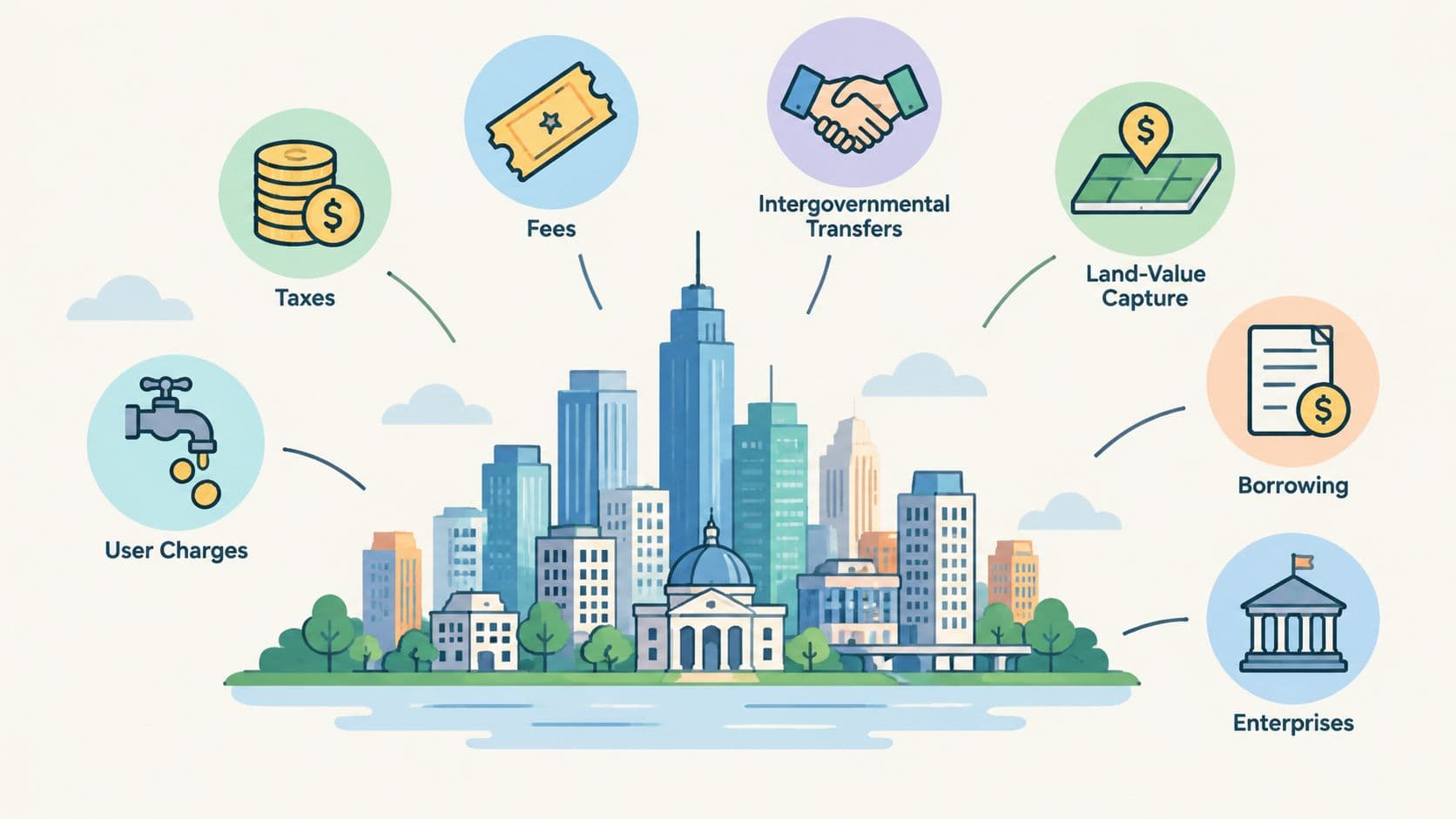
A city manager opens the budget file and finds the same problem that appears in municipalities everywhere: road repairs are overdue, service demand is rising, and a promised transfer from a higher level of government may change before the fiscal year begins. Residents want reliable transit, clean streets, safe water, and responsive permitting, but the revenue system may depend on a narrow set of politically difficult or economically volatile sources.
Understanding municipal revenue sources means more than memorizing tax categories. It means asking who controls each source, who ultimately pays, how reliably the money arrives, whether the instrument discourages useful investment, and whether the city can administer it fairly. Land-value-based instruments add an important dimension because they can capture value created by location and public investment without taxing buildings or productive activity in the same way.
Table of Contents
- Why Municipal Revenue Mix Matters Right Now
- Understanding the Core Categories of Municipal Revenue
- Comparing Major Revenue Instruments and Their Trade Offs
- Legal and Administrative Constraints That Shape What Cities Can Use
- How Land Value Based Instruments Work and Why Pricing Mechanics Matter
- Implementing and Transitioning to a Resilient Revenue Mix
- Case Studies and Lessons for Adopting Land Value Instruments
Why Municipal Revenue Mix Matters Right Now
A municipal budget can look balanced on paper and still be fragile. A city may depend heavily on grants that arrive with conditions, property taxes that respond slowly to reassessments, or sales taxes that weaken when households reduce spending. At the same time, officials must maintain infrastructure, respond to service needs, and plan capital projects that last well beyond a single budget cycle.
The United States provides a useful starting point. In 2021, taxes supplied 42% of local general revenues, including 30% from property taxes; charges supplied 16%, miscellaneous sources supplied 5%, and intergovernmental transfers supplied 37%. These figures come from the Tax Policy Center's overview of state and local revenue. The lesson isn't that one category is universally correct. It's that municipal finance rarely rests on one instrument.
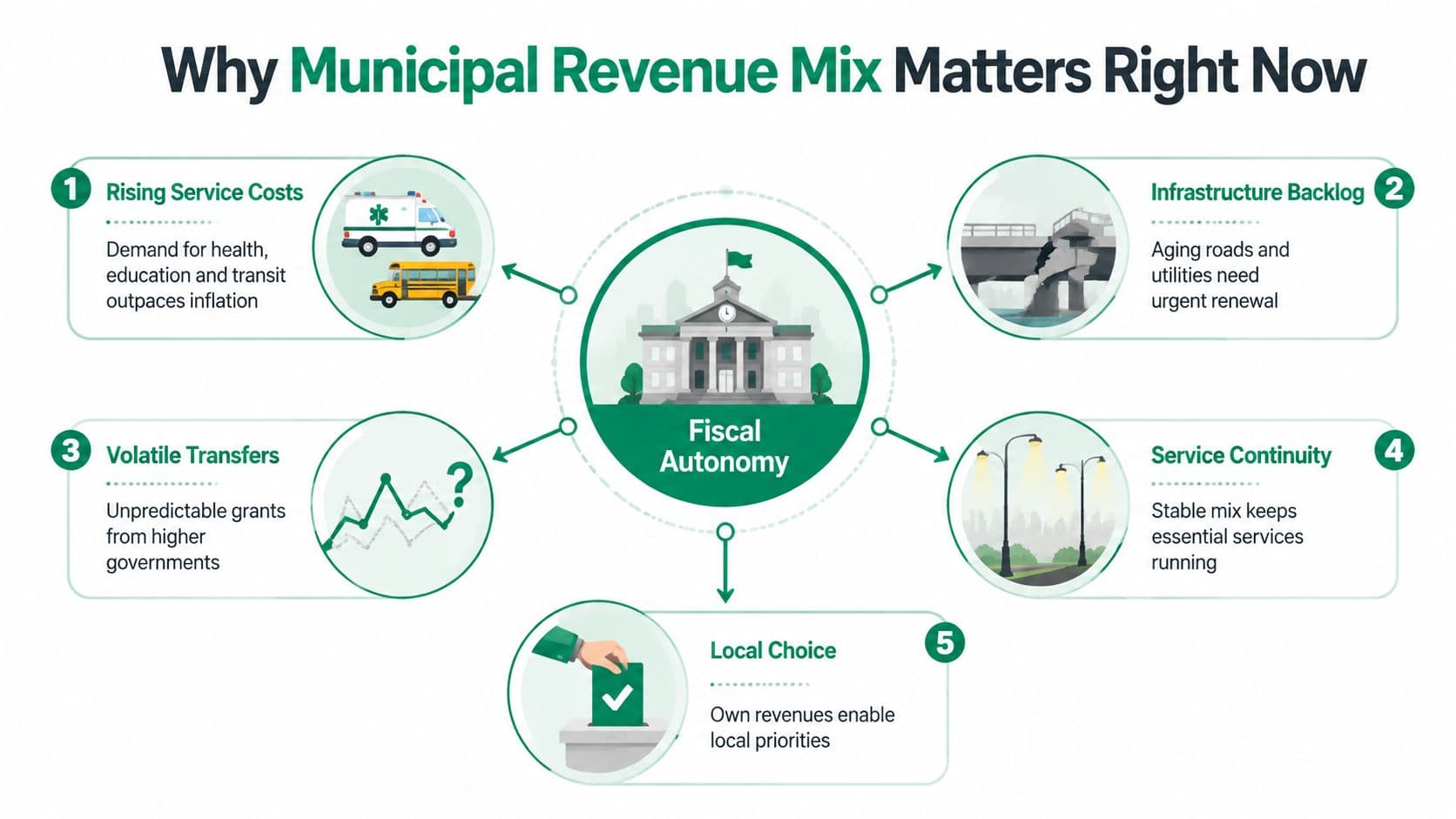
A finance director reviewing the next budget should separate three questions:
- Control: Can the city set the rate, broaden the base, or change collection rules?
- Reliability: Will the source continue during a downturn or a transfer dispute?
- Economic effect: Does the charge discourage work, construction, business formation, or productive land use?
That framework turns fiscal sustainability into a practical management issue rather than a slogan. A city with several dependable own-source revenues has more room to choose local priorities, while a city reliant on unpredictable transfers may have less control even if its total funding appears adequate. The fiscal sustainability guidance from Unitism offers a related way to think about recurring revenue, service obligations, and long-term resilience.
Municipalities also need to distinguish operating revenue from capital finance. Taxes, fees, and transfers usually support recurring services. Bonds and loans can fund a bridge, water system, or transit extension, but they create future repayment obligations. Land-value capture sits between these questions because it can connect public investment to the increase in site value that investment helps create.
Understanding the Core Categories of Municipal Revenue
Start with a household analogy. A household might receive wages, payments for occasional work, help from relatives, income from an asset, and a loan for a major purchase. A municipality has similar categories, but each carries different rules, accountability requirements, and risks.
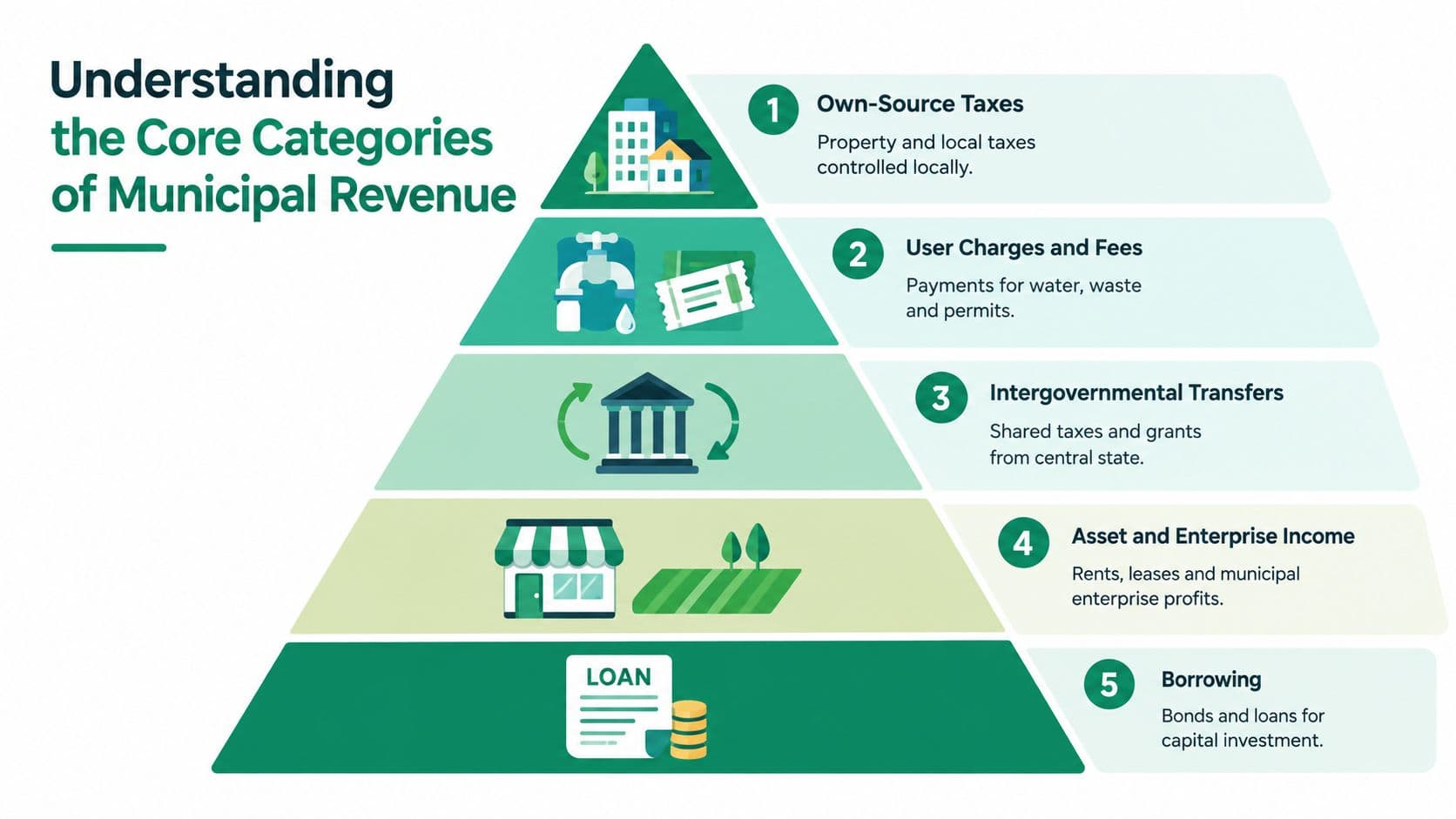
Own-source taxes
Own-source taxes are revenues the local government raises through its legally assigned tax powers. Property taxes are the clearest example. Other systems may use local sales surcharges, business taxes, vehicle taxes, tourism taxes, transfer taxes, or tolls. The World Bank municipal finance handbook describes this broad international range and emphasizes that the balance depends on legal authority, administrative capacity, and the transfer system.
Property taxes are especially important in many countries, but their role varies sharply. Across OECD countries, recurrent property taxes averaged 0.9% of GDP in 2016, represented 33.5% of subnational tax revenue, and accounted for 9.5% of total subnational revenue across 74 countries. In Anglo-Saxon OECD countries, property taxes exceeded 70% of local tax revenue, while Canada reached 2.9% of GDP, the OECD high point for recurrent immovable property tax revenue. These comparisons are documented in the OECD report on bricks, taxes, and spending.
User charges and transfers
User charges and fees connect payment to a service. Sewerage, parking, permits, waste collection, recreation, and public transport can all use charges, although affordability and public access limit how far this approach can go. A fee that recovers operating cost may be appropriate for a private-benefit service, while a broad public-health service may require tax support.
Intergovernmental transfers include grants and shared revenues from central, state, or provincial governments. They can correct regional inequalities and finance responsibilities that local governments can't support alone. They can also reduce local discretion when conditions are strict or funding changes unexpectedly.
Assets, enterprises, and borrowing
Municipalities may earn income from land and property sales, rents, licenses, permits, investment returns, and municipal enterprises. Some of these are recurring, while others are one-time. Selling a parcel can fund a project once, but it can't reliably pay for permanent staff or ongoing maintenance.
Borrowing belongs primarily in the capital-finance category. Loans and bonds let a city spread the cost of long-lived infrastructure across the period in which residents use it. They don't create free revenue. Debt service must be supported by future taxes, fees, transfers, or asset income.
A strong revenue review asks whether each source is recurring or one-off, locally controlled or externally determined, and linked to a service or general public purpose. Development-related charges, for example, can help fund infrastructure associated with new growth. The development impact fee explainer is useful when officials need to distinguish a cost-based charge from a general tax.
Comparing Major Revenue Instruments and Their Trade Offs
No instrument wins on every criterion. Property taxes can be broad and comparatively steady, but they're politically visible and depend on accurate valuation. Sales taxes can grow with economic activity, but consumer slowdowns can reduce collections. User charges can improve accountability, yet they may exclude residents who can't afford the full cost.
Property taxes are the dominant recurrent municipal tax in many OECD systems, but the OECD comparison shows why officials shouldn't assume that every city has the same fiscal architecture. A tax that works well where local governments control valuation and collection may perform poorly where records are incomplete or rate authority is restricted.
| Instrument | Revenue Potential | Stability | Key Trade Off |
|---|---|---|---|
| Property tax | Broad where property records are reliable | Usually steadier than transaction taxes, though exposed to valuation and political cycles | Visible burden, valuation disputes, and possible pressure on housing costs |
| Sales or business tax | Can expand with commerce and economic activity | Sensitive to consumer spending and business cycles | May burden transactions or local competitiveness |
| User charges and fees | Strong for services with identifiable users | Linked to service demand and collection performance | Equity concerns if essential services become unaffordable |
| Intergovernmental transfers | Can finance major responsibilities and equalization | Depends on higher-government policy and grant stability | Less local control and possible conditions |
| Borrowing | High for approved capital projects | Debt service is predictable after issuance | Creates future obligations and can't replace recurring revenue |
| Land-value capture | Can broaden the base around valuable locations and public investment | Tied to land values and administrative quality | Requires valuation, legal authority, and careful transition design |
The central comparison is not “tax versus no tax.” It's which base is being charged. A levy on buildings can make construction more expensive at the margin. A levy on site value targets the location advantage that public services, infrastructure, and surrounding activity help create. The comparison of land-value tax and property tax helps clarify why separating land from improvements changes the incentive structure.
Cities should also include procurement savings in their fiscal planning, even though savings aren't a revenue source. Shared purchasing can reduce avoidable costs and improve budget capacity. For school systems and municipal partners evaluating that option, cooperative purchasing contracts for schools provides practical context on how group purchasing arrangements work.
A decision matrix should reflect local conditions:
- Choose broader taxes when the city needs general-purpose revenue and can administer the base consistently.
- Use charges carefully when users receive a distinct, measurable benefit and affordability protections are available.
- Protect transfers for shared responsibilities rather than treating them as a substitute for local fiscal capacity.
- Reserve borrowing for durable assets with a credible repayment plan.
- Test land-based instruments where public investment has increased site value and land records can support fair assessment.
Legal and Administrative Constraints That Shape What Cities Can Use
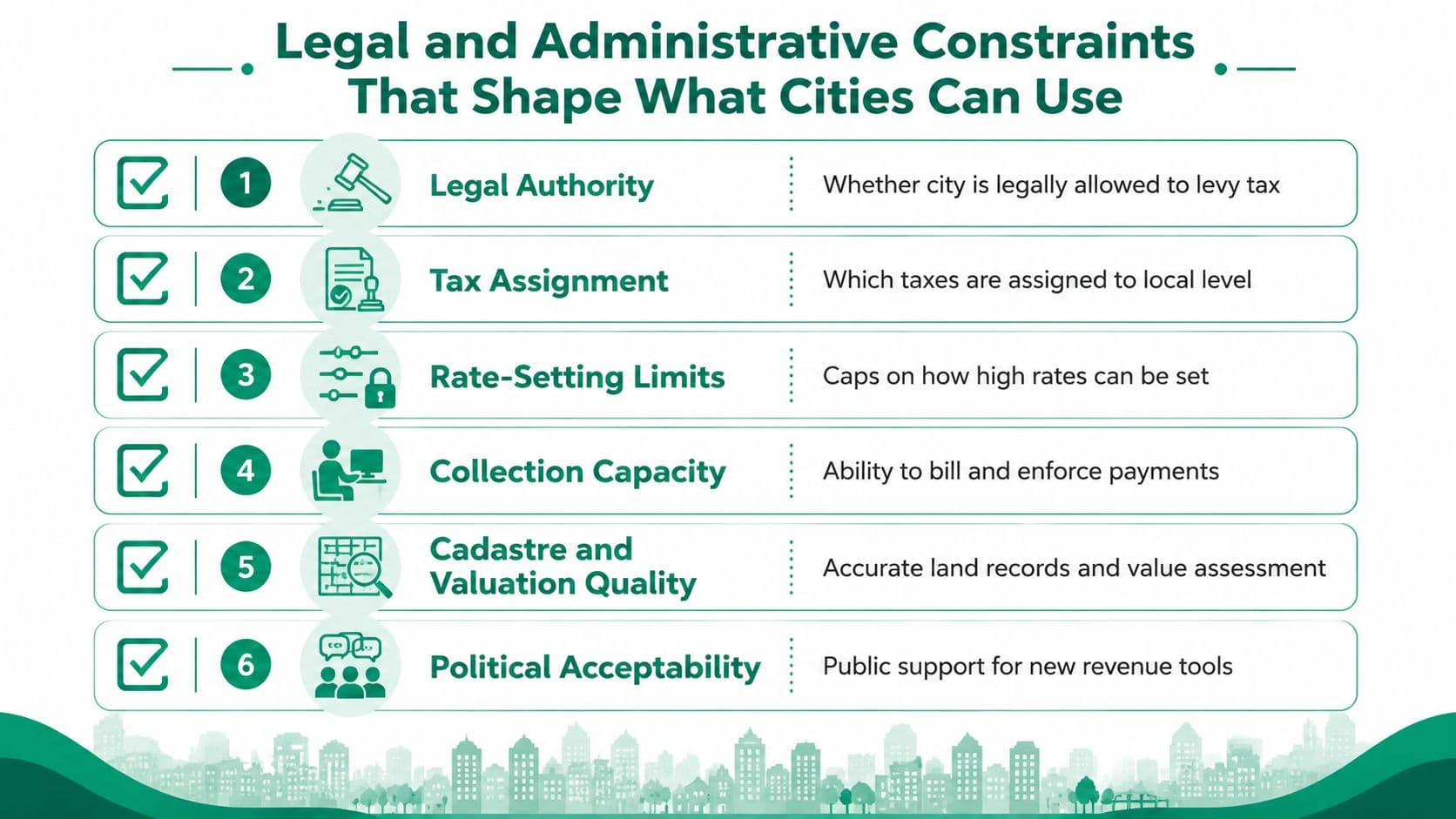
Two cities may face similar service pressures but possess entirely different revenue options. One may have authority to levy a property tax, while another depends on a regional government to collect it. One may set user charges directly, while another needs legislative approval. A city can't choose an instrument because another jurisdiction uses it successfully.
Authority and assignment
Legal authority determines whether a municipality can levy a tax, issue debt, impose a fee, or collect a share of a broader tax. Tax assignment determines which level of government receives each base. Rate-setting limits can also prevent a city from responding to rising costs, even when the tax itself is legally available.
Transfer design matters just as much. A grant may be unconditional, formula-based, project-specific, or tied to service standards. Each arrangement changes the city's room to prioritize spending and its exposure to decisions made elsewhere.
Capacity determines actual yield
A statutory rate doesn't guarantee collections. The IGC's analysis of land and property taxes for municipal finance expresses potential revenue as the registered tax base minus exemptions, multiplied by taxable value, legal rate, and collection efficiency. That formulation makes the operational point clear: coverage, valuation quality, and compliance can matter as much as the headline rate.
The same IGC analysis estimates that a 1% land-and-property levy in Kigali could yield over USD 60 million annually under full compliance. This is an illustration of modeled potential, not a promise that another city would achieve the same result. A municipality with incomplete cadastre records, outdated valuations, weak billing systems, or limited enforcement would need to address those constraints before relying on projected yield.
Officials should diagnose readiness before selecting a reform:
- Authority: Confirm the constitution, statutes, charter, and regulations that govern the instrument.
- Records: Check whether the cadastre identifies parcels, ownership, use, and improvements.
- Valuation: Test whether assessors can separate site value from building value.
- Collection: Review billing, appeals, payment channels, arrears management, and enforcement.
- Governance: Publish assumptions and explain how rates, exemptions, and relief measures affect residents.
A tool copied without its enabling system usually disappoints. Administrative reform isn't a technical afterthought. It's part of the revenue instrument itself.
How Land Value Based Instruments Work and Why Pricing Mechanics Matter
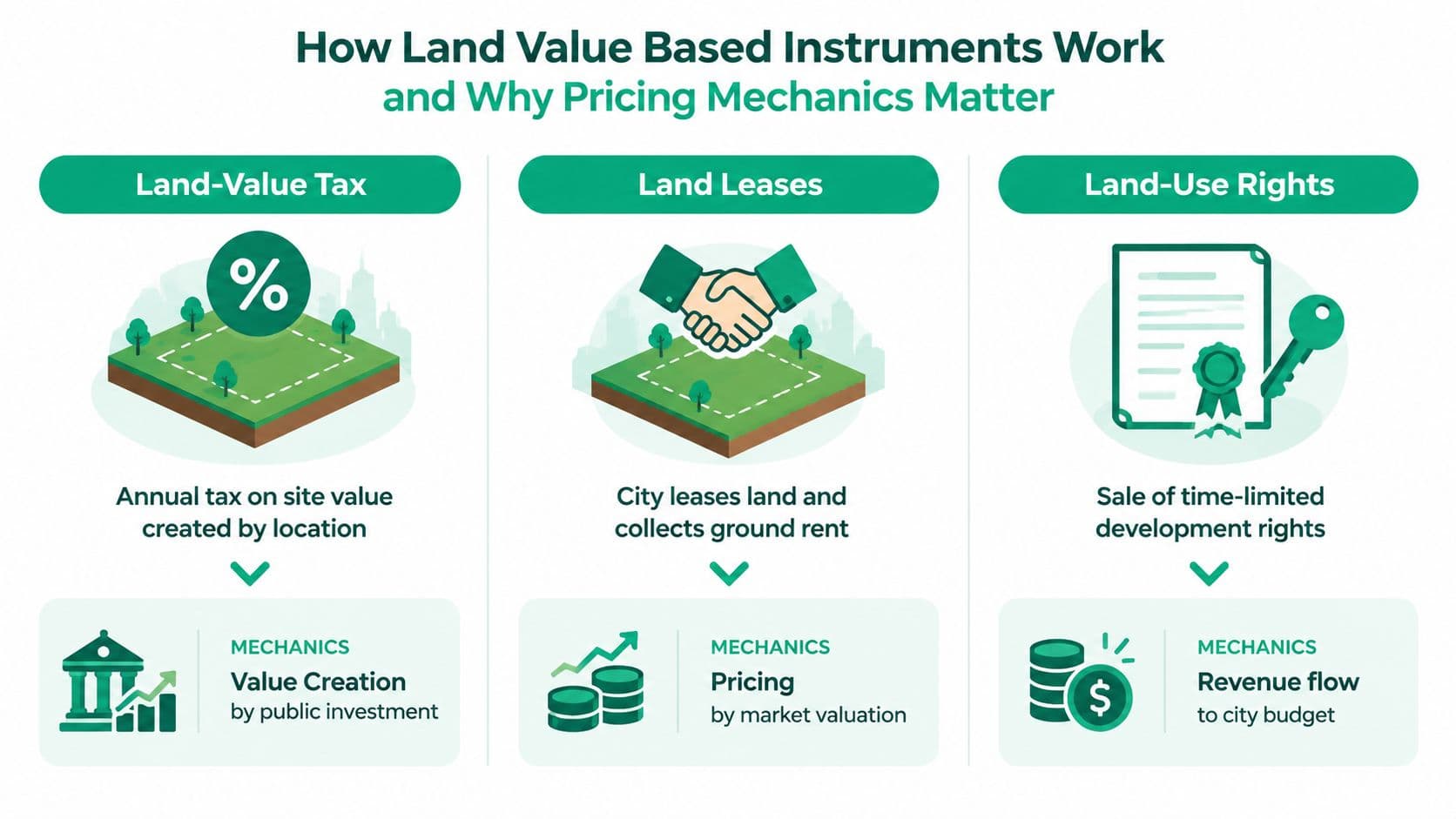
Land has value because of location, access, infrastructure, legal permissions, and the activity surrounding it. A new road, transit stop, utility connection, park, or zoning decision can increase the value of a site even when the owner hasn't improved the parcel. Land-value-based instruments seek to share part of that location value with the public.
Three instruments, three pricing systems
A land-value tax is an annual charge on the value of the site, separate from the value of buildings and other improvements. By focusing on land rather than construction, it can reduce the penalty on adding homes, workplaces, or useful structures. The land-value calculation guide provides a practical starting point for understanding the assessment task.
A land lease gives someone possession or use of land for a fixed term at a fixed price. Leases may be renewable or non-renewable. Renewable leases provide some certainty during the term, but when renewal arrives, the accumulated gap between the lease rate and the market can be closed through a major repricing. Non-renewable leases become progressively harder to refinance and sell as the remaining term shortens. Fixed leases don't correctly price risk. They postpone it.
Land-use rights are different. They're indefinite, have no expiration, require no renewal, and are repriced annually. Because the price is updated each year, people can buy and sell the rights at low cost without waiting for a lease renewal or facing a shrinking term. Properly designed land-use rights price land appropriately while avoiding a burden on entrepreneurship and other productive enterprises.
Sometimes fixed leases are labeled “land-use rights.” That label is incorrect unless the arrangement is annually repriced, indefinite, and free from renewal requirements. A fixed-term agreement remains a fixed lease, regardless of what its paperwork calls it.
Why mechanics affect behavior
A land-value tax creates a continuing cost for holding a valuable site, which can encourage owners to develop, sell, or use land more intensively. A fixed lease can let a tenant retain an outdated bargain until renewal, then create a sudden repricing that disrupts financing and business planning. An annually repriced indefinite right avoids that cliff by keeping the land charge current.
The IGC model also shows why valuation and collection efficiency are essential. Land-based reform isn't a decision to write a new rate into law. It requires parcel data, transparent assessment methods, appeal procedures, and a transition that protects households and viable enterprises from abrupt displacement.
Implementing and Transitioning to a Resilient Revenue Mix
Implementation should begin with a fiscal map, not a preferred instrument. List recurring expenditures, existing revenue bases, legal limits, arrears, transfer dependencies, capital needs, and the groups most exposed to each possible reform. Then model how each change affects renters, homeowners, businesses, developers, public agencies, and people who hold valuable land without using it productively.
Build the information system first
A land-based reform needs a dependable cadastre and valuation framework. Officials should connect parcel identifiers with ownership, land use, permitted development, infrastructure access, and observed market evidence. Assessors must document how they estimate site value and how they separate it from structures.
A practical sequence looks like this:
- Audit the base: Identify missing parcels, outdated records, exemptions, arrears, and valuation gaps.
- Map value drivers: Record how transit, utilities, roads, schools, parks, and planning permissions influence site value.
- Model alternatives: Compare current taxes with land-value charges, including distributional effects and relief options.
- Pilot the process: Test valuation, notices, appeals, payment systems, and compliance workflows before broad implementation.
- Legislate clearly: Define the base, rate authority, reassessment cycle, exemptions, appeals, enforcement, and use of proceeds.
- Publish results: Show assumptions, parcel-level methods where appropriate, aggregate impacts, and transition safeguards.
The current fiscal environment makes sequencing urgent. A 2025 European local-government report states that local responsibilities expanded faster than the revenue base and records a negative EU-27 local-government balance of −2.1% in 2024, meaning spending exceeded revenue. That evidence appears in the European Local Government Report 2025.
Replace fragile sources carefully
England illustrates the danger of narrow dependence. For 2025-26, local authorities expected 53.1% of revenue expenditure to be financed by central government grants, 31.1% by council tax, with most of the remainder from retained business rates. For 2024/25, the Institute for Government reported a different mix, 32.1% grants, 45.6% council tax, and 22.3% retained business rates, as documented in the English local government financial statistics. The contrast shows why officials must define the year and accounting measure before comparing dependence.
A transition should avoid replacing one distortion with another. Revenue-neutral design, targeted relief, public education, and transparent annual repricing can help communities understand both winners and losers. The revenue-neutral tax reform resource can help officials frame the reform around shifting burdens rather than increasing collections.
Case Studies and Lessons for Adopting Land Value Instruments
International examples point to different institutional paths. Denmark and Estonia demonstrate the importance of recurring land and property valuation within a wider tax system. Singapore shows how public control of land and lease arrangements can shape urban development, though its institutional model isn't directly transferable to every municipality. Canberra illustrates a leasehold approach, while Allentown, Pennsylvania is often discussed in relation to split-rate property taxation that places relatively greater weight on land than buildings.
These cases shouldn't be treated as plug-and-play templates. Their results depend on land records, assessment practice, planning rules, public administration, political consent, and the way other taxes interact with the land charge. A fixed lease in one city may look like a land-use right in casual conversation, but it still carries repricing and refinancing risks if it expires or uses infrequent fixed prices.
A municipal readiness checklist can keep reform grounded:
- Legal fit: Does the city have authority to assess and collect the proposed charge?
- Data fit: Can officials identify parcels and estimate site value transparently?
- Economic fit: Will the reform reduce penalties on buildings and productive activity?
- Equity fit: What protections address cash-poor households, renters, and small businesses?
- Fiscal fit: Does the source remain dependable when transfers, housing, or consumption weaken?
- Operational fit: Can the city manage billing, appeals, enforcement, and annual updates?
The broad lesson is straightforward. A resilient mix combines dependable own-source revenue, carefully designed charges, appropriate transfers, disciplined borrowing, and land-based instruments that price location value without creating fixed-term risk. The best choice isn't the instrument with the most attractive theory. It's the one the city can administer openly, transition fairly, and sustain through changing economic conditions.
Unitism® helps governments and cities assess land values, design land-value capture policies, model fiscal and distributional impacts, and prepare practical implementation systems. Visit Unitism® to explore its research, valuation methods, training, and policy-design support for more resilient municipal revenue sources.