Explore proven policy evaluation methods from RCTs to theory of change, with practical guidance on choosing and communicating them to policymakers.
August 24, 2026
Policy Evaluation Methods: A Practical Guide for Reformers
Explore proven policy evaluation methods from RCTs to theory of change, with practical guidance on choosing and communicating them to policymakers.

The finance ministry has a site-value tax proposal on the cabinet agenda. The minister wants evidence that the reform can raise recurring revenue without punishing construction, while treasury officials want a distributional map, a credible estimate of behavioural change, and a plan for updating the cadastre. A single headline number won't answer all three questions.
That situation captures the practical challenge of policy evaluation methods. Evaluation isn't one test applied after a policy is launched. It's a choice about what decision-makers need to know, what comparison is credible, what data administrators can maintain, and whether officials will act on the findings. The right method can turn a controversial land reform into a manageable sequence of decisions. The wrong one can make a sound proposal look speculative.
Table of Contents
- Why Choosing the Right Policy Evaluation Methods Matters Now
- How Policy Evaluation Methods Became Formalized
- The Five Core Frameworks Used in Policy Evaluation Methods
- Experimental and Quasi-Experimental Designs Side by Side
- Land Leases Versus Land-Use Rights and Annual Land-Value Charges
- Choosing Policy Evaluation Methods for a Land-Value Reform
- The Hidden Constraint in Policy Evaluation Methods
- Communicating Policy Evaluation Methods to Decision Makers
Why Choosing the Right Policy Evaluation Methods Matters Now
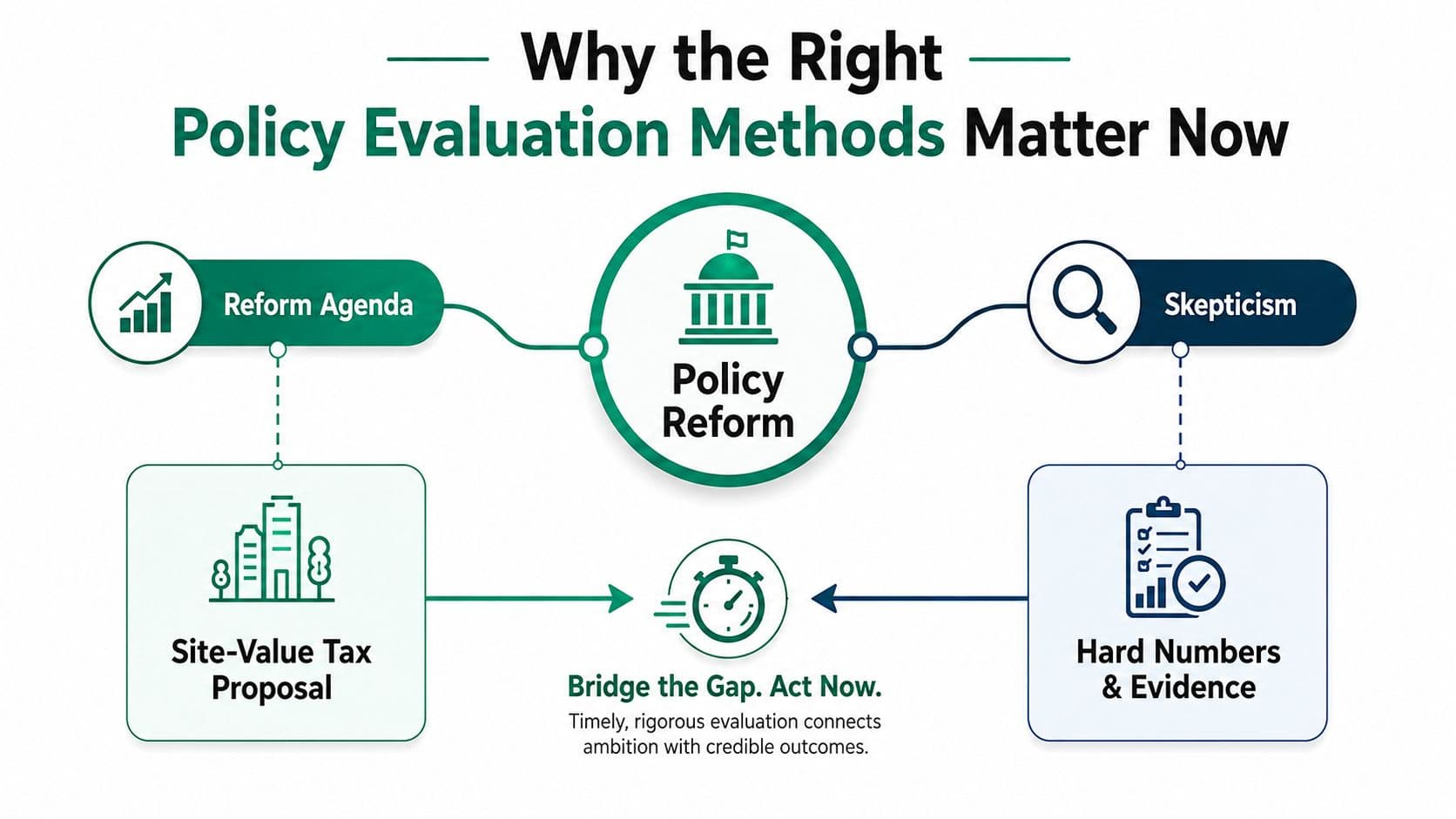
Five minutes before the cabinet meeting, a finance ministry director faces a familiar choice. Should the presentation lead with a cost-benefit model, evidence from another jurisdiction, a distributional assessment, or a pilot design? Each would be relevant, but each answers a different question. A fiscal model may show potential revenue, while leaving unanswered who bears the charge and whether owners change their behaviour.
That distinction matters particularly for land-value reform. The OECD definition of policy evaluation describes it as a structured, objective assessment of an ongoing or completed policy. An impact evaluation asks a narrower question, whether the policy works, usually by comparing observed outcomes with what would have happened without it.
Three pressures shape the choice
Finance ministries are selecting evaluation methods under pressure from several directions:
- Tighter fiscal decisions: A site-value tax proposal must be assessed alongside competing uses of public money and existing revenue risks. A broader discussion of this challenge appears in Unitism's fiscal sustainability insights.
- Demand for fairness: Officials need to show how a land charge affects owners, renters, small businesses, regions, and local authorities, not merely report an aggregate revenue estimate.
- External scrutiny: Donors, legislators, credit analysts, and civil society groups increasingly expect transparent assumptions, reproducible calculations, and evidence that implementation risks have been considered.
Land reform raises further stakes. The evaluation may influence recurring public revenue, incentives for urban redevelopment, housing affordability, and the treatment of existing tenure arrangements. Those outcomes unfold through different channels and at different speeds, so one method rarely provides a sufficient answer.
Practical rule: Start with the policy decision, not the available spreadsheet. Ask what must be known before choosing how to measure it.
A working evaluation toolkit therefore combines fiscal analysis, distributional analysis, causal designs, implementation monitoring, and communication. It treats evidence as part of reform design rather than an audit attached at the end.
How Policy Evaluation Methods Became Formalized
Modern evaluation grew from a simple problem: how can an analyst tell whether an intervention caused an outcome rather than merely appeared alongside it?
Step one was controlled comparison
In the agricultural work of Ronald Fisher and Jerzy Neyman during the 1920s, randomized experiments gave researchers a disciplined way to separate treatment effects from pre-existing differences. Fisher's experimental designs made random assignment central to comparison. Neyman supplied a formal framework for thinking about potential outcomes, including the unobserved result that would have occurred under the alternative treatment.
That counterfactual remains the foundation of impact evaluation. For a land-value tax pilot, the treated municipality's observed revenue, construction activity, or land-use pattern isn't enough. Analysts also need a defensible estimate of what those outcomes would have looked like without the pilot.
The measurement infrastructure matters just as much. A team assessing property values needs parcel identifiers, building information, transaction records, assessment histories, and consistent geographic boundaries. Practical work on mass appraisal methods becomes relevant because the credibility of a policy result depends partly on the quality and consistency of the underlying valuation system.
Social policy made the question unavoidable
Experimental methods entered mainstream social policy evaluation during the 1960s and 1970s, after developments including the Coleman report and the New Jersey Income Maintenance Experiment. The focus shifted from describing programme activity to testing whether an intervention produced a measurable change.
A major institutional milestone arrived in 1988, when the U.S. Family Support Act made randomized experiments compulsory for evaluating training programs. This marked a turning point toward causal inference in public policy, although governments still use non-randomized approaches when experiments are impractical or unethical.
The OECD evaluation framework now combines quantitative and qualitative evidence. Its criteria were revised globally in 2019 into relevance, coherence, effectiveness, efficiency, impact, and sustainability. For land reform, that means asking not only whether a charge raises revenue, but whether it fits existing institutions, reaches its intended purpose, uses administrative resources sensibly, creates wider effects, and can endure.
The Five Core Frameworks Used in Policy Evaluation Methods
A finance ministry team usually needs several frameworks at once. Each offers a different lens on the same proposal.
Cost-benefit analysis converts gains and losses into comparable monetary terms over time. It can help compare the cost of a national cadastre transition with expected administrative savings and revenue effects. Its weakness is that monetization can obscure distribution and make long-term assumptions appear more certain than they are.
Distributional analysis asks who gains, who pays, and how effects vary by income, location, tenure, property type, and economic role. It is essential when public land leases are repriced and officials need to protect households or enterprises exposed to sudden changes. Unitism's distributional analysis guidance is a useful reference for framing those groups explicitly.
Counterfactual impact estimation compares actual outcomes with a carefully estimated alternative scenario. A randomized rollout of a split-rate land-value tax could provide a strong comparison, while a synthetic control could construct a weighted benchmark from similar municipalities. This framework is persuasive on whether change occurred because of the intervention, but it demands credible comparison data and clear assumptions.
Theory of change maps the causal chain from inputs to activities, outputs, intermediate effects, and long-term outcomes. For a new land-use-rights registry, the chain might run from legal rules and parcel identification to registration, transferability, investment decisions, and more efficient land use. The method makes assumptions visible, although it doesn't by itself prove that the intervention caused the final outcome.
Modelling approaches, including microsimulation and system dynamics, project interactions across households, firms, public budgets, land markets, and property cycles. They can stress-test an annual land-value charge under different behavioural responses. Their value lies in exploring scenarios, not presenting forecasts as facts.
| Framework | One-Line Definition | Land-Reform Use Case | Main Weakness |
|---|---|---|---|
| Cost-benefit analysis | Compares monetized gains and losses over time | Assessing a cadastre transition | Sensitive to valuation and discounting assumptions |
| Distributional analysis | Maps effects across affected groups | Repricing public land leases | Can become politically contested when categories are incomplete |
| Counterfactual estimation | Estimates what would have happened without the policy | Piloting a site-value tax | Requires a credible comparison design |
| Theory of change | Explains how activities are expected to produce outcomes | Launching a land-use-rights registry | Depends on explicit, testable assumptions |
| Modelling | Projects interactions and scenarios | Stress-testing annual land charges | Results can change sharply with model structure |
A strong appraisal doesn't force these frameworks into one blended score. It uses each for the question it can answer, then makes disagreements between methods visible.
Experimental and Quasi-Experimental Designs Side by Side
Randomized controlled trials are the strongest design for causal policy evaluation because random assignment makes treatment and control groups statistically indistinguishable on average. The OECD discussion of policy evaluation design also identifies the limits, including feasibility, ethics, and external validity.
Land policy rarely offers a clean laboratory. Officials can't always randomize tax liability, lease security, or access to a registry. They can sometimes randomize the rollout order of cadastre digitization across districts, but a voluntary pilot may create selection effects that require a quasi-experimental design.
What each design can credibly answer
- Randomized controlled trial: Clears the highest causal credibility threshold when officials can randomize assignment or rollout. It needs a pre-specified design, reliable outcome data, and safeguards for affected groups.
- Difference-in-differences: Compares changes over time between a treated area and a comparison area. A site-value tax pilot might use municipalities that adopt at different times, but the analysis depends on the plausibility of similar pre-policy trends.
- Regression discontinuity: Uses a rule-based cutoff, such as eligibility tied to a tax threshold, to compare units just above and below the boundary. It can identify local effects near the cutoff, not necessarily effects across the whole market.
- Propensity score matching: Builds a comparison group from units with similar observed characteristics. It can be practical with administrative data, but unmeasured differences may remain.
- Synthetic control: Constructs a weighted combination of untreated areas to approximate the treated jurisdiction before reform. It suits a major municipal intervention with a clear adoption date, though the result depends on the quality of the donor pool.
The OECD routes to experimentation distinguishes counterfactual methods, which test whether an intervention made a difference, from theory-based and process-tracing methods, which help explain how and why it worked.
| Design | Credibility Tier | Data Requirement | Land-Reform Use Case |
|---|---|---|---|
| Randomized controlled trial | Highest causal credibility | Random assignment and reliable follow-up | Staggered cadastre digitization |
| Difference-in-differences | Strong if trends are comparable | Repeated treated and comparison data | Phased tax adoption |
| Regression discontinuity | Strong near a valid cutoff | Precise eligibility and outcome records | Behaviour near a tax threshold |
| Propensity score matching | Moderate, based on observed factors | Rich baseline characteristics | Comparing similar parcels or municipalities |
| Synthetic control | Strong for a well-matched treated unit | Long pre-policy series across areas | A single-jurisdiction land reform |
A phased implementation plan can make evaluation more feasible, as described in Unitism's phased implementation resource. When randomization isn't possible, a transparent comparison group is usually a better standard than pretending that a simple before-and-after result proves causation.
Land Leases Versus Land-Use Rights and Annual Land-Value Charges
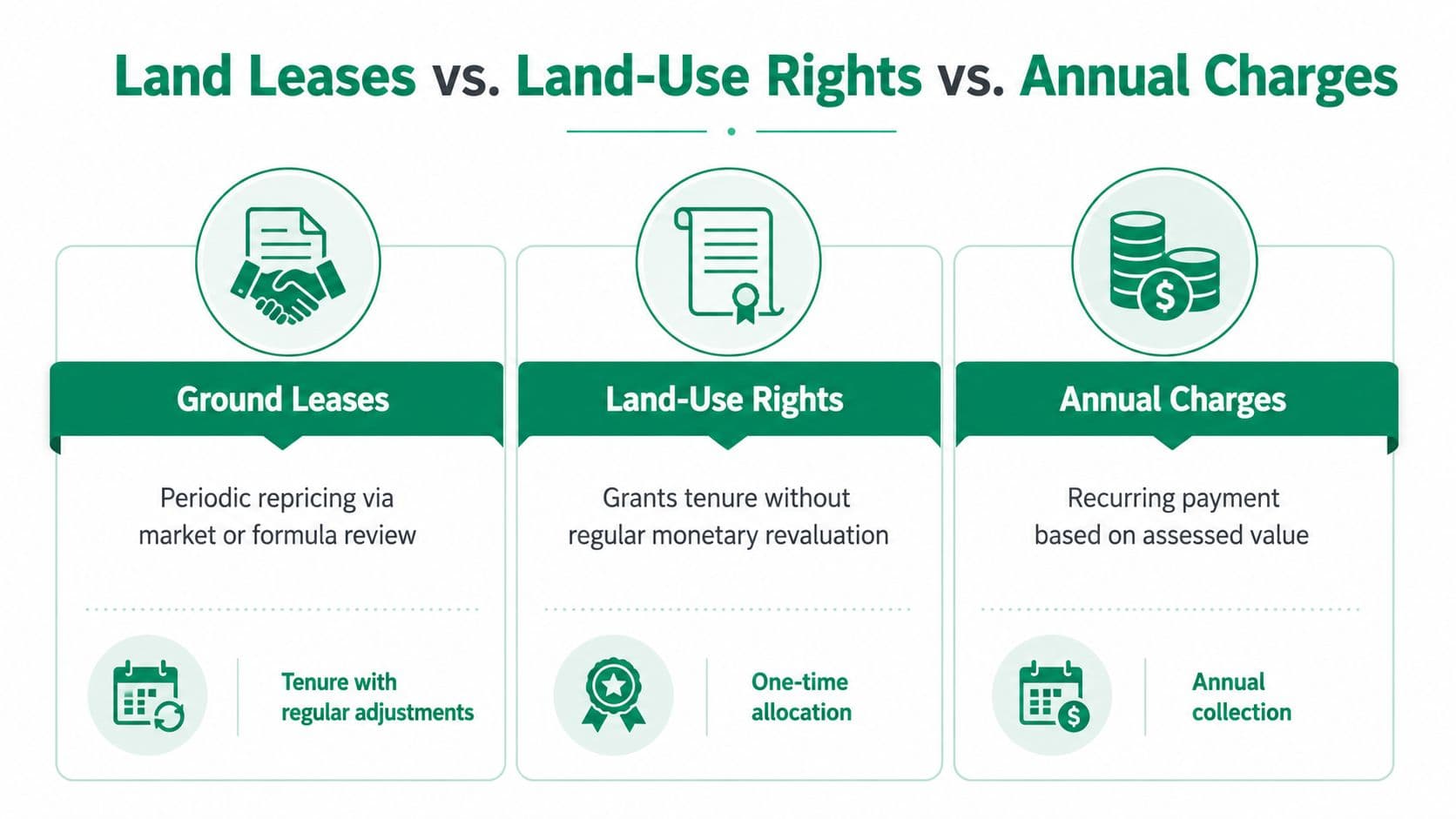
A finance ministry comparing land reforms may see three ways to charge for access to a site. The policy effects differ. Land leases, land-use rights, and annual land-value charges assign tenure, repricing, and financial risk through different mechanisms.
A land lease grants use for a defined term, at a fixed price or under stated review rules. A renewable lease gives the occupant payment certainty during that term, while renewal creates a later decision point. If the lease rate falls below market value, the gap may close through a large repricing rather than gradual adjustment. With a non-renewable fixed-term lease, the remaining tenure shortens as expiry approaches, which can make refinancing and resale harder. For a practical explanation of how 99-year land leases function in practice, the key issue is the timing of that eventual repricing or expiry.
Japan sets out the distinction in law. Under the Act on Land and Building Leases, a standard land lease right lasts 30 years, followed by renewal periods of 20 years for the first renewal and 10 years for later renewals, unless the parties agree to longer periods. The same law includes fixed-term forms: a general fixed-term land lease right of 50 years or more, and a business-use fixed-term lease right of 10 to under 50 years.
Repricing determines who carries risk
A fixed lease postpones part of the risk. The occupant knows the payment for a period, then faces uncertainty over renewal, resale, and refinancing. Hong Kong shows what a hard reset can look like. At the government's discretion, leases without a renewal right may be extended for 50 years, with annual rent equal to 3% of rateable value, according to the Lincoln Institute of Land Policy.
Under the framework used here, land-use rights also grant control over land, but they have no expiration and are repriced annually. That recurring adjustment can make transfers easier because a buyer does not inherit a looming expiry or a major renewal negotiation. It also connects the payment more continuously to land value, rather than concentrating the adjustment at the end of a fixed term.
An annual land-value charge uses a different route. The Federal Highway Administration definition of land value tax describes a levy on unimproved land value that disregards buildings and shifts the tax base away from improvements. Recurring assessments spread adjustment over time, although revenue may vary with land-market conditions.
| Instrument | Repricing pattern | Main risk bearer | Best evaluation emphasis |
|---|---|---|---|
| Land lease | Fixed term with renewal or review | Lessee and capital market | Market response and refinancing |
| Land-use right | Indefinite tenure with annual repricing | Right holder and public authority | Registry delivery and behavioural pathway |
| Annual land-value charge | Recurring assessment on unimproved site value | Landholder and public budget | Distribution, compliance, and revenue stability |
The word “indefinite” can still receive different administrative treatment. HMRC's stamp duty guidance treats an indefinite lease initially as a fixed one-year lease, then as a notional two-year, three-year, and subsequent-year lease if it continues. If that notional term raises the total net present value of rents, a revised return or notification may be required within 30 days after the first 12-month period expires.
Choosing Policy Evaluation Methods for a Land-Value Reform
A usable selection rubric has three filters. Start with data availability, then consider policy stage, and finish with stakeholder capacity.
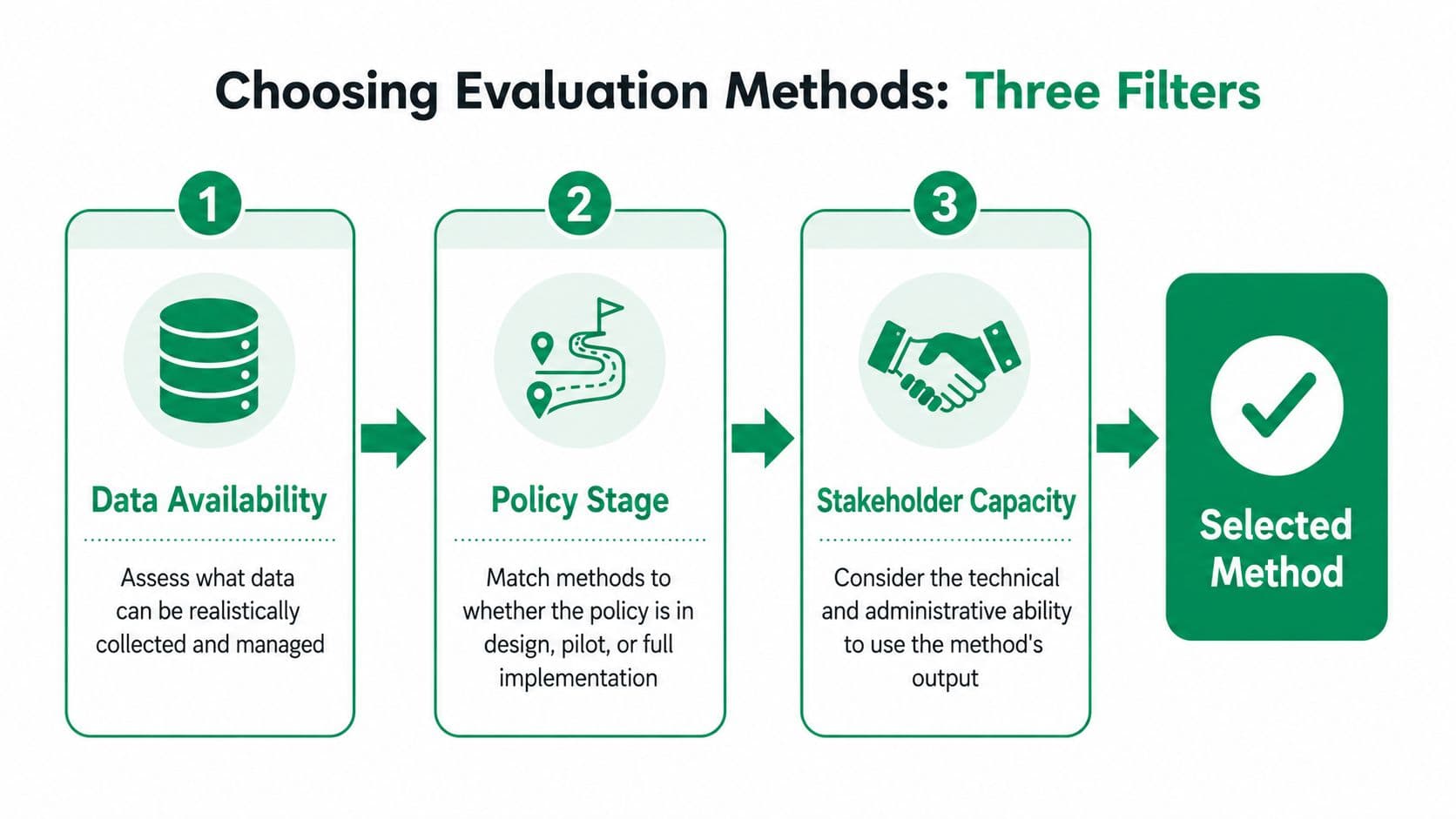
Filter one asks what can actually be measured
If parcel records are incomplete and valuation histories aren't consistent, a causal estimate may rest on unstable foundations. Begin with a theory of change, a data inventory, and a monitoring plan. Identify which outcomes can be observed before rollout, such as assessed land value, billing performance, construction permits, occupancy, or appeals.
Filter two locates the reform in its lifecycle
A policy still in design needs scenario modelling, legal analysis, stakeholder interviews, and distributional mapping. A pilot with treatment variation may support difference-in-differences or synthetic control. A mature system with linked tax, cadastral, and household records can support more detailed fiscal and distributional analysis.
Filter three tests institutional capacity
Ask whether the ministry can maintain the data, explain the assumptions, run the analysis, and respond to criticism within the political timetable. A method that produces an elegant report but cannot be updated after implementation isn't a durable evaluation method.
For a mid-reform jurisdiction choosing between synthetic control and difference-in-differences, the decision turns on the intervention pattern. If one municipality adopted the charge while several comparable areas remained untreated, synthetic control may offer a clearer benchmark. If multiple jurisdictions adopted at different times and repeated records exist, difference-in-differences may use the available variation more effectively.
Three decision questions keep the choice disciplined:
- Is there a credible counterfactual? If not, use theory-based evaluation and transparent scenario analysis rather than overstating causal certainty.
- Can baseline data be collected? If yes, define indicators before rollout and preserve the baseline for later comparison.
- Will the findings survive scrutiny within the decision window? If not, simplify the design, document assumptions, and build independent review into the process.
The Hidden Constraint in Policy Evaluation Methods
A technically impressive evaluation can fail because the programme never produces usable implementation data. The OECD's Government at a Glance 2025 findings report that 9 of 31 countries, or 29%, lack mechanisms to ensure evaluation findings are implemented and monitored in line ministries. That leaves a familiar failure mode, publication without administrative follow-through.
The same OECD material points to weak methods, limited formal standards, and insufficient government-wide frameworks as continuing institutional problems. It also highlights AI as an emerging aid for automating data collection, analysis, and synthesis. AI can reduce repetitive work, but it can't create ownership, repair a broken cadastre, or compel a ministry to use a finding.
Objectives come before econometrics
EY's 2026 public policy evaluation barometer found that 42% of respondents identified poorly defined policy objectives as the most frequent methodological or project-management difficulty. The same survey identified weak monitoring or data quality at 25% and poorly defined performance indicators at 20%.
Those findings change how reform teams should allocate effort. Before debating a synthetic control specification, officials need to agree on what success means. For a land-value charge, that could include reliable billing, fair assessment appeals, construction activity, land-use change, household incidence, and public revenue. Each indicator needs an owner, a collection process, and a timetable for review.
Execution beats elegance: A simpler evaluation that administrators maintain can support better decisions than a complex design built on data nobody updates.
This is also where distributional blind spots become dangerous. EY's findings emphasize shortages in training, dedicated staff, and budget lines, while a 2025 systematic review identified methodological limitations, limited study of vulnerable groups, and a lack of standardized indicators, particularly in developing-country contexts. A land reform can affect owners, renters, builders, and local governments differently over a long horizon, so a single average effect may conceal the policy's most important consequences.
Communicating Policy Evaluation Methods to Decision Makers
Ministers don't need less rigour. They need the method translated into the decision they must make.
Use three layers:
- Decision brief: Put the policy question, selected method, headline finding, main uncertainty, and recommended decision on one page.
- Technical annex: Show assumptions, sensitivity tests, data sources, comparison groups, definitions, and limitations so analysts can reproduce the result.
- Public explanation: Connect the findings to tangible outcomes, such as changes in speculative holding, redevelopment incentives, housing costs, administrative burden, or public revenue.
A minister considering a site-value tax shouldn't receive a model output without its range of plausible results. Present uncertainty directly. False precision invites justified scepticism, while a clear explanation of what could change the result helps decision-makers judge risk.
Pre-register the evaluation design before results arrive. State the outcome measures, comparison strategy, timing, and rules for interpreting mixed findings. This reduces the risk that officials will appear to have selected the method after seeing the data.
Communication also tests the theory of change. If residents, legislators, assessors, and local officials can't explain how the reform is supposed to work, the causal chain may be incomplete. Their questions can reveal missing indicators, overlooked transition costs, or assumptions about behaviour that the model never examined.
A finance ministry should therefore treat communication as part of evaluation, not publicity added after analysis. The public narrative, technical annex, and decision brief should describe the same policy logic at different levels of detail.
Unitism® supports land-value reform through valuation assessments, distributional and fiscal impact modelling, cadastre integration, implementation support, monitoring and evaluation, and education for public officials and stakeholders. Visit Unitism® to explore practical tools and advisory support for turning land-value policy evidence into implementable reform.