Learn how property tax on vacant land can reduce urban blight and fund public services while avoiding common policy mistakes that harm housing markets.
October 12, 2026
Property Tax on Vacant Land: A Guide for Governments
Learn how property tax on vacant land can reduce urban blight and fund public services while avoiding common policy mistakes that harm housing markets.

A municipal finance officer reviews the annual roll and finds the same pattern again: a serviced parcel sits unused beside a road, sewer connection, and growing neighborhood, while the owner pays far less than an improved property would generate. Residents still expect those services to be maintained, nearby owners absorb the effects of neglect, and elected officials ask whether the tax system is rewarding delay.
Property tax on vacant land can address that mismatch, but only when the jurisdiction gets the tax base, valuation method, exemptions, and enforcement process right. A charge imposed without those foundations may create appeals, penalize land that can't realistically be developed, or raise little revenue. A well-designed system treats vacancy taxation as both a behavioral and fiscal tool, not as an automatic housing-supply solution.
Table of Contents
- Understanding the Policy Landscape for Vacant Land Charges
- Distinguishing Property Tax Approaches for Vacant Land
- Choosing Between Fixed Leases and Annual Land-Use Rights
- Building a Defensible Mass-Appraisal Workflow for Vacant Land
- Designing Exemptions and Escalating Vacancy Charges
- Implementing Land-Value-Capture Policy with Support and Precedents
Understanding the Policy Landscape for Vacant Land Charges
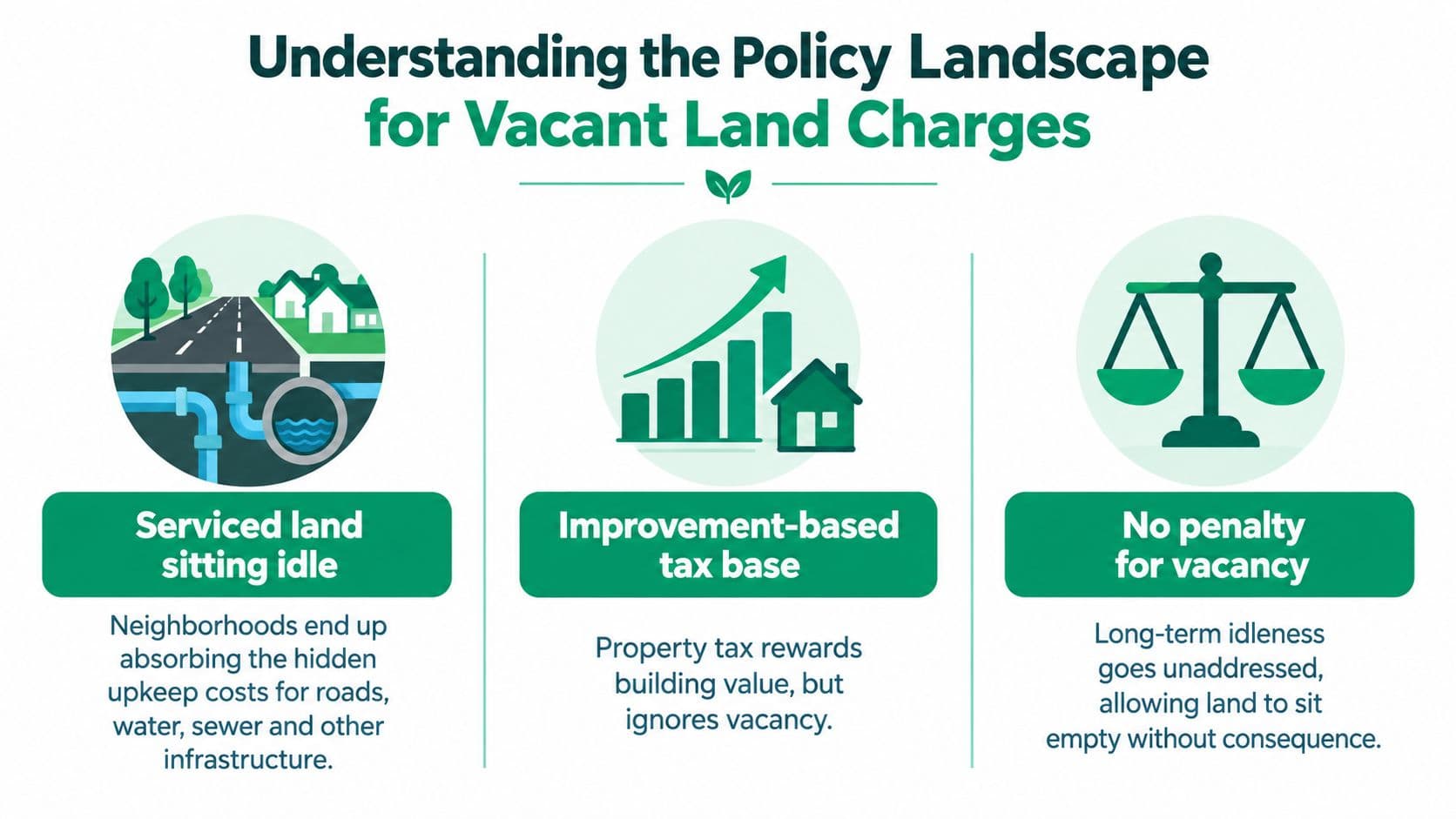
Consider a vacant lot in an established neighborhood. The municipality may already have extended streets, utilities, drainage, and public services to the area. Yet the lot produces little property-tax revenue because it has no building, while nearby residents may see weaker property values and the public may face additional maintenance costs.
The fiscal comparison can be substantial. Evidence cited by the U.S. Environmental Protection Agency on the true costs of vacant properties shows that, in St. Paul, Minnesota, a vacant lot generated $1,148 in property taxes over 20 years, compared with $5,650 from an unrenovated but inhabited home and $13,145 from a rehabilitated property. The same report cites a Philadelphia study in which homes within 150 feet of a vacant or abandoned property experienced an average net value loss of $7,627.
Why the policy attracts attention
Vacant land is not a marginal issue in many urban areas. Historical estimates in the United States have consistently placed vacant land at approximately 20% of the land area in cities with populations above 100,000, although the proportion varies by city and over time, according to the EPA report cited above. That reserve can matter for housing supply, redevelopment, and municipal finance, particularly where land is already serviced and demand exists.
A targeted charge changes the cost comparison facing an owner. Holding land unused becomes less attractive when the annual liability reflects the public value of the site or increases with prolonged vacancy. The intended response may be development, sale to an owner who can develop, or a more realistic valuation and use plan.
But a higher rate won't create construction where the basic conditions aren't present. The International Growth Centre's policy note on vacant-land taxation emphasizes that infrastructure, zoning, credit, demand, title clarity, and enforcement influence whether owners develop or sell.
Practical rule: Tax the holding decision only after checking whether the owner has a legally and physically viable development option.
A municipality should therefore ask four questions before setting a rate:
- Is the parcel serviced? Roads, utilities, and other infrastructure affect whether development is feasible.
- Is development legally permitted? Zoning, subdivision rules, and permits may limit the parcel's practical use.
- Is there market demand? A tax can change incentives, but it can't manufacture buyers, tenants, or financing.
- Can the authority administer the rule? Reliable parcel data, inspections, notices, exemptions, and appeals matter as much as the statutory rate.
Municipalities also need a clear public explanation. People often assume an owner is being taxed merely because grass grows on an empty lot. In reality, the charge may be based on ordinary property value, development potential, site value, or a defined period of non-use. Clear information about the role of local governments in land policy helps residents understand why the policy exists and how public infrastructure connects to private land decisions.
Distinguishing Property Tax Approaches for Vacant Land
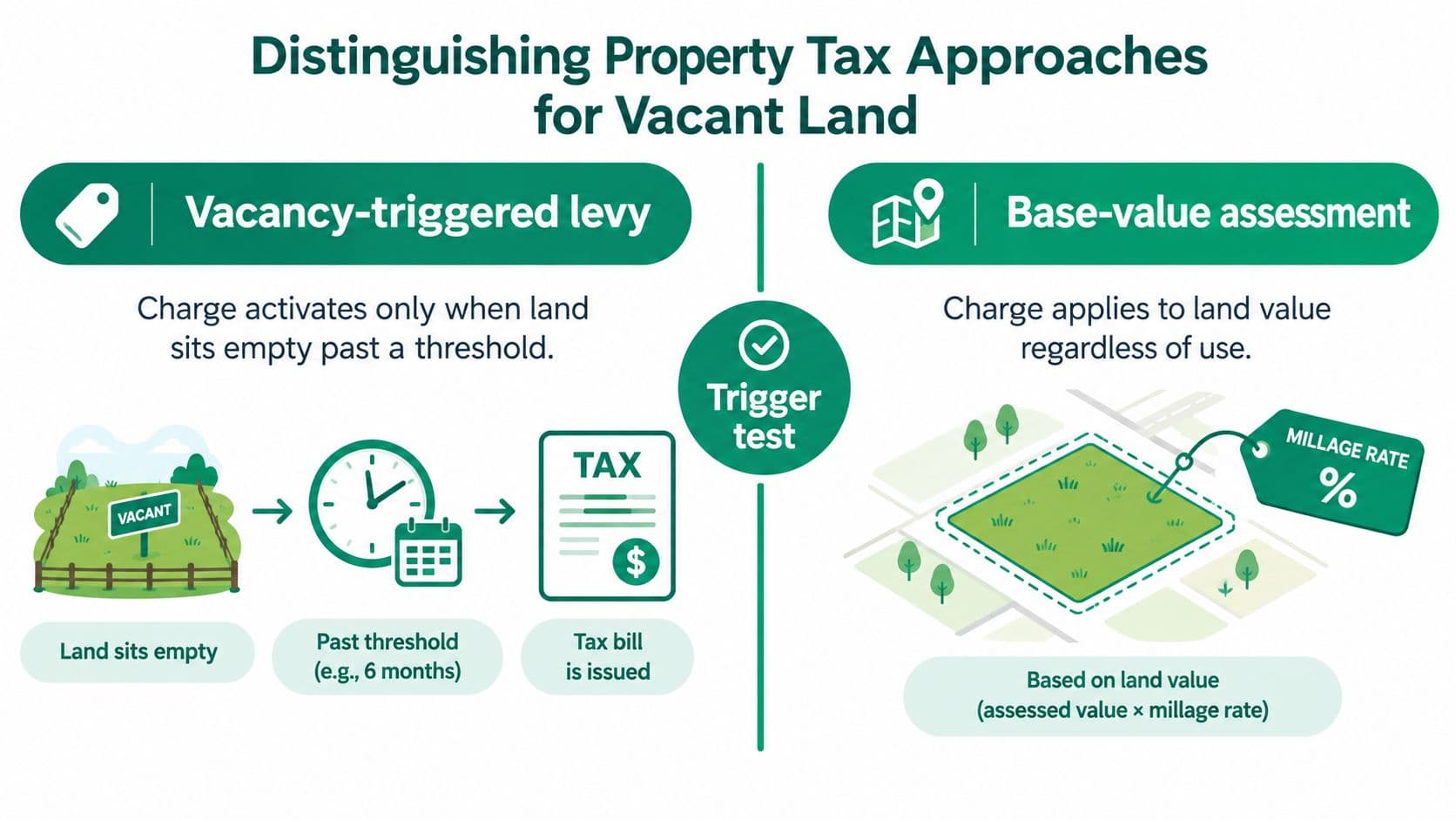
A vacant lot can generate different tax bills under different rules. One jurisdiction may apply its ordinary property tax, another may add a charge after a defined period of non-use, and a third may tax the land value while excluding buildings and other improvements. The policy label matters less than the assessment base, the trigger, and the evidence required to support the bill.
| Approach | What determines liability | Typical policy question |
|---|---|---|
| Ordinary property tax | The jurisdiction's standard assessment of land and improvements | What is the property worth under the normal tax system? |
| Vacancy-triggered charge | A statutory definition and duration of non-use | Has the parcel been vacant long enough to activate the charge? |
| Land-value tax | The value of unimproved land, excluding buildings | What is the site worth regardless of the improvements placed on it? |
A New York assessment explanation of highest and best use shows why ordinary assessment can produce an unexpected result. New York generally values idle vacant land according to its highest and best use, rather than its current use. A lot with no building may therefore receive an assessment based on development potential.
A land-value-tax system begins with a different base. It taxes site value, including the effects of location, access, infrastructure, and surrounding economic activity, while excluding improvements. The Federal Highway Administration notes that, in a revenue-neutral shift, vacant lots, surface parking, and boarded-up buildings would generally face higher liabilities because their improvement-to-land-value ratio is low or zero. The distinction between land-value tax versus property tax therefore turns on both the base and the rate, not on terminology alone.
The highest-and-best-use test
Highest and best use can produce a defensible valuation when it reflects an owner's realistic options. It becomes questionable when an assessor assumes a development that zoning, financing, contamination, access, or permitting prevents in practice.
An ordinary system may undertax a parcel if it ignores valuable development potential. It may also overvalue the same parcel if the assessment treats every undeveloped site as equally usable. Staff should separate a theoretical use from a financially feasible use supported by market and site evidence.
Use this sequence to test the assessment:
- Identify the jurisdiction and tax type. Establish whether the bill is ordinary property tax, a vacancy surcharge, or a site-focused land charge.
- Check the legal use. Review zoning, permitted uses, density, subdivision limits, and pending planning restrictions.
- Test physical feasibility. Examine access, utilities, topography, wetlands, contamination, and other site conditions.
- Review comparable evidence. Confirm that the assessor used comparable vacant-land sales and made appropriate adjustments.
- Confirm procedure. Check notice requirements, evidence standards, filing dates, and appeal deadlines.
The sequence clarifies what the owner is paying for: vacancy, development potential, or land value. That distinction also guides municipal communication. A vacancy-triggered charge requires proof of non-use and a clear start date. A potential-use assessment requires support for the assumed use. A site-value tax requires a defensible method for separating land from improvements.
Choosing Between Fixed Leases and Annual Land-Use Rights
Tax policy and land contracts solve different problems. A tax determines how the public sector collects revenue from land value. A lease or land-use right determines the private party's legal access to land, including the right to use, develop, transfer, inherit, or benefit from it.
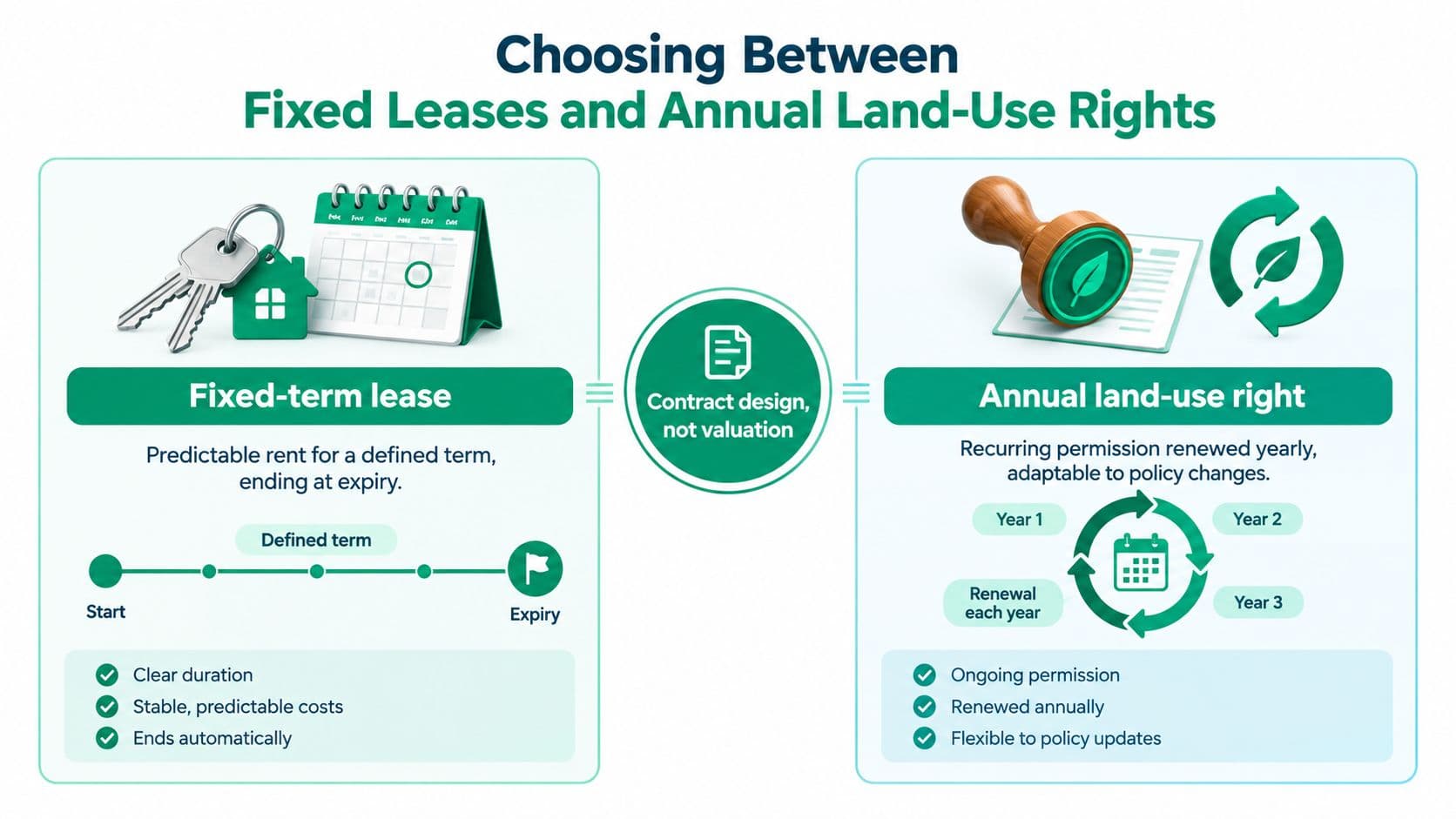
Land leases are fixed-term contracts. They may be renewable or non-renewable, and their price may remain fixed for the agreed period. That predictability can help a project plan its costs, but it also postpones land-price risk rather than removing it.
A renewable lease offers certainty only until expiry. If the contractual rent falls below the market value of the site during the term, the gap may accumulate and close through a major repricing at renewal. A non-renewable lease creates a different problem. As expiry approaches, lenders and buyers must value the shrinking remaining term, which can make refinancing and resale progressively harder.
A fixed lease doesn't eliminate risk. It moves the risk to the renewal date, the expiry date, or the next financing decision.
Hong Kong provides a documented example of why the pricing rule matters. Before 1997, annual rent was fixed and unrelated to increases in land value, so rent collected remained minimal despite land appreciation, as described in the Lincoln Institute discussion of public land leasing. Public leasehold systems may collect land value through an initial premium, annual land rent, premiums for changes that permit additional development, and a renewal premium when rights expire.
Three models with different consequences
| Model | Duration | Repricing | Main administrative risk |
|---|---|---|---|
| Renewable fixed lease | Defined term, with a renewal option | Often concentrated at renewal | A repricing cliff and renewal negotiations |
| Non-renewable fixed lease | Defined term, no automatic renewal | May occur through contract terms or extension | Shrinking term affects finance and resale |
| Land-use right | Indefinite, with no expiry | Every year | Requires credible annual valuation and billing |
A true land-use right must be indefinite, require no renewal, never expire, and be repriced every year. A long contract doesn't qualify merely because its term is generous. If it expires or requires renewal, it's still a fixed lease.
Annual repricing prevents a large expiry-date adjustment from accumulating. Buyers and sellers can transfer the right without discounting an approaching loss of access or negotiating a renewal cliff. That lower transfer burden can support entrepreneurship and productive enterprises because the land payment reflects current site conditions rather than a hidden future shock.
The distinction matters for vacant-land policy. A fixed lease can make a site appear inexpensive to hold until renewal, while an annual land-use right continuously reflects the value of continued access. The analysis of 99-year land leases is useful for separating a long fixed term from an indefinite right.
Governments should write the classification into law and contracts. Calling a fixed lease a “land-use right” doesn't change its expiry mechanics. The decisive tests are annual repricing, no renewal requirement, and no expiration.
Building a Defensible Mass-Appraisal Workflow for Vacant Land
A vacant parcel can look simple on a map and still be difficult to value. One site may have road access, utilities, and permission to build. Another may share the same zoning but face contamination, title problems, or an unusable shape. A defensible assessment therefore begins with parcel facts, not a target revenue figure. Staff need a repeatable process that produces consistent values and gives owners enough information to understand and challenge the result.
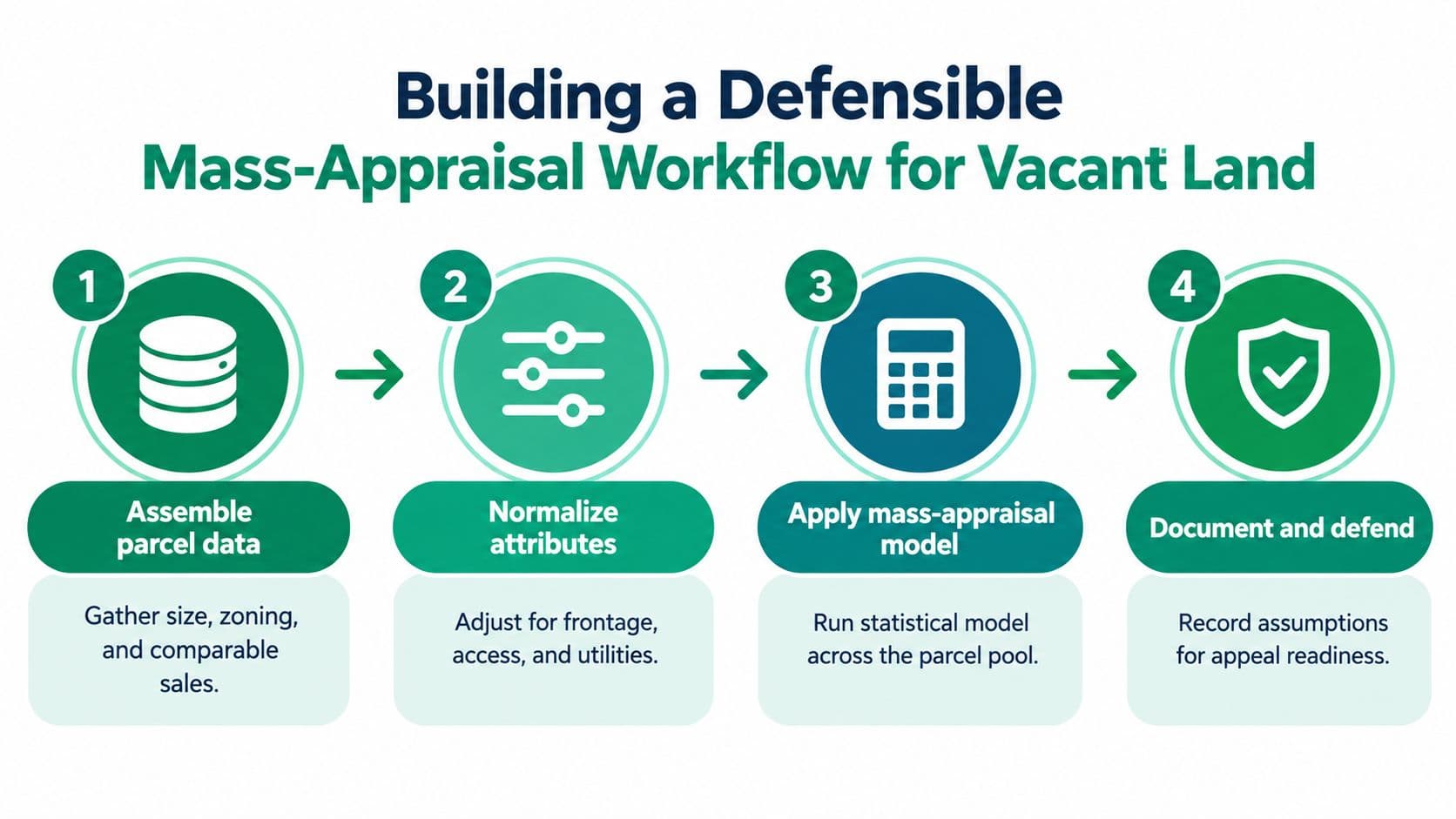
The workflow has seven connected stages.
Start with the parcel, not the model
-
Establish the physical and legal record. Confirm boundaries, area, zoning, access, servicing, environmental constraints, and permitted uses. A cadastral map shows ownership and dimensions, but it does not establish that development can proceed.
-
Test highest and best use. The proposed use must be legally permissible, physically possible, financially feasible, and maximally productive. A site without legal access, with unresolved contamination, or without available utilities should not be valued as if construction could start immediately.
-
Assemble verified sales. Use transactions involving vacant or near-vacant land. Exclude sales distorted by unusual financing, related parties, development agreements, or other conditions that do not reflect ordinary market behavior.
-
Normalize the evidence. Bring transaction prices to a common valuation date and unit measure. This creates a consistent comparison before staff account for differences between parcels.
Adjust, reconcile, and defend
-
Adjust for material attributes. Location, size, shape, frontage, topography, utilities, access, and development restrictions can change value. Each adjustment should be documented and supported by market evidence. Standard percentages applied without explanation weaken the assessment when an owner appeals.
-
Estimate and reconcile. Direct comparison generally suits vacant land because it avoids separating building value from total property value. Where vacant sales are scarce, residual extraction, income methods, or other approaches can provide supporting evidence. Residual extraction estimates land by subtracting depreciated improvement cost from total improved value, so its result depends heavily on the quality of both inputs.
-
Test and audit the result. Run statistical tests, review value maps, verify selected parcels in the field, and examine appeal outcomes. CAMA systems can organize parcel data, generate initial estimates, and flag outliers, but professional judgment must remain part of the process. A comparison of mass-appraisal methods shows how valuation techniques balance accuracy against administrative cost. The system should direct unusual results to professional review rather than present its output as unquestionable.
The Lincoln Institute guide to mass appraisal of vacant land supports this structured approach and cautions against treating every undeveloped parcel as equally developable.
For finance teams maintaining broader asset records, an ERP guide for fixed asset valuation offers context on recording asset attributes, valuation assumptions, and review controls. It does not replace a land-appraisal model. Its practical contribution is a disciplined record trail and repeatable review.
Appeal readiness starts before the notice is mailed. Preserve comparable sales, adjustment logic, map reviews, field notes, and development-feasibility evidence supporting each material conclusion.
A sound workflow also improves policy design. If staff cannot distinguish a serviced, developable infill site from a constrained parcel, a vacancy charge may burden the wrong owner. Better valuation records help government target the behavior it intends to change.
Designing Exemptions and Escalating Vacancy Charges
A vacancy rule is only as fair as its treatment of genuine non-use. Land may remain undeveloped because an owner is actively building, resolving title, selling the parcel, dealing with contamination, or waiting for a planning decision. A statute that treats every case as deliberate speculation will generate avoidable disputes.
Victoria, Australia shows why the administrative details matter. Metropolitan land capable of residential development can fall under vacant residential land tax after five continuous years undeveloped. The rate rises from 1% of capital improved value after one year of liability to 3% after three or more years, according to the State Revenue Office Victoria notification guidance.
From 1 January 2025, Victoria extended one exemption to three years where ownership is unchanged and the owner made genuine and reasonable efforts to sell. Owners must still notify the revenue authority even when they believe an exemption applies.
Build the evidence rule into the policy
A workable system should specify what proves an exception. Relevant records may include:
- Planning evidence: Applications, refusals, conditions, or correspondence showing why permitted development has not yet proceeded.
- Construction evidence: Building permits, contracts, inspection records, financing documents, and verified site activity.
- Sale evidence: Listing agreements, marketing records, offers, and documented attempts to complete a transaction.
- Ownership evidence: Probate, inheritance, title-clearing, or transfer documents showing why control changed.
- Site-condition evidence: Environmental reports, access disputes, infrastructure records, or other material constraints.
- Hardship evidence: Financial or personal circumstances recognized by the governing statute.
An exemption should not depend on an assessor's informal impression. The owner needs a clear filing route, the authority needs a consistent review standard, and the appeal body needs a complete record.
Escalating charges can align liability with duration and development capability. They also create a stronger incentive to resolve a site's status, but only if the authority updates records when construction begins, ownership changes, or an exemption ends. Overlapping land-tax and property-tax regimes should be explained in the bill and guidance so taxpayers know which charge applies and why.
The practical lesson is simple: define vacancy, define proof, and define the clock. A charge that ignores those three elements will produce administrative friction rather than redevelopment.
For a broader treatment of the policy mechanics, idle-land tax guidance can help staff compare vacancy triggers with land-value assessments and consider how each approach treats productive use.
Implementing Land-Value-Capture Policy with Support and Precedents
A vacant-land charge works best when it fits a wider land-value-capture framework. The central economic distinction is between land, labor, and capital. Buildings and business investment represent productive capital, while location value arises from public infrastructure, surrounding activity, legal permissions, and natural advantages.
A land-value tax is a recurring charge on unimproved land, not on buildings or other improvements. Public leasehold systems can collect the same underlying value through an initial premium, annual land rent, additional-development premiums, or renewal premiums. The academic account of land-value taxation and public land rent distinguishes these mechanisms from a conventional tax on combined land and improvement value.
That distinction supports a more balanced reform path. A municipality can model how a site-focused charge affects vacant parcels, improved properties, builders, renters, and public revenue before changing rates. It can also phase the transition, publish assumptions, and create protections for owners whose land is constrained by conditions outside their control.
Administrative readiness determines credibility
Policy adoption requires more than legislation. Governments need:
- Reliable valuation data for site characteristics, comparable sales, infrastructure, and permitted uses.
- Clear collection rules explaining billing, annual repricing, vacancy status, and appeals.
- Distributional modeling showing who gains and who pays under different transition paths.
- Public education using plain-language guides, interactive models, multilingual materials, and practical FAQs.
- Implementation support for legislative drafting, cadastre integration, compliance workflows, and staff training.
Documented precedents from Denmark, Estonia, Singapore, Alaska, Canberra, Norway, and Allentown offer material for comparative policy analysis, but no jurisdiction can copy a model without adapting it to its legal system, land market, and administrative capacity.
Unitism® offers land valuation assessments, policy design, distributional and fiscal modeling, implementation support, education, public-facing materials, interactive tools, and advisory work on replacing transaction and building taxes with land-based charges. Those services can help a government connect vacant-land taxation to a broader goal, aligning private holding decisions with public infrastructure costs without placing the same burden on wages or productive construction.
A credible reform tells owners exactly how value is assessed, when liability begins, what evidence supports an exemption, and how to appeal. That transparency is not an accessory to land-value capture. It's what makes the policy enforceable.
Municipal leaders can use Unitism® to assess vacant-land values, model distributional effects, design land-value-capture rules, and prepare the administrative systems needed for implementation. Visit the platform to discuss a practical transition path that aligns property tax on vacant land with infrastructure costs while protecting productive investment.