Stamp duty reform guide: why the tax locks people in, which replacements work, and how to phase a land value charge.
November 17, 2026
Stamp Duty Reform Options, Impacts and Paths
Stamp duty reform guide: why the tax locks people in, which replacements work, and how to phase a land value charge.

Your three-bedroom semi made sense when the children were small. Now the commute runs two hours each way, the garden eats every weekend, and a retired couple two streets over would happily trade their four bedrooms for your smaller place. Both households would gain from the swap. Neither moves, because in the week the deeds change hands one of them owes the treasury a sum that looks like a deposit.
The bill arrives whatever the reason for the move. That is what a transaction tax does. Stamp duty is charged on the transfer, not on the occupation of the site. You pay because ownership changed hands, not because the new arrangement suits you better than the old one.
Table of Contents
- Why Moving Homes Triggers a Large Bill
- Land Charges versus Leases and Use Rights
- Reform Options Compared on the Same Criteria
- Measured Effects on Mobility, Jobs and Welfare
- How to Phase Out the Transaction Tax
- Holidays, Surcharges and Choosing the Goal
Why Moving Homes Triggers a Large Bill
The arithmetic of that week is familiar to anyone who has moved, and it does not stop at the tax line.
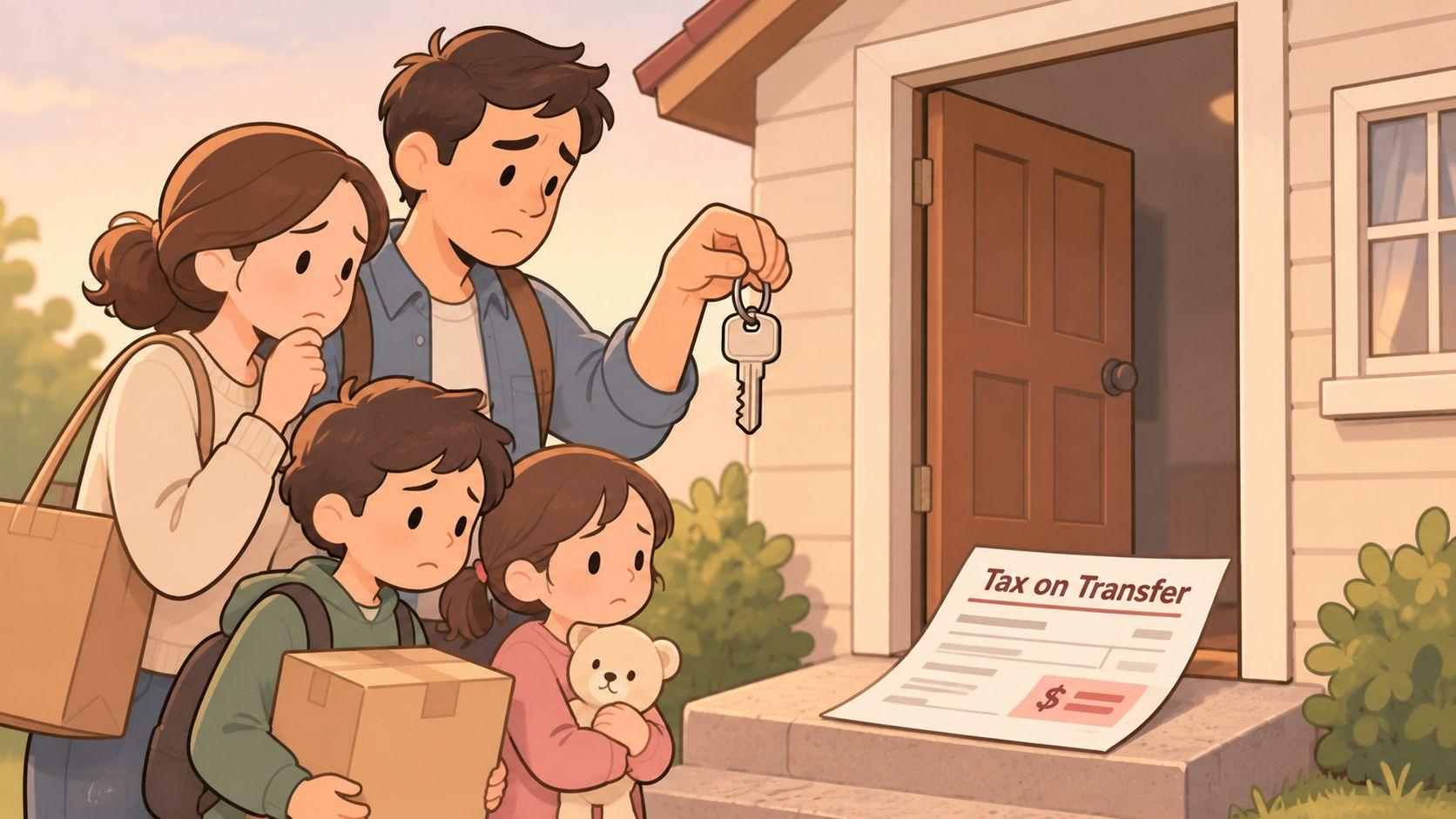
Stamp duty, registration, agent fees and the removals invoice all land together, and household moving costs in Sydney show how fast the ancillary items accumulate. The tax line is the one a finance ministry controls.
What the 2014 UK redesign actually changed
Before December 2014, the UK charged a single rate on the entire price. A buyer who crossed a threshold paid the higher rate on the whole purchase, so the last pound of price could cost thousands. The reform replaced that slab with slices, applying marginal rates to successive portions of the price, as the UK government's summary of the reform records.
Within the first year, more than 780,000 homebuyers were estimated to have benefited, saving about £657 million between them, and liability fell for 98% of people who paid residential stamp duty.
That is the smallest version of reform: same tax, gentler edges. Notice what it did not do. Stamp-duty receipts from homes priced above £1 million rose 15% in the year after implementation. Better marginal design can lower bills for ordinary buyers and still collect more from the top of the market.
The value that never gets recorded
The move that doesn't happen destroys something nobody measures: the commute not shortened, the spare room not freed for a family that needs it, the shop unit that stays empty because the tenant won't pay twice to relocate. Economists describe the gap between what a move was worth and what it cost as a deadweight loss, and a tax triggered by transfer is unusually efficient at producing one.
Every reform conversation then reduces to a choice of objective. Mobility, revenue, or curbing concentrated buying. Those three pull against each other, and the alternative Unitism's core proposal rests on is a charge on land value rather than on the act of moving, so that communities fund themselves from land value instead of taxing work.
Name the objective in writing before anyone drafts a rate schedule. A rate cut aimed at turnover gets judged by a different test than a surcharge aimed at investors, and mixing the two produces a reform that satisfies neither.
Land Charges versus Leases and Use Rights
Briefings go wrong here. Three different instruments get described as land taxes when only one of them prices land continuously.
The platform and the building. Think of the site as the platform the community provides: the roads, the drains, the school places, the customers who walk past the door. The building on top is the owner's own work. A land value charge is a public payment on the value of the platform, not on the house or shop standing on it. Unitism's land value tax applies to the value of land, not to buildings or improvements, and the revenue is returned to the community. Because it ignores the building, it never punishes anyone for investing in one, which is the whole point of separating land value from building value.
A land lease is a different animal. It is a contract, renewable or non-renewable, at a price fixed for a defined term. The mechanics of fixed-term land leases and renewal are well documented, and the weaknesses follow directly from that fixed price.
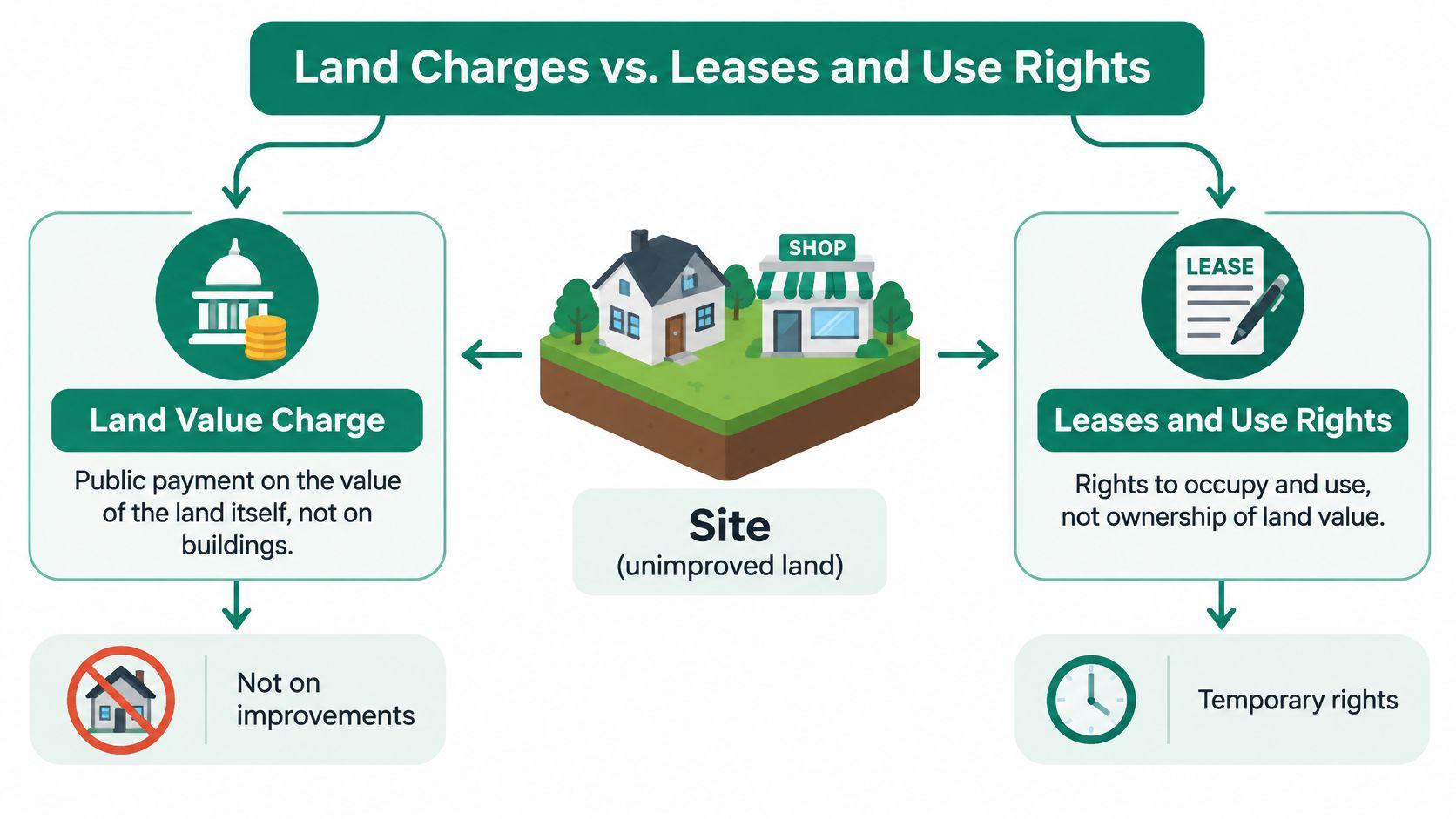
A renewable lease provides certainty only until the term ends, and any gap between the old rate and the market gets closed at that moment in one large repricing. A non-renewable lease has the mirror problem: as the remaining years shorten, refinancing and selling become progressively harder. Both postpone risk instead of pricing it.
The test for a drafter: if the payment can drift away from the market for a decade and then jump in a single year, it is a lease.
The three tests for a land-use right
A land-use right, properly named, is a right to use land that is indefinite, requires no renewal, does not expire, and is repriced every year.
- Annual repricing keeps the claim current. The payment tracks the site rather than a number agreed years ago, so nobody accumulates an unpriced liability in the background.
- No renewal means no cliff. There's no scheduled moment when the authority reopens the contract and the holder discovers what the market has done.
- No expiry means the asset stays sellable. A buyer takes the right on the same terms the seller held it, so the transaction price stays low.
When all three hold, the instrument behaves like a recurring land-value charge. People buy and sell the right cheaply, and nobody is loading an expiry-date balloon payment into a business plan.
Sometimes a fixed lease gets marketed under the friendlier label. It is still a fixed lease, and renaming it doesn't remove the refinancing risk. Apply the three tests to any draft bill before the country comparison starts.
Reform Options Compared on the Same Criteria
A buyer in a high-price suburb pays the transfer tax on the day they move, then stays put because the next move would trigger the same bill. Trimming that cheque does not fix the matching problem. Workers still face a toll between the house they have and the job they could take. The instrument you pick sets the revenue pattern, the mobility effect, and the administrative workload that follows. Read the rows as alternative meters, not as slogans.
Stamp duty reform instruments compared
| Instrument | When paid | What is taxed | Effect on moving | Revenue pattern |
|---|---|---|---|---|
| Stamp duty on the transfer | Once, at purchase | Whole transaction price | Large upfront lock-in | Volatile with turnover |
| UK-style slice rates | Once, at purchase | Marginal bands of the price | Smaller bill for most buyers; wedge remains | Still volatile; high-value share can rise |
| Annual unimproved land charge | Every year while held | Site value, excluding buildings | Removes the buyer wedge | Steadier than turnover taxes |
| NSW 2020 opt-in property tax | Buyer's choice, then annual | Fixed amount plus a rate on unimproved land value | Buyer can avoid the lump sum | Grows slowly as buyers opt in |
| Henry-style marginal land tax | Annual | Unimproved value per square metre, per holding | Encourages development of each site | Broad base, thresholds by site value |
| Fixed-term land lease | Contractual term | A price fixed until renewal or expiry | Harder to refinance as the term shrinks | Repricing postponed to the end |
| Indefinite land-use right | Repriced each year | Current site value, no expiry and no renewal | Low cost to buy and sell the right | Risk priced continuously |
Reading the rows in order
The top row is the status quo in one line. The buyer pays a lump sum on the full price, and receipts swing with however many sales happen that year. Mobility is a side effect of the cash register: fewer moves mean a quieter treasury and a tighter labour market.
The second row keeps the wedge and files down the cliffs. The UK moved to marginal slices from December 2014. Ordinary buyers paid less. High-value purchases kept raising revenue. The sale is still the taxable event, so a household that would gain from a better job match still waits.
Rows three to five replace the point of sale with a recurring charge on land. The payment works like a meter on the site, not a toll booth at the front door. People can change address without buying their way out of the tax. The New South Wales design is worth studying because it is not a flat percentage of the whole price. A 2020 consultation model described an annual property tax made of a fixed amount plus a rate applied to each property's unimproved land value, with purchasers choosing between the existing stamp duty and the smaller annual tax, as the analysis of Australian land tax design sets out. Excluding buildings matters. The charge lands on the site, so it does not tax the next round of construction, and using the land well is not punished.
The same analysis records the Henry Review line: abolish duties on all property transactions, apply land tax to all land at increasing marginal rates on unimproved capital value, set thresholds by value per square metre, and assess each holding separately rather than aggregating an owner's whole portfolio, so that developing a site is not penalised. That is a productivity rule as much as a revenue rule. The annual charge follows the site. A fixed lease only postpones the day the price is reset.
The last two rows are the ones most easily confused with a land value charge. The fixed-term lease never reprices the site, while the land-use right only matches a land value charge if it is repriced every year. A lease that sits still for a decade and then jumps is still a postponed repricing, whatever name appears on the contract.
Surcharges are a different instrument
The UK's October 2024 increase to the higher rates of Stamp Duty Land Tax was estimated to raise £170 million in additional receipts in 2026-27, according to the government's costing of the higher-rate change. That figure is a projection for a future year, not a receipt already banked.
The scale of surcharges in practice shows up in the returns. 211,700 transactions were subject to the Higher Rates for Additional Dwellings surcharge in 2024-25, generating £2.790 billion, per HMRC's stamp tax statistics.
Surcharges raise money and deter some buyers. They do not remove the wedge for the buyer who still pays, and they do not help a worker match to a job in another town. Mark which row matches the stated objective: a mobility and productivity goal points to row three or five, a revenue goal can be met by several rows, and an investor-deterrence goal points at a surcharge that leaves the underlying transfer tax intact. What a land value tax is sets out the valuation logic behind an annual charge on the site rather than on the building.
Measured Effects on Mobility, Jobs and Welfare
Treat these as estimates produced by models, not promises about outcomes. Read the scale and the channel separately, because the channel is where the argument usually turns.
Modelled and observed effects of replacing stamp duty
| Source | Change modelled or observed | Scale reported | Main channel |
|---|---|---|---|
| Overlapping-generations model | Remove duty; revenue-neutral recurrent or consumption tax | Turnover up more than 50%; owner-to-owner moves nearly double | Buyer wedge removed |
| NSW government modelling | Upfront duty replaced by annual land-value charge | Transactions +20–30% short run, +40–60% long run; GSP +1.7% | Lower cost of moving |
| NSW output and jobs results | Same land-value replacement | About A$11 billion in four years; about 75,000 jobs; about A$3,300 per household | Continuous charge, more activity |
| ACT from 2012 | 20-year phase-out toward unimproved land value | Two decades, broadly revenue-neutral by design | Shift off the point of sale |
| Australian spatial model, 2025 | Lower stamp duty | Welfare +3.57%, of which 95% from job-location matching | Workers matched across places |
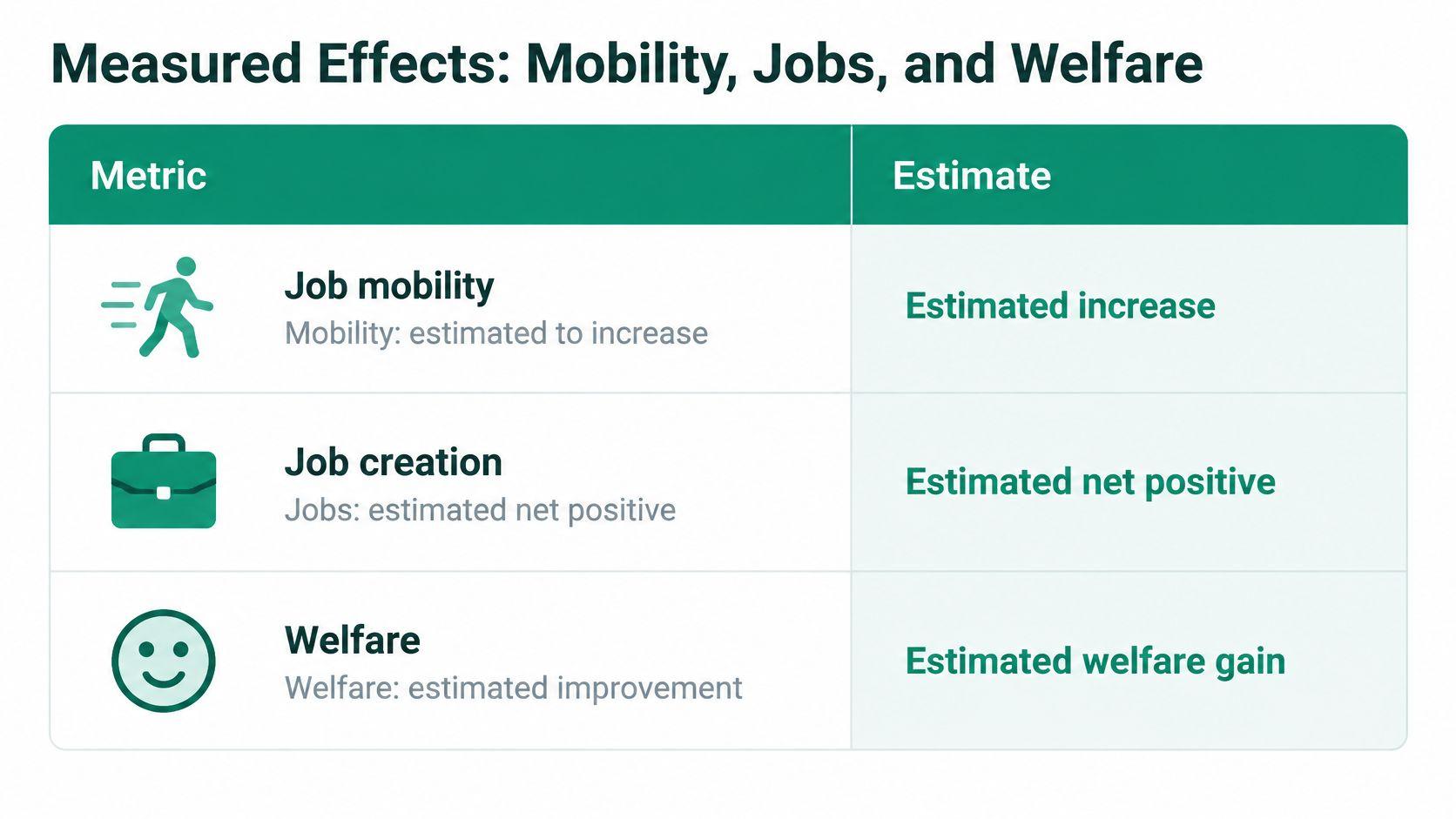
The first row comes from a calibrated general-equilibrium model with overlapping generations. Its headline result is that removing stamp duty and replacing it with a revenue-neutral recurring property tax or consumption tax can lift housing turnover by more than 50% and nearly double homeowner-to-homeowner transitions, with moderate house-price increases, lower rents, and better housing outcomes for younger households, as the Quantitative Economics study on stamping out stamp duty reports. The mechanism is simple to describe to a minister: the seller receives more and the buyer pays less, so the same move becomes worth making.
The New South Wales numbers come from the government's own modelling of its replacement proposal. Removing the upfront payment was estimated to raise property transactions by 20–30% in the short term and 40–60% over the long term, inject about A$11 billion into the state economy over the first four years, lift gross state product by 1.7% (around A$3,300 per household) and employment by 1.4%, roughly 75,000 jobs, as the NSW Government's case for property tax reform sets out. These are modelled effects from a proposal, which is a weaker form of evidence than an observed result.
The one long-running national-scale experiment is the Australian Capital Territory, which announced in 2012 a plan to phase out stamp duty over 20 years while raising reliance on a tax on unimproved capital value, designed to be broadly revenue-neutral and to shift the burden from transactions to ownership, according to the LSE analysis of stamp duty and the English housing market. Its value is that it links the reform to an identified replacement revenue source rather than cutting a tax.
The 95 percent that reframes the case
A 2025 spatial general-equilibrium study of Australia estimates social-welfare gains of 3.57% from reducing stamp duty, with 95% of those gains arising through improved worker-location decisions rather than through the housing market alone, as the study of stamp duty and spatial misallocation finds.
That single number changes the sales pitch. Reform isn't mainly a gift to people who move often. It's a productivity measure that lets a warehouse supervisor take the job two towns over without paying a toll at the county line.
The same study is candid about what its model leaves out. Households that buy and sell frequently may gain disproportionately from replacement with an annual land tax, while infrequent owners could end up worse off. Capitalisation into prices, renter and landlord incidence, and the timing shift from an upfront bill to an annual one all need separate work.
Which workers gain from greater mobility, which households carry the replacement charge, and how much revenue gets recycled to protect cash-poor owners? Those three questions matter more than whether sales rise.
Taxation and efficiency sets out how to think about the wedge itself rather than only its size.
How to Phase Out the Transaction Tax
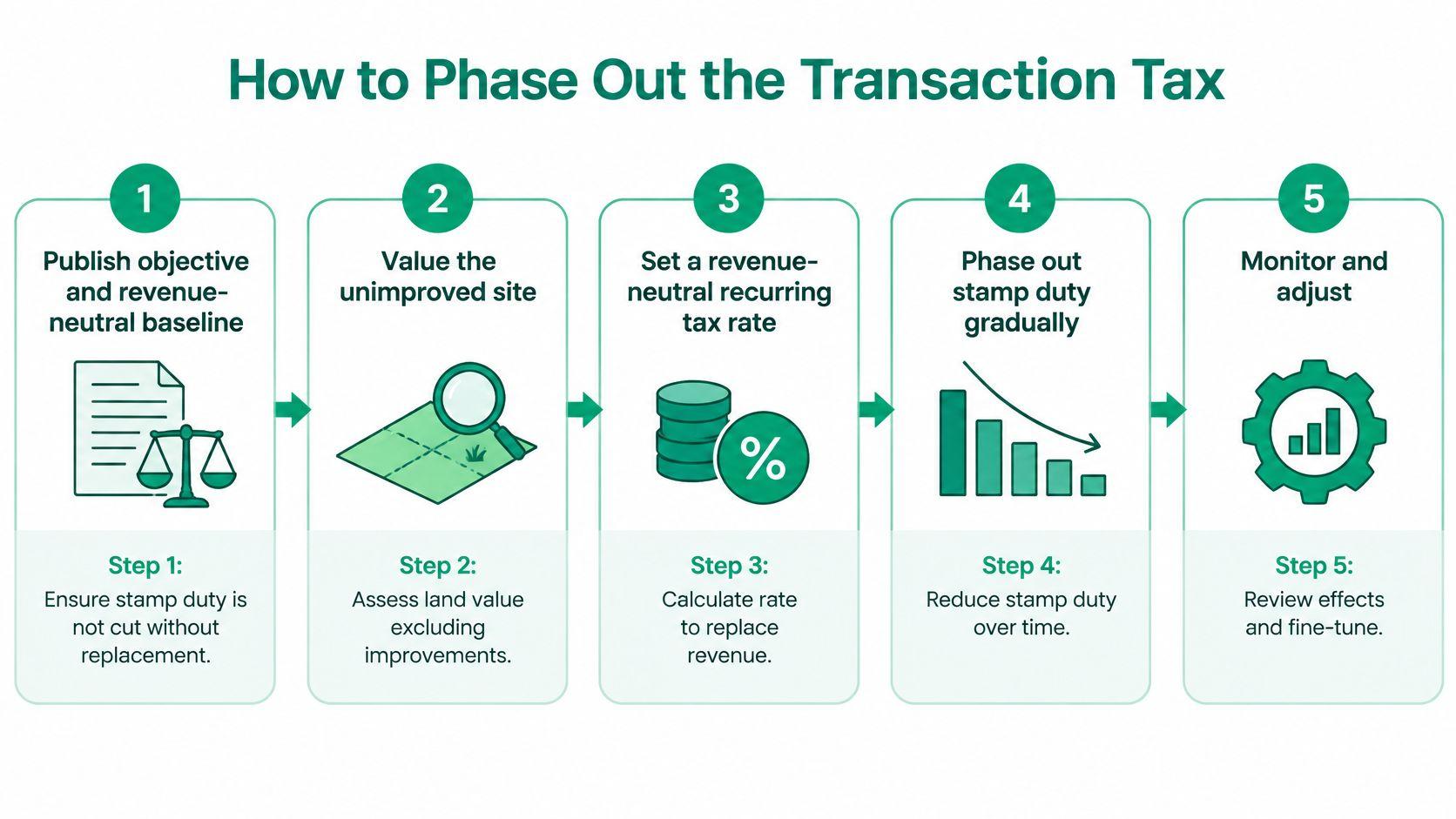
A nurse is offered a post in a town that cannot fill the ward. The house that would make the commute workable is for sale. Stamp duty works like a cover charge at the door: the household pays a large sum on the day it moves, even though the move would put the right worker in the right place. Phasing that charge out is a matching and productivity job a ministry can staff. Five pieces of work have to be ready before the first bill.
-
Publish the objective and a revenue-neutral baseline. Name the target: fewer mismatched homes and jobs, funded from land value instead of from the act of moving. Set today's stamp-duty yield beside that target so a cut cannot pass without a replacement.
-
Value the unimproved site, not the building. Use the cadastre you already hold. The drivers are frontage, access, permitted use, and comparable site sales. A land value tax applies to the value of land, not to buildings or improvements. If the building is in the valuation, the charge punishes construction.
-
Model who gains and who pays. Include capitalisation into prices, landlord and renter incidence, age, and how often each household transacts. A reform that looks neutral in total can still hit one cohort hard. The evidence on the lock-in wedge and how to phase it out makes the design constraint explicit: households face a large upfront cost even when the move would improve the match between their needs and the dwelling, and the efficiency loss falls mainly on spatial misallocation of housing rather than on all mobility equally. The same analysis flags what transition planning must model, namely cash-flow constraints for existing owners, deferrals for asset-rich but income-poor households, and revenue timing, because stamp-duty receipts are volatile and concentrated in periods of high turnover.
-
Pair a declining stamp-duty schedule with a rising annual charge, and choose opt-in or a universal switch on purpose. A slow crossover keeps prices from jumping in a single assessment year. The ACT announced a two-decade switch in 2012, which is the concrete precedent for that pace. New South Wales set out a 2020 consultation proposal that would let purchasers choose an annual tax instead of duty. An opt-in softens the politics and slows the growth of the base. That trade-off is real. An annual charge reprices the site on a cycle. A long fixed lease only postpones the next reset, so the mismatch can sit untouched until the lease ends.
-
Write the deferral, the recycling rule, the reassessment cycle, and a public calculator before legislation. Asset-rich, income-poor owners need a way to roll the annual charge up and settle on sale or from the estate, so a pensioner is never forced to sell in order to pay a tax on staying. Returning part of the revenue by cutting taxes on wages and business makes the package a trade rather than a new bill on owners. Land cannot be hidden, moved abroad or smuggled out, which makes it the most honest source of public revenue, so keep the charge on land value and update it on a published timetable. One page showing the old lump sum against the annual amount for a typical flat, a family house and a high-value site does more for public trust than a white paper.
Fund the bridge and protect the pensioner
Two risks decide whether the programme survives its third year.
The revenue bridge. Stamp duty arrives in lumps when the market is busy and dries up when it isn't. An annual charge arrives steadily but starts small. In the crossover years, receipts from falling transfer volumes and a still-narrow annual base can both be weak at once. Ring-fence a bridge in the medium-term fiscal plan. A recession in the housing market is exactly when the annual charge looks most attractive and the budget gap is widest.
The deferral rule. Without one, the first televised case of a long-standing owner selling up to pay an annual charge will define the reform for a decade. With one, the treasury carries a receivable and the owner keeps the home.
Readiness test: a defensible valuation roll, a published deferral rule, and a rate path that runs for at least a decade. Transition requirements is the checklist to work through before a bill is tabled.
Holidays, Surcharges and Choosing the Goal
Jersey's ministers rejected a proposed stamp-duty holiday meant to encourage older homeowners to right-size. Officials concluded that suitable smaller homes, not stamp duty, were the more significant barrier, and that the evidence didn't justify the lost revenue, as the BBC's report on the Jersey decision and the wider reform picture records. The same account notes that Ireland raised stamp duty on bulk purchases of ten or more houses to 15% and introduced a 6% rate for residential property above EUR 1.5 million, while the Netherlands reduced its real-estate transaction-tax rate from 10.4% to 8%, effective 2026.
Four different tools, four different goals. Jersey tested a relief against a supply constraint and found the constraint held. Ireland's measures target bulk acquisition and high-value property. The Netherlands is making a broad cost cut. None of them prices a site each year.
What each tool can and cannot do
A holiday lifts turnover while it lasts and pulls forward sales that would have happened anyway. When it ends, activity falls back and the queue of moves has already been cleared. It does nothing about the destination housing stock, which is why a downsizing relief without smaller, suitable, affordable homes releases nothing.
A surcharge raises revenue and deters some buyers. It also deepens the wedge for everyone still charged, including the first-time buyer competing against nobody.
A slice schedule takes the cliff off ordinary purchases while leaving the lock-in in place. Useful, popular, and not a mobility policy.
A recurring charge on unimproved land value is the only one of the four that changes the decision at the margin: stay or move, develop or hold. That is why the objective has to be chosen first.
A verdict by goal
If the aim is more moves and better matching of workers to jobs, the instrument is an annual charge on unimproved land value, paired with a deferral rule for owners whose income doesn't match their asset.
If the aim is softening cliffs for typical buyers at no fiscal cost, a slice schedule delivers that and keeps the lock-in.
If the aim is slowing bulk investor acquisition, a surcharge is the tool, and it is not a housing-supply policy.
Reject a fixed lease as a substitute in every case, renewable or not. The price is frozen, and the risk arrives either as one repricing at renewal or as a shortening tail nobody wants to buy. Accept a land-use right only when it is repriced yearly, requires no renewal and does not expire. Unitism's support for clients covers exactly this: assessing land values, designing the policies that collect them, and modelling who gains and who pays.
Write the decision note on one page. Objective, rate path, deferral rule, revenue bridge. Then take the next action, which is naming the goal in writing before any rate is cut.
Unitism® works with finance ministries and city governments on precisely this sequence: valuing land separately from the buildings on it, modelling who gains and who pays under a replacement charge, and drafting the transition rules that keep cash-poor owners in their homes while the base widens. If your ministry is weighing a move away from transaction taxes, our team can build the distributional model, the rate path and the public calculator before a single rate is cut. Visit Unitism® to see how the land value work is structured.