Understand tax exemption for senior citizens through credits, deferrals, and policy design options that fit land-value and traditional revenue systems.
October 9, 2026
Tax Exemption for Senior Citizens: Full Guide
Understand tax exemption for senior citizens through credits, deferrals, and policy design options that fit land-value and traditional revenue systems.
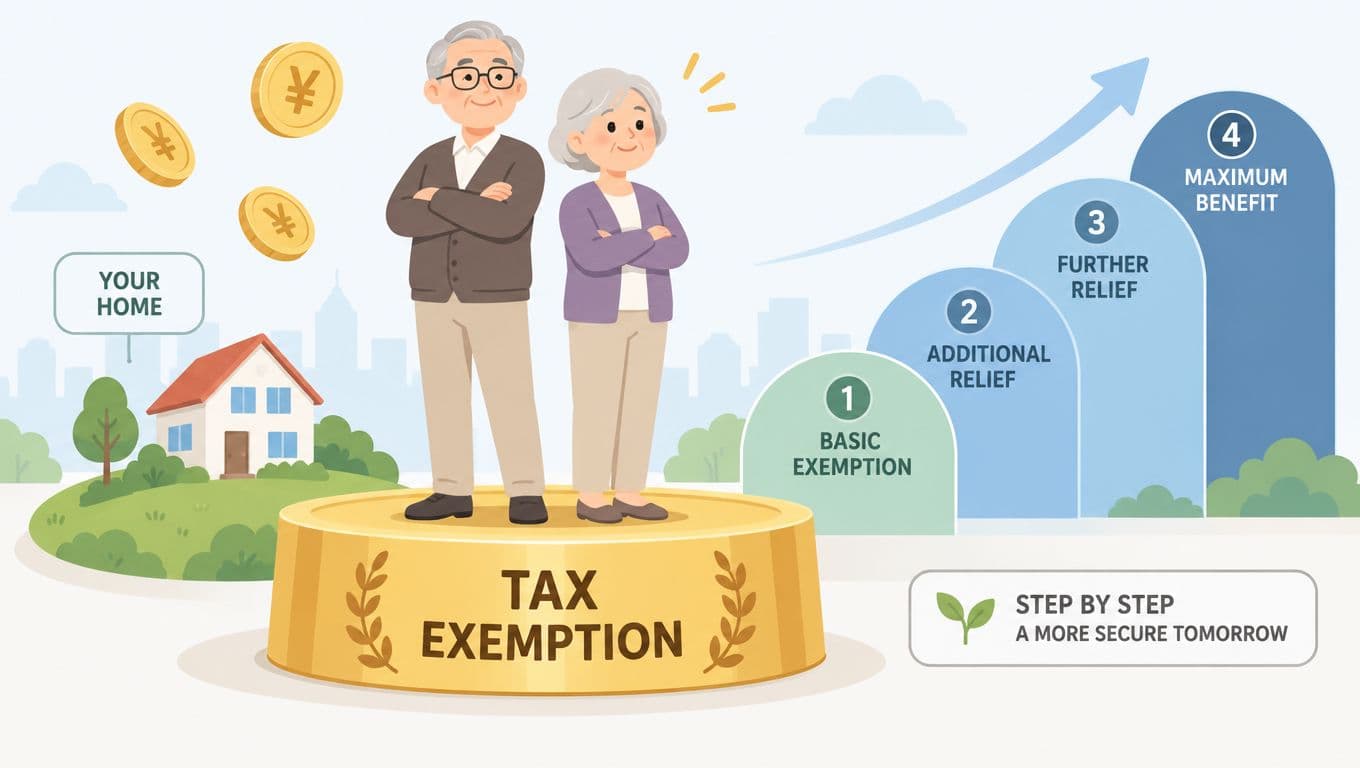
Senior tax exemption is rarely a blanket zero-tax rule. It usually combines age tests, income thresholds, filing exemptions, and payment deferrals rather than permanently eliminating liability.
So what does “tax-exempt” really mean for an older household with pension income, savings, a home, and perhaps part-time work? The answer depends on which tax is involved, how the relief is calculated, and whether the program removes a charge or only postpones it.
An older couple may pay little or no tax on one source of income while still owing tax on another. Their pension could qualify for preferential treatment, investment returns could remain taxable, and a property-tax program might reduce the current bill but create a repayment claim against the home. That's why a reliable answer to “Do senior citizens pay taxes?” must examine the whole household rather than age alone.
Table of Contents
- What Senior Tax Relief Actually Looks Like
- Exemption Versus Credit, Freeze, and Deferral
- How Eligibility and Targeting Shape Outcomes
- Distributional Impacts and Fiscal Trade-offs
- Senior Relief in Land-Value and Property-Tax Systems
- Land Leases and Land-Use Rights Explained
- Practical Eligibility and Next Steps for Older Households
What Senior Tax Relief Actually Looks Like
Consider a retired couple receiving a public pension, interest from savings, and income from a small rental property. One spouse is also doing occasional consulting work. They own their home, but the property's assessed value has increased. A brochure promising a tax exemption for senior citizens sounds reassuring, yet it doesn't answer the questions that determine their actual bill.
Is the relief available only to people above a particular age? Does the household's total income fall below a threshold? Does the program cover pension income, property tax, or both? Must the couple occupy the property and file an application each year? A senior allowance may reduce income tax while leaving property tax, consumption taxes, and tax on investment income untouched.
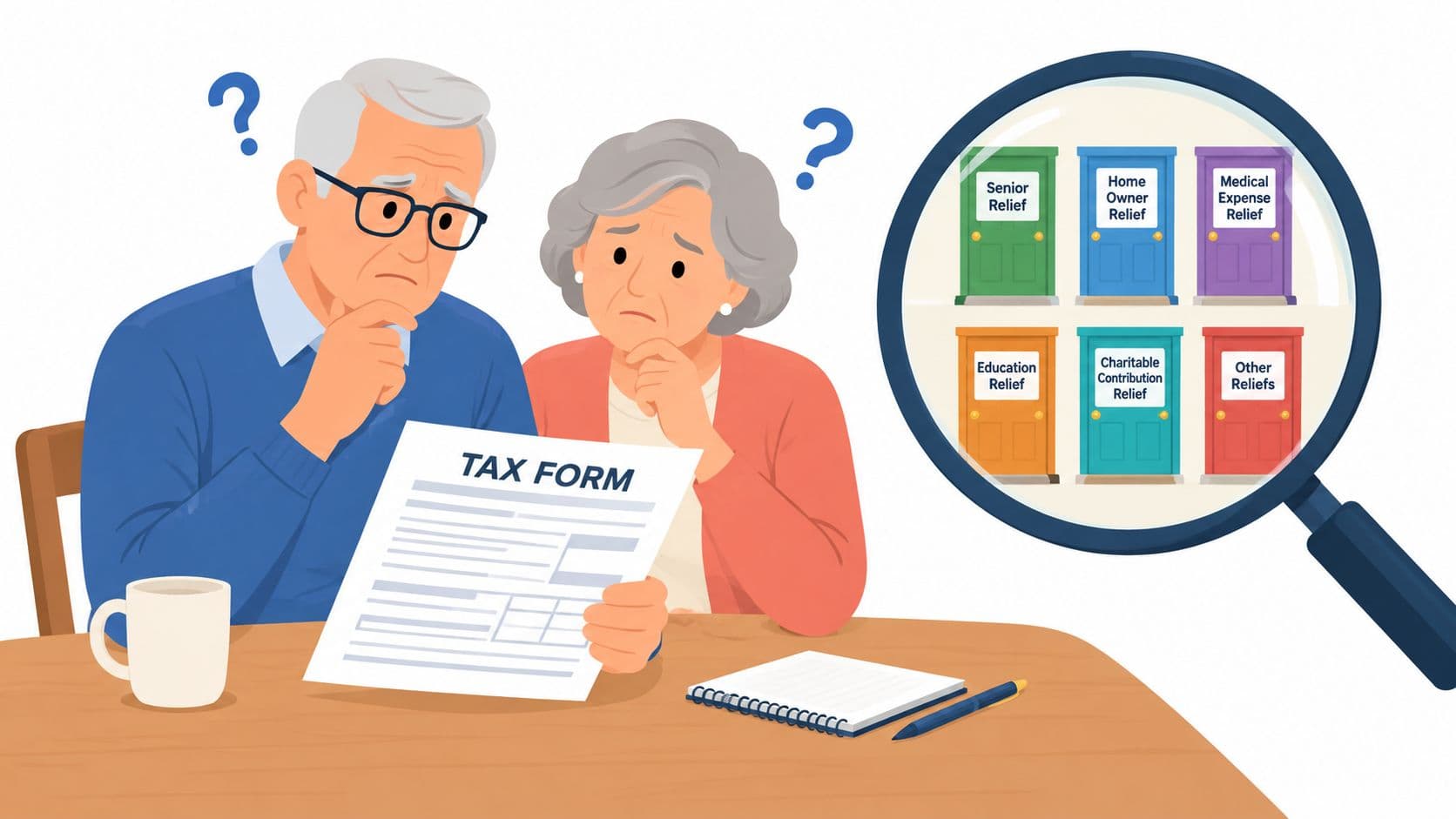
The global pattern is targeted relief
Across the OECD, 20 of 35 countries provided older people with additional basic personal-income-tax relief, commonly through an extra allowance or tax credit, according to the OECD analysis of pensions and pensioner taxation. When preferential treatment applying specifically to pension income is included, 28 OECD countries had some form of relief for older people or pension income.
That relief takes different forms. In 14 countries, public pensions received full or partial income-tax relief. In the United States, depending on total income, between 15% and 50% of Social Security income may be excluded from federal taxation. In Australia, benefits derived from previously taxed pension contributions and investment returns are generally not taxable when paid to people aged over 60. These examples show why the phrase “senior tax exemption” can conceal several different mechanisms.
Retirement doesn't end tax liability
The OECD estimated that a pensioner receiving the gross replacement rate of a full-career average earner paid, on average, 11% of income in taxes and social contributions. The policy objective is usually to recognize lower retirement income, not to exempt every older household, including affluent households with substantial assets and earnings.
Homeowners should also distinguish income-tax relief from property-tax rules. A local property assessment may change even when an owner's age stays the same, so readers should understand the mechanics described in this guide to whether property tax increases every year. The first practical rule is simple: identify the tax, the taxable base, the eligibility test, and whether the benefit is permanent.
Exemption Versus Credit, Freeze, and Deferral
The word exemption suggests that tax disappears, but senior programs often use four distinct designs. Classifying the mechanism is more useful than relying on the program's title.
| Mechanism | Effect on Liability | Typical Triggers | Common Risks |
|---|---|---|---|
| Exemption | Removes some taxable income, value, or levy from calculation | Age, income, residence, or pension source | Relief may cover only selected tax components |
| Credit | Reduces tax dollar-for-dollar, sometimes with refundability | Age, disability, income, and filing status | Phaseouts can raise the effective burden on added income |
| Freeze | Holds an assessed value or bill at a defined level | Age, occupancy, ownership, and an application | Future sale or eligibility changes may end protection |
| Deferral | Postpones payment until a later event | Age, income, equity, and property ownership | Interest, liens, sale, or death can trigger repayment |
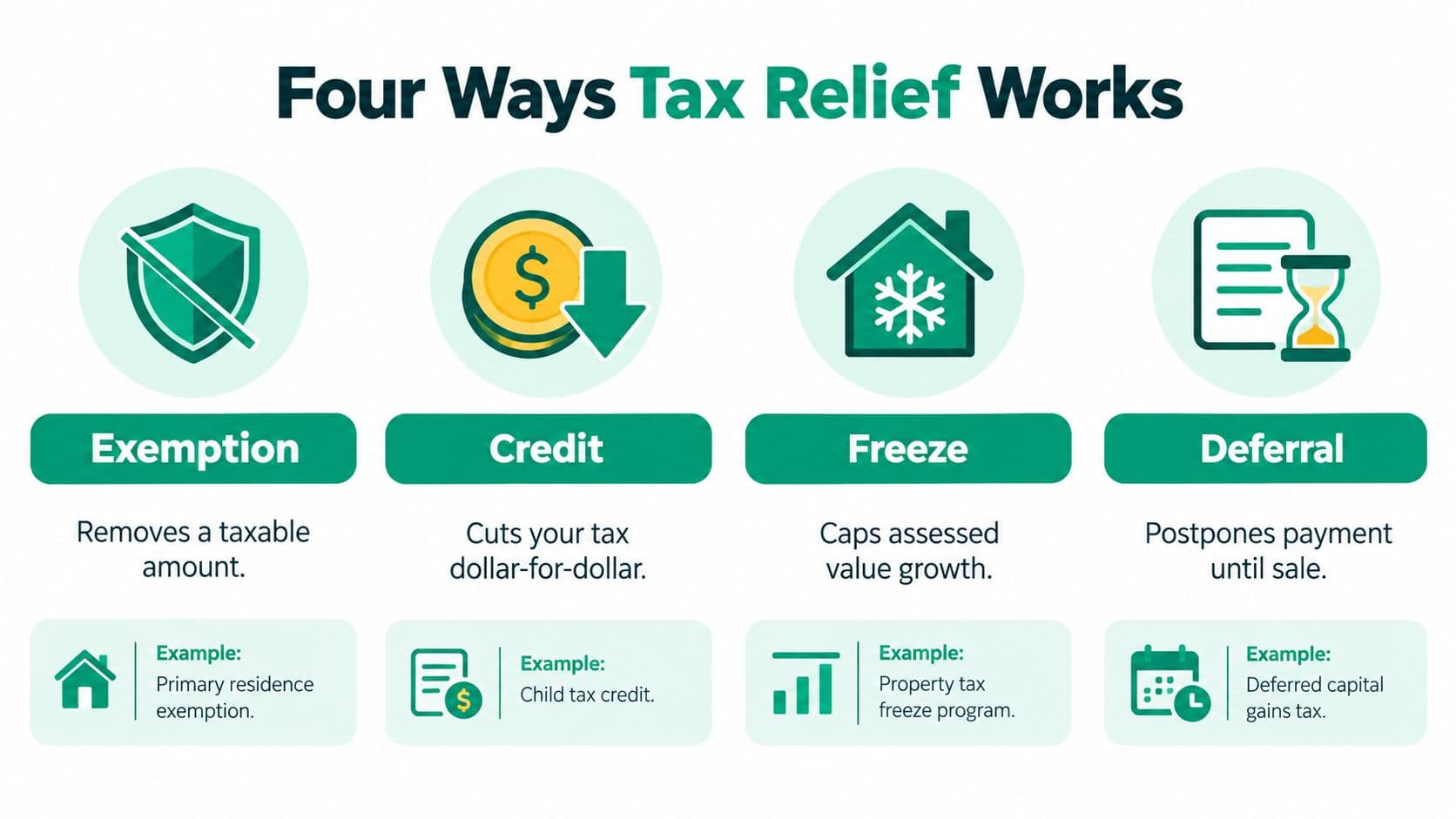
Permanent reduction or postponed bill
New York allows local governments and school districts to adopt property-tax exemptions for qualifying residents aged 65 or older, with income limits that localities can set within statutory ranges, as explained by the New York senior citizens exemption rules. That's an exemption, but its scope depends on local adoption, income, and the levy involved.
A credit works differently. It offsets tax already calculated, dollar for dollar. A refundable credit can provide value even when the taxpayer's initial liability is low. A freeze generally protects against changes in an assessed value or bill under specified conditions, but it doesn't necessarily erase the underlying tax base.
A deferral protects cash flow rather than creating a free benefit. A University of Vermont review found that 31 states and the District of Columbia offer property-tax deferral programs. Deferred tax typically accrues interest and becomes payable when the property is sold or the owner dies. The homeowner may remain in the house, but the claim can reduce equity available to heirs.
Practical rule: Ask whether the program reduces the liability, reduces the current bill, or merely changes the payment date.
The same distinction matters when comparing a senior benefit with a circuit breaker tax credit. A household considering a reverse mortgage, a sale, or an inheritance plan should check for liens, interest, repayment triggers, and whether co-owners must meet the same conditions.
How Eligibility and Targeting Shape Outcomes
Age is easy to verify, but it's a weak proxy for financial need. Two people of the same age may have completely different combinations of pension income, investments, housing costs, employment income, and family responsibilities. Modern relief systems therefore layer age requirements with income ceilings, filing status, pension-source rules, and administrative conditions.
Credits can create hidden marginal rates
The United States Credit for the Elderly or the Disabled illustrates the complexity. The taxpayer generally must be at least 65 at year-end, or permanently and totally disabled, and must remain below statutory income limits. The credit applies a 15% rate to a reduced base after specified amounts are subtracted from adjusted gross income and certain nontaxable pension or annuity income.
The IRS specifies initial subtraction amounts of $7,500 for single filers and heads of household, $10,000 for joint filers, and $5,000 for qualifying married-separate filers, according to IRS Publication 524. Because filing status and retirement-income composition affect the calculation, an additional dollar of pension, interest, or earnings can reduce the credit as well as increase taxable income.
That produces a marginal effective tax rate higher than the statutory rate during a phaseout. A refundable credit, carefully indexed thresholds, and coordinated treatment of pensions and savings can protect low-income households more precisely than a broad deduction.
Different countries target different friction points
The United Kingdom shows how reducing age-specific relief can expand participation in the tax base. The Institute for Fiscal Studies reports that the proportion of people aged 65 and over paying income tax rose from 48% in 2010–11 to 65% in 2023–24, as pensioner incomes rose and the higher pensioner allowance was phased out or brought into line with the standard personal allowance, according to the IFS report on tax policy from 2010 to 2024.
India uses both thresholds and filing simplification. A resident senior citizen receives a basic exemption threshold of ₹300,000, while a super senior citizen aged at least 80 receives a ₹500,000 threshold. Separately, residents aged 75 or above with only pension and qualifying bank-interest income may avoid filing a return when the specified bank calculates and deducts the tax, as described by the Income Tax Department's threshold guidance.
These designs reach different people. A renter may benefit from a refundable credit, an asset-rich homeowner may benefit from deferral, and a retiree with simple bank income may benefit most from filing relief. Local rules also matter, as the District of Columbia homestead exemption illustrates.
Distributional Impacts and Fiscal Trade-offs
Senior relief is not only a household benefit. It changes who finances public services and how much revenue governments collect from a population with growing demands for pensions, health care, and long-term care. The OECD describes ageing as a source of pressure on spending and public revenues, strengthening the case for broader tax bases and continued labour-force participation among older workers in its analysis of ageing populations and fiscal policy.
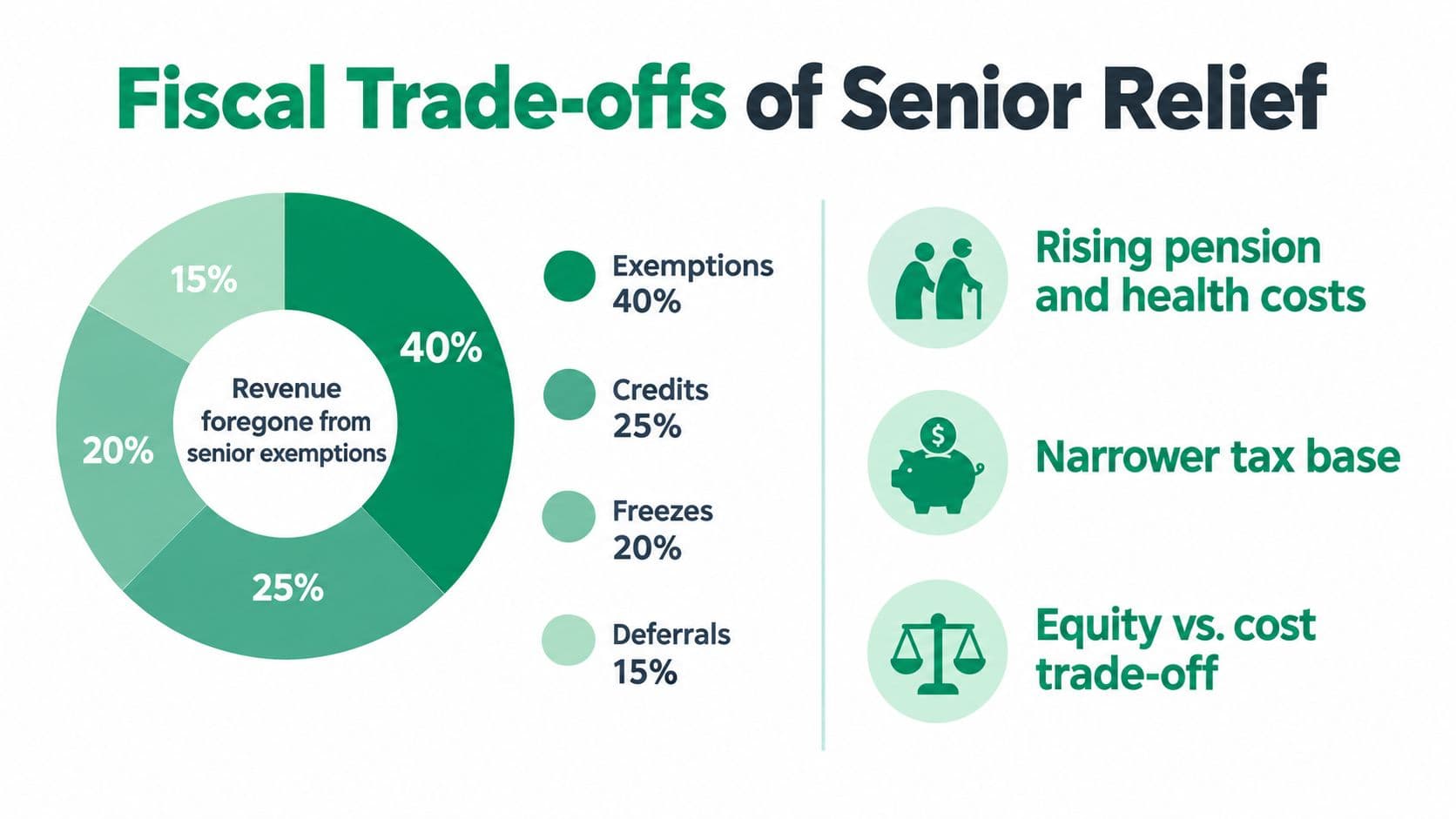
Who receives the benefit
A broad deduction often gives more value to people with enough taxable income to use it. A refundable credit can reach households whose initial income-tax liability is small. A property exemption or freeze may favor homeowners, while renters may receive little unless a separate renter credit exists.
That distributional question should come before the label. Does the program help a caregiver with low income? Does it reach a widow facing high housing costs? Does it assist an older renter, or mainly preserve equity for a homeowner with valuable land?
Relief that protects cash flow can still transfer a future claim to the household's estate.
A deferral can be fair when a household is asset-rich and income-poor, but it can be unsuitable for someone who wants to preserve a bequest or avoid a lien. Policymakers should compare the lifetime cost, not just the current-year bill. A credit may require more public spending immediately, while a deferral shifts collection into the future.
Land-based revenue changes the comparison
A property-tax reform can tax buildings and improvements, land value, or both. The choice affects construction, employment, and the distribution of relief. A system that relies more heavily on land value can reduce pressure on work and productive capital, but it still needs transparent safeguards for older households whose home value is high relative to income.
The policy debate around property-tax reform therefore shouldn't stop at “exempt or not.” It should ask whether the revenue base is broad, whether relief is targeted, and whether older households can transition without being forced to sell.
Senior Relief in Land-Value and Property-Tax Systems
A land-value-based revenue system starts from a different question: how should the public recover part of the location value created by community investment, public services, and economic activity? Under a land-value approach, governments can capture site rental value while reducing taxes on wages, buildings, and productive investment. Senior relief then becomes a targeted protection within a broader revenue structure, rather than a blanket escape from charges on every part of a property.

Separate land, labor, and capital
Tri-factor economics distinguishes labor, capital, and nature-derived value. A building reflects labor and capital, while the underlying site is part of nature and gains value from its location and surrounding community. Taxing the building can discourage construction or renovation. Taxing land value can encourage owners to use well-located sites efficiently, although hardship protections may still be needed.
That distinction matters for older homeowners. A senior who has occupied a modest home for decades may face a high site value without having high annual income. An income-tested credit or carefully designed deferral can address that cash-flow problem without exempting every high-value property owned by a wealthy household.
The practical contrast is visible in local programs. For a jurisdiction-specific overview of how Texas helps seniors with taxes, readers should check the current official rules and distinguish reductions from deferrals. A land-value system would add another question: does the charge fall on the site, the structure, or both?
Revenue design affects productive decisions
A charge on land value cannot be avoided by withholding construction from a valuable site. A charge on buildings can make renovation less attractive. Combining land-based revenue with age- and income-tested relief can protect vulnerable households while avoiding subsidies that encourage speculative holding.
The result depends on valuation quality, transition rules, and administration. A well-designed system should show the household's current liability, the relief available, and any future claim clearly enough that an older owner can make an informed housing or inheritance decision.
Land Leases and Land-Use Rights Explained
Land leases and land-use rights are often treated as interchangeable, but the distinction is mechanical and important. A land lease is a fixed-term arrangement, either renewable or non-renewable, with a fixed price. A genuine land-use right is indefinite, requires no renewal, doesn't expire, and is repriced annually.
Why fixed leases postpone risk
A renewable fixed lease offers certainty only until its term ends. At renewal, the accumulated gap between the fixed lease rate and the market can close in one major repricing. The household receives short-term predictability, but the risk hasn't disappeared. It has been postponed.
A non-renewable fixed lease creates a different problem. As the remaining term shortens, refinancing and resale become progressively harder. Buyers and lenders must account for the approaching expiration, and the fixed price may no longer reflect the site's value.
Fixed leases therefore don't correctly price risk. They shift a future adjustment into a moment when the household may have fewer options, which can matter greatly for an older owner planning to remain in the home or transfer it to heirs.
What makes a land-use right different
Land-use rights function like land leases in the sense that they grant access to a site, but they have three defining features:
- Annual repricing: The price reflects updated land value each year rather than accumulating a hidden gap.
- Indefinite duration: The right doesn't expire, so the owner doesn't face a terminal renewal or expiration date.
- No renewal requirement: The household can buy and sell the right without negotiating a new fixed term.
Annual repricing allows people to buy and sell land-use rights at low cost. It also prices land appropriately without burdening entrepreneurship and other productive enterprises with a sudden lease reset.
Calling a fixed lease a “land-use right” doesn't make it one. Unless it is repriced each year, indefinite, and free from renewal requirements, it remains a fixed lease. That terminology matters when evaluating housing affordability, inheritance value, and the interaction between land charges and senior tax relief.
Practical Eligibility and Next Steps for Older Households
Eligibility usually turns on four questions: How old are you? What income counts? Do you own and occupy the property? What must you file or document? A program may also distinguish pension income from investment income, require an application, or cover only specific levies.
Washington State demonstrates why national assumptions fail. Its senior property-tax relief uses county-based income thresholds. The qualifying threshold is the greater of the prior year's threshold or 70% of the county's median household income, and the program can exempt eligible seniors from excess levies. The precise benefit depends on the applicable income level and levy category, as explained in the Washington senior property-tax exemption guidance.
Compare the benefit with the obligation
The District of Columbia offers another useful contrast. A senior or disabled property owner aged 65 or older may receive a 50% reduction in real-property tax when the applicant owns at least 50% of the property or cooperative unit. For tax year 2026, total household federal adjusted gross income for 2024 must be below $163,500. The District also provides a separate low-income senior property-tax deferral route for households with adjusted gross income below $50,000, according to the District's official property-tax relief rules.
The reduction lowers the current bill. The deferral generally postpones payment. Those are different financial outcomes, even when both programs use the language of senior relief.
Before applying, gather the documents that establish age, income, ownership, occupancy, pension sources, and filing status. Then ask whether the program covers the entire property-tax bill or only specified components. Older Australians comparing age-related concessions may also find it useful to review how to apply for Commonwealth Seniors Card, while recognizing that a benefits card isn't automatically the same as a tax exemption.
A practical review checklist
- Identify the tax: Separate income tax, property tax, pension withholding, and consumption taxes.
- Classify the mechanism: Determine whether the program is an exemption, credit, freeze, or deferral.
- Test every threshold: Check age, household income, filing status, ownership percentage, occupancy, and local levy rules.
- Model the lifetime cost: For deferral, calculate interest and identify whether sale or death triggers repayment.
- Check alternatives: Compare refundable credits, deductions, filing simplifications, and local programs, including renter relief such as the Pennsylvania renters rebate.
Official program pages should control the final decision because thresholds, forms, and local rules can change. The clearest application is one that shows both the immediate saving and any future liability.
Unitism® helps governments and organizations design land-value revenue systems, model distributional effects, and build transition paths that protect households while reducing taxes on work and productive capital. Visit Unitism® to explore research, policy tools, and practical guidance on connecting senior relief with fairer land and property-tax design.