Tax reform explained: learn how tax bases, rates and land value taxes work, who really pays, and how governments phase in reform. Clear examples included.
November 3, 2026
Tax Reform Explained: How Land Value Changes the Math
Tax reform explained: learn how tax bases, rates and land value taxes work, who really pays, and how governments phase in reform. Clear examples included.

Why do tax debates focus so heavily on rates, while barely asking what gets taxed? A government can lower a headline rate yet collect more revenue, or promise to reward investment while still taxing every new building.
Getting tax reform explained clearly starts with separating the rate, the tax base, and the people who ultimately bear the cost. Land adds another distinction: taxing a valuable location isn't the same as taxing the homes, shops, or workshops people build on it.
Table of Contents
- What Tax Reform Changes and Why It Matters
- How a Land Value Tax Shifts the Burden
- Land Leases, Land-Use Rights and Land Taxes Compared
- Who Really Pays When a Tax Changes
- International Precedents Compared Side by Side
- Phase In and Test a Tax Reform
What Tax Reform Changes and Why It Matters
Two proposals can share the same headline rate and still tax an economy in very different ways. Tax reform is a redesign of the tax base, rates, exemptions, and administration: the base defines what is taxable, the rate sets the charge applied to it, exemptions remove selected items or taxpayers, and administration turns the rules into actual collections.
The rate works like a tap, the base like a bucket, and exemptions like holes drilled through the sides. Opening the tap further does not guarantee much extra water if the bucket is small or leaking, and good collection systems are what make sure water reaches the bucket at all.
The scale of these choices is substantial. The OECD's Revenue Statistics records an average OECD tax-to-GDP ratio rising from 24.9% in 1965 to 33.6% in 2020. That ratio measures the overall size of taxation relative to the economy; on its own it says nothing about which bases carry the weight or who ultimately pays.
The levers behind the headline
Tax reform levers and what each one changes
| Lever | What It Changes | Typical Example | Main Risk |
|---|---|---|---|
| Tax base | Which income, goods, property or land is taxed | Broadening a VAT or property base | Narrow bases leak revenue |
| Statutory rates | The percentage applied to the base | Cutting a top personal income rate | A rate cut lowers revenue if the base is not broadened |
| Exemptions and allowances | Who or what is excluded from the base | Removing deductions and preferences | Political pressure to restore exemptions |
| Administration | How tax is valued, collected and checked | Updating property valuations and data links | Outdated records undercut expected revenue |
The base row deserves a second look, because it is the lever most tax explainers skip. Governments increasingly combine personal income taxes with payroll, consumption, and property taxes, and each base creates different incentives and different collection challenges. Land is the quietest base of all: it cannot be hidden, moved abroad or smuggled out, which makes it an unusually honest source of public revenue. Whether a system charges the land itself, the buildings placed on it, or both decides who pays and whether an owner is rewarded for putting a site to work or for leaving it idle while the community's growth raises its value.
Lower rates can coexist with stable or rising revenue when deductions disappear, compliance improves, or taxable activity expands. Raising a rate can yield less than expected if taxpayers avoid the charge, reduce investment, or move activity into untaxed forms.
So the useful test is broader than whether a proposal raises or lowers taxes. An assessment of taxation and efficiency asks how the entire package changes decisions about working, saving, building, and investing.
Before accepting a reform's headline, ask:
- Which base changes? Identify the income, transactions, assets, or sites brought into taxation.
- Which rates move? Separate statutory rates from the effective charge after deductions.
- Who is exempted? Check whether relief targets hardship or protects favored activities.
- Who checks the numbers? Look for published assumptions, independent scrutiny, and collection plans.
How a Land Value Tax Shifts the Burden
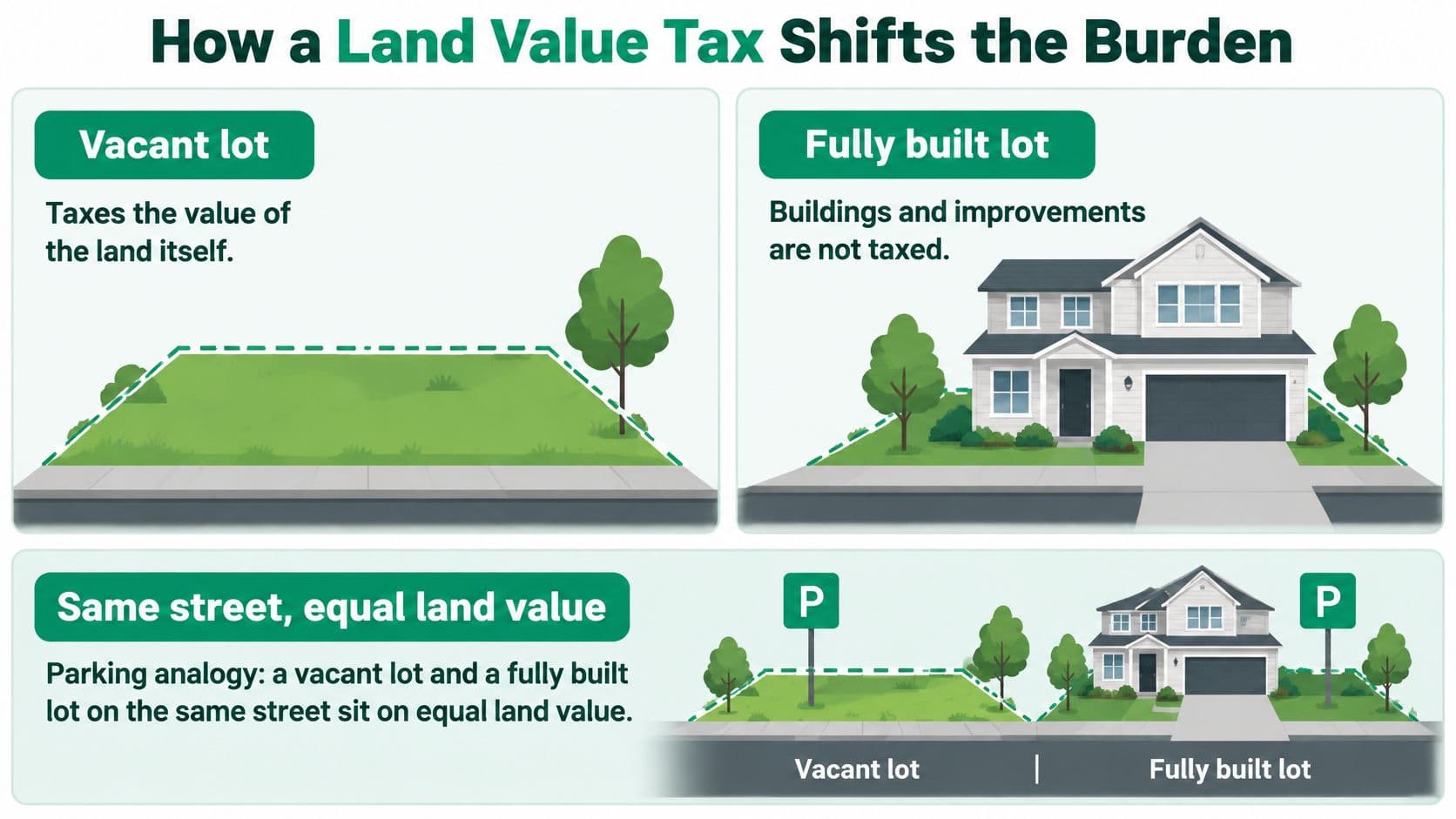
A vacant parking lot and a developed site can occupy equally valuable land. If their size, location, permitted uses, and other site characteristics are equivalent, constructing a building doesn't itself increase the underlying land-tax base.
That's the distinction behind land value taxation, a public charge on the value of land itself, not the buildings or improvements on it. A conventional combined property tax can charge an owner more after construction; a land-only charge doesn't add a tax penalty because the owner builds.
The comparison is easiest to see visually.
A hypothetical calculation
Suppose two lots each have $200,000 of land value. Lot A is vacant, while Lot B has a $300,000 building. Applying an illustrative annual rate of 1%, without exemptions, produces the following calculation.
Two lots under a combined tax and a land-only tax
| Lot | Building Value | Combined 1% Tax | Land-Only 1% Tax |
|---|---|---|---|
| Lot A (vacant) | $0 | $2,000 | $2,000 |
| Lot B (built) | $300,000 | $5,000 | $2,000 |
These are hypothetical bills, not a revenue-neutral reform forecast. Keeping the same rate while removing buildings from the base reduces collections in this example; an actual replacement tax needs its own revenue calculation.
The incentive difference remains clear. Owners don't receive a lower land-only bill merely by leaving a valuable site empty, and builders don't receive a higher bill merely for adding useful space.
Why the land base matters
Land cannot be hidden, moved abroad, or smuggled out, making it the most honest source of public revenue. Assessors can still misvalue it, but owners can't relocate the site to another jurisdiction.
Much of a location's economic rent reflects surrounding activity: transport access, public services, neighboring businesses, and community demand. Collecting that value allows the community to recover value it helped create.
The U.S. Federal Highway Administration's land value tax fact sheet describes Allentown, Pennsylvania's phased schedule: 20% land and 80% buildings initially, followed by annual 10-percentage-point shifts until 2011, when the schedule reached 100% land and 0% buildings.
Practical rule: Ask whether the proposal taxes what's on the site, the site itself, or both.
Land Leases, Land-Use Rights and Land Taxes Compared
Fixed-term land leases set a fixed rent for a defined period and are either renewable or non-renewable. Scholarship on the certainty-of-term requirement in the Cambridge Law Journal explains why a lease's defined term matters legally.
A renewable lease provides a measure of certainty only until its term ends. When rent remains below market, the accumulated gap closes at renewal through a major repricing; a non-renewable lease becomes progressively harder to refinance and sell as its remaining term shortens.
Fixed leases postpone risk rather than correctly price it. A predictable payment today can conceal a concentrated adjustment later, which is why evaluating long fixed-term land leases requires more than comparing the initial rent.
Different rights, different payment mechanisms
Land-use rights, in the policy sense used here, resemble land leases but are indefinite, require no renewal, and are repriced annually. Annual repricing allows people to buy and sell the rights at comparatively low cost because less accumulated land value needs to be purchased upfront; legal and administrative transaction costs still require attention.
These rights price land continuously rather than allowing a large contractual gap to accumulate. By charging for the site rather than productive improvements, they avoid burdening entrepreneurship and other productive enterprises through a building charge.
A land value tax, by contrast, is a recurring public levy on assessed site value. It leaves the underlying ownership or lease structure intact.
Fixed leases, land-use rights and land taxes side by side
| Feature | Fixed-Term Land Lease | Land-Use Right (Annually Repriced) | Land Value Tax |
|---|---|---|---|
| Duration | Fixed term, renewable or non-renewable | Indefinite, no expiration | Recurring levy with no contract term |
| Price reset | Fixed rent until renewal or expiry | Repriced every year | Site value reassessed on the jurisdiction's cycle |
| Renewal needed | Yes, or the lease ends | No | No |
| Risk when land value rises | Gap builds until one major repricing | Gap closes gradually each year | Captured through the annual levy as assessments update |
| Ease of buying and selling | Harder as a non-renewable term shortens | Low transfer price from annual repricing | Ownership transfers without a new contract term |
The State Revenue Office Victoria's land tax schedule illustrates progressive taxation of aggregated taxable site values, including 0.3% on the portion above $300,000 up to $600,000, 0.6% above $600,000 up to $1 million, and 2.65% above $3 million. These are portions of a progressive schedule, not flat rates on the entire holding.
A fixed lease doesn't become an indefinite land-use right just because someone changes its label.
Ask three questions of any contract or charge: Does it expire? When is its payment reset? Does continued occupation require renewal? Call it a land-use right in this sense only when it's repriced each year, requires no renewal, and never expires.
Who Really Pays When a Tax Changes
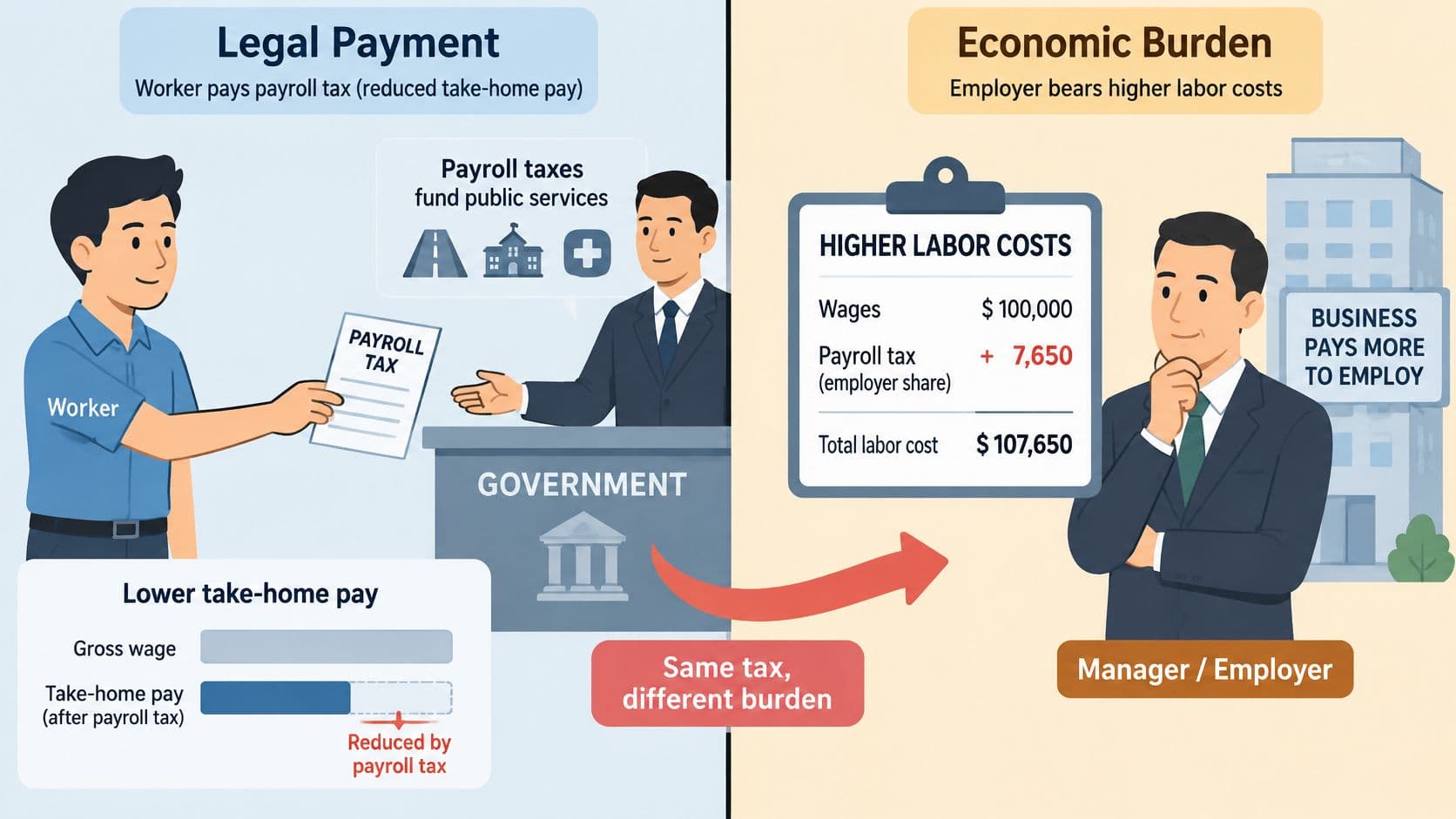
The person who writes the check isn't necessarily the person who bears the tax. Legal liability tells you who remits payment; economic incidence tells you whose income, purchasing power, or wealth changes after people respond.
A payroll tax may reduce take-home wages, increase employer costs, or change hiring. Businesses may absorb part of a consumption tax rather than pass it all to customers, while property taxes can affect rents, asset prices, construction, and the services financed.
The distinction between remittance and burden is especially important for employment taxes.
The OECD's analysis of tax reform and economic growth ranks recurrent taxes on immovable property as less harmful to long-run growth than corporate income, personal income, and consumption taxes. That finding isn't a guarantee for every property-tax design: broad coverage, current valuations, and protection for liquidity-constrained households remain essential.
Separate the transition from the settled system
Consider a homeowner whose valuable site generates little cash income, a landlord financing rental housing, and a builder planning additional homes. Their exposure differs even when they face the same land-tax rules.
An existing owner may experience an immediate reduction in land capital value. A future purchaser may instead pay less upfront because the continuing levy is reflected in the acquisition price.
Who bears a land-based tax change, short run and long run
| Group | Short-Run Effect | Long-Run Effect |
|---|---|---|
| Existing landowner | Immediate adjustment in land capital value | Pays the annual site levy without a building penalty |
| Future buyer of land | Potentially lower acquisition price as the levy is priced in | Pays the levy with less untaxed land rent capitalized upfront |
| Builder or renovator | No extra land-tax charge on improvements | Can benefit when construction responds |
| Renter | Rent may adjust slowly as landlords respond | Outcome turns on new supply, demand, and local constraints |
| Worker | Lower payroll-tax pressure if work taxes are cut | Benefits if wages and hiring rise |
These are mechanisms to test, not promised outcomes. A useful distributional analysis separates household income, tenure, wealth, and location rather than reporting only an average bill.
For pilot evaluation, PlotStudio AI's explanation of estimating treatment effects among treated participants helps clarify how analysts can assess effects on people exposed to a policy rather than confuse general economic changes with reform impacts.
Three assumptions deserve correction:
- Higher rates guarantee more revenue. Taxpayers' responses can change collections.
- Only rich owners are affected. Idle holdings of any size face exposure, and valuable sites don't always belong to cash-rich households.
- Transitional losses recur forever. An initial asset-price adjustment differs from the continuing annual payment, although the wealth loss can remain consequential.
Fair implementation needs hardship deferrals, independent appeals, and clear eligibility rules, not an assumption that every affected owner can immediately pay.
International Precedents Compared Side by Side
International precedents reveal design choices, not ready-made systems to copy. Compare what each mechanism requires from assessors, taxpayers, and administrators before importing its headline features.
| Design Lesson | Precedent | What to Examine |
|---|---|---|
| Phasing | Allentown's split-rate transition | A predictable shift away from buildings |
| Annual repricing | South Australia's site valuations | Assessment timing and valuation quality |
| Tiered rates by holding size | Victoria's aggregated site-value approach | Ownership records and progressive treatment |
| Broad base with compliance | VAT adoption across jurisdictions | Credits, transaction records, and household safeguards |
Allentown's phased split-rate schedule demonstrates how governments can give owners time to adjust instead of changing the entire burden immediately. Victoria illustrates a different choice: applying progressive treatment to an owner's aggregated taxable site values.
Annual valuation is an operating commitment
South Australia excludes buildings and improvements from site value, and its Valuer-General issues a new general valuation annually, according to RevenueSA's land tax calculation guide. The valuation is taken at midnight on June 30 before the financial year; the guide's 2026–27 schedule charges holdings above $936,000 and up to $1,504,000 $0.50 for each $100, or part of $100, above the threshold.
That arrangement requires more than adopting a rate. Assessors must maintain site records, explain valuation changes, and distinguish changes in location value from improvements made by owners.
Annual assessment can reduce the gap between taxable values and current conditions. It also makes accessible explanations and timely appeals important, because owners must understand why their assessment changed.
A broader lesson from consumption taxation
The IMF's account of VAT's spread identifies France's first recognizable VAT in 1948, adoption by Brazil and Denmark in 1967, and an increase from 2 to 30 African countries using VAT during the 1990s. Its spread illustrates how a tax mechanism can travel across very different administrative settings.
VAT taxes value added through production and distribution, generally allowing businesses credits for tax paid on inputs. Those linked transactions create records that can support compliance, but household protection still needs deliberate design because lower-income households typically spend more of their income on consumption.
A history of property taxation is useful for the same reason: institutional details explain more than labels. Across these examples, durable reform combines a workable base, administrative capacity, and explicit distributional safeguards.
Phase In and Test a Tax Reform
A tax law isn't an implementation system. Governments need a way to identify taxable sites, value them consistently, issue understandable bills, resolve disputes, and verify that collections match expectations.
An IMF synthesis of revenue reform describes base-broadening measures as capable of generating gains of about 2% of GDP over two to three years. That's evidence about broader reform packages, not a forecast for a particular land tax, and it shouldn't be inserted into a local budget without modeling administrative capacity and the proposed base.
The practical sequence begins with valuation and testing, not a promised revenue total.
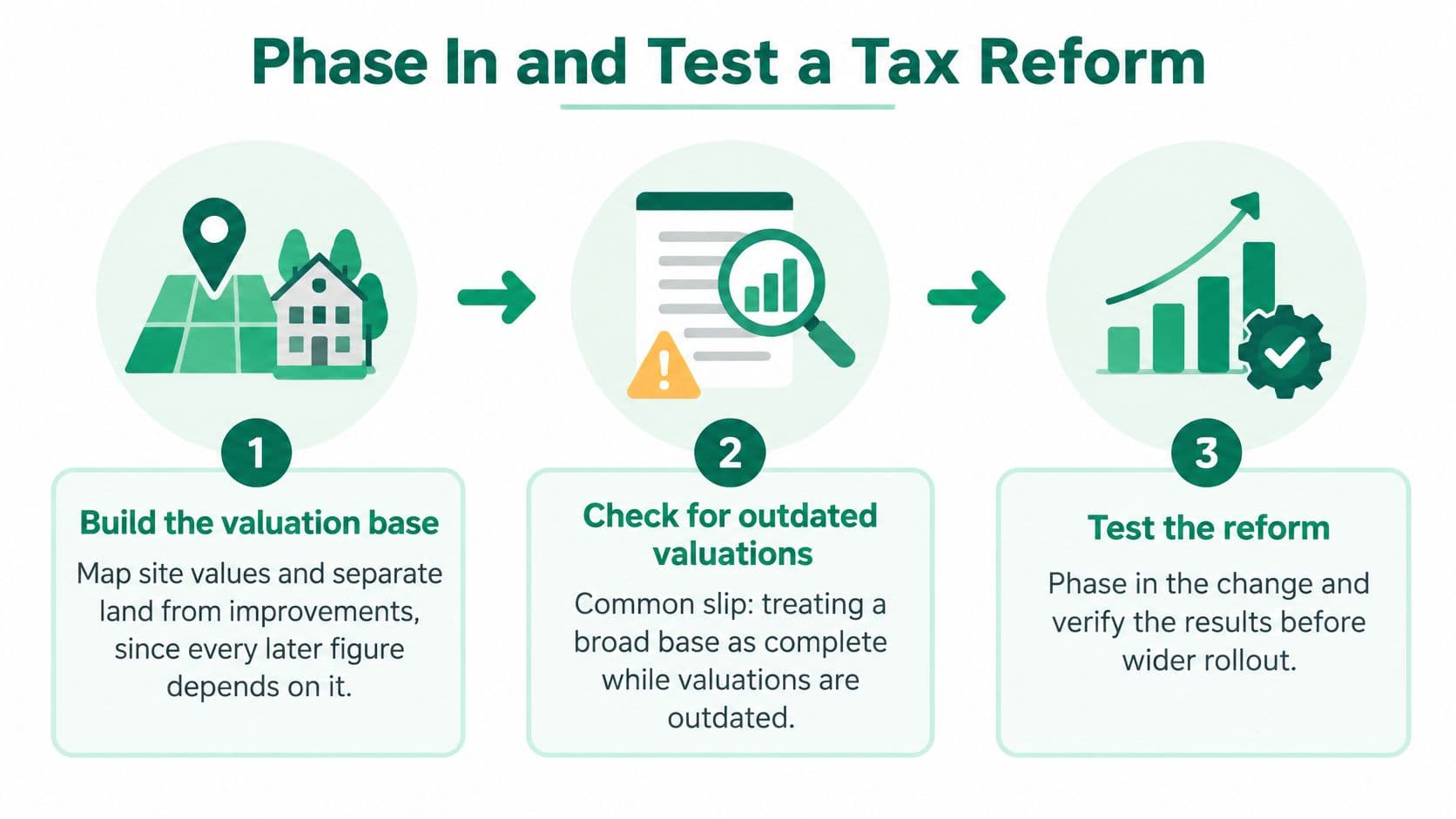
Build the system before scaling it
-
Build the valuation base. Map parcels and site values, separating land from buildings and other improvements. Record permitted uses, access, environmental restrictions, and other characteristics that explain differences between sites. Common slip: treating coverage as complete when assessments are outdated or land and improvements remain bundled.
-
Connect the records. Link the cadastre, taxpayer identifiers, ownership information, transaction records, and relevant withholding systems. Assign responsibility for correcting mismatched owners, missing parcels, and duplicate entries. Common slip: allowing later exemptions to erode the base without recording their fiscal cost or intended beneficiaries.
-
Publish microsimulation results before legislating. Estimate bills for individual households and businesses under phased scenarios, then aggregate revenue and distributional effects. Test alternative assumptions about compliance, land prices, construction, and any offsetting labor-tax reductions. Common slip: publishing a single revenue number while concealing the assumptions that produce it.
-
Pilot and audit. Choose districts with contrasting site conditions rather than testing only where records are easiest. Compare assessed values with credible market evidence, investigate underassessed sites, and measure how quickly appeals are resolved. A pilot should test billing and collection workflows as well as valuation accuracy.
-
Legislate a transparent annual schedule. Publish when assessments change, when bills arrive, how the burden shifts, and when reviews occur. Households, lenders, and businesses need a timetable they can use for financial decisions. Common slip: changing the transition midstream without clear triggers or an explanation of who is affected.
-
Establish independent appeals and hardship deferrals. Give taxpayers access to the evidence behind an assessment and a defined route for challenging factual errors. Specify deferral eligibility, any interest treatment, and the event that makes deferred amounts payable. Relief should address payment difficulty without removing valuable sites from the system.
-
Monitor and adjust. Publish annual results for revenue, compliance, assessment accuracy, appeals, and household burdens. Compare outcomes with the model, explain deviations, and adjust the relevant mechanism rather than automatically raising rates. Track local service funding so a successful central reform doesn't leave municipalities with an unexplained shortfall.
Evidence officials should demand
Before approval: Require a named tax base, current valuations, a published microsimulation, a transition timetable, and independent appeals.
These transition requirements make political promises testable. They also distinguish a valuation problem from a collection problem, and an affordability problem from a poorly targeted exemption.
For officials, the next step is to commission a site-value assessment, an instrument design, and a distributional model showing who gains and who pays. Our support at Unitism® covers that work, linking land assessment to policy design and fiscal analysis. Martin Adams's work translates economic insights into practical frameworks that governments and organizations can put into action today.
Unitism® offers land valuation, policy design, and distributional modeling to help governments shift revenue toward land value while reducing taxes on work and productive investment. Visit Unitism® to explore support for assessing your land base, choosing an appropriate instrument, and designing a transparent transition.