Learn how to calculate land value of property using comparables, residual, and income methods. Includes worked examples, sensitivity tips, and policy context.
October 14, 2026
How to Calculate Land Value of Property
Learn how to calculate land value of property using comparables, residual, and income methods. Includes worked examples, sensitivity tips, and policy context.
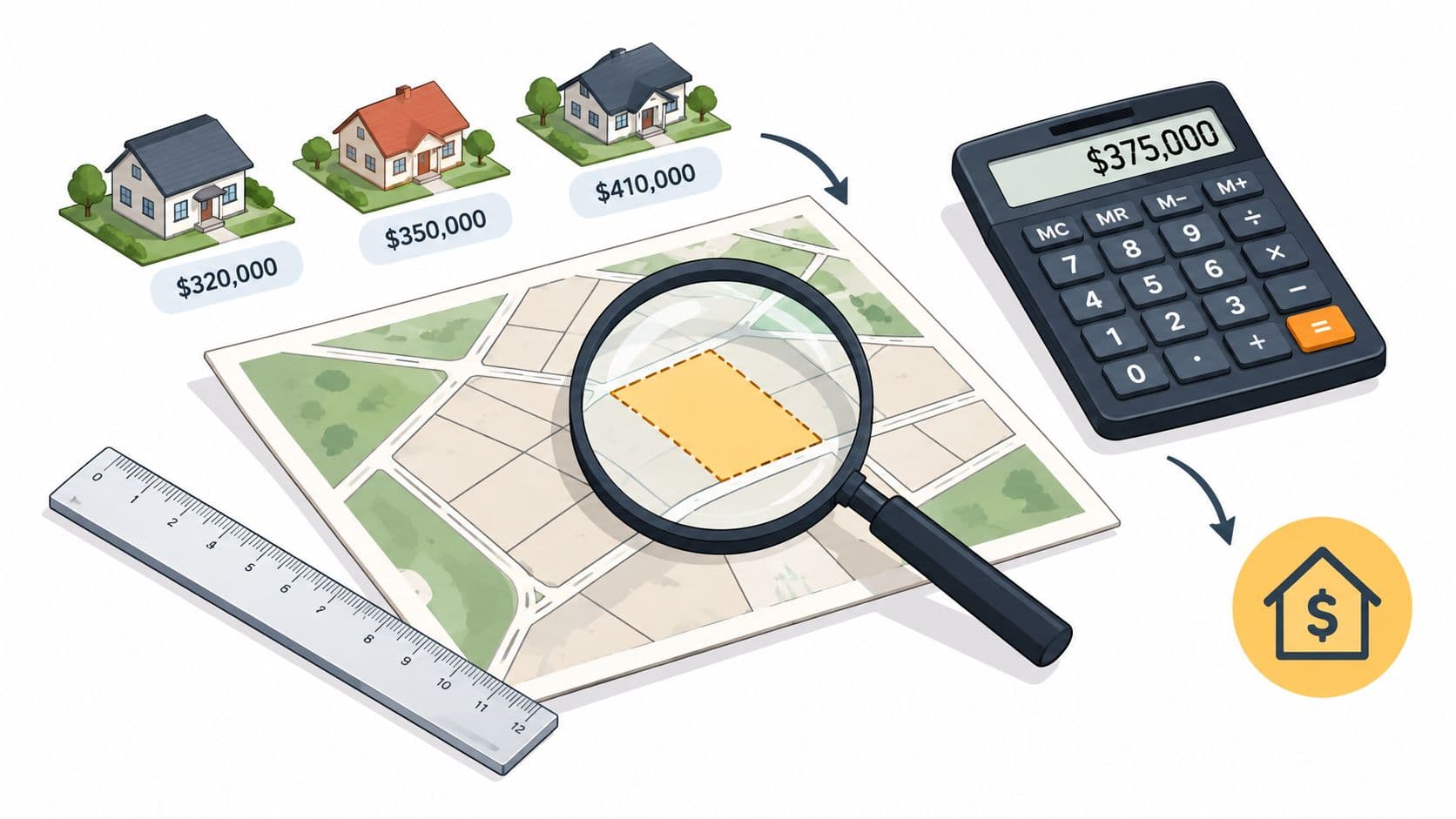
Apartment land prices in Sweden rose 370% from 2000 to 2021, while construction prices for owner-occupied apartments rose 150% and rental-apartment construction costs rose 116% over the same period, a sharp reminder that a site's price is not the same thing as the value created by buildings, permits, or public decisions OECD Sweden survey referenced in official UK valuation guidance. That gap is exactly why how to calculate land value of property starts with choosing the right method, not hunting for a single clean number.
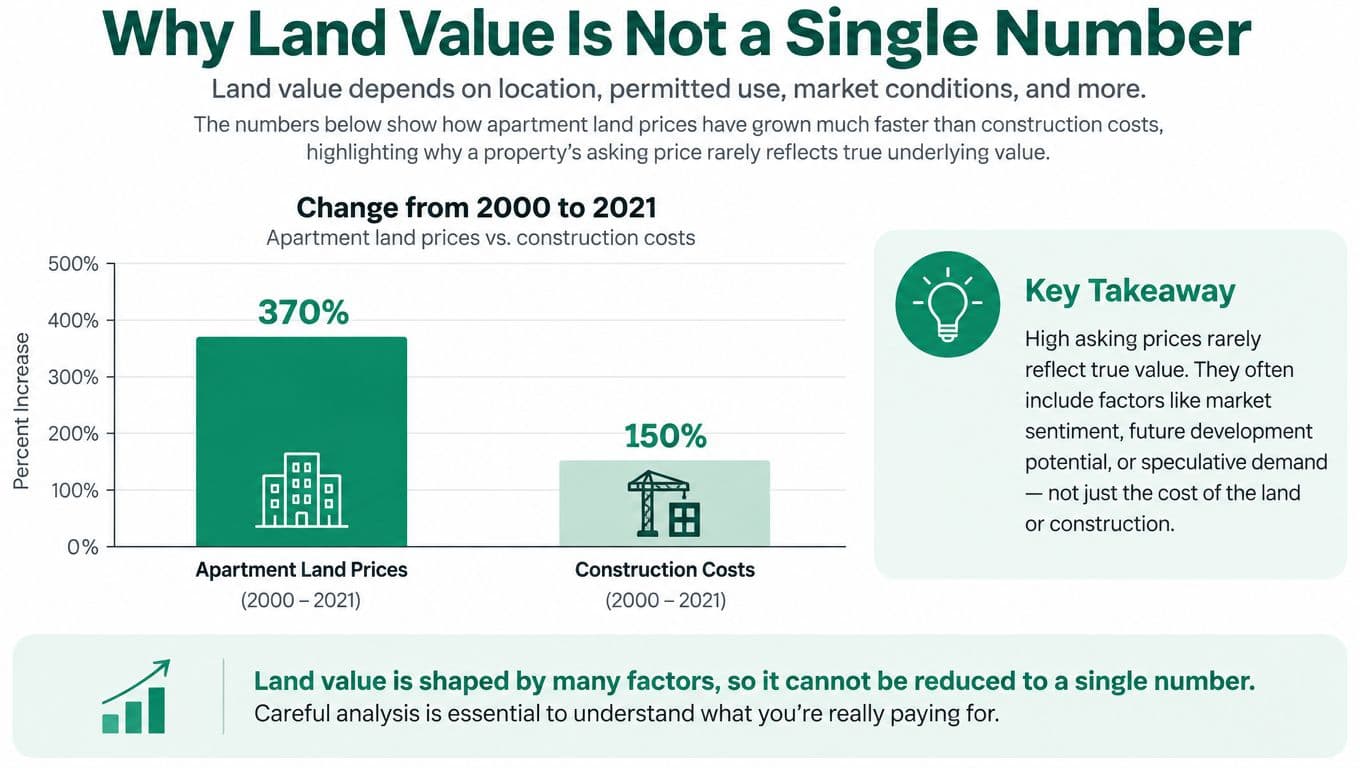
A nearby sale or a seller's asking price can reflect a zoning change, a transit project, a subsidy, or pure speculation. For a practical baseline on what “land value” means before you start adjusting, this plain-English overview of land value is a useful companion. And if you want to see how site value sits inside a broader property-finance workflow, the white-label DXP case study is a good reference point.
Core insight: a number is only as honest as the assumption behind it.
Table of Contents
- Why Land Value Is Not a Single Number
- A Four-Step Decision Tree for Choosing a Method
- Calculating Land Value with Comparable Sales
- Calculating Land Value with the Residual Method
- Calculating Land Value with the Income Approach
- Land Leases, Land-Use Rights, and Land-Value Taxes Compared
- Data Sources and Troubleshooting Common Errors
Why Land Value Is Not a Single Number
A land valuation is really a judgment about highest-and-best use. Official guidance distinguishes three materially different approaches, and each one fits a different kind of property: comparable sales for sites with reliable local transactions, residual valuation for development land, and income valuation for property that throws off rent or ground income UK land value estimates guidance.
That distinction matters because people often ask for one precise figure when the right answer is a range tied to the use case. A serviced infill lot, a bare suburban parcel, and a retail site don't behave the same way, so forcing all three through one formula produces tidy-looking nonsense. The valuation method should follow the evidence, not the other way around.
Policy-driven value is the hidden variable
The land price you see in the market can include value created by planning permission, roads, utilities, tax treatment, or public investment. In other words, a high price doesn't always tell you what the bare site is worth on its own. It may only show that someone else captured the uplift first.
That's why I like to separate the site from everything standing on it or flowing into it. If you don't split out the policy layer, you'll overpay for land that only looks expensive because of a decision outside the boundary line. The right question is not “what did it sell for?” but “what part of that price belongs to the site, and what part belongs to the system around it?”
A practical example is a developer chasing a parcel near new infrastructure. The premium might be rational if access, density, or use rights changed, but it doesn't automatically become a benchmark for every nearby lot. That's also why land-value analysis needs context, not just a spreadsheet.
A number without its planning context is usually a story, not a valuation.
A Four-Step Decision Tree for Choosing a Method
The best way to think about land valuation is as a sequence of decisions. First, confirm the legally permissible use from planning rules and zoning. Second, estimate the market-supported completed value of that highest-and-best use. Third, if the site is development land, subtract the full stack of costs. Fourth, calculate the residual and test it under low, central, and high assumptions.
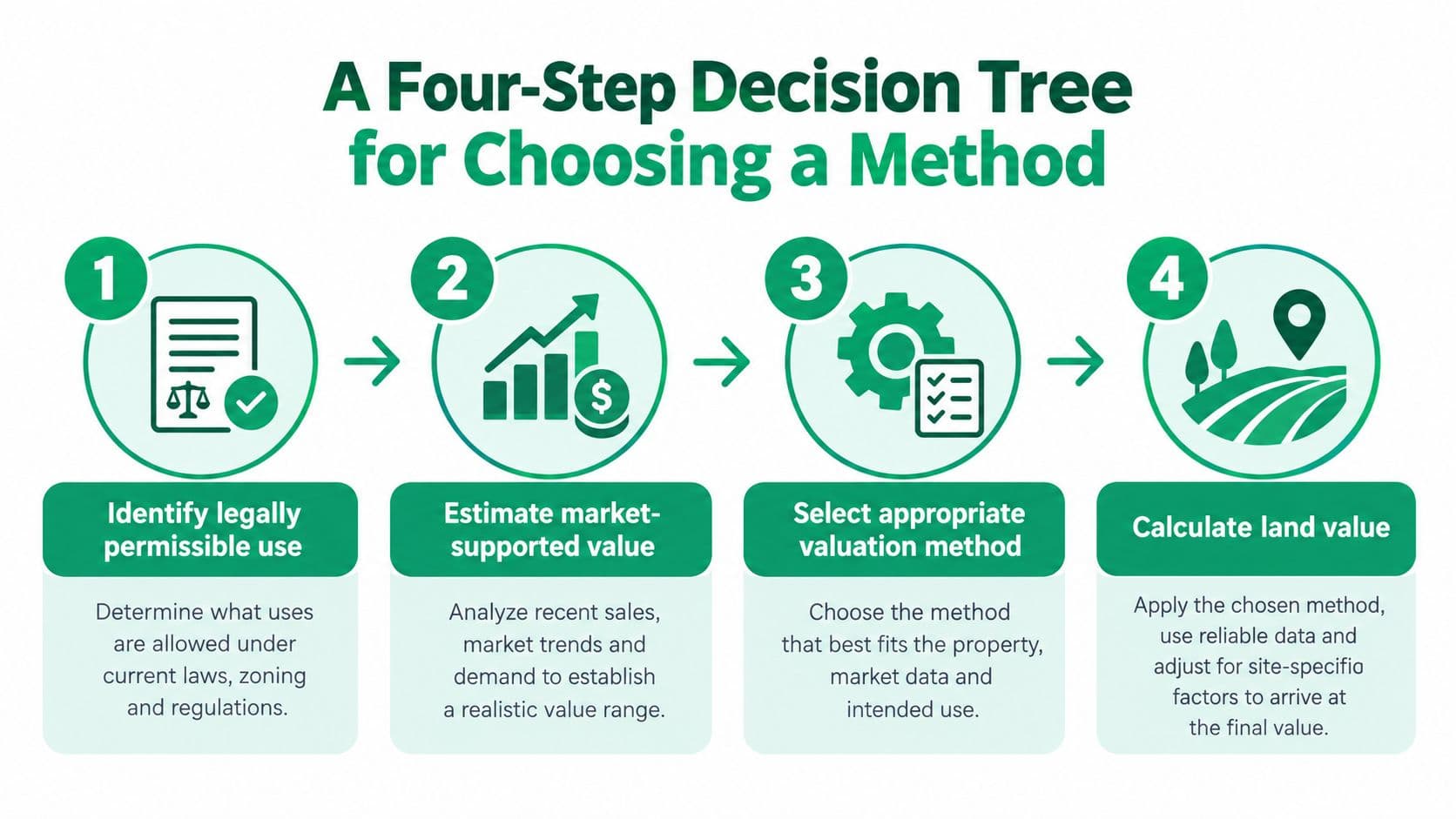
A downtown infill parcel usually starts with the residual method because its value depends on what can be built. A suburban single-family lot often starts with comparable sales because there are enough similar transactions to anchor the estimate. A shopping-center site may lean on income if the asset's value is tied to rent, not just raw land.
The rule before any spreadsheet
If you can't answer these three questions, you're not ready to value the land yet:
- Is there reliable transactional evidence? If yes, comparables may lead.
- Is the site development-ready or improved? If yes, residual logic often matters most.
- Does the buyer care more about price or yield? If yield dominates, income analysis belongs in the mix.
That decision tree keeps you from misusing a method just because it's familiar. The same parcel can move from one branch to another if planning changes, a lease expires, or redevelopment becomes feasible. For a deeper look at the top-down logic of site value, see this highest-and-best-use guide.
Calculating Land Value with Comparable Sales
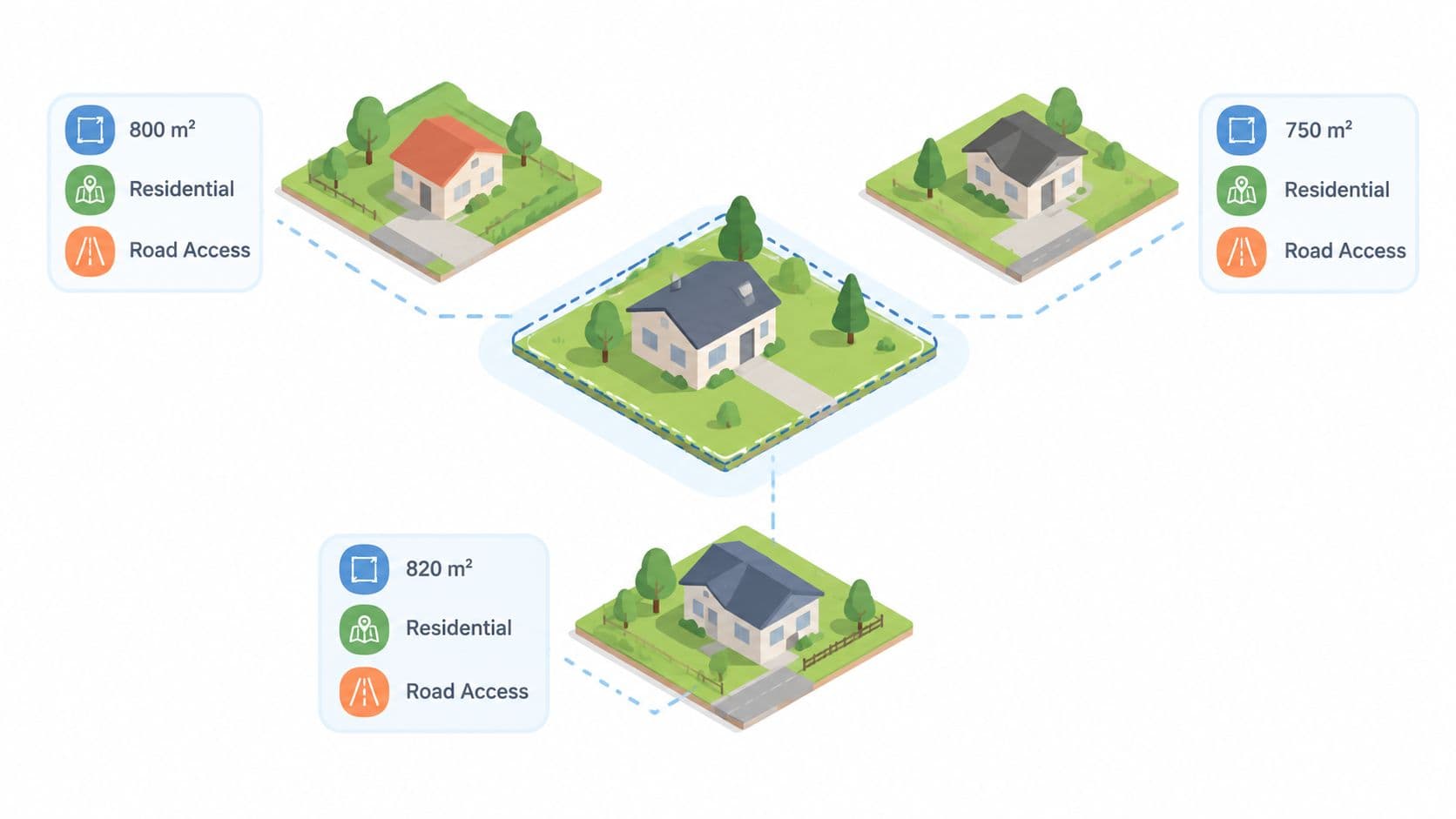
Comparable sales work best when the local market is active and the sites are similar. You want settled transactions, not asking prices, and you want land that matches on size, zoning, frontage, access, and utility availability. If those basics are off, the comparison stops being evidence and starts becoming guesswork.
How to choose true comps
Start with the last set of closed sales you can document from the land registry or title records. Then sort out which ones are really comparable and which ones only look similar from a distance. A lot of apparent matches fall apart once you factor in slope, easements, corner access, or planning uplift.
Adjust for the differences that buyers price:
- Size: smaller or larger plots often trade at different unit rates.
- Shape and frontage: awkward geometry or weak road exposure lowers utility.
- Planning uplift: a sale that already captured zoning value isn't a clean comp for an unzoned lot.
- Time: if market conditions shifted, older sales need time adjustment before anything else.
- Physical constraints: slope, easements, and access differences can be decisive.
A practical workflow is to weight the most similar transactions more heavily than the most recent ones. Recency matters, but similarity matters more. A recent sale of an inferior parcel tells you less than a slightly older sale of a near-identical one.
A simple residential lot example
Suppose a 600-square-metre residential lot is being valued against three nearby closed sales. One sale is similar but has weaker frontage, another is smaller but better located, and the third has a minor easement issue. You'd start with the observed sale prices, make line-item adjustments for each difference, and convert everything to a common unit before averaging.
Practical rule: don't anchor on one adjusted figure, report a range after the adjustments are complete.
That's where sensitivity testing belongs. Change the adjustments at the end, not the beginning, so you can see which assumption moves the result. If you want a practical way to organize comparable selection across geographies, this guide to selecting comps for flips is worth reading.
For a quicker way to structure a local search, the land value estimator by address can help you frame the questions before you compare individual sales.
Calculating Land Value with the Residual Method
The residual method starts with what the finished project could sell for, then backs out everything needed to make that project real. It's the cleanest way to value development land because it isolates the site's contribution from the building that will eventually sit on it. Official valuation guidance treats this as a distinct approach for development sites, and it's the right tool when a plain comp set would miss the economics of the scheme UK land value estimates guidance.
Work through the cost stack
The starting point is gross development value. From there, subtract construction, infrastructure, finance, marketing, professional fees, developer profit, and a sensible contingency. What remains is the land residual.
The key weakness is sensitivity. A small change in expected completed value, profit requirement, or financing terms can move the land number sharply because the site is the balancing figure. That's why you should never trust a residual estimate built on one assumption set and left untested.
A compact way to approach it is:
- Estimate the completed value. Use the market-supported value of the finished scheme, not wishful pricing.
- List the actual costs. Include hard costs and soft costs, not just bricks and labour.
- Insert the required profit. Development has risk, and the model has to pay for it.
- Run scenarios. Low, central, and high assumptions show whether the site still works.
A mixed-use example needs three runs
Take a small mixed-use scheme. In the low case, the completed value is softer and the profit allowance stays cautious. In the central case, pricing and absorption look balanced. In the high case, the project sells faster or at stronger unit values, and the residual expands.
You don't need perfect certainty to use this method well. You do need discipline about what belongs in the cost stack and what doesn't. If a line item is real and the developer will pay it before the site is acquired, it belongs in the model.
This is also why residual valuations show up in planning obligations and infrastructure funding. They isolate what the bare site contributes before construction begins. If you want a focused reference on that logic, the residual land value guide is the closest companion piece.
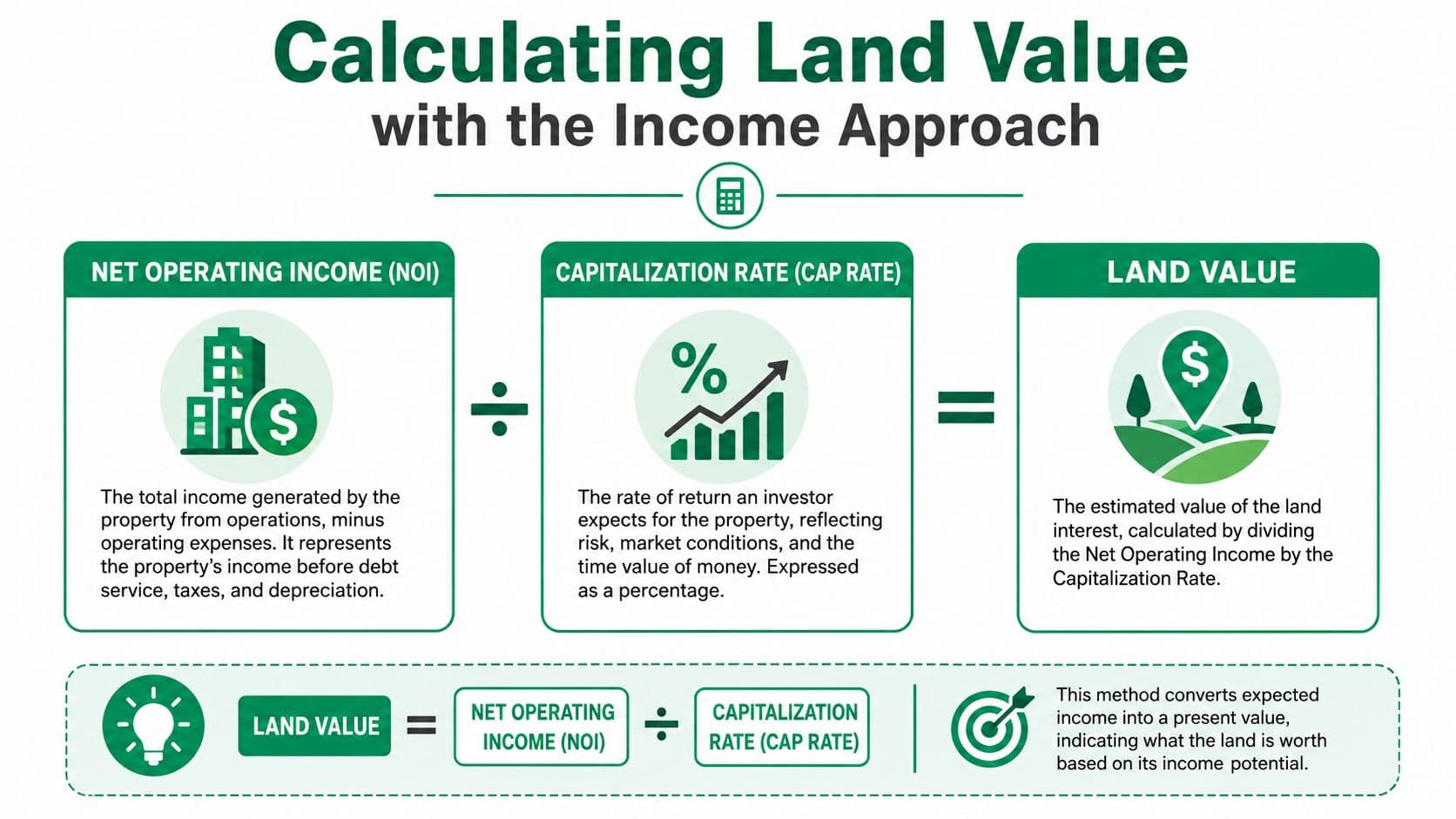
Calculating Land Value with the Income Approach
The income approach fits property that earns rent, such as offices, shopping centers, or build-to-rent assets. The trick is to value the land income stream, not the whole property as one blended asset. If you capitalize total property income without separating land from improvements, you're mixing two different return profiles.
Separate land return from building return
Land and buildings don't earn the same way. The building wears down, needs upkeep, and carries different risk. The site itself doesn't depreciate in the same mechanical way, so the capitalization logic has to reflect that difference.
A practical approach is to estimate the rent attributable to the site and apply a land capitalization rate. That rate can be triangulated from nearby ground rents and land transactions, while the building side is handled separately through its own return assumptions. For a stabilized income-producing site, this produces a land value that's tied to actual cash flow instead of a headline property price.
Don't use the wrong cap rate
The main mistake is applying an overall property cap rate to bare land. That shortcut confuses the value of the site with the value of the structure and the tenancy. The result may look mathematically neat, but it ignores the fact that land and improvements carry different risk and depreciation profiles.
A clean income valuation asks three questions:
- What income does the land itself support?
- What capitalization rate reflects land risk?
- What part of the property's income belongs to the improvements instead?
If you're working on an income-producing asset, this is also where rent evidence matters. Ground rents advertised for nearby sites can help triangulate the rate, but only if the terms are genuinely comparable. For a more commercial-property-focused framing, the commercial property valuation guide gives useful context.
Land Leases, Land-Use Rights, and Land-Value Taxes Compared
A land lease is a fixed-term contract that transfers land-use and development rights for a set period in exchange for a premium, annual ground rent, or both. Public leasing models commonly use long terms, often more than 50 years, and may include renewal options Lincoln Institute public land-leasing paper. That term limit is the key feature, because the price eventually has to be reset or renegotiated.
Why fixed leases postpone risk
Renewable leases offer certainty only until the next repricing point. When renewal arrives, the gap between the old lease rate and current market value gets closed at once, so the risk was postponed, not removed. Non-renewable leases are tougher to refinance and sell as expiry approaches because the buyer is staring at a shrinking term with no contractual reset path.
A land-use right, by contrast, only fits the term if it has no expiration, no renewal requirement, and is repriced annually. That structure keeps the price aligned with current site value and reduces the friction that comes from long fixed terms. Some people use the label loosely for fixed leases, but a fixed lease is still a fixed lease if it expires or needs renewal.
A land-value tax is different again. It's a recurring tax on the site value itself, collected through the tax system rather than through a lease contract land tax versus ground rent paper. The mechanism matters because taxes, leases, and land-use rights allocate repricing risk differently.
| Mechanism | Repricing | Term | Transferability | Who carries repricing risk |
|---|---|---|---|---|
| Land lease | At renewal or scheduled review | Fixed term | Tradable within the lease term | Lessee until reset |
| Land-use right | Annual | No expiration | Easier to trade if annually reset | Repriced continuously |
| Land-value tax | Through the tax system | Ongoing | N/A, it's a tax | Taxpayer, via the public system |
One useful way to think about them is simple. A lease is a contract, a land-use right is a continuously repriced land interest, and a land-value tax is a public charge on site value. If a fixed lease is being marketed as if it were perpetual, that description is wrong.
The fixed-term distinction is important because a lease doesn't become a land-use right just because someone calls it one. If it expires or requires renewal, the financing and resale consequences still follow the lease structure.
Data Sources and Troubleshooting Common Errors
Good land valuation starts with the right records. You need cadastre and title data, recent settled sales, planning maps and zoning codes, infrastructure plans, ground-rent evidence, and, where the income approach applies, net operating income statements. If one of those sources is missing, you can still estimate land value, but you should widen the range and say so clearly.
Common errors and how to fix them
-
Using asking prices instead of settled sales.
The symptom is a neat number with no transaction proof. The fix is to replace listings and broker opinions with closed deals from the registry. -
Treating a zoning-uplift sale as a comp for an unzoned site.
The symptom is an inflated benchmark. The fix is to separate planning uplift from underlying site value. -
Ignoring holding costs or developer profit in the residual method.
The symptom is a residual that looks too generous. The fix is to rebuild the cost stack from the top down. -
Applying an overall property cap rate to bare land.
The symptom is a land value that tracks the whole building's income. The fix is to isolate the land income stream first. -
Mixing policy-driven value with market-driven value.
The symptom is a site price that seems to jump for no clear market reason. The fix is to flag the effect of infrastructure, density, tax treatment, or subsidy separately.
Policy-driven value and market-driven value are not the same thing, and confusing them is one of the fastest ways to misread a site.
A fast troubleshooting rule helps when you're under time pressure. If the site has reliable transactional evidence, use comparables first. If it's development-ready, use the residual method. If the buyer needs yield, use income logic. Those three tests decide the method more reliably than habit does.
A household valuing a home site usually needs comparable sales. A developer pricing a parcel usually needs the residual model. An investor buying a leased site usually needs the income approach. That triad won't solve every edge case, but it covers most decisions cleanly.
As more jurisdictions move toward site-value-based taxation, transparent valuation will matter even more. The same discipline that helps you price a parcel today will help you defend that figure when policy, financing, or planning changes tomorrow. For teams building public-facing explanations around property and land value, browse YouTube growth for realtors can be useful if they need to communicate these concepts visually and consistently.
If you need land value assessed for a parcel, a portfolio, or a policy model, Unitism® can help with site-value assessments, valuation methods, and implementation-ready frameworks. Visit Unitism® to see how its land-economics work can support your next valuation, planning review, or reform project.