Learn how land value for taxes is assessed, how it differs from leases and land-use rights, what it can raise and who pays.
November 14, 2026
Land Value for Taxes: How It Works and Who Pays
Learn how land value for taxes is assessed, how it differs from leases and land-use rights, what it can raise and who pays.

The most common advice about land value for taxes is to shift the rate off buildings and onto sites. It sounds like a free lunch. Construction gets cheaper, speculation gets dearer, and the public recovers value it created. Then a finance ministry tries it and meets two bottlenecks the textbook skips.
The first is measurement. Land rarely sells on its own, so someone has to estimate what a site would be worth without the building on it, defend that number in an appeal, and keep it current. The second is tenure. Where land is held under a long fixed lease, the contract price can sit far below what the site is worth today, and a charge built on contract rent will undercharge exactly the locations that have become most valuable.
Handle those two properly and a land value tax is one of the cleanest instruments in public finance. Handle them badly and it becomes a tax on whatever an assessor happened to write down. Start with the charge itself.
Table of Contents
- What a Land Value Tax Charges and Where Its Base Comes From
- How Land Taxes, Leases and Land-Use Rights Differ
- Separating Land Value From Buildings in Practice
- How Much Revenue Land Value Taxes Can Raise
- Who Pays Under a Land Value Tax and How to Protect Households
- Decide Whether a Land Value Tax Fits Your Jurisdiction
What a Land Value Tax Charges and Where Its Base Comes From
Two lots, one bill
Two identical 500 square metre lots sit on the same street. One is empty gravel. The other carries a three-storey office block. Give each lot a site value of 400,000 and set the annual rate at 1%, and both owners owe 4,000 a year.
The owner who built the office pays exactly what the owner who left the lot bare pays. That is the design in a single sentence. A land value tax is a recurring public charge on the assessed value of the land itself, excluding buildings and other improvements.
The U.S. Federal Highway Administration describes the instrument as an annual charge on land's rental value and frames the mechanic as a shift of the property-tax base away from structures and toward the site itself. Two consequences follow. The bill stays payable whether or not the owner builds, and construction never raises the taxable base.
The quick test: if adding a floor to a building increases the tax bill, you're looking at a conventional property tax with a land-friendly name.
That distinction also separates a land value tax from a land lease. A tax is a compulsory public charge assessed periodically. A lease is a contract, private or public, granting possession or use for an agreed payment over an agreed term. The two can sit on the same parcel at once, and treating a lease payment as if it were the site's value is where many reform proposals go wrong.
Where a site's value comes from
Land value is no reward for effort. Economic rent is income that comes from owning a desirable location or natural resource, not from work or investment. Two lots of the same size, zoned the same way, can differ in value several times over because one sits beside a tram stop and a primary school and the other sits behind a freight yard.
The gap owes nothing to either owner. A location's value comes from the people, roads, schools and businesses around it. When a city opens a new bus line, parcels along the route gain value before any owner lifts a finger, and the gain lands with whoever happens to hold the title.
That is the case for charging land rather than buildings. A charge on the site collects part of a shared gain. A charge on the building penalises whoever built it, which is why a conventional property tax makes construction marginally more expensive at exactly the moment a city wants more of it.
Why pure land taxes are rare
Site-value taxation is unusual even though almost every advanced economy taxes property.
An OECD review of housing taxation examined 38 member countries and found recurrent taxes on immovable property in all 38, though not necessarily at every level of sub-central government. It identified pure land taxes in just three jurisdictions, New South Wales in Australia, Denmark and Estonia, where the property tax rests entirely on land rather than on land and buildings together.
Everyone else taxes the combined value of land and structures, or falls back on area-based rules. That has a direct consequence for reading international comparisons. A revenue figure for "property taxes" describes land and buildings lumped together, so it cannot tell you what a site-value charge would collect.
That raises the practical question in this section's heading: where does the base come from when land almost never sells on its own? Rebuilding it means choosing among methods of land valuation, from comparable sales to residual estimates of what a site would fetch without its building. The choice decides whether the charge tracks real site values or drifts toward whatever the valuation model happens to produce, and it decides how much of the tidy example above survives contact with a real roll of parcels.
How Land Taxes, Leases and Land-Use Rights Differ
| Arrangement | Term | Price adjustment | Renewal or refinancing |
|---|---|---|---|
| Land-use right (as defined) | Indefinite, no expiration | Repriced every year | No renewal required |
| Renewable fixed-term lease | Finite term plus renewal option | Fixed during term, reset at renewal (Hong Kong: 3% of rental value) | Renewal without an initial premium, and the repricing gap closes at renewal |
| Non-renewable fixed-term lease | Finite term, no renewal clause | Fixed until expiry | Regrant application, early applications up to 20 years before expiry; harder to refinance and sell |
| Land-value tax | Recurring annual charge, no contract | Reassessed periodically on unimproved land value | Not applicable; payable while the owner holds the land |
The timing problem in a fixed lease
A renewable fixed-term lease buys certainty only until the term runs out. The gap between the contract payment and the market keeps widening in the background, then closes in one event. Hong Kong shows the machinery plainly: renewable leases grant an additional 50-year renewal option without an initial premium or fee, but at renewal the rent is reset to a level equivalent to 3% of the property's rental value (Lincoln Institute case study).
Non-renewable leases have no renewal clause at all. The lessee must apply for a regrant, and eligible lessees can apply early, as much as 20 years before expiry. Until then, the site is locked at the old price.
The later years of a lease carry the strain. A Massachusetts Institute of Technology thesis on ground leases reports that commercial ground leases may use fixed-rate or CPI-linked escalators, while others reset to fair-market-value rent at varying intervals. It describes uncertainty about future resets as potentially prohibitive for investors, and it identifies an inability to refinance out of the ground lease as a recurring drawback. Near the end of the term, growing ground rent can outpace comparable financing costs and cut off exit options.
So fixed leases do not correctly price risk. They postpone it. The lessee gets predictable payments early, and repricing risk, refinancing difficulty and resale discounts land later.
Watch the contract rent. Lincoln Institute research on public land leasing warns that fixed lease prices may not reflect current market land values, so lease rates cannot automatically serve as reliable measures for property-tax assessment. Copying contract rent into a tax roll reproduces the original undercharge.
Three tests for a genuine land-use right
A land-use right looks like a lease in structure and behaves nothing like one in price. It passes three tests or it isn't one:
- No expiration. The right runs indefinitely, with no end date waiting in the background.
- No renewal required. Nothing has to be renegotiated, regranted or reapproved.
- Repriced every year. The payment tracks site value continuously rather than in one catch-up event.
Meet those tests and the economics change. Rights can be bought and sold at low cost, because a buyer isn't pricing decades of deferred repricing into the deal. Land gets priced appropriately. Entrepreneurship and other productive enterprises aren't burdened by a stale contract that has drifted away from reality.
Fixed leases are sometimes called "land-use rights" in policy documents. They aren't. If an arrangement has a term, a renewal event, or a price set at the start rather than annually, it's a fixed lease under a friendlier label.
A land value tax remains a different instrument again. It is an ongoing charge on the site, independent of any contract, payable whether or not the owner builds. For the holding-cost arithmetic behind each arrangement, see land holding costs.
Separating Land Value From Buildings in Practice
Theory draws a clean line: tax the land, spare the building. The assessor's desk is where that line gets tested, because land almost never sells separately from what sits on it. Site value has to be inferred first, then defended parcel by parcel.
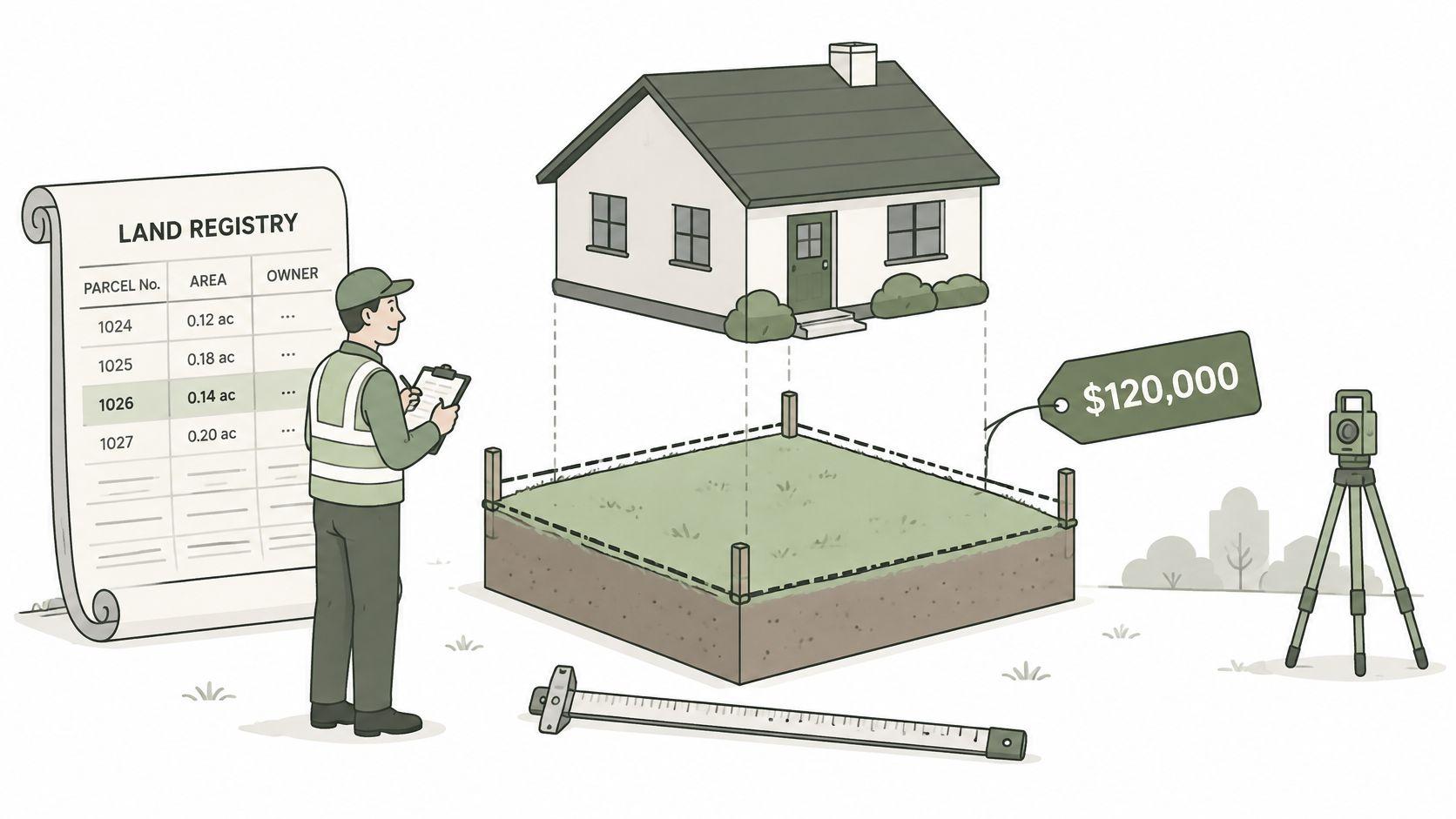
A workable system rests on four pieces of infrastructure: an up-to-date land registry, plot-level land-use planning, adequately resourced valuation professionals, and reliable methods for splitting site value from improvements on developed parcels. If any one of them is missing, the tax base is guesswork before the first bill goes out.
One decision comes before all of them. Will assessments follow current use or highest-and-best use? The answer changes the base, the bills and the appeals caseload. A downtown car park assessed on current use is worth little. The same parcel assessed at its redevelopment potential is worth a great deal, and its owner will argue about it.
Land valuation methods and when each fits
| Method | Best suited to | Main weakness |
|---|---|---|
| Comparable land sales | Sites that trade often | Thin data for unique or rarely sold parcels |
| Residual valuation | Development land with a known end use | Sensitive to construction cost and yield assumptions |
| Rental capitalisation | Income-producing sites with rent records | Needs reliable rent data and vacancy assumptions |
| Mass appraisal | Large numbers of parcels | Accuracy varies by neighbourhood; needs model testing |
| Hedonic regression | Regions with rich transaction and attribute data | Can absorb building effects unless they are separated |
The residual method works like a subtraction problem. Take the expected sale price of a finished project, deduct construction costs, fees and developer profit, and what remains is the value attributable to the site. Every input is an estimate, which is why small shifts in cost or yield assumptions move the land figure a long way.
Hedonic models deserve a warning. They estimate value from property characteristics, and building characteristics are part of that set. Unless the building contribution is explicitly stripped out, the model will price the structure into the land figure without anyone noticing.
The awkward parcels
Five cases need their own rule, not an afterthought:
- Mixed-use sites. A shop with flats above needs the site value split from two income streams, and the split must survive appeal.
- Leaseholds. The lessee's interest and the freeholder's interest carry different values, and a tax on the site has to name which one it hits.
- Agricultural land. Farm data usually bundles land with buildings, so a site-value estimate needs a separate derivation rather than a borrowed total. The USDA's National Agricultural Statistics Service reported average U.S. farm real-estate value, including land and buildings, at $4,170 per acre in 2024, up $200 per acre, or 5.0%, from 2023 (USDA land values report).
- Public land. Hospitals, schools and parks produce no transaction price but sit on valuable sites, so exemptions and notional valuations have to be decided in advance.
- Redevelopment potential. A parcel with an assembly premium or a zoning uplift needs a documented treatment, or every owner will claim one.
Australia's 2025 Commonwealth Grants Commission review shows what those adjustments cost in practice. State land-value data needed correction for valuation dates, joint ownership, related companies and exempt land, and doubt about the accuracy of those corrections was handled by discounting the assessed figures inside the funding framework.
That built-in discount is the honest part of the story. The barrier to land taxation is rarely the economics and rarely public opposition. It is measurement capacity: whether the registry, the valuation models and the appeal records can hold a site value steady under challenge.
How Much Revenue Land Value Taxes Can Raise
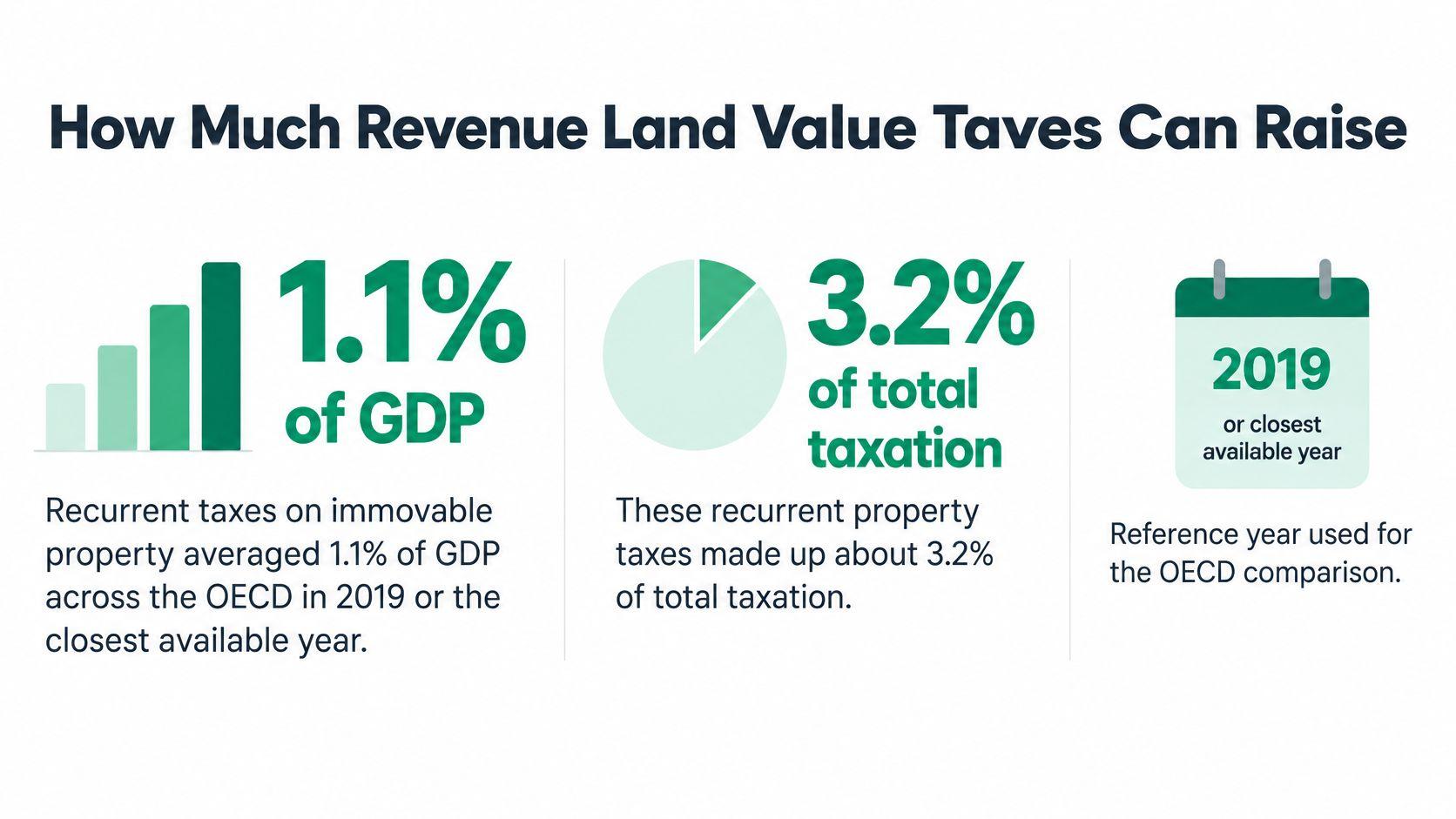
Across the OECD, recurrent taxes on immovable property averaged 1.1% of gross domestic product in 2019, or the closest available year, and represented about 3.2% of total taxation, according to OECD figures on recurrent property taxation. They were the largest property-tax category in most member countries.
| Indicator | OECD figure | What it means |
|---|---|---|
| Share of GDP, OECD average | 1.1% | Scale of the fiscal base across member countries |
| Share of total taxation | About 3.2% | A modest but steady slice of tax income |
| Range of revenue as share of GDP | About 0.1% in Luxembourg to 3.1% in Canada | Design and base choices drive the spread |
Why those figures overstate a pure land yield
The 1.1% average covers charges on land, buildings or both. It does not isolate site value, so it cannot be read as the yield of a land-only tax. A country at 3.1% of GDP may be taxing apartment towers heavily. A country at 0.1% may be leaving a valuable base untouched.
The spread tells the more useful story. The distance between Luxembourg and Canada is not explained by how much land each country has. It is explained by how the base is defined, how often values are updated and how much land sits under exemptions. Two jurisdictions with identical land wealth can collect very different sums if one keeps its roll current and the other lets values drift.
Lease design is the other quiet gatekeeper. A base written on freehold value in a city where prime land sits under long leases yields less than the headline suggests, because the charge reaches only the interest the statute names. Owners of car parks and empty lots in city centres are where a land charge bites first, but only if the roll can see those parcels and the lease structure lets the bill land on the right party.
Building a local estimate
You can approximate your own jurisdiction's land base without waiting for a national study. Take the assessment roll and separate the land component from the improvement component. Apply the current rate to the land line only, and you have an order-of-magnitude figure for a revenue-neutral shift. The roll works like a meter here: the rate collects only what the meter registers, so test the estimate against actual collections, because exemptions and appeals will pull the number down.
Some jurisdictions already publish the land line separately, which makes the exercise easier. The Riverside County Assessor reported land values alone assessed at $113.89 billion in 2024, an increase of 6.27% from the prior year (Riverside County Assessor).
Revenue potential is an empirical question for each place. It depends on how much of the base is land, how much of it sits exempt, and how well the valuation survives appeal. A jurisdiction that can separate site value, update it on schedule and defend it before a tribunal collects close to what the arithmetic promises. One that cannot collects a fraction of it. For a closer look at the fiscal arithmetic, see land value tax revenue.
Who Pays Under a Land Value Tax and How to Protect Households
Taxing valuable locations sounds progressive by construction. The owner of a prime site pays more, the owner of a modest lot pays less, and the burden lands on those with the most valuable holdings. Assessment practice does not reliably deliver that outcome.
A 2025 Harvard Law Journal analysis of property tax regressivity reported that, in nearly all jurisdictions with available data, expensive properties were assessed below their eventual sale prices while inexpensive properties were assessed above them. It also summarised research finding racial assessment gaps in several U.S. markets and larger model errors in majority-Black neighbourhoods.
The consequence is uncomfortable for reformers. A base that is progressive on paper becomes regressive in the bill, because valuation error shifts burden toward lower-value owners and toward neighbourhoods with weaker transaction data. Renters can absorb part of it too when owners pass the charge through.
Fairness is an assessment question before it is a rate question. Two jurisdictions can run identical rates on identical land and distribute the burden completely differently.
Four safeguards that belong in the statute
Order matters here, because each safeguard depends on the one before it.
- Publish assessment-to-sale ratios by price band and neighbourhood. Without that table, nobody outside the assessor's office can tell whether the base is behaving as designed.
- Test automated valuation models for spatial and demographic bias. A model trained on thin data in one district will reproduce that district's gaps at scale and at speed.
- Provide appeals that a non-lawyer can use. Plain forms, published deadlines, and a decision on the record.
- Offer targeted deferrals or circuit breakers for cash-poor households. Older owners on fixed incomes can be land-rich and income-poor, and a deferral that accrues against the property keeps them housed without giving away the base.
The sequencing point is not bureaucratic tidiness. The OECD's 2025 review of Czechia and Poland highlighted the need for reliable transaction data and appropriate valuation standards before value-based reform, and those are the same foundations the four safeguards rest on. Where the underlying analysis of who gains and who pays needs to be done properly, distributional analysis sets out the method.
Before supporting any bill, ask for three numbers: the assessment-to-sale ratio by price band, model error by neighbourhood, and the count of households receiving relief. A proposal that can't produce them isn't ready.
Decide Whether a Land Value Tax Fits Your Jurisdiction
Work through five checks in this order. Each one can stop the process, which is the point.
- Confirm the legal power. The legislation has to allow land value to be assessed and billed separately from buildings. Without that, the rest is an exercise in drafting.
- Audit the registry, planning records and sales data. Check currency, coverage and coverage gaps. Budget for cadastral integration as a line item, not a rounding error.
- Pick a valuation method and publish it. Choose from the method comparison on the basis of what your data can support, document the model, and set a reassessment cycle the office can meet.
- Run the fairness tests before the first bill. Assessment-to-sale ratio by price band, model error by neighbourhood, relief take-up. Fix what fails.
- Phase the rate and write the transition rules. Sudden revaluation shocks are the fastest route to repeal, so stage the shift and protect sitting owners with deferrals rather than permanent exemptions.
The plain verdict
A land value tax suits a jurisdiction with strong valuation capacity and a fiscal need to raise revenue without taxing work or buildings. It is much harder to justify where transaction data are thin, the registry is out of date, or the last revaluation is a distant memory.
That is not an argument for abandoning reform. It's an argument for sequencing it properly. A jurisdiction without capacity can commission an independent external review of its registry, its valuation methods and the distributional impact before committing to anything. Our work at Unitism® follows that same order: assessing land values, designing the policy that collects them, and modelling who gains and who pays.
The first decision is narrow and practical. Do your registry and sales data justify starting an assessment pilot on a few hundred parcels? If yes, run the pilot and publish the results. If no, fix the data first. For the sequencing detail behind a phased rollout, see transition requirements.
Land value for taxes only works when the valuation behind it survives scrutiny and the tenure system stops hiding what sites are worth. Unitism® supports finance ministries, cities and policy teams through land value assessments and data frameworks, policy design for land-value capture instruments, and distributional and fiscal impact modelling that shows who gains and who pays before a bill reaches a legislature. If you're weighing a shift toward land value in your jurisdiction, visit Unitism® to see how the assessment, design and transition work fit together.