Progressive vs flat tax compared on fairness, revenue, and behavior. See how land-value reform reshapes the trade-offs between them.
September 11, 2026
Progressive vs Flat Tax: How Each One Actually Works
Progressive vs flat tax compared on fairness, revenue, and behavior. See how land-value reform reshapes the trade-offs between them.

The OECD average top personal income tax rate fell from 65.7% in 1981 to 41.7% in 2010, a decline of more than 23 percentage points in three decades, according to the OECD's analysis of top incomes and taxation. That history changes the question. The debate over progressive vs flat tax systems isn't a choice between an old model and a new one. It's a continuing argument over how much income should be taxed, whose income counts, and whether governments should raise revenue from work, capital, or the value of land.
The rate schedule matters, but it isn't the whole tax system. A flat rate on a broad base can produce a different distribution from the same rate applied after generous deductions. A progressive schedule can also lose much of its redistributive effect when high-value income escapes through preferential treatment, while credits and allowances can make a nominally flat system progressive in practice.
The most useful analysis therefore tests three things together: marginal rates, the tax base, and the wider tax-and-transfer system. Land-value capture adds a third policy lever, because shifting revenue toward the rental value of land can change the efficiency and fairness trade-offs associated with either income-tax schedule.
Table of Contents
- What Progressive and Flat Income Taxes Actually Mean
- How the Modern Progressive vs Flat Tax Debate Took Shape
- Equity and Efficiency Trade-offs Between the Two Systems
- Revenue Capacity, Behavioral Effects, and Administrative Cost
- International Evidence From Denmark, Estonia, and U.S. States
- Why Flat Taxes Are Rarely Flat in Practice
- Land Leases Versus Land-Use Rights and the Third Lever
- Choosing a Path Forward and Sequencing the Transition
What Progressive and Flat Income Taxes Actually Mean
A progressive income tax uses marginal rates that rise as taxable income enters higher brackets. The higher rate applies only to the income within the relevant bracket, not automatically to every unit of income. That distinction separates a taxpayer's marginal rate, the rate on the next unit of taxable income, from the effective average rate, total tax divided by the income subject to tax.
A flat tax applies one statutory rate to a defined tax base. The word “flat” describes the rate schedule, not necessarily the tax burden across households. A basic allowance, personal exemption, refundable credit, or transfer can reduce the effective burden for lower-income households while leaving the headline rate unchanged.
The vocabulary that prevents bad comparisons
Taxable income is the amount left after the law applies permitted adjustments, deductions, and exemptions. Adjusted income is an earlier measure that may be used to determine eligibility for deductions, credits, or other provisions. Those definitions matter because two countries can publish the same nominal rate while taxing very different bases.
A comparison should also ask whether labor income, dividends, and capital gains are treated under one unified schedule or under separate rules. A single rate on labor income alongside preferential treatment for capital income isn't equivalent to a single rate applied across all major income sources.
Bracket creep occurs when inflation or nominal income growth pushes taxpayers into higher brackets without a comparable increase in real purchasing power. It can raise effective liabilities even when lawmakers haven't formally increased statutory rates. Schedule progressivity refers to rising marginal rates, while rate progressivity describes the resulting distribution of average burdens. The two can diverge.
| Feature | Progressive Tax | Flat Tax |
|---|---|---|
| Statutory rate | Rises across income brackets | One rate across the defined base |
| Marginal burden | Increases at higher thresholds | Usually remains constant |
| Effective burden | Often lower than the top marginal rate | Can vary through allowances and credits |
| Main design question | How steep should the brackets be? | How broad should the base be? |
| Distributional result | Depends on brackets, base, and transfers | Depends heavily on allowances, credits, and exclusions |
| Administrative focus | Bracket rules and threshold management | Base definition and exceptions |
The later debate should use this shared language. Asking whether “flat” is fair without defining the base, or whether “progressive” is efficient without examining avoidance and capital-income treatment, produces more heat than analysis.
How the Modern Progressive vs Flat Tax Debate Took Shape
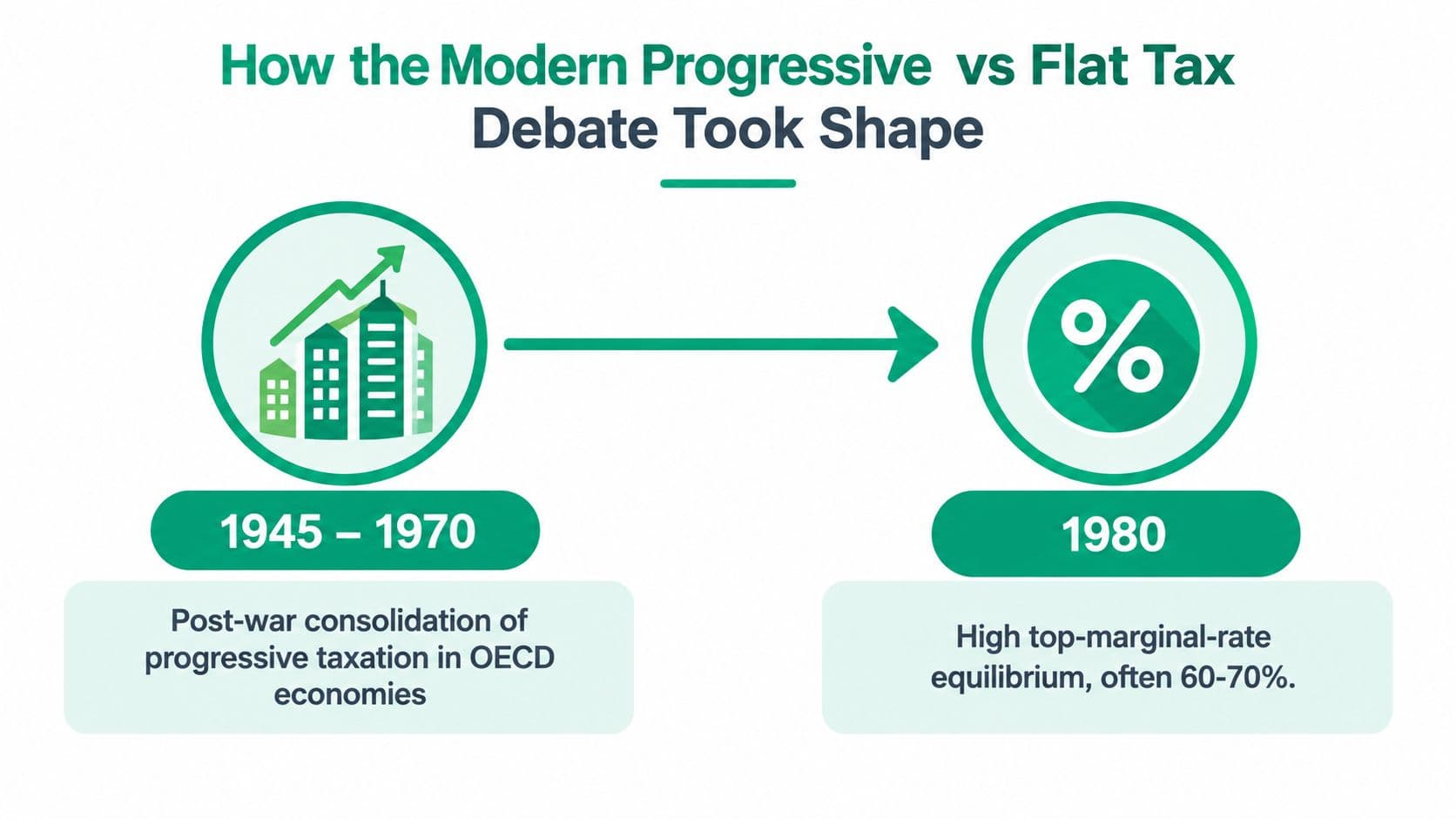
Modern tax debates developed against a long period in which advanced economies relied on steeply graduated personal income-tax schedules. By the early 1980s, top statutory rates had reached historically high levels in many OECD countries. The subsequent reform era narrowed rate spreads, reduced surtaxes, broadened bases, and lowered the tax burden at the top.
The OECD records a fall in the average top personal income tax rate from 65.7% in 1981 to 50.6% in 1990 and 41.7% in 2010. It also records a decline in top all-in tax rates from 49.4% in 2000 to 45.4% in 2010, reinforcing the direction of travel toward lower top-end taxation. These figures describe a structural shift, not merely a change in political labels.
Why flat taxes entered the policy mainstream
The post-communist transition created a receptive environment for flat-tax reforms. Estonia and Lithuania introduced flat personal income taxes in 1994, Latvia followed in 1997, Russia in 2001, and Slovakia in 2004, as documented in the IMF review of flat-tax reforms.
Estonia became the first European country to introduce a flat tax, adopting a 26% flat rate on personal and corporate income in 1994. Russia's 13% flat personal income tax in 2001 became a frequently cited example of large-market adoption. The same reform literature describes countries replacing multi-bracket schedules, including Bulgaria's 12%, 15%, 17%, and 20% rates or Slovakia's schedule ranging from 10% to 38%, with single-rate structures such as 13%, 19%, or 26%.
The political appeal rested on several arguments. A simpler schedule could make compliance easier, a lower top rate could reduce incentives for avoidance, and a broad base could compensate for lower rates. Tax competition and capital mobility strengthened those arguments, particularly for countries seeking investment after institutional and economic upheaval.
The historical record offers a useful benchmark for today's proposals. Readers can place these changes alongside the history of property taxation, because income-tax reform never operates in isolation from the way governments tax property, transactions, and land.
Equity and Efficiency Trade-offs Between the Two Systems
The strongest case for progressive taxation is vertical equity, the principle that households with greater ability to pay should contribute a larger share of their income. A progressive schedule can also support redistribution when the government uses revenue for public services or targeted transfers. But fairness has another dimension, horizontal equity, which asks whether households with similar economic resources receive similar treatment.
A flat schedule can appear horizontally fair because taxpayers face the same statutory rate. That appearance weakens when deductions, exemptions, capital-income preferences, and household credits vary substantially. A progressive schedule can also violate horizontal equity if two households with similar total resources report different taxable incomes because the law treats their income sources differently.
What efficiency depends on
The central efficiency question is how taxpayers respond to marginal rates. People may alter labor supply, compensation form, timing, investment, or reporting behavior. Those responses don't automatically invalidate progressive taxation, but they can reduce the revenue collected from a high bracket.
The IMF's technical conclusion is more specific than the usual flat-tax argument. Its analysis states that efficiency generally “requires a non-linear structure of the PIT with rising marginal tax rates towards the top, not a flat tax,” while also emphasizing that higher rates are more efficient when applied to bases with relatively inelastic supply or demand. In other words, the relevant question is not whether a high rate exists, but whether it falls on income that can easily move, be reclassified, or disappear from the taxable base.
A broad, enforceable base can make progressive rates workable. A narrow base with weak administration can make even an elegant progressive schedule fragile. Conversely, a flat tax may improve transparency where the previous system contains many brackets and exceptions, but its apparent simplicity won't compensate for a poorly designed base.
| Criterion | Progressive Tax | Flat Tax |
|---|---|---|
| Vertical equity | Stronger direct capacity to redistribute | Requires allowances, credits, or transfers |
| Horizontal equity | Can weaken through complex exemptions | Can weaken when income categories receive different treatment |
| Work incentives | Higher marginal rates may affect behavior | Uniform marginal rate can reduce schedule-induced distortions |
| Revenue targeting | Can concentrate revenue at higher incomes | Depends on base breadth and compliance |
| Administrative risk | More thresholds and interactions | Fewer rates, but exceptions can recreate complexity |
An analyst should resist universal verdicts. The IMF evidence supports rising marginal rates in a well-designed personal income tax, but that conclusion doesn't imply that every high bracket is efficient. The outcome depends on base breadth, enforcement capacity, income mobility, and the share of capital income concentrated at the top. A useful discussion of these trade-offs appears in taxation and efficiency, particularly for readers evaluating rates alongside broader economic incentives.
Revenue Capacity, Behavioral Effects, and Administrative Cost
Tax structures should pass three separate operational tests. Revenue capacity asks whether the system can fund public obligations. Behavioral effects ask how households and firms respond to rates. Administrative cost asks whether taxpayers and officials can apply the rules consistently.
A progressive schedule has more capacity to target additional revenue at higher incomes, provided those incomes remain within the base. A flat schedule can be fiscally effective when it replaces a narrow, distortionary system with a broader base and clearer rules. The rate alone doesn't determine collections.
Behavioral responses vary by setting
The JRC and European Commission analysis shows why policymakers should avoid applying one labor-supply assumption to every country. Estimated labor-supply elasticities range from 0.186 to 0.398 for Bulgaria and from 0.152 to 0.198 for Estonia, depending on participation assumptions, according to the JRC cross-country analysis. Those ranges don't prove that a flat tax will produce a particular response. They show that reform modeling is sensitive to household behavior and institutional context.
The response can also differ by income source. A worker with limited control over hours may react differently from a high-income professional who can defer compensation, change its form, or shift activities across jurisdictions. A serious revenue model therefore tests labor supply, taxable-income responses, avoidance, and income reclassification separately.
Modeling rule: A statutory rate is an input. It isn't a forecast of revenue until the model specifies the base, behavior, enforcement, and interactions with transfers.
Administrative simplicity has limits
A single rate can reduce the number of bracket calculations, but a flat system may still require extensive rules for allowances, credits, deductions, capital income, and household status. Progressive systems create visible complexity through thresholds and marginal rates, yet a flat system can recreate hidden complexity beneath a simpler headline.
Property owners and businesses also need to distinguish tax treatment from accounting treatment. A practical resource such as create a depreciation schedule helps illustrate why taxable income isn't the same as cash income. Depreciation changes the timing and measurement of taxable profit, so policymakers assessing a flat rate must define the base carefully.
| Test | Progressive Tax | Flat Tax |
|---|---|---|
| Revenue capacity | Strong when high-income bases are broad and enforceable | Strong when simplification broadens compliance |
| Behavioral effects | More exposure to high-bracket responses | More uniform marginal incentives |
| Administrative cost | Brackets and thresholds require maintenance | Exceptions and credits can restore complexity |
| Forecasting | Sensitive to top-income volatility | Sensitive to base exclusions and rate competition |
Revenue offices also need to track how income-tax collections interact with other municipal revenue sources. A national schedule can look stable while local governments face pressure from property markets, service demand, or transfers. The operational lesson is simple: test each tax instrument on its own terms, then test the combined fiscal system.
International Evidence From Denmark, Estonia, and U.S. States
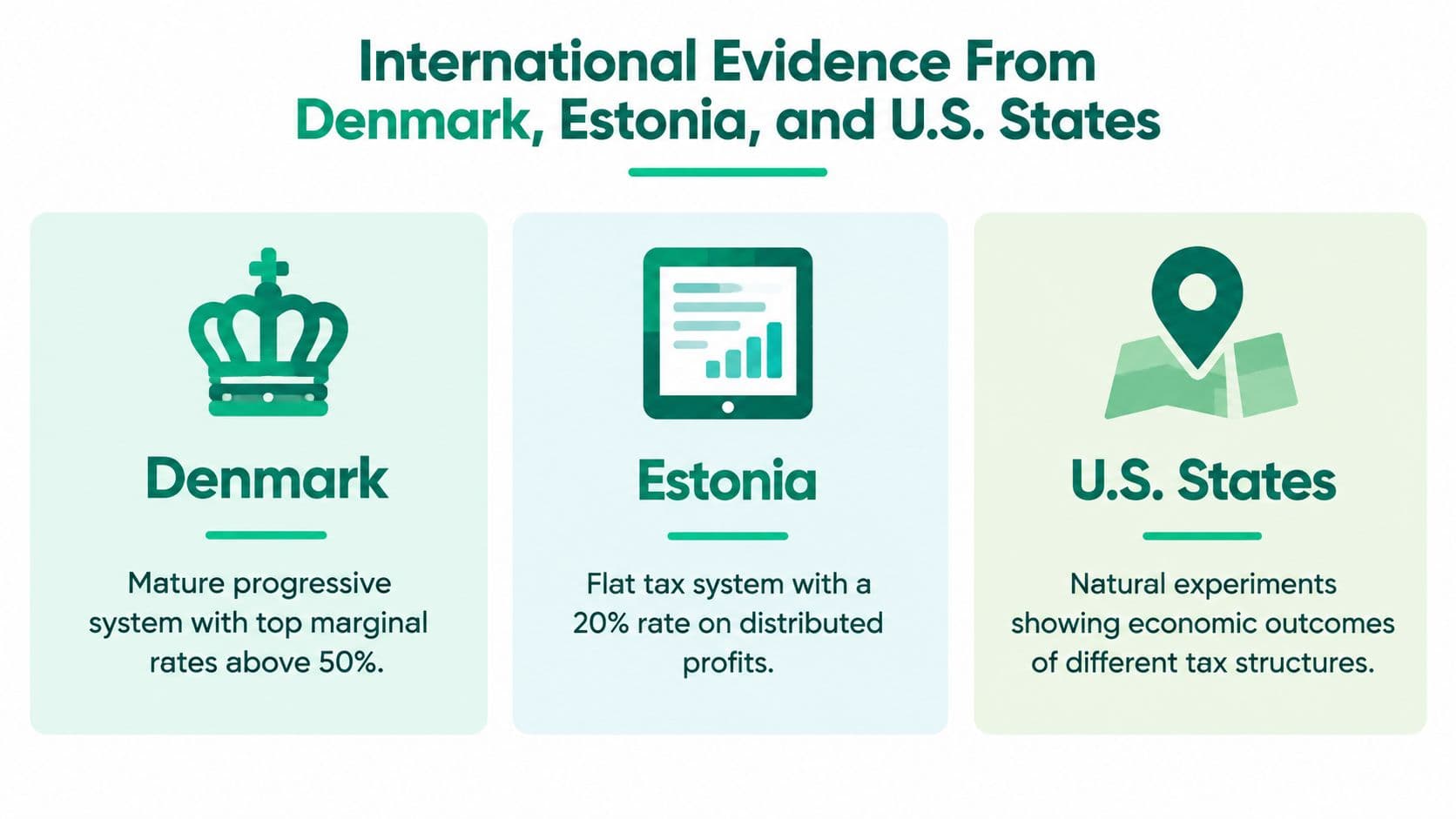
Denmark, Estonia, and U.S. states offer different settings for the same policy question. They shouldn't be treated as interchangeable experiments. Denmark represents a mature high-capacity system, Estonia represents a prominent flat-tax reform path, and U.S. states provide subnational examples where tax competition and balanced-budget pressures matter.
Denmark tests the strongest anti-progressive claim
Denmark shows that a mature progressive system can coexist with substantial labor-market participation and a functioning advanced economy. The case doesn't prove that higher rates never affect behavior. It does undermine the simplistic claim that progressive taxation automatically destroys work incentives.
The relevant policy conditions include administrative capacity, public services, social insurance, and the treatment of different income sources. A country with those features may sustain a more progressive schedule than a country with weak enforcement and a narrow base. Denmark therefore illustrates the importance of institutional complements rather than offering a universal rate prescription.
Estonia shows what a reform can and cannot prove
Estonia's flat-tax history began with its 26% personal and corporate rate in 1994, while the CFR comparison of flat-rate systems identifies Estonia at 20%, alongside the Czech Republic at 15%, Hungary at 15%, and Latvia at 23% in its comparison. These figures reflect different points in the evolution of national systems, so they shouldn't be collapsed into one timeless “Estonian rate.”
Estonia is valuable because it links a clear institutional reform to a broader transition environment. Growth, investment, administration, and structural change can all affect revenue after a tax reform. A researcher who attributes every improvement to the rate schedule risks confusing tax design with the surrounding economic transformation.
U.S. states add fiscal-risk pressure
Between 2021 and 2025, eight U.S. states enacted laws to transition to a flat individual income tax, according to the Tax Foundation's state flat-tax review. The same source identifies major moves in 2025, including Kansas triggering a flat tax and Ohio moving toward a flatter structure.
State reforms test political durability as much as economic theory. States already operate with broad tax bases, mobile households, constitutional constraints, and pressure to keep budgets balanced. A lower or flatter rate may strengthen competitiveness arguments, but it can also expose budgets to revenue volatility and create distributional effects that differ across household types.
Taken together, these examples support a conditional conclusion. Starting conditions, enforcement capacity, complementary transfers, and fiscal constraints often matter more than the label attached to the rate schedule.
Why Flat Taxes Are Rarely Flat in Practice
The headline rate is only the visible layer of a flat-tax system. A basic allowance can remove initial income from taxation. A refundable credit can transfer money to households with little tax liability. Child-related provisions, deductions, and social contributions can change the effective burden without changing the statutory rate.
That means a “flat” tax can be progressive in outcome even when its marginal income-tax rate is constant. The OECD's analysis of flat-tax systems emphasizes that progressivity can come from a basic allowance or basic-income provision rather than rising marginal rates. This is a more useful description of many real-world systems than the simple claim that every taxpayer pays the same share.
Nominal simplicity versus effective distribution
Suppose lawmakers announce one rate. The distributional analysis still needs to answer several questions:
- Where does liability begin? A tax-free allowance changes the burden at the bottom.
- Which credits are refundable? A refundable credit can support households even when their calculated tax is low.
- What income enters the base? Excluding dividends or gains can favor households receiving those forms of income.
- How do transfers interact with earnings? Benefit withdrawal can create a higher effective marginal burden than the income-tax rate suggests.
The OECD's work on Slovakia provides a warning. It notes that the flat tax likely increased inequality overall because middle-income single earners lost relative to both low-income and high-income households. The result shows why analysts should compare households across the distribution instead of focusing only on the nominal rate.
| Income Decile | Gross Income | Headline Rate | Effective Rate |
|---|---|---|---|
| Lower-income households | Defined by the reform model | One statutory rate | Reduced by allowances and credits |
| Middle-income households | Defined by the reform model | One statutory rate | Sensitive to lost deductions and benefit withdrawal |
| Higher-income households | Defined by the reform model | One statutory rate | Influenced by base exclusions and income composition |
The table intentionally avoids invented household figures. Without a specified country, filing unit, allowance, credit schedule, and income mix, precise effective-rate examples would be misleading. The analytical point is stronger than a fabricated illustration: a flat statutory rate doesn't establish a flat average burden.
A real comparison must model the entire tax-and-transfer package. Otherwise, policymakers may advertise simplicity while retaining parallel calculations for credits, exemptions, and income categories. The system may be less progressive than a graduated schedule, more progressive than its headline suggests, or unevenly distributed across household types.
Land Leases Versus Land-Use Rights and the Third Lever
Income-tax debates often overlook a tax base that responds less to work and production: the value of land. Land-value taxation charges the annual rental value of land, excluding buildings and other improvements. Annual site value means the rent a parcel could command if offered vacant, as explained in parliamentary evidence on land-value taxation and the FAO land-tax glossary.
Land leases and land-use rights apply different pricing mechanisms. A land lease is a fixed-term arrangement with a fixed price. It can be renewable or non-renewable, but both forms postpone rather than continuously price changes in land value. A renewable lease offers certainty only until its term ends, a dynamic explored in 99-year land leases. Renewal can then close the gap between the lease rate and market value through a major repricing. A non-renewable lease becomes harder to refinance and sell as its remaining term shortens.
Why terminology matters
A land-use right, as described in Chinese land-use-right literature, is not automatically indefinite or repriced every year. China's statutory maximum terms are 70 years for residential land, 50 years for industrial land, and 40 years for commercial land, according to the Chinese legal text on urban real-estate administration. Residential land can be extended automatically under the cited law. The framework still creates an expiration point and a renewal event, rather than continuous annual repricing.
Chinese legal scholarship describes renewal as requiring reacquisition at then-current fair market value, concentrating adjustment at the end of the term. Other scholarship describes renewal as “infinitely renewable” only in theory and notes that additional fees may apply. Allocated rights must also be converted into granted rights before leasing and require payment to the granting authority. These arrangements are economically closer to fixed-term leases than to indefinite rights repriced annually.
The distinction should remain strict:
- Fixed land lease: limited term and fixed price, renewable or non-renewable.
- Land-use right in the strict economic sense: no expiration, no renewal requirement, and annual repricing.
- Land-value tax: recurring charge on annual unimproved site rental value.
Calling a fixed lease a land-use right conceals the risk mechanism. Fixed leases delay repricing. Annually repriced rights allow people to trade access to locations without a sudden renewal shock. They also avoid charging buildings and productive improvements. The choice of base therefore changes the efficiency comparison between progressive and flat income taxes.
A land-value charge can complement either schedule. It may let a flat income tax operate on a broader, less distortionary base. It may also help a progressive system reduce taxes on work while funding transfers through location value. The third lever does not settle the rate question by itself. It changes the conditions under which either structure can deliver fairness and efficiency.
Choosing a Path Forward and Sequencing the Transition
Policymakers shouldn't choose between progressive and flat taxation by headline rate alone. They should first map the current base, identify distributional outcomes, and test how land-value capture changes the revenue requirement imposed on labor and capital.
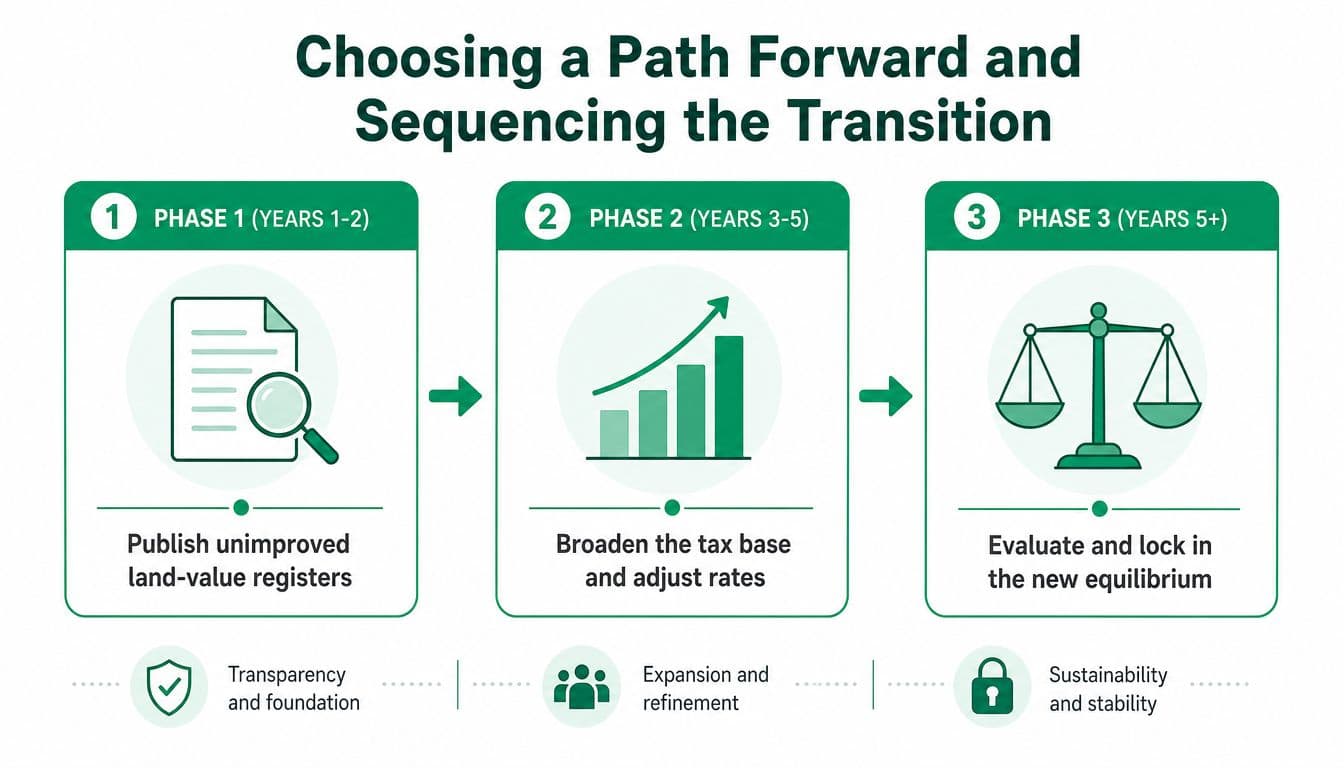
A practical transition can proceed in phases:
-
Build the evidence base. Publish unimproved land-value registers and run revenue-neutral shadow schedules for flat and progressive options against current law. The model should report marginal rates, effective rates, household distribution, income-source treatment, and local fiscal effects.
-
Test land-rent capture locally. Pilot assessment and collection in selected metropolitan regions before national adoption. The pilot should measure valuation disputes, effects on owners with mortgages, treatment of improvements, and the reliability of recurring revenue.
-
Lock in the combined system. Use validated land-rent revenue either to reduce reliance on the income-tax rate or to expand targeted credits within a progressive schedule. Automatic stabilizers can reduce the temptation to change rates whenever land markets or top incomes fluctuate.
The transition has real risks. Assessment appeals can delay implementation. Owners with high debt may need relief while the market adjusts. In the United States, constitutional limits related to federal tax uniformity can constrain design choices. These issues require legal and administrative work, not just a preferred economic theory.
A revenue-neutral tax reform framework can help policymakers compare alternatives without assuming that one schedule wins in every setting. The final judgment should be conditional: use progressive rates where redistribution and a broad enforceable base justify them, consider flat rates where simplification and base broadening are credible, and evaluate both alongside land-value capture.
Unitism® offers land valuation assessments, distributional and fiscal-impact modeling, policy design, and implementation support for governments evaluating land-value capture alongside income-tax reform. Visit Unitism® to explore how land, labor, and capital can be modeled together before policymakers commit to a rate schedule.