Legislative drafting guidelines for land-value laws: clause checklists, common pitfalls, and why fixed leases are not land-use rights.
October 28, 2026
Legislative Drafting Guidelines for Land-Value Laws
Legislative drafting guidelines for land-value laws: clause checklists, common pitfalls, and why fixed leases are not land-use rights.

Plain language isn't a quick editorial fix for a badly designed law. Canada's experience makes that clear: a report commissioned in 1986 recommended a cross-jurisdiction drafting guide, but although that guide wasn't produced, plain-language guidance entered the regulation-making manual in 1998, according to the Statute Law Review account of plain-language drafting. Institutional practice matters as much as sentence construction.
For land-value legislation, the practical test is whether an assessor, property owner, collection officer and appeal body can perform their respective tasks without inventing missing rules. Good legislative drafting guidelines therefore treat a bill as an administrative system: who acts, by when, using what evidence, subject to which limits, and with what route to correction.
Table of Contents
- Drafting Standards to Check Before Anything Else
- How to Finish the Policy Work Before Drafting Starts
- Land Leases, Land-Use Rights and Land-Value Taxes Compared
- How to Order the Parts of a Bill
- Clause-by-Clause Entries for a Land-Value Charge
- Common Drafting Pitfalls and How to Fix Them
- How to Prove Consultation Changed the Bill
- Designing Review and Evaluation Into the Law
- Run the Drafting Gate Before Introduction
Drafting Standards to Check Before Anything Else
| Standard | Test question | Passing clause looks like | Typical failure |
|---|---|---|---|
| Plain language | Can a non-lawyer find and understand the rule? | Short sentences, defined terms, active voice | Long conditional chains with buried exceptions |
| Internal consistency | Does each term keep one meaning? | Defined terms used the same way throughout | One concept called three different names |
| Structural navigability | Can a reader find the rule and its exceptions? | Headings and order follow the logic of the bill | Exceptions placed far from the rule they qualify |
| Accessibility | Can every affected group access the text? | Accessible formats and minority-language versions | Only a dense PDF published in one language |
| Operational usability | Can officials apply it without guessing? | Each power has a subject, a limit and a deadline | Discretion granted with no criteria |
Plain-language legislative drafting developed from Lord Thring's advocacy of ordinary language in England. By 2011, the U.S. Federal Plain Language Guidelines treated wording, organization and design together as quality measures, as described in the Administrative Conference report on plain regulatory drafting.
Test the reader's task, not the sentence alone
A short clause can still be unusable. An owner may understand that a return is required but remain unable to identify the form, filing authority or evidence needed to complete it.
Review the bill through actual tasks: finding liability, checking an assessment, claiming relief and challenging a decision. Ask a reviewer unfamiliar with the policy to trace each task through the text and supporting documents. Record every place where the reviewer needs an explanation that the documents don't provide.
For teams comparing tax administration with financial supervision, FCA and PRA regulation with Glentorion provides a useful companion topic for examining how regulated readers address overlapping requirements. Keep the drafting distinction clear: legislation establishes binding duties, while supporting guidance explains how to comply without adding new duties.
First-pass rule: A clause doesn't pass because its author can explain it. It passes when its intended user can act on it.
Apply the table before polishing individual provisions. Log each failure against the affected clause, name the person responsible for resolving it, and distinguish editorial repairs from unresolved policy decisions. Carry unresolved policy failures into the pre-drafting gate rather than disguising them with more precise-looking language.
How to Finish the Policy Work Before Drafting Starts
Don't use operative clauses to negotiate unfinished policy. The OECD checklist on law drafting and regulatory management separates the justification, legal basis, impacts and administration of intervention from the preparation of legal text.
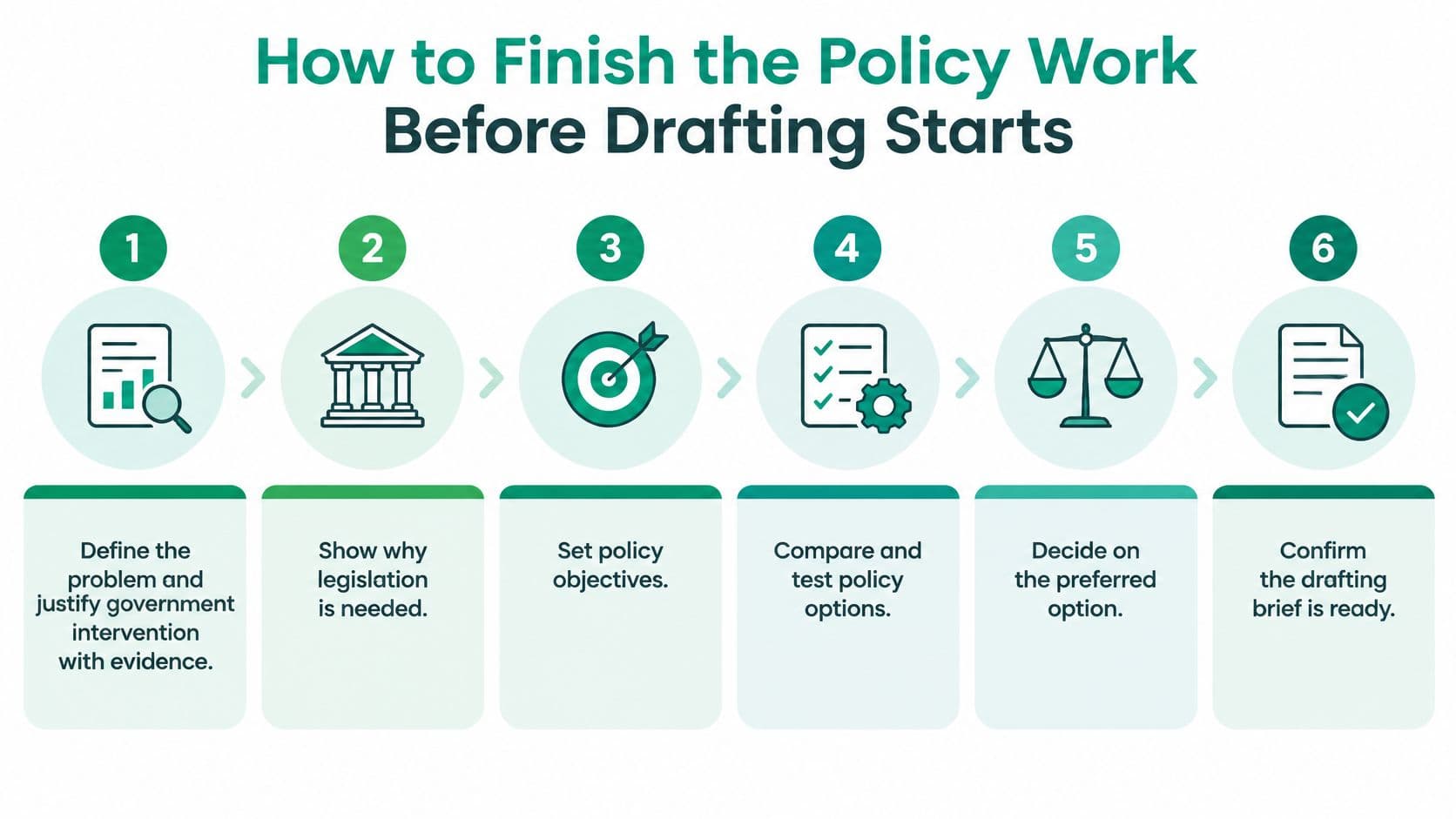
Complete the following steps before writing the charging provision.
-
Define the problem and justify intervention. Identify the conduct or condition that government intends to change, then assemble evidence of its scale and causes. For a proposed charge on vacant urban lots, distinguish speculative withholding from delayed infrastructure, contaminated land and projects awaiting permission, because those problems require different responses.
-
Show why legislation is necessary. Compare the proposal with guidance, voluntary codes, enforcement of existing obligations and adjustments to existing taxes. Begin the regulatory impact assessment here, while its findings can still change the design rather than merely defend it.
-
Confirm authority and governmental responsibility. Identify the constitutional or statutory basis for imposing the charge, conducting valuations, obtaining information and collecting arrears. Resolve which level of government may act before assigning functions to a municipality that lacks the necessary powers.
-
Estimate benefits, costs and distributional effects. Model who gains and who pays by income band and tenure, including owners with limited cash income and occupiers exposed to contractual pass-through. Include valuation, appeals, collection and compliance costs, not just projected receipts, so ministers can compare the policy's net effects.
-
Settle the land-charge base and mechanics. Decide the taxable base, valuation method, liable person, assessment cycle, exemptions, appeals route, collection authority and interaction with property or transaction taxes. In the vacant-lot scenario, settle whether vacant parcels are liable from the first assessment year, rather than leaving the commencement drafter to infer the answer.
-
Build the implementation matrix. Map each objective to operative provisions, give every administrative power a legal subject and limit, and record each obligation's trigger, deadline, evidence standard, decision-maker, remedy and sanction. This exposes missing authority and unassigned work before they become disputes about statutory interpretation.
Make readiness a documented decision
Attach a policy-impact note to the matrix. Record rejected alternatives and assumptions that would change the recommendation, including valuation coverage, collection capacity and the availability of household-level information.
Use a transition requirements assessment to separate legal commencement from administrative readiness. A legally valid start date won't help if the authority can't identify parcels, notify liable people or process objections.
The sponsoring ministry should sign off unresolved choices explicitly. A blank cell in the matrix is a decision still needed, not an invitation for the drafter to supply policy.
Land Leases, Land-Use Rights and Land-Value Taxes Compared
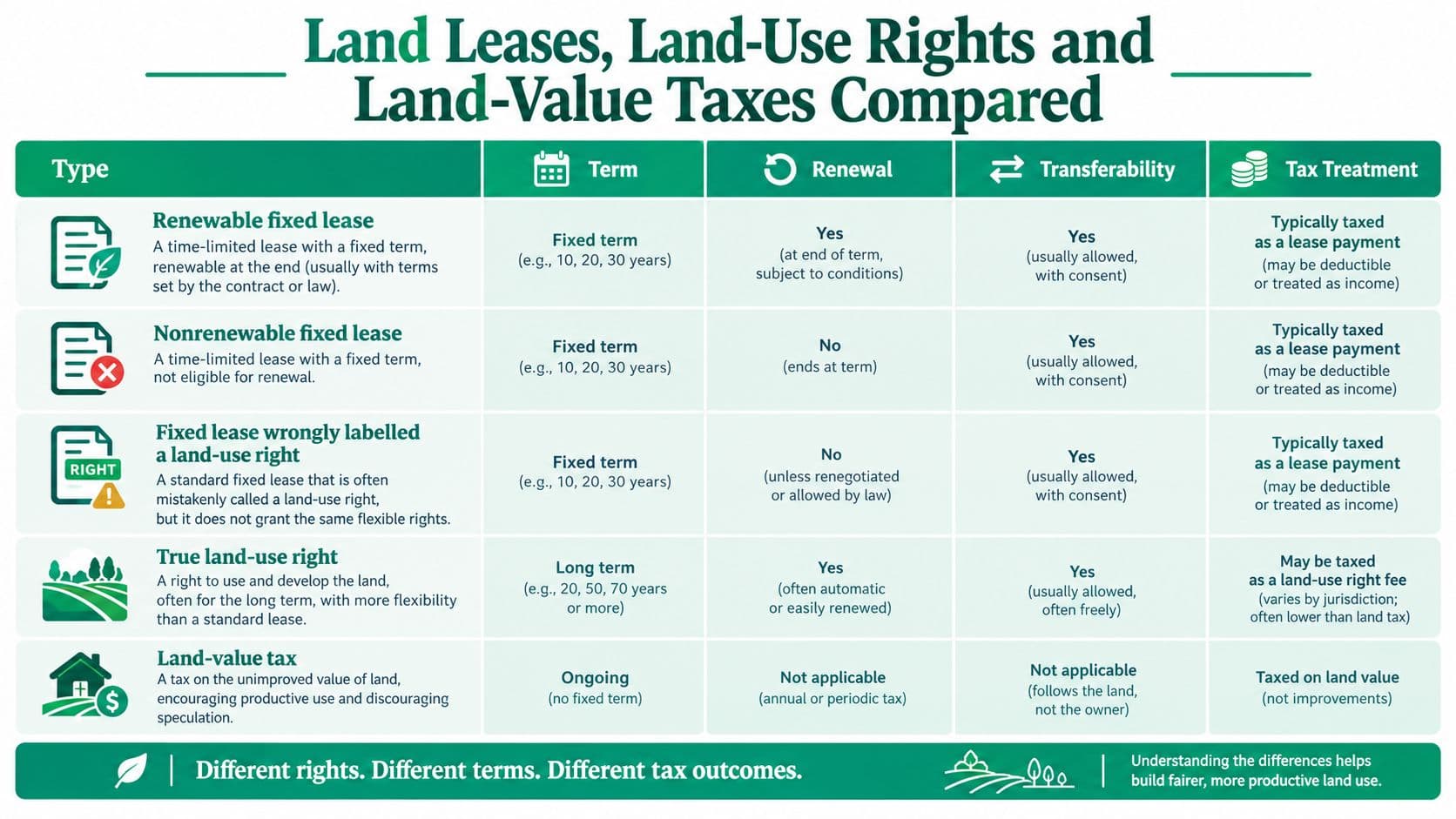
The legal label does not determine how a land charge works. Drafting must establish its term, how its price changes, who pays, and what happens when a valuation is challenged. These details determine how the arrangement operates for owners, administrators and lenders.
| Feature | Renewable fixed lease | Nonrenewable fixed lease | Fixed lease labelled land-use right | True land-use right | Land-value tax |
|---|---|---|---|---|---|
| Term | Fixed, with a renewal option | Fixed, no renewal | Fixed, with expiry or renewal | Indefinite, no expiry | No term; levied each assessment year |
| Renewal | Required at term end | None; the lease ends | Still required or expiring | None needed | None needed |
| Price setting | Fixed until renewal, then one large repricing | Fixed to expiry | Fixed to expiry; the label changes nothing | Repriced annually to current site rental value | Reassessed on land value each cycle |
| Risk handling | Postponed to renewal | Postponed to expiry | Postponed under the underlying lease | Priced continuously through annual resets | Priced continuously on site value through reassessment |
| Transfer and refinancing | Certain until term ends | Harder as expiry nears | Same as the underlying fixed lease | Low-cost transfer without end-of-term renegotiation | Obligation follows the owner; not a lease |
| Legal character | Contract for occupation | Contract for occupation | Contract, not a land-use right | Possession right with annual repricing | Public levy on land value; ground rent is separate |
Here, land leases are fixed-term agreements with a fixed price, whether renewal is possible or not. The price stays unchanged during the term, so a lease does not continuously reflect changes in land value. With a renewable lease, the adjustment is deferred until renewal. The resulting difference between contractual rent and current market conditions may then be addressed through a large repricing.
A nonrenewable lease has a different timing risk. As expiry approaches, buyers and lenders have less time to recover their investment, which can make the interest harder to sell or refinance.
Hong Kong's historical renewable leases illustrate one way governments have structured renewal. The Lincoln Institute's public-land leasing analysis reports that leases allowed renewal for another 50 years without an additional premium, with rent at renewal equivalent to 3% of the property's rental value. That renewal arrangement is distinct from repricing a right throughout occupation.
Historical public-land leases have also recovered part of land-value increases and contributed to infrastructure funding. Such experience can inform policy design, but it does not establish the revenue a new scheme will collect. A bill must specify how charges are assessed, collected and applied, rather than rely on past outcomes as a forecast.
Price the land, not productive improvements
A true land-use right, under the strict definition used here, continues indefinitely and is repriced annually. It resembles a lease in granting possession, but it has no expiry or renewal point. The holder can transfer the right without a costly end-of-term renegotiation. A law creating this arrangement should state how annual values are set, who makes the assessment, and how affected holders can challenge it. The land-use right guide explains the distinction between a land-use right and other forms of land tenure.
Pricing land rather than buildings or productive improvements avoids charging for investment in those improvements. The trade-off is administrative: annual adjustments remove a concentrated renewal reset, but they still depend on credible valuations and a usable review process. Drafting should assign responsibility for assessment and specify how a challenge is decided.
A land-value tax is different in legal character. It is a public levy on site value, typically payable by the owner or freeholder. The UN-Habitat's Land and Property Tax guide distinguishes ground rent from land-based taxation and notes that they can coexist without necessarily constituting double taxation. The legislation should identify the liable person, assessment basis and collection process.
Use the term land-use right only when the right is repriced each year, requires no renewal and does not expire. If the price remains fixed until expiry or renewal, changing the instrument's name does not change its legal operation.
How to Order the Parts of a Bill
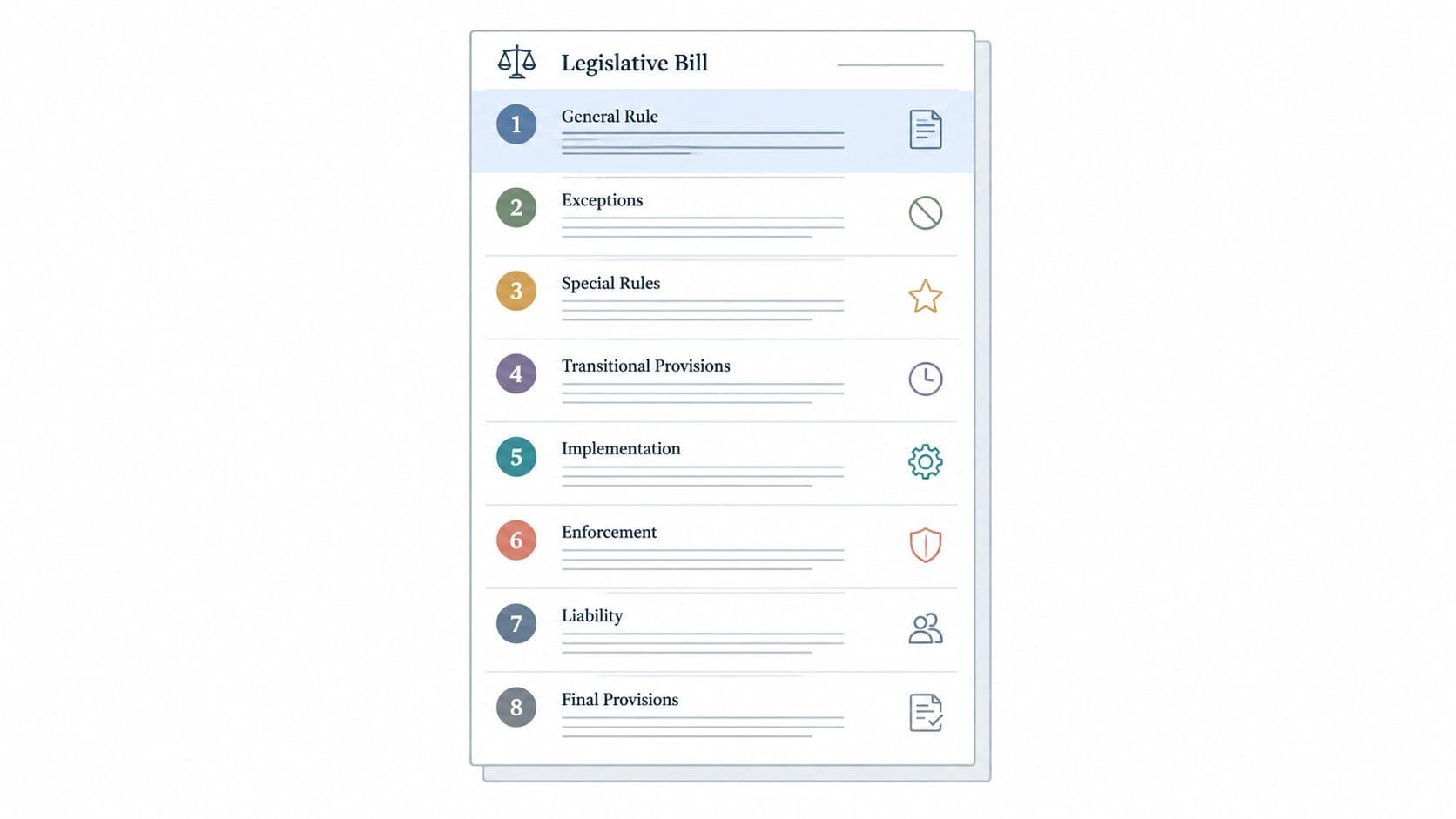
The U.S. House Office of the Legislative Counsel's drafting introduction describes a useful sequence for organizing legislation. Use it as a logical framework, then adapt the presentation to the jurisdiction's drafting conventions.
- State the general rule. Readers need the baseline before they can understand qualifications.
- Specify exceptions. Keep departures close enough to the rule that users can identify their full obligation.
- Set out special rules. Separate treatment for unusual cases shouldn't obscure ordinary administration.
- Address transition. Identify which cases retain old treatment and when that treatment ends.
- Add other necessary provisions. Place supporting machinery where readers can connect it to the power or obligation it serves.
- Define terms. Reserve statutory definitions for specialized meaning, repeated use or necessary limits on scope.
- Set the effective date. Distinguish enactment, preparatory powers and substantive liability.
- Include appropriations authorization where relevant. Check whether the intended administrative work requires separate spending authority.
Keep architecture separate from hidden effects
For a land-charge bill, open with purpose and scope, introduce essential vocabulary where local conventions require it, then place the charging rule before administrative machinery. Put consequential amendments last. The clause table below supplies the detailed presentation order.
A transitional provision can override the principal rule even when it appears later. Test its legal effect rather than assuming its position makes it subordinate. Likewise, a definition must explain a term, not smuggle in an exemption.
Keep amendatory instructions outside quoted statutory text. Check whether this Act means the new amending enactment or the statute being amended.
Say an amendment moves the payment provision to a different subsection but leaves the interest provision pointing to its old location. The resulting reference might now identify an exemption instead of a due date.
Before introduction, verify every cross-reference, renumbered subsection, commencement dependency and transitional interaction against a maintained checklist. Use a cross-reference report where drafting software supports it, but inspect the legal destination manually.
Clause-by-Clause Entries for a Land-Value Charge
| Clause element | What it must specify | Worked example | Common error |
|---|---|---|---|
| Purpose and scope | Which land, owners and assessment periods | Suppose the charge applies to municipal cadastre parcels from 1 January of the first assessment year | Scope tied to a list never updated |
| Definitions | Land, site value, improvements, owner, occupier, valuation period | Site value means land value in its existing use, excluding improvements | Definition contains an operative exemption |
| Charging rule | Who pays, on what base, at what rate | Owner pays the enacted rate on site value each year | Charge called rent, leaving tax treatment unclear |
| Valuation and revaluation | Method, valuer powers, interval | Annual revaluation using sales and rental evidence | No revaluation trigger |
| Returns and records | Filer, contents, deadline, retention rule | Owner files changed-use information by the deadline stated in the assessment notice and retains supporting records | Obligation has no deadline |
| Payment and enforcement | Due date, interest, collector, sanctions | Named collector assesses interest on overdue amounts from the due date | Remedy without a decision-maker |
| Reliefs and transition | Exemptions, phased rates, caps | Suppose owner-occupier rates phase in over five years | Transition overrides the principal charge |
| Review and appeal | Route, time limit, decision-maker | Owner seeks administrative review within the statutory period, then appeals to the designated tribunal | Courts are the only practical route |
| Information sharing | Data owner, cadastre feed, privacy limits | Cadastre office supplies parcel boundaries monthly | Undefined feed produces stale records |
| Regulations | Delegated subjects and limits | Regulations set valuation methods but cannot change the rate | Unlimited regulation-making power |
| Commencement | Effective date and staged start | Valuation powers begin before liability starts | Start depends on an unmade regulation |
| Consequential amendments | Conforming tax and property-law changes | Existing property-tax provisions remove an unintended duplicate charge | Conflicting provisions remain in force |
These are worked design examples, not existing legal thresholds. The bill must replace each placeholder choice with an enacted rule or a bounded power to prescribe it.
Choose the legal instrument before finalizing liability
Decide whether the bill creates a tax, contractual ground rent or a payment attached to an indefinite possession right. Don't assume that similar economic effects make the instruments legally interchangeable.
A land-value tax operates through public charging and assessment powers. A fixed lease creates time-limited contractual occupation, while a qualifying land-use right combines continuing possession with annual repricing. The GSA guidance on renewal options_C.pdf) is a useful reminder to examine renewal machinery separately from the payment label.
Write down whether the underlying right expires, whether renewal is required and how often the amount resets. Tax and ground rent can coexist without necessarily creating double taxation, but the drafter must identify which obligation this bill establishes and how it interacts with existing payments.
Charging-rule template: The [charge] is payable by the [liable person] on the [taxable base] at [rate] for each [assessment period] beginning [date].
This is a diagnostic template, not a complete model clause. Add rules for ownership changes, joint liability, corrected assessments and refunds where the chosen policy requires them. Don't leave the collection authority to decide who owes a disputed amount.
Specify the assessment record
Choose a fixed valuation date and an explicit revaluation interval. Annual or triennial assessment can be considered for a tax; a land-use right meeting the strict definition requires annual repricing. Compare methods of land valuation before selecting evidence rules that the valuation office can't implement.
Name a data owner for each cadastre feed, including parcel geometry, ownership changes and land-use classification. Specify correction responsibilities when the cadastre and assessment register disagree, and preserve the version of the evidence used for each assessment.
Give the taxpayer a single intelligible appeal route with an express deadline. State when that deadline begins, how notice is served, whether payment continues during a dispute and who can order a refund.
Finally, test the complete assessment notice against the bill. If the authority can't explain the parcel, base, rate, amount, payment date and challenge route from the enacted provisions, the administrative design is unfinished.
Common Drafting Pitfalls and How to Fix Them
A clause can be grammatically sound and still allocate the wrong power. Reviewers should diagnose the legal defect, identify its cause and make a targeted repair rather than rewrite everything around it.
-
Fixed lease labelled a land-use right. The text promises continuing access but retains expiry or renewal machinery. The cause is instrument selection by label rather than mechanics; repair the term and annual repricing provisions, or describe the arrangement as a fixed lease.
-
Ambiguous reference to this Act. A provision intended to amend the principal statute instead points to the amending enactment. Copying boilerplate usually causes the problem; name the intended statute in full wherever the reference could be misunderstood.
-
Definition that creates a rule. A site-value definition excludes a favoured class of owners, even though the charging provision appears universal. The drafter has mixed vocabulary with policy; move the exemption into an operative relief provision and specify its eligibility and administration.
-
Obligation without a trigger. A return must be filed promptly, but nobody can establish when noncompliance begins. Replace the vague instruction with a triggering event, an express deadline, a receiving authority and a decision-maker for extensions or penalties.
-
Cross-reference broken by renumbering. A late amendment moves a subsection without updating dependent references. Treat every structural change as a reason to rerun the reference checklist, including references in forms, regulations and consequential amendments.
-
Tax-or-rent ambiguity. Different provisions call the same payment ground rent and tax, creating uncertainty over assessment, recovery and remedies. Choose the legal character deliberately, align every operative provision with it, and reserve separate terms for distinct obligations.
Review outcomes, not appearances
A global search can identify inconsistent terminology, but it can't decide whether the terms describe different legal interests. Maintain a terminology register with the concept, approved term and provisions where it operates; have the policy lead resolve substantive differences.
A reviewer should be able to explain what changed legally after every drafting correction, not merely say that the wording reads better.
Use the comparison's labelling test when checking possession instruments. For every repaired administrative clause, also ask what evidence will reveal whether the repair works after enactment. The review-and-evaluation provisions must let officials detect recurring errors rather than wait for litigation to expose them.
How to Prove Consultation Changed the Bill
Consultation guidance often explains how to invite participation without showing whether participation affected the legislation. A meeting list and a folder of submissions prove activity, not influence.
The ECNL manual on participation in decision-making describes participation across preparation, drafting, enactment, implementation and evaluation, alongside principles associated with early impact assessment, affected-group identification, timely publication, minority-language access and disability-accessible formats. Apply those requirements while policy choices remain open, not after ministers have settled every material question.
Build evidence of inclusion
Use a stakeholder engagement strategy to identify whose evidence is missing, rather than merely whose submission has arrived.
- Representativeness checks. Compare participating groups with affected owners, occupiers, businesses and residents.
- Plain-language distributional summaries. Explain likely changes in liability and relief eligibility without requiring readers to interpret a fiscal model.
- Multilingual and offline channels. Accept participation from people who can't use the consultation website or working language.
- Practical support. Consider assistance or compensation where participation costs would exclude relevant voices.
- Privacy safeguards. Separate publishable policy evidence from personal financial information and identifiable case details.
More participation isn't automatically more legitimate. Organized, well-resourced groups can dominate a nominally open process, while targeted engagement with underrepresented people can reveal administrative barriers that a larger submission count misses.
Maintain a consultation-to-text audit trail
| Proposal | Submitter type | Decision | Reason | Clause affected |
|---|---|---|---|---|
| Allow assisted filing | Disability organization | Accepted | Digital-only filing would exclude some liable people | Returns and records |
| Exempt every vacant parcel | Property-owner association | Rejected | Would undermine the intended charge base | Charging rule |
| Expand hardship protection | Community organization | Modified | Target relief using eligibility evidence | Reliefs |
Publish the response matrix with appropriate privacy protections. Explain rejection as carefully as acceptance, and distinguish a policy disagreement from a proposal that falls outside the government's legal authority.
Keep the record current through amendments. If the legislature changes a provision after consultation, identify whether the change answers a recorded concern or creates a new implementation issue requiring further engagement.
Designing Review and Evaluation Into the Law
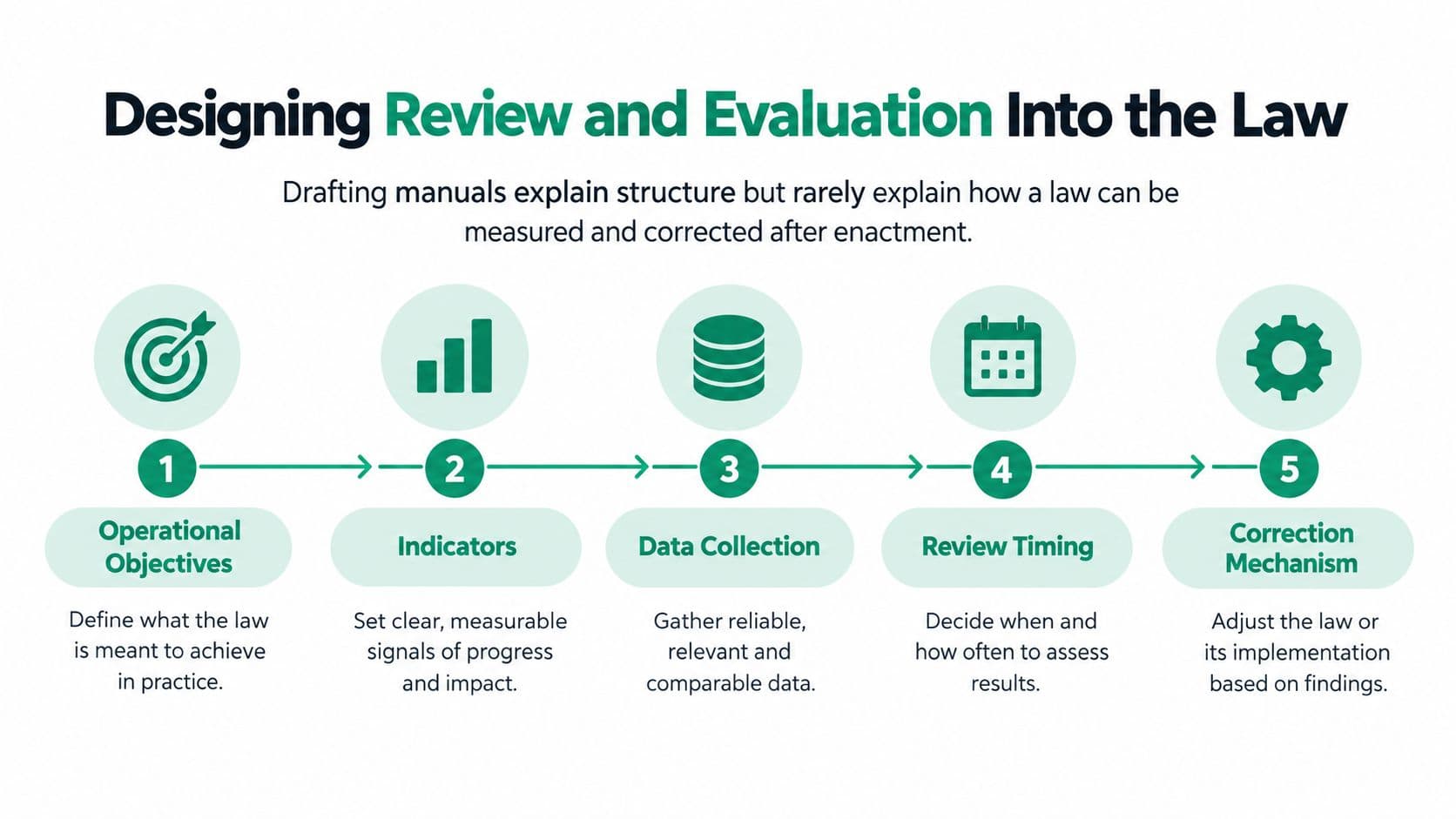
Drafting manuals explain structure more reliably than they explain how officials should measure and correct a law after enactment. Clearer prose doesn't guarantee better outcomes: a technically polished statute can preserve an ineffective or inequitable policy.
The European Parliament analysis of digital tools across the legislative cycle identifies uneven adoption, concentrated in ideation and drafting, while evaluation remains constrained by weak data and methodology. Software can flag inconsistent terms; it can't supply an absent baseline or decide who must maintain assessment records.
Write the measurement duties
- Operational indicators. Track parcels revalued on schedule, development permits on vacant lots, collection rates, appeal volume and burden changes for low-income owners.
- Baseline. Establish the pre-implementation position using comparable definitions and parcel identifiers.
- Responsible data owner. Assign each indicator to a named authority and specify its source.
- Reporting deadline. Require publication, including missing-data explanations and methodological changes.
- Review triggers and correction. Define when findings require review and provide a route to amendment or sunset.
Connect reporting to a decision
The administrative sequence should be explicit: draft the duties, establish the baseline, enact, complete the first assessment, publish the first report, test the review trigger, then decide whether to amend or sunset the measure. Choose policy evaluation methods that distinguish implementation failure from a flawed policy assumption.
Reporting is useful only if someone must consider the findings and explain the resulting decision.
Don't make disappointing results trigger automatic repeal without examining causes. Missing cadastre records, weak collection and an inappropriate charge base require different corrections, even when they produce similar revenue shortfalls.
Run the Drafting Gate Before Introduction
Answer each check yes or no. Record the supporting document or provision, not merely the reviewer's assurance.
- Policy mapping. Does every objective map to an operative clause in the implementation matrix?
- Instrument identity. Are charge type, term, renewal and repricing explicit, with no fixed lease mislabelled a land-use right?
- Architecture. Does the bill follow a defensible sequence, with no exceptions hidden in definitions?
- Administration. Does every obligation have a trigger, deadline, decision-maker and remedy?
- Participation. Does the consultation audit trail record the outcome and reason for each proposal?
- Correction. Are indicators, a baseline and a review trigger written into the bill?
Any no means no-go. Return the unresolved issue to policy work rather than introducing a bill that officials will have to complete through informal practice.
A bill that passes goes to the legislature with its implementation matrix and consultation audit trail attached. Our In-Depth Guides offer plain-language explanations of topics from land-use rights to housing unaffordability, helping policy teams explain the choices behind the legal text.
Unitism® offers policy design, research and analysis, education and training, and implementation support for land-value reform. We help assess land values, design policies that collect them, and model who gains and who pays, so drafting choices connect to workable administration. Visit Unitism® for support applying this drafting gate to a specific bill.