Explore the role of local governments in land value reform, from planning and zoning to land leases, land-use rights, and phased tax transitions.
October 6, 2026
Role of Local Governments in Land Value Reform
Explore the role of local governments in land value reform, from planning and zoning to land leases, land-use rights, and phased tax transitions.

A striking 55% of total public investment was carried out by subnational governments on average across OECD countries in 2020, according to the OECD's analysis of subnational government finance1/en/pdf). That figure changes how we should understand the role of local governments. Municipalities aren't just administrative outposts. They decide where infrastructure goes, how land may be used, and how public investment changes the value of private sites.
Land-value reform therefore isn't only a national tax-policy question. It's also a practical municipal question about maps, permits, assessments, roads, utilities, public hearings, and budget resilience. The hardest part is often not choosing a principle, but distinguishing the tools accurately and sequencing reform so local services remain funded while incentives improve.
Table of Contents
- Why Local Governments Are Central to Land Policy
- How Decentralization Reshaped Local Power
- Core Tools Local Governments Use to Shape Land Use
- Land Leases and Land-Use Rights Clearly Explained
- What a Land-Value Tax Actually Does Differently
- Real-World Examples of Cities Reforming Land Value
- Designing a Phased Transition for Revenue Stability
- Misconceptions That Derail Land Value Reforms
Why Local Governments Are Central to Land Policy
In 2020, subnational governments accounted for an average of 37% of total public expenditure across OECD countries, and their share exceeded half of national public expenditure in Canada, Denmark, and Switzerland, according to the OECD report on subnational government finance). They also carried out 55% of total public investment on average, with the share exceeding 70% in six OECD countries. These figures show why land policy cannot remain only a national concern. Local governments control many of the decisions that turn legal rules into streets, buildings, services, and changing land values.
A national ministry may define property law and broad tax rules. A municipal planning office applies those rules to a particular site. Its zoning map determines permitted uses and development intensity. A building department issues permits and inspections. A finance team turns assessments into bills, while elected officials respond when a project affects traffic, housing, access, or public space.
Those decisions shape value in practical ways. A zoning change may allow apartments where only houses were permitted. A transit connection can make nearby sites easier to reach. A sewer extension may make development feasible. The municipality does not create every source of land value, but it often coordinates the public choices that make land more or less useful.
The municipal translation problem
National legislation provides the frame. Local administration fills in the working details. Staff must maintain cadastral records, evaluate applications, coordinate procurement, explain charges, enforce standards, and reconcile information held by separate departments. A reform can look sound in legislation yet fail in practice if records are incomplete, assessments are disputed, or billing systems cannot support it.
Local government therefore carries both implementation and accountability. Residents experience land policy through permit delays, street conditions, housing supply, drainage, and the fairness of charges. Weak controls can turn a technically sound reform into an opaque or unequal process. Research on investigating corruption in municipalities also illustrates why oversight, transparent procedures, and clear responsibility matter.
A workable municipal toolkit joins six functions:
- Planning, which sets long-term development objectives.
- Zoning, which defines permitted uses and development intensity.
- Taxation, which determines how publicly created value returns to the budget.
- Permitting, which affects timing, certainty, and development cost.
- Public investment, which shapes accessibility and land values.
- Engagement, which gives residents and affected owners a meaningful role.
The tools should not be treated as interchangeable. A fixed land lease is a contract for occupying land under stated terms. An indefinite land-use right grants continuing use without the same payment structure as a lease. A land-value tax is a recurring charge on the value of land itself. A municipality may first improve records and planning, then clarify leases and use rights, and later introduce or adjust taxation as assessments and administration become reliable. That sequence connects technical distinctions to revenue stability and gives residents a clearer basis for judging reform.
How Decentralization Reshaped Local Power
More than 75 countries attempted to transfer state responsibilities to lower levels of government over the last quarter-century, according to the World Bank's review of decentralization and service delivery. Decentralization therefore changes more than the location of government offices. It changes who is responsible for roads, schools, housing, planning, water, waste, and public investment.
The rationale is practical. Locally elected officials are closer to residents and can adjust services to local conditions. A municipality may know which neighborhoods need drainage, which roads connect workers to jobs, or which parcels could accommodate housing more effectively than a distant ministry. The transfer of authority, however, does not automatically transfer the staff, systems, or money needed to use it well.
The World Bank evidence shows the administrative risk. During one documented period in Uganda, only 13% of nonsalary spending allocated for primary education reached primary schools, while absenteeism among doctors in primary health centers in Bangladesh reached 74%. Uganda also saw primary-health-care spending fall from 33% to 16% during decentralization, partly because lower levels lacked sufficient public-finance and accounting capacity. These cases connect political responsibility to mundane systems: trained personnel, procurement controls, reliable accounts, predictable revenue, and performance information.
What the fiscal picture actually tells us
OECD indicators provide a useful baseline, while leaving important questions for country-specific investigation. Subnational governments can carry a large share of public spending and capital investment, yet local own-revenue may remain unclear or unevenly measured. Comparisons across country groups therefore require care. A national ministry may report that functions have been devolved, while a municipal finance team still depends on transfers whose timing and conditions it cannot control.
The OECD reports that subnational tax revenue averaged 7.2% of GDP and 32.3% of total public tax revenue in 2020. Those figures show why national tax policy and municipal finance cannot be separated neatly. Cities with major spending and investment duties but weak own-source revenue become dependent on transfers and exposed to national budget decisions.
Practical rule: Treat a devolved mandate as fully funded only when the municipality can identify the revenue source, responsible staff, reporting system, and method for covering future operating costs.
A guide to local autonomy and decentralized decision-making offers useful context for understanding why authority, fiscal capacity, and accountability must develop together.
Brazil's municipal reforms after 1988 and South Africa's post-1994 intergovernmental framework provide analytical reference points for asking whether transferred authority came with adequate finance and administrative tools. The question matters for land policy. Planning powers without dependable revenue can encourage cities to approve development without having the funds to provide roads, drainage, water, or other infrastructure that development requires.
Land-based instruments can connect public action to a visible local tax base, but they do not replace sound transfers, budgeting, or oversight. A municipality may need a phased transition: first establish records and planning authority, then clarify land leases and land-use rights, and later introduce or adjust a land-value tax when assessments and collection systems are reliable. The sequence turns decentralization from a legal transfer into an operating arrangement that residents can evaluate.
Core Tools Local Governments Use to Shape Land Use
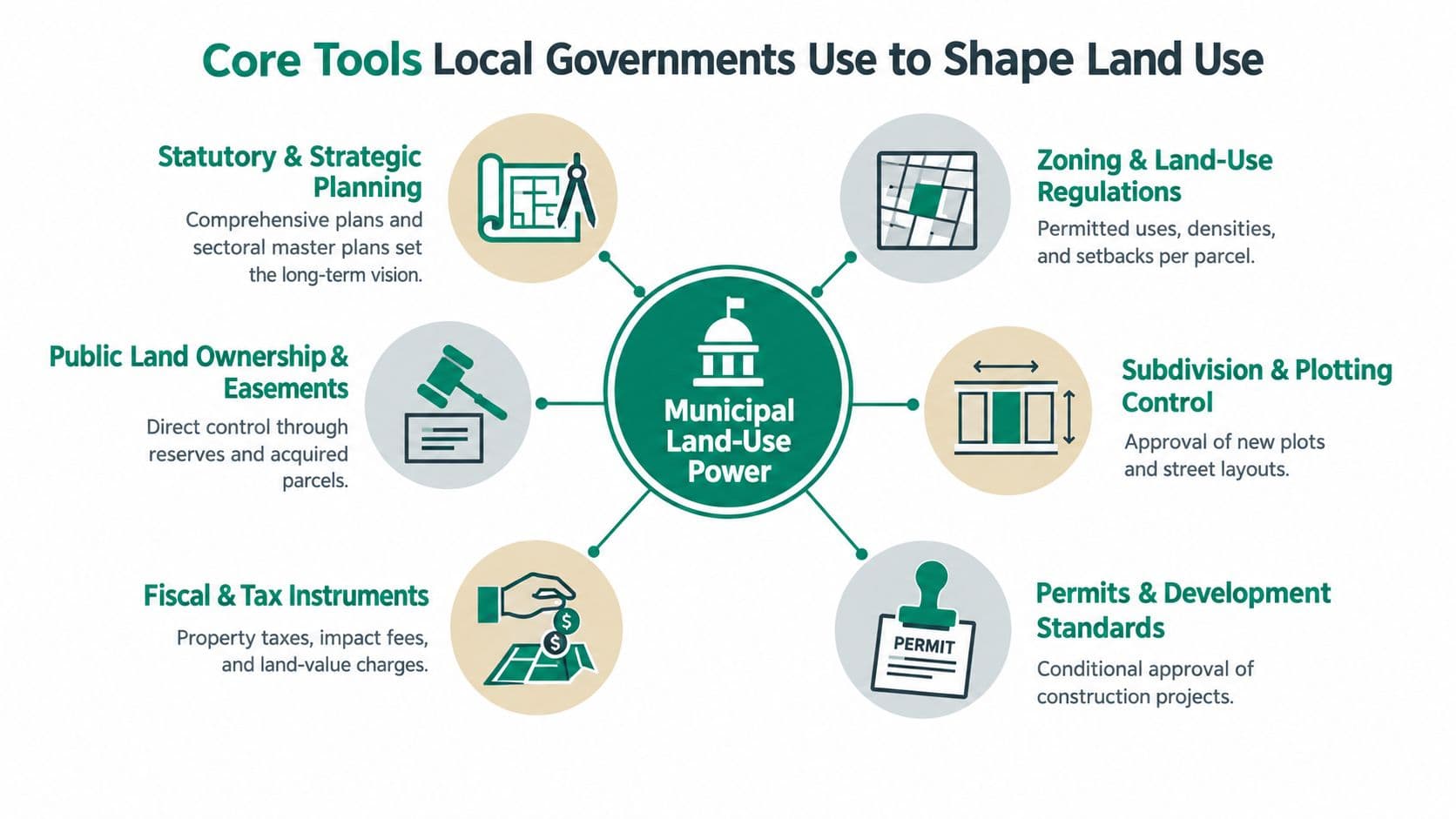
Municipalities rarely shape land use with one instrument. They combine several tools, each affecting a different part of the development process.
Planning and regulation
Statutory and strategic planning establishes the broad direction. A general plan can identify growth areas, conservation areas, transport corridors, and infrastructure priorities. Sectoral master plans add detail for water, mobility, housing, or environmental management.
Zoning and land-use regulation then apply those priorities to parcels. Zoning controls permitted uses, density, height, setbacks, and sometimes design standards. A zoning change can raise the potential value of a site, but the increase won't automatically benefit the public. The municipality needs a fiscal or contractual mechanism that can recover an appropriate share without making development impossible.
The guide to land-value capture provides a useful framework for understanding how public decisions and land-value increases can be connected.
Permits and public investment
Permitting and inspection determine whether legal development rights become a buildable project. Unclear requirements, inconsistent inspections, or unpredictable timelines increase risk. Clear standards and coordinated reviews can reduce uncertainty without weakening safety or environmental controls.
Public investment is the physical side of land policy. Roads, utilities, transit, drainage, parks, and public spaces change accessibility and support development. The World Bank's urban spatial growth evaluation emphasizes coordinated land-use planning, basic services, transport, geospatial data, cadastral coverage, land registers, rights-of-way, zoning, and building codes as connected administrative foundations. Its survey found that 87% of surveyed staff considered Urbanization Reviews useful for national urban policies, 68% for city-level strategies, and 74% for improving clients' capacity to manage urban spatial growth, as reported in the World Bank evaluation of urban spatial growth work.
Taxation and participation
Local taxation includes property rates, betterment levies, developer contributions, and land-value charges. Each tool has a different base and distributional effect. A charge linked to a specific infrastructure improvement may be appropriate for beneficiaries of that project, while a broad land-value tax can support general municipal services.
Stakeholder engagement includes statutory consultation, public hearings, neighborhood meetings, and institutions such as community land trusts. Engagement isn't a replacement for technical analysis, but it can reveal practical impacts that a map or model misses. It also gives officials a way to explain why a zoning change, assessment, or contribution is being proposed.
The six tools work as a system. Up-zoning land near a new transit line may increase site value. If the tax system ignores land value, the municipality may bear the infrastructure cost while private owners receive most of the uplift. If the municipality captures too much or applies rules unpredictably, projects may not proceed. Good land policy coordinates planning, regulation, taxation, permitting, investment, and participation rather than relying on any single lever.
Land Leases and Land-Use Rights Clearly Explained
Confusion begins when similar words describe different legal and fiscal arrangements. A municipal finance team should test every instrument against three questions:
- Who owns the underlying land?
- How is the payment calculated?
- Does the obligation run with the land or with the holder?
A land lease is a contract in which an owner, including a public authority, grants a tenant use of land for a fixed term. The price may be an upfront premium, an annual ground rent, an infrastructure-related fee, or a combination. Public ground leases are typically fixed-term arrangements, often lasting more than 50 years and sometimes including renewal options, according to the Lincoln Institute of Land Policy analysis of public land leasing.
A renewable lease gives the tenant certainty until the term ends. At renewal, however, the accumulated gap between the fixed lease rate and current market conditions may be closed through a major repricing. A non-renewable lease becomes harder to refinance or sell as expiration approaches. Fixed leases don't eliminate risk. They postpone it.
A land-use right, as used here, has a stricter meaning. It must be repriced each year, require no renewal, and not expire. Sometimes a fixed lease is called a land-use right, but a label doesn't change the legal structure. If the arrangement has an expiration date or requires renewal, it remains a fixed lease.
A land-value tax is different again. It's an annual public levy assessed on the value of the land itself, rather than a negotiated rent paid under a specific lease. The research on land-value-tax implementation identifies regular revaluation as an important administrative requirement, with annual revaluation described as ideal and a longer valuation cycle with annual indexation presented as a possible practical compromise.
| Criterion | Land Lease | Land-Use Right | Land-Value Tax |
|---|---|---|---|
| Underlying land | Owned by the lessor, with use transferred contractually | Ownership remains separate from the indefinite use permission | Ownership may be public or private |
| Payment calculation | Contractual rent, premium, or fee | Annual repricing linked to the current site value under the legal model | Public assessment of land value |
| Duration | Fixed term, renewable or non-renewable | No expiration and no renewal requirement | Continues while the tax law applies |
| Obligation | Usually follows the lease contract and its holder | Attached to the legally recognized right | Attached to the taxable land |
| Main risk | Expiration, renewal, refinancing, or repricing risk | Assessment, administration, and legal-design risk | Valuation, affordability, and tax-compliance risk |
A city can use all three instruments at once. The accounting error is to record contractual lease income as if it were a land-value tax, or to call a renewable lease an indefinite land-use right. The guide to land-use rights helps keep those categories separate.
What a Land-Value Tax Actually Does Differently
A land-value tax targets the site, not the structure. The assessment concerns the unimproved value of land, excluding buildings and other improvements. The owner pays an annual levy whether the parcel is vacant, underused, or intensively developed.
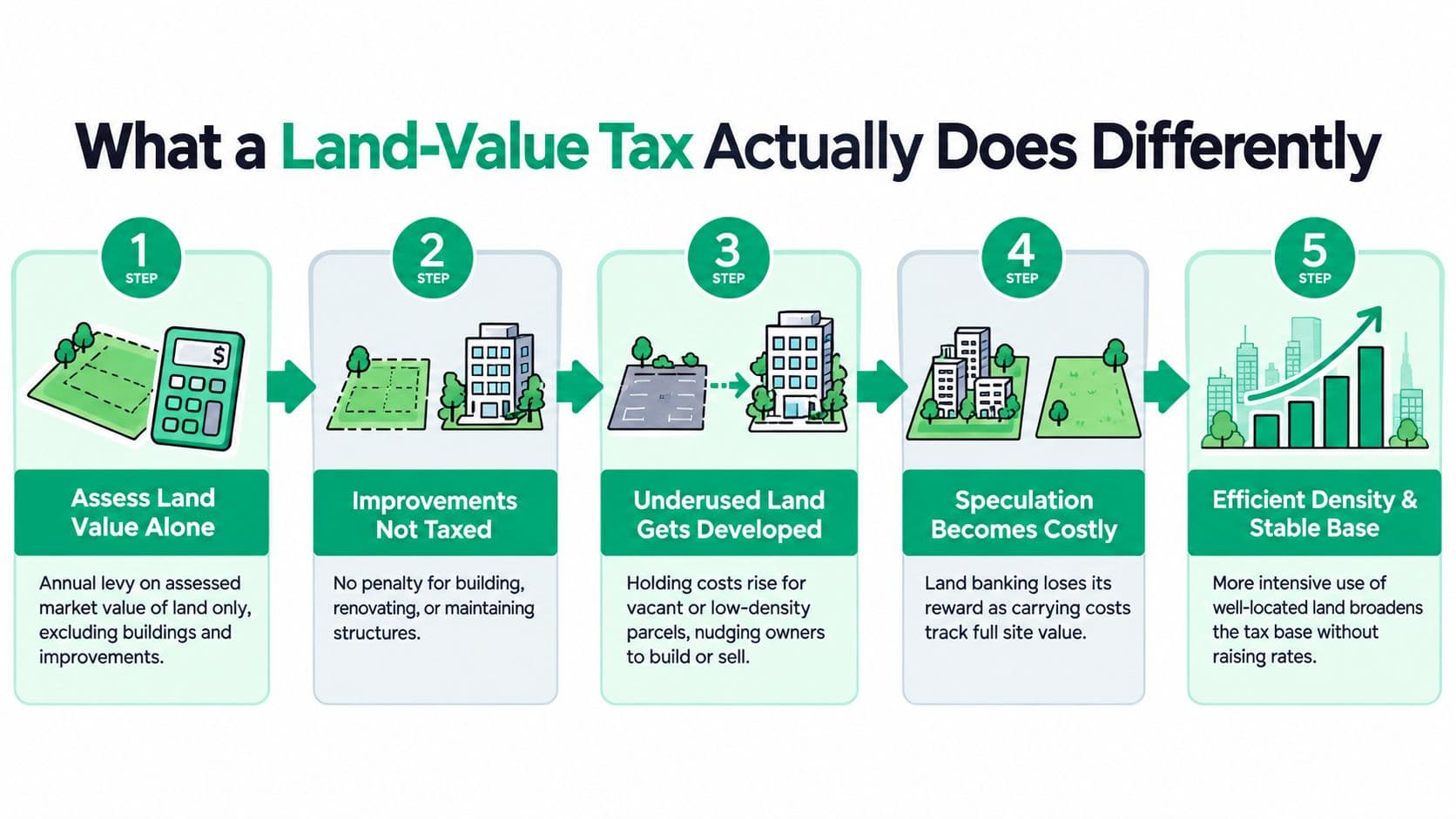
That distinction changes the incentive. A conventional property tax applies to land and buildings, so construction and renovation can increase the bill. A land-value tax keeps the charge focused on the location itself. Building a better structure doesn't create the same tax penalty, while leaving a well-located parcel idle doesn't remove the land charge.
Consider a vacant site beside a new transport connection. Public investment may improve accessibility and increase the site's potential. Under a land-only assessment, the owner still faces the recurring cost of holding the site, even without constructing anything. That can make land banking less attractive and encourage an owner to develop, sell, or find a more productive use.
How officials build the assessment
A municipal finance team needs a defensible valuation system, not just a new rate. It should separate land value from improvement value, maintain parcel records, document valuation methods, and establish a process for appeals. Possible designs include base-year valuations, valuation bands, or separate schedules for land and buildings.
The administrative choices are consequential:
- Revaluation frequency: Assessments must stay connected to changing site conditions.
- Transition rules: Officials need to decide how quickly the new base replaces existing property taxation.
- Exemptions and relief: Public services, hardship cases, and owner-occupiers may require carefully designed treatment.
- Revenue use: Earmarking can build public confidence, but excessive earmarking may reduce budget flexibility.
- Distributional analysis: Officials should identify effects on tenants, landlords, businesses, retirees, and low-income households.
A land-value tax also doesn't solve every municipal finance problem. It requires reliable cadastral data, capable assessors, transparent appeals, and communication that residents can understand. The explanation of what a land-value tax is is useful for separating the tax base from the buildings people see and occupy.
The central policy difference is simple. A land lease negotiates a payment for a defined use over a defined term. A land-use right, under the strict definition used here, has no expiry or renewal event and is repriced annually. A land-value tax is a recurring public levy on assessed site value. Those distinctions determine who bears risk and how public revenue responds to changing land conditions.
Real-World Examples of Cities Reforming Land Value
Cities don't begin with identical land-tenure systems, political constraints, or valuation capacity. That's why land-based reform should be approached as a menu of instruments rather than a universal template.
Estonia offers a useful model to examine where municipalities control public land and can use leasing arrangements to make land value visible through auctions or rent. The relevant question for officials is whether public land should generate revenue through a contractual lease, a tax, or a combination. A lease can be targeted to a specific parcel and project, while a tax applies across a defined base.
Denmark is a useful case for studying a split between land and buildings in property taxation. The policy lesson isn't that every municipality should copy the same rate structure. It's that separating the site from the improvement can make the tax consequences of construction more transparent.
Singapore provides a contrasting land-tenure model for examining long-term public land leases and the relationship between scarcity, planning, and public revenue. A fixed-term lease remains a lease, even when the term is long and the public authority retains ownership. Its expiration and renewal provisions still matter for valuation, financing, and transfer.
Allentown, Pennsylvania, is relevant as an example to investigate when a municipality wants to apply a land-value tax overlay in a defined area while reducing the rate applied to improvements. A targeted approach can let officials test assessment methods, observe distributional effects, and build administrative experience before considering a broader change.
Match the tool to the constraint
The right question isn't “Which city has the best model?” It's “Which instrument fits this city's legal ownership, data quality, revenue needs, and political room?”
- A city with substantial public land may use auctions and ground leases.
- A city with broad private ownership may rely more heavily on land-value taxation.
- A city with weak assessment capacity may begin with parcel mapping and transparent pilot valuations.
- A city facing redevelopment pressure may combine planning changes with infrastructure contributions.
- A city concerned about blight may test a land-focused rate in a defined district.
The evidence on land-tenure systems also shows why legal labels require caution. In Indonesia, for example, Hak Guna Bangunan is described as a transferable right lasting 20 or 30 years and renewable for another term. Those features describe a fixed-term interest, not an indefinite, annually repriced land-use right. Officials should record duration, renewal, expiry treatment, and repricing frequency instead of relying on labels alone, as explained in the comparative review of land tenure and use-right regimes.
Designing a Phased Transition for Revenue Stability
A land-value reform can fail even when its economic logic is sound. The danger usually appears in the transition. Owners receive unexpected bills, assessors lack parcel data, elected officials face pressure to reverse the change, or the municipality discovers that an assumed revenue stream isn't ready.
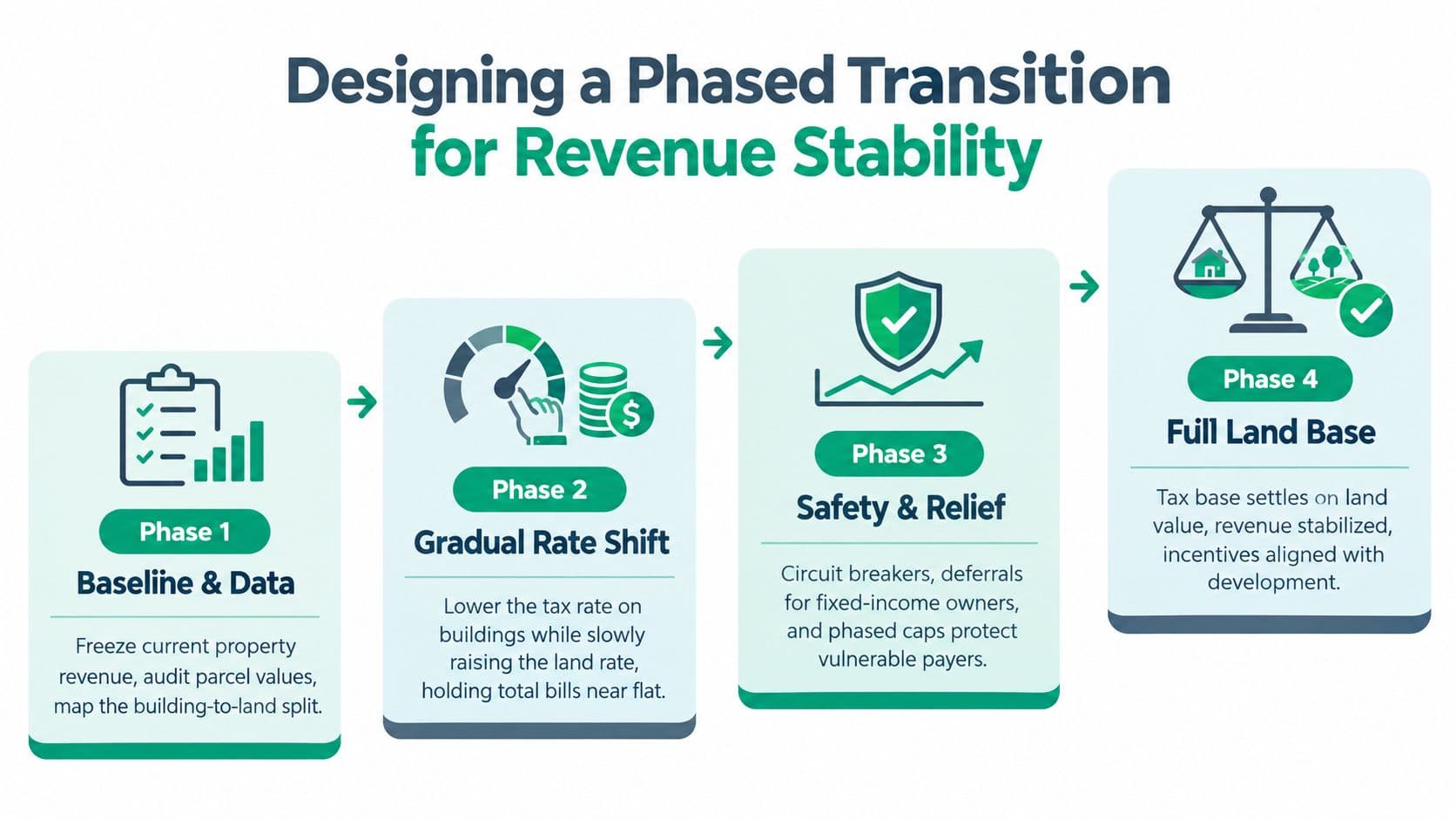
Phase one establishes the baseline
Start by freezing the current property-revenue picture. Map parcels, ownership, current assessments, building values, exemptions, arrears, and appeals. The finance team should identify how much revenue comes from land and how much comes from improvements, even if the existing system doesn't report those components cleanly.
This phase should also test the cadastre against planning and infrastructure records. A parcel map that can't connect ownership, permitted use, development status, and service access won't support a credible reform.
Phase two introduces a dual structure
A dual-rate structure can lower the tax rate on buildings while gradually increasing the land rate. The objective is to keep total revenue close to the existing baseline while changing the incentive at the margin. That doesn't mean every bill stays unchanged. Some owners will pay more, especially where valuable land is lightly used, while others may pay less because improvements receive a lower charge.
Phase three adds protection
Relief mechanisms should address genuine liquidity problems without permanently hiding land value. Options include deferrals, circuit breakers, targeted exemptions, and phased caps for vulnerable payers. The municipality should publish who qualifies, how long relief lasts, and whether deferred charges become a claim against the property.
Climate risk makes this planning more urgent. Municipalities increasingly need to connect hazard maps, land-use decisions, infrastructure investment, insurance conditions, and public disclosure. Policy analysis from the Carnegie Endowment on climate risk and local governments argues that cities need granular physical-risk, insurance-pricing, and transaction data, along with a dedicated adaptation official and transparent benefit, cost, and success metrics.
Phase four monitors the settled system
After the rate shift, officials should monitor revenue, appeals, development activity, vacancy, rents, land prices, and distributional effects. Revaluation cycles and planning updates should be coordinated rather than handled as unrelated administrative events.
Decentralization makes this sequencing essential. Authority may move downward faster than revenue capacity, and new climate or housing responsibilities may arrive without durable funding. The guide to phased implementation captures the broader principle: reform should be staged so institutions can learn, correct errors, and maintain trust.
Misconceptions That Derail Land Value Reforms
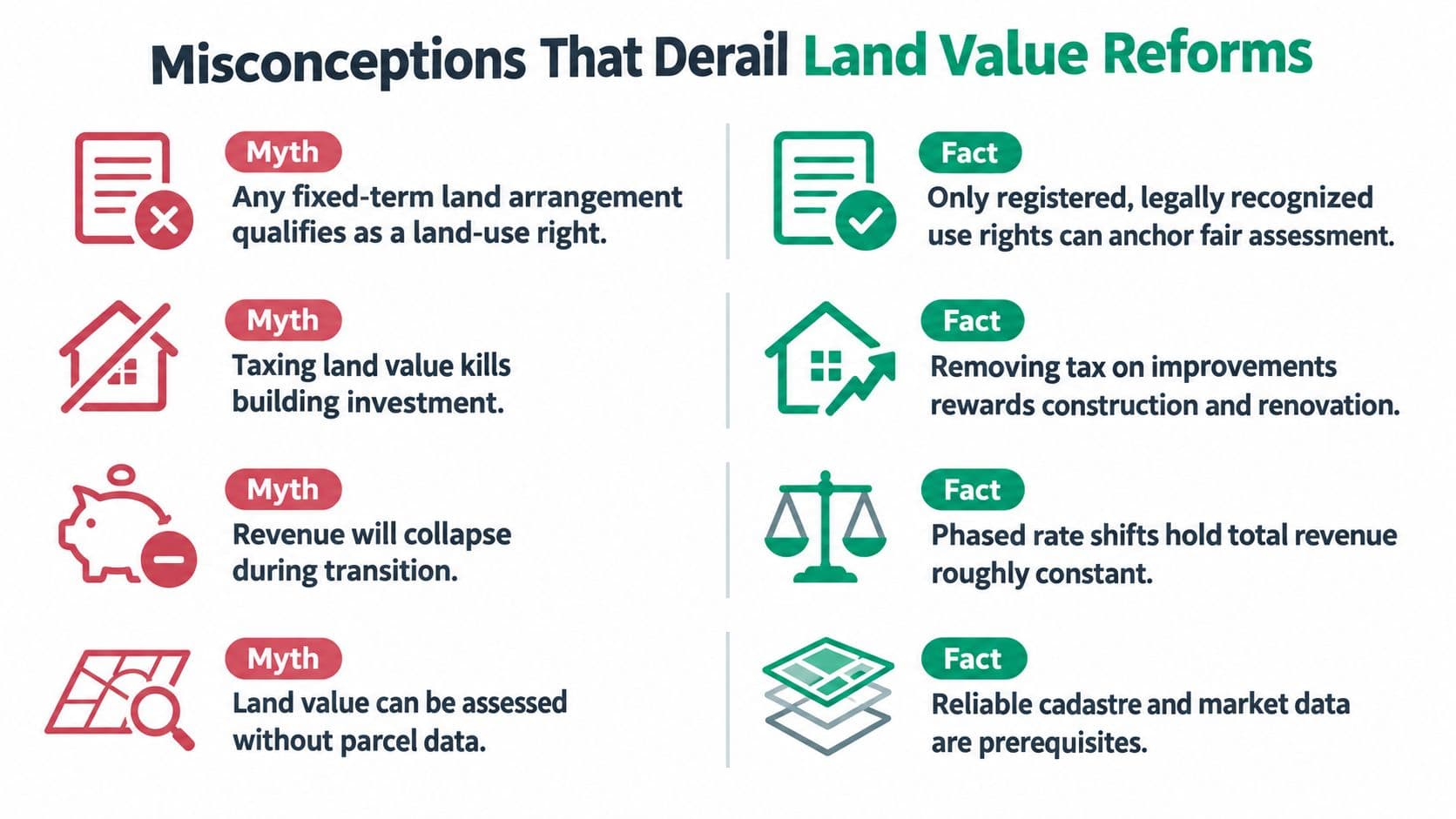
The first misconception is that any fixed-term land arrangement is a land-use right. It isn't. A fixed lease expires or requires renewal. An indefinite land-use right must have no expiry, no renewal requirement, and annual repricing. Municipal contracts should state those features explicitly.
The second misconception is that decentralization automatically improves outcomes. Local knowledge can improve responsiveness, but authority alone doesn't guarantee delivery. The World Bank examples of weak education and health-service flows show why finance controls, staff capacity, monitoring, and accountability must accompany transferred functions.
The third misconception is that new mandates arrive with matching revenue. They often don't. The European Local Government Report recorded an aggregate negative balance of 2.1% in 2024 for EU-27 local governments, linking fiscal pressure to responsibilities and spending demands that can expand faster than the revenue base, according to the European Local Government Report 2025.
The fourth misconception is that a land lease and a land-value tax are interchangeable. A lease is a time-limited contract. A land-value tax is an annual public levy. A land-use right is a separate legal category with a strict indefinite and annually repriced structure. Treating them as synonyms produces errors in valuation, budgeting, risk allocation, and public communication.
Municipal leaders can begin with four practical actions:
- Audit the legal instruments: List every lease, use right, tax, fee, renewal rule, and expiry provision.
- Build the parcel system: Connect cadastral, planning, infrastructure, hazard, ownership, and assessment data.
- Model the transition: Estimate who gains, who pays, how relief works, and how revenue remains stable.
- Publish the rules: Explain the tax base, valuation method, appeals process, and intended use of revenue before bills change.
Unitism® helps governments and cities assess land values, design land-value capture and taxation policies, model distributional effects, and plan administrative implementation. Visit Unitism® to explore practical research, valuation, education, and transition-support resources for aligning municipal finance with land economics.