Master stakeholder engagement strategies for land-value reform. Practical guide with maps, messaging, legal readiness, and case studies for public officials.
August 23, 2026
Stakeholder Engagement Strategies for Land-Value Reform
Master stakeholder engagement strategies for land-value reform. Practical guide with maps, messaging, legal readiness, and case studies for public officials.

A reform can fail even when the public has been invited to comment. In regulatory engagement across OECD member countries, oversight and quality control scored only 0.38 out of 1 in 2024, and just 39% of countries required policymakers to consider oversight-body comments after review (IAIA paper). The counterintuitive lesson is that consultation itself isn't the finish line. The decisive question is whether anyone has a duty to respond, revise the proposal, and carry the result into administration.
Land-value reform makes that problem visible. A proposal to share the rental value of land can affect homeowners, tenants, developers, farmers, lenders, employers, public agencies, and elected officials in different ways. If officials explain only the economic theory, opponents can define the reform as confiscation, uncertainty, or a technical experiment imposed from above.
The practical task is harder and more useful: build a coalition that understands the policy, knows how decisions will be made, and can remain involved after the announcement. The following stakeholder engagement strategies focus on that institutional work, including the trust, sequencing, legal duties, and administrative capacity that determine whether reform survives contact with reality.
Table of Contents
- Why Land-Value Reform Fails Before It Begins
- Mapping Stakeholders for Land Reform
- Explaining Land Tenure and Value Differentials
- Designing Participation Formats and Timelines
- Ensuring Legal and Administrative Readiness
- Global Precedents and Measuring Success
Why Land-Value Reform Fails Before It Begins
A municipal team can spend months refining a valuation model and still lose public trust before residents see it. The failure often starts with a planning document written in specialist language, followed by a consultation held after the main choices are settled. Residents attend meetings, submit objections, and receive a summary stating that their views were “considered.” They still cannot see which comment changed the proposal, who rejected another, or what happens next.
That process creates opposition even when the policy has merit. People respond not only to the charge or instrument, but also to unclear risk, weak explanations, and the suspicion that participation is ceremonial. Engagement must therefore shape policy design, not serve as a communications exercise at the end. The UNECE stakeholder-engagement toolkit sets out a practical sequence: examine context, define the purpose, assign stakeholder roles, choose outreach methods, evaluate results, and adjust the process. It also points to open decision-making, specific feedback, systematic evidence, community relationships, and clarity about the public's influence.

Replace persuasion with a visible bargain
Officials should not promise consensus. Land-value reform raises genuine distributional questions, and some participants may oppose it because their financial position could change. The credible promise is narrower: show what the reform does, identify who bears each risk, explain the limits of influence, and publish responses to material objections.
This approach also exposes rent-seeking without treating every opponent as dishonest. A property owner concerned about valuation error needs a different response from an intermediary whose business depends on scarcity or opaque transactions. A plain-language primer on rent-seeking in economics can help officials distinguish productive activity from gains linked to control of scarce land.
Practical rule: Never ask people for input on a decision when the administration cannot explain how that input will affect the decision.
Design for the implementation coalition
The strongest supporters may not be the loudest advocates at the start. A tenant organization may care about housing supply and public services. A small builder may want fewer barriers to construction. A planning department may want idle sites brought into use, while a finance department may prioritize stable revenue. Their language differs, yet their interests can overlap.
Engagement should create working relationships, not merely favorable sentiment. Assign each group a defined role in testing assumptions, reviewing administrative procedures, or monitoring delivery. The coalition must be able to defend the policy when valuation disputes, appeals, and political changes arrive. Technically sound reforms often fail because that coalition was never built.
Mapping Stakeholders for Land Reform
A stakeholder list becomes useful only when it shows who is affected, who has power, who controls information, and who can block implementation. Begin with a full inventory, then allocate engagement effort according to influence, exposure, and responsibility for delivery.
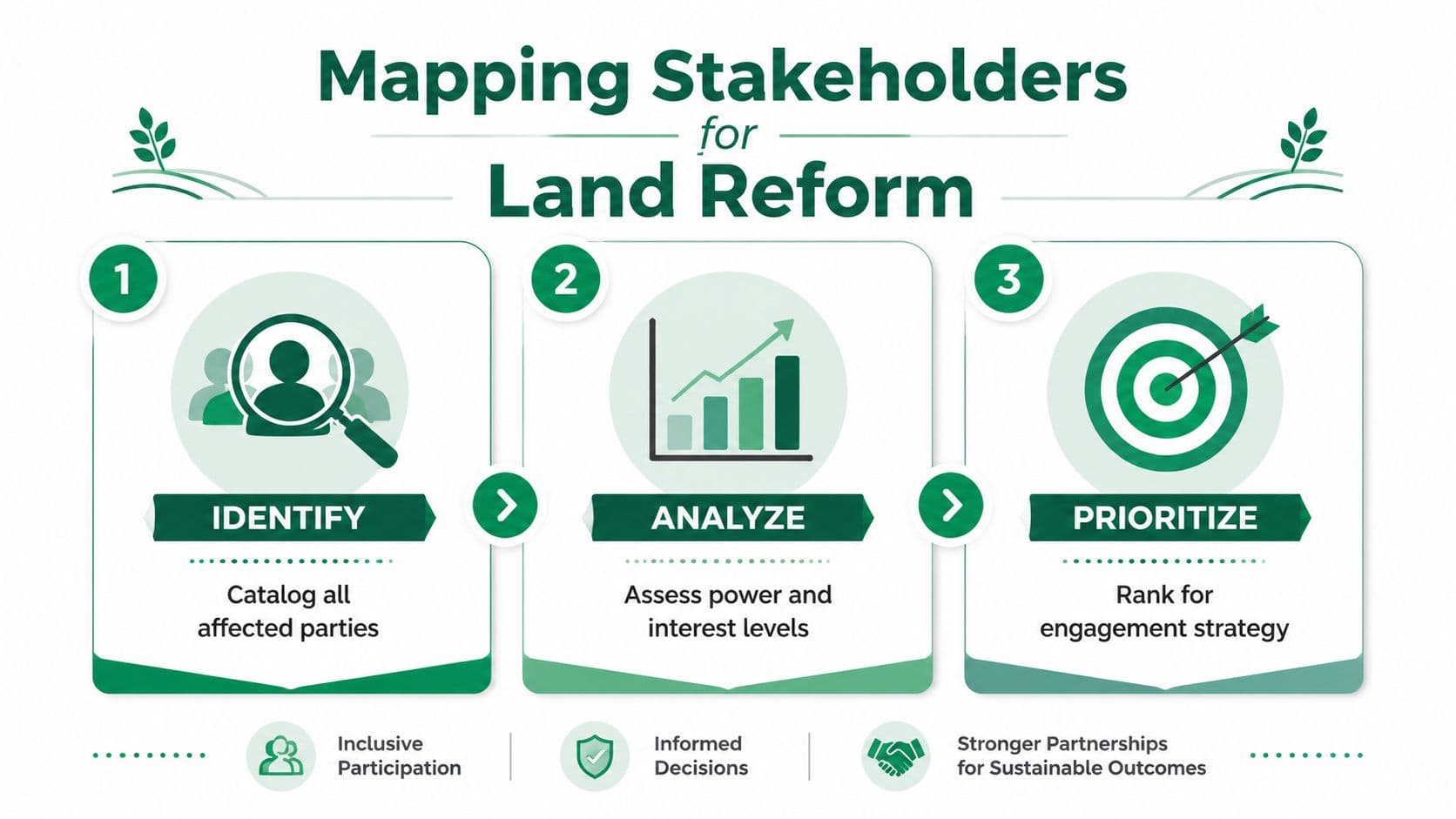
Set the reform's context and purpose, map roles, choose how each group will participate, and define how officials will review and adjust the approach. The map is a working document, not a permanent record. A resident may remain a passive observer until a draft reaches their property, sector, or household budget. At that point, earlier assumptions about interest and opposition can become obsolete.
Build the map in three passes
Identify affected parties. Include people who pay, people whose assets are assessed, officials who administer the charge, and residents who rely on the resulting revenue. Add groups unlikely to attend public meetings, including informal occupants, small landlords, tenants, rural landholders, community associations, lenders, and local employers.
Analyze power and interest. For each stakeholder, record the likely concern, decision rights, access to data, capacity to organize, and preferred communication format. A large institutional owner and an individual homeowner may both have high interest, but their resources and ability to shape public discussion differ sharply.
Prioritize engagement. Assign intensive staff time to groups with high influence, high exposure, or a direct role in implementation. Keep lower-power groups informed through accessible materials and feedback channels. Inviting everyone to every technical workshop consumes capacity without necessarily improving the decision.
Use four working categories:
- Direct beneficiaries: Groups likely to gain from lower taxes on work or productive capital, improved services, or more efficient land use.
- Active opponents: Groups facing higher charges, new disclosure requirements, or lower gains from holding scarce sites.
- Passive observers: Residents and organizations that need clear information but may not need repeated meetings.
- Essential enablers: Councillors, valuation professionals, registry officials, tax administrators, courts, lenders, and data owners whose cooperation affects delivery.
Spend capacity where it changes outcomes
Prioritization does not mean excluding people. It means matching the method to the decision. A technical agency may need a working session on valuation data. Residents may need a simple calculator, neighborhood examples, and a clear appeal route. Community organizations can extend reach, provided officials supply usable materials and enough notice.
Long reforms also need a way to sustain participation after the launch meeting. Officials can build an active online membership to collect questions and distribute updates, but a digital list cannot replace representation. Online channels may miss people with limited access, limited time, or low trust in government.
The map should end with an ownership column. Name the official responsible for each relationship, the question under review, the next decision date, and the evidence to record. Teams can use land-use policy analysis to connect stakeholder concerns with planning rules, development incentives, and public objectives. This record turns consultation into an administrative workflow that can survive staff changes, budget pressure, and organized resistance.
Explaining Land Tenure and Value Differentials
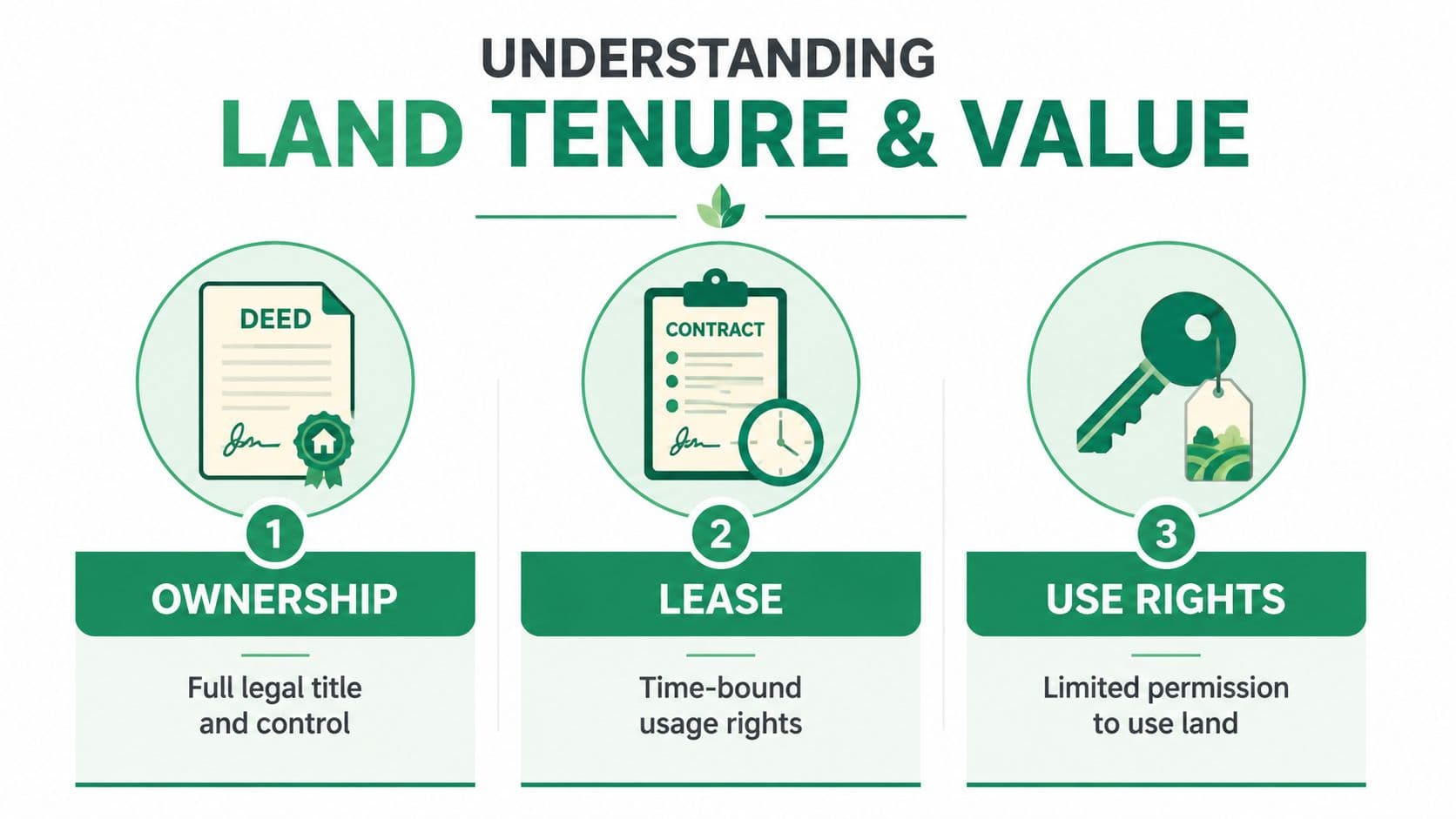
Stakeholders often argue past one another because they use ownership, leases, and land-use rights as if they were interchangeable. They aren't. A land-value tax is also not the same thing as a lease payment. Officials need precise language before they ask the public to evaluate a reform.
A land lease grants use for a defined contractual term. It may be renewable or non-renewable, and it commonly carries a fixed price. A renewable fixed-term lease gives the holder some certainty until the term ends, but it can postpone risk rather than remove it. When the lease rate falls below the market, the accumulated gap may be closed at renewal through a major repricing. A non-renewable lease becomes progressively harder to refinance and sell as expiry approaches.
Fixed leases therefore create a difficult trade-off. They can make payments predictable in the short run, but they don't continuously price changing land value or risk. The arrangement postpones the adjustment, which can make the eventual adjustment more disruptive.
Separate the legal right from the payment mechanism
Land-use rights are another structure. China's state-owned urban land-use-right system, for example, uses national maximum terms of 70 years for residential land, 50 years for industrial land, and 40 years for commercial land (Cornell legal analysis). A separate legal analysis describes Chinese land-use rights as, in theory, infinitely renewable, subject to state priorities and additional fees (University of California legal analysis).
That example shows why officials must distinguish duration, renewal, repricing, and payment timing. A right can be formally time-limited while renewal makes it practically durable. It can also be transferred under rules that differ from a private lease.
The payment structure matters as well. Public-land leasing in China commonly uses a large upfront payment, including the leasing fee, conveyance costs, and related charges, rather than annual ground rent (Lincoln Institute analysis). An annual land-rent model would spread payment over time, and land-use rights could be transferred with yearly rental payments instead of a single conveyance fee (Lincoln Institute report).
Explain the reform without collapsing the distinctions
For engagement purposes, officials can use this comparison:
| Mechanism | Main feature | Risk created |
|---|---|---|
| Ownership | Broad legal title and control | Public value may remain private unless captured through policy |
| Fixed-term lease | Time-bound use at a fixed price | Repricing or refinancing pressure is postponed |
| Land-use right | Permission to use land under defined legal rules | Renewal, transfer, and state-priority rules must be clear |
| Land-value tax or annual rent | Ongoing charge linked to land value or use | Valuation, appeals, and distributional effects require transparent administration |
A land-value tax should be presented as a recurring public charge, not as a lease disguised by different terminology. Land-use rights can be designed as indefinite rights repriced annually, allowing transfer at lower cost than fixed-term leases and avoiding a sudden expiry cliff. In that model, annual repricing makes the land component visible while productive buildings, labor, and enterprise aren't treated as the source of the land value. Municipal teams should use a land-value calculation framework to show how valuation assumptions affect actual parcels and stakeholders.
Designing Participation Formats and Timelines
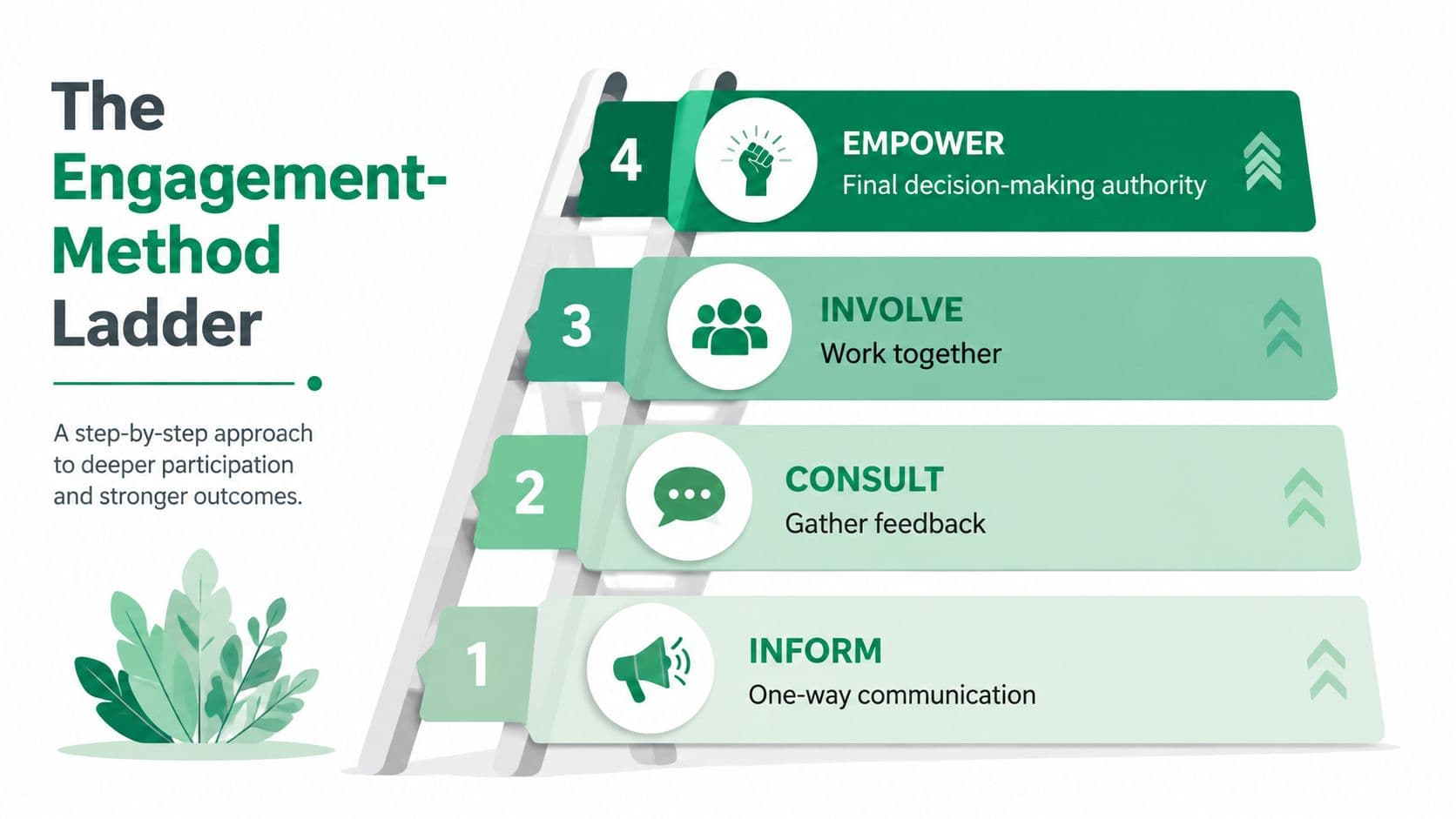
A participation plan fails when every stakeholder receives the same invitation, regardless of their influence, risk, or role in implementation. Use a participation ladder: increase involvement as the decision becomes more consequential, less reversible, or more dependent on a stakeholder's cooperation.
The ladder covers information-sharing, consultation, joint planning and action, and community-directed engagement. Information-sharing may use newsletters, notices, websites, and local media. Consultation can use meetings, interviews, surveys, and focus groups. Joint work adds participatory stakeholder mapping, advisory committees, taskforces, and formal agreements. Community-directed engagement can include participatory planning, expenditure tracking, and performance monitoring supported by public authorities (OpenLearn engagement-method ladder).
Match the format to the decision
Use information-sharing after the administration has made a lawful decision and needs to explain it. Use consultation while officials can still change assumptions, exemptions, valuation rules, or implementation details. Use joint planning when agencies and affected groups must coordinate delivery. Community-directed arrangements fit decisions where residents can shape priorities, spending oversight, or performance monitoring.
A meeting alone does not create meaningful participation. A small technical workshop with published questions, draft answers, and a response log may resolve more than a large town hall where officials cannot address parcel-level concerns. Choose the format according to the decision's reversibility, the stakeholder's practical influence, and the cost of delay.
Set a minimum viable process
Limited budgets make indiscriminate engagement counterproductive. A 2025 evidence synthesis found that 97% of papers in intervention-implementation studies didn't clearly report stakeholder preparation, while the literature also showed weak planning and poor evaluation or reporting of involvement (OECD Government at a Glance 2025). The practical lesson is to prepare participants, define decisions, and record results rather than adding events.
A minimum viable process should include:
- A plain-language baseline: Explain the current system, the proposed change, the alternatives, and what is outside scope.
- A role-specific question set: Ask residents about affordability and service priorities, administrators about workflow risks, and technical stakeholders about data quality.
- A response register: Record each material issue, the responsible official, the decision, and the reason for acceptance or rejection.
- A defined cadence: Schedule engagement around policy phases, with clear points for evidence, revision, and decision.
- A fatigue safeguard: Combine short digital updates, written submissions, targeted workshops, and occasional public meetings so participation does not require constant attendance.
Recent Australian CASA survey evidence found that 70% of respondents wanted simplified rules and processes, while 38% prioritized improved engagement and 37% prioritized improved communication. Stakeholders may be asking for fewer, better-designed interactions rather than an endless calendar.
A phased implementation plan can align engagement with pilots, legal approvals, valuation updates, and review points. Teams can use phased implementation guidance to define each stage, its decision gate, and the evidence required before the next stage begins. That structure turns public input into an operational sequence and gives officials a defensible record when fatigue or opposition grows.
Ensuring Legal and Administrative Readiness
Public input has no force unless the administration can convert it into duties, decisions, and remedies. A meeting may expose a serious valuation error, yet the issue will disappear into the minutes if legislation, regulations, data systems, and staff procedures do not assign responsibility.
Translate engagement promises into enforceable requirements before outreach begins. The draft law or regulation should specify who publishes the proposal, which evidence accompanies it, how comments are submitted, who assesses them, when responses are issued, and whether the final instrument must explain departures from significant recommendations.
Build the response chain before outreach
A municipal team should test the full chain on paper:
- Drafting: Identify the legal authority for the charge, valuation method, exemptions, appeals, data access, and review.
- Oversight: Give an independent or designated review body a defined opportunity to comment, then require the policymaker to respond.
- Administration: Assign ownership for parcel records, valuation updates, billing, collection, hardship procedures, and dispute resolution.
- Publication: Release the proposal, evidence, feedback log, decision record, and implementation timetable in accessible formats.
- Monitoring: Track errors, appeals, arrears, processing delays, and unresolved complaints.
The same discipline applies to subordinate regulations. The IAIA paper reports weak oversight for these instruments, with an oversight score of 0.37 out of 1, while engagement trails the process for primary laws. Enabling legislation can therefore pass while the detailed rules receive little scrutiny.
A comment log without a decision owner is a filing cabinet, not accountability.
Integrate the cadastre with public explanation
Land-value reform depends on records that connect parcels, legal interests, use, improvements, valuation inputs, and billing responsibility. Residents do not need every database field. They do need a clear account of which facts determine an assessment and how to correct an error.
Run administrative simulations before announcing the final design. Select representative parcels and follow each case from record matching through valuation, notice, payment, appeal, and correction. Ask staff and affected stakeholders to test the process. Their review can expose handoff failures, missing records, and delays that a policy paper will miss.
The engagement process should use the practical discipline associated with client onboarding explained: clear entry points, named handoffs, required information, visible status, and a defined route when something goes wrong. The analogy supports service design only. Land reform still requires public-law safeguards, equal treatment, and transparent reasons for decisions.
Legal readiness also requires transition rules. Officials should state how existing obligations interact with the new charge, how disputes are handled during migration, and how elected bodies review results.
If officials cannot explain the remedy for an incorrect assessment, they are not ready to ask the public to trust the system.
Global Precedents and Measuring Success
International precedents are useful when officials study the institutional pattern rather than copy a headline. Documented examples from Denmark, Estonia, Singapore, Alaska, Canberra, Norway, and Allentown form part of Unitism's stated evidence base, but each jurisdiction operates within its own legal, fiscal, and administrative setting. The transferable lesson is not that one instrument works everywhere. It is that reform needs clear valuation, understandable distributional analysis, credible administration, and a transition path that people can inspect.
Canberra, Singapore, and Estonia can prompt different questions. How did officials explain the relationship between land, buildings, and public investment? Which agency held responsibility for valuation and appeals? How were revenue changes communicated? What evidence did decision-makers use to address concerns from owners, renters, businesses, and local government departments? Ask those questions before treating any precedent as a model.
A rigorous distributional analysis should show who gains, who pays, how effects vary by tenure and land use, and which transition measures address hardship. Avoid presenting a single average outcome. Stakeholders need parcel-level and household-level explanations, especially where land values differ sharply across neighborhoods.
Measure whether engagement changes the reform
Attendance is an activity measure, not a success measure. Track whether participants understand the proposal, whether key concerns receive documented answers, whether draft rules change for defensible reasons, and whether departments can perform the required tasks. Also monitor whether people return to later stages, because repeat participation can indicate that the process produces useful responses rather than ceremonial acknowledgment.
A practical scorecard can include:
- Clarity: Can different stakeholder groups accurately describe the proposal and its limits?
- Coverage: Did the process reach affected groups that don't usually attend formal meetings?
- Influence: Can officials point to specific changes made because of feedback?
- Readiness: Are legislation, data, valuation, billing, appeals, and oversight responsibilities assigned?
- Durability: Can the coalition explain and defend the reform during implementation?
The strongest stakeholder engagement strategies make institutional mechanics visible. They don't promise that every participant will agree. They show who decides, how evidence is weighed, how errors are corrected, and when the public can review performance.
Unitism® supports governments and municipal teams with land valuation frameworks, distributional modeling, policy design, legislative and administrative implementation support, and stakeholder education for land-value reform. Visit Unitism® to explore practical tools and advisory support for turning public input into a workable transition.