Factors of Production Land explained: how land differs from labor and capital, how economic rent works, and why it shapes land-value tax policy.
November 15, 2026
Factors of Production Land: What It Is and Why It Matters
Factors of Production Land explained: how land differs from labor and capital, how economic rent works, and why it shapes land-value tax policy.
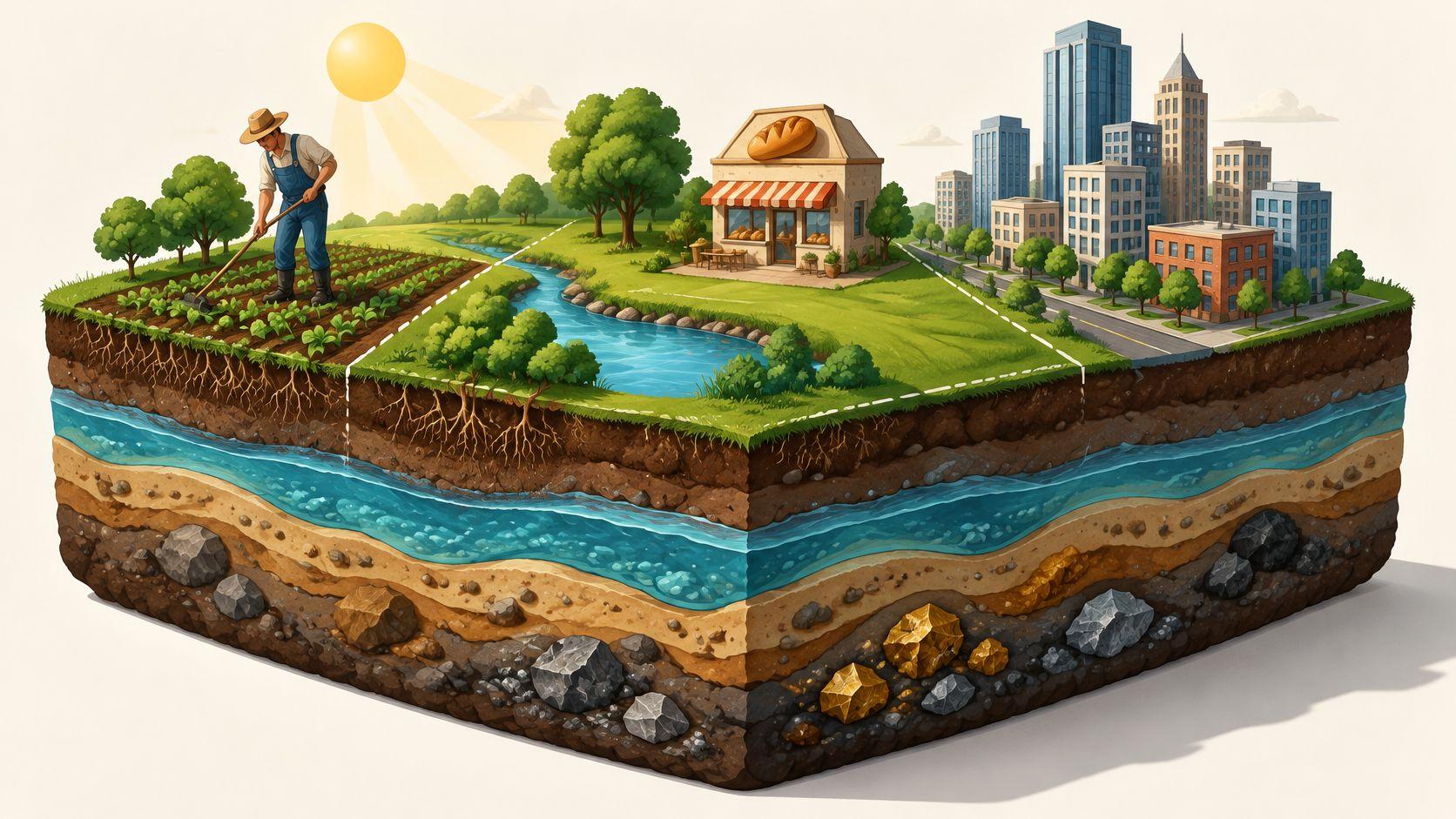
How can the same fixed stretch of land support farms, forests and cities? Land includes natural resources and the locations where production takes place. Since all other production depends on it, land earns rent. Together with labor, the human effort and skill used in production, and capital, the tools, machines and buildings people make, land forms one of the three factors of production.
Ask finance officials what a hectare is worth, and they may point to yields and comparable sales. Ask who should receive that value, or what changes when a site is held on a 99-year lease instead of owned outright, and the answer is less straightforward.
The distinction matters for housing bills, farm investment and municipal budgets. A lease sets the terms for using a site over time; outright ownership gives the owner a different claim on its value. The form of tenure helps determine who keeps the rent and who carries the risk. That is where debates about land's role in production become questions about who benefits from a location's value.
Table of Contents
- What Land Means as a Factor of Production
- Land, Labor and Capital Compared
- Why Land Supply Is Fixed and Its Uses Compete
- How Land Earns Economic Rent
- Land Leases, Land-Use Rights and Land-Value Taxes Compared
- Land in Tri-Factor Economics and Public Policy
- Classify Each Income Before You Apply the Model
What Land Means as a Factor of Production
Land is the part of production that nature supplies without human effort: soil, water, minerals, forests, air and the sea, plus the fixed locations on which buildings and businesses stand.
A bakery needs three things before it sells a single loaf. It needs a site with water and power, which is land. It needs bakers, which is labor. And it needs ovens, mixers and a delivery van, which is capital. The first of those is the one people misread, because land in economics means far more than a plowed field.
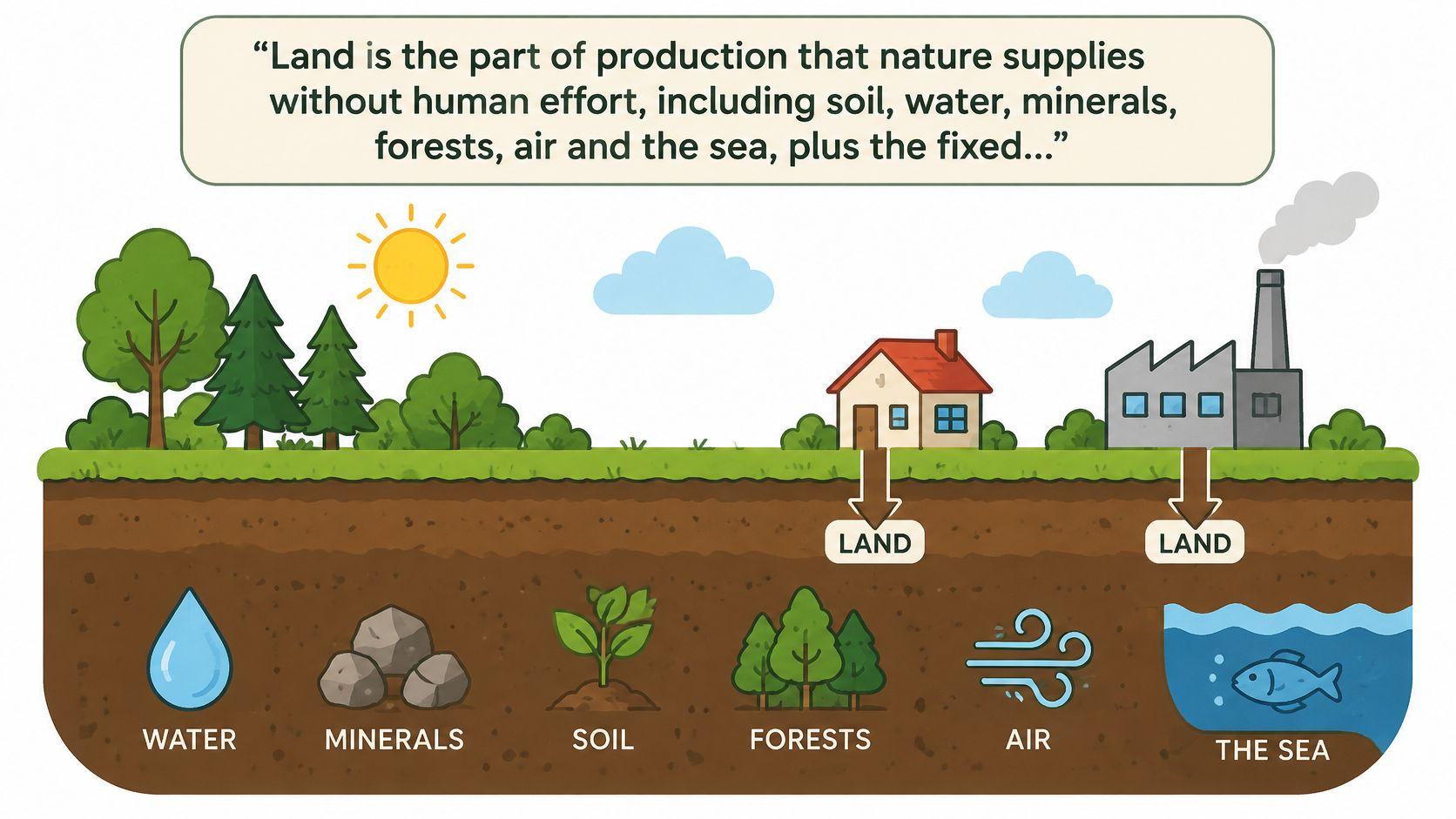
Think of land as the stage. Every other input performs on it, and it was there before anyone arrived. The bakers can change and the ovens can be replaced, but the plot stays put and stays the same size.
Location travels with the resource. Two plots with identical soil can earn wildly different returns because one sits beside a rail terminal and the other sits six miles from a paved road. Terrain, water, climate, permitted uses and access to customers all come bundled with the ground.
Land also isn't one commodity. The FAO counted 1.573 billion hectares of cropland against 3.208 billion hectares of permanent meadows and pastures in 2022 (FAO land statistics), two categories with different buyers, different cycles and different risks. A wheat field and a grazing lease don't behave like the same asset.
Some frameworks separate nature from capital explicitly. Unitism's tri-factor economics treats labor, capital and nature as three distinct sources of wealth, and that split is the one this article follows, while noting that plenty of textbooks fold land into a broader capital category.
The next step is to run all three factors through the same four questions and see exactly where they diverge.
Land, Labor and Capital Compared
The cleanest way to keep the three apart is to run them through identical criteria: where each comes from, whether its supply can grow, what income it earns, and whether it can move.
| Factor | Source | Can supply grow? | Income it earns | Mobility |
|---|---|---|---|---|
| Land | Nature and fixed location | No, quantity is fixed | Rent | Immobile |
| Labor | Human effort and skill | Yes, with population and training | Wages and salaries | Mobile between jobs and regions |
| Capital | Produced goods such as machinery and buildings | Yes, through saving and investment | Interest and profit | Mobile and can be sold |
Land comes from nature and sits in a fixed location. Its total quantity can't be increased, it earns rent, and it cannot move. You can't manufacture another coastline or relocate a deposit of iron ore.
Labor comes from human effort and skill. Its supply grows with population and with training, it earns wages and salaries, and workers move between jobs and regions. A welder laid off in one city can apply in another.
Capital consists of produced goods such as machinery, tools and buildings. Its supply grows through saving and investment, it earns interest and profit, and it can be moved or sold. The oven can be shipped to a second bakery; the site can't follow it.
Where the classification gets blurry
The case that trips up most readers is a warehouse on a city site. That single property bundles two different factors. The land underneath earns rent, because the site's value comes from location and from everything built around it. The building itself earns a capital return, because someone spent money and labor putting it there, and it wears out over decades.
Separate them and the numbers stop arguing with each other. The building depreciates and can be rebuilt. The site doesn't depreciate, and its value can climb while the structure on it loses value every year.
Keep the money question distinct too. Capital is the tools, not the cash that buys them, and the capital glossary entry is where to go if that distinction has ever muddled a balance sheet for you.
When a real property, a farm lease or a tax bill lands on your desk, four questions at the end of this article will sort each income line into the right factor.
Why Land Supply Is Fixed and Its Uses Compete
Can a city mint another hectare the way a factory turns out another machine? It cannot. Land is a fixed stock in a fixed place, so a hectare put to one use is a hectare denied to every other use.
The stock is large, and the agricultural slice of it has been shrinking. The FAO's land statistics put global agricultural land at 4.6 billion hectares in 2024, more than one-third of the world's total land area (FAO land statistics, 2001 to 2024). FAO reported that total agricultural land declined by about 134 million hectares between 2000 and 2020, reaching roughly 4.744 billion hectares; inside that total, permanent meadows and pastures fell by roughly 203 million hectares while cropland rose by more than 69 million hectares, about 5%, to around 1.56 billion (FAO analysis of global land statistics).
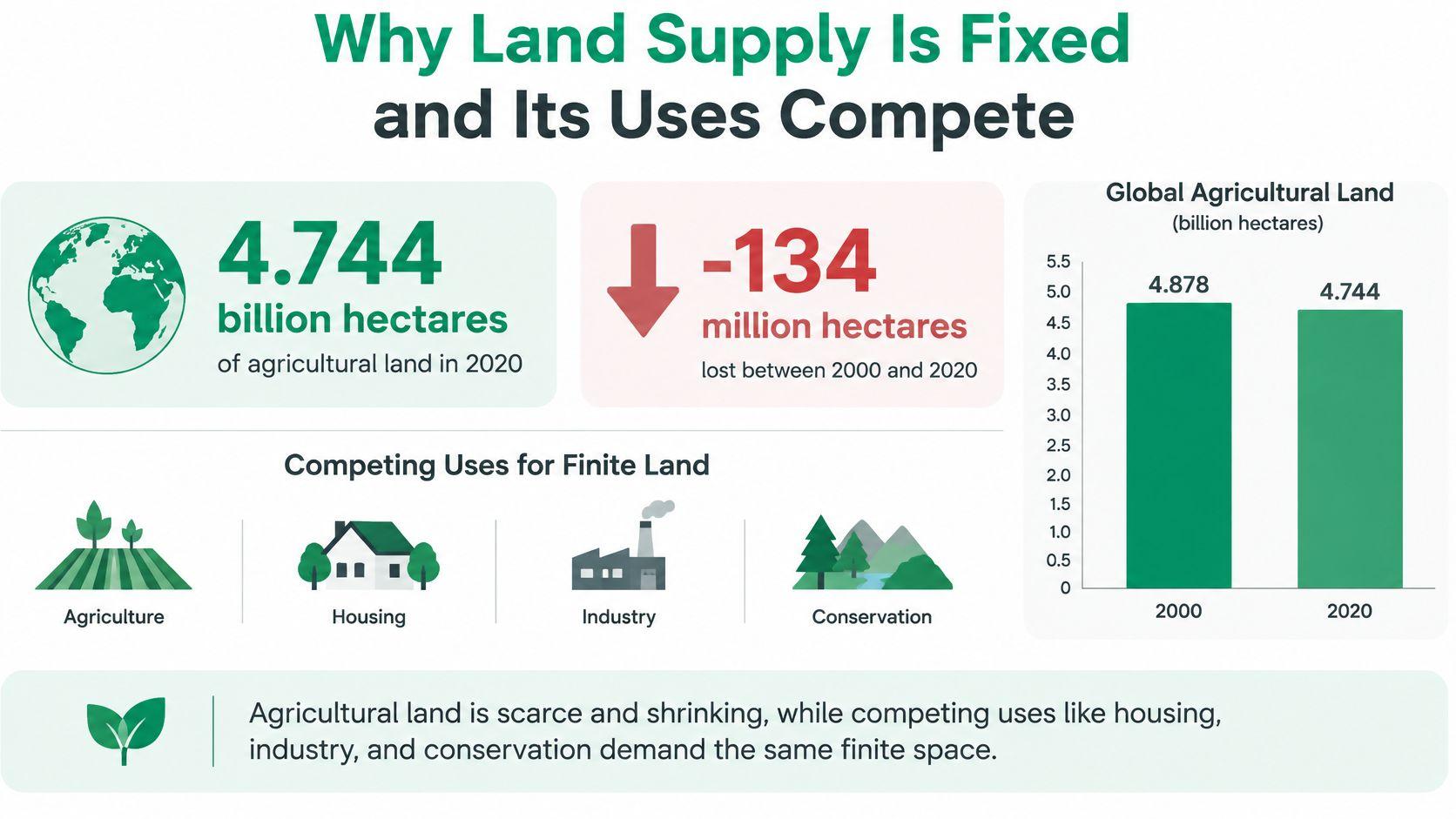
Read the mix, not only the headline. In 2020 cropland covered nearly 12% of the world's land area and permanent meadows and pastures covered almost one-quarter. FAO also estimated that, excluding Antarctica, the planet holds about 13 billion hectares of land, split across agriculture, forest and everything else. Pasture lost ground while cropland gained it. Housing, industry and conservation draw on the same fixed map.
| Category | Area | Change or share |
|---|---|---|
| Agricultural land, 2020 | 4.744 billion ha | Down about 134 million ha since 2000 |
| Cropland, 2020 | About 1.56 billion ha | Up more than 69 million ha (about 5%); nearly 12% of world land |
| Permanent meadows and pastures, 2020 | About 3.18 billion ha | Almost one-quarter of world land; down about 203 million ha since 2000 |
| Forest land | About 4.1 billion ha | Excludes Antarctica |
| Other land (deserts, barren areas, urban land, infrastructure) | About 4.2 billion ha | Excludes Antarctica |
| Total land excluding Antarctica | About 13 billion ha | Basis for the shares above |
Opportunity cost appears the moment one use replaces another. Turn pasture into wheat and food output may rise, while grazing, forest or conservation capacity falls somewhere else. That loss never shows on the farmer's balance sheet. Which use a site may legally support therefore decides the income the location can earn, the question planners settle through rules on highest and best use.
Why the same hectare produces different returns
Two fields of equal size can feed very different livelihoods. Soil depth, terrain, water, infrastructure and access to markets are stuck to the map. You can truck a tractor to a better district. You cannot truck the district to the tractor.
Tenure decides who keeps the location income and who carries the risk when that income changes.
A fixed lease freezes the charge for the term. If a station or a new employer lifts what the site is worth, the holder keeps the rise. If the neighborhood weakens, the holder still pays the old price.
A non-renewable term ends the claim. The outgoing holder does not meet the next price. The next user does.
An annually repriced land-use right resets the charge to the site's current value. Holding land idle for a jump in price stops paying, because the charge moves with the location.
A land value tax does related work on owned land. It rewards good use, makes speculation unprofitable, and returns to the community the value the community created. The owner who improves a building is not punished for the building. The charge follows the site.
Secure rights change what people will sink into that site. The World Bank reports that secure property rights are associated with average agricultural-output increases of about 40%, while poorly defined rights can reduce investment and encourage unsustainable extraction, including soil mining (World Bank land data work). A farmer plants trees and lays irrigation pipe when the returns are expected to stay with the farm.
Public ownership runs under different tenure and access rules from a private freehold: who may enter, and on what terms, depends on how the land is classed. this guide to Canada's public hunting land explains how crown land is classified and who may use it.
Check the hectare twice before you treat its area as its capacity. Ask what the soil and the location can support, then ask which tenure rule collects the location income and which party is left holding the loss if that income falls.
How Land Earns Economic Rent
A front-row seat at a sold-out concert costs far more than a seat at the back, and not because the front-row holder worked harder. The premium comes from the seat's position and from the crowd that wants it.
Economic rent is income that comes from owning a desirable location or natural resource, not from work or investment. That definition does a lot of work, because it separates what an owner collects for owning from what a producer earns for producing. The economic rent glossary entry keeps the term distinct from the everyday sense of a monthly rent cheque.
The test that separates rent from return: if the owner stopped working tomorrow and invested nothing, would the income still arrive? If yes, you're looking at rent.
There's a community dimension that standard treatments leave out. Unlike labor and capital, the market value of nature is created by the surrounding community, not by its owner. A vacant lot near a new transit station doubles in value because of the station, the schools and the employers around it, none of which the owner built.
What Sweden's housing market shows
Sweden supplies an unusually clean natural experiment. Between 2000 and 2021, the price of land for owner-occupied apartments rose 370%, against a 150% increase in construction prices; for rental apartments, land prices rose 317% against 116% for construction costs (OECD Economic Surveys, Sweden 2025). Overall Swedish land value increased 27-fold since 1980 and was identified as the largest driver of rising housing prices.
The mechanism is straightforward once you split the asset. Buildings are replaceable and their input costs move slowly. Well-located sites are not replaceable at any price, so scarcity rents accumulate there even when the structure on top is thirty years old.
That gives you two different returns in one transaction. A landowner's return comes from holding a position everyone else needs. A builder's productive return comes from organizing materials, labor and finance into a finished structure. Tax and regulatory design that ignores the split tends to hit the second while leaving the first alone, which is a live issue for anyone weighing tenant protections under rent regulation and wondering why affordability rules so often collide with supply.
Run the Swedish test in your own city. Pull land prices and construction costs for the same area over a decade and compare the growth rates. If land outruns construction, the gap is rent, and you've found where the money went.
Land Leases, Land-Use Rights and Land-Value Taxes Compared
Who keeps the rent when a site grows more valuable, and who is left holding the loss? Four arrangements can sit side by side on a title deed and still split that rent and that risk in opposite ways. Read them on term, on how the price is set, on what happens at the end, and on how easily each changes hands.
| Arrangement | Term | How the price is set | What happens at the end | Ease of transfer |
|---|---|---|---|---|
| Renewable fixed-term lease | Fixed term, renewable | Fixed rate for each term | Renews, but the gap to market closes in one major repricing | Transferable, though the coming renewal sits in the price |
| Non-renewable fixed-term lease | Fixed term, no renewal | Fixed at grant | Expires and the land returns to the state or owner | Harder to refinance and sell as the term runs down |
| Land-use right (as defined here) | Indefinite, no expiry | Repriced every year | Nothing expires and no renewal is needed | Low cost to buy and sell |
| Land-value tax | Recurring annual charge | Based on assessed site value | Ongoing public charge, not a contract | Not applicable (a charge, not a right) |
A fixed lease works like a restaurant booking locked in years ahead at today's menu price. The bill is known until the booking ends. After that, the menu is someone else's problem, or suddenly yours.
Land leases are fixed-term arrangements with a fixed price, either renewable or non-renewable. Both postpone the market rather than price it each year. On a renewable lease the holder pays a steady rate through the term, then meets the whole gap to current land value in one repricing. Years of rising rent land on a single date. On a non-renewable lease the site returns to the state or owner when the term ends. Refinance and resale grow harder as that date approaches, because every buyer and lender can see the remaining years shrinking. The private holder carries the decay. The ultimate owner keeps the site.
Land-use rights, as used here, give occupancy like a lease and differ in two features. They do not expire, and the charge is reset every year. No one has to renegotiate the whole remaining term as one lump. Buying and selling stays low cost because the price follows this year's site value instead of a long countdown. The annual reset is what takes away the cliff at the end of a fixed term. The holder cannot sit on an old rate while the location's value climbs, and there is also no expiry date that dumps the loss on one cohort of households.
Singapore shows the fixed lease in public view. State residential and commercial leases commonly run for 99 years, and the land returns to the state at the end. Most public housing there is held on those 99-year state leases. The price is fixed at grant, while the market value of the years still left keeps moving.
Research on those housing leases records a distributional problem built into the design. Some older HDB leases have begun to lose value as they approach the halfway point of their term, creating concerns for household wealth distribution (study of Singapore's 99-year housing leases).
A finite lease is a wasting asset, and everyone holding it knows the end date.
The naming rule worth memorizing: a fixed lease does not become a land-use right because a brochure calls it one. To qualify, it must be repriced every year, require no renewal, and never expire.
A land-value tax is a different instrument again: a compulsory annual payment to government based on a site's assessed value, not a contractual right to occupy. It captures some of the rent without transferring any tenure. The owner keeps the right to use the site and gives up part of the location's rise each year, with no contract expiry to fear. Governments also reach for land value when a planning decision lifts a site, and these explanations of Hetel Hashbacha payment rules show how a betterment levy charges landowners at that moment.
If you want the long version of the term-decay problem, the analysis of 99-year land leases follows what happens to household balance sheets as a lease ages.
Land in Tri-Factor Economics and Public Policy
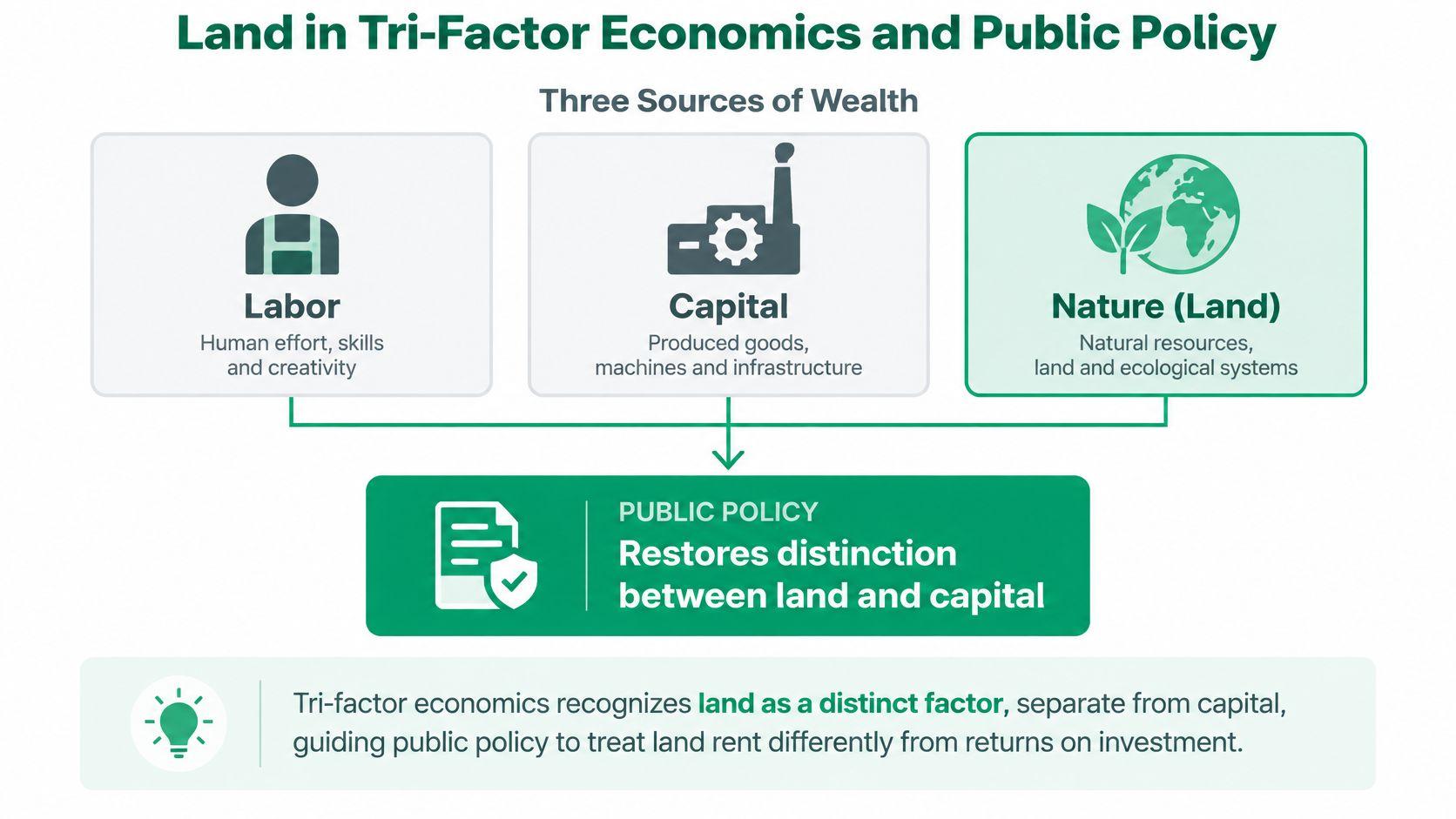
Once land sits in its own column, tax design stops being a single question. Unitism uses tri-factor economics, which recognizes three sources of wealth: labor, capital, and land (nature). That framework restores a distinction between land and capital that much present-day economics blurs, and the blurring is what lets tax systems treat a building and a city block as if they were the same kind of asset.
Taxes on wages and on buildings push against work and against construction. Both are things a city wants more of. Site-value taxation shifts the burden onto something whose supply can't respond, which is why the OECD recommends relying less on housing transaction taxes and more on annual taxes on immovable property, with the base moving from structures to current land prices; annual property taxes tied to recent market values can improve macroeconomic stability and support long-run growth because land is immobile and taxing it has little effect on investment decisions (OECD, Bricks, Taxes and Spending). The full mechanics of a land value tax run from assessment through to the annual charge.
Four problems follow directly from treating land as a separate factor:
- Housing unaffordability driven by land price inflation, where homes cost far more than the structures on them.
- Idle sites and urban blight, since holding underused land carries little cost when the tax falls on buildings instead.
- Boom and bust cycles amplified by speculation, because land is the asset most easily bought on credit and held empty.
- Sprawl, which appears when land at the edge is cheap relative to land in the center.
Unitism's position is that land wealth concentrates faster than any other kind of wealth, and that sharing land value stops the widening gap at its source. Martin Adams's work addresses the underlying pattern, where the rising value of land, created by the whole community, flows to private owners rather than back to the public. Weigh that against the alternatives rather than taking it on faith.
The objections worth taking seriously
Valuation accuracy is the first. Assessed site values can be challenged, litigated and got wrong, and a tax built on a bad valuation loses legitimacy fast. Reassessment frequency is the second: states that update values once a decade hand windfalls to owners and lose revenue in between. Revenue adequacy is the third, since a jurisdiction that leans on land alone may find the base too narrow for its spending.
Building taxes remain a fallback where land values are hard to assess, though they carry the supply problem already described. For an analyst, the discipline is simple. Separate the land component of a sale price from the building component before judging any tax, and the incidence question answers itself.
Classify Each Income Before You Apply the Model
Four questions will sort almost any income line, and you can run them in order.
- Does the income come from a fixed site, resource or location rather than effort or investment? If yes, treat it as land rent.
- Would it continue if the owner stopped working and invested nothing? If yes, it's rent rather than wages.
- Could you reproduce it by spending on machinery or buildings? If yes, it's a capital return.
- Does it depend on hours worked or skills applied? If yes, it's labor.
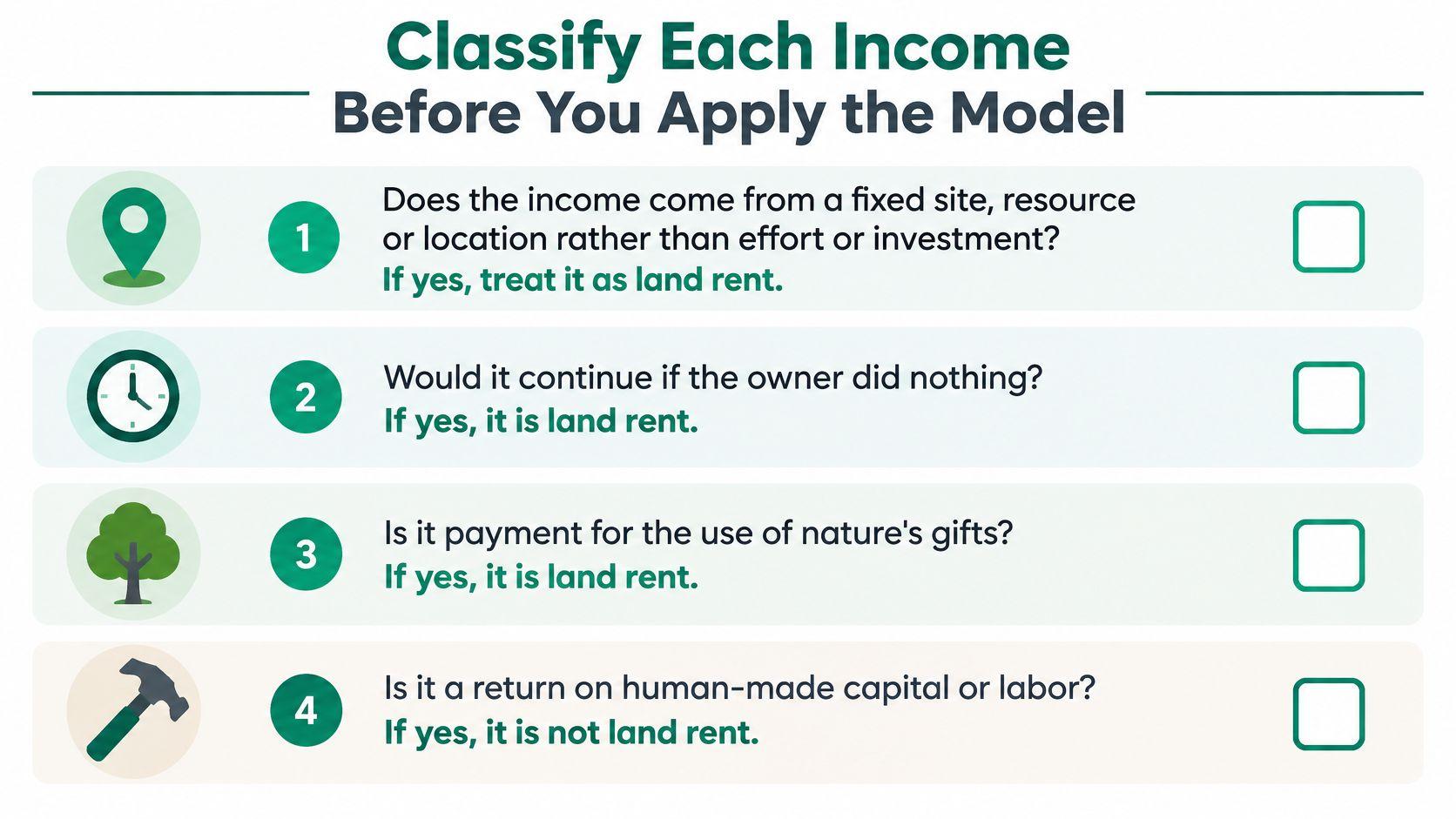
Then check the tenure, because the same parcel produces different answers under different contracts. Read the document and match it against the table above. Is it a renewable fixed lease with a renewal cliff coming? A non-renewable lease running toward expiry? Or a true land-use right that is repriced each year, needs no renewal and does not expire?
Don't stop at acreage and boundaries. They describe the parcel, not its earning power. Combine tenure, soil, location and rental observations before you put a number on productive capacity, because a hectare with secure title and road access is a different asset from the one next to it.
The action for today is small. Write three columns, for land, labor and capital, and place each income line from a site or policy case you know into one of them. Our interactive tools are simple models that show how land shapes the economy, which makes them a reasonable place to test the split before you commit to a policy position.
Unitism® works with finance ministries, city governments and research teams to measure land values, model who gains and who pays when revenue shifts from building and transaction taxes to land-based charges, and design the assessment and tenure rules that make the change workable. If you want to test the three-factor split against a real site or a real tax base, our economists can build the valuation and scenario models behind it with you. Visit Unitism® to see the research, the glossary and the policy design work.