Learn how an idle land tax works, why governments use it, how it's designed and valued, and what real-world cases reveal about revenue, supply
August 25, 2026
Idle Land Tax: How It Works, Design Options, and Real-World
Learn how an idle land tax works, why governments use it, how it's designed and valued, and what real-world cases reveal about revenue, supply

An idle land tax is an annual surcharge on underused parcels, and in the Philippines it can reach up to 5% of assessed value on top of the basic property tax. Its purpose is to make waiting costly enough that owners choose productive use, sale, leasing, or development instead.
You may see the policy problem every day without having a name for it. A surface parking lot sits beside apartment towers, a serviced parcel remains fenced behind a sign, and a subdivision contains lots that have never been built on. The mayor asks why nothing gets built, while the finance director asks whether a new tax can change the owner's calculation without punishing legitimate construction delays.
That calculation is the starting point. Holding land has an opportunity value, because an owner may expect the site to become more valuable later. An idle land tax adds a recurring public charge to that private option. It doesn't force a particular building or business, but it changes the cost of waiting.
Table of Contents
- What an Idle Land Tax Is
- How an Idle Land Tax Fits Inside Land-Value Policy
- Land Leases and Land-Use Rights Compared to Idle Land Taxes
- Designing Rates, Exemptions, and Idle-Parcel Triggers
- Valuing Land and Measuring Vacancy for Administration
- International Precedents and What They Teach Reformers
- What the Evidence Really Says About Vacancy and Affordability
- Implementing an Idle Land Tax From Design to Rollout
What an Idle Land Tax Is
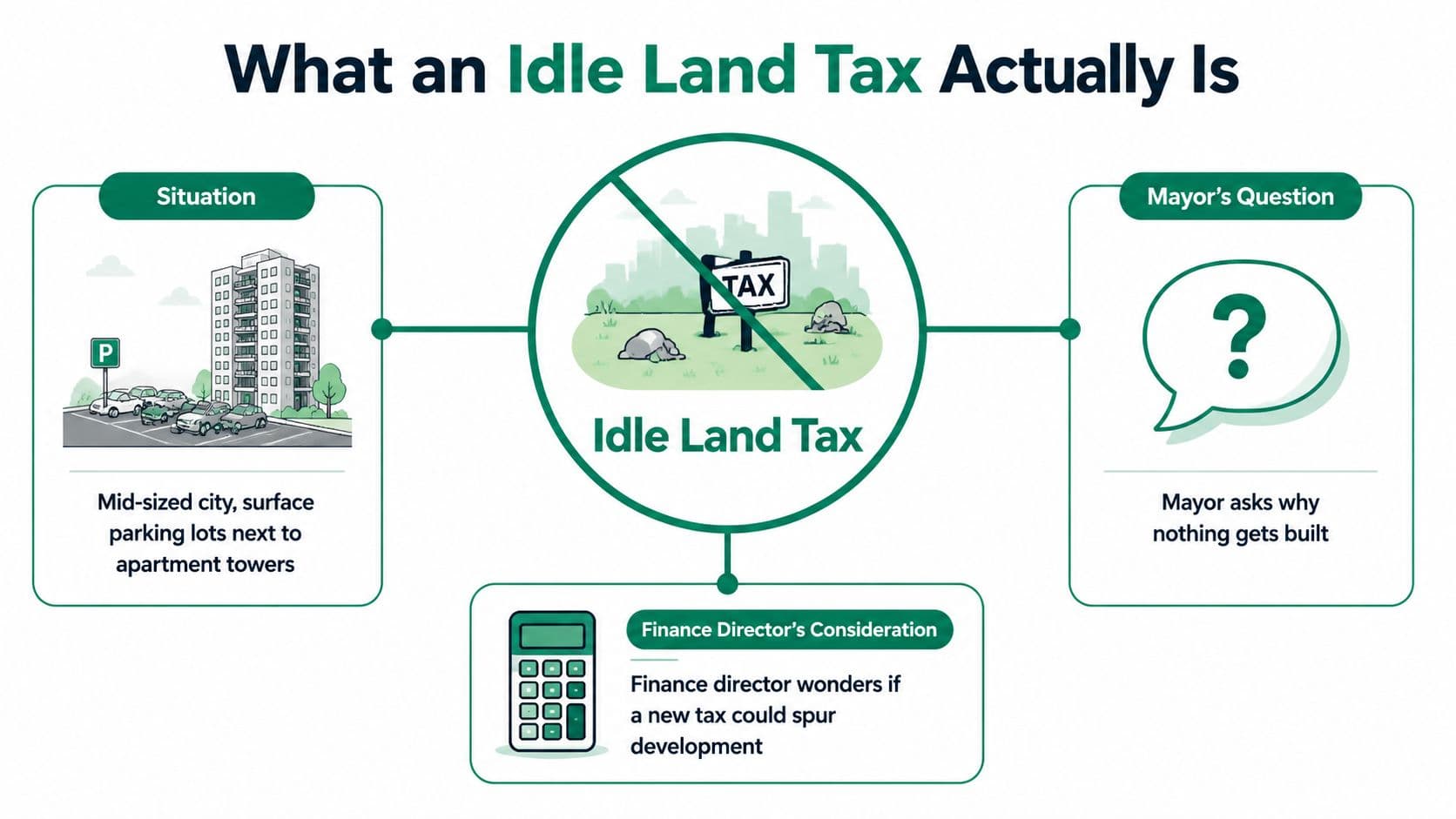
A surface parking lot beside new apartment towers can remain unused for years while its owner waits for higher land prices. An idle land tax addresses that choice by placing a recurring surcharge on land judged to be vacant, idle, or underused. Authorities may calculate it as an increase on assessed land value or on the ordinary site-value tax. The legal formula varies, while the economic mechanism remains consistent: the owner pays more each year the parcel stays within the taxable category.
Annual repricing changes the decision. A one-off penalty may be treated as a transaction cost. A yearly charge continues to reduce the financial return from postponing development, leasing, or sale. This makes the tax part of a broader family of land-pricing tools that also includes leases and land-use rights. Each can place a price on continued access to a site, but an idle land tax revisits that price every year as long as the underuse condition remains.
The distinction from ordinary property taxation matters. Conventional property tax may cover both land and buildings. A well-designed idle land tax concentrates on the site, or adds a special charge when a parcel meets an underuse test. Construction itself therefore does not become the target, helping preserve incentives to build, renovate, or intensify use.
The basic decision facing an owner
An owner normally weighs three paths:
- Develop: Accept construction costs and begin earning income from the site.
- Lease or sell: Transfer the parcel to someone able to use it more productively.
- Wait: Keep the land idle while expecting its value to rise.
The tax leaves waiting available, but adds a carrying cost that can change its ranking against the other options. This matters in cases of land speculation, where anticipated land-price growth matters more to the owner's return than current production.
The Philippines offers a concrete legal example. Local governments may impose an idle-land surcharge of up to 5% of assessed value alongside the basic property tax. Some cities apply graduated rates of 1% to 3% according to location and classification. Certain rules also test whether land exceeds 1,000 square meters and leaves at least half unutilized.
In plain terms, an idle land tax is an annual charge on qualifying underuse, designed to make productive use more attractive than indefinite holding. Its effect depends on clear definitions, reliable valuation, and exemptions for legitimate delays, subjects that require careful design.
How an Idle Land Tax Fits Inside Land-Value Policy
Idle land taxation belongs to a wider family of policies that price access to land according to its site value. The intellectual tradition is often associated with Henry George, whose central distinction was between land, which nature supplies, and improvements, which people create. A broad land-value tax follows that distinction by taxing the unimproved value of every parcel.
That broad approach treats land as a continuous tax base. A well-used site and an idle site both face a land charge, although their assessed values may differ because location, zoning, access, and public investment differ. The owner isn't rewarded with a lower land tax merely because the parcel has no building on it.
An idle land tax takes a narrower route. It identifies a subset of parcels that meet an underuse definition, then adds a higher marginal charge to those sites. Its objective is more behavioral than fiscal. Policymakers aren't only asking how much revenue the land base can raise. They're asking whether the charge can move a specific owner toward construction, leasing, sale, or redevelopment.
Broad base, narrow trigger
The difference can be expressed this way:
| Feature | Broad Land-Value Tax | Idle Land Tax |
|---|---|---|
| Tax base | Site value across the land base | Site value or assessed value of qualifying idle parcels |
| Coverage | Generally applies to every parcel | Applies only when an underuse test is met |
| Main purpose | Raise revenue while shifting taxation away from improvements | Change behavior and discourage prolonged underuse |
| Treatment of buildings | Can reduce reliance on taxes on buildings | Usually leaves improvements outside the surcharge |
| Administrative challenge | Accurate parcel valuation | Accurate valuation plus vacancy classification |
| Main policy trade-off | Broad efficiency with less targeting | Sharper targeting with more classification disputes |
The narrower instrument can be politically easier to introduce. A ministry can present it as a response to visible vacant sites instead of proposing an immediate redesign of the entire property-tax system. That can help build public support, particularly where residents see land held empty beside congested housing markets.
The cost is selectivity. Two parcels with similar site value may face different liabilities because one is classified as idle and the other is not. That creates room for appeals, exemptions, and strategic compliance. The Federal Highway Administration's discussion of land-value taxation highlights the underlying technical advantage: taxing land rather than improvements preserves incentives to construct and improve property, while a parcel-level charge can raise the holding cost of vacant sites.
A finance ministry should therefore distinguish the instruments by purpose. Broad land-value taxation is a system-wide pricing reform. Idle land taxation is a targeted behavioral surcharge. They can operate together, but they solve different administrative and political problems.
Land Leases and Land-Use Rights Compared to Idle Land Taxes
A developer acquires a valuable urban parcel under a fixed-term lease. For years, the payment remains unchanged while nearby land values rise. At renewal, the government must reset the price, and the developer faces a large adjustment at one decision point. The same policy problem can be handled through three related instruments, land leases, land-use rights, and idle land taxes. The difference lies in who holds the right, when payment is reset, and whether the charge applies to use or non-use.
A government land lease usually grants possession for a fixed term at a fixed price. It may be renewable or non-renewable. With renewal, the old lease rate can remain below market for years, then close the gap through one major repricing. Without renewal, the remaining term becomes shorter as expiry approaches. Buyers and lenders then discount the right, making it harder to sell or refinance.
Practical rule: Fixed leases do not remove land-price risk. They postpone it.
An idle land tax places a recurring annual charge on qualifying land while it remains unused. The owner receives a new holding cost each year, rather than waiting for lease renewal. That recurring bill can encourage construction, leasing, or another permitted use, provided the vacancy test is clear and enforcement is credible.
A land-use right assigns a user the legal ability to occupy or develop land without transferring the underlying title. A plain-language guide to land-use rights helps separate the use entitlement from ownership. In an indefinite model, the right continues while its price is updated annually. Buyers and sellers can then transfer a durable right without waiting for renewal, while the public sector captures changes in site value through regular payments.
The timeline clarifies the choice. A fixed lease holds the price until renewal or expiry. An indefinite land-use right resets the price each year. An idle land tax also appears annually, but only while the parcel meets the legal definition of underuse. The first two price access to land. The third adds a behavioral charge to continued non-use.
China shows why terminology matters
China's urban system separates state ownership of the underlying land from time-bounded land-use rights. Commonly reported terms are 70 years for residential land, 50 years for industrial land, and 40 years for commercial land, as described by the Lincoln Institute's account of publicly owned land in China. A University of Tennessee legal analysis likewise explains that users hold a time-bounded right rather than freehold-style ownership, and may need to reacquire it at then-current market value when it expires.
That arrangement resembles a long lease more closely than an indefinite, annually repriced right. Published descriptions also distinguish grants with a substantial upfront payment and a small annual land-use fee from leases with higher annual rent and no large down payment, as described in this overview of China's land law.
| Instrument | Price timing | Ownership structure | Main risk |
|---|---|---|---|
| Fixed-term land lease | Fixed until renewal or expiry | State or landlord retains ownership | Repricing shock or declining transferability |
| Indefinite annual land-use right | Repriced annually | User holds a durable use right | Annual valuation and political resistance |
| Idle land tax | Annual surcharge while underuse continues | Private or public owner remains titleholder | Classification, valuation, and enforcement |
The policy choice is therefore practical. Annual repricing prices land risk as it emerges. Fixed-term pricing postpones risk until a decision point. An idle land tax does not create a tradable development right, but it makes continued non-use financially visible each year.
Designing Rates, Exemptions, and Idle-Parcel Triggers
A finance ministry setting an idle land tax must decide four connected questions: what rate applies, which cases receive exemptions, what counts as idle, and when liability begins. These choices determine whether the policy reaches speculative holding or penalizes owners facing genuine planning, financing, environmental, inheritance, or construction constraints.
The Philippines provides a concrete design reference. Under its local-government framework, an idle-land surcharge can reach 5% of assessed value in addition to the basic property tax. Some cities use graduated rates of 1% to 3%. Legal tests can also cover urban lots above 1,000 square meters when at least half remains unused. These figures illustrate how a tax can be defined through both a rate and a parcel-level threshold, rather than through a general statement that land is “underused.”
Four levers determine the result
-
Rate: A low surcharge may be simple to administer but too weak to change holding decisions. A high rate sends a stronger financial signal, while increasing the risk of hardship, litigation, and avoidance. The rate should therefore reflect the reliability of valuation, appeals, and enforcement.
-
Exemptions: Agricultural land, active construction, environmental restrictions, inheritance disputes, and land offered for lease may need distinct treatment. Each exemption should specify the evidence required and its duration. Without those limits, an exception can become a standing route out of liability.
-
Idle definition: “Productive use” needs an objective test. Building coverage, lawful occupancy, documented agricultural activity, and approved construction milestones are easier to review than a discretionary judgment about whether an owner is trying hard enough.
-
Trigger: Liability may start when a parcel first meets the legal test, after a notice period, or following a documented period of non-use. A graduated schedule linked to vacancy duration gives owners time to respond and creates a stronger signal as non-use continues, provided the registry can track dates reliably.
The main trade-offs can be ranked by administrative difficulty:
- Lowest classification burden: an annual land-value charge applied across the land base. It avoids deciding whether one parcel is idle while another is productive, but it reaches sites regardless of their use.
- Moderate burden: a targeted vacant-site model with clear land-use, development-status, or vacancy-period tests.
- Highest burden: a surcharge requiring officials to verify parcel classification, lawful exceptions, notices, and recurring underuse. It can focus the policy more narrowly, but each disputed case adds review and enforcement work.
| Jurisdiction | Rate | Idle-Parcel Threshold | Key Exemptions | Trigger Mechanism |
|---|---|---|---|---|
| Philippines | Up to 5% of assessed value, with some cities using 1% to 3% graduated rates | Tests can include urban parcels above 1,000 square meters with at least half unused | Varies by local rule, including classification and ownership carve-outs | Legal parcel classification and underuse determination |
| Broad land-value model | Set by the jurisdiction | No special idle threshold | General statutory exemptions | Annual assessment across the land base |
| Targeted vacant-site model | Set by the jurisdiction | Defined by land use, development status, or vacancy period | Genuine construction, planning, or hardship cases may qualify | Notice, classification, and recurring reassessment |
Annual repricing changes the policy's operating logic. Land leases set a payment through a contract, and land-use rights define what a user may do. An idle land tax keeps title with the owner while making continued non-use financially visible each year. Unitism's discussion of taxation and efficiency explains why charges focused on land can preserve incentives for work and productive investment more effectively than taxes imposed on buildings or activity. The legal trigger still needs to be precise enough for owners and administrators to know when the charge applies.
Valuing Land and Measuring Vacancy for Administration
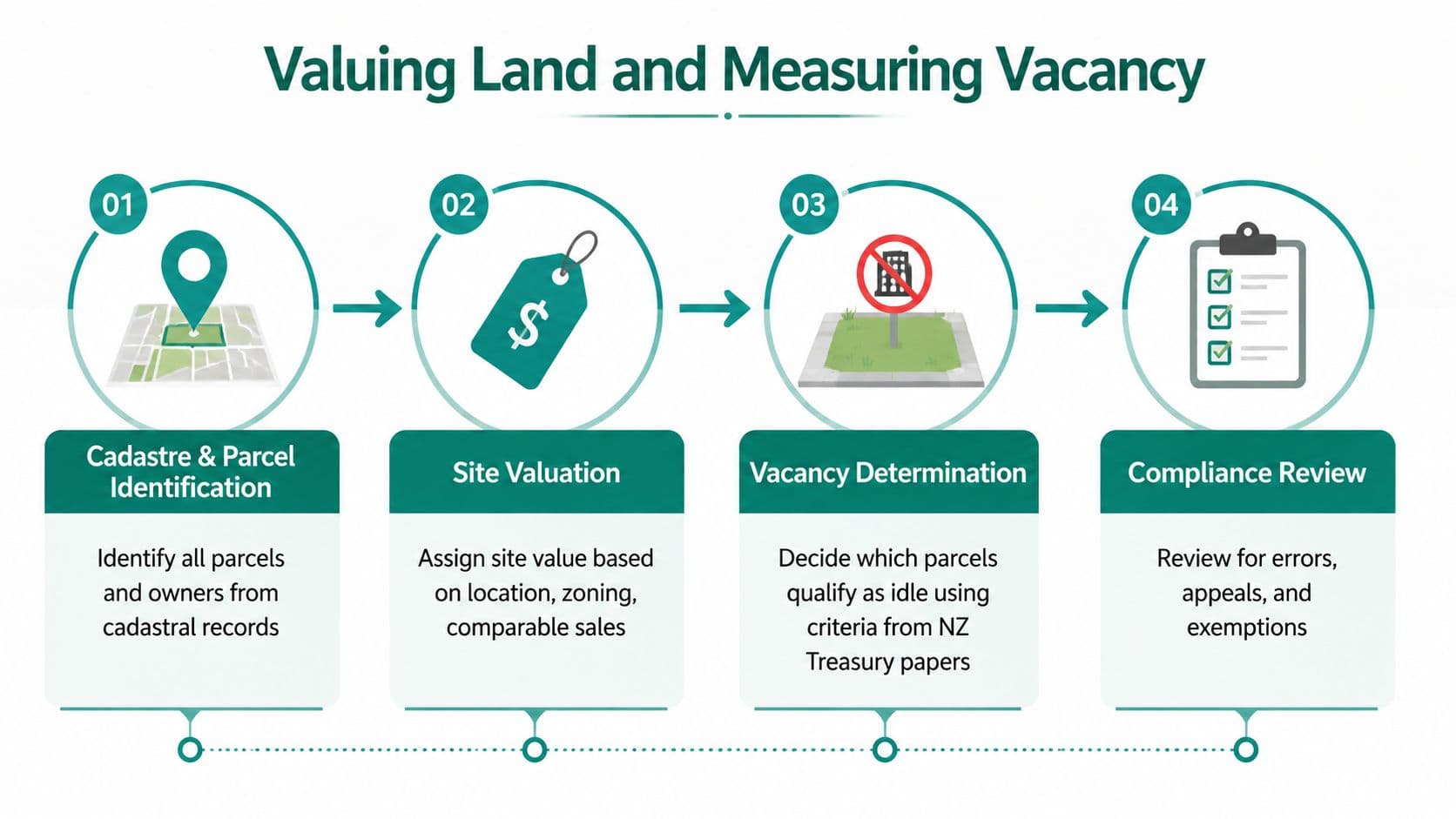
Administration begins with two separate questions. What is the parcel's site value? And does the parcel meet the legal definition of idle? A jurisdiction can answer the first accurately and still produce an unreliable tax if it can't answer the second.
Site value can be estimated through comparable sales, income capitalization for undeveloped parcels, or mass-appraisal models. Comparable sales use nearby transactions after adjusting for location and legal characteristics. Income capitalization asks what the site could earn under permitted use. Mass appraisal combines parcel records, zoning, location, access, and market evidence to estimate values consistently across a large area.
A workable evidence chain
Administrators can combine:
- Cadastre and title records: Identify parcel boundaries, registered owners, tenure, and land classification.
- Utility information: Show whether a site has active connections or consumption consistent with use.
- Planning records: Reveal permits, approved construction, subdivision status, and lawful development constraints.
- Satellite and field evidence: Help verify physical conditions, although imagery still requires careful interpretation.
New Zealand Treasury has emphasized that assessing a vacant-land tax is difficult when data is limited, especially because authorities must identify idle land in places with housing need (Treasury housing-tax paper). Seasonal agricultural fallow, active redevelopment, disputed title, and planning-stage projects can all look like vacancy from a distance but require different legal treatment.
Classification needs an appeal path
Objective indicators reduce disputes. A parcel with no registered improvements, no relevant permit, and no evidence of lawful use is easier to classify than a site undergoing phased construction. The authority should publish evidence requirements, inspection powers, deadlines, and appeal standards before issuing the first assessment.
The hidden cost is institutional. Registration gaps, inconsistent parcel identifiers, reassessment backlogs, and appeals can consume revenue and public trust. Holdings that haven't changed hands in decades may carry outdated records, making a technically sound tax politically difficult to enforce.
Mass-appraisal methods can support consistent parcel-level valuation, but no model replaces a reliable cadastre and a credible review process. The administrative test is not merely whether a city can calculate a rate. It is whether the city can identify the right land, explain the assessment, correct errors, and collect the charge at a reasonable cost.
International Precedents and What They Teach Reformers
The history of land-value and idle-land policy is longer than modern housing debates. England introduced a Land Tax in 1692, initially based on annual rental values. After the first valuation, authorities carried forward the figures without further revaluations, and county quotas were fixed using 1692 values from 1698. The tax's share of total revenue fell from 35% at the start to 17% by the 1790s and 11% by the 1820s, before abolition in 1963 (history of land-value taxation).
That case supplies a warning about stale assessments. A land tax can begin with a strong base and gradually lose fiscal importance if administrators stop updating values. In the United States, Hyattsville, Maryland, enacted the first city land-value tax in 1898. Later split-rate systems taxed land more heavily than buildings, including Titusville City, where the land rate was 53.510 mills compared with 13.35 mills for buildings, approximately a four-to-one relationship, according to the same historical account.
Reform milestones and design lessons
Japan's land-tax reform after the Meiji Restoration began implementation in 1873. The reform connected taxation to land value and helped establish a framework for recurring site-based assessment. The lesson is technical: valuation rules must match the intended base, and changing from yield-based taxation to price-based taxation changes both administration and taxpayer behavior.
In 1898, Kiauchau, China, introduced a tax on land-value increments to recoup gains expected from harbor and public-works spending. Great Britain's 1909 to 1910 Finance Act also imposed a tax on increments in site value. These examples show how governments have repeatedly linked public investment to land-value capture.
The International Monetary Fund has documented recurrent land-value taxes in Jamaica, New Zealand, parts of Australia, Canada, East Africa, South Africa, and Denmark (IMF discussion of land taxation). The broader lesson is that land-based charges recur across different legal systems, but their durability depends on valuation, political design, and administrative capacity.
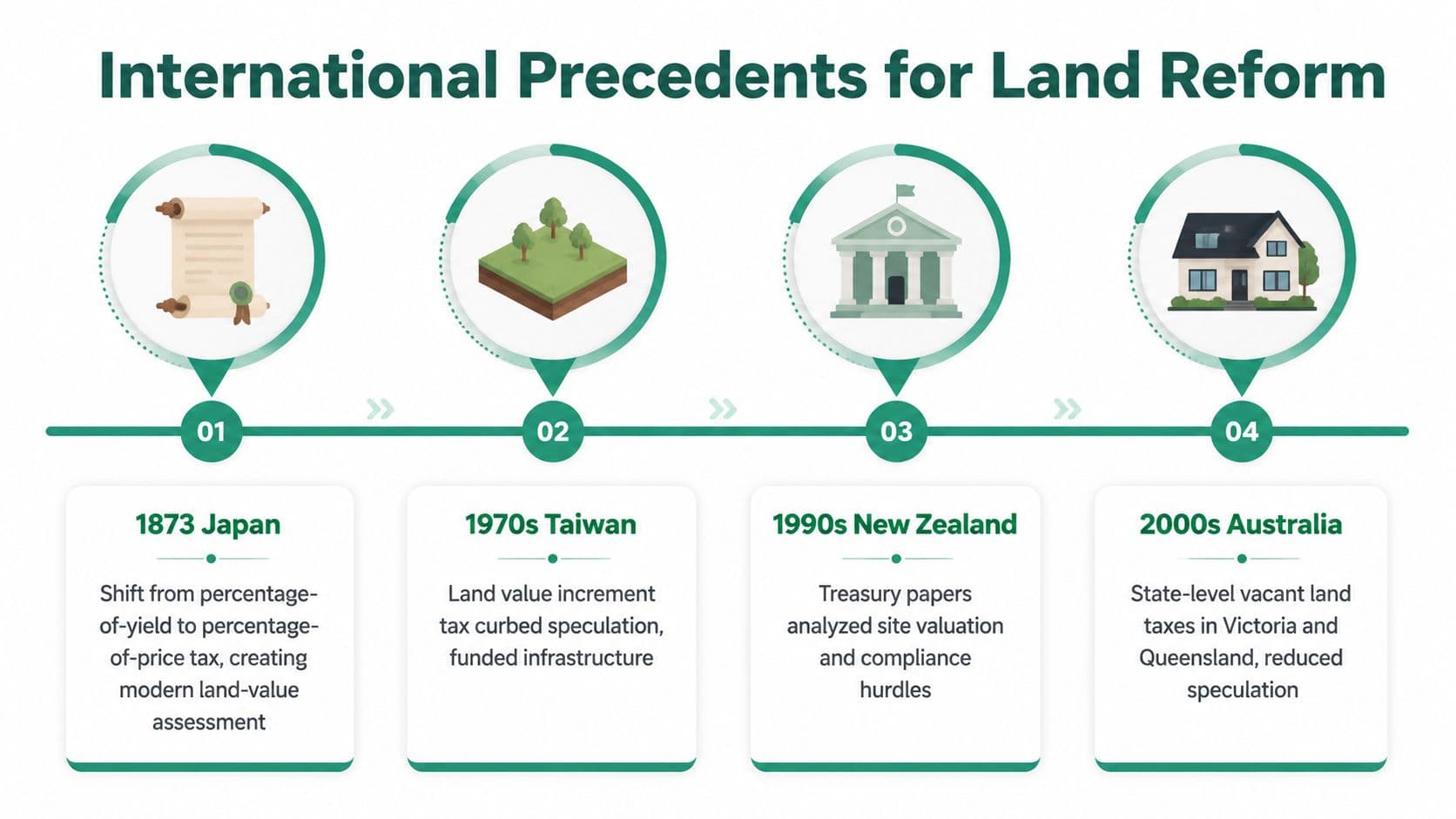
Victoria illustrates the politics of expansion. The state expanded its vacant residential land tax statewide from 2025 and tightened or extended rules for undeveloped land from 2026, showing that governments continue to test broader coverage and escalating obligations. The lesson is institutional rather than ideological: policymakers often begin with a narrow charge, then adjust the base when evidence and enforcement experience reveal gaps.
What the Evidence Really Says About Vacancy and Affordability
An idle land tax can change occupancy or development incentives without making housing affordable by itself. Those are separate outcomes, and public debate often treats them as one.
The clearest recent evidence comes from Canada's vacant-home taxes. One study found a 1.5 percentage point reduction in vacancy, roughly a 21% reduction in taxed areas, but found no reduction in average rents and no increase in new construction (C. D. Howe Institute analysis). The result is important because it identifies the likely first channel: bringing existing homes into use, not automatically adding new supply.
| Jurisdiction | Occupancy Shift | Supply Response | Rent or Price Effect |
|---|---|---|---|
| Canada's taxed areas | Vacancy declined by 1.5 percentage points, approximately 21% | No increase in new construction identified | No reduction in average rents identified |
| Underused urban land generally | Owners may choose use, leasing, sale, or development | Depends on zoning, finance, infrastructure, and demand | Cannot be assumed from the tax alone |
A vacant-home tax may work well when the problem is a usable unit held empty. An idle land tax addresses a different asset, often a parcel awaiting development. The owner may still face zoning restrictions, high construction costs, weak demand, or inadequate infrastructure. A surcharge can't remove those barriers merely by increasing the annual bill.
Occupancy is a short-run use outcome. Affordability is a broader market outcome.
The policy should therefore be judged against its stated objective. If the objective is to reduce empty holdings, the relevant indicator is whether qualifying parcels or units leave the idle category. If the objective is new housing, officials must track permits, starts, infrastructure access, and completed homes. If the objective is lower rents, they need rent and household-income measures, not just vacancy counts.
Idle land taxation is best treated as a complement to zoning reform, infrastructure investment, housing finance, and broad land-value taxation. It can correct a holding incentive, but it can't supply every missing input in the development process.
Implementing an Idle Land Tax From Design to Rollout
A practical rollout should begin with legislation, not billing software. The statute must define idle land, identify the liable person, establish exemptions, specify evidence, and provide an appeal route. Ambiguous definitions create unequal enforcement and invite litigation.
A finance ministry can sequence implementation as follows:
- Write the legal test: Define underuse using measurable parcel characteristics, lawful use, development status, and time thresholds.
- Build the parcel base: Link cadastral records, title information, zoning, permits, and assessed site values.
- Integrate use evidence: Use utility information, inspection records, planning data, and other lawful evidence to identify possible idle parcels.
- Publish guidance: Explain notices, documentation, exemptions, payment dates, appeals, and correction procedures in plain language.
- Phase the charge: Introduce the surcharge gradually over three to five years, allowing owners, assessors, lenders, and planners to adjust.
- Monitor behavior: Track idle-parcel counts, permit applications on previously vacant sites, revenue per hectare, appeals, and displacement complaints.
Phased implementation helps officials separate policy learning from permanent design. Early monitoring should ask whether owners are developing, selling, leasing, or just absorbing the charge. It should also test whether the tax is reaching speculative holdings or falling on small owners who lack financing and legal capacity.
Legal safeguards matter. Retrospective definitions can create disputes, agricultural exemptions can be over- or under-inclusive, and a uniform charge can affect small holders disproportionately. Transition credits, hardship deferrals, and clear construction exemptions can soften the adjustment without weakening the core incentive.
Unitism® offers land valuation assessments, land-value policy design, fiscal-impact modeling, cadastre integration, compliance workflows, and training for public officials working on reforms of this kind. Visit Unitism® to explore practical tools and advisory support for designing an idle land tax that fits local data, law, and housing objectives.