Explore mixed income communities with a clear guide to design, evidence, policy tools, and outcomes. Learn how cities deliver them well and measure what works.
September 16, 2026
Mixed Income Communities: A Practical Guide to Design
Explore mixed income communities with a clear guide to design, evidence, policy tools, and outcomes. Learn how cities deliver them well and measure what works.
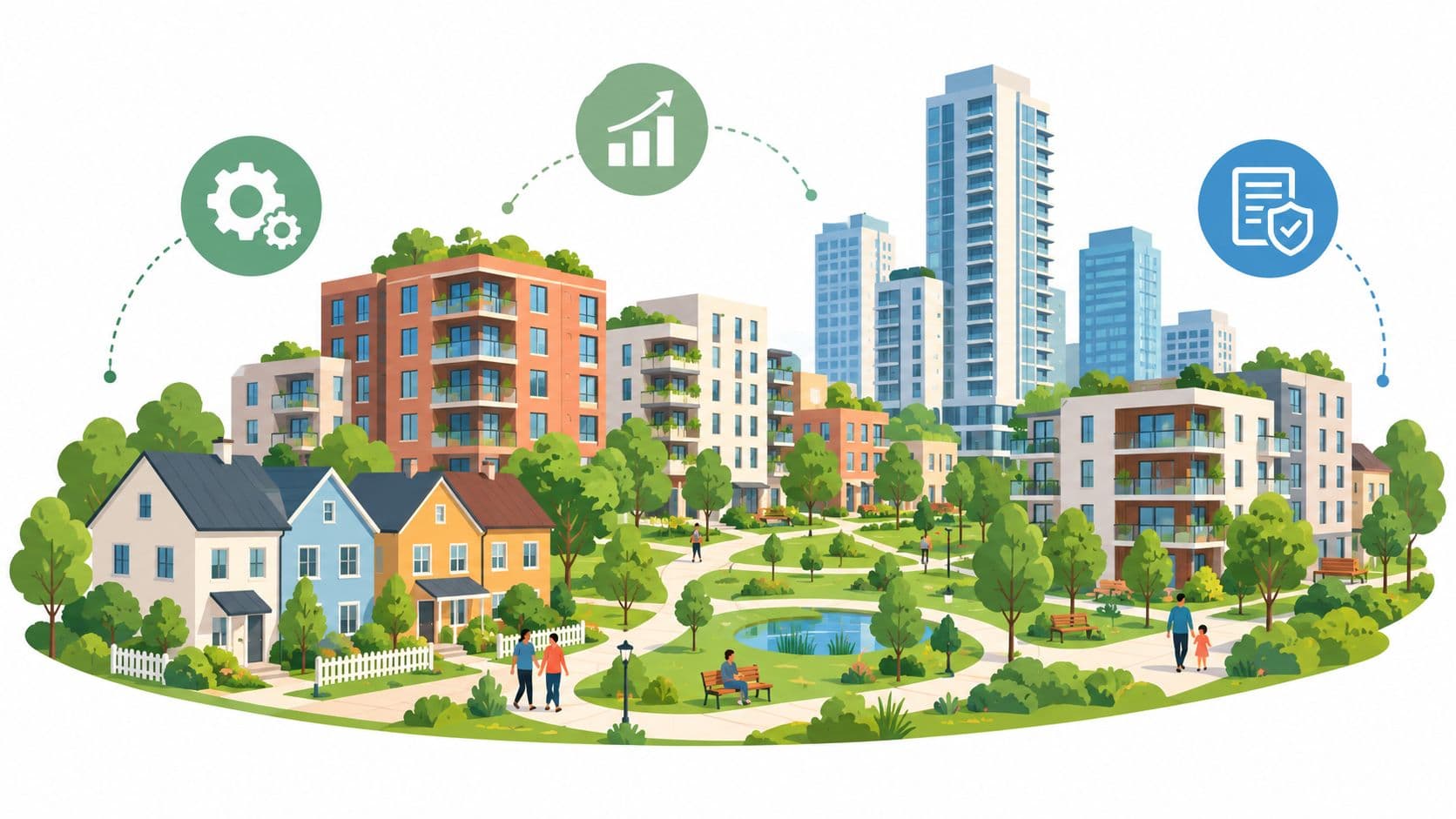
A planning meeting is underway. A developer has proposed 220 homes beside a transit stop, and the staff must decide whether it qualifies as a mixed-income community. The site includes market-rate apartments, income-restricted homes, and a public housing partnership, but the units may have separate entrances, separate management systems, and no shared community space. The label sounds clear until the team asks what the arrangement is designed to accomplish.
That question matters because mixed-income housing can improve buildings and neighborhoods without automatically improving residents' incomes or social connections. The strongest projects treat affordability, design, land economics, services, and long-term governance as one system. This guide explains how to tell those projects apart, using the policy record and evidence available to planners today.
Table of Contents
- What Mixed Income Communities Actually Are
- How the Policy Idea Took Shape in the United States
- What the Evidence Shows Residents Gain
- Design Principles and Policy Tools That Work
- Land Leases, Land-Use Rights, and Land-Value Capture
- Case Studies of Implementation in Practice
- Equity Risks and Common Pitfalls to Avoid
- Metrics, Evaluation, and the Road Ahead
What Mixed Income Communities Actually Are
A mixed-income community deliberately houses households across income brackets, usually through a combination of market-rate, subsidized, and sometimes public units on the same site or within close proximity. The purpose isn't just to place different rents behind one address. It's to create a neighborhood where households with different financial circumstances can access a shared physical environment, common services, and durable housing options.
Planning teams commonly distinguish several income bands. Extremely low-income households generally fall below 30 percent of area median income, while low-income households may fall below 60 or 80 percent of area median income. Moderate-income households occupy a higher affordability band, and market-rate households pay rents or prices without an income restriction. Federal policy commonly describes mixed-income developments as projects combining units at different affordability levels, usually market-rate and below-market units, as explained in the HOME Program guide to affordable housing and inclusionary zoning.
Look beyond the unit count
An inclusionary zoning project may qualify as mixed income because it sets aside below-market homes within a larger development. A luxury tower with affordable units may also meet a formal definition, although its design and management may create separation. Naturally occurring mixed-income neighborhoods, sometimes called NOMI neighborhoods, arise without a specific affordability mandate because buildings, tenure types, and household incomes vary over time.
Those arrangements shouldn't be treated as interchangeable. A public land project with project-based vouchers has a different fiscal structure from a private development complying with an inclusionary requirement. A community land trust has a different long-term affordability strategy from a building whose restrictions expire after a financing period.
Mixed income also isn't the same as scattered-site vouchers, an isolated public housing tower, or upzoning without affordability requirements. Those policies may support housing choice or production, but they don't necessarily create a shared mixed-income setting. Readers trying to connect neighborhood form with affordability should also understand the wider forces discussed in this guide to why housing is unaffordable.
Planning rule: Count more than units. Review who shares entrances, amenities, management, governance, and long-term security.
In the United States, mixed-income communities are sizable but remain a minority housing form. In the 100 largest metropolitan areas, just under 5,000 census tracts, about 10% of all tracts, met research criteria for mixed-income status. Those tracts contained about 23 million people, or 11% of the population in those metropolitan areas, according to a HUD review of mixed-income neighborhoods. The practical lesson is simple: the term describes a broad family of arrangements, not one standard product.
How the Policy Idea Took Shape in the United States
The modern policy story begins with a contradiction. The Fair Housing Act of 1968 challenged discriminatory housing systems, while urban renewal and public housing policy often concentrated low-income households in large, physically isolated developments. The Brooke Amendments of 1969 strengthened rent protections for public housing residents, but they didn't solve the problems caused by poor maintenance, segregation, weak services, and concentrated poverty.
By the late twentieth century, policymakers were searching for a different physical and social model. The idea was to replace distressed public housing with neighborhoods containing multiple tenure and rent levels, better streets, safer buildings, and stronger connections to surrounding institutions. The HUD account of mixed-income policy development identifies the HOPE VI program, launched in 1993, as a major federal vehicle for that transition. It also identifies the Moving to Opportunity demonstration in 1994 as an important policy strategy for testing whether neighborhood conditions could change household outcomes.
Policy learned through failure
HOPE VI redevelopment became influential because it changed the development model, but early projects also exposed the cost of moving too quickly. Redevelopment in places such as Atlanta and Chicago showed that demolition, relocation, and replacement could weaken social networks and displace former residents when planners failed to provide enough return opportunities or adequate relocation support. A lower-poverty site wasn't automatically a successful community for the people who had lived there.
Inclusionary zoning developed along a parallel path. Local governments expanded these policies in the 1970s, with examples in Montgomery County, Maryland, and Boston. Montgomery County's program illustrates the basic mechanism. Under the HOME guide, up to 15 percent of a new housing development with 50 or more units may be made available to low- and moderate-income households. Most states also offer tax-exempt financing for projects reserving at least 20 percent of units for low- and moderate-income households, according to the same guide.
The financing system changed further with the creation of the Low-Income Housing Tax Credit in 1986, which became the dominant vehicle for producing income-restricted rental housing. Later, the Obama-era Choice Neighborhoods program, launched in 2010, broadened the strategy beyond a single building by connecting housing redevelopment with neighborhood investment, schools, transportation, and services.
The federal government still supplies major financing and program frameworks, but cities and states decide how those tools operate on actual sites. That division explains why mixed-income development became the default reform vocabulary. It offers a way to combine public goals with private capital, but local design and accountability determine whether the combination works.
What the Evidence Shows Residents Gain
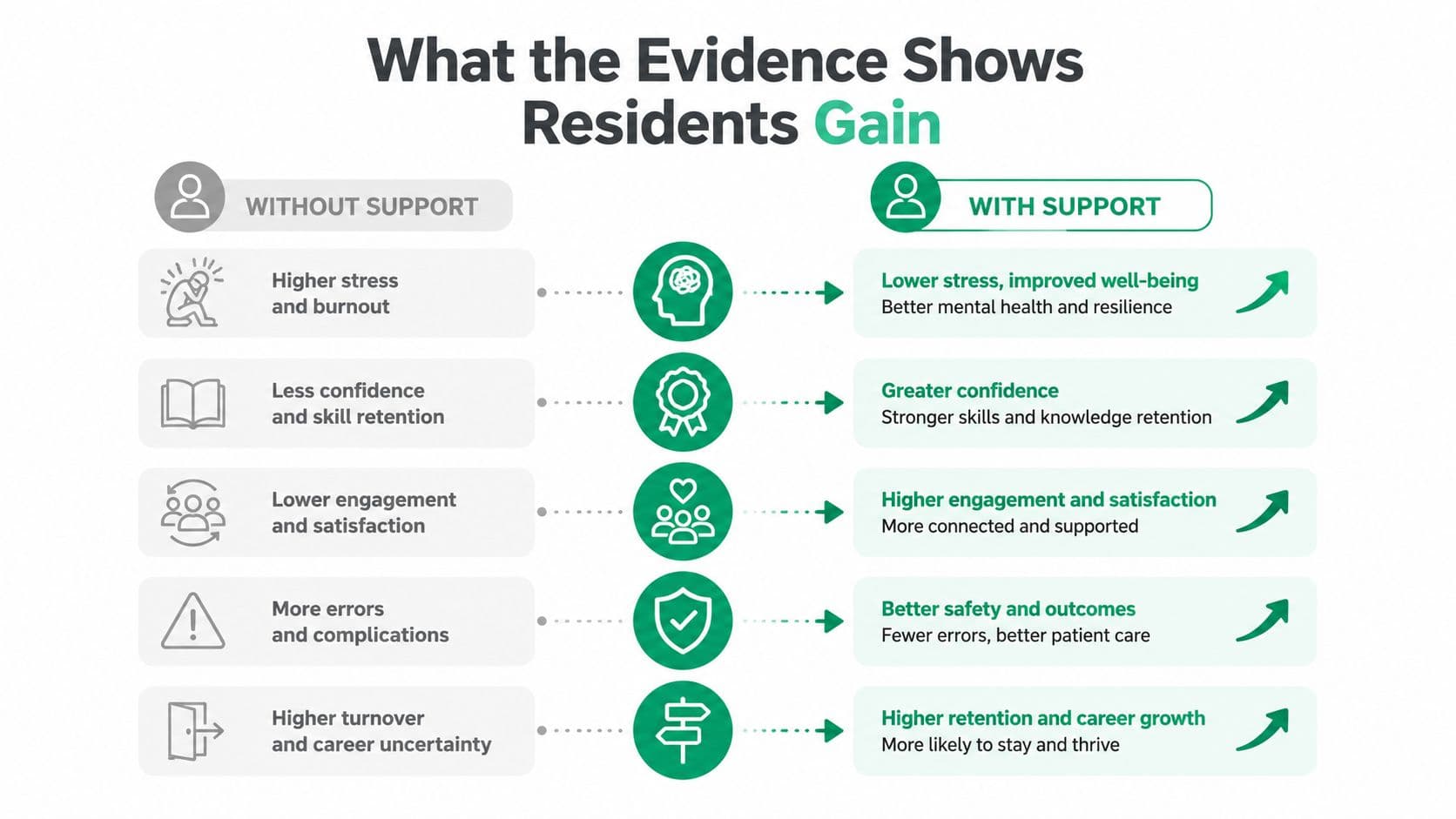
The clearest gains from mixed-income communities usually appear in the built environment, not in direct income mobility. Low-income residents often receive better housing quality, safer surroundings, improved management, and stronger access to services than they had in distressed developments. The Urban Institute review of mixed-income communities finds that evidence for large gains in household income remains weak, with limited employment improvements and little or no income growth.
That distinction should shape both public expectations and evaluation. A safer building with functioning elevators, maintained common areas, and access to transit is a meaningful outcome. It isn't evidence that the project has moved residents out of poverty. Treating physical improvement as economic transformation creates misleading success stories and weakens future policy.
Children and adults may experience different results
The intergenerational record is more encouraging than the adult earnings record. A 2026 UNC summary of HOPE VI evidence reports an estimated 2.8% higher adult earnings for each year of childhood exposure to revitalized mixed-income housing, with about 50% higher lifetime earnings for people who lived there from birth. That source also reports little economic gain for adults, highlighting why evaluations must separate the timing and age of exposure. The UNC summary of the HOPE VI evidence provides that distinction.
The result isn't a license to promise that every child will experience the same outcome. It does show that housing conditions during childhood may influence long-run opportunity in ways that adult relocation studies don't capture. Access to safer neighborhoods, better services, and more stable surroundings can matter over a long time horizon.
Services determine whether design becomes opportunity
Physical mixing alone doesn't guarantee school improvement, employment access, or social trust. The Urban Institute research on HOPE VI and mixed-income redevelopment finds that developments were often safer and better managed than the distressed housing they replaced, with some evidence of higher property values and lower crime in surrounding areas. It also emphasizes that place-based improvements work best when residents receive actual access to institutions and services.
The policy implication is direct:
- Build quality matters: Safe, durable, well-managed homes are a legitimate and measurable benefit.
- Service access matters: Schools, health services, transit, childcare, and employment connections must be reachable in practice.
- Income mobility needs support: Training, childcare, transportation, and school partnerships must complement the housing strategy.
- Integration needs management: Shared buildings don't create strong cross-class ties without deliberate programming and fair treatment.
Mixed income is therefore necessary in some redevelopment strategies, but it isn't sufficient. The development must connect housing to opportunity rather than treating the rent schedule as the entire intervention.
Design Principles and Policy Tools That Work
A planning team should begin with the resident experience, not with a preferred financing program. Units should be distributed throughout the site rather than arranged in a visible affordability staircase. Shared circulation, entrances, courtyards, play areas, and community rooms help prevent the building from communicating that some households belong less than others.
A 60-20-20 unit mix can serve as a planning example, with market-rate, moderate-income, and lower-income homes distributed across the project. It isn't a universal formula, and the right mix depends on local incomes, subsidy availability, construction costs, and demand. The principle is more important than the exact ratio: create several affordability levels without creating separate physical identities.
Match the tool to the constraint
Zoning can create permission, but it can't by itself close a financing gap. Density bonuses may provide additional revenue-producing units, while project-based vouchers can stabilize revenue for affordable homes. Public land disposition can reduce the site's acquisition burden, but the public owner must attach enforceable affordability and governance terms.
| Principle or Tool | What It Does | Best Fit | Main Constraint |
|---|---|---|---|
| Dispersed unit mix | Places income groups throughout the project | New construction and major redevelopment | Requires fair management and careful leasing |
| Shared circulation and amenities | Creates common daily spaces | Multifamily sites with enough operating capacity | Poor management can still produce informal separation |
| Inclusionary zoning | Requires or negotiates below-market units | Strong markets with development activity | May reduce feasibility without a calibrated bonus |
| Density bonus | Adds revenue-producing capacity | Transit-rich or high-demand sites | Can strain infrastructure and neighborhood trust |
| Expedited approvals | Lowers time and carrying costs | Fully planned projects with clear affordability terms | Must include public accountability |
| Project-based vouchers | Supports operating revenue for selected units | Deep affordability and public housing replacement | Depends on public funding and contract stability |
| Public land disposition | Reduces land cost and preserves public leverage | Publicly owned, transit-accessible sites | Requires long-term stewardship after sale |
The HOME Program guide provides federal context for affordability levels and inclusionary zoning. Environmental performance should also be considered as part of long-term operating affordability, not as a decorative feature. Planning teams can use designing with nature to connect site planning with energy, water, and resident health.
Decision test: If a tool lowers initial cost but leaves affordability vulnerable at refinancing, resale, or ownership transfer, it has solved the opening transaction, not the neighborhood's long-term problem.
Successful combinations usually include a public land contribution, a density or zoning benefit, layered subsidies, and operating support for the lowest-income homes. They also include a management plan that treats residents consistently across tenure types. A ribbon-cutting may show the unit count, but only a long operating horizon reveals whether the design holds.
Land Leases, Land-Use Rights, and Land-Value Capture
A mixed-income community can remain affordable at opening and lose that quality later because the land arrangement expires, reprices abruptly, or fails to capture rising site value. Three instruments need to be separated clearly: fixed-term land leases, true land-use rights, and land-value capture.
A fixed-term ground lease grants use for a defined period at a fixed price or under a fixed schedule. Community land trusts, cooperatives, and affordable housing projects may use leases that protect affordability for decades, while a 99-year ground lease is a familiar example of a long fixed term. The term creates initial certainty, but it doesn't eliminate risk. A renewable lease provides certainty only until renewal, when the gap between the old lease rate and market value may close through a major repricing. A non-renewable lease becomes progressively harder to refinance and sell as expiration approaches.
China's system illustrates a different legal structure, although it still isn't an indefinite ownership model. Residential land-use rights generally run for up to 70 years, industrial rights for 50 years, and commercial rights for 40 years, according to this academic analysis of China's land-use-right system. These are fixed-term rights that expire and require reacquisition. They shouldn't be confused with the definition used here for true land-use rights.
The crucial distinction
For this framework, a true land-use right is indefinite, has no expiration, requires no renewal, and is repriced annually. That annual repricing allows the public or community landowner to receive the current rental value of the site without forcing a large end-of-term reset. Sometimes fixed leases are called “land-use rights,” but they are still fixed leases if they expire or require renewal.
Hong Kong's academic literature distinguishes renewable and nonrenewable leases and identifies refinancing and resale risk as a lease approaches its end. For leases expiring after July 1, 2047, the source estimates post-2047 reneging risk at 1.6%, equivalent to an expected reneging event about every 61 years, as described in this analysis of Hong Kong property rights.
| Instrument | Repricing Mechanism | Where Revenue Goes | Durability of Affordability |
|---|---|---|---|
| Fixed-term lease | Fixed or contract-based until renewal | Private or community landowner | Strong during the term, vulnerable at renewal or expiry |
| True land-use right | Repriced each year, with no expiry | Public or community landowner | Durable when affordability rules and governance endure |
| Land-value capture | Collects a share of site-value uplift | Public services, housing, or community investment | Can recycle appreciation into future affordability |
Land-value capture and site-value taxation can direct rising land value toward public purposes instead of leaving all appreciation to private holders. The guide to land-value capture explains the basic policy logic. The key stance is practical: fixed leases postpone risk, while annual land-value pricing makes the land obligation visible and recyclable.
Case Studies of Implementation in Practice
Three developments show why mixed-income policy can't be judged by the rent chart alone. Columbia Point in Boston represents HOPE VI-era redevelopment, The Orchards at Saratoga demonstrates a small inclusionary project using a long-term ground lease, and Via Verde in the South Bronx combines layered subsidies with a deliberate cross-subsidy design.
Columbia Point in Boston
Columbia Point replaced distressed public housing with a redesigned mixed-income community that used project-based vouchers alongside new public housing stock. The financing stack joined federal redevelopment support, public housing resources, and private development capacity. The most important design rule was the shift from an isolated high-rise complex toward a neighborhood form with better management, streets, and connections to the surrounding city.
The trade-off was relocation. A project can improve buildings while disrupting the people and networks that gave the original community its social infrastructure. A current team would place more emphasis on resident return rights, relocation continuity, and resident governance before demolition begins.
The Orchards at Saratoga
The Orchards at Saratoga illustrates a smaller inclusionary development in which below-market homes were protected through a long-term ground lease rather than relying only on resale restrictions. That structure uses land ownership to support affordability, but the lease still requires careful drafting. The key financing and governance question is what happens when the term approaches renewal, when financing changes, or when the land value rises faster than the contracted payment.
A stronger contemporary version would pair the ground lease with explicit renewal protections, transparent operating rules, and a plan for land-value appreciation. The Rondo Community Land Trust discussion offers a useful comparison for thinking about community control of land beyond a single development transaction.
Via Verde in the South Bronx
Via Verde uses layered subsidies, stepped massing, and shared green space to create an 80-20 cross-subsidy model, with affordable and market-rate homes integrated rather than placed in separate wings. The design rule that mattered most was the connection between density and common outdoor space. Terraces, gardens, and shared areas give residents a common daily environment while supporting a range of unit types.
The financing stack illustrates how public subsidies and market-rate revenue can work together, but it also exposes a recurring constraint. Cross-subsidy depends on market demand and careful operating assumptions. A team designing the project today would stress-test the affordability plan against changing rents, insurance costs, energy expenses, and refinancing conditions rather than assuming the original stack will remain stable.
These examples don't produce one universal template. They show that financing, spatial integration, and land control must reinforce one another. A project can succeed physically and still need stronger protections for resident continuity or long-term affordability.
Equity Risks and Common Pitfalls to Avoid
Putting incomes in one development doesn't automatically create integration. Residents can occupy the same site while using different doors, elevators, amenities, management offices, and social networks. Earlier HUD research and later syntheses report weak cross-class ties and persistent stigma, while the MDRC evaluation of Purpose Built Communities found progress toward lower poverty and a broader income mix without a simple transformation narrative.
The first failure begins in the income targets. If the lowest-income units dominate the project, the development may reproduce concentrated poverty under a mixed-income label. If the affordability targets focus only on moderate-income households, the project may exclude households with the greatest housing needs. Planners should examine the full range from extremely low income through market rate, including households between 30 and 60 percent of area median income, rather than treating one set-aside as proof of equity.
Management can recreate segregation
A building's rules may communicate hierarchy even when its architecture doesn't. Separate service standards, different repair response times, restricted amenity access, “poor doors,” and unequal enforcement tell residents who has priority. Relocated public housing residents may also lose social ties if the new project provides no shared spaces or resident-led institutions.
Market-rate construction creates another risk. New investment can accelerate rents around the project beyond original projections, putting nearby renters and small businesses under pressure. Race also remains a binding constraint in housing outcomes, so an income-only analysis can miss discrimination, segregation, and unequal access to opportunity.
| Pitfall | Equity Risk | Mitigation |
|---|---|---|
| Low income targets | Recreates concentrated poverty | Set a deliberate range of affordability bands |
| Separate entrances or amenities | Signals unequal belonging | Use shared circulation and equal access rules |
| Relocation without continuity | Breaks social networks | Fund return rights, mobility support, and resident services |
| Unequal management | Produces tenure-based discrimination | Audit repairs, enforcement, leases, and complaints |
| Expiring affordability | Converts public support into temporary benefit | Use enforceable renewal clauses and durable land control |
| New investment without protection | Displaces nearby households | Pair development with tenant protections and monitoring |
A tenant protection guide can help practitioners connect project-level affordability with neighborhood-level stability. Effective safeguards include mixed-tenure governance, on-site services, enforceable renewal clauses, resident-led monitoring, and transparent grievance systems.
Equity standard: A household shouldn't receive a better building only to lose its voice, community, or housing security.
Affordability is a continuing obligation, not a one-time deed restriction. The public sector must monitor who benefits, who leaves, and who gains control as the project matures.
Metrics, Evaluation, and the Road Ahead
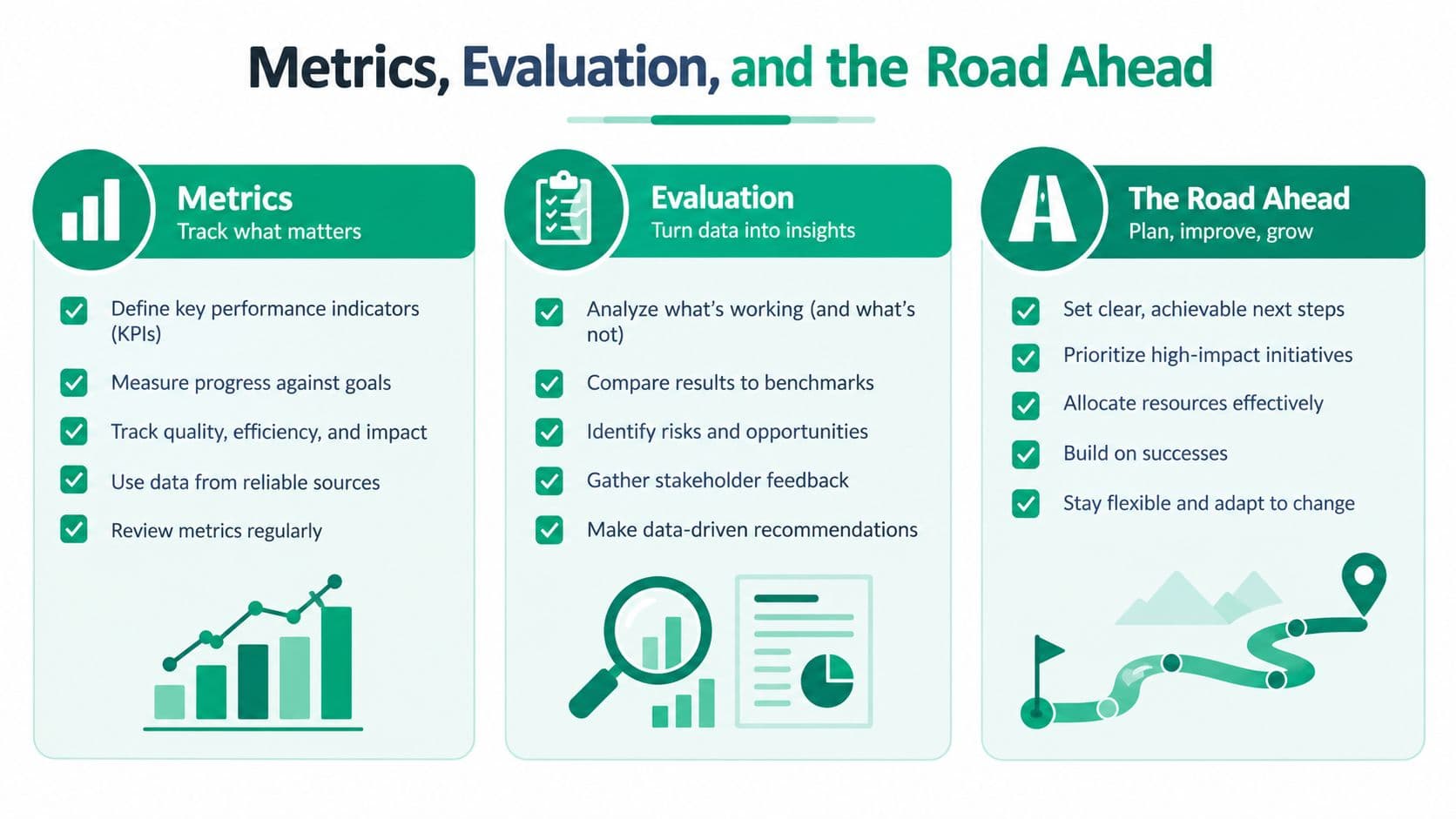
Cities need a scorecard that separates inputs, outputs, and resident outcomes. Unit counts and financing commitments are inputs or outputs. They don't reveal whether residents can remain housed, access opportunity, participate in governance, or share the benefits of rising land value.
A practical evaluation system should track four dimensions:
- Stability: Measure tenure length, eviction rates, lease renewals, involuntary moves, repair response, and resident satisfaction with management.
- Opportunity: Track school access, employment proximity, transit connectivity, service use, and whether residents can reach institutions without unreasonable travel burdens.
- Social integration: Monitor cross-tenant interaction, civic participation, shared-space use, resident associations, and complaints about unequal treatment.
- Fiscal performance: Examine land-value capture yields, subsidy efficiency, operating reserves, refinancing exposure, and the public cost of maintaining affordability.
Measure early signals and long-term results
During lease-up, developers can monitor application patterns, acceptance rates, waitlist composition, move-in retention, service uptake, and use of shared amenities. These leading indicators can reveal whether the project is excluding households, confusing residents, or creating visible tenure divisions before those problems become entrenched.
Residents experience lagging outcomes over a much longer period. Cities should use resident surveys, third-party audits, and longitudinal administrative data to study housing stability, education, employment, health, and mobility. The evidence summarized in earlier sections makes age and exposure especially important. An adult move and a child's sustained childhood exposure shouldn't be placed in the same outcome category.
Build policy for the next cycle
The road ahead includes tighter fiscal constraints, climate retrofits for legacy projects, and political disputes over property-tax exemptions. Those pressures make land stewardship more important. A project that captures site-value appreciation and recycles it into maintenance, services, or future affordability may be more resilient than one dependent on repeated one-time subsidies.
Future subsidy should be tied to demonstrated outcomes as well as unit production. That doesn't mean withholding support from communities with difficult conditions. It means rewarding transparent management, resident stability, service access, fair treatment, and durable affordability instead of counting units alone.
Planning departments should ask five questions before approving a project:
- Can residents return and remain?
- Do all households share the same quality of space and management?
- What services connect housing to opportunity?
- Who receives rising land value?
- What happens when the financing or lease term changes?
Unitism® offers land valuation assessments, policy design for land-value capture, distributional modeling, implementation support, and education for governments and housing agencies evaluating these questions. Visit Unitism® to explore practical resources for connecting housing affordability with land economics and durable public value.