Community stabilization starts with how land is priced, held, and taxed. A practical guide for governments on tools, evidence, and implementation.
September 20, 2026
Community Stabilization: A Practical Guide for Policymakers
Community stabilization starts with how land is priced, held, and taxed. A practical guide for governments on tools, evidence, and implementation.

Your housing team wants more eviction prevention money. Your planning team wants faster approvals near transit. Your finance team is watching assessment appeals chip away at the tax base. Meanwhile, the same vacant parcels sit two blocks from public investment, waiting for the next price jump.
That isn't a service-delivery problem first. It's a land-pricing problem.
Most community stabilization policy still starts too late in the chain. It treats instability as something to manage after land has already been bid up, withheld, underused, appealed down, or converted into a speculative asset. Then government tries to compensate with rent aid, legal defense, code enforcement, supportive housing, and cleanup funds. Those tools matter. But if you leave the land basis untouched, you're paying to counteract incentives your own fiscal system created.
Table of Contents
- Why Stabilization Starts With How Land Is Priced
- The Four Drivers Behind Unstable Neighborhoods
- Land Leases Versus Land-Use Rights Versus Land-Value Taxation
- The Working Policy Toolkit for Stabilization
- What the Precedents Actually Show
- Implementation From Valuation to Communication
- Why Land-Value Reform Is the Spine of Stabilization
Why Stabilization Starts With How Land Is Priced
A familiar pattern shows up in mid-sized cities. The council expands tenant assistance. The housing department funds mediation. The code office chases vacant properties. Yet owners still hold underused sites near transit because the carrying cost of waiting stays low, while the upside from appreciation stays private.
That is why most community stabilization efforts feel expensive and partial. They target distress downstream while leaving the upstream price signal intact.
The upstream variable
If you need a quick framing tool, start with the broader resilience lens in this guide on what is community resilience. Then narrow the question. In municipal land policy, resilience turns on who captures rising site value and who pays when neighborhoods destabilize.
The practical issue is simple. When a tax system treats land and buildings as one bundle, owners can improve a site and face a higher tax bill, or leave it idle and wait for the neighborhood to lift the parcel's price. That isn't neutral. It rewards delay.
For a primer on separating site value from improvement value, this explanation of what is land value is useful. The key policy point is that land value is socially created. Transit, schools, safety, zoning, and surrounding commerce push it up. Private owners then capture much of that uplift unless government recovers it through the tax or tenure system.
Practical rule: If your stabilization budget rises while idle land still pays too little to sit empty, you're financing symptoms.
What changes when you reprice land
Once government taxes or charges against unimproved site value, the holding decision changes. A vacant lot stops being a cheap option on future neighborhood growth. Building, leasing, or selling becomes the rational response.
That one shift improves the performance of the tools cities already use:
- Tenant protections work better because speculative churn loses part of its fuel.
- Code enforcement bites harder because owners can't cheaply warehouse land while fighting citations.
- Transit investment generates less displacement pressure when uplift is recaptured instead of capitalized entirely into site prices.
- Local revenue becomes less dependent on punishing construction and rehabilitation.
The policy mistake is treating community stabilization as a social-service annex to the economy. It belongs inside land and public finance.
The Four Drivers Behind Unstable Neighborhoods
Cities often diagnose neighborhood instability as four separate problems. They aren't separate. They are four visible expressions of the same pricing failure.
Speculation, displacement, vacancy, and fiscal imbalance
Speculation happens when owners can hold land for gain while paying too little for non-use.
Displacement follows when public action raises site values faster than local incomes can absorb.
Vacancy persists when doing nothing outperforms building, renting, or selling.
Fiscal imbalance deepens when cities rely on volatile or regressive taxes while lightly charging land rents.
The common error is treating each domain with its own siloed program.
A useful reference point is the mixed evidence from federal stabilization policy. In one HUD evaluation, NSP2 tracts were initially 48.6% lower priced than control tracts and remained about 42.9% lower in the post-NSP2 period, while the study also reported no detectable effect on housing prices and other housing outcomes in surrounding areas. The same evaluation notes that more than 8 million very low-income U.S. households pay over 50% of income for housing, and the national rental shortage was estimated at 7 million homes for households below 30% of area median income in HUD's Neighborhood Stabilization Program evaluation. That's exactly the point. Service and redevelopment interventions can matter, but they don't automatically reset the underlying land logic.
Four drivers and their land-pricing root
| Driver | Land-Pricing Root Cause | Observable Indicator |
|---|---|---|
| Speculation | Low carrying cost on underused sites | Long-held parcels with minimal improvement |
| Displacement | Publicly created land uplift privately captured | Rent and land-price pressure after rezoning or transit |
| Vacancy | Non-use remains profitable relative to development | Empty lots, mothballed buildings, stalled rehab |
| Fiscal imbalance | Revenue tied too heavily to buildings, transactions, or labor | Appeals pressure, weak base growth, regressive tax reliance |
For policymakers thinking about neighborhood composition rather than just parcel taxation, this piece on mixed-income communities helps connect land pricing to who can remain in place.
Community stabilization fails when government subsidizes occupancy but still subsidizes land withholding.
Why fragmented programs underperform
You can spend heavily on eviction defense and still watch land speculation reset the problem next year. You can clear blight on one corridor and trigger renewed land hoarding on the cleaned parcels. You can stabilize one household and lose the block.
That isn't because the programs are useless. It's because the fiscal architecture contradicts them. If the tax system still favors passive appreciation over active use, instability will keep reappearing under different labels.
Land Leases Versus Land-Use Rights Versus Land-Value Taxation
Policymakers often mash these tools together. They shouldn't. Land leases, land-use rights, and land-value taxation are not the same mechanism, and they distribute risk very differently.
Start with the definitions that matter
A land lease is a fixed-term right to occupy or use land at a fixed price. It may be renewable or non-renewable. Either way, the term matters. Renewable fixed leases offer certainty only until expiry, then close the accumulated gap between old pricing and current market conditions in one repricing shock. Non-renewable fixed leases get harder to refinance and harder to sell as expiry approaches. Fixed leases don't price risk correctly. They postpone risk.
A true land-use right is different. Use the term only if all three conditions hold:
- Repriced each year
- No renewal required
- No expiration
Sometimes governments call long fixed leases "land-use rights." They aren't. They are still leases if they expire or require renewal.
China's urban system is a useful caution. State ownership of urban land is separated from the right to use land, but those rights are commonly fixed-term: 70 years for residential land, 40 years for commercial land, and 50 years for industrial land in this legal overview of lease agreements and land-use rights in China-20230228.pdf). That is not an indefinite annually repriced right.
The repricing question is the real question
The risk of fixed-term structures becomes obvious at expiry. In Wenzhou, reports said some 20 to 25 year residential leaseholds faced renewal charges of about 33% or more of home value, as described in reporting on the Wenzhou land lease expiry issue. That is what deferred repricing looks like in practice.
Scholarly discussion of public leasehold systems also notes that leasehold pricing can be tied to land value rather than improvements, and that renewal can require separate payment rather than operate like an indefinite annually repriced right, as outlined in this analysis of public leasehold systems. Separate research on Chinese extensions shows why labels matter. One paper describes a case where lessees need not apply for renewal and pay no renewal fee, while another notes rights are "in theory" infinitely renewable only upon additional fees in research on Chinese land-use-right extensions. The mechanism depends on repricing and renewal rules, not on branding.
For context on the practical limits of long-duration leaseholds, see this background on 99-year land leases.
Comparing the options
| Criterion | Land Leases | Land-Use Rights | Land-Value Taxation |
|---|---|---|---|
| Repricing frequency | Periodic or only at renewal | Annual | Recurs through the assessment cycle |
| Who bears land-value risk | Leaseholder at repricing cliff | Holder pays continuously | Owner pays continuously through public charge |
| Transaction friction | Rises as expiry approaches | Lower if indefinite and annually repriced | Lower than fixed-term leasehold because tenure doesn't expire |
| Effect on entrepreneurship | Can deter investment near lease end | More compatible with long-term enterprise | Encourages building by reducing penalty on improvements |
If you mention land-value taxation, you must be precise about the contrast. It differs from land leases because it doesn't rely on a fixed term. It differs from true land-use rights because it is a tax instrument, not a tenure right. But like true land-use rights, it can reprice land regularly instead of storing up one large reset.
The stabilization test is blunt. Which system makes holding unimproved land more expensive than putting it to use? Fixed-term leases often fail that test over time. Annual land repricing passes it.
The Working Policy Toolkit for Stabilization
When governments treat community stabilization as a land-pricing problem, the toolkit gets sharper. Four instruments matter most. They work best together, not in isolation.
Site-value taxation
Tax the site, not the building. That means assess land separately from improvements and place the burden on the unimproved value.
Administrative details matter more than slogans:
- Valuation cadence: Annual updates are better than long gaps. The longer you wait, the bigger the political shock when values catch up.
- Assessment ratio: Keep the ratio explicit in law. Hidden adjustments create distrust and appeal pressure.
- Transition relief: Use targeted hardship relief for cash-poor households. Don't blunt the core incentive by exempting broad classes of valuable land.
If you need a concise overview of the mechanics, this guide to land value capture explained is a practical starting point.
Land banks and ground disposition
Land banks should not become parking garages for distressed parcels. Their job is to clear title, assemble sites where needed, and move land back into use under terms that suppress re-speculation.
Use these design rules:
- Entity structure: Give the land bank a clear public mandate with defined acquisition and disposition powers.
- Disposition standard: Prefer ground leases or use covenants where market conditions would otherwise recycle parcels back into passive holding.
- Side-letter covenants: Require build timelines, occupancy commitments, and penalties for non-performance.
One useful implementation option is external technical support. Unitism® provides land valuation frameworks, policy design, fiscal modeling, and implementation support for land-based revenue reform. That's relevant when a city or ministry has policy intent but weak valuation and transition capacity.
Implementation note: A land bank without pricing discipline can clear parcels and still hand them back into the same speculative loop.
Anti-displacement measures with real teeth
Tenant rights still matter. Keep the standard package. Use just-cause eviction rules, rights of first refusal where legally feasible, mediation, legal support, and targeted rent relief. But don't pretend they can absorb unlimited land-value escalation.
The overlooked lesson from service systems is variation without clear causal guidance. Metro Oregon reports that in FY 2024-25 its regional supportive-housing system placed nearly 8,800 households and provided housing stabilization services on over 18,711 occasions, while also showing substantial variation in service mix and scale across counties in its supportive housing services annual report. Output counts are useful. They don't settle which package prevents neighborhood churn if land values keep outrunning the intervention.
Vacancy and speculation fees
Charge visibly for non-use. A vacancy registry tied to billing, code enforcement, and title records gives government the basic operating system.
The case for this is not theoretical. The Boston Fed noted nearly 19 million homes nationwide were vacant at the time of publication and argued that prices and neighborhoods cannot stabilize unless households remain housed and vacancy falls in its report on REO and vacant properties. HUD has also stated in the same policy domain that escalating vacant-property fees can deter mothballing, return properties to use, and recover municipal enforcement costs.
Build the fee system around operations:
| Tool | Mechanism | Admin Complexity | Revenue Effect | Primary Stabilization Outcome |
|---|---|---|---|---|
| Site-value taxation | Charges unimproved land value | High at setup, moderate in steady state | Broad recurring base | Reduces speculative holding |
| Land bank | Acquires and redirects distressed land | Moderate to high | Indirect, depends on disposition model | Prevents blight recycling |
| Anti-displacement rules | Slows involuntary turnover | Moderate | Limited direct revenue | Keeps households in place |
| Vacancy fees | Raises cost of non-use | Moderate | Targeted and potentially self-funding | Pushes idle property back into use |
What the Precedents Actually Show
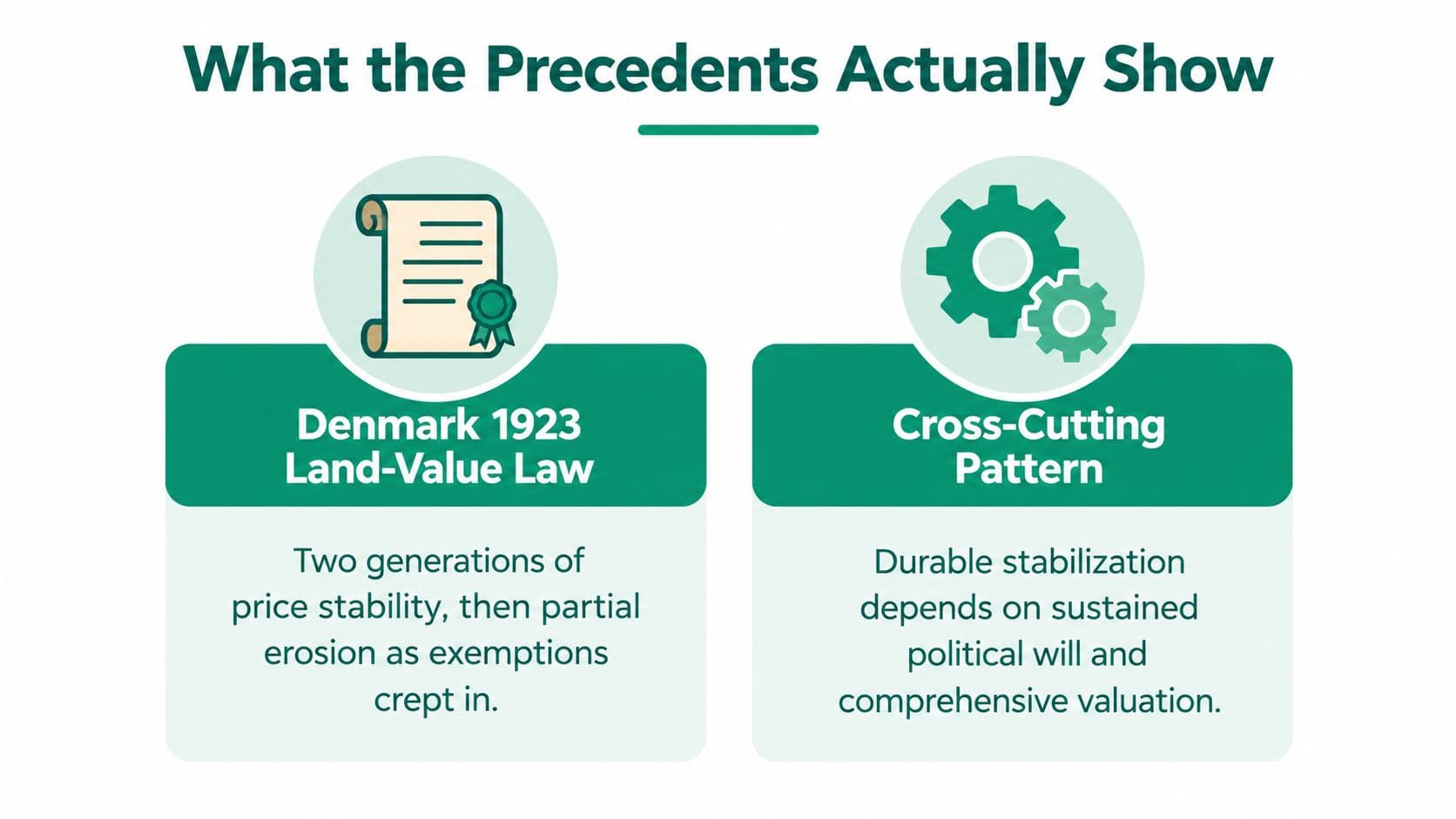
The argument for land repricing doesn't rest on one legal form. It rests on one operational pattern. Systems stabilize better when public policy keeps land values from sitting outside the fiscal frame.
The historical anchor people skip
A lot of housing officials still talk as if stabilization starts with service delivery. It doesn't. One of the clearest U.S. precedents is the Community Land Trust model. It evolved during the 1960s and received its first U.S. municipal funding in 1983, when Burlington, Vermont committed $200,000 to create the Burlington Community Land Trust, as documented in this history of the Burlington Community Land Trust. The design used 99-year leases and community control to remove land and housing from the speculative market while preserving long-term affordability.
That matters because it shows the mechanism. The stabilizing feature wasn't sentiment. It was taking land out of the speculative cycle.
The pattern across different models
Denmark, Estonia, Singapore, Alaska, Canberra, Norway, and Allentown are often grouped together for the wrong reason. The relevant comparison isn't national ideology or formal tenure label. It's whether the system continuously disciplines land value or merely manages fallout after appreciation.
Where governments sustain valuation discipline, they compress speculative margins and make public investment easier to recoup. Where they rely only on cleanup, subsidy, or one-time acquisition, the market often re-speculates cleaned land.
A second precedent worth keeping in mind is scale. New York's rent-regulation reporting shows the regulated housing system exceeded 1.06 million stabilized units statewide in reporting discussed within this anti-displacement review. That doesn't prove one instrument solves everything. It proves stabilization policy operates at system scale, and small design changes can move very large stocks.
Durable community stabilization depends less on legal form than on whether government keeps repricing pressure continuous instead of episodic.
Implementation From Valuation to Communication
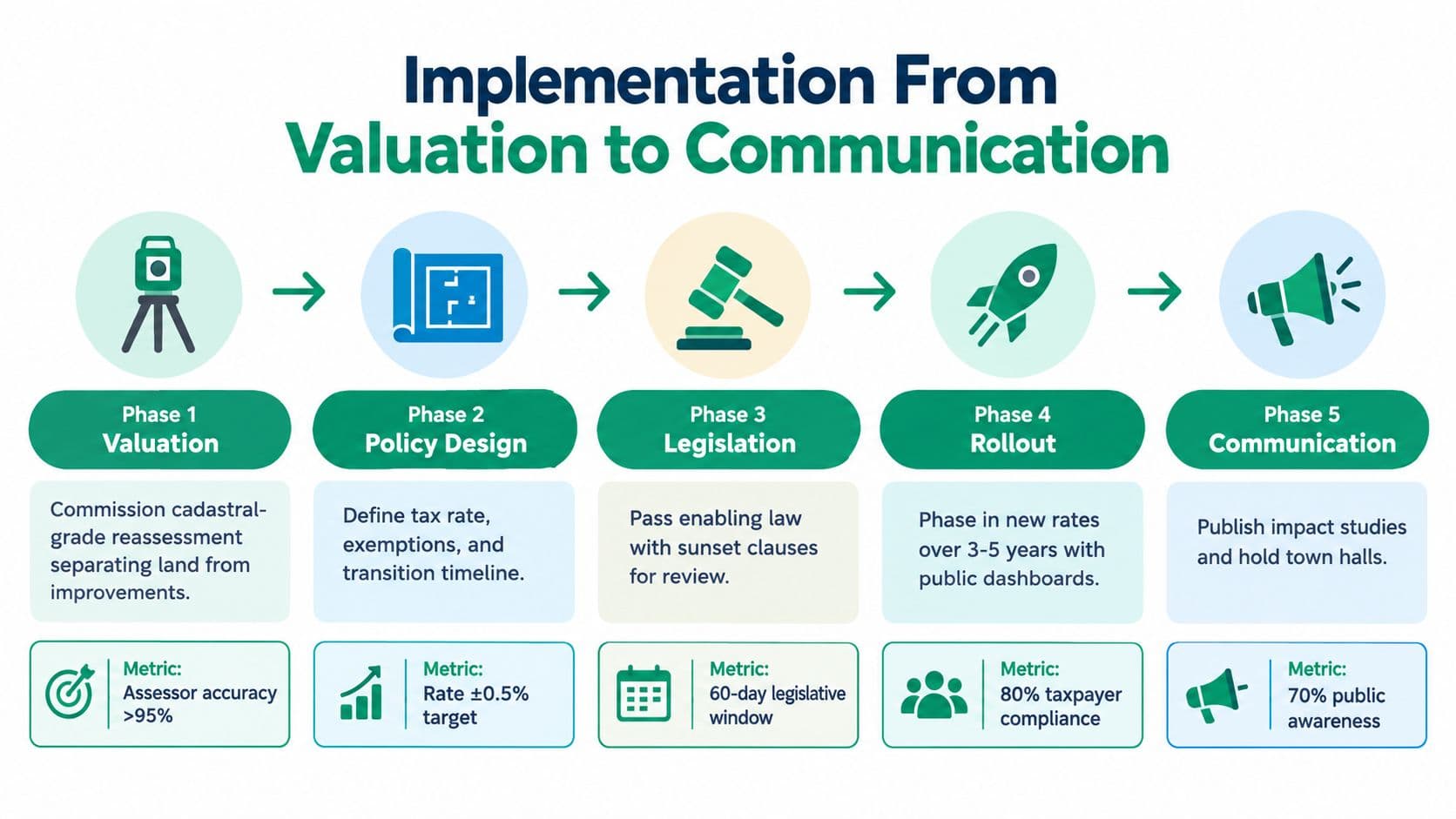
Most reforms fail in the handoff from concept to administration. The sequencing isn't glamorous, but it's where serious policy either survives or collapses.
Phase one and phase two
Phase 1 is valuation. Commission a cadastral-grade reassessment that separates land from improvements. Publish methods, publish the appeals window, and insist on quality assurance before rates are even discussed. If your assessment office can't explain why two adjacent parcels carry different site values, stop there and fix the data.
For readers working through the technical side, this introduction to mass appraisal methods is a useful reference.
Phase 2 is distributional and fiscal modeling. Model incidence across owner-occupied, rental, commercial, and vacant parcels. Run multiple land-price scenarios. Finance ministries should care less about headline winners and losers than about whether the tax base becomes more stable and less distortionary.
Use a hard decision gate between these phases. If the valuation file is weak, don't legislate. If the incidence model is weak, don't message.
Phase three, four, and five
Phase 3 is legislative design. Set the assessment ratio in law. Define hardship exemptions tightly. Specify vacancy-fee triggers, billing cadence, and appeal channels. If you are using a split-rate transition, write the schedule clearly enough that a taxpayer can follow it without a consultant.
Phase 4 is administrative rollout. Integrate the valuation roll with billing, code enforcement, registry data, and any land-bank disposition workflow. Staff the appeals board before notices go out, not after. Publish parcel-level data unless privacy law clearly forbids it.
Phase 5 is stakeholder education. Ratepayers need plain language. Assessors need technical manuals. Legislators need a fiscal note with scenario analysis. Journalists need a one-page explanation that answers the obvious attack line, which is that repricing land is "just a tax increase."
The communication frame should be fairness and function. Government created much of the site value. Government should recover part of it instead of taxing work and construction more heavily.
A disciplined five-phase process also helps manage heterogeneous local conditions. Federal Reserve analysis of the Neighborhood Stabilization Program found that in some targeted tracts, presumed owner-occupants were less likely to leave properties vacant, and in Wayne County NSP2 tracts saw significantly larger vacancy declines than comparison groups, while other counties showed no statistically significant vacancy differences in this Federal Reserve analysis of NSP vacancy outcomes. That is a blunt reminder that execution, property condition, and throughput matter. Funding alone doesn't stabilize neighborhoods.
Why Land-Value Reform Is the Spine of Stabilization
Finance and planning directors should stop treating land-value reform as a parallel initiative. It is the organizing axis.
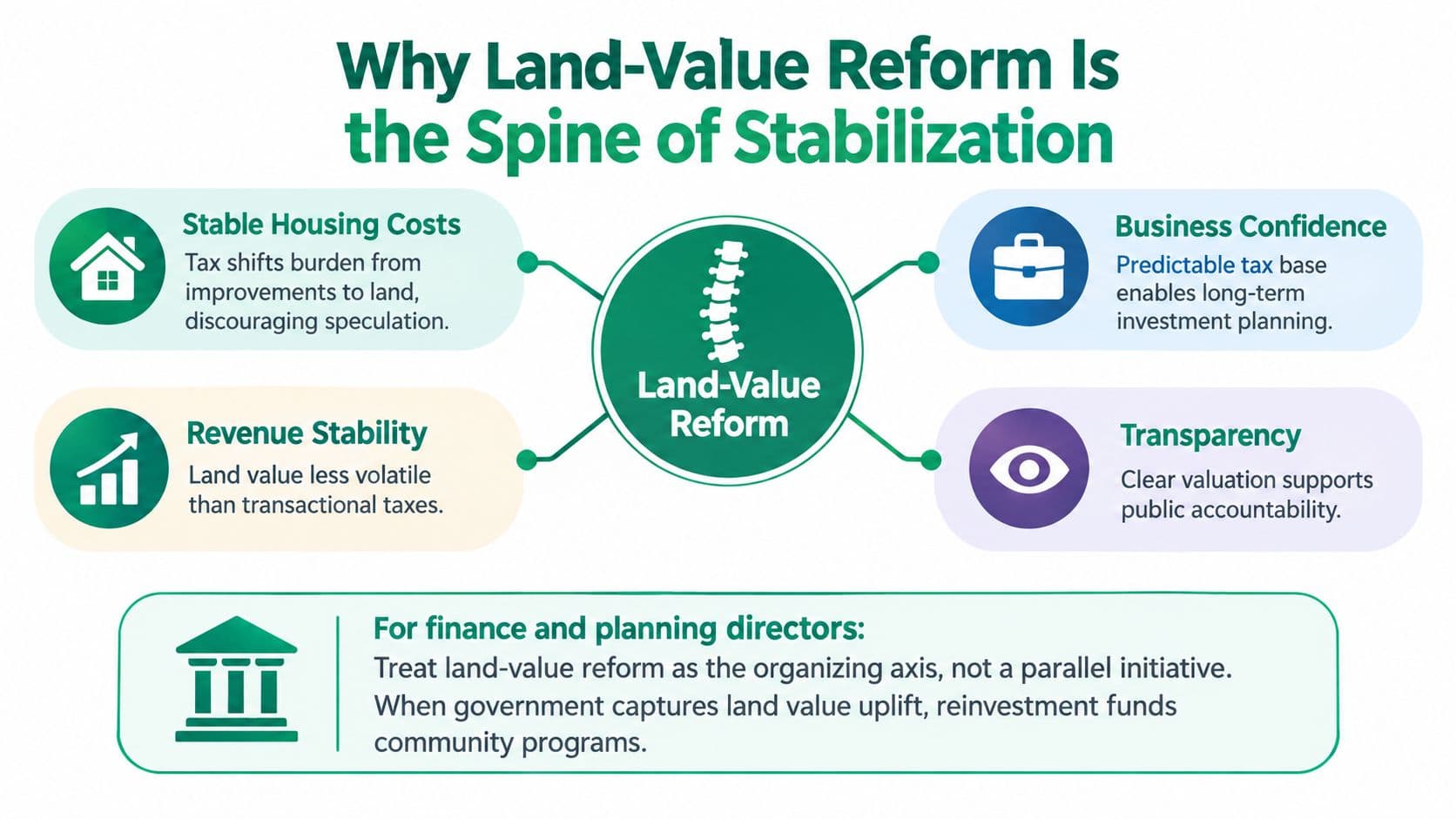
The reason is operational, not ideological. When government captures unearned land value through site-value taxation, disciplined land leases, land banks, or true annually repriced land-use rights, it gets two things at once. It gets a price signal that suppresses land withholding. It also gets a revenue stream that can fund anti-displacement measures, infrastructure, and neighborhood services.
That is how you turn community stabilization from a recurring budget fight into a built-in fiscal mechanism.
Three changes follow quickly:
- Budget stability improves because the public base tracks ground rent rather than leaning so heavily on taxes that punish construction, labor, or transactions.
- Displacement pressure eases because vacant and underused land becomes more expensive to sit on.
- Public investment becomes recoverable because government can recapture part of the value it creates.
The best diagnostic lens for sequencing these reforms is a tri-factor one. Separate labor, capital, and nature. Taxing buildings and work discourages production. Ignoring land rents encourages speculation. Blending the categories produces bad policy and muddled politics.
Community stabilization that depends on annual appropriations will keep losing ground to the land market. Community stabilization that is financed and enforced through the land base has a chance to last.
Unitism® works with governments and public bodies on land valuation, policy design, fiscal modeling, legislative drafting, and implementation support for land-based reform. If you're trying to make community stabilization financially durable rather than programmatically fragile, visit Unitism® and look at the valuation, transition, and education tools built for that job.