Understand the rental value of agricultural land: what drives it, four valuation methods, worked lease examples, and how leases differ from land-use rights.
October 5, 2026
Rental Value of Agricultural Land Explained
Understand the rental value of agricultural land: what drives it, four valuation methods, worked lease examples, and how leases differ from land-use rights.

Why can two fields with similar acreage, in the same broad farming region, command radically different rents? The answer usually isn't found in a county average. It lies in soil, water, access, cropping history, tenant competition, and the way the agreement prices risk over time.
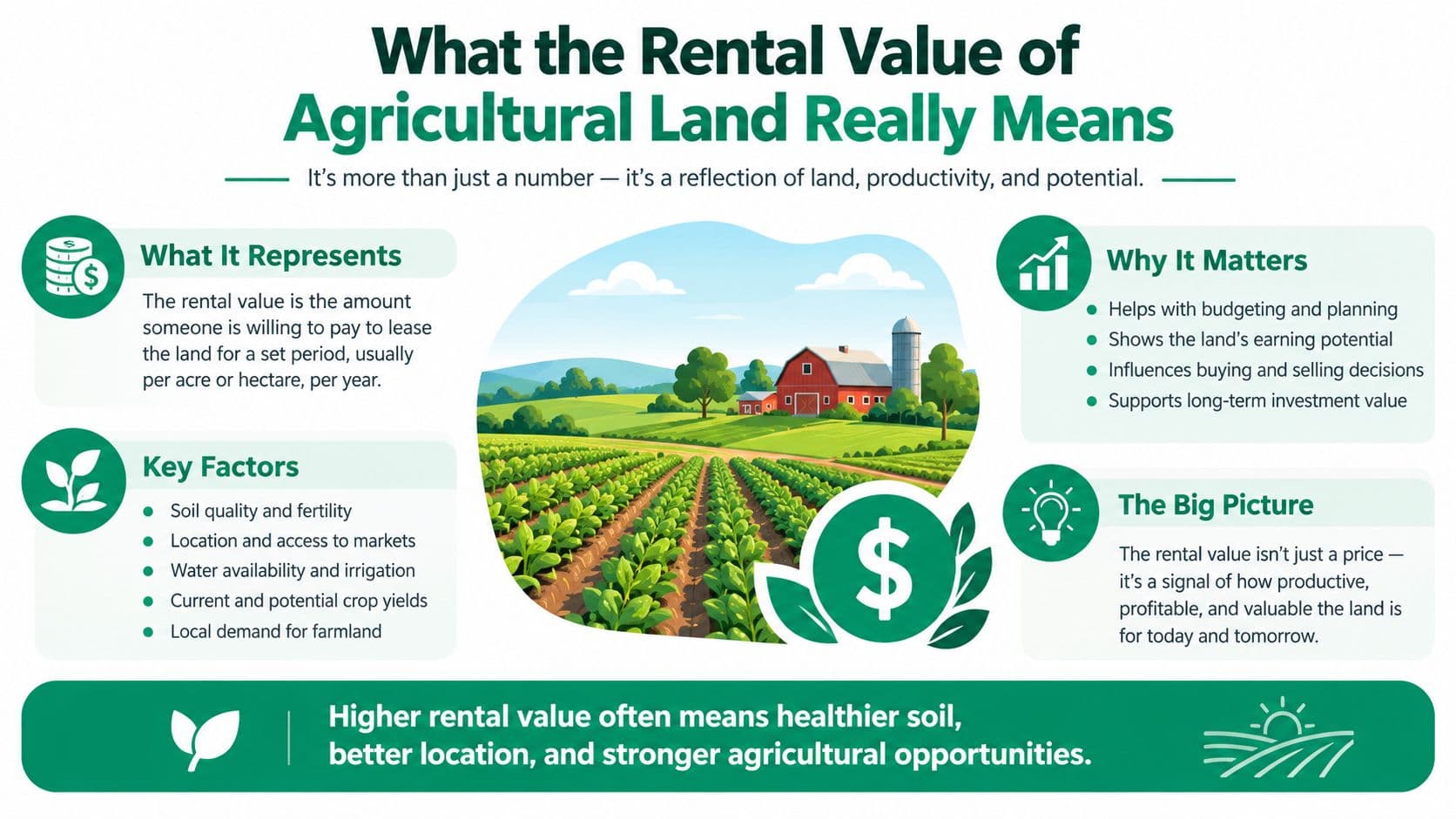
The rental value of agricultural land is the annual value of access to a productive site. It isn't the same as the land's sale price, and it isn't automatically equal to the average rent published for a county or state. A useful estimate must translate broad market evidence into a field-level judgment.
That distinction matters to three groups. Farmers need it to avoid paying more than a field can support. Landowners need it to capture genuine value without setting an unworkable rate. Ministries and local authorities need it to design land charges, subsidies, and public-revenue systems that reflect economic reality rather than arbitrary benchmarks.
Table of Contents
- Why Two Similar Fields Can Rent Very Differently
- What the Rental Value of Agricultural Land Really Means
- What Drives Rent on Any Given Field
- Four Ways to Estimate Site Rental Value
- Turning Published Averages Into Your Lease Number
- Land Leases, Land-Use Rights, and Land-Value Taxes Compared
- Why Rental Value Matters for Policy and for Your Pocket
Why Two Similar Fields Can Rent Very Differently
A tenant compares two fields that appear almost interchangeable. Both have similar acreage, both sit within reach of the same grain markets, and both are advertised as productive cropland. Yet one attracts a rent several times higher than the other.
The difference may be invisible from the road. One field drains quickly after heavy rain, has a regular shape, supports efficient machinery movement, and has a documented yield history. The other contains wet spots, awkward corners, a narrow entrance, and soil that needs expensive correction. Their acreage is similar, but their usable productive capacity isn't.
The same puzzle appears when a landowner compares a published regional average with a proposed lease. The average may combine irrigated and non-irrigated fields, large and fragmented parcels, strong and weak soils, and locations with very different levels of tenant competition. Treating that blended number as a quote for one property creates a false sense of precision. Guidance on choosing the best value driver is useful here because it encourages the parties to identify which characteristics explain the difference.
The field is an income-producing site
A farmer doesn't rent acres as abstract units. They rent expected production, workable field area, reliable access, and the right to use the site under agreed conditions. A landowner, meanwhile, is offering a bundle of advantages that may include drainage infrastructure, irrigation, buildings, fencing, and a favorable location.
That bundle produces a stream of potential farm income. The portion that can be paid to the landowner after allowing for the tenant's operating costs, risk, labor, and capital is the economic basis of rent. A field with better infrastructure can support a higher lease payment because it may reduce costs or protect yields, not merely because it looks more valuable on a map.
What this means for the reader
The practical task isn't to reject averages. Published averages provide an anchor. The task is to adjust the anchor using evidence that belongs to the specific parcel.
By the end of this guide, a tenant should be able to ask why a benchmark applies, a landowner should be able to document a defensible premium, and a policymaker should be able to distinguish annual site value from the price of owning land. The analysis also separates three institutions that are often confused: fixed-term land leases, genuine land-use rights, and land-value taxes.
What the Rental Value of Agricultural Land Really Means
Start with a simple comparison. A house has a sale price and a monthly rent. Those figures are related, but they aren't interchangeable. The sale price reflects ownership of an asset, while the rent reflects the value of using it for a defined period.
Agricultural land works the same way. Rental value is an annual payment for access to productive land. Land price is the amount someone pays to acquire the asset itself. A buyer may accept a low current rental return because they expect land prices to rise. Another buyer may demand a higher return because interest rates, farm risks, or future expectations have changed.
Economists often describe the relationship through capitalization. Capitalization converts an expected annual income into an asset value by applying a required rate of return. If that rate changes, the implied land price can change even when the current rent changes little. This is why a landowner shouldn't infer an annual lease rate mechanically from a sale price without examining financing conditions and expectations.
Benchmarks across different markets
The European Union's average rental price for arable land and permanent grassland was €173 per hectare in 2023. The country spread was wide: the Netherlands averaged €914 per hectare, Denmark €594, and Greece €498, while Slovakia, Croatia, and Malta averaged €67, €74, and €91 respectively. For permanent grassland alone, the range ran from €41 per hectare in Slovakia to €390 per hectare in Ireland. These figures come from the USDA land values and cash rents publication, which reproduces the stated European comparison.
The United States shows a different but complementary distinction. Average cropland rent was $136 per acre in 2013, up 8.8% from 2012 and nearly double the $73 per acre recorded in 2003. In 2024, average U.S. cropland rent reached $160 per acre, with irrigated cropland at $245 and non-irrigated cropland at $146. The same USDA material reports that about 40% of U.S. farmland has been rented over the last 30 years, while more than half of cropland is leased. Those figures show why rent is central to land access even though it remains distinct from the ownership price.
For readers who want a broader introduction to agricultural work and technology, an agriculture xag job ready course can provide useful context around the operational side of farm production. That context matters because rent is ultimately supported by what a tenant can produce, not by acreage alone.
The concept is closely related to economic rent in agriculture, but the practical calculation still requires field-level evidence.
Carry this rule forward: annual rent measures the value of using land, while the sale price measures the value of owning an asset whose future income and risks may change.
What Drives Rent on Any Given Field
A regional average becomes useful only after someone explains why the target field should sit above, near, or below it. The strongest explanations connect physical characteristics to farm income or cost.
Factors that support a premium
Soil type and fertility affect the crops a tenant can grow and the inputs required to reach a target yield. Deep, consistent soils with sound nutrient levels generally provide more dependable production than soils with shallow profiles or depleted fertility. Soil-test results turn a general claim about quality into evidence that both parties can inspect.
Drainage reduces the time a field remains too wet to work. Drainage tile can support timely planting and harvesting, reduce compaction risk, and make field operations more predictable. A landowner who documents the location and condition of drainage infrastructure gives the tenant something more useful than the phrase “well drained.”
Irrigation can raise rental value where dependable water protects production or expands cropping choices. The premium isn't automatic. Water access has value only when the system is legally available, operationally reliable, and economically useful for the crops and climate in question.
Field size and shape influence machinery efficiency. Large, regular fields usually require fewer turns and less time spent moving around obstructions. A tenant may accept a higher rent for that efficiency because the field can fit more easily into an existing operating system.
Access and location affect travel, transport, and harvest logistics. A field with a reliable entrance, suitable road access, and a short route to storage or processing may be more attractive than a field with the same soil class in a less convenient location.
Cropping history reveals how the soil has performed under actual management. Yield records, crop rotations, fertilizer applications, and evidence of compaction can expose differences that a soil map misses.
Factors that justify a discount
Small or irregular fields can carry a discount because machinery spends more time turning, moving, or avoiding boundaries. Obstructions, wet spots, poor access, and inconsistent soil can reduce the area that a tenant can use efficiently. These aren't minor inconveniences when they recur every season.
A tenant should also ask who pays to correct a defect. If the landowner funds drainage or supplies functioning irrigation, the improvement may support a higher rent. If the tenant must make the investment and bear the risk of recovery, the lease should account for that cost through a lower initial payment, a longer secure term, or another agreed mechanism.
Practical rule: price the productive service the field provides, not the acreage printed on the parcel map.
The evidence should work for both sides. Landowners can assemble soil tests, yield histories, productivity indices, drainage maps, irrigation records, and access details. Tenants can use the same documents to challenge an unsupported premium. A defensible negotiation doesn't ask whether the land is “good.” It asks which measurable features change expected revenue, operating cost, or risk, and who receives the benefit.
Four Ways to Estimate Site Rental Value
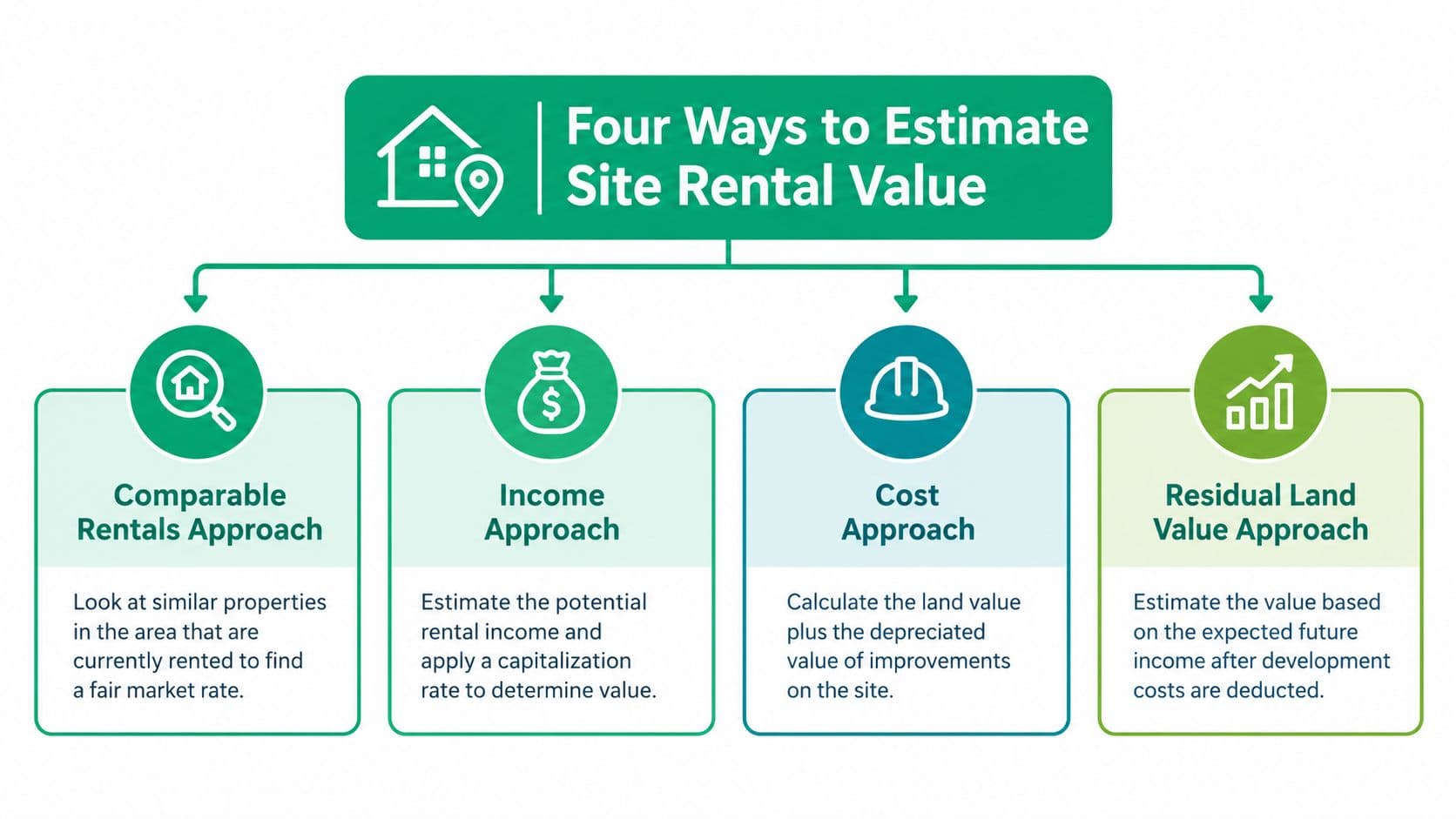
No single valuation method works in every market. A tenant negotiating one parcel needs a practical estimate. An appraiser needs a disciplined process. A tax authority needs consistency across many parcels. Four methods provide different answers because they start from different evidence.
Comparable rents
The comparable method asks what similar fields rented for. The best comparisons match soil, water access, field configuration, location, lease conditions, and timing. It works well where transactions are frequent and the recorded terms are reliable.
Its weakness is a thin market. A small number of leases can make an average look authoritative when it really reflects unusual circumstances, a related-party agreement, or a field with features unlike the subject property. Comparables also conceal the reasons for the price unless the underlying attributes are recorded.
Capitalization
The capitalization method starts with land price and converts it into an implied annual return. It can help an owner test whether a proposed rent is consistent with an asset valuation and a required return.
The failure point is the capitalization rate. Interest rates, perceived farm risk, inflation expectations, and land-market optimism can all affect the rate. A land price may rise because buyers expect future appreciation, not because current agricultural rent has risen by the same amount. The method is therefore a cross-check, not a substitute for operating evidence. A practical explanation of the relationship appears in calculating land value.
Hedonic analysis
A hedonic model uses many observations to isolate the contribution of individual features. It can estimate how soil class, irrigation, parcel size, buildings, access, or location relate to rent while holding other characteristics broadly constant.
This method is powerful for an assessor or ministry with a strong database. It demands clean records, consistent definitions, and enough observations across different field types. If the dataset is weak, the model can produce a precise-looking result that rests on unstable assumptions.
Productivity and residual income
A productivity-based estimate begins with expected crop revenue and subtracts non-land costs. The residual is the amount available to compensate land, after accounting for labor, machinery, seed, fertilizer, financing, management, and an allowance for risk. This method speaks directly to the tenant's business reality.
Its weakness is sensitivity to prices, yields, input costs, and management assumptions. A productive field can still support only a modest rent during a difficult price cycle. The method also handles ecosystem services, conservation benefits, and seasonal rent structures poorly unless the analyst defines those benefits and payment periods explicitly.
A tenant can combine a few credible comparables with a simple residual-income check. A professional appraiser may add capitalization and hedonic analysis. A tax authority should generally triangulate across methods, then apply a transparent rule consistently. The goal isn't to find a magical single number. It's to identify a range that survives scrutiny from both the person paying and the person receiving the rent.
Turning Published Averages Into Your Lease Number
A published average is a starting benchmark, not a ready-made lease offer. The conversion should follow a clear sequence: identify the correct market, classify water access, assess soil and field condition, then test the result against local competition and the tenant's budget.
The 2025 U.S. benchmark provides a useful starting point. Average cropland rent was $161 per acre, irrigated cropland averaged $244, and non-irrigated cropland averaged $147. State outcomes diverged sharply, with Iowa at $271 per acre, California at $346, and Texas dry cropland at $36.50. These figures are reported in the 2025 USDA cash rents and land values publication.
Consider a non-irrigated field in a state where the relevant benchmark is $147 per acre. That figure should be adjusted downward if the parcel has wet spots, weak access, poor fertility, or a fragmented shape. It should move upward relative to comparable non-irrigated fields if the soil is consistent, drainage is strong, machinery access is easy, and nearby tenants are competing for land. The result is a defensible position for negotiation, not an invented formula.
| Starting benchmark | Adjustment factor | Effect on rent |
|---|---|---|
| Relevant non-irrigated regional or state average | Soil class and verified yield history | Higher for consistent, productive soils, lower for weak or variable performance |
| Correct crop category | Irrigation or dependable water access | Higher where water is reliable and economically useful |
| Comparable field set | Drainage, shape, access, and obstructions | Higher for efficient fields, lower for difficult operations |
| Market benchmark | Local tenant competition and farm margins | Stronger competition can support a premium, while weak margins limit it |
The same process travels to a very different region. A California irrigated field shouldn't be compared directly with Texas dry cropland because both are measured per acre. Start with the correct local benchmark, then examine water reliability, crop mix, soil performance, and tenant demand. The broad gap between the reported state outcomes is a warning against applying one national number mechanically.
Recent evidence also argues for caution. Iowa cash rents fell 2.9% in 2025 to $271 per acre, the first decline since 2019, while U.S. cropland rent was nearly flat. Maryland non-irrigated cropland fell from $124 to $120 per acre in 2025, according to the Iowa State cash rental rate survey. A strong historical average may therefore overstate what a tenant can safely pay today.
Land Leases, Land-Use Rights, and Land-Value Taxes Compared
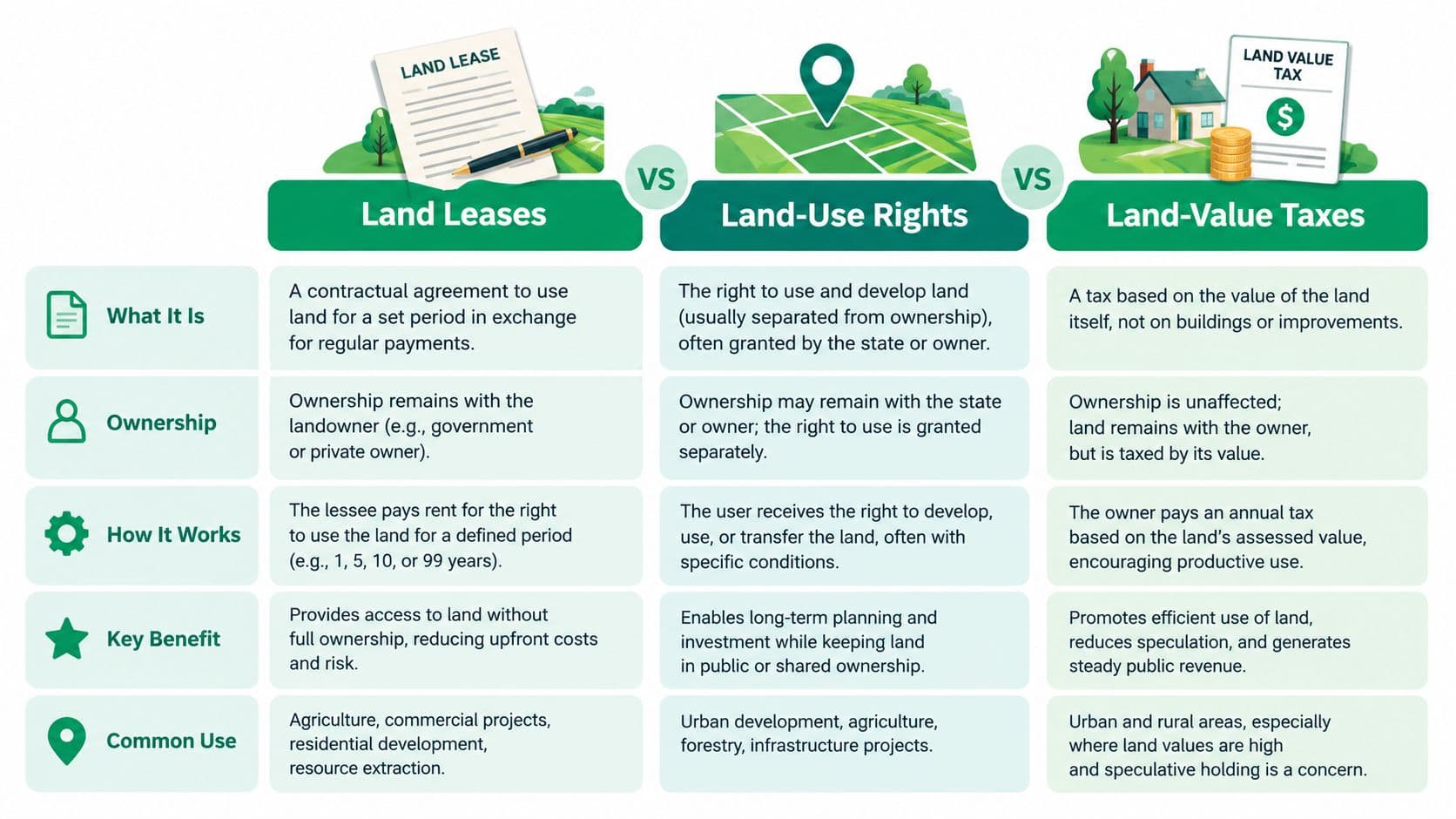
These three arrangements answer different questions. A land lease grants use for a defined period under agreed terms. A land-use right, in the strict sense used here, grants indefinite use and is repriced annually. A land-value tax is a public charge on the value of land, rather than a private contract for possession.
Fixed-term land leases
Land leases are either renewable or non-renewable fixed-term agreements with a fixed price. They can provide useful certainty for a farmer and predictable income for a landowner, but the fixed price doesn't correctly price changing risk. It postpones risk.
With a renewable lease, the parties may tolerate a gap between the contract rate and the current market for the duration of the term. At renewal, that accumulated gap can be closed in one major repricing. The tenant then faces a sudden cost increase, while the landowner may face conflict or vacancy.
A non-renewable lease has the opposite difficulty near expiration. Financing and resale can become progressively harder because the remaining access period is shrinking. A buyer or lender must account for the approaching loss of use. The analysis of 99-year land leases illustrates why a long term doesn't automatically remove the underlying pricing problem.
Genuine land-use rights
A genuine land-use right is indefinite, never expires, requires no renewal, and is repriced every year. Because the payment is updated annually, the right can be bought and sold at relatively low cost without forcing a buyer to wait for a distant lease renewal. Annual repricing keeps the charge closer to current land value.
This arrangement differs from a fixed lease even if someone uses the same label. Some fixed leases are marketed as “land-use rights,” but they aren't land-use rights unless they meet all three conditions: annual repricing, no renewal requirement, and no expiration. A contract that lasts for a fixed term and has a fixed price remains a fixed lease.
The economic purpose is to price access to land while leaving labor, enterprise, and productive investment free to respond to changing conditions. The user pays for the site, not for a permanent penalty on the business built or operated there.
Land-value taxes
A land-value tax is imposed by a public authority and assessed according to the value of the land. It doesn't grant possession in the way a lease does, and it doesn't create a private transferable right in the same way as an annually repriced land-use right. It raises public revenue from the location or site value while the owner or user retains responsibility for lawful use.
The distinction matters when discussing public finance. Property taxation can fund public services, as explained in this overview of how property tax funds local services, but a land-value tax focuses specifically on land value rather than treating buildings and productive improvements as the same tax base.
Annual reassessment is essential when land conditions change. Official FHWA guidance on land value taxation states that rezoned properties should be reassessed to reflect the development potential created by the change. That is the same periodic-repricing logic that distinguishes current land value from a fixed charge locked into an old contract.
Why Rental Value Matters for Policy and for Your Pocket
Rental value connects private farm decisions to public policy because it measures the economic benefit created by access to land. A government that wants to raise revenue from land, distribute a resource dividend, or design site-value taxation needs a credible estimate of that benefit. A farmer and landowner need the same estimate to negotiate without confusing land income with returns to labor, machinery, or management.
Policy transfers create a further complication. Direct agricultural payments can increase the amount a tenant can bid, allowing part of the support to flow into land rent. An Italian microdata study found that rental price per hectare was significantly influenced by plot size, average parcel dimension, rural buildings, the tenant farm's economic size, farm specialization, and the coupling of CAP subsidies to the lease contract. Another European analysis found that an additional €100 per hectare in direct payments raises land rents by about €10 to €15 per hectare, meaning roughly 10% to 15% of subsidy value can be capitalized into rent. These findings are documented in the research on subsidies and agricultural land rents.
What landowners and tenants can do
A landowner should separate the rent attributable to soil, water, access, and improvements from a premium based only on optimistic expectations. The owner should also specify who maintains drainage, protects fertility, repairs infrastructure, and bears the cost of unusual events.
A tenant should prepare a field budget before agreeing to a headline rate. Expected yield and price matter, but so do machinery use, input costs, travel time, financing, labor, conservation obligations, and the security of the term. A lease that appears affordable can become expensive if it shifts major maintenance or soil-restoration duties onto the tenant.
For ministries and local authorities, the central lesson is distributional. A subsidy intended for producers may partly raise the value of land held by owners. A land-based charge may recover some of that publicly created or policy-supported value, but its design must account for assessment quality, transition conditions, and the difference between land and improvements. The analysis of shifting the tax burden provides a policy lens for considering those choices.
A practical checklist
- For a tenant: compare the field with the correct irrigated or non-irrigated benchmark, then document every cost or limitation that changes residual income.
- For a landowner: support premiums with soil tests, yield records, drainage maps, water documentation, and access evidence.
- For a public official: publish the valuation method, reassess when land-use potential changes, and test who receives the benefit of subsidies or infrastructure.
- For both parties: write maintenance, conservation, renewal, repricing, and improvement obligations into the agreement rather than relying on informal expectations.
Rental value is not just a number to place in a lease. It is a way to identify who benefits from land, who bears the risk, and whether the institution collecting the value updates its claim as conditions change.
Use a field-level rent assessment to compare your soil class, water access, productivity history, and lease terms before the next negotiation. Unitism® offers land-value research, valuation frameworks, policy design, distributional modeling, and implementation support for organizations working with site rental values, so visit Unitism® to explore how those tools can support a clearer agricultural land policy or lease decision.