Learn how a community solar program works, from virtual net-metering to LMI design with policy models and 2026 guidance.
July 25, 2026
Community Solar Program: 2026 Guide & Implementation Tips
Learn how a community solar program works, from virtual net-metering to LMI design with policy models and 2026 guidance.
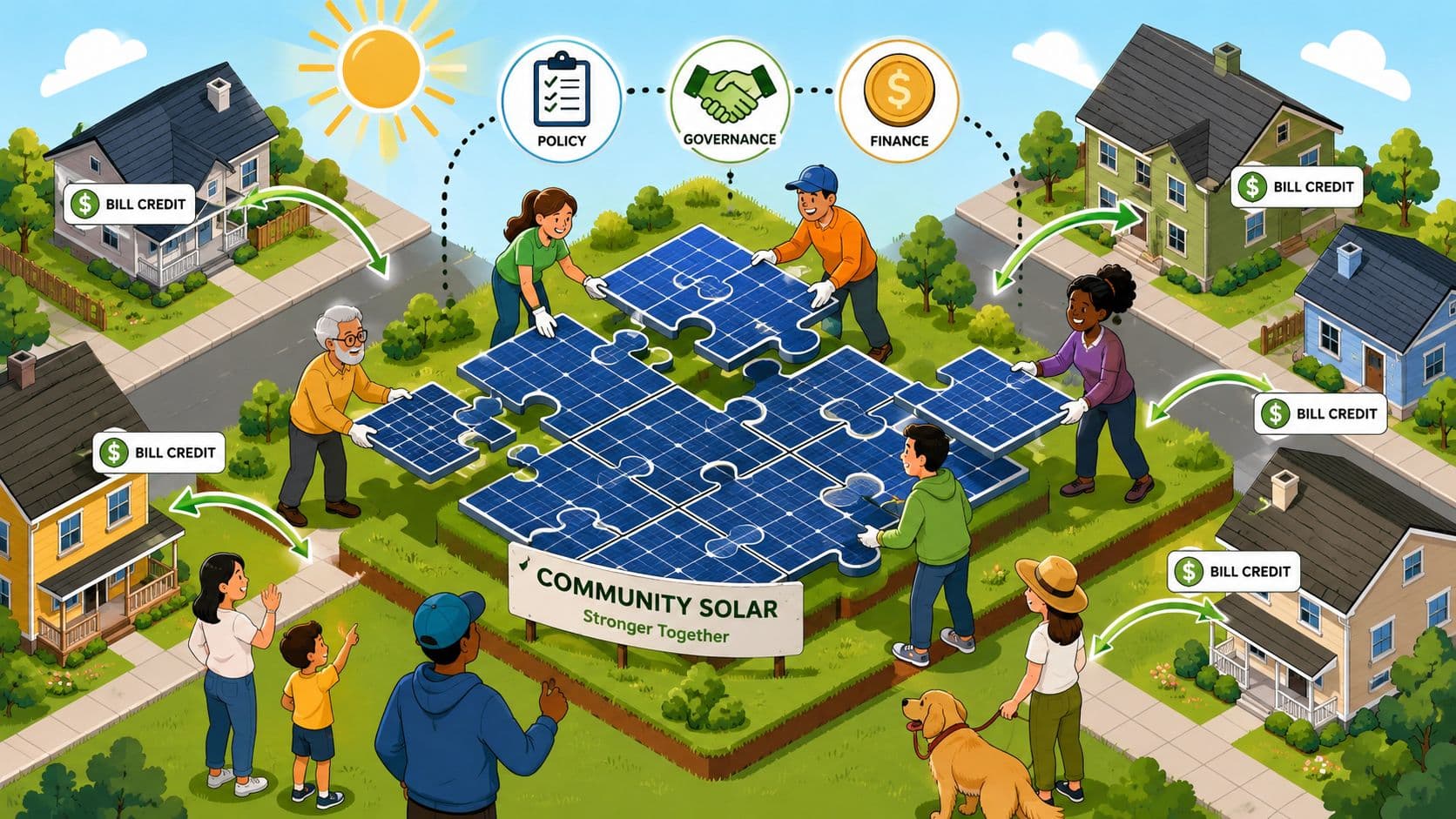
Community solar is no longer a side story in U.S. energy policy. As of 2025, 44 states have community solar programs and 24 states have legislation enabling them, which means the model has moved from pilot logic to mainstream retail-energy design (RMI policy overview). That shift matters because the key question is no longer whether solar can be shared, it's who controls the subscription, who gets the bill credit, and who captures the value stream.
That's why the strongest way to analyze a Community Solar Program is as a regulated retail-energy product, not just a renewable project. The panels matter, but the settlement rules matter more, and the siting choices matter because they shape whether the program reaches renters, multifamily residents, nonprofits, and municipalities that can't host rooftop arrays. If you're also comparing distributed-energy models that turn a physical asset into a customer-facing service, the logic behind unlocking your solar battery value is a useful parallel, because value comes from the market structure around the asset, not just the hardware itself.
Table of Contents
- Why Community Solar Now Looks Like a Retail-Energy Product
- How a Community Solar Program Works
- Comparing the Four Common Program Models
- Subscriber Management, Credit Banking, and Land Use
- Stakeholder Engagement and Implementation Steps
- Distributional and Fiscal Impacts Worth Measuring
- Two Programs That Show What Works in Practice
- A Diagnostic Checklist for 2026 Program Design
Why Community Solar Now Looks Like a Retail-Energy Product
Community solar is no longer a novelty market. DOE's market tracker put U.S. community solar at about 7.87 GW in operation as of June 2024, across 44 states and localities, including the District of Columbia, and more than three quarters of that capacity sat in just four states: Florida, New York, Massachusetts, and Minnesota (DOE market trends). That concentration matters because large programs do not rise or fall on project count alone. They rise or fall on whether the program settles credits cleanly, keeps subscribers from churning, and gives utilities a revenue flow they can administer without constant dispute.
What the product really is
DOE defines community solar as a project or purchasing program within a geographic area whose benefits flow to multiple customers, with subscribers typically receiving a monthly bill credit for their share of an off-site array (DOE community solar definition). That structure makes the program look less like a construction effort and more like a regulated retail contract with a distributed-generation backend. The panels are the asset, but the subscription terms determine who gets paid, who bears friction, and who can participate.
Practical rule: If a program cannot show how a subscriber turns kilowatt-hours into a bill credit, it does not yet have a retail design. It has a project idea.
That same lens also changes how siting is evaluated. A project on low-value land, a landfill, or unused land outside urban areas can be a sensible choice, but only if the settlement rules let the value flow to the intended customers rather than leaking into fees, cross-subsidies, or landlord capture (WRI on community solar siting and access). Land use rights matter here as fiscal levers, because the siting decision can determine whether value accrues to subscribers, local landowners, or intermediaries. The issue is similar in other distributed-energy arrangements where revenue depends less on physical installation than on how the asset is aggregated, credited, and monetized. A land trust structure can also change who holds the long-term site benefit, which is why the land-use layer deserves more attention than it often gets. See how a land trust can structure site control and long-term value.
Why the policy lens matters
A retail-energy lens forces three questions that many glossy community solar explainers skip. Who owns the asset. Who recruits the customer. Who takes the risk if subscription load changes. Those answers determine whether the program is bankable, equitable, and politically durable.
The same logic applies to storage-backed retail structures. If a program later pairs solar with batteries, the value still depends on how output is assigned, credited, and sold, which is why models discussed in how battery storage value is accessed through virtual power plant structures matter for program design. Community solar works best when the program can keep the bill-credit formula clear, assign customer rights cleanly, and preserve enough margin for developers without shifting hidden costs onto unsubscribed ratepayers.
How a Community Solar Program Works
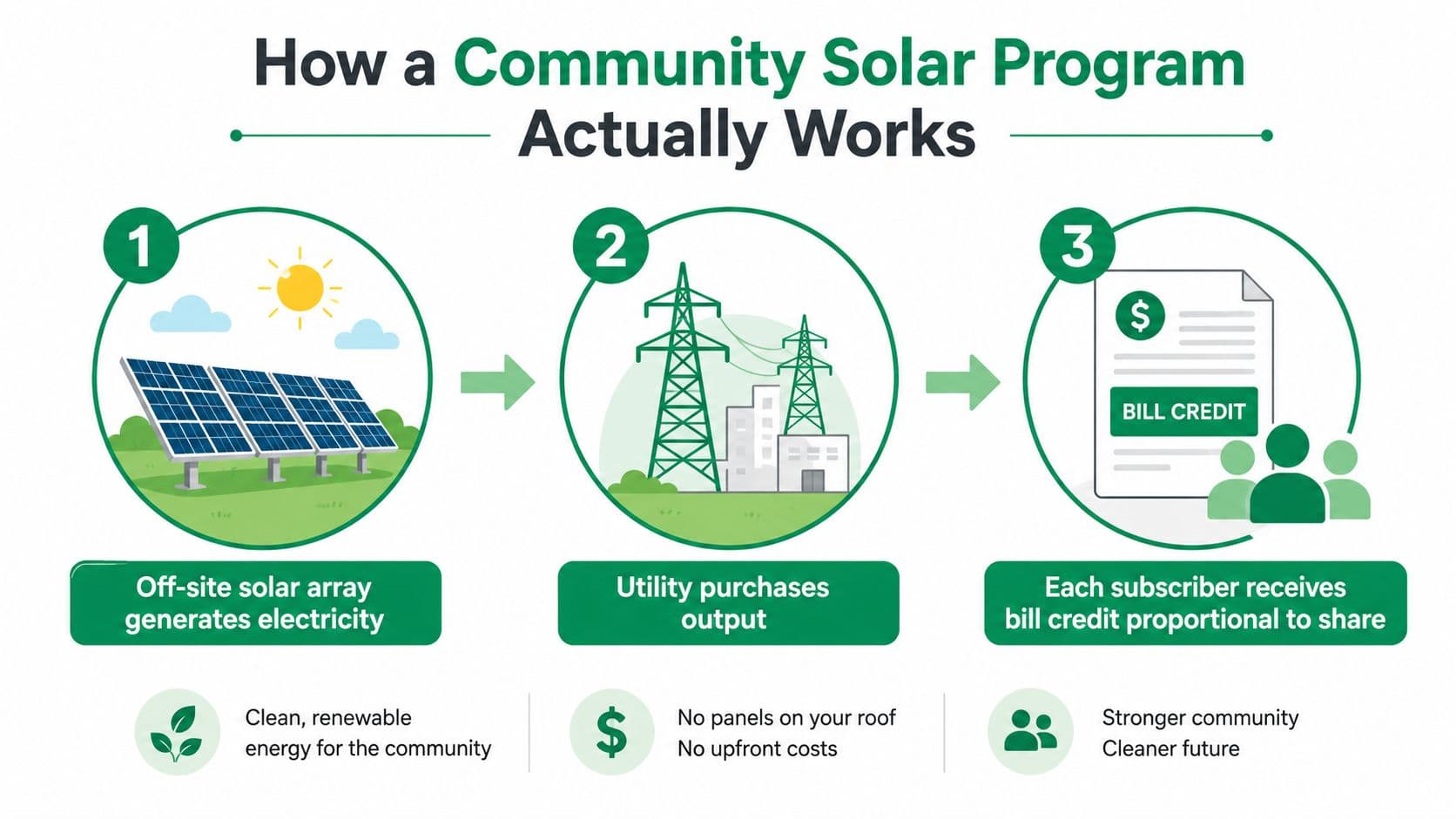
A community solar program is a regulated retail-energy arrangement built around virtual net metering. A single off-site array produces electricity, the utility buys that output, and each subscriber receives a bill credit tied to the share of generation assigned to them. The structure is closer to a retail invoice adjustment than to a private ownership stake in a power plant.
The subscriber sees a bill, not a power plant
From the customer side, the monthly sequence is straightforward. The array generates power. The utility applies the subscriber's bill credit. The subscriber pays the program's recurring subscription fee instead of paying for rooftop hardware, inverters, maintenance, or roof repairs. The economics depend on the spread between the value of the bill credit and the subscription price.
That structure is why the model fits renters, multifamily residents, small businesses, nonprofits, and municipalities that cannot install on-site PV (DOE basics). It separates solar access from roof suitability and from property ownership. A household does not need to control the roof, and an organization does not need a structurally favorable building, only a program that lets it subscribe.
A useful internal comparison comes from land policy. A land-trust framework clarifies how access rights can be packaged separately from ownership, which is why it helps to read the community solar subscription as a claim on a defined value stream rather than on the underlying asset: what a land trust is. The important point is who captures the long-term value, the subscriber, the site owner, or an intermediary.
The size and interconnection rules shape the market
Program design also narrows the addressable market through technical limits. Maryland's program shows the point clearly. Individual projects are capped at 5 MW, and projects over 2 MW require a CPCN (DOE basics). Those rules do more than govern engineering. They shape who can build, where projects can sit, and how quickly a pipeline can move.
The siting layer matters for fiscal as well as operational reasons. If the landowner holds scarce development rights, part of the value stream can shift before any subscriber sees a credit. That is why site control, easements, and land-value capture deserve the same attention as subscription enrollment and utility billing.
Community solar is therefore not just solar. It is a regulated retail product with a grid-connected delivery chain. If the utility billing path is clunky or the project-size rules are too restrictive, the program can look healthy on paper and still fail to attract enough subscribers to hold up financially.
Comparing the Four Common Program Models
The four models practitioners keep returning to are utility-led, subscriber-based, municipal, and non-profit. The labels sound like ownership distinctions, but the key distinction is about who controls the customer relationship and where the political risk lands.
| Model | Asset Owner | Subscriber Recruitment | Bill Credit Path | Strongest Fit |
|---|---|---|---|---|
| Utility-led | Utility | Utility or utility partner | Directly through utility billing | Speed, billing integration, administrative simplicity |
| Subscriber-based | Private developer | Developer or subscription partner | Utility-issued bill credit, with private subscription billing | Capital efficiency, fast scaling, broad market reach |
| Municipal | City or county | Local government or its contractor | Utility credit tied to municipal program rules | Mission alignment, local accountability, public trust |
| Non-profit | Community organization or anchor institution | Non-profit network, advocates, or local partners | Utility credit plus mission-driven enrollment | Underserved communities, trust-building, LMI outreach |
Where each model tends to win
Utility-led programs can move fast because the utility already controls the billing relationship. That integration lowers friction, but it also concentrates public skepticism if ratepayers think the program is being used as a revenue-protection device rather than an access tool. Utility ownership can be efficient, but it often needs stronger guardrails to prove it isn't shifting costs onto nonparticipants.
Subscriber-based programs usually win on capital efficiency. Private developers know how to finance arrays, build portfolios, and market subscriptions. The trade-off is obvious, because marketing pressure can crowd out equity unless the rules force transparent subscriber allocation, consumer protections, and meaningful LMI participation.
Municipal programs work when local leaders want visible accountability. A city or county can link the project to public land, local climate goals, or economic development plans. That makes sense when the jurisdiction wants direct control over siting and tenant protections, but it also means local finance staff need to be comfortable with procurement and credit support.
Non-profit models are often the best fit where trust is a primary bottleneck. Community organizations can explain the program in plain language, recruit households that distrust utility marketing, and coordinate with housing providers. The limitation is scale, since these models usually depend on grants, partner capacity, or a very capable anchor organization.
Decision shortcut: If your jurisdiction has strong utility billing systems but weak outreach trust, you need a different model than a jurisdiction with a strong civic network and limited private developer appetite.
Subscriber Management, Credit Banking, and Land Use
The panels do not decide whether a community solar program works. The delivery rules do. Two programs can use the same technology and produce very different results if one handles subscriber churn well and the other does not, or if one captures land value for the public and the other gives away site access for free.
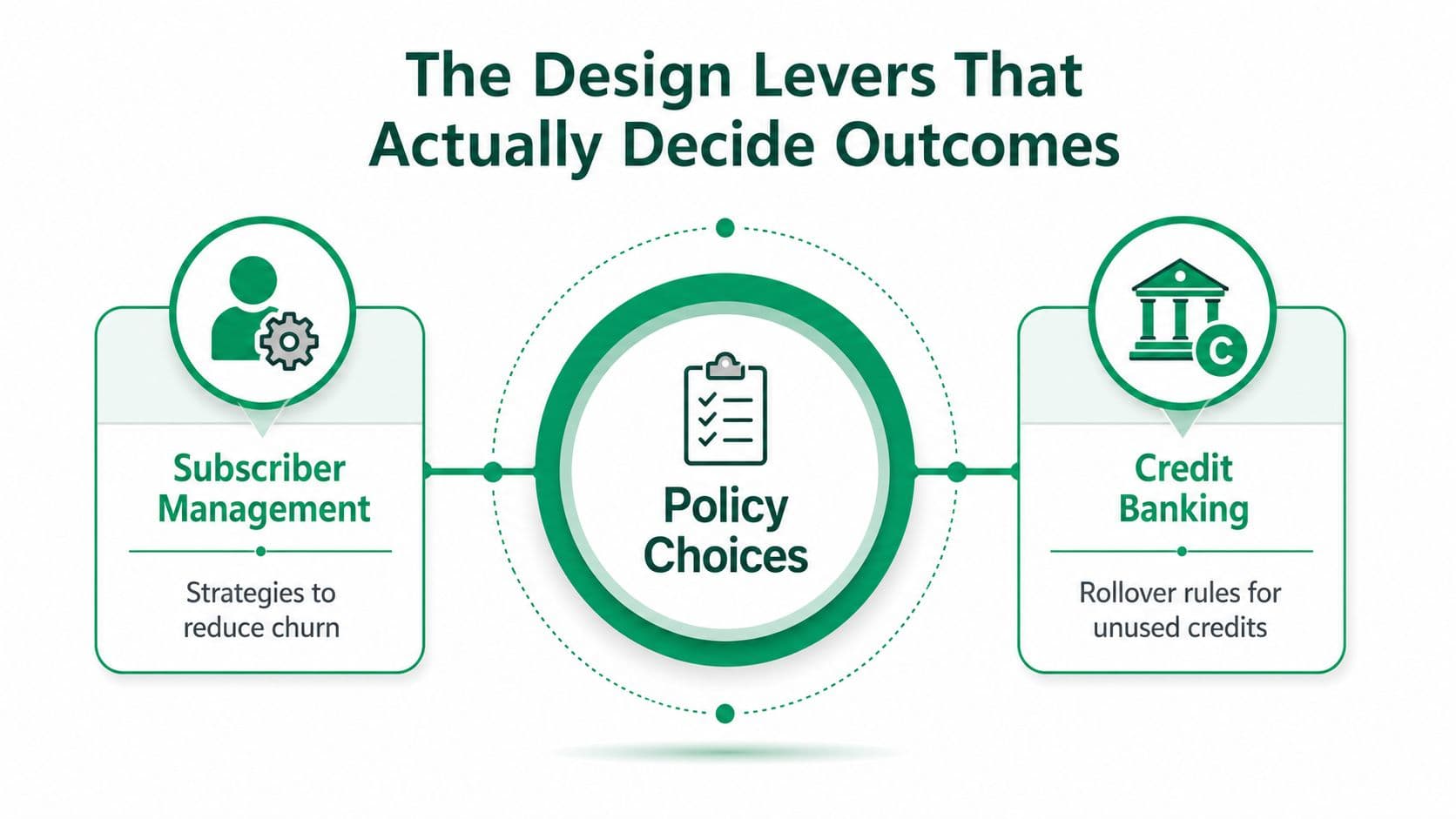
Subscriber management and credit banking are not admin details
The Community Solar Access policy guidebook treats subscriber management and credit banking as core controls, not back-office chores. It recommends that subscriber lists be changeable in real time or at least monthly, and that unsubscribed bill credits be bankable for at least one year so turnover and load variation do not damage project revenue or customer savings. That is the operational difference between a stable portfolio and a program that loses value whenever a tenant moves or a small business changes usage.
The same control logic shows up in other metering-heavy systems, including water submetering and leak detection. If usage, accounts, and billing do not reconcile cleanly, value leaks even when the physical asset performs well.
If the program cannot replace a departing subscriber quickly, the economics punish everyone else in the pool.
California's 2024 redesign shows how serious that issue becomes when a market matures. The CPUC moved away from earlier community solar tariff structures and launched a new Community Renewable Energy program to avoid shifting costs to non-participating ratepayers. That matters because program durability depends on whether the utility, regulators, and ratepayers view the rules as fair.
Land use is a fiscal lever, not just a siting question
A lot of communities treat cheap land as an incidental development benefit. It is not incidental. A project on a landfill, vacant municipal parcel, or underused public site can convert a low-yield land use into a public asset, but only if the lease structure captures part of that land value for the public.
That is where land-value tax and land-use rights need to be kept distinct. A land-value tax is a tax on the site value of land. Land-use rights are land leases repriced annually with no expiration dates, and because they are repriced annually, they can be bought and sold at relatively low cost. Those rights can be used as a siting tool for community solar because they let a city keep long-run control of a parcel while giving a developer enough certainty to build.
A land-value approach and an annually repriced use-rights approach both push against speculation, but they are not the same instrument. The first is a tax reform. The second is a leasing and access framework. Used together, they can make discounted leases on landfills or municipal vacant land politically easier to justify, because the public can point to a measurable capture of land value rather than a hidden giveaway.
The internal comparison between the two is worth reading alongside land-value tax vs property tax, especially if your local government is trying to decide whether to subsidize the site, tax the site, or lease the site differently.
Stakeholder Engagement and Implementation Steps
The first implementation failure usually happens in consultation, not construction. A community solar program works better when the utility, LMI advocates, municipal finance staff, housing agencies, and tribal authority where applicable are involved before the rules are locked in. If those parties arrive late, the program tends to be redesigned under pressure, and the result is usually weaker subscriber access or a billing model that is harder to administer.
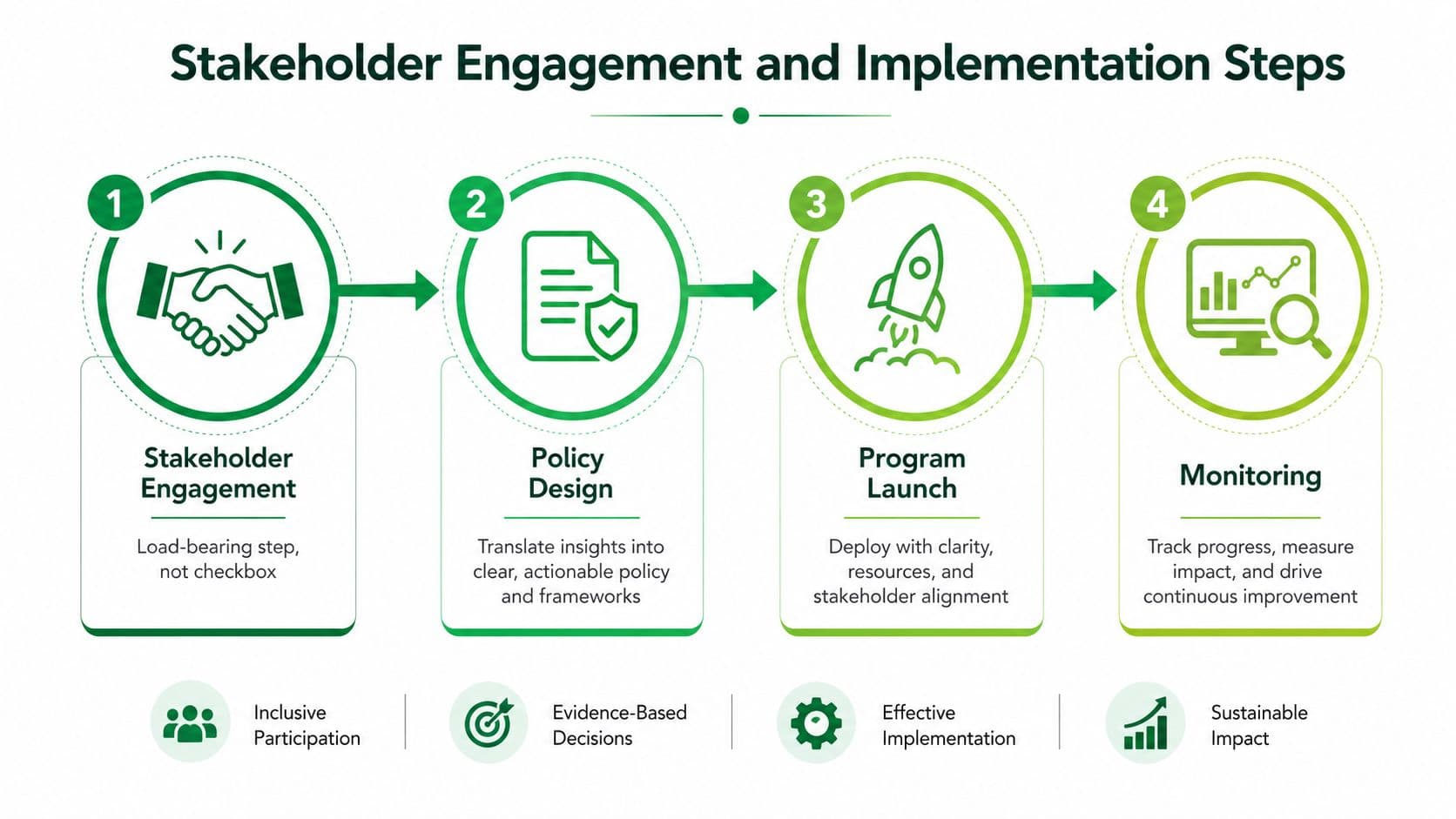
The sequence that avoids predictable failures
The DOE workbook is direct about the conditions that make participation workable. Programs need clear eligibility rules, community engagement plans, no credit checks where possible, linguistically accessible outreach, and in some cases no-cost or consolidated billing. It also recommends compensating community participants and considering job training, because participation is a trust and capacity issue as much as an enrollment issue (DOE workbook).
That sequence usually looks like this:
- Stakeholder engagement: Identify the parties that can block or stabilize the program, then get their constraints on the record early.
- Policy design consultation: Test subscriber rules, eligibility definitions, and bill-credit mechanics before drafting.
- Subscriber platform procurement: Choose the system that can reconcile credits, changes, and billing without manual workarounds.
- Marketing and outreach: Use plain language, multilingual materials, and trusted intermediaries, especially for LMI households.
- Launch and monitoring: Track enrollment churn, bill-credit settlement, and complaints from day one.
The infrastructure funding question matters here because community solar programs often fail at the gap between policy ambition and administrative capacity. A program can look sound on paper and still stall if the utility, the state, and the developer do not have a clear path for data sharing, billing coordination, and customer service.
Administrative friction is the real equity test
NREL guidance adds a detail that matters a lot in multifamily affordable housing. Those sites may need special subscription limits and lower subscription rates to improve uptake (DOE workbook). The point is not whether solar is available. The point is whether the program can fit tenant turnover, building billing arrangements, and landlord-tenant relationships without becoming too cumbersome to use.
A program that looks equitable in rulemaking can still miss the households it is supposed to serve if enrollment is too rigid or the billing system is too opaque. In a retail-energy product, those details determine who captures the value stream, whether subscribers retain savings, and whether the program feels usable instead of theoretical.
Distributional and Fiscal Impacts Worth Measuring
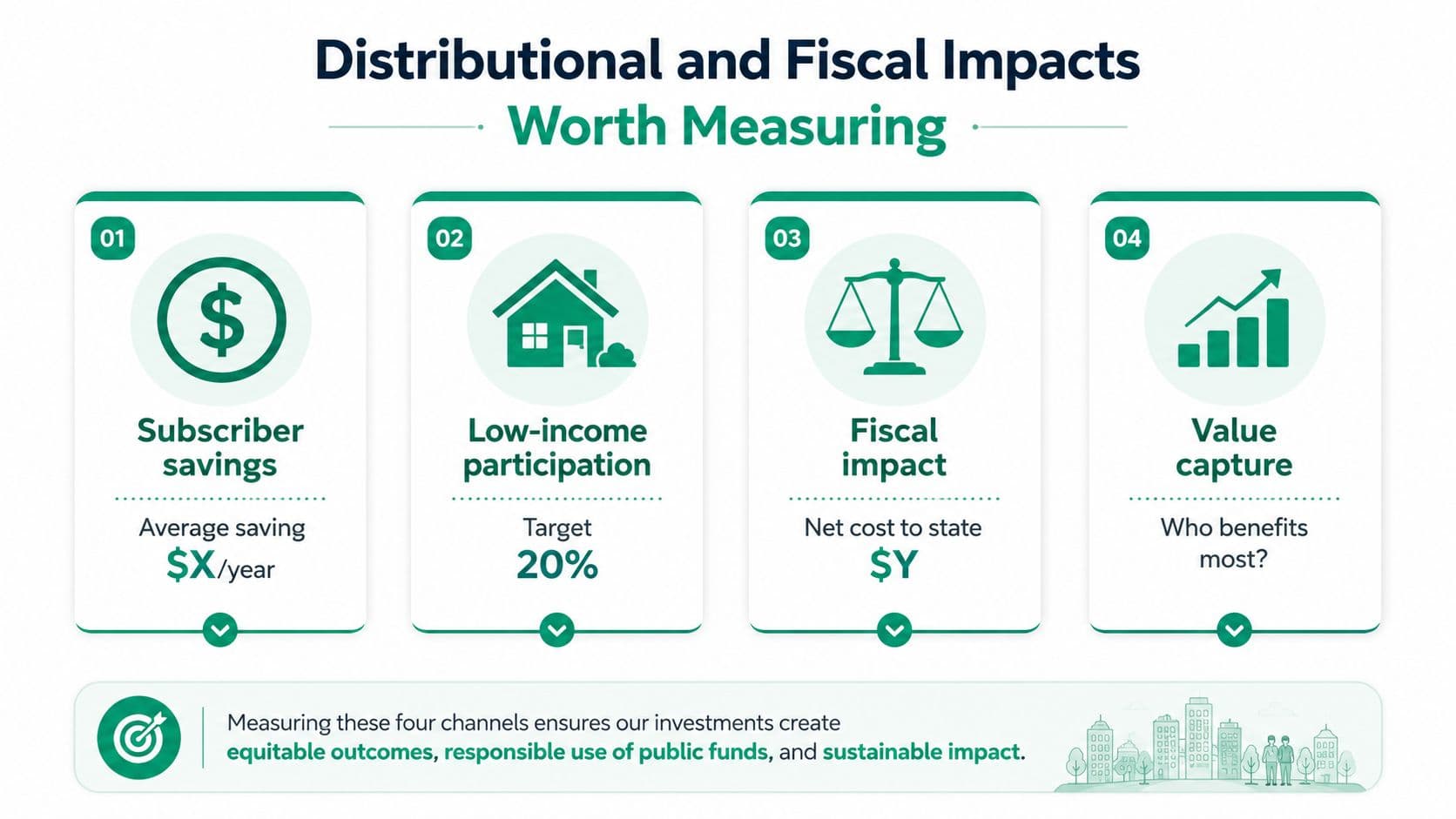
The distributional question in community solar is not whether subscribers save money on average. It is who captures the value at each step of a regulated retail-energy product. Bill credits, subscription terms, utility settlement, and site control can move value toward households, landlords, site hosts, utilities, or local governments, depending on how the program is written.
Four channels determine the actual outcome
First, there is subscriber bill savings. Market tracking from DOE shows that the median capacity-weighted net present value of a community solar subscription was modeled as positive through mid-2024, which is a useful sign that the typical subscription can produce net savings over time. That benchmark still does not answer the more important policy question, which is who keeps those savings after fees, credits, and settlement rules are applied.
Second, there is landlord capture in rental settings. HUD guidance clarified that community solar credits for residents of HUD-assisted housing can be excluded from rent increase and utility allowance adjustments, which helps keep the benefit with the tenant rather than flowing back into housing calculations. That is one of the clearest examples of energy policy and housing policy interacting in a way that affects who receives the economic value.
Third, there is utility cost recovery and cost-shifting. EPA guidance emphasizes that shared solar programs need to fit within legislative and regulatory frameworks and use pricing models that make the net effect on subscribers and ratepayers visible. If a utility cannot defend the settlement design, the program can trigger opposition even when it is delivering savings to participants.
Fourth, there is local fiscal impact. Community solar can generate property tax revenue in some places, but only if program structure and local rules are set up to capture that benefit. If a jurisdiction wants community solar to support local budgets, it has to think beyond the rate bill and into the site economics, including whether land-use rights or land-value capture are written in a way that returns some of the surplus to the public.
Why land economics belongs in the same conversation
Land-value capture belongs in the same analysis because site selection is a fiscal choice as much as a technical one. A program that intentionally uses underused public land, or structures land-use rights so the public retains bargaining power over time, can create a more durable public return than a program that picks the cheapest available parcel. That affects who gets the surplus, whether the terms can be renegotiated later, and whether the project supports or weakens the local tax base.
A close look at fiscal impact analysis is useful here because community solar should be judged as a public-finance decision, not only an energy one. The better programs are the ones where bill savings, tenant protections, ratepayer fairness, and local revenue all move in the same direction.
Two Programs That Show What Works in Practice
The clearest lesson from current community solar program design is that the retail customer side decides whether a market scales cleanly. California's 2024 redesign shows that point plainly. The state kept its equity objective in place, preserved a 20% bill discount for income-qualified customers in disadvantaged communities under the DAC Green Tariff and Community Solar Green Tariff pathways, and changed the settlement structure so non-participating ratepayers were not left covering costs they did not choose (policy guidebook). That is the important policy signal. A program can keep its social هدف intact and still fail if the bill-credit mechanics are too loose to defend.
What California got right
California's value is not just that it maintained a discount. It showed that discount design has to sit inside clean accounting, clear eligibility rules, and a tariff structure that utility staff can explain without hand-waving. The general Green Tariff pathway was also built to avoid cross-subsidies, and the program carries a statewide cap of 562 MW (policy guidebook). The cap is less important as a growth claim than as a governance choice. It tells planners that regulators treated the program as a bounded retail product with defined exposure, not as an open-ended development initiative.
The more useful takeaway for other states is narrower. California treated subscriber access, bill-credit settlement, and ratepayer protection as one system, not three separate policy questions. That matters because the parts fail together. If the credit is hard to verify, or if eligibility is too fuzzy, the utility relationship becomes harder to administer and the program becomes easier to attack.
What the market concentration tells you
The four-state concentration noted earlier carries a different lesson. Market leadership has come from places that made the customer side predictable enough for lenders, subscribers, and utilities to trust the cash flow. More than three quarters of U.S. community solar capacity sits in Florida, New York, Massachusetts, and Minnesota (DOE market trends). That is not just a statement about legal authorization. It is evidence that rules for billing, enrollment, and credit transfer are doing real work.
For planners, the implication is direct. The relevant comparison is not whether a state has enabling language on the books. It is whether the state has turned the program into a regulated retail-energy product with stable settlement rules, clear LMI allocation, and subscriber management that can survive churn without breaking project finance. Those are the features that matter to bankability. A project sponsor still has to model revenue carefully, and a stronger revenue forecasting model is only as good as the program rules underneath it.
That is also where land-use decisions re-enter the analysis. The same market logic applies to siting. A project placed on land where public authorities retain bargaining power, or where lease terms and land-value capture are structured to return some of the surplus, keeps more of the value stream visible to the public. A project that chases the cheapest parcel may pencil out on paper and still leave local governments with little fiscal return. That difference affects who captures the benefit, how durable the arrangement is, and whether the program strengthens or weakens the local tax base.
In practice, the strongest programs are the ones that make those trade-offs explicit. They do not rely on broad rhetoric about clean energy. They align bill-credit mechanics, subscriber design, and land economics so the same project can satisfy customer savings, utility settlement discipline, and local fiscal goals at once.
A Diagnostic Checklist for 2026 Program Design
A serious Community Solar Program for 2026 should be judged in sequence. Start with bill-credit design. It has to prevent cost shifting and protect utility revenue adequacy. Then test whether the program assigns LMI capacity clearly and keeps tenants from losing savings through housing calculations. After that, examine subscriber management and credit-banking infrastructure. If those systems cannot handle churn without breaking project cash flow, the program is weak even if the policy language looks strong. Finish with the land strategy. The site and lease structure should let local government capture value, not give it away.
For a faster pre-rulemaking screen, ask a set of plain questions. Who gets the bill credit in practice, and how is that verified every month? What happens when a subscriber leaves, moves, or reduces load? Can low-income renters participate without credit checks or billing barriers? Does the land arrangement return value to the public through lease terms, taxes, land-value capture, or a mix of all three? And can sponsors produce a credible revenue forecasting model that reflects churn, settlement rules, and credit transfer timing, or is the finance case assuming away the hard parts?
DOE's national community solar partnership set a 20 GW by 2025 target in 2021, framed as enough to serve the equivalent of 5 million households and deliver $1 billion in cumulative savings (DOE partnership target). That benchmark is useful, but the next wave of programs will be judged less by headline targets than by whether the delivery mechanics are disciplined enough to hold value in place for subscribers, utilities, and local governments.