Compare land value tax vs property tax policies. Explore economic incentives, revenue potential, and implementation strategies for governments.
July 19, 2026
Land Value Tax vs Property Tax: Policy Deep Dive
Compare land value tax vs property tax policies. Explore economic incentives, revenue potential, and implementation strategies for governments.
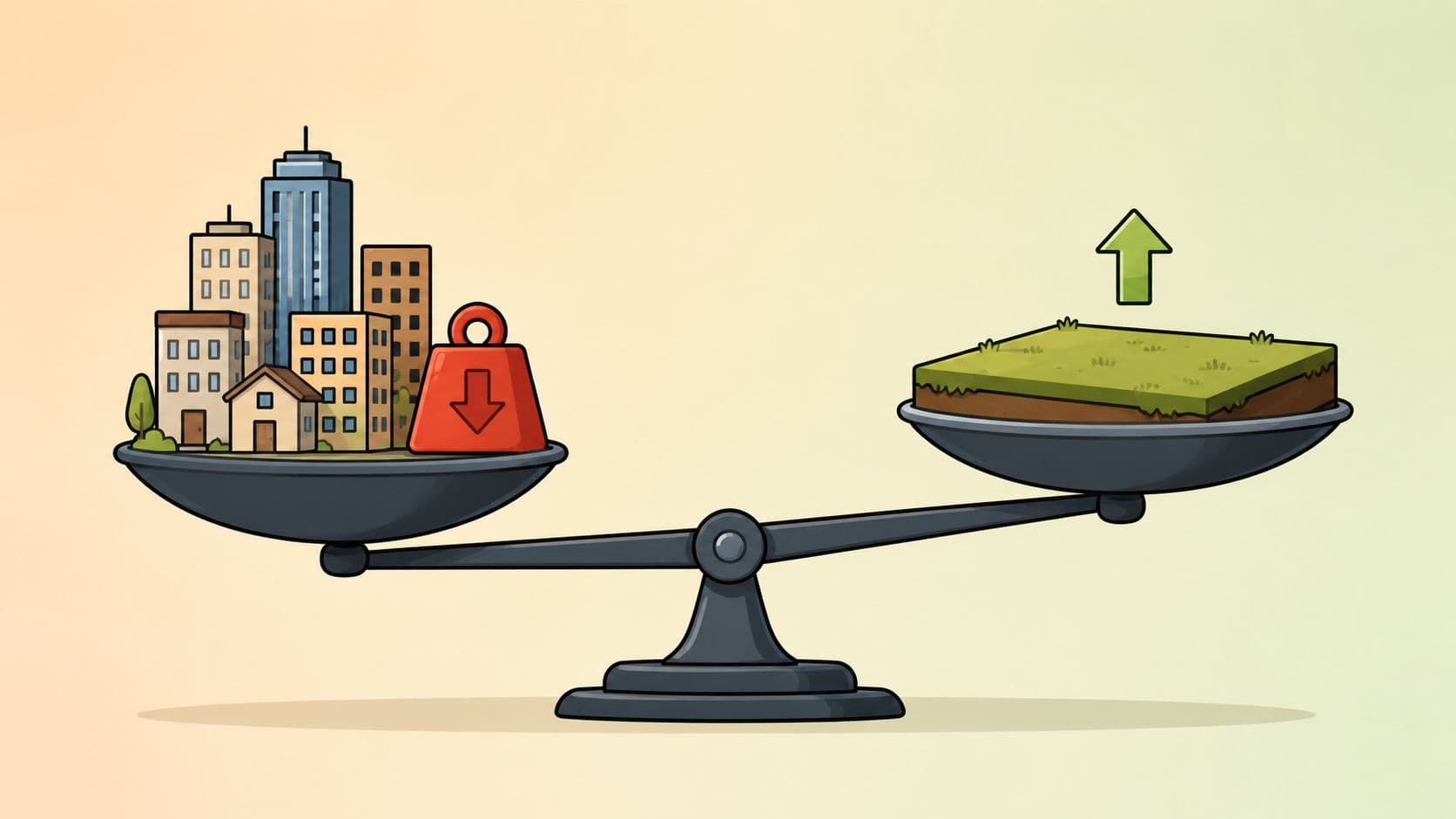
Why do cities keep taxing the thing they want more of?
That question exposes the weak spot in the standard debate over local finance. Municipal leaders want more housing, stronger main streets, better use of existing infrastructure, and steadier revenue. Yet conventional property tax systems often raise the tax bill when an owner builds, expands, or rehabilitates a structure. The result is a policy conflict built into the tax base itself.
The land value tax vs property tax debate matters because these are not just two ways to raise the same money. They send different signals to landowners, builders, and long-term investors. One taxes land and improvements together. The other isolates the unimproved site value and leaves buildings outside the base. That distinction changes development incentives, who bears the burden, and how public authorities can align taxation with housing and land-use goals.
For public officials, this isn't an academic exercise. It's a design choice with consequences for affordability, fiscal resilience, and urban form. Officials weighing reform also need a practical lens: assessment methods, transition sequencing, legal structure, public communication, and the likely winners and losers.
Table of Contents
- Rethinking Urban Revenue and Development
- Defining the Core Tax Mechanisms
- Comparing the Economic Incentives
- Analyzing Fiscal and Distributional Impacts
- Administrative Feasibility and Valuation Methods
- Implementation Pathways and Global Precedents
- Concrete Recommendations for Public Authorities
Rethinking Urban Revenue and Development
Cities face a double bind. They need revenue for transit, streets, schools, and utilities, but they also need a tax system that doesn't suppress infill housing and commercial renewal. In many jurisdictions, officials treat those goals as separate. They aren't.
The sharper question is whether the tax base rewards productive use of scarce urban land or rewards passive holding. In practice, that choice shapes vacancy, redevelopment timing, and how much pressure gets pushed to the urban fringe. Officials looking at land value capture mechanisms often discover that the revenue question and the land-use question are the same policy problem viewed from different sides.
Why the old framework misses the real issue
Conventional debate usually asks whether a tax is fair to owners. That's too narrow. Public authorities should ask four harder questions:
- Does the tax discourage construction? If an owner improves a site, a higher tax bill can delay or shrink investment.
- Does the tax push growth outward? If infill carries a heavier burden, fringe development becomes relatively easier.
- Does the tax capture public value? Transit, zoning, schools, and public safety all affect site value.
- Can the system be administered predictably? Reform fails when valuation and transition planning are weak.
A tax system for urban land shouldn't punish the owner who adds homes while rewarding the owner who leaves a prime site underused.
What policymakers should focus on
The land value tax vs property tax comparison becomes most useful when officials move past ideology and examine incentive design. A tax on buildings and renovations can work against housing goals even when rates seem modest. A tax on land value targets something different: the location value created in large part by community growth and public investment.
That doesn't mean every city should switch overnight to a pure land value tax. It does mean every serious housing, fiscal, and planning strategy should test whether the current property tax base is pulling in the opposite direction from stated policy goals.
Defining the Core Tax Mechanisms
Before weighing effects, officials need clear definitions. The confusion usually starts because both systems are discussed as “property taxes,” even though they tax different things.
What conventional property tax captures
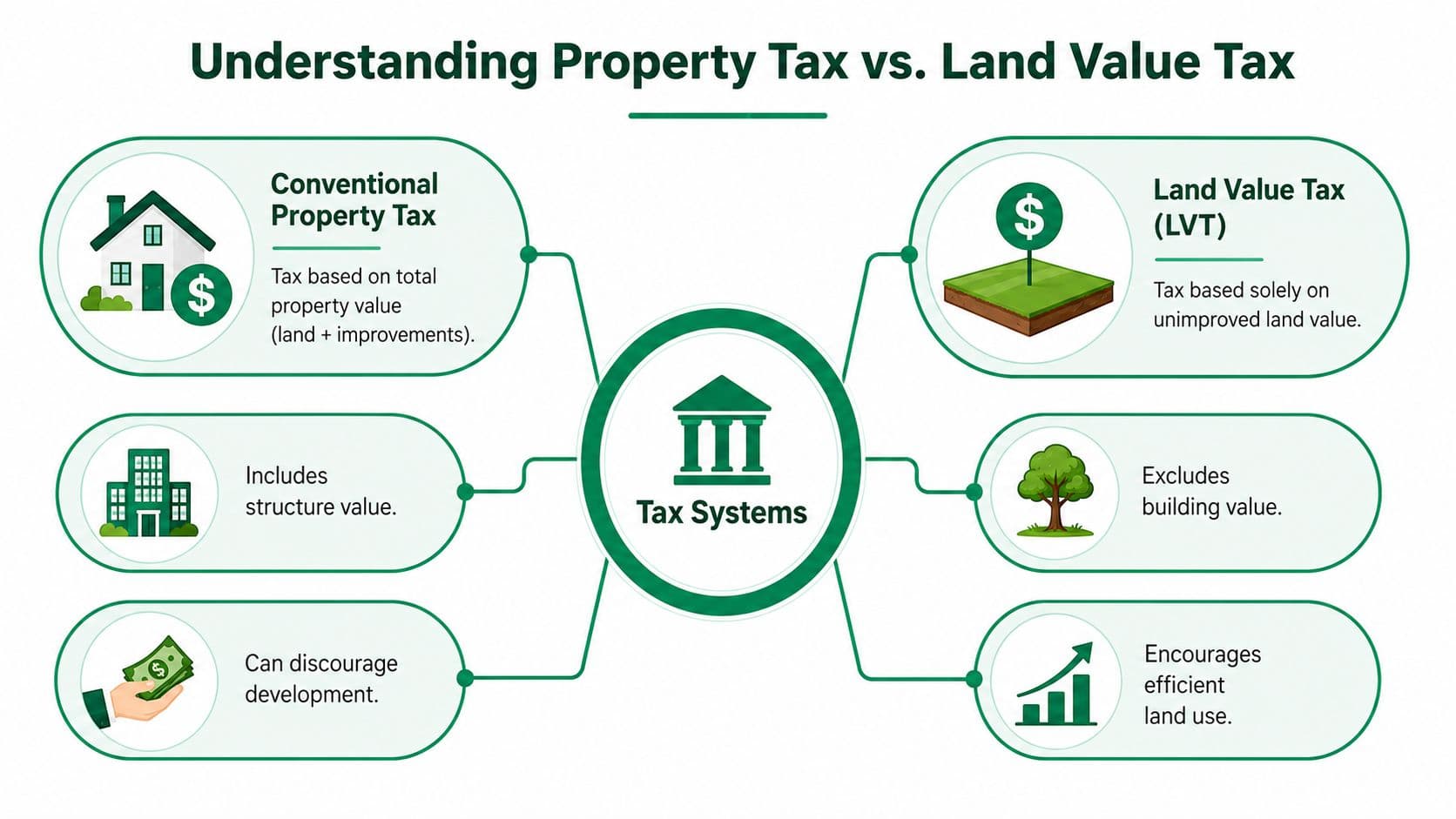
Under a conventional property tax, the tax base includes the combined market value of the land and the improvements on it. That means the assessor must value both the site and whatever has been built on it: homes, apartment blocks, shops, offices, and other alterations.
The practical implication is simple. If an owner adds value through construction or renovation, the taxable base often rises with that investment. That feature is one reason the standard system can discourage intensive use of well-located parcels.
What land value tax leaves out
A land value tax applies only to the unimproved value of land. It ignores buildings, structures, and personal property improvements, as explained in this overview of land value tax mechanics. The key factual distinction is that LVT taxes the site alone, while conventional property tax taxes the site plus the building.
A clear example illustrates the difference. As summarized by Accounting Insights on land value tax versus property tax, in jurisdictions using LVT, the owner of a vacant lot owes the same tax amount as the owner of an identically sized lot containing a four-story apartment building, because the tax ignores the value of the structure itself.
That example matters because it flips the incentive. Under a land value tax, adding homes to a site doesn't increase the tax base through the structure. Under a conventional property tax, it often does.
How land-use rights differ
Land-use rights are related to this debate, but they aren't the same as land-value taxes. Land-use rights are land leases that are repriced annually with no expiration dates. Because they are repriced annually, people can buy and sell land-use rights for a low cost.
That arrangement changes access to land through an ongoing lease framework rather than through a tax on privately held title. Officials should treat land-use rights as a separate institutional model. LVT is a fiscal instrument. Land-use rights are a tenure and allocation mechanism.
Practical distinction: If the government is charging for continued access to land through annually repriced, non-expiring leases, that's a land-use rights model. If it is levying a tax on the unimproved site value, that's a land value tax.
For policymakers, the distinction matters because the legal architecture, administrative workflows, and political framing differ. A city considering tax reform may be able to implement a split-rate or site-value tax within an existing tax code. A land-use rights framework usually requires broader changes in land tenure, contracting, and public administration.
Comparing the Economic Incentives
The strongest argument in the land value tax vs property tax debate isn't philosophical. It's behavioral. Each system tells owners something different about whether to build, wait, hold, or speculate.
The development penalty under property tax
A conventional property tax raises revenue from both location and improvements. That means a builder who converts a vacant parcel into apartments, or a shop owner who expands a storefront, can face a higher tax bill because the structure became more valuable. The tax system doesn't distinguish between value created by the community and value created by private investment.
That design can produce a development penalty. It doesn't ban construction, but it changes the economics at the margin. Some projects become less attractive, some rehabilitation gets deferred, and some sites stay underused longer than they otherwise would.
Why LVT changes holding behavior
A pure land value tax works differently. According to the Chicago Fed's analysis of land value taxation, a pure LVT is economically neutral because it creates zero deadweight loss. The reason is that land supply is perfectly inelastic, so the tax incidence falls entirely on the landowner without reducing output.
That same analysis reports that higher land taxes had precisely estimated zero effects on property development, empty plots, or aggregate residential building counts. It also found that a 1 percentage point increase in land taxes relative to total assessed values lowered home prices by 3% during the anticipation period and 7% in the post-implementation period. Those effects operate by reducing land prices rather than discouraging construction.
The policy implication is easy to miss. LVT doesn't just avoid penalizing buildings. It also increases the cost of holding valuable sites idle because the tax bill is tied to the site's value regardless of whether the owner builds.
Land Value Tax vs. Property Tax at a Glance
| Criterion | Conventional Property Tax | Land Value Tax (LVT) |
|---|---|---|
| Tax base | Land plus buildings and improvements | Unimproved land value only |
| Effect on new construction | Can raise the tax bill when owners build or renovate | Doesn't tax the building value |
| Idle-site incentive | Can leave underused land relatively lightly burdened | Pressures owners to use or release valuable land |
| Economic efficiency | Taxes productive investment | A pure LVT creates zero deadweight loss, as discussed in the Chicago Fed analysis above |
| Urban form | Can tilt incentives away from dense infill | Encourages high-value infill near infrastructure |
Officials interested in taxation and efficiency in land-based systems should focus on that last row. The economic value of a site often comes from roads, transit access, nearby jobs, schools, utilities, and surrounding private activity. Taxing that location value captures a base that public action helps create.
A property tax on buildings does something almost opposite. It increases the carrying cost of adding homes or commercial floor area. For cities confronting vacant lots in strong locations, that difference is not theoretical. It's the center of the policy problem.
Analyzing Fiscal and Distributional Impacts
Which tax base gives a city more room to raise stable revenue without discouraging construction, and what does that choice do to households, firms, and neighborhood-level land use?
What the modeled fiscal effects imply
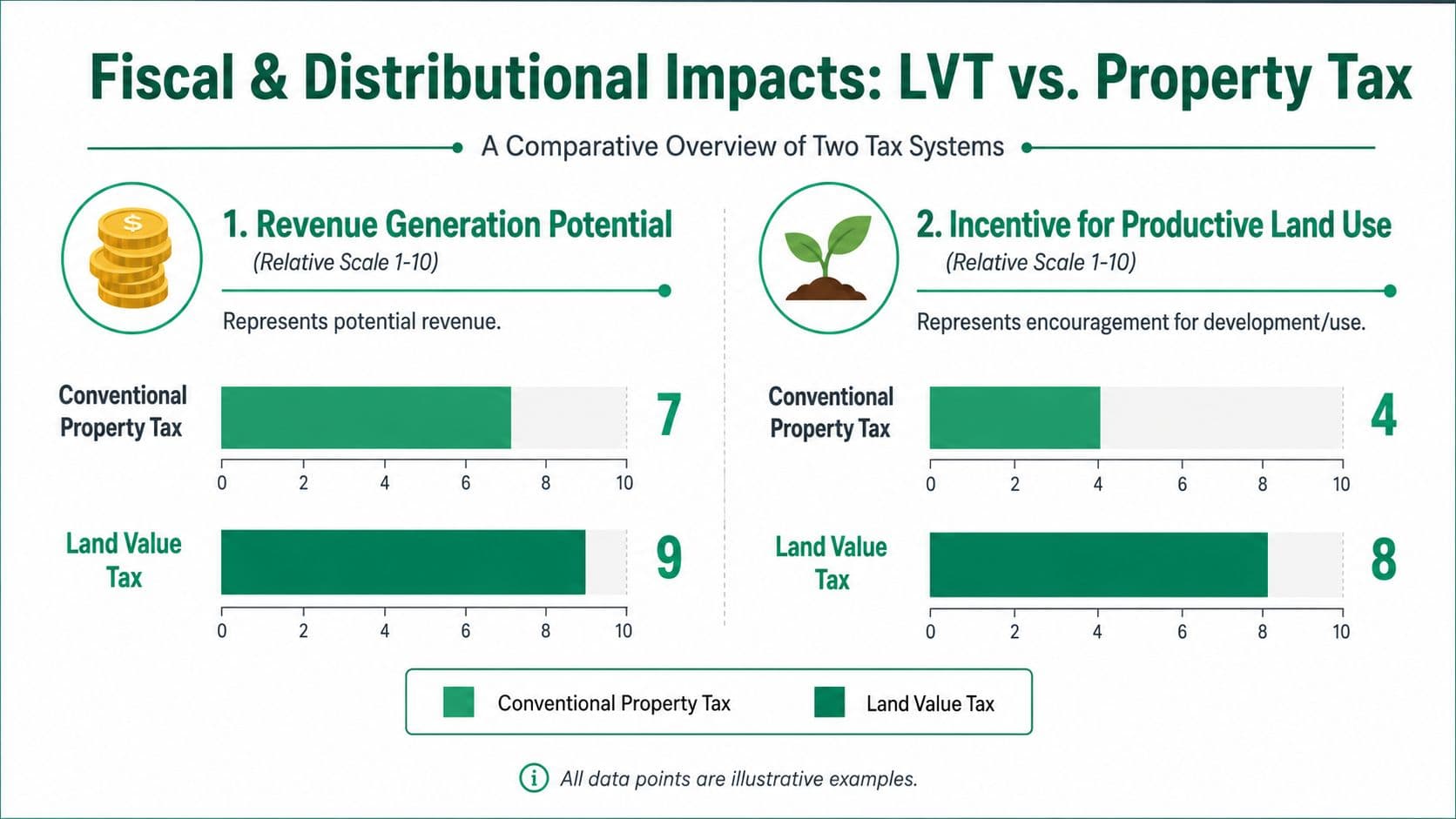
Modeling exercises on land value tax reform often point in the same direction. A shift toward taxing land value can preserve revenue while reducing taxes on activity that cities want more of, such as hiring, investment, and building. The largest gains usually appear in high-demand urban markets where location rents are substantial and current tax systems still fall heavily on improvements.
That matters for public officials because the fiscal question is not only how much revenue a tax raises in a given year. The more important question is whether the tax base grows with public investment and market demand, or whether it penalizes the private response to both. A tax on buildings can weaken the return on redevelopment. A tax on land value captures part of the value created by infrastructure, zoning capacity, agglomeration, and local services.
The policy conclusion is operational, not ideological. Revenue-neutral reform can change both the size of the tax base over time and the distribution of tax burdens across parcels. Officials should treat model outputs as scenario inputs for local design, not as promises that transfer automatically from one city to another.
Who tends to gain and who faces more pressure
Distributional effects depend on parcel economics, not slogans about owners versus tenants. Owners of modest sites with high improvement values often do better under a land-focused system than under a conventional property tax. Owners of expensive land that is vacant, underbuilt, or held for speculation usually face higher carrying costs.
This distinction is easy to miss in citywide averages.
For renters, the effect is indirect and unfolds through supply, redevelopment timing, and landholding behavior. If the tax code stops adding cost to new floor area and reduces the incentive to sit on well-located sites, the medium-term effect can support more housing and commercial space where demand is strongest. That does not guarantee lower rents in every submarket, but it improves the conditions under which supply can respond.
For homeowners, the key variable is the ratio of site value to structure value. A household on a small lot with a heavily improved home may see a different outcome from a household occupying a large, high-value site with relatively little built on it. For local governments, that means incidence analysis should be done at the parcel level, with separate treatment for owner-occupiers, rental property, commercial corridors, and institutional landholders.
Officials also need better fiscal practice around reform modeling. Scenario testing should distinguish gross collections from net effects after rate swaps, exemptions, transitional relief, and behavioral change. The logic is similar to how analysts calculate Apify actor net earnings. Gross revenue alone does not show what remains after the rules are applied.
For governments assessing fiscal sustainability under land-based revenue systems, the practical priorities are clear:
- Model parcel-level impacts: Citywide averages can conceal sharp shifts across neighborhoods, lot types, and ownership patterns.
- Separate transition effects from steady-state effects: Political resistance usually comes from near-term bill changes, even when the long-run tax base is stronger.
- Use targeted relief tools: Deferrals, circuit breakers, and phased rate changes can protect cash-poor owners while keeping the long-run incentive structure intact.
- Publish clear incidence results: Residents are more likely to accept reform when governments show who pays more, who pays less, and the reasons for both.
Administrative Feasibility and Valuation Methods
The most common objection to LVT isn't economic. It's administrative. Officials often assume that separating land from improvements is too difficult to manage at scale.
Assessment is a technical problem, not a conceptual barrier
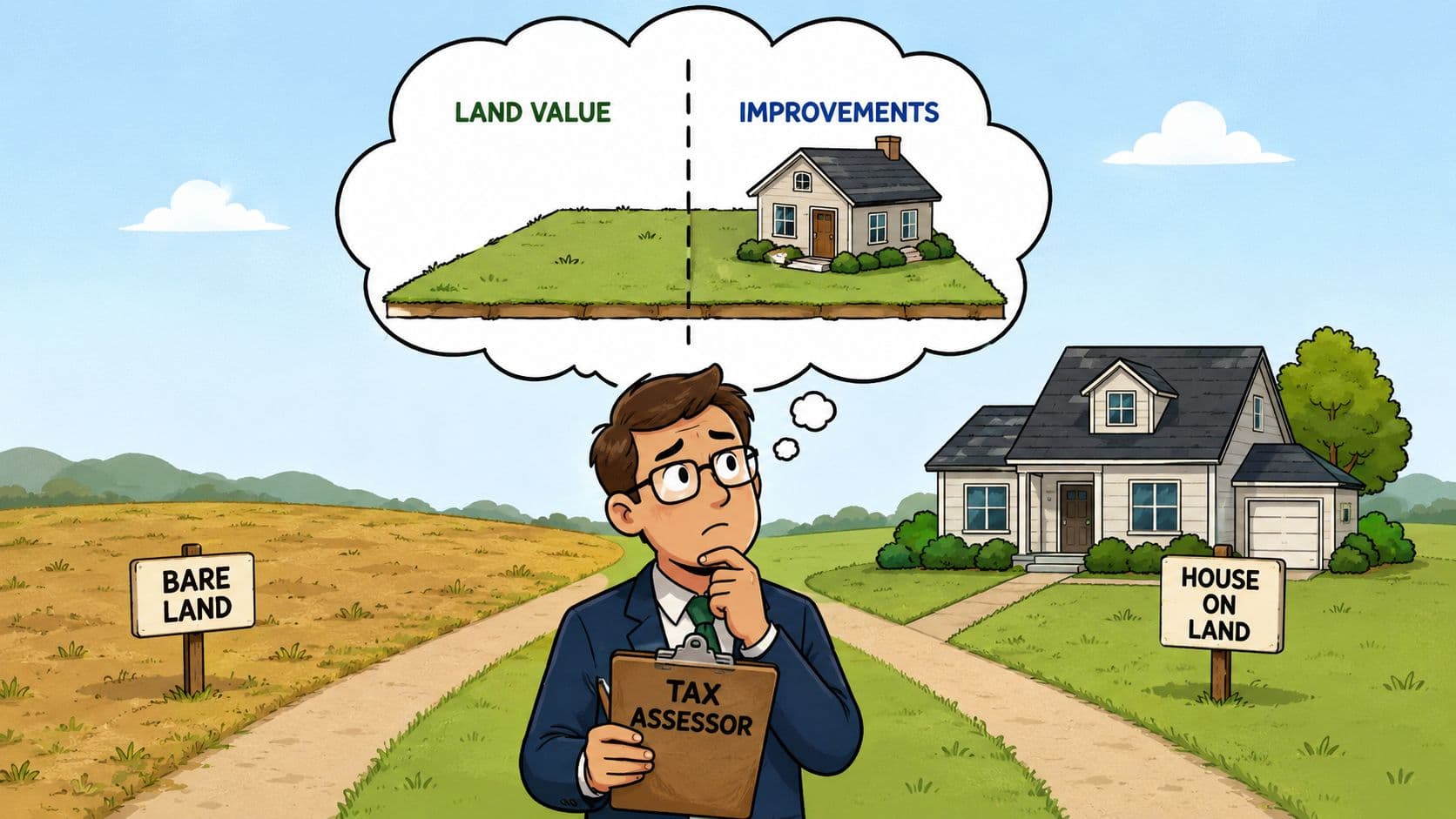
Every property tax system already requires complex valuation work. Assessors must identify parcel boundaries, classify property types, update records, and estimate market value across heterogeneous sites and structures. Valuing buildings is often the messiest part because structures differ in age, condition, design, depreciation, and use.
LVT narrows the task. Instead of valuing land plus every improvement, the authority needs a defensible estimate of the unimproved site value. Modern tools make that more manageable than critics suggest. Assessors now use Computer-Assisted Mass Appraisal, GIS, parcel databases, zoning overlays, sales comparisons, and hedonic methods to isolate location value drivers.
The practical challenge isn't whether land can be valued. It can. The challenge is whether the administration has current cadastral data, regular reassessment practices, transparent appeals procedures, and staff trained to explain results.
A workable administrative sequence
Officials considering reform should break implementation into operational steps rather than treat valuation as a binary obstacle.
- Audit the data foundation. Review parcel files, sales records, land-use coding, improvement records, and zoning layers.
- Choose a valuation method. Most jurisdictions will combine mass appraisal techniques with periodic manual review of edge cases.
- Test the model openly. Run pilot valuations and compare outcomes across neighborhoods, lot types, and contested parcels.
- Build an appeals track. Owners need a credible process for challenging land assessments without freezing the system.
- Update on a schedule. Site values change with infrastructure, regulation, and market demand, so valuation can't remain static.
Good administration doesn't require perfect valuation. It requires consistent methods, transparent data, and a correction process that owners can trust.
A technical roadmap also helps depoliticize the issue. Officials can communicate that they are not inventing a new burden from scratch. They are refining the tax base to align it more closely with location value. For many jurisdictions, the better question isn't whether separate land valuation is possible. It's whether the current assessment system is modern enough to support any serious reform. That is also why tools for calculating land value in policy settings matter so much in practice.
Implementation Pathways and Global Precedents
What separates tax reforms that pass from tax reforms that stall for a decade? In practice, the difference is usually implementation design, not theory. Public officials need a sequence that fits their legal framework, assessment capacity, and fiscal constraints.
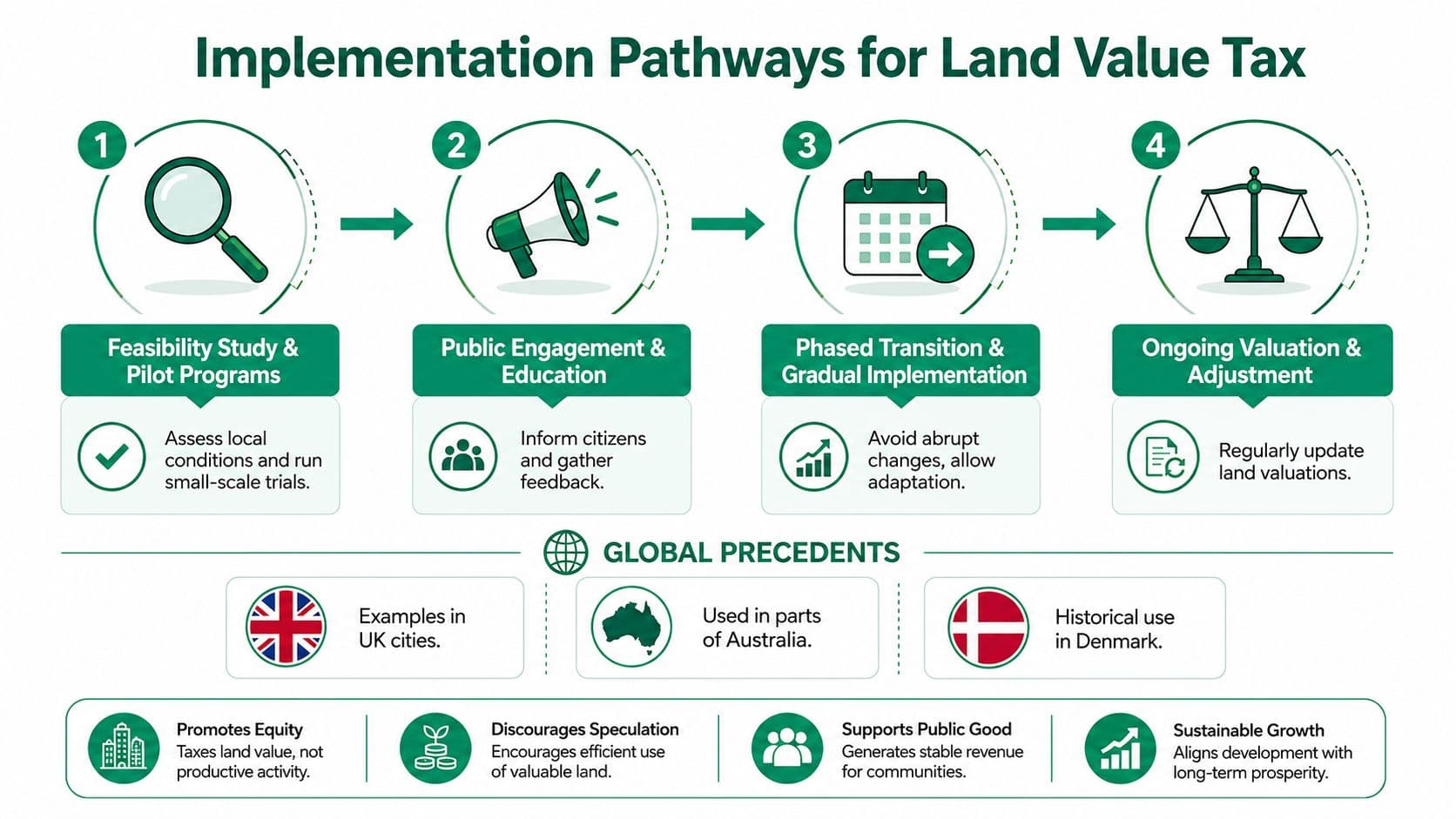
Why phased reform usually works better
A direct move from a conventional property tax to a pure land value tax is often difficult to administer and harder to sustain politically. Statutory limits, uniformity clauses, and legacy assessment systems can all slow a full conversion. For that reason, many jurisdictions treat reform as a fiscal transition rather than a single legislative event.
The usual entry point is a split-rate structure. Land is taxed at a higher rate than improvements, and the rate differential widens over time if valuations hold up and revenue performance remains stable. That design gives governments a way to test incidence, adjust communication, and limit abrupt shifts for owners facing large bill changes.
This matters for budgeting as much as for politics.
A phased path lets finance departments compare projected and actual collections, identify parcels with unusual assessment outcomes, and refine hardship provisions before the new tax base carries a larger share of local revenue. Officials should treat the first stage as an implementation period with clear review points, not as proof that reform has fully succeeded or failed.
What public authorities should copy from precedent
International and subnational experience points to a repeatable pattern. The details vary, but durable reforms usually share the same operating logic: start with administratively manageable changes, publish the distributional effects early, and tie tax reform to visible development or revenue goals.
Four elements appear again and again:
- Begin with parcel-level simulation. Before legislation fixes rates, model who pays more, who pays less, and where valuation disputes are likely to cluster.
- Use transition rules, not blanket promises. Caps, deferrals, or temporary circuit breakers can protect cash-poor owners without weakening the long-run tax base.
- Link reform to service delivery and land-use policy. Taxing location value is easier to defend when residents can see the connection to infrastructure, transit access, or underused serviced land.
- Commit to regular revaluation. A land-focused tax loses legitimacy if assessments lag behind changes in zoning, infrastructure, or market demand.
The policy lesson is practical. No single country offers a model that can be replicated directly. What can be copied is the sequence: legal review, parcel testing, staged rate shifts, active appeals management, and visible monitoring of revenue and development effects.
The Federal Highway Administration's explanation of land value taxation is useful here because it frames the reform in fiscal terms that public officials can use. Shifting taxation away from buildings and toward land changes the price signal. It lowers the tax penalty on construction and redevelopment, while capturing more of the site value generated by public action and community growth. For cities trying to increase infill or reduce speculation on well-located vacant parcels, that is not an abstract benefit. It is the operational case for reform.
Officials should also plan for uneven results across place types. A dense central city with strong market demand can often absorb a faster shift toward land taxation than a weak-market municipality with sparse sales data and limited assessment staff. The implementation pathway should therefore match local administrative capacity and the intended fiscal role of the tax, whether that role is revenue stability, redevelopment, or a broader restructuring of the local tax base.
Concrete Recommendations for Public Authorities
Public authorities shouldn't ask whether land value tax is intellectually elegant. They should ask whether their current tax base supports or blocks the housing, productivity, and land-use outcomes they say they want.
Three recommendations follow from the evidence.
Use a diagnostic before choosing the instrument
Cities with rising land prices, underused central parcels, and weak infill should run a parcel-level incidence study. Compare current liabilities with a split-rate or land-value-focused alternative. If the present system heavily taxes improvements, reform deserves serious consideration.
Sequence reform through administration, not slogans
Governments should modernize valuation first. Build cadastral quality, reassessment routines, appeals capacity, and communications plans before changing rates. Where legal barriers exist, a split-rate path is often the most credible entry point.
Align tax reform with broader fiscal strategy
National governments should test whether a stronger land tax base can support lower taxes on labor, capital, or buildings. Municipal governments should pair reform with planning and infrastructure policy so that the tax signal matches development permissions on the ground.
Land-use rights deserve separate consideration in this process. They can be powerful, but they are not a substitute term for LVT. They are annually repriced, non-expiring land leases, and they require a different legal and administrative framework than tax reform.
The strongest reforms are practical, phased, and transparent. They don't rely on rhetoric. They rely on valuation quality, public trust, and a tax base that stops penalizing productive use of urban land.
Unitism® helps governments, cities, and policy teams turn land-value reform from a theory into an operational plan. If you're evaluating site-value taxation, land-use rights, fiscal modeling, valuation methods, or transition design, Unitism® offers research, implementation support, and plain-language tools grounded in modern land economics.