See how a resource rent tax takes surplus after a normal return, with cash-flow triggers, Australia and Norway rates, and deduction traps.
November 22, 2026
Resource Rent Tax: How Surplus Becomes Revenue
See how a resource rent tax takes surplus after a normal return, with cash-flow triggers, Australia and Norway rates, and deduction traps.

A resource rent tax charges only the surplus a project earns after it has recovered its costs and paid investors the return they needed to commit capital, not gross production and not ordinary profit. In the standard worked example, no tax is levied while accumulated cash flow stays below a 20 percent hurdle return, and everything above that line is then taxed at 50 percent; a ring-fenced version of the same design pairs a 16.5 percent threshold with a 22.5 percent rate.
Most public argument goes after the wrong number. People fight over the headline rate, whether it should be 40 percent or 25 percent or 22.5 percent, as though the rate alone decided how much money arrives. It doesn't. Two jurisdictions can print the same figure in statute and one collects billions while the other collects a rounding error, because the trigger, the base and the deduction rules do the heavy lifting.
The popular advice is simple in a way that should make you suspicious: raise the rate and the rent will follow. It won't, not reliably. What follows is how the charge is meant to work, where it stops working, and why land needs a different instrument from the ones used on oil and ore.
Table of Contents
- What a Resource Rent Tax Actually Taxes
- How the Cash Flow Threshold Collects Rent
- Design Choices That Decide Who Pays
- Australia, Norway and Alaska in Practice
- Why Some Rent Taxes Collect Almost Nothing
- Land Value Charges, Leases and Use Rights
- Choose the Instrument That Fits the Rent
What a Resource Rent Tax Actually Taxes
The thing being taxed has a name. Economic rent is income that comes from owning a desirable location or natural resource, not from work or investment, as the Unitism glossary entry on resource rent sets out. It exists because a good ore body, like a good corner site, is fixed in supply. Nobody manufactured the deposit or the harbour, so the payment for access to it isn't a reward for effort or for building anything.
Contrast that with the instruments governments usually reach for. A royalty takes a slice of volume or sales value from the first barrel or tonne, profitable or not. A corporate income tax applies to accounting profit and taxes a modest return and a spectacular one at the same rate. A resource rent tax is built to wait: it looks for the margin left over once costs and a required return are covered, and takes a share of that alone.
The door and the jackpot. A royalty is the cover charge at the door. It's collected whatever happens inside, and it can be enough to stop a thin-margin act from booking the room at all. A rent tax is a share of the winnings after the band has been paid and after the backers have earned the return they needed for the night.
Governments care because of who created the value. The rent comes from the resource itself and from the wider economy that made the commodity valuable, yet it flows to whoever holds the title. When communities collect economic rent for public purposes, they can fund services, reduce taxes on labour and business, and reduce inequality.
That's a strong theory. The catch sits in the waiting. A charge that bites only above a hurdle has to be told how to measure the hurdle and what counts as a cost, and those instructions decide almost everything downstream. Write them generously enough and the surplus never reaches the treasury at all.
How the Cash Flow Threshold Collects Rent
The test is a running balance, not an annual profit line. In the IMF's simplified example of a resource rent tax, project cash flows are compounded at a 20% threshold rate of return, and no rent tax is charged while accumulated cash flows remain negative after that compounding. The balance works like a scorecard for the investor: costs roll in, receipts roll out, and the compounding stands in for the return the money should have earned while it was at risk.
The sequence matters, so take it in order.
- Compound the balance forward. Each year's net cash flow is carried forward at the threshold rate.
- Charge nothing while the balance is negative. A project still short of the hurdle owes no rent, which is what makes the design investment-neutral on paper.
- Stop at the crossover. Once accumulated cash flow becomes positive, the project has achieved the 20% return and the accumulation process stops.
- Tax what follows. Subsequent positive cash flows are taxed at 50% in the same example.
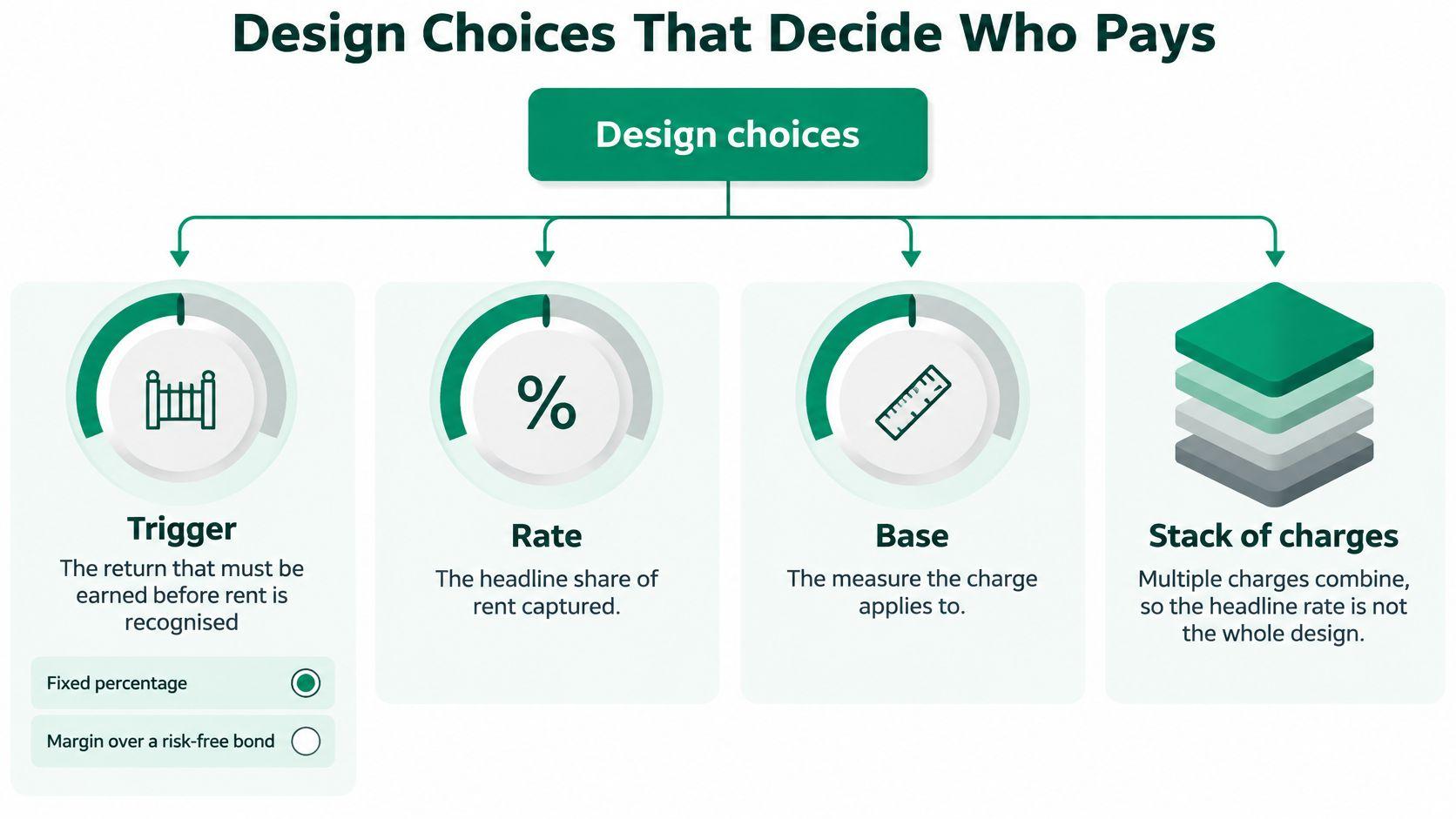
Four elements drive the outcome in any real regime, and only one of them is the tax rate.
The hurdle is a dial, not a doctrine
The numbers above are a setting, not a law of nature. A separately published IMF presentation works through a fully ring-fenced resource project with a 16.5% threshold rate of return and a 22.5% tax rate applied to net profits once the threshold is reached, and it stresses that the threshold should not sit below the investor's minimum required return, which shifts with the cost of capital and with how profitable the particular deposit looks.
The hurdle can be a fixed percentage or a margin above a reference rate such as a risk-free bond or long-term debt, which lets it move with capital markets rather than being frozen at a number chosen in a boom. That flexibility cuts both ways: a hurdle that tracks falling interest rates collects sooner, and one that tracks rising rates can push the whole charge into the future.
| Instrument | When it applies | Tax base | Published example | Marginal project |
|---|---|---|---|---|
| Royalty | From first production | Volume or sales value | Set in the licence or statute | Can make a high-cost deposit uneconomic |
| Corporate income tax | When taxable profit exists | Accounting profit after usual deductions | The ordinary company rate, 22 percent in one stacked petroleum regime | Taxes normal and excess returns together |
| Return-threshold rent tax | After the hurdle return | Net cash flow above the threshold | 50 percent after a 20 percent return in the IMF example | Little or no tax if only a normal return is earned |
| Ring-fenced profit rent tax | After project net profit clears the hurdle | Project profit, losses not offset elsewhere | 22.5 percent after a 16.5 percent threshold | Protects the normal return but blocks loss sheltering |
| Price-linked profit schedule | As the commodity price rises | Profits, with a rising rate | Alaska taxes oil profits at 25 percent at or below 30 dollars a barrel, then adds 0.4 percentage points per extra dollar, per the IMF presentation on resource taxes | Captures a price windfall rather than a measured project return |
Read the last row next to the third one and the difference between the two targeting methods becomes obvious. A return threshold asks how profitable the project is. A price schedule asks how expensive the barrel is. Alaska's ladder, with its 25 percent at or below 30 dollars a barrel and 0.4 points more for each further dollar, raises the government share when the market hands out a windfall, even if the operator's cost base hasn't moved.
The timing feature is the whole design. The government share can sit at zero for years and then climb steeply, which is precisely how a rent tax protects marginal projects from being taxed into losses. It's also how a treasury ends up with a tax that looks substantial in statute and produces nothing for a decade.
Design Choices That Decide Who Pays
Design is three dials and a stack of charges, not a single headline rate. A resource rent tax as the IMF defines it captures only the surplus generated after an extractive project has recovered its allowable operating costs and an investor-defined return on capital. The standard architecture has three technical parameters.
- Trigger. The return that must be earned before rent is recognised, set either as a fixed percentage or as a margin over a risk-free bond or long-term debt rate, and never below the investor's minimum required return.
- Rate. The share of rent captured, applied only to profits above the trigger, which is why a high statutory rate can still leave a developer a reason to proceed.
- Base. A project-level ring fence so losses or heavy deductions from one mine or field can't shelter rent from another. It improves revenue integrity and raises risk for marginal or exploration-stage projects that can no longer average wins and losses across a group.
Neutrality, in practice, depends on accurate cost recognition, sensible treatment of depreciation and financing, a credible uplift rate for unrecovered expenditure, and transfer-pricing and audit capacity that can survive a challenge. The efficiency case for charging fixed supply rather than effort is the same argument that runs through Unitism's note on taxation and efficiency: a charge on the value of something that can't be created doesn't change how much of it exists.
Uplift is what turns a cash flow tax into an allowance
Uplift is the mechanism that carries unrecovered spending forward with interest, and its size decides how long the state waits. In the Australia-style petroleum rent tax that the IMF's summary of petroleum fiscal regimes describes, exploration expenditure is uplifted at the bond rate plus 15 percentage points and other expenditure at the bond rate plus 5 percentage points, producing a marginal government share that ranges from 0 percent to 69 percent. No tax is due while accumulated uplifted costs remain unrecovered, and the state's share rises only once the project reaches the rent-producing stage.
Keep that mechanism separate from the 40 percent statutory rate on taxable petroleum-project profits in the original imposition legislation. The headline is a rate; the effective take is a curve that starts at nothing. Confusing the two is the most common error in public debate about these taxes.
Tiers sharpen the design further. Raising the rate as rent, or a measurable proxy such as price, rises captures commodity windfalls without a flat royalty that charges the same share when costs are high. The practical package stacks rather than swaps: a royalty or minimum payment for early cash, ordinary company tax across the life of the project, and a progressive rent slice for the upside.
A low rate with loose deductions collects less than a high rate with tight ones. Write the deduction rules first and choose the headline rate last.
Australia, Norway and Alaska in Practice
Resource-rent taxes look different across countries because governments choose different tax bases and collection rules. Australia taxes project profits, Norway applies special taxes to petroleum and onshore wind, and Alaska links its oil-profit schedule to prices.
| Regime | Start | Rate | What is taxed | Recorded result |
|---|---|---|---|---|
| Australia PRRT | Announced 1984, enacted 1987, effective from 15 January 1984 | 40 percent of taxable project profits | New offshore petroleum; Bass Strait and North West Shelf excluded or grandfathered | More than A$22 billion by October 2008 from 10 projects; about A$1.2 billion in 2014–15 |
| Norway petroleum special tax | 1975, after Ekofisk | Special petroleum tax on profits, on top of company tax | Oil and gas returns above ordinary compensation | A durable part of a major-market fiscal system, not a one-off windfall levy |
| Norway onshore wind rent tax | In force for 2025 | 32.1 percent formal, 25 percent effective after the company-tax deduction | Onshore wind resource rent | Rent taxation applied beyond petroleum |
| Alaska oil profit schedule | 2007 | A ladder that steps up as the barrel price rises | Oil profits, with the mechanism summarised by the IMF | Government share rises with price |
| Australia MRRT | After the Henry Review | 22.5 percent, against a proposed 40 percent | Large coal and iron-ore profits above A$75 million | Narrower base and lower rate than the review proposal |
Australia shows the timing problem
Australia's Petroleum Resource Rent Tax (PRRT) was announced in 1984 and enacted in 1987. The law applied from 15 January 1984, as recorded in parliamentary research on the PRRT. It covered new offshore petroleum projects in Commonwealth waters, while Bass Strait and the North West Shelf were excluded or grandfathered. The 40 percent tax applied to taxable project profits after eligible costs, rather than to production volume or sales value.
Collections varied sharply over time. By October 2008, the government had received more than A$22 billion, with ten projects and nine corporate groups paying at that point. Official parliamentary material records approximately A$1.2 billion collected in 2014–15. The same tax can produce very different receipts as projects, costs and profits change.
Norway shows durability
Norway introduced a special tax on oil and gas production in 1975, after Ekofisk revealed the scale of petroleum income. The tax targeted returns above ordinary compensation for labour, capital and operating risk, given that the resource is nationally owned and finite, as described in this analysis of Norway's resource-rent system. It became a lasting part of the country's fiscal system, rather than a temporary levy on a windfall.
Norway has also applied rent taxation beyond petroleum. For 2025, the Norwegian Tax Administration sets the formal resource-rent tax rate for onshore wind at 32.1%, equivalent to an effective rate of 25% after the company-tax deduction, according to its guidance on onshore wind taxation.
Alaska and the minerals cut show scope
Alaska uses a price-linked oil-profit schedule: as the barrel price rises, so does the government share. Australia's minerals tax took a different approach. The IMF's review of fiscal regimes and progressive rent taxes records that the Henry Review proposed a 40 percent minerals rent tax, while the subsequent MRRT set a 22.5 percent rate and covered only large coal and iron-ore profits above AUD 75 million.
These examples show how the choice of tax base shapes the result. A price-linked schedule responds to commodity prices; a project-profit tax depends on the rules for costs and deductions. In either case, receipts rise and fall with the conditions the tax is designed to capture.
Why Some Rent Taxes Collect Almost Nothing
Start with the number that should stop a room. The Australian Taxation Office reported that PRRT payable fell from A$1.867 billion to A$1.483 billion in 2023–24, even after the number of paying entities rose from 11 to 16, as recorded in the tax office's energy and resources working group minutes. More taxpayers, less money.
The paying population is tiny enough to audit closely. Sixteen entities appear in the 2023–24 PRRT corporate tax transparency population, per the tax office's transparency data. When the base shrinks, it isn't because thousands of filers found clever positions. It's because a handful of large projects ran their deduction rules as written.
The deduction paths, in the order an accountant meets them
- Long carry-forward. Uplifted costs accumulate for years, and the running balance stays negative long after production starts.
- Generous uplift. An uplift set well above the bond rate can outrun the deposit's true rent and keep the state waiting past the point of profitability.
- The definition of exploration. Australian reforms clarified that "exploration" deductions are limited to discovering and identifying petroleum, excluding feasibility work aimed at assessing commercial recoverability, per the ATO working group record. Labelling feasibility work as exploration inflates the shield.
- Related-party pricing. Financing, marketing and service charges set between affiliates move profit out of the ring fence without moving a barrel.
- Hedging and delayed production. Which years look profitable depends on when output starts and how prices were locked in.
So is this evasion? Mostly not. The ATO's estimated PRRT net tax gap for 2023–24 was 2.6%, equivalent to about A$40 million, according to the tax office's PRRT gap estimate. Assessments are largely paid. The problem is a tax base that legally shrinks.
A neutral tax on paper becomes a deferral device the moment uplift, cost allocation and related-party pricing keep the accumulated balance negative.
The border is the second half of the story
A project ring fence stops at the national boundary. Multinational groups shift taxable profit through financing, marketing hubs, intermediate entities and transfer prices, while governments compete for the same investment with royalties, company taxes, subsidies and production-sharing terms. The discussion of windfall profit taxes hosted by the Addis Tax Initiative notes that one petroleum regime runs a combined marginal rate of 78 percent, and argues that rent taxes can stay broadly non-distortionary where profitable projects keep a reason to operate and invest.
Headline burdens settle nothing. The same discussion records a model in which an export tax would produce an 82.6 percent total tax burden, and critics of Australia's regime argued a better-designed PRRT should have raised far more than the A$1.5 billion collected. Compare effective project-level rates, deduction timing, location-specific rents and investor hurdle rates instead of statutory percentages.
Which is why any revenue forecast built on the headline rate rather than on a project cash-flow model will be wrong. Model the uplift, the ring fence and the year each deduction is taken, and the receipt line becomes predictable.
Land Value Charges, Leases and Use Rights
The same logic applies to the ground under a city, and the legal instruments are not interchangeable. Economic rent on land is value the surrounding community creates through roads, transit, schools and everything else that makes a site desirable. A land value tax is a public charge on the value of land itself, not on the buildings or improvements on it, and it returns to the community the value the community created.
What you build and earn stays yours. That's the bargain. The charge rewards good use of a site, makes speculation unprofitable, and it doesn't wait on a company clearing a petroleum-style hurdle, because site value is assessed every year rather than accumulated in a running balance.
A land lease is a different animal and a weaker way to price the same rent. Leases come as renewable or non-renewable fixed-term contracts carrying a fixed price. A renewable lease gives certainty only until the term ends, at which point the accumulated gap between the lease rate and market value is closed all at once in a major repricing. A non-renewable lease becomes progressively harder to refinance and to sell as expiry approaches. Fixed leases, in effect, don't price risk correctly; they postpone it.
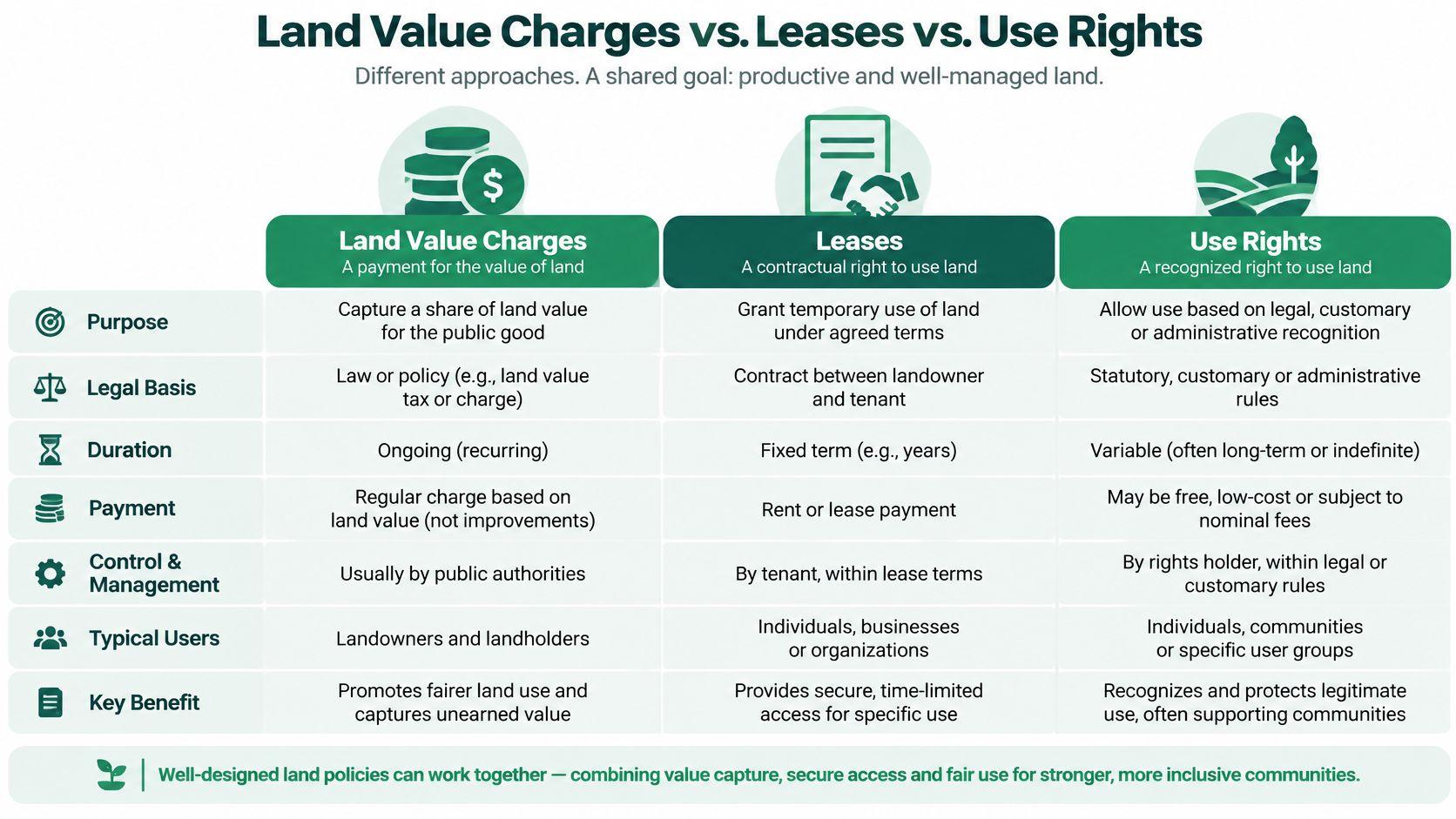
A land-use right looks similar on paper and behaves completely differently. It's indefinite, it doesn't expire, it needs no renewal, and it's repriced annually. Because the charge resets each year, people can buy and sell the right at low cost, unlike a fixed-term lease, and the price stays aligned with the site so entrepreneurship and other productive enterprises aren't handed a lump-sum catch-up. The Unitism guide to land-use rights sets out how the instrument works in practice.
Three tests, one name. Repriced every year. No renewal required. No expiry. Fail any of them and you're looking at a fixed lease with a friendlier title.
Some statutes attach the name land-use right to a fixed lease. Don't follow the label. If any of the three tests fails, it's still a fixed lease, and it still postpones the gap rather than pricing it.
| Instrument | Term | How price is set | Buying and selling | Risk |
|---|---|---|---|---|
| Land value tax | Ongoing public charge while the site has value | Annual assessment of site value only, not buildings | Owner keeps title; the charge follows the land | Shares community-created rent each year |
| Renewable fixed lease | Fixed term that can be renewed | Fixed price until expiry, then one large catch-up | Usable, but certainty ends with the term | Postpones the gap between lease rate and market |
| Non-renewable fixed lease | Fixed term that ends | Fixed price for the term | Progressively harder to refinance and sell | Postpones risk and strands it near expiry |
| True land-use right | Indefinite, no expiry, no renewal | Repriced every year | Bought and sold at low cost | Prices the site currently and doesn't burden productive use |
Choose the Instrument That Fits the Rent
A non-renewable deposit needs a payment before production begins, so a modest royalty can provide early revenue. Pair it with a project-specific rent tax that applies only after the project has recovered its costs and earned the investor's required return. The test is practical: a project earning a normal return should still proceed, while a price spike should generate public revenue in the same cycle.
If tax payments stay low while commodity profits rise, check how the rules define exploration costs, calculate the uplift margin and handle related-party prices. Where profits can be shifted abroad, examine group financing and transfer prices as well as the project ledger. The same discipline applies to any investment case: assess cash received, not just the project ledger. Faberwork on smart controller profitability makes a similar distinction between realised savings and promised performance.
Urban land calls for a different instrument. An annual charge on site value leaves buildings untaxed; a true land-use right is repriced each year, has no expiry and requires no renewal. A fixed lease instead holds the price for a term, leaving the gap to be settled later. For a wider view of how land and natural resources generate rent, see Unitism's explanation of land and water.
The choice comes down to what generates the rent and when the public should receive it: use a cash-flow tax or royalty for a resource project, and an annual land-value charge or properly structured land-use right for a site. Then test the expected payment against the project's hurdle or the site's annual assessment.
Unitism® supports governments, cities and organizations with land valuation, policy design, and modeling of who gains and who pays. Its work focuses on sharing the rental value of land and nature to fund public services while reducing taxes on work and productive capital. Explore Unitism's frameworks, glossary and case studies.