Explore how land and water value capture funds public services. Learn tri-factor economics, valuation methods, policy instruments, and implementation steps.
August 3, 2026
Land and Water Value Capture for Public Finance
Explore how land and water value capture funds public services. Learn tri-factor economics, valuation methods, policy instruments, and implementation steps.

Most advice about land and water starts from the wrong premise. It treats both as environmental concerns, then leaves finance ministries to muddle through housing shortages, weak revenue bases, expensive infrastructure, and speculative land holding with tax systems that punish work instead of rent. That is backward. Land and water are fiscal infrastructure, because the value tied to location, access, scarcity, and public investment can be captured to fund services without taxing buildings, wages, or productive enterprise.
That matters because the physical base is finite and uneven. About 71% of Earth's surface is water and 29% is land, and only about 0.5% of Earth's water is usable fresh water once the inaccessible share is stripped out, according to the U.S. Bureau of Reclamation's water facts page on global water distribution (U.S. Bureau of Reclamation). Agriculture already takes the largest share of freshwater withdrawals, and land degradation raises the cost of every policy failure that gets pushed downstream. Governments that ignore those limits end up financing scarcity with distortionary taxes and emergency spending.
The better approach is to treat land and water rents as the revenue base that modern states keep leaving on the table. If public investment creates value, public finance should recover some of that value. That is the logic behind land-value capture, and it is the right logic for housing, infrastructure, and resource policy.
Table of Contents
- Why Land and Water Are Fiscal Infrastructure
- Understanding Tri-Factor Economics
- Valuation Methods for Land and Water Rents
- Land and Water Value Capture Instruments
- Case Studies and Implementation Precedents
- Implementation Steps for Governments
- Environmental and Housing Outcomes
Why Land and Water Are Fiscal Infrastructure
The standard mistake is to classify land and water as outside the tax base, then overtax the things people produce. That creates perverse incentives. A developer who builds gets hit, while a speculator who sits on a prime site or a major water user who enjoys scarcity rents often pays too little for the privilege. That is not neutral policy, it is a subsidy for hoarding.
The public sector already understands this logic in other contexts. Utilities recover network costs from users, ports charge for access, and congestion pricing recognizes that scarce capacity has value. Land and water should be treated the same way. The rental value of a well-located site, or a scarce water right, is not created by the owner alone. It reflects location, public services, legal privilege, and natural scarcity.
Practical rule: If value rises because the community builds roads, pipes, schools, and drainage, the community should recover part of that gain.
That is why infrastructure funding should not be treated as a narrow capital budgeting issue. The revenue question and the asset question are the same question, especially where cities and water systems are constrained. A finance ministry that wants stable, broad-based revenue should look at site rents, resource rents, and the public costs created by mispriced land use. The case for this shift is strongest where speculative holding is driving up housing costs and where water scarcity is already forcing expensive treatment, pumping, or transfer projects. For a practical overview of how infrastructure funding logic connects to revenue design, see Unitism's infrastructure funding insight.
The policy implication is blunt. Stop taxing improvement and labor first. Start capturing the rent embedded in access to land and water. That broadens the base, reduces deadweight loss, and aligns private decisions with public capacity.
Understanding Tri-Factor Economics
Public finance works best when it separates labor, capital, and nature. Labor is effort. Capital is produced investment, such as machines, buildings, and equipment. Nature covers land, water, minerals, and the location advantages no private owner created. If land gets folded into capital, governments tax the wrong base and miss where value comes from.
The stage, the props, and the actors
Land is the stage. Capital is the props. Labor is the actors. The play only happens when all three are present, but the stage is not the same as the props, and neither is the same as the actors. That distinction matters because a tax on the stage does not punish someone for adding better props. A tax on the props does.
Site value is a better tax base than buildings. A site's value rises because of surrounding demand, public transport, zoning, neighborhood quality, and access to markets. The owner did not create those conditions alone. Public policy did. Water rents work the same way. Scarcity, allocation rules, and access infrastructure create economic value that is separate from the farmer's effort or the industrial user's machinery.
Policy test: If an asset's value would remain even after the owner removed all improvements, you are looking at rent, not productive capital.
That test keeps ministries from treating land like a building and water rights like operating equipment. It also explains why value capture supports growth when designed correctly. Taxing land value leaves the building untaxed, so owners have less reason to keep empty lots idle and more reason to develop them. That is the point of the policy.
For technical users who need a valuation workflow, the issue is method, not theory. Governments need mass appraisal systems, cadastral records, and transparent appeals so site values and water charges are defensible. For a useful orientation on valuation workflows, BatchData's tax assessment versus market value resource is a practical reference for comparing assessed values with market signals. For the broader policy logic behind rent capture and productivity, see Unitism's insights on productivity improvements. If you want a policy frame that links natural value to public returns, pair that with Unitism's ecosystem service valuation guide.
Valuation Methods for Land and Water Rents
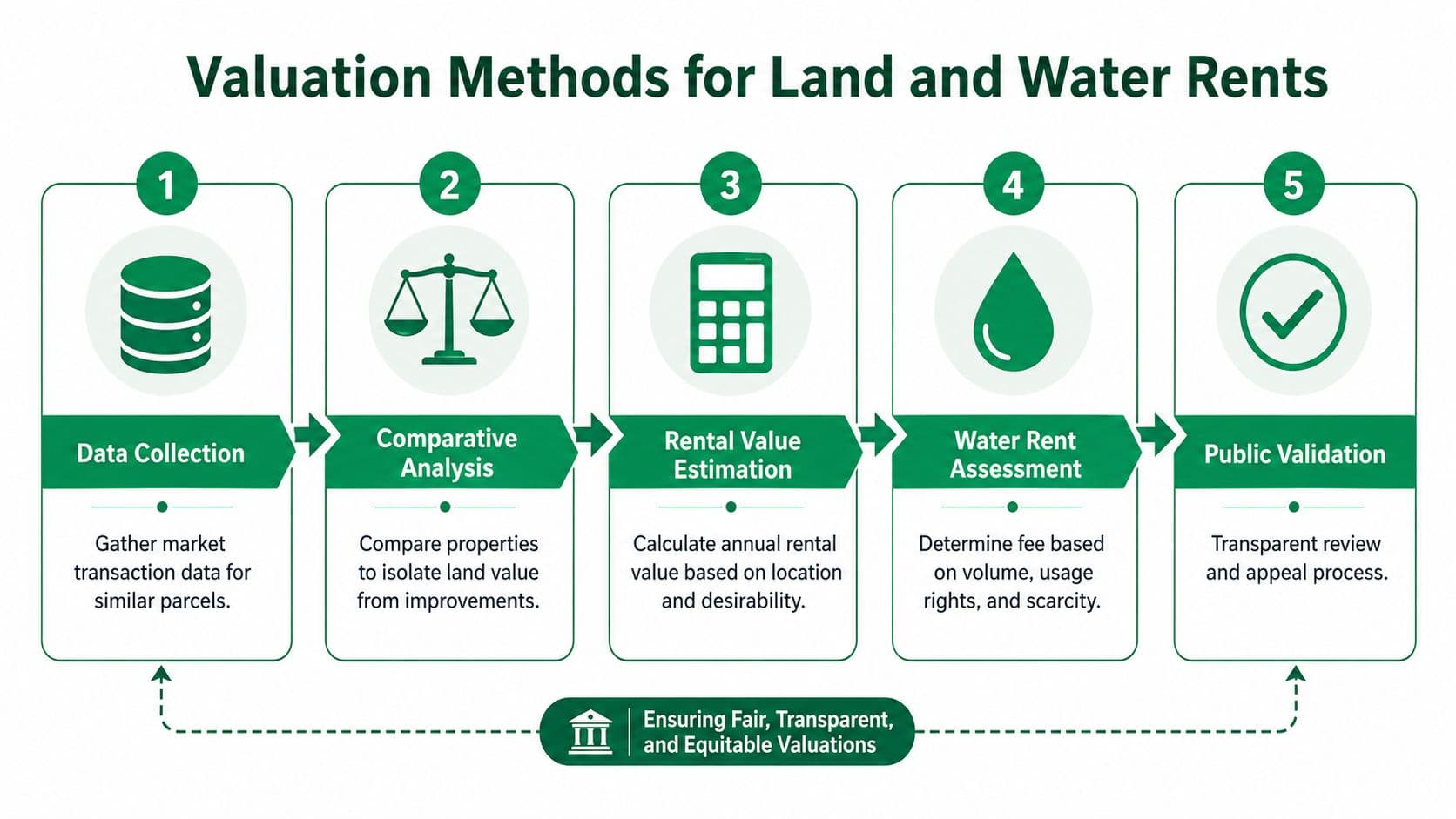
Valuation is where most reforms succeed or die. If the tax base is sloppy, the politics collapse. If the valuation is transparent, the politics are manageable. Governments do not need perfect precision on day one, but they do need a defensible system that separates site value from improvement value and separates water scarcity rent from ordinary operational cost.
How governments isolate the rent
The first move is data discipline. Cadastres, parcel maps, transaction records, and utility data need to talk to one another. That is how assessors distinguish what a parcel is worth because of its location from what the owner added through construction. In dense urban areas, mass appraisal can work well because comparable sales are plentiful. In weaker data environments, governments can phase in valuation with narrower geographic pilots and clearer appeal rights.
Water valuation needs similar care. Scarcity is not the same as usage volume, and allocation privilege is not the same as pumping cost. A ministry that prices water only by meter reading misses the rent created by shortage and legal access. That is why modern resource accounting frameworks matter. FAO's water data framework emphasizes collecting and harmonizing data on status, trends, pressures, and drivers, and it explicitly supports assessment of water availability, use, allocation, water-use efficiency, and water stress (FAO water data and resource assessment).
What the data stack should do
The most credible systems combine administrative and geospatial tools. NASA's MOD44W Version 6.1 land-water mask provides a global map of surface water at 250 m resolution and is available annually from 2000 to present, which makes it useful for coastal planning, flood screening, and watershed analysis rather than a simple land-versus-sea classification (NASA Earthdata MOD44W Version 6.1). That kind of satellite layer is not a substitute for local assessment, but it strengthens the evidence base and helps ministries compare exposure across jurisdictions.
For investors and assessors, the key point is that valuation must be auditable. Appeals should be built in. Public validation should be routine. Governments that hide methodology will face lawsuits and political resistance. Governments that publish the logic, the inputs, and the review process will move faster, even if the first pass is imperfect.
Transparent valuation is not a luxury. It is the administrative price of legitimate rent capture.
Land and Water Value Capture Instruments
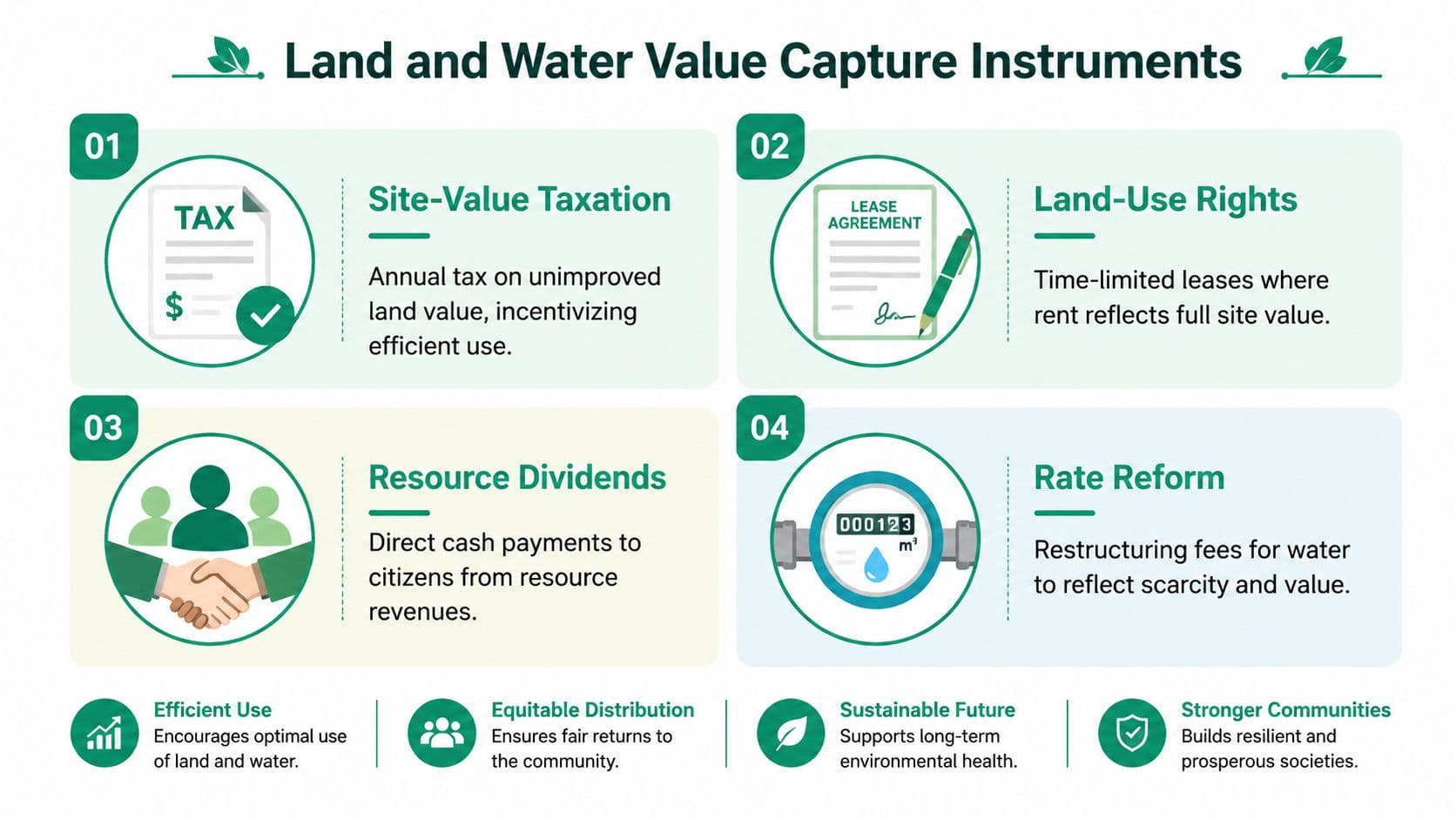
Different instruments suit different institutions. A dense city with decent cadastre capacity can move quickly on site-value taxation. A jurisdiction with major public land holdings may prefer land-use rights. A resource-rich economy may need resource dividends. A utility under water stress may need rate reform first. The wrong move is to treat these as mutually exclusive. They are tools, and the context decides the sequence.
Site-value taxation and land-use rights
Site-value taxation taxes the value of land while exempting buildings and other improvements. That is the cleanest way to discourage speculation and reward construction. It is also easier to defend economically than a broad property tax that hits both site and structure. By contrast, land-use rights are land leases that are repriced annually with no expiration dates. Because they are repriced annually, people can buy and sell land-use rights for a low cost. That makes the landholding function closer to a public lease than a private absolute title, while still preserving market transferability.
The design difference matters. Site-value taxation preserves conventional ownership and adjusts the tax bill. Land-use rights shift the legal form of tenure itself. Countries choose between them based on constitutional law, land administration capacity, and political tolerance for change.
Resource dividends and rate reform
Resource dividends send captured rents back to citizens as direct payments. Alaska is the best-known example of this logic in public debate, even though the institutional context differs from land taxation. The fiscal advantage is political. Citizens can see the value return, which makes rent capture easier to defend when the state is collecting from a politically sensitive base. For households and analysts comparing what capital gains or land-based charges mean in practice, a real estate tax calculator from thecalcs can help frame the difference between transaction-focused thinking and annual holding-cost thinking.
Rate reform is the most incremental water tool. It adjusts utility fees and extraction charges so scarcity is reflected in price. That does not solve tenure politics, but it does stop utilities from pretending water is cheap when the system is not. In water-stressed regions, that is often the fastest path to fiscal realism.
The best package usually mixes two approaches. Use land-based charges to stabilize the revenue base, then use water pricing to align use with scarcity. That combination is stronger than either tool alone, because it reaches both the site market and the resource market. For readers who want the institutional design logic behind implementation, Unitism's guide to land-value capture is a useful companion.
Case Studies and Implementation Precedents
Reform is not hypothetical. Jurisdictions have already tested pieces of this model, and the pattern is consistent. Success comes from clear administration, visible fairness, and a transition that does not shock households or firms. Failure comes from weak communication, bad sequencing, and trying to do too much at once.
Denmark's site-value tax experiments showed the logic of taxing site value separately from improvements, which is exactly why assessors and finance officials keep returning to it when they want a cleaner base. Estonia's land taxation is another reminder that the administrative side matters as much as the theory. If the cadastre is credible and the rules are legible, a land-based charge can be normalized.
Singapore is the clearest example of land-use rights as a fiscal and planning tool. The state's leasehold structure ties development rights closely to public policy and long-term planning rather than absolute private land control. Canberra's leasehold system points in the same direction. The institutional lesson is not that every city should copy the same model, but that the legal form of tenure can be used to align development with public goals.
Norway and Alaska show a different side of the story, resource rents can be shared through public revenue mechanisms and dividends. That makes the political coalition easier to hold together, because citizens can see a direct return from common-resource wealth. Allentown's two-rate property tax is the local-government version of the same principle, since it shifts pressure away from buildings and toward land.
Reform succeeds when the public sees that productive activity is not being punished. The charge falls on holding scarce value, not on creating it.
The common failure point is transition design. Governments often announce the principle too late, then discover they have not prepared appeals, databases, or public messaging. The better sequence is simple. Establish the valuation basis, explain who gains and who pays, phase the reform, and protect households with transition rules where needed. That sequence reduces panic and gives municipalities time to fix the technical issues before they become political ones.
Implementation Steps for Governments
A finance ministry should treat land and water value capture like any other revenue reform, with legal, administrative, and political work streams running in parallel. The first decision is jurisdictional. Who controls the land base, who controls the water allocation system, and which agency owns the data? If that is unclear, the reform will stall before it starts.
Build the base before the tax
Start with legal review, then move to valuation architecture. Draft the enabling legislation around the base you can measure, not the ideal base you wish you had. Integrate cadastre records, parcel maps, utility accounts, and land-use classifications so the assessment office isn't working from contradictory files. Then define the appeal process before the bills go out.
The second move is distributional modeling. Ministries need to know which households, farms, and firms are exposed, and which ones gain from lower taxes on buildings, payroll, or investment. That modeling should be public enough to build trust and precise enough to support phase-ins. Governments that hide the distributional picture usually get it wrong in the public debate.
Sequence the rollout
A practical rollout usually has four parts:
- Pilot zones: Start where the cadastre is strongest and the land market is easiest to observe.
- Appeals and corrections: Build a fast review channel before full rollout, so errors don't harden into opposition.
- Phased rates: Adjust charges gradually to reduce shock and give owners time to respond.
- Public communication: Explain that the reform shifts the burden away from work and structures and toward rent.
The administrative question is not whether the state can ever build the perfect system. It can't. The question is whether the state can build a good enough system to recover value now and improve it over time. That requires cross-agency coordination, especially between finance, planning, water utilities, and land registries. It also requires a clear narrative: the government is not inventing a new burden, it is recapturing value that public policy and scarcity already created.
Environmental and Housing Outcomes
The case for reform is practical. Governments should capture land rent and water rent instead of taxing buildings and labor, because that cuts the reward for holding serviced land idle and raises the reward for using it productively. The result is more development in existing urban areas, where roads, sewers, and transit already exist, and less pressure on public budgets that depend on volatile property cycles.
Housing policy improves for the same reason. A land charge pushes owners to bring sites into use, so developers face less speculation-driven scarcity and more predictable access to serviced land. For more on how land-value capture affects housing markets, see Unitism's housing affordability policy insights. It also gives finance ministries a cleaner revenue base, because they collect from location value instead of from work and new construction.
The environmental effect is direct as well. Water pricing that reflects scarcity reduces over-extraction and creates a funding stream for conservation, while land-value taxation favors compact development over sprawl. That matters because urban expansion is already colliding with productive land and infrastructure limits. The FAO notes that urban areas occupied less than 0.5% of Earth's land surface in 2000, yet by 2014 54% of the world's population lived in cities, and it says this growth has been encroaching on good agricultural land (FAO urbanization and land suitability facts). That is a planning problem, not a slogan problem.
A finance ministry also has to price the risk correctly. The UNCCD reports that 40% of all intrastate conflicts in the past 60 years are linked to natural resources, and that 135 million people may be displaced by 2045 as a result of desertification (UNCCD Land in Numbers). Those figures point to fiscal, security, and migration exposure. Ignoring land and water scarcity just pushes those costs into emergency spending later.
If you want cheaper housing, cleaner water policy, and a steadier tax base, stop taxing the thing people build and start capturing the rent created by place and scarcity.
Housing ministries should ask one question. Are they subsidizing speculation, or are they making serviced land cheaper to use productively? Finance ministries should ask the same question in fiscal terms. Are they collecting revenue from work and construction, or from the value that public institutions and natural limits already create? The reform package should follow the second answer.
If the state wants a practical partner for land-value reform, valuation design, and implementation support, Unitism® works on these questions for governments and cities. Use that kind of support if you need a revenue strategy that treats land and water as fiscal infrastructure, not just environmental background.