Guide to revenue neutral tax reform via land value. Covers modeling, transition paths, stakeholder engagement, legal actions, and case-study templates.
September 7, 2026
Revenue Neutral Tax Reform Guide for Land Value Shifts
Guide to revenue neutral tax reform via land value. Covers modeling, transition paths, stakeholder engagement, legal actions, and case-study templates.

Your finance team has been asked to keep public services funded without raising the overall tax take. At the same time, property owners are watching assessments move, builders are questioning whether another project is viable, and elected officials are trying to explain why a “neutral” reform may still leave some households paying more.
That tension is the core problem. Revenue neutral tax reform doesn't mean every taxpayer pays the same amount, and it doesn't guarantee that collections will remain stable once behavior, appeals, exemptions, and political compromises enter the process. A workable reform needs a defensible baseline, a clear legal instrument, reliable valuation, distributional analysis, and a transition plan that officials can audit in public.
Table of Contents
- Understanding the Key Concepts
- Modeling Revenue Neutral Scenarios
- Planning the Transition Pathway
- Managing Stakeholder Engagement
- Avoiding Legal Pitfalls and Administrative Hurdles
- Case Study Templates for Practical Guidance
- Key Tips and Conclusion
Understanding the Key Concepts
A municipality usually starts with a familiar problem. Building costs rise, land values move unevenly, and a conventional property tax charges both the site and the structures on it. The council needs revenue for roads, schools, and services, but increasing the tax on construction can discourage improvement while leaving well-located, underused land lightly charged.
A land-value shift changes the base. The government taxes the unimproved value of land more heavily and reduces taxes on buildings, labor, or capital where the policy design allows. The Chicago Fed explains that a pure land value tax can be revenue neutral because land supply is fixed. It may raise enough revenue to replace a typical property tax, or potentially other municipal taxes, without creating deadweight loss. The land value tax overview from Unitism provides a useful foundation for distinguishing the value of the site from the value created by labor and capital.
The phrase “revenue neutral” needs a precise definition. True neutrality compares projected post-reform collections with a clearly stated current-policy baseline. Nominal neutrality may instead rely on future-law assumptions, the removal of tax breaks, or optimistic behavioral projections. Independent analysis warns that plans marketed as neutral can change once analysts clarify whether the comparison is current law or current policy. Legislators should publish both baselines, not hide the choice in technical documents.
Tri-factor economics makes the policy logic clearer. Labor supplies work, capital supplies tools and improvements, and nature, especially land, supplies locations and resources that people don't create. A charge on land value can fund public services while reducing penalties on productive activity, but only if the government measures land separately and writes the rules precisely.
Land tenure also matters. A fixed land lease isn't the same as a land-use right. A lease has a fixed term and a fixed price, while a genuine land-use right is indefinite and repriced annually according to the site's current rental value. That distinction determines who bears valuation risk and how easily the interest can be transferred.
Modeling Revenue Neutral Scenarios
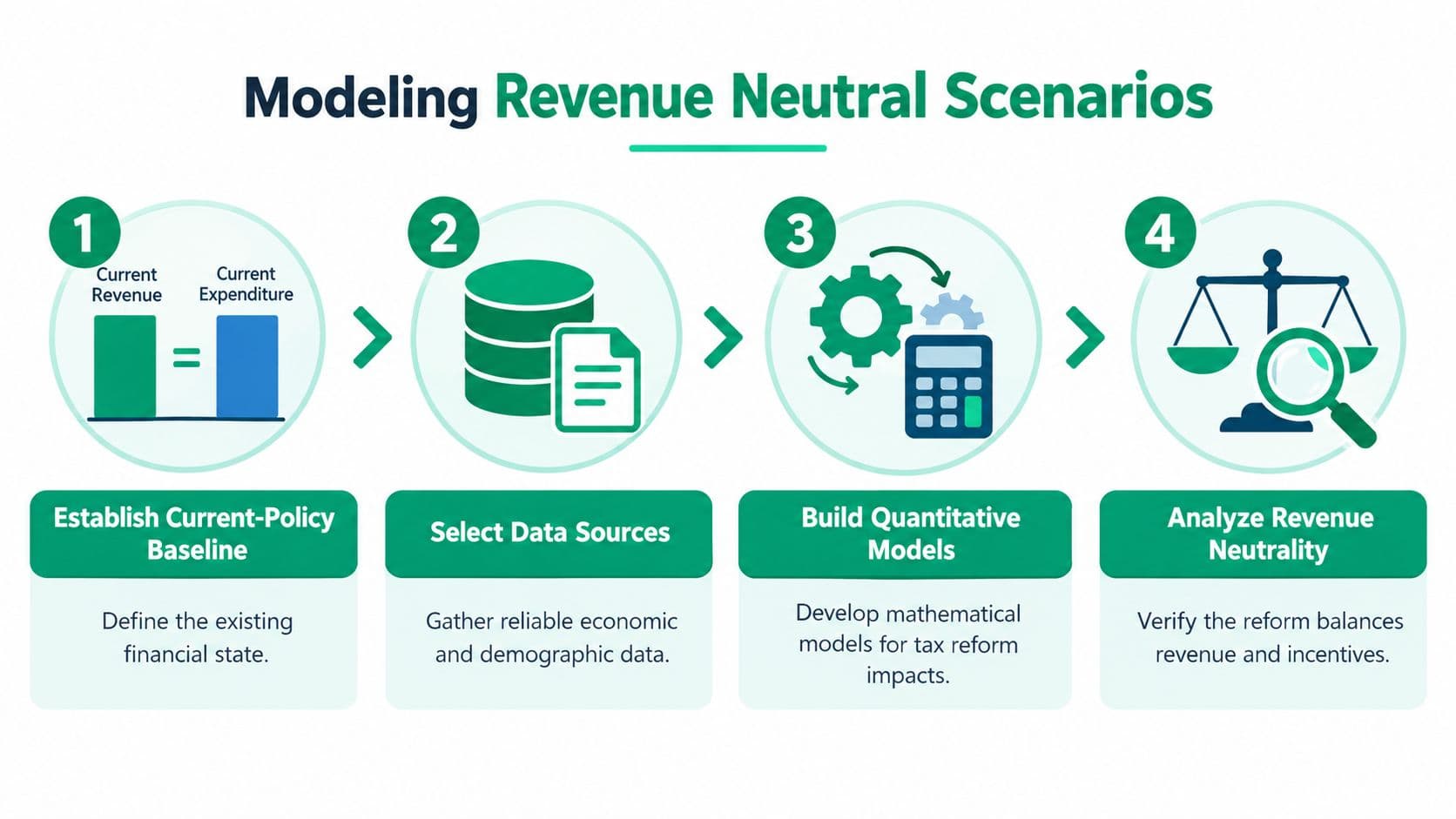
Revenue neutrality fails when officials model a preferred rate before establishing the fiscal baseline. Start with the tax base already in use, including exemptions, credits, arrears, collection costs, and expenditure commitments. State whether the target means unchanged gross revenue, unchanged net revenue after administration, or unchanged collections against a future-policy baseline.
Build the baseline before changing rates
Use cadastral records, assessment rolls, billing systems, appeals data, and audited collections. Estimate each site's rental value separately from buildings and other improvements. An annual charge on unimproved land value excludes buildings and crops, so regular valuations and modern computer-assisted mass appraisal methods matter. Weak land assessment produces a weak neutrality calculation.
A lease and a land-use right also belong in separate model fields. A lease has a fixed term and price. A genuine land-use right is indefinite and repriced annually according to the site's current rental value. That difference changes who bears valuation risk, how rights transfer, and whether the modeled revenue remains stable when assessments change.
Run the analysis in layers:
- Reproduce current collections. Reconcile assessed values and statutory rates with actual bills and receipts.
- Separate the tax base. Estimate site value, improvement value, exemptions, and taxable occupancy categories.
- Apply alternative rates. Test land-heavy, split-rate, and credit-supported designs.
- Calculate incidence. Show changes by household type, firm, property category, neighborhood, and region.
- Stress the assumptions. Test assessment errors, appeals, delayed payments, land-price changes, construction responses, and exemption growth.
- Reconcile the result. Compare modeled collections with the amount the treasury must replace.
Credits must sit inside the model, not appear as a political fix after rates are chosen. The Dover, New Hampshire example shows how a credit-supported design can offset concentrated burdens while preserving the overall revenue target. Save parcel-level impacts and rate details for the case study rather than presenting one headline rate as a universal solution.
A spreadsheet works for an initial prototype. Production analysis requires version control, parcel-level data, reproducible calculations, and an audit trail that records every changed assumption. Use PlotStudio AI's scenario analysis guide to organize alternatives, then consult this scenario modeling software guide when assessing whether existing systems can support repeatable testing and review.
Modeling rule: Publish the baseline, credits, exemptions, lease or land-use-right assumptions, and behavioral responses behind every neutral rate.
Planning the Transition Pathway
A reform should preserve its fiscal target at every stage, not just at the final destination. Officials need a written schedule that states what changes first, what remains protected, and what action follows if collections diverge from the target.
Set the rules before setting the calendar
During the planning phase, adopt an explicit revenue target and define the measurement period. Decide whether the government will move immediately, use a staged rate shift, or begin with a limited pilot. Pair each rate change with a corresponding reduction, credit, or allowance so taxpayers can see how the replacement works.
The implementation phase should use two forms of scoring. Static scoring estimates the result without assuming major behavioral change. Dynamic scoring tests likely responses, including construction, land holding, redevelopment, business relocation, appeals, and payment timing. Neither method is enough by itself. Officials should publish both and explain where their conclusions differ.
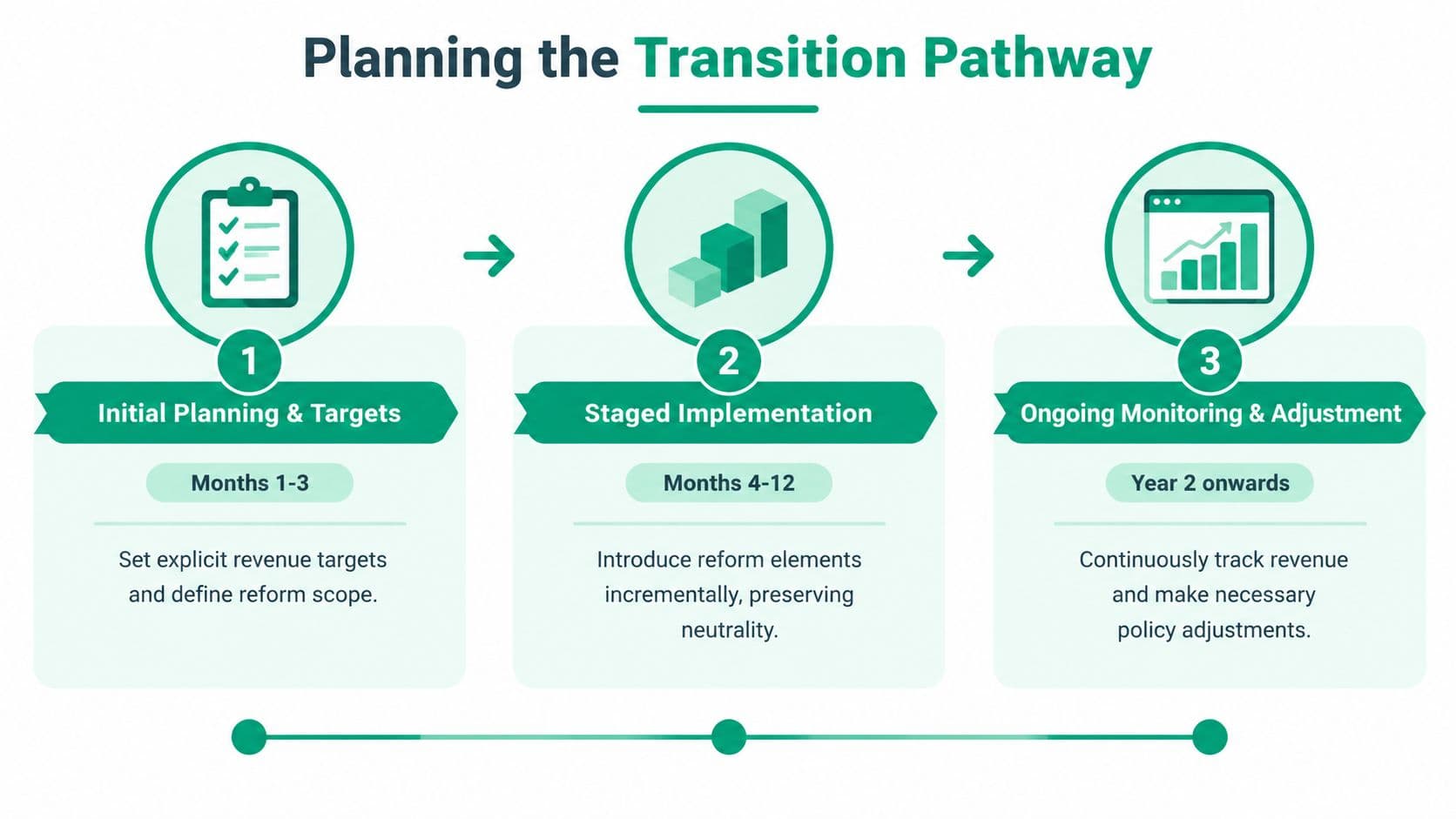
Monitoring begins with a live reconciliation between assessed liability, billed liability, cash collections, refunds, credits, and appeals. Set contingency triggers in advance. If collections fall below the approved target, pause the next rate step and investigate the cause. If they exceed it, return the excess through a scheduled adjustment rather than treating an unexpected surplus as proof that the original model was perfect.
Reforms designed to be neutral often exceed their original targets because political and behavioral responses alter the effective tax take, as documented in the classic review of revenue-neutral reform outcomes. That finding supports disciplined administration, not abandonment of reform. Use ex ante scoring, publish assumptions, and reconcile projections with actual collections after implementation. The phased implementation guide offers a practical framework for organizing those checkpoints.
Managing Stakeholder Engagement
A neutral treasury result won't persuade a homeowner who sees a larger bill, a developer who expects a higher site charge, or a labor group that doubts promised tax relief. Engagement must begin with an incidence map, not a slogan.
List the affected groups and identify their actual exposure:
- Homeowners and tenants: Show the effect of land charges, building-tax reductions, credits, and possible rent transmission.
- Developers and builders: Explain how lower taxes on improvements interact with the annual cost of holding a site.
- Employers and workers: Identify whether the reform reduces charges on payroll, earnings, or productive capital.
- Land-rich institutions: Test the effect on public bodies, nonprofits, farms, utilities, and large commercial owners.
- Neighborhoods and regions: Map differences between high-value locations, weak markets, and areas with limited redevelopment capacity.
Recent policy analysis emphasizes that treasury neutrality can conceal shifts between households, firms, and regions, which is why detailed incidence studies matter as discussed by the C.D. Howe Institute. Publish distributional tables in plain language. Show who pays more, who pays less, which credits apply, and which assumptions could change the result.
Hold separate technical sessions for assessors, finance officers, and legal counsel, then public workshops for residents and businesses. Give participants parcel examples, not abstract averages. A resident should be able to understand why a vacant central site, an occupied home, and a newly improved property receive different treatment.
Use a feedback register with four columns: concern, evidence, proposed response, and decision. Publish updates on a fixed communication calendar. The stakeholder engagement strategies guide can help teams structure workshops, surveys, and feedback loops without allowing the loudest participant to define the entire policy.
Communication rule: Explain the tax base first, the rate second, and the distributional result third. Reversing that order creates avoidable fear.
Avoiding Legal Pitfalls and Administrative Hurdles
The statute must define the taxable interest before the assessor can value it. A land-value charge should identify the site, exclude buildings and crops where that is the policy, establish the valuation date, prescribe annual billing, and specify how credits, appeals, delinquencies, and refunds operate.
The legal distinction between leases and land-use rights deserves special care. Land leases are renewable or non-renewable fixed-term agreements with a fixed price. A renewable lease offers certainty only until its term ends, then closes the accumulated gap between the lease price and the market in a major repricing. A non-renewable lease becomes harder to refinance and sell as its expiration approaches. Fixed leases postpone risk rather than pricing it continuously.
A genuine land-use right has no expiration and requires no renewal. Its annual charge is repriced to the site's current rental value, so the right remains secure for as long as the annual price is paid, as described in the land-use right guide. Because the price updates annually, people can transfer these rights at lower cost than fixed-term interests. That structure prices land risk directly without burdening entrepreneurship and productive improvements.
| Feature | Land Lease | Land Use Right |
|---|---|---|
| Duration | Renewable or non-renewable fixed term | Indefinite, with no expiration |
| Price | Fixed for the lease term | Repriced annually |
| Renewal | Required for renewable leases | Not required |
| Risk | Accumulates until renewal or becomes harder to refinance | Adjusts continuously with current rental value |
| Transfer | Can become difficult as expiration approaches | Can be bought and sold without waiting for renewal |
| Legal test | A fixed-term interest remains a lease | It qualifies only when it is indefinite and annually repriced |
Sometimes a fixed lease is labeled a “land-use right.” That label is wrong unless the interest is indefinite, never requires renewal, and is repriced every year. Drafting should prevent terminology from concealing the economic reality.
Administratively, integrate cadastral maps, ownership records, valuation models, billing, appeals, and collections. Give assessors a documented mass-appraisal method, taxpayers a meaningful appeal route, and auditors a record of every valuation change. The government should also publish data-governance rules, because a neutral tax model cannot survive missing parcel records or inconsistent classification.
Case Study Templates for Practical Guidance
Officials should choose a template that matches their legal authority, valuation capacity, and tolerance for taxpayer disruption. Each case begins with a published baseline, separates land from improvements, models incidence, and settles the taxable interest in legislation before setting a rate.
Template one with credits
A city facing resistance to a full shift can identify existing property-tax revenue, map parcels exposed to a higher land charge, and place targeted credits inside the same fiscal model. The rate change should accompany a lower building component, not operate as a separate relief program.
The Dover plan offers a concrete pattern. It raised the land rate from $13.98 to $27.89 per $1,000, granted $8.4 million in credits across nearly 9,000 bills, and collected $26.2 million overall as reported by the Chicago Fed. Copy the structure, not the figures. Legislation should define credit eligibility, duration, application, review, and treatment of unpaid liabilities. Evaluation should compare billed revenue with cash revenue, then track appeals, construction activity, and distributional changes across property categories.
Template two with a partial phase-in
A second jurisdiction can retain an existing building rate while increasing the land rate in stages. This approach gives administrators time to improve land valuation and gives taxpayers time to understand the new base, but it also prolongs exposure to inconsistent assessments.
The statute should specify every phase, its revenue target, and the condition that permits the next increase. It should also require a public review before each step. Publish actual collections, appeal outcomes, and incidence results, then authorize the next phase only when the evidence meets the stated conditions.
Template three for a land-use-right pilot
A pilot can test indefinite, annually repriced land-use rights for a defined class of sites. The legal instrument must state that the right does not expire, requires no renewal, and carries an annual price tied to current rental value. Public documents, contracts, and assessment records must use the same definition. Calling a fixed lease a land-use right creates avoidable disputes over renewal, transfer, valuation, and enforcement.
For economic context, a peer-reviewed policy model raised the land tax rate from 0.55% to 5.55%, while cutting capital-income taxes by 28 percentage points and labor-income taxes by 10 percentage points. The model maintained government revenue, increased output, and improved welfare according to the cited policy report. Treat those results as model outcomes, not a forecast for the jurisdiction running the pilot.
Track valuation accuracy, transfer costs, administrative workload, taxpayer comprehension, appeals, and changes in site use. A land-value uplift framework helps officials connect public investment, location value, and the tax base while keeping improvements distinct from land value. The pilot should also record how assessors classify interests and how tribunals resolve challenges, because administrative practice can determine whether the reform remains revenue neutral.
Key Tips and Conclusion
Revenue neutral tax reform succeeds when officials treat neutrality as an operating discipline, not a campaign phrase.
- Define the baseline: Publish current law and current policy comparisons.
- Separate the factors: Keep land, labor, and capital effects visible.
- Value sites properly: Exclude improvements where the instrument requires it.
- Model incidence: Show household, firm, and regional effects.
- Price risk continuously: Don't relabel fixed leases as land-use rights.
- Use credits deliberately: Put relief inside the fiscal model.
- Score behavior: Include construction, holding, appeals, and compliance responses.
- Write triggers: Pause or adjust rates when collections diverge.
- Publish reconciliations: Compare forecasts with actual receipts.
- Engage with evidence: Use parcel examples and transparent tables.
Start with a defensible parcel dataset, a public baseline, and draft legislation that defines the taxable interest. Then test the transition with independent incidence analysis before the first rate change.
Unitism® offers land valuation assessments, fiscal and distributional modeling, legislative drafting support, cadastre integration, stakeholder education, and step-by-step transition advice for governments shifting revenue toward land value. Visit Unitism® to explore practical tools and advisory support for designing a revenue neutral tax reform that can withstand legal, administrative, and public scrutiny.