Learn what site value on appraisal means, how it differs from improvement value, and how appraisers estimate land with the residual method.
November 23, 2026
Site Value on Appraisal Explained: Meaning and Method
Learn what site value on appraisal means, how it differs from improvement value, and how appraisers estimate land with the residual method.

Site value is the value of the land alone, as if vacant and put to its best use, with buildings and improvements excluded. In an appraisal, that figure is rarely observed directly: it's the balance left when you subtract the cost of a scheme, its fees, its finance and the developer's profit from what the finished development would sell for. Land worth gets recorded at national scale too, and the totals are large. At 1 July 2025, the NSW Government's land values overview records 2,281,992 residential properties in New South Wales carrying a combined land value of A$2,369,598,471,154. That's land alone, buildings stripped out.
You probably have a version of this in front of you. An appraisal lands on your desk or your committee's agenda, there's one confident total at the bottom, and nothing in it tells you which part is the ground and which part is the thing standing on the ground. That gap matters the moment anyone uses the number for something real: a tax base, a compulsory purchase, a rent reset, a loan, or a business case for a scheme that hasn't been built.
Two forces decide how that number behaves. The assumptions inside the residual calculation move it first, often by more than people expect. The form of tenure decides who carries the land-price risk afterwards, and whether that risk gets priced continuously or parked until a distant date. Both are worth understanding before you stake a decision on a single figure.
Table of Contents
- Site Value and Improvement Value at a Glance
- Why Appraisers Separate Land From Buildings
- How Appraisers Estimate Site Value Step by Step
- How Site Value Changes Real Appraisals
- Land-Value Tax Is a Charge, Not a Tenure
- Fixed Leases and Land-Use Rights Compared
- Check the Assumptions Before You Rely on a Site Value Figure
Site Value and Improvement Value at a Glance
Two houses on identical plots, same street, same frontage, same outlook. Say one sells for 600,000 and the other for 450,000. The land can't explain that gap, because the land is the same in both cases, so the buildings do. A report that gives only a total hides which portion of the value would survive a demolition order, a change of use or a fire.
Site value is what the plot is worth as if it were empty and available for its best permitted use. Improvement value is what the house, garage, outbuildings, fences, drainage and other works add on top. One figure is created largely by the neighbourhood; the other by whoever paid the builder.
| Aspect | Site value | Improvement value |
|---|---|---|
| What it measures | Value of the land alone, as if vacant and put to its best use | Value added by buildings, fixtures, works and other improvements on the land |
| Typical estimation method | Residual method and comparable land sales | Cost approach or comparable building sales |
| What moves it | Location, demand, planning permissions and permitted density | Construction costs, age, condition and depreciation |
| Treatment under a land-value tax | Taxed as the charged base | Excluded from the charge |
| Example | Value of a city plot before any house is built | Value of the house built on that plot |
The practical habit is short: when you're handed a single total, ask for the site figure and the improvement figure as separate lines. They behave differently. A new employer in town lifts location value across a whole postcode while the houses themselves keep ageing; a jump in timber and labour costs lifts replacement cost while the ground underneath doesn't move at all. If you want to see how a residential appraisal assembles those components from the property end, Upchurch Inspection's home appraisal explainer walks through the inspection and reporting process.
Two numbers, two different stories. You can't separate them if nobody wrote them down.
Why Appraisers Separate Land From Buildings
A seat in a theatre is worth roughly what the production is worth. The ticket holder didn't write the play, hire the actors or maintain the building, yet the price of the seat depends on all of it. Land behaves the same way. A location's value comes from the people, roads, schools and businesses around it, not from anything its owner did.
Economists call the income that flows from that advantage economic rent: income that comes from owning a desirable location or natural resource, not from work or investment. It's the reason a bare plot in a thriving city can cost more than a finished house in a shrinking one.
Because that value attaches to location rather than effort, appraisers measure it apart from the buildings. The International Monetary Fund's historical analysis of site-value taxation defines site value as the capital sum a property title could command in a bona fide sale, regardless of the property's current use. That last clause does the work. A parcel with an ageing bungalow earning modest rent can be worth far more than its income suggests, because the location would support something denser or different. Value it on today's income and you'll understate both its development potential and its alternative-use value.
The split is easier to see when it's drawn out than when it's described:

The split has an administrative history
The same IMF analysis records that Jamaica's Parliament enacted a Land Valuation Law in December 1956, requiring the revaluation of land and the taxation of unimproved land values. The reform followed reports dating from the beginning of the twentieth century and drew on a 1956 report by J. F. N. Murray. Separating site value from improvements turns out to be an administrative practice with roots in twentieth-century public finance, not a recent theoretical proposal.
Practical tools make the separation workable at scale. Land-value maps and cadastral maps extend benchmark values from representative areas to individual properties. Assessors group comparable locations, set a benchmark for each group, then adjust for frontage, shape, access and recent nearby sales. Once that structure exists, valuing thousands of parcels stops being an impossible job and becomes a matter of maintaining the map.
How Appraisers Estimate Site Value Step by Step
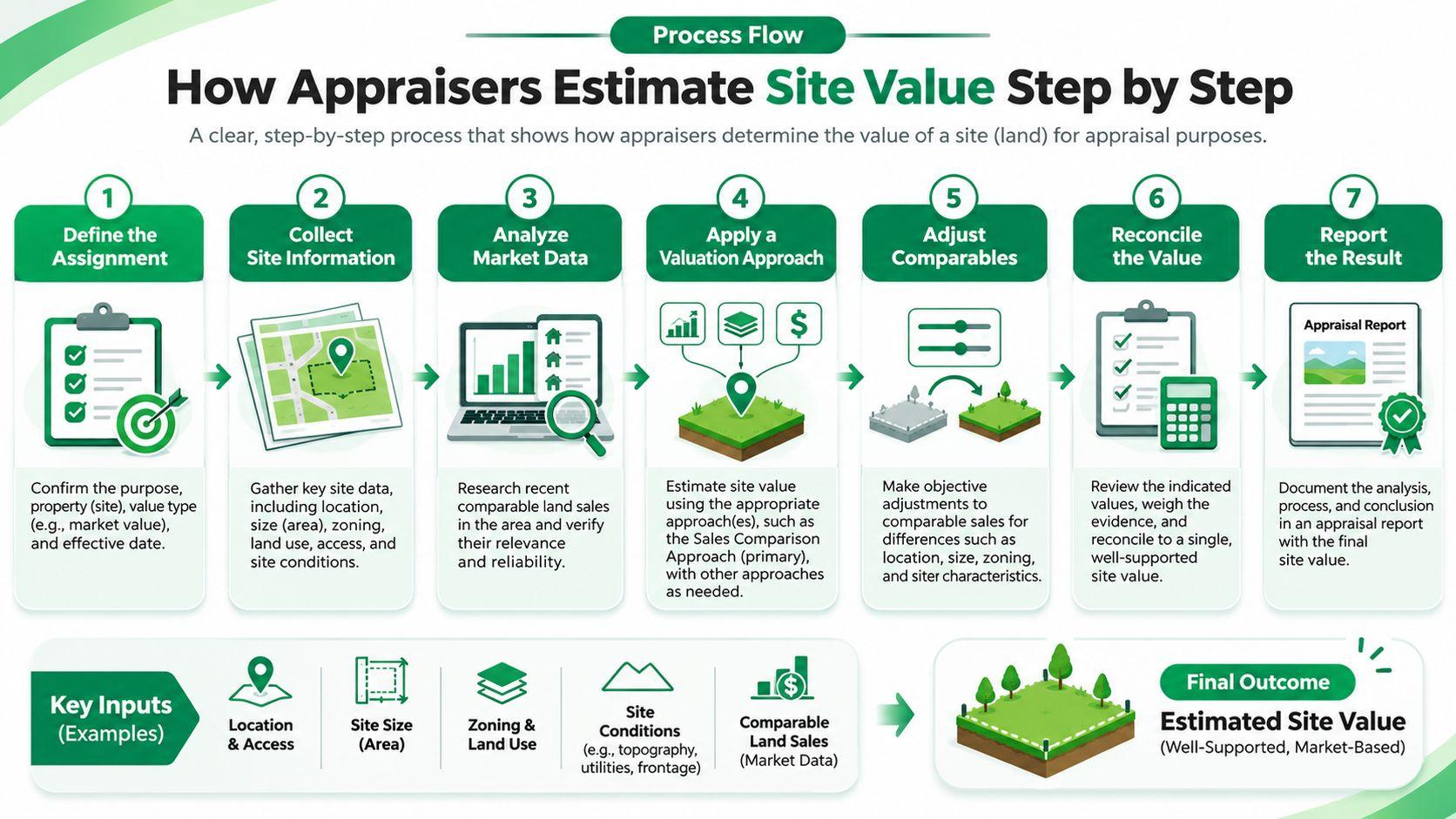
A valuer often prices the finished flats before pricing the field they stand on. Many site values are calculated backwards from a scheme that has not been built yet, using what the UK government's land value estimates guidance calls the residual method: start with the completed value, subtract every cost required to deliver it, and treat the leftover as the land. National residential land-value estimates use the same family of models, so the approach is routine appraisal practice rather than an edge case.
The arithmetic works like a household budget run in reverse. The expected sale proceeds are the pay packet, every committed cost is a standing order, and the site value is whatever remains once each claim has been paid.
- Set the gross development value. This is the expected market value of the completed scheme, inferred from comparable sales or rents. Everything downstream is a deduction from this number, so an optimistic sale value inflates the land figure directly.
- Deduct construction costs. Use a quantity surveyor's estimate, not a builder's verbal guess, because the build cost is usually the largest single deduction.
- Deduct professional fees. Architect, engineer, planning consultant, project manager and legal costs, commonly expressed as a percentage of construction cost so they scale with the job.
- Deduct planning obligations. Affordable housing contributions, infrastructure payments and similar requirements attached to the consent. They consume value before the landowner sees any.
- Deduct finance costs. Interest on the loan that carries the build, calculated over the build period. A slower programme reduces land value as well as patience.
- Deduct marketing and sales costs. Agents, advertising and conveyancing on the completed units.
- Deduct a contingency. A reserve for overruns, weather and ground conditions nobody spotted at survey stage.
- Deduct the developer's required profit. The return that makes the scheme worth doing at all. Remove it explicitly, because a scheme without it does not get built.
- The remainder is the residual site value. What is left after every other party has been paid.
That final figure is the part people misread. It is no fixed slice of the building's price and no percentage anyone can look up. It is a remainder, and remainders are small and fragile when the deductions around them are large. Run the arithmetic once with round, illustrative figures, chosen to show the structure rather than taken from any market:
| Line item | Basis |
|---|---|
| Gross Development Value | Comparable sale prices for the completed scheme, giving 2,000,000 here |
| Construction costs | Quantity surveyor estimate of 1,200,000 |
| Professional fees | 10% of construction cost, so 120,000 |
| Planning obligations | Set to zero in this example |
| Finance costs | Loan interest over the build period, 60,000 here |
| Marketing and sales | 3% of GDV, so 60,000 |
| Contingency | 5% of construction cost, so 60,000 |
| Developer profit | 20% of GDV, the required return, so 400,000 |
| Residual site value | GDV minus all deductions, 100,000 |
The fragility is visible in the last line. Land is 100,000 against a gross development value of 2,000,000, five per cent of the scheme. Add five per cent to construction cost, sixty thousand on this scheme, and the residual falls to forty thousand with nothing else changing. That is the mechanism behind the guidance's warning that the method is highly sensitive to assumptions about permitted density, sale prices, construction costs, financing and risk: a small change in any one input can produce a substantial change in the land residual.
A credible appraisal therefore shows its assumptions and tests low, base and high scenarios instead of presenting a single point. Tenure decides who carries that estimation risk. A buyer paying the full residual freehold price carries the loss if consent, costs or sale prices move against the scheme. Where land is held under a lease or land-use right with payments set by a stated formula, some of that risk shifts to whichever party agreed to bear it. The site value remains an estimate either way; the contract determines who pays when the estimate proves wrong.
The residual approach sits alongside comparative methods and income approaches, so a sound valuation brief states which methods of land valuation are being used and why.
How Site Value Changes Real Appraisals
Take a corner plot with a 1960s bungalow on it, let at a modest rent. The rent roll looks calm, almost boring. The location does not: the same site could carry four units, so its value can sit well above what the present use earns. Site value works like the price of the stage rather than the play now performing on it.
Change the permitted density and the stage is repriced. More units raise gross development value, so the residual land value rises with it; fewer units cut the residual even though the soil, street and neighbours are identical. Two planning outcomes on one parcel can produce site values that look as if they belong to different postcodes.
Highest and best use is the lever people skip. Site value rests on the most profitable lawful use the land could support, which may differ from the use it has today. If the appraisal assumes a consent planning would refuse, or a scheme buyers would not fund, the land figure inherits that error before any comparable sale is even chosen.
Mass appraisal adds scale, and scale adds a new risk. Benchmark values and land-value maps let an assessor group comparable locations, then adjust for frontage, shape, access and recent sales. Used well, that keeps values consistent; used carelessly, one weak benchmark can repeat across a whole street. The workflow behind it is set out in this guide to mass appraisal methods.
So test the driver before you trust the number. If the answer names density, sale price, costs or the comparable set, you have found the input that moves the result. The same habit applies when a tax figure rather than an appraisal is challenged: resources on how to protest property taxes are about disputing the assessed base and its inputs, not the wording on the bill. Who carries that risk also depends on tenure: an owner, a fixed-term leaseholder and a land-use right holder do not face the same exposure when the site estimate shifts.
Land-Value Tax Is a Charge, Not a Tenure
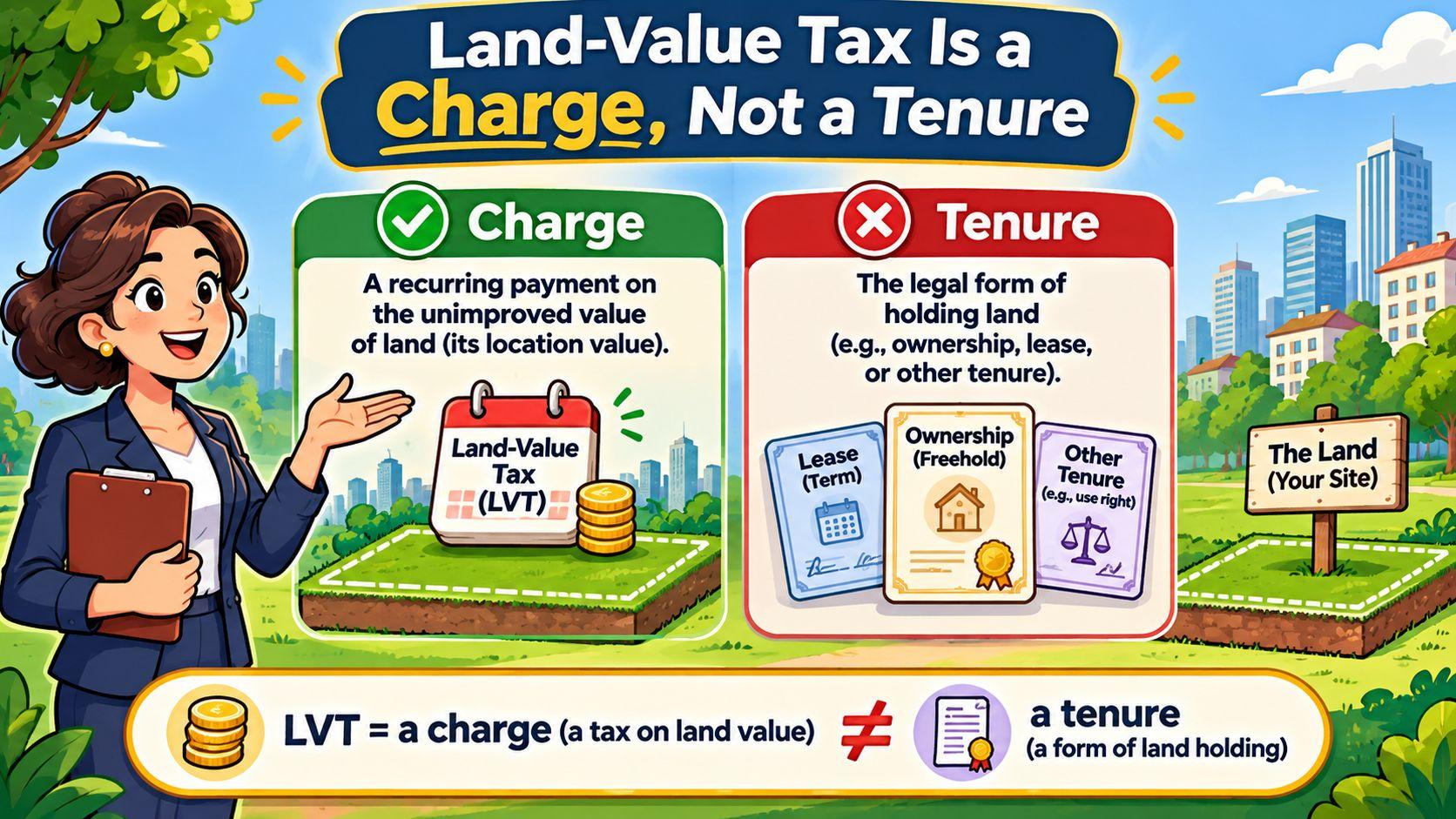
A land-value tax is an ongoing annual charge on the unimproved or site value of land, paid while the owner keeps the land. It's a public charge on the value of the land itself, not on the buildings or improvements placed on it, so the building never enters the base. Because the base is the site figure, everything in the sections above lands here. An overstated site value shifts the charge onto that owner; an understated one shifts it onto everybody else.
The distinction is easier to hold onto once you see what the charge does and doesn't do:
Rates are set by the jurisdiction, and the arithmetic is simple. A 2025 regional study modelled a proposed 1.05% site-value rate for Bizkaia, Spain. Applied to a plot with a site value of 200,000, that's 2,100 a year, whatever gets built on top of it. Build a modest house or a six-storey block and the land charge stays where it is, which is exactly the incentive a building tax destroys.
Revenue can be returned to the community whose roads, schools and services helped create the value in the first place, so the charge rewards good use of land and makes holding a site idle cost money. The base, the rate and the reliefs are all set locally, so the land value tax explainer is worth reading before you compare one jurisdiction's rules with another's.
Here's the point that trips people up. A charge is not a right. A land-value tax doesn't grant occupation, transfer possession or end it, and paying it buys nothing except the privilege of holding the land. A fixed-term land lease does grant occupation, for a defined period at a fixed contractual price. A land-use right also grants occupation, but indefinitely, with the payment reset every year. Those two forms carry risk in very different places, which is where the next section goes.
Fixed Leases and Land-Use Rights Compared
A 99-year lease can feel like ownership with a very long fuse. The fuse is the point. A price fixed for decades does not remove land-price risk; it parks that risk inside the contract and lets it grow until renewal, resale, refinancing or expiry forces the issue. The sensitivity of the underlying site value matters here. If the land figure is a residual built from density, sale prices, costs, finance and profit assumptions, then tenure decides who absorbs the error when those assumptions move.
Where a renewable lease puts the risk
During the contractual term, the holder gets certainty: the payment is fixed even while surrounding roads, schools and businesses keep changing what the location is worth. Certainty ends at renewal. If market land rents have risen above the contractual rate, the gap has been compounding off the balance sheet and is settled in one repricing event. The analysis of land as a factor of production explains why that gap belongs to the location rather than to the owner's effort.
The danger is the shape of the adjustment, not only its size. A smooth annual reset spreads market movement across many small decisions. A fixed lease stores the same movement and releases it at the worst moment, when a lender, buyer or valuer has to treat the renewal date as part of the asset. Transferability can therefore be misleading: the lease may be saleable, but the approaching repricing is already inside the price anyone rational will pay.
Why a non-renewable lease decays
Remove renewal and time stops being neutral. The contractual price can still be fixed, but the interest is now wasting: each year, the remaining term shortens while the building may have decades of useful life left. Singapore makes the mechanism visible at scale: the academic analysis of the Singapore model notes that the government owns about 90% of the land and commonly grants 99-year leases, with the upfront price representing the capitalized value of the land's rental value over that period. On that structure, if no further value is paid at the end, residual leasehold value runs arithmetically to zero at expiry.
That is why the details in 99-year land leases matter more than the comforting length of the term. A lender facing a 20-year residual on a building with a 60-year life can shorten the loan, raise the rate or decline; a buyer discounts for the loss being purchased. The closer the terminal date gets, the less the price behaves like a property price and the more it behaves like the present value of a shrinking right.
The three conditions a land-use right has to meet
A land-use right is a different instrument, and the label on the document proves nothing by itself. According to the explanation of land in economics, all three of these must hold:
- Repriced each year. The payment resets to current land value, so it tracks the market instead of drifting away from it.
- No renewal required. There is no renewal event, which means there is no renewal repricing to absorb.
- It does not expire. The right is indefinite, so the holder never faces a terminal date when the interest falls to nothing.
Miss any one of the three and the instrument is a fixed lease wearing a friendlier name. The annual reset may look less safe because the payment can move, yet that movement is exactly what keeps a large gap from being stored up for a single day of reckoning.
Why the annual reset changes the cost of transferring land
The surprising part is liquidity. A fixed-lease buyer pays today for a large stock of future rent plus uncertainty around renewal. An annually repriced right is cleaner: the buyer pays for this year's access and accepts that future payments will follow future land value. Nothing large is prepaid, so less has to be financed, guessed or discounted.
That keeps the transfer cost low and keeps the payment honest. The right prices access to land while leaving buildings, labour and productive capital distinct from the land charge, so revenue can be raised without taxing the workshop, the machinery or the wages.
A fixed lease wearing the wrong name is still a fixed lease. Some documents describe a fixed-term lease as a land-use right. Unless it is repriced each year, needs no renewal and never expires, it is not one. Put the three tests in writing before you sign.
| Feature | Renewable fixed lease | Non-renewable fixed lease | Land-use right |
|---|---|---|---|
| Term | Fixed, renewable at the end | Fixed, ends without renewal | Indefinite, never expires |
| Price over time | Fixed during the term, then one major repricing at renewal | Fixed during the remaining term, harder to refinance as expiry nears | Reset every year to current land value |
| Renewal needed | Yes, to keep the lease | No, the interest simply ends | No |
| Cost to buy or sell | High, because future rent is bundled into the price | High, because the remaining term loses value | Low, because no large stock of future rent is paid upfront |
| Main risk | Accumulated rent gap settled in a single jump | Loss of the interest at expiry | Annual price changes that follow market value |
The practical question is where the risk sits when the residual site value turns out to be wrong. A fixed lease leaves that answer until renewal or expiry, when one party has fewer options. A land-use right makes the answer arrive gradually, in step with the value the surrounding community is creating.
Check the Assumptions Before You Rely on a Site Value Figure
Every item below marks a place where a residual site value can move, so each one is worth ten minutes before the figure goes into a decision.
- Look for two lines, not one. Site value and improvement value should appear separately, so the land figure can be read on its own terms rather than extracted by guesswork.
- Test the gross development value. Ask whether it rests on comparable sales or rents, and how recent those comparables are. It's the largest input, so an error here propagates through every deduction.
- Read the assumption list. Permitted density, sale prices, construction costs, finance rates and developer profit should all be stated. If any is missing, the residual is unaudited.
- Ask for the scenario table. Low, base and high values for the key inputs show you how far the figure can travel. A single point estimate is a headline, not a finding.
- Check the lease terms if tenure is involved. Remaining term, renewal terms, and the contractual rate against current market rent tell you where the risk sits.
- For a tax base, confirm buildings are excluded. A base that includes improvements turns a land charge into a property tax and changes who pays.
The use assumption deserves its own reading, because it's where most disputes start. A site is valued at its most profitable lawful use, and the test for highest and best use is the one to apply before you accept the appraiser's chosen scenario. When clients ask us to build this split into policy rather than a single report, Unitism® assesses land values, designs the policies that collect them and models who gains and who pays.
Your action for this week is narrow and specific. Before the number is used in any decision, request two things from the appraiser: the site and improvement split, and the scenario table behind it. Getting those two documents changes the conversation from haggling over a total to examining the inputs that produced it.
The site value in front of you is an estimate built on assumptions, and the tenure wrapped around it decides who pays when those assumptions age. Unitism® works with governments, cities and organisations on the valuation frameworks, the policy design and the distributional modelling that turn a land-value estimate into a workable charge, including the concrete steps of putting it into practice. If you're setting a base, testing a rate or explaining the split to a council or a finance ministry, visit Unitism® to see how that work is done.