What is land economics? Discover how separating land from capital and labor explains housing costs, speculation, and policy tools like land-value capture.
August 16, 2026
What Is Land Economics and Why It Shapes Housing Policy
What is land economics? Discover how separating land from capital and labor explains housing costs, speculation, and policy tools like land-value capture.
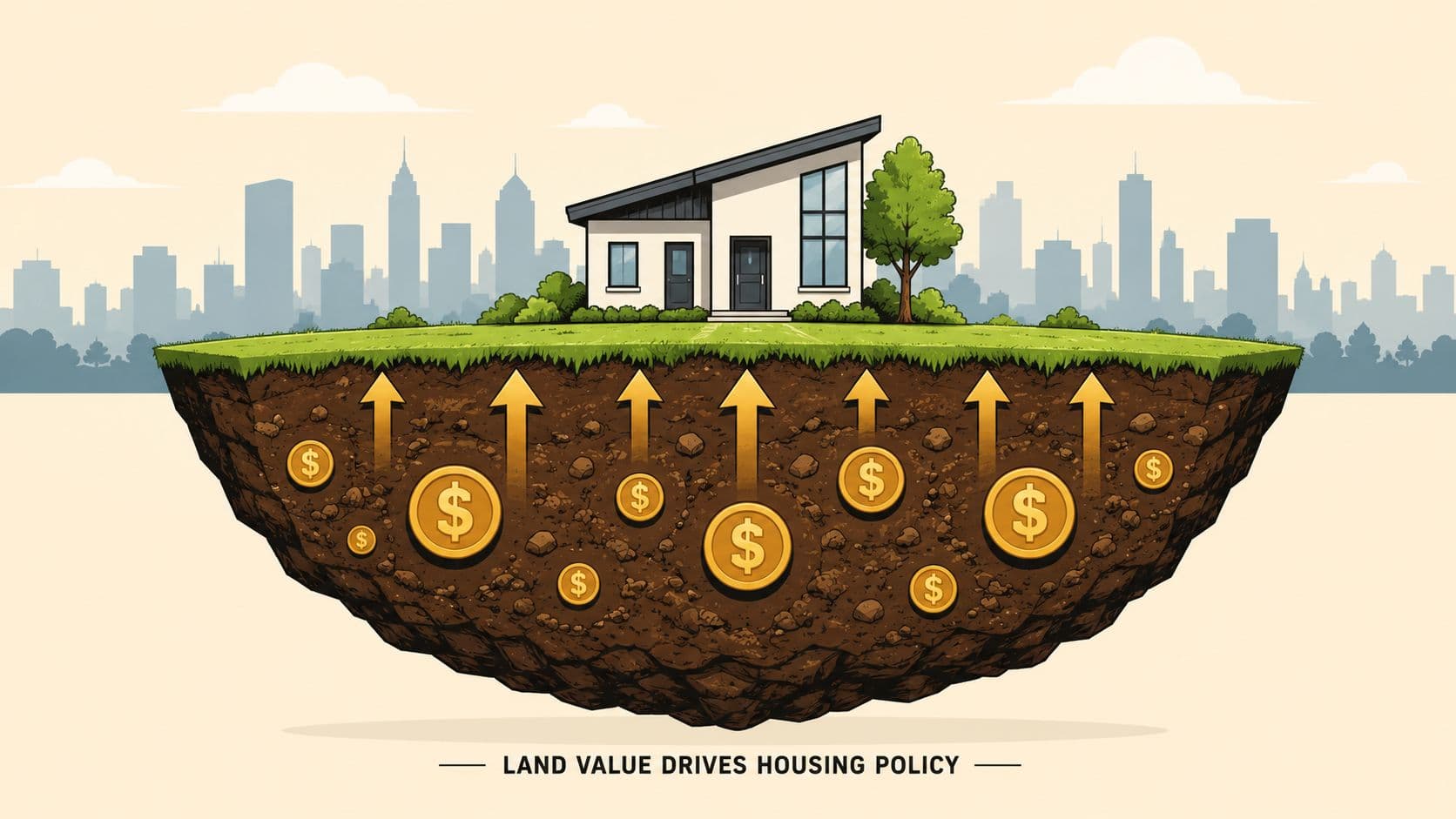
Land economics studies how a fixed, non-reproducible resource generates value through population growth, public investment, and location demand, and why governments must treat land differently from buildings and labor. In one major advanced-economy example, land wealth reached 589% of annual GDP in 1991, showing how large the value beneath an economy can become.
That's the counterintuitive starting point for housing policy. A city can approve better construction methods, reduce material costs, and speed up permits, yet homes may remain unaffordable if the price of the site keeps rising. The ground beneath a building isn't produced by the builder, and it can't be imported from somewhere else. Its value reflects access to jobs, transport, schools, public services, natural amenities, and the activity of the surrounding community.
For a mayor trying to reduce housing costs, the practical question isn't only how to build more. It's also who receives the value created by growth, how land access is priced, and whether the tax system rewards construction or speculation.
Table of Contents
- The Hidden Force Behind Housing Crises and Wealth Inequality
- Understanding the Tri-Factor Framework of Land Labor and Capital
- Historical Foundations and Key Thinkers Who Shaped the Field
- Comparing Land Leases Land-Use Rights and Land-Value Taxes
- Empirical Evidence on Land-Value Taxation and Housing Outcomes
- How Land Economics Informs Modern Policy Design and Advisory Practice
- Further Reading and Interactive Tools for Exploring Land Economics
The Hidden Force Behind Housing Crises and Wealth Inequality
Land is often the quiet driver of an apparently construction-led crisis. When residents say housing has become too expensive, the immediate explanations usually involve labor, materials, financing, or strong demand. Those factors matter, but they don't explain why the same building can carry radically different prices in different locations, or why a modest home in a well-connected district can cost more than a larger structure in a remote area.
Land economics examines that difference. It focuses on how the value of land changes with population growth, public investment, and economic development, and why governments treat land differently from buildings or labor. The discipline asks what portion of a property's value comes from the site itself, what portion comes from private construction, and what portion reflects public decisions such as roads, transit, zoning, utilities, and schools.
The distinction has direct relevance to the causes described in why housing is unaffordable. If a city becomes more accessible and productive, nearby landowners can benefit even when they haven't built anything new. A transit station, public park, or employment center can increase the desirability of surrounding sites. The community creates much of the setting that makes those sites valuable.
A different kind of economic asset
Buildings wear out, can be redesigned, and can be constructed in new places. Labor comes from human time, skills, and effort. Land, by contrast, is fixed in location and non-reproducible. A city may reclaim or reshape land, but it can't manufacture another central location with the same connections and accumulated advantages.
That scarcity creates economic rent. In plain language, rent is the return associated with controlling a scarce opportunity, not necessarily a reward for producing a better building or working harder. Land economics therefore treats the site component of property value as a separate object of analysis.
Practical rule: If a public decision raises the value of a location, ask whether the public should recover part of that value before assuming that private property prices must absorb the entire gain.
Why the issue reaches beyond housing
Land values influence tax bases, infrastructure finance, development patterns, and wealth distribution. Owners of well-located sites can gain from regional growth, while renters and new entrants face higher access costs. A tax system that taxes buildings heavily but leaves valuable vacant land lightly taxed can also make construction less attractive relative to holding land idle.
This is why land-focused policy has returned to debates over housing affordability and fiscal balance. The goal isn't to deny private owners a return on construction. It's to distinguish value created by private investment from value created by shared location advantages, then design rules that don't punish productive use.
Understanding the Tri-Factor Framework of Land Labor and Capital
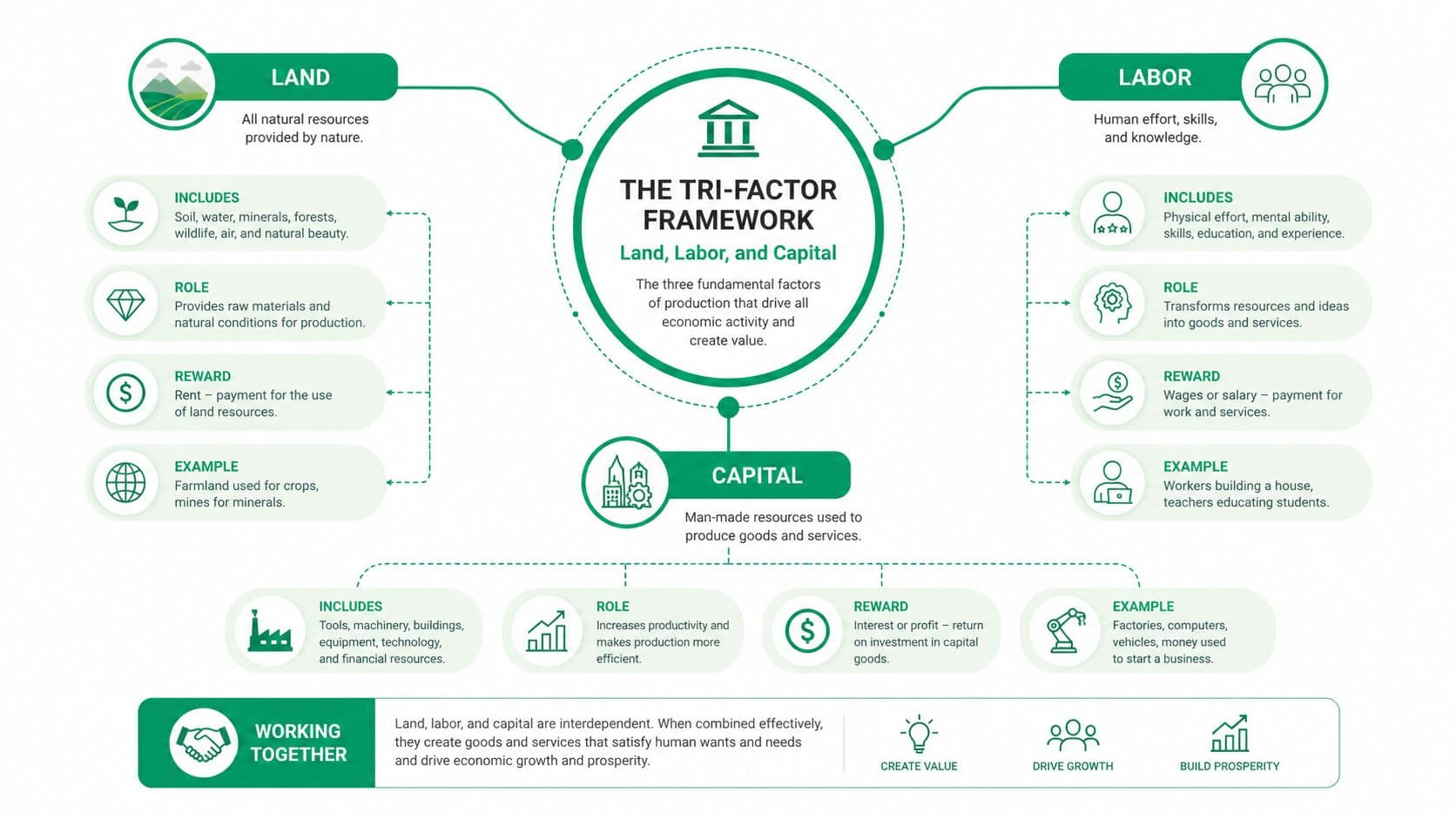
A clear answer to what is land economics begins with three separate factors of production: land, labor, and capital. Modern property discussions often group land and buildings together, but that shortcut hides the policy choices a city needs to make.
First, identify land
Land means more than a parcel on a map. It includes location, natural resources, ecological capacity, and access to surrounding opportunities. A central site, a fertile field, a mineral deposit, and a coastline all provide different services, but each is tied to a natural or location-based asset that people can't reproduce through ordinary production.
Land value is shaped by demand and public investment rather than by a cost of production. A government can build a rail connection, improve a street, protect a shoreline, or permit additional activity. Those choices can change what users are willing to pay for nearby sites.
Second, separate labor
Labor is human effort. Architects design, builders assemble, planners evaluate, teachers educate, and maintenance workers keep places functioning. A worker can improve their skills and apply effort in different locations. That makes labor mobile in a way that land isn't, even though moving may involve costs and constraints.
A policy that taxes wages changes the reward for working. A policy that taxes buildings changes the reward for constructing or improving them. Those effects differ from a charge on the value of a location.
Third, recognize capital
Capital consists of produced tools and improvements used to create goods and services. In property, a building, elevator, road improvement, or factory installation is capital. Owners and developers decide whether to maintain, renovate, replace, or expand those improvements.
This separation helps a policymaker read a property assessment. The site value reflects the location before considering the structures placed on it. The improvement value reflects private capital. Economic rent belongs primarily to the scarce opportunity associated with the site, while returns to labor and capital compensate effort, risk, financing, and production.
The economic land glossary offers a useful entry point for readers who want the terminology in a more compact form. The key point is practical: if a city taxes land and buildings as though they were identical, it may discourage construction while failing to address the gains from controlling scarce locations.
Land supply is perfectly inelastic in the core theoretical model. That means a tax on unimproved site value can be capitalized into a lower land price rather than pushed forward as a higher rent, because the quantity of land doesn't shrink when the tax is imposed. The result isn't automatic fairness, but it explains why land-focused charges are analyzed differently from taxes on work or productive investment.
Historical Foundations and Key Thinkers Who Shaped the Field
Land economics developed through a long argument about where economic value comes from and who should receive the gains associated with land. Eighteenth-century discussions of land value treated agriculture and natural resources as central to national wealth. Later economists examined how location scarcity produced rent, especially when population and commerce concentrated in particular areas.
From rent theory to public finance
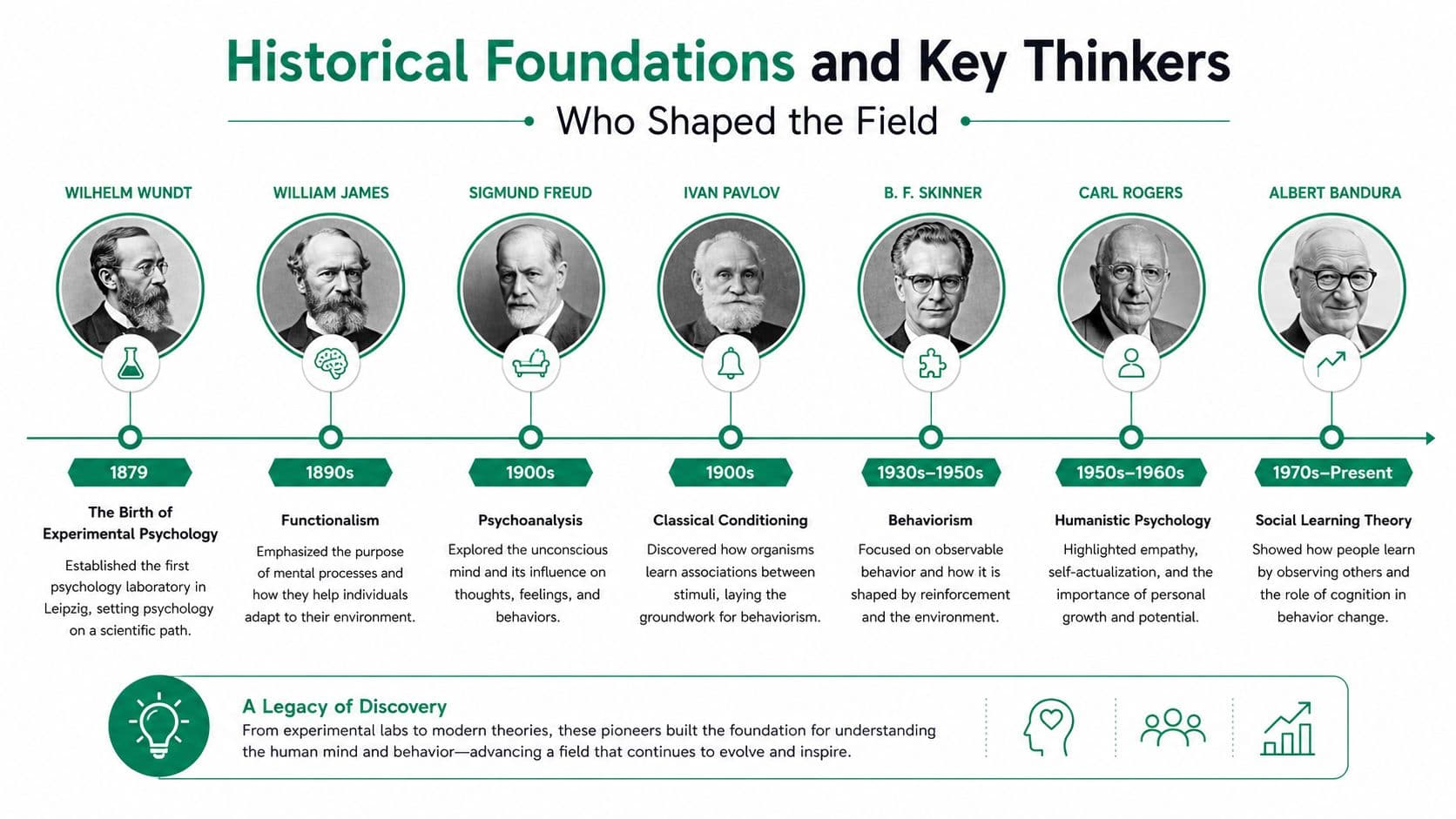
The important intellectual shift was separating the return to land from the return to labor and capital. Thinkers including Henry George argued that the value arising from community growth should support public purposes, while private enterprise should retain the reward for building, producing, and working.
George's argument remains influential because it connects a moral concern with a technical one. If public investment raises site values, recovering part of that increase can help finance public services without placing the same burden on construction or employment. The Henry George glossary entry provides a concise introduction to that tradition.
Modern analysis has refined rather than repeated the older argument. OECD work describes split-rate taxation as a hybrid in which land is taxed at a higher rate than improvements. It also notes that land-value taxation has been discussed since at least the eighteenth century, while pure land taxes remain uncommon.
Policy experiments require context
Land-focused instruments have appeared in different forms across places such as Denmark, Estonia, Singapore, Alaska, Canberra, Norway, and Allentown in Pennsylvania. These examples shouldn't be treated as interchangeable proof. Each jurisdiction has its own constitutional rules, land ownership system, administrative capacity, housing market, and political settlement.
The historical lesson is more modest and more useful. Land taxation, land-value capture, public leasing, and resource dividends are established families of policy, not a single universal formula. Their results depend on valuation quality, transition rules, exemptions, revenue use, and whether officials address distributional effects.
A mayor should therefore ask three questions before adopting a reform:
- What value is being measured? Site value, lease value, development rights, and total property value aren't the same base.
- Who created the value? Private construction, public infrastructure, environmental amenities, and regional growth may all contribute.
- How will the transition work? A sound theory can still produce hardship if assessments, appeals, and payment schedules are poorly designed.
History supplies a toolkit, not a shortcut. It shows that the land question has survived because cities repeatedly confront the same tension: growth creates value, but existing rules don't always share or price that value well.
Comparing Land Leases Land-Use Rights and Land-Value Taxes
These three instruments all regulate access to land, but they solve different problems. Confusing them leads to poor policy design.
A land lease grants possession for a fixed term at a fixed price. It may be renewable or non-renewable. A renewable lease gives the holder certainty until the term ends, but the gap between the lease rate and the market can accumulate. At renewal, the parties may close that gap through a single major repricing. A non-renewable lease avoids a renewal promise, but it can become progressively harder to refinance and sell as the remaining term shortens. Fixed leases don't correctly price risk. They postpone risk.
A land-use right works similarly to a lease in that it grants the right to use land, but under the policy model described here it is indefinite and repriced annually. Annual repricing lets people buy and sell the right at comparatively low cost because the price doesn't need to compensate for a long period of mispricing or a looming expiration. This structure can price land more accurately without burdening entrepreneurship and other productive enterprises.
A land-value tax is different again. It doesn't transfer a temporary right of possession. It is an annual charge on site value, generally while ownership remains with the owner. Public-land lease pricing, as explained in research on collecting land value through public land leasing, can bundle the benefit of access with a contract payment. A land-value tax instead applies continuously to the value of the location.
| Instrument | Duration | Pricing Mechanism | Risk Allocation | Impact on Enterprise |
|---|---|---|---|---|
| Land lease | Fixed term, renewable or non-renewable | Fixed contract price | Risk is postponed, then repriced or becomes harder to refinance | Can create uncertainty near renewal or expiry |
| Land-use right | Indefinite | Annual repricing | Market value is updated regularly | Supports transfer and productive use without an expiry shock |
| Land-value tax | Ongoing ownership with annual charge | Annual assessment of site value | Owner carries the recurring land-value obligation | Leaves building and productive investment distinct from site value |
China illustrates fixed-term land-use rights under a state-owned urban land regime. Maximum terms are 70 years for residential land, 50 years for industrial land, and 40 years for commercial land, according to MIT course material on urbanizing China. Japan's leasehold law offers another model, with a general 30-year duration, default renewal periods of 10 years, and 20 years for the first renewal after establishment, while contracts lasting 50 years or more can be structured without a renewal right, as set out in the English translation of Japan's land and building lease law.
For readers considering the fiscal connection, how land use affects property taxes helps frame the relationship between land-use decisions and tax administration. The central design choice is whether government wants a temporary access contract, a continuously updated use right, or a recurring charge on site value. A longer discussion of fixed-term arrangements appears in 99-year land leases, but duration alone doesn't solve the underlying pricing problem.
Empirical Evidence on Land-Value Taxation and Housing Outcomes
Land economics offers a strong theory, but policy advice must distinguish theory from demonstrated outcomes. The evidence is especially important for a mayor who needs to know whether a land-focused charge will affect prices, construction, vacancy, speculation, and household security.
OECD-linked analysis reports that since 1985, the share of land in total residential property value has increased everywhere except Japan. That pattern is consistent with the growing importance of land scarcity and urbanization in housing costs. The same analysis states that only three OECD countries have a pure land tax, while most tax both land and improvements, as discussed in this OECD-linked analysis of green land-value taxation.
What the price evidence says
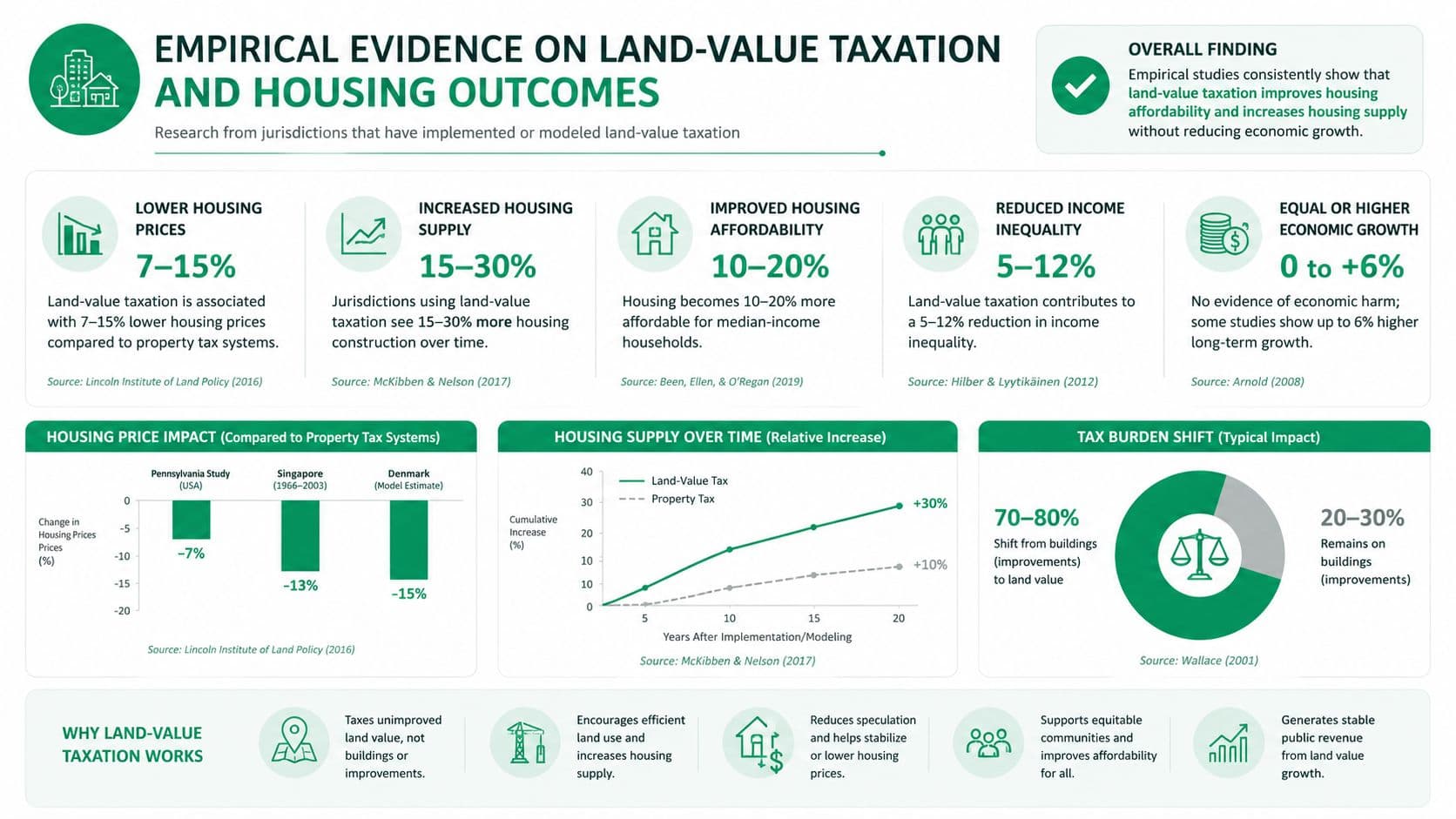
A 2024 analysis found a precise zero effect of land taxes on residential home prices, a result consistent with the capitalization theory described earlier. The study is summarized in the analysis of land-value-tax incidence and efficiency. The interpretation is important: a tax on a fixed factor can reduce the price of the land component without creating the same forward price effect associated with taxing a reproducible structure.
That finding supports a policy distinction. Taxing buildings can reduce the incentive to add floors, renovate homes, or replace obsolete structures. A site-value charge targets the location component while leaving the return to construction more intact. It may also make holding an underused site less attractive, especially where demand for development is strong.
Property valuation still involves human judgment, neighborhood context, and information that automated estimates can miss. For a complementary discussion of the human side of valuation, readers can explore insights from Richard Maize. That perspective reinforces why assessment systems need transparent methods and appeal procedures.
Where the evidence remains limited
Evidence on land-focused taxation is not equally strong across all outcomes. Real-world implementations remain limited, which constrains firm conclusions about vacancy reduction, rent trajectories, displacement, gentrification, and distributional effects. Research agendas also examine how credit and financial frictions can amplify land prices and divert savings toward speculation rather than productive investment.
A responsible policy program should therefore set measurable objectives without promising automatic results. Officials can track site assessments, building permits, redevelopment activity, vacancy, rents, ownership changes, and household impacts. The land-value tax and property-tax comparison helps clarify the difference between shifting the tax base and raising the total property-tax burden.
The evidence supports careful experimentation and transparent evaluation. It doesn't justify claiming that one instrument will eliminate housing unaffordability by itself.
How Land Economics Informs Modern Policy Design and Advisory Practice
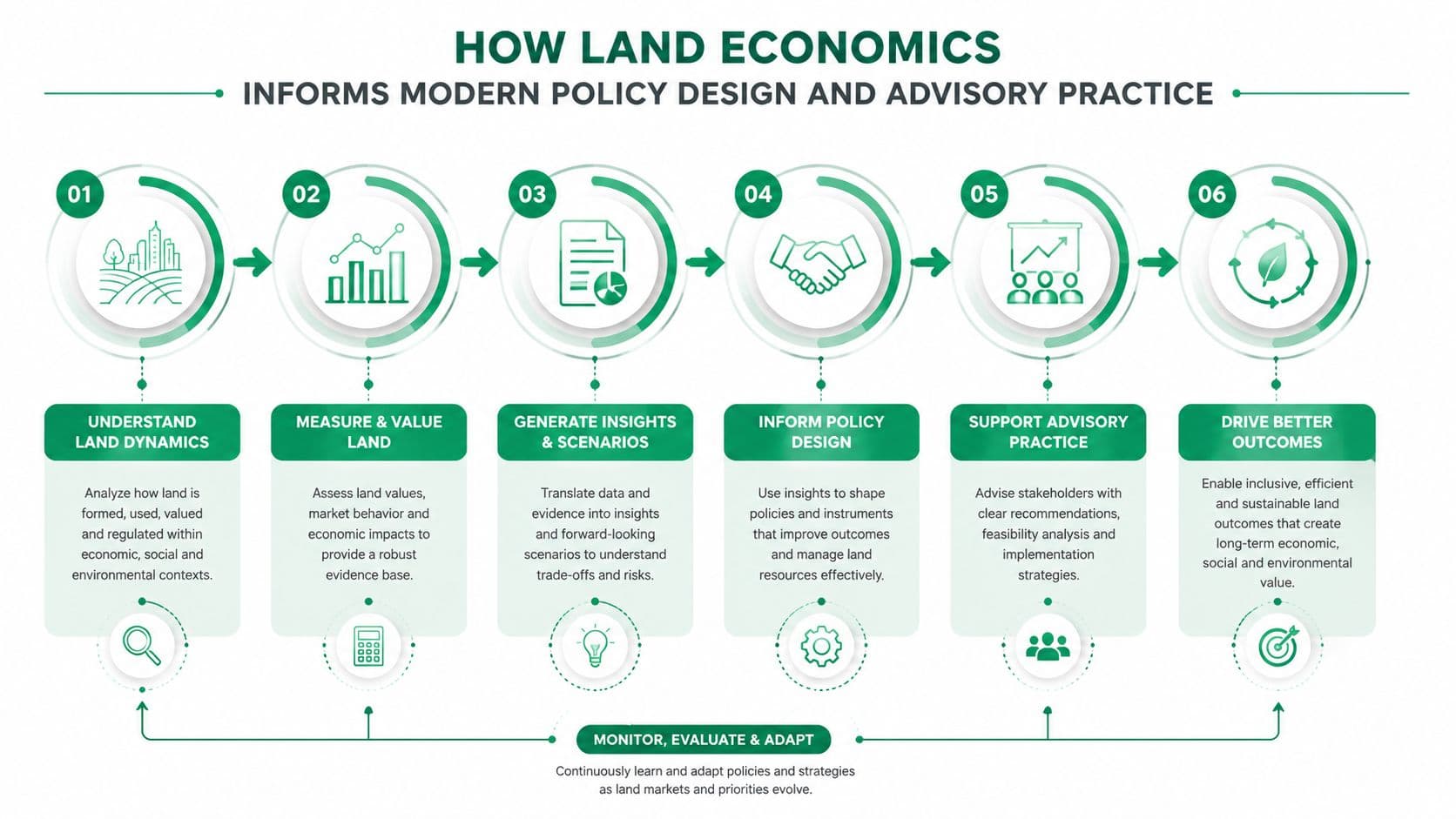
A land-value reform succeeds or fails through administration. The theory may distinguish land from capital with precision, but officials still need parcel data, valuation rules, legal authority, payment systems, public communication, and a credible transition plan.
Start with the valuation system
The first task is to estimate site rental values or land values separately from improvements. That requires a consistent cadastre, parcel-level records, location variables, sales and lease evidence where available, and methods for handling unusual properties. Officials should publish enough of the method that owners can understand an assessment and challenge errors.
The second task is fiscal modeling. A city needs to know how a proposed charge affects homeowners, renters, commercial sites, developers, public agencies, and owners of vacant land. Distributional modeling can identify who gains, who pays, and how exemptions or phased changes alter the result.
Design the instrument around the objective
A city seeking to encourage infill may shift taxation away from buildings and toward site value. A government controlling public land may use leases, annual land-use rights, or capture mechanisms. A national government with natural-resource revenue may consider a dividend or public fund. These instruments can coexist, but they shouldn't be treated as synonyms.
Implementation also requires legal drafting, administrative process design, cadastre integration, compliance workflows, and staff training. Stakeholder education matters because residents often hear “land tax” and assume the policy taxes the full value of their home. Clear bills that separate site value from improvement value can reduce that confusion.
Build the transition before the announcement
A practical transition plan may include staged rates, deferrals for cash-poor households, relief for hardship cases, reassessment schedules, and rules for new construction. It should also explain how revenue supports public services or reduces other taxes. Without that connection, a technically sound reform can appear to be a new burden rather than a change in the way community-created value is shared.
Implementation principle: Measure first, model distributional effects second, draft the legal mechanism third, and communicate the transition before collection begins.
Unitism® is one advisory option for governments and organizations that need land valuation assessments, policy design, distributional modeling, implementation support, and public education grounded in tri-factor economics. The practical standard remains the same regardless of provider: connect the valuation method to the policy objective, test household and enterprise effects, and give administrators a workable delivery plan.
Further Reading and Interactive Tools for Exploring Land Economics
A productive learning path begins with the distinction between site value, improvements, labor, and capital. From there, readers can examine land rent, property taxation, public finance, environmental systems, regional development, and urban form. Foundational books, including Martin Adams' Land: A New Paradigm for a Thriving World, can help connect classical arguments with current policy questions.
Use glossaries and explainers to clarify terminology before comparing jurisdictions. Then read peer-reviewed work on land economics and public finance, paying attention to the difference between a theoretical prediction, a measured association, and a tested policy result. Interactive models are especially useful because they let users vary assumptions about land values, building taxes, public revenue, and household distribution without pretending that one city's outcome automatically transfers to another.
For readers approaching land through an investment lens, the Buy Rehab Rent Refinance Repeat guide offers a separate perspective on property strategy. Land economics adds the missing public-policy question: how do financing, construction, and ownership decisions interact with the underlying value of location?
The most useful exercise for a city team is to choose a real neighborhood and map its value drivers. Identify transport, schools, utilities, employment, environmental amenities, vacant sites, building age, and current tax treatment. Then ask whether the rules encourage the owner to build, maintain, sell, or wait for surrounding investment to raise the site price.
Unitism offers governments, cities, and organizations support with land valuation, land-value capture design, distributional and fiscal modeling, implementation planning, and stakeholder education. Visit Unitism® to explore practical tools and advisory resources for applying land economics to housing affordability and public finance.