Learn what is legal drafting: its purpose, the elements of a good draft, legislative vs transactional work, and why it shapes land-value policy.
November 9, 2026
What Is Legal Drafting? a Plain Guide for Policy Makers
Learn what is legal drafting: its purpose, the elements of a good draft, legislative vs transactional work, and why it shapes land-value policy.

Legal drafting is the disciplined process of converting policy objectives, rights, duties, powers, procedures, and remedies into enforceable legal text, and every draft must settle who it binds, what they must or may do, when the duty starts, and what happens if they fail. Why do reforms that sound clear in a speech still stall when an agency tries to apply them? Usually the words describe an outcome but don't build the machinery that produces it.
That's the gap drafting fills. It doesn't just polish sentences. It decides which office acts, which date triggers liability, which exceptions apply, and how a person can challenge a decision.
Table of Contents
- What Legal Drafting Means in Plain Terms
- Why Drafting Is a Design Job, Not Just Writing
- Key Terms Every Newcomer Needs
- The Elements Every Well-Drafted Provision Needs
- Legislative and Transactional Drafting Side by Side
- Land-Value Taxes, Leases and Land-Use Rights Compared
- Common Misconceptions About Clear Drafting
- Checking AI-Assisted Drafts Before They Take Effect
- Testing a Draft Before You Adopt It
What Legal Drafting Means in Plain Terms
Think of policy as an architect's intent. Drafting is the working drawing that a builder and a building inspector can both follow without guessing. A speech can say a house should be safe and affordable. The drawing must show dimensions, materials, load paths, and inspection points.
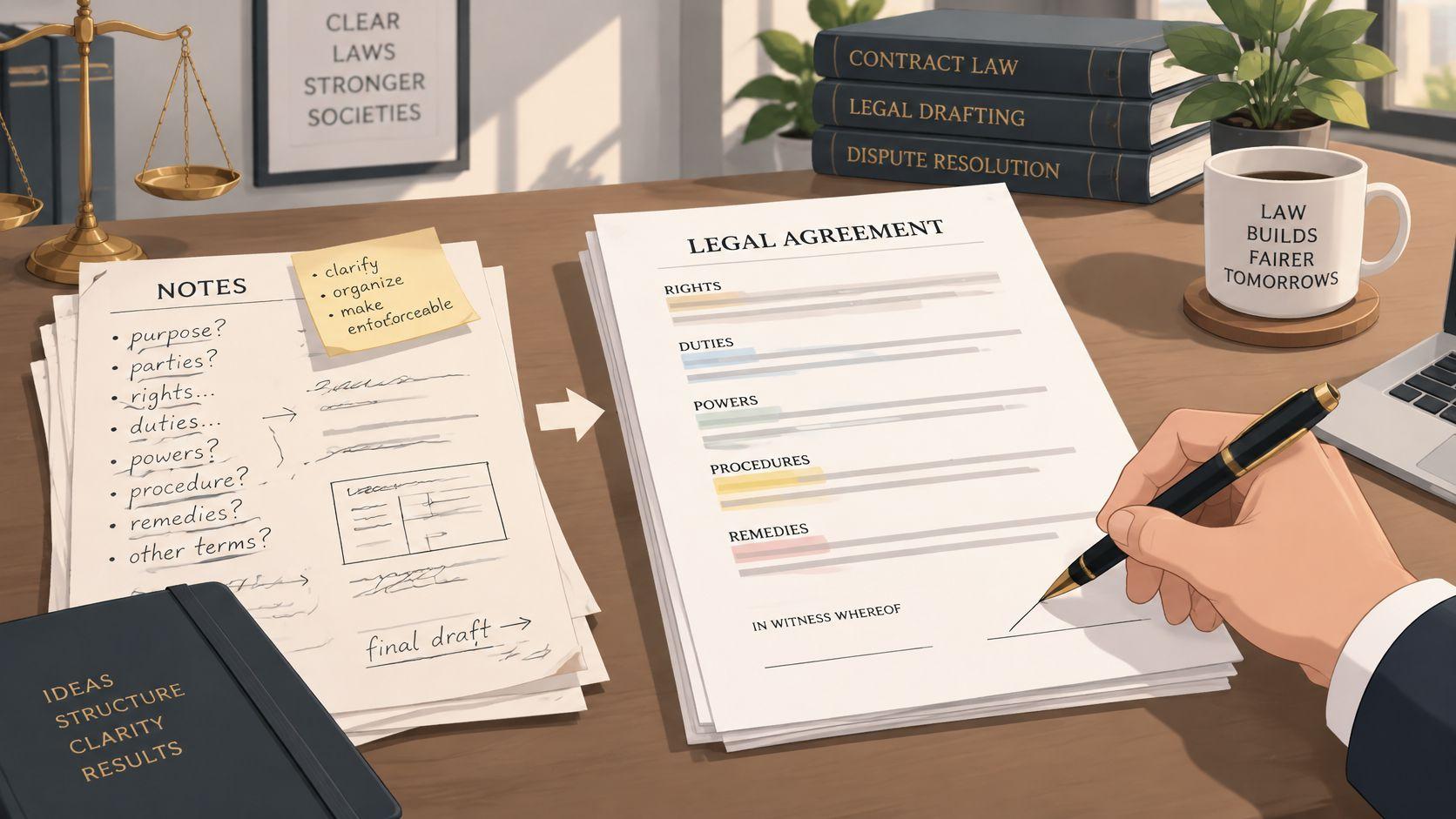
Legal drafting works the same way across statutes, regulations, contracts, leases, and licences. The subject changes, but the core job doesn't. Someone must be given a right, a duty, or a power in words another person can enforce.
The four questions a draft must answer
- Who's bound: Name the person, business, official, or class of people covered.
- What's required: State what they must do, must not do, or may choose to do.
- When it starts: Give the event or date that triggers the rule.
- What follows failure: State the penalty, remedy, loss of benefit, or review route.
Leave one answer out and you've created work for a court, an auditor, or a frustrated administrator. Say a rule requires owners to pay a land charge "promptly." Promptly could mean ten days to a taxpayer and sixty days to a collector. Replace it with a named deadline, a notice method, and an interest rule, and the argument largely disappears.
A well written paragraph can still be unenforceable. It might read beautifully while omitting the trigger, exception, or responsible authority that makes it operate. Good drafting gives you three properties at once. It implements the intended rule, it resists conflicting readings, and the people who must apply it can administer it with the data and powers they've been given.
If you need one sentence for a colleague, use this. Drafting turns a decision about what should happen into instructions that bind people, trigger on a stated event, and produce a stated consequence.
That instruction quality is what separates legal drafting from general legal writing. An essay persuades. A draft governs.
Why Drafting Is a Design Job, Not Just Writing
On 8 February 1869, a Treasury Minute established the United Kingdom's Office of the Parliamentary Counsel as a two-year experiment, with Henry Thring as full-time head and one assistant, and in January 1871 the experiment became permanent, according to the UK Civil Service history of the Office of the Parliamentary Counsel. The problem was practical. Government bills were being drafted by departmental officials, independent counsel, and lawyers attached to individual departments, so form and quality varied.
The new office created a division of labour. Policymakers supplied the intended policy. Specialist drafters analysed the proposal, identified legal consequences, structured the provisions, and expressed them in language suitable for parliamentary enactment.
That isn't editing. The UK government describes the task as subjecting policy ideas to rigorous intellectual and legal analysis and clarifying and expressing legislative propositions. A drafter asks whether Parliament has power to do this, whether the agency can run it, whether courts can interpret it, and whether officials can enforce it without inventing missing steps.
The design elements hiding inside a sentence
A single operative sentence can depend on definitions, commencement rules, delegated powers, cross references, and an amendment path. Change any one and you may change who pays, who decides, or when a right can be exercised. That's why drafting integrates policy, legal authority, institutional competence, interpretation, administration, and enforcement.
The central office model later influenced legislative counsel institutions in many common law jurisdictions. It also offers a useful test for modern reforms, including the work discussed in land use policy. Don't ask only who designed the policy. Ask who checked whether it works mechanically, clause by clause, on a bad day when a taxpayer disputes the bill and an official has to point to exact text.
Key Terms Every Newcomer Needs
Drafters repeat the same term in the same way throughout an instrument for a reason. If site value means one thing in a charging clause and something slightly different in an appeal clause, you've built a dispute into the text. Consistency isn't pedantry. It's how readers know they're still following the same rule.
| Term | Meaning | Example |
|---|---|---|
| Provision | A numbered clause or sub-clause that states one rule | Section 4(2) sets the valuation date |
| Operative clause | The clause that imposes a duty, power or right | The assessor must issue a valuation notice |
| Mandatory word | Must or shall, which creates a duty | The owner must pay within 30 days |
| Discretionary word | May, which grants a power or option | The authority may waive interest on hardship grounds |
| Definition | The fixed meaning of a term across the whole instrument | Site value means the value fixed by the stated method |
| Cross-reference | A pointer to an exact provision elsewhere | Clause 6 applies the formula in Schedule 2 |
| Schedule | An attached part holding detail such as formulas or tables | Schedule 2 contains the valuation formula |
| Trigger | The event that starts a duty or liability | Liability starts on the stated valuation date |
| Commencement | The date the instrument takes legal effect | The Act comes into force on 1 April |
| Transitional provision | The rule for cases that exist before commencement | Leases signed before commencement keep their rent |
| Delegated power | Authority to make subordinate rules under a parent law | The minister may make regulations on assessment |
The most consequential distinction in the table is must versus may. Must creates a duty someone can demand. May creates a power someone can choose to use or not use. Swapping one for the other can turn a guaranteed appeal into a favour, or turn a flexible enforcement power into an obligation the agency can't afford to perform in every case.
The other terms divide into two groups. The operative clause, trigger, and consequence carry the rule itself. Definitions, schedules, and cross references carry the detail that completes it.
When you meet an unfamiliar term later, check it against this list before you rely on the text. If a draft uses a term repeatedly but never defines it, treat that as a warning, not a minor style issue.
The Elements Every Well-Drafted Provision Needs
A provision isn't finished when everyone nods at a meeting. It's finished when a stranger can apply it to a new case and reach the result the policymaker intended. The U.S. House Legislative Counsel drafting manual treats accuracy, brevity, clarity, and simplicity as core quality controls, and it warns that undefined jargon can allow an agency or court to assign a meaning different from the policy intention.
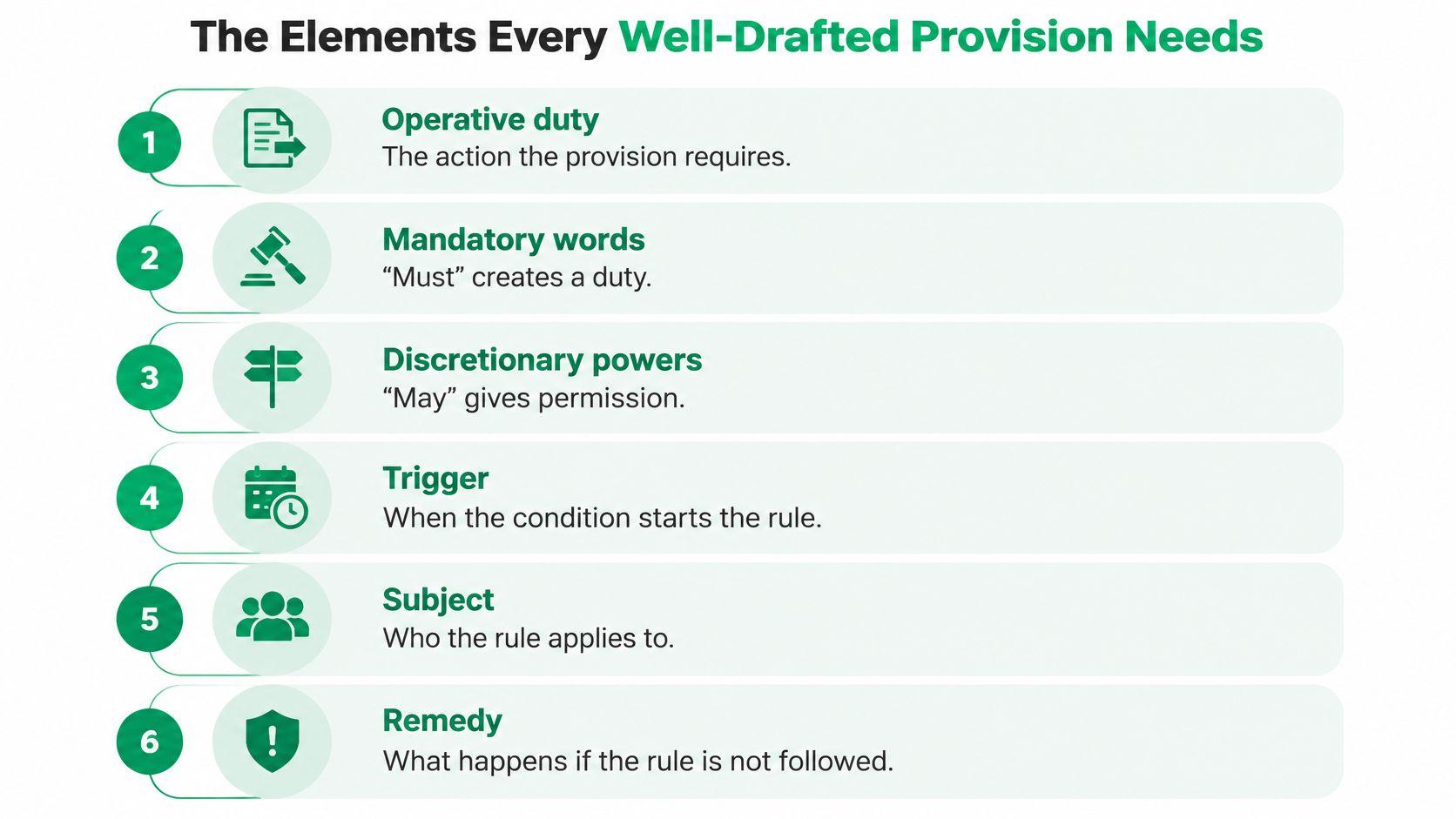
| Element | Test question | Land-value example |
|---|---|---|
| Operative duty | Who must act, and what must they do? | The assessor must issue a valuation notice to each owner |
| Trigger | When does the duty arise? | Liability for the charge starts on the stated valuation date |
| Exceptions | Which cases are excluded? | Hardship relief for low-income occupiers who meet set criteria |
| Consequence | What follows non-compliance? | Interest accrues on late payment, with a stated enforcement route |
| Definitions | What does each key term mean? | Site value is defined by a stated method, data source and calculation date |
| Cross-references | Where is the rule completed? | The valuation formula sits in Schedule 2, cited by its exact clause |
Duty, trigger, exception, consequence
Start with the operative duty. Put the actor first, then the verb. "The assessor must issue a valuation notice" tells the reader who's responsible. "A valuation notice will be issued" hides that person and gives nobody a clear obligation.
The trigger then tells the actor when to move. It might be a valuation date, receipt of an application, transfer of ownership, or failure to pay by a deadline. Without it, two offices can apply the same duty at different times and both claim they're complying.
Exceptions should be narrow enough to administer. "Hardship cases are exempt" leaves officials guessing. A workable version names the criteria, the evidence required, the decision maker, and the period the relief lasts. The consequence completes the circuit by stating whether non-compliance brings interest, a penalty, loss of a licence, invalidation, or another specified result.
Definitions and document structure
Define only terms that carry a specialised or repeated meaning. Keep a term list as you draft, then audit headings, operative clauses, schedules, and amendments to confirm each defined term is used the same way every time. For land value legislation, site value, assessed value, chargeable land, exemption, occupier, and collection period each need administrable definitions tied to valuation data, a responsible authority, a calculation date, appeal rights, and enforcement consequences.
Predictable order helps readers find those pieces. A common hierarchy runs from purpose or application, to definitions, substantive duties or entitlements, administrative powers, calculation rules, procedures, enforcement, review or appeal, transitional provisions, and commencement. Readers who know where to look waste less time and miss fewer conditions.
Cross references need restraint. Name the exact provision, and avoid circular chains that send a reader from Clause 4 to Clause 9 to a schedule and back again just to reconstruct one rule. Practical guidance on legislative drafting guidelines is useful here because structure decides whether detail supports the rule or buries it.
First-time reader test: Can a new reader identify the prohibited activity, the people covered, and the consequence without asking the drafter what was meant?
If they can't, the provision needs more design. More decorative wording won't fix it.
Legislative and Transactional Drafting Side by Side
Legislative drafting creates public rules. Transactional drafting allocates rights and risks between named parties. Both depend on precision, but they fail in different ways and they're corrected through different routes.
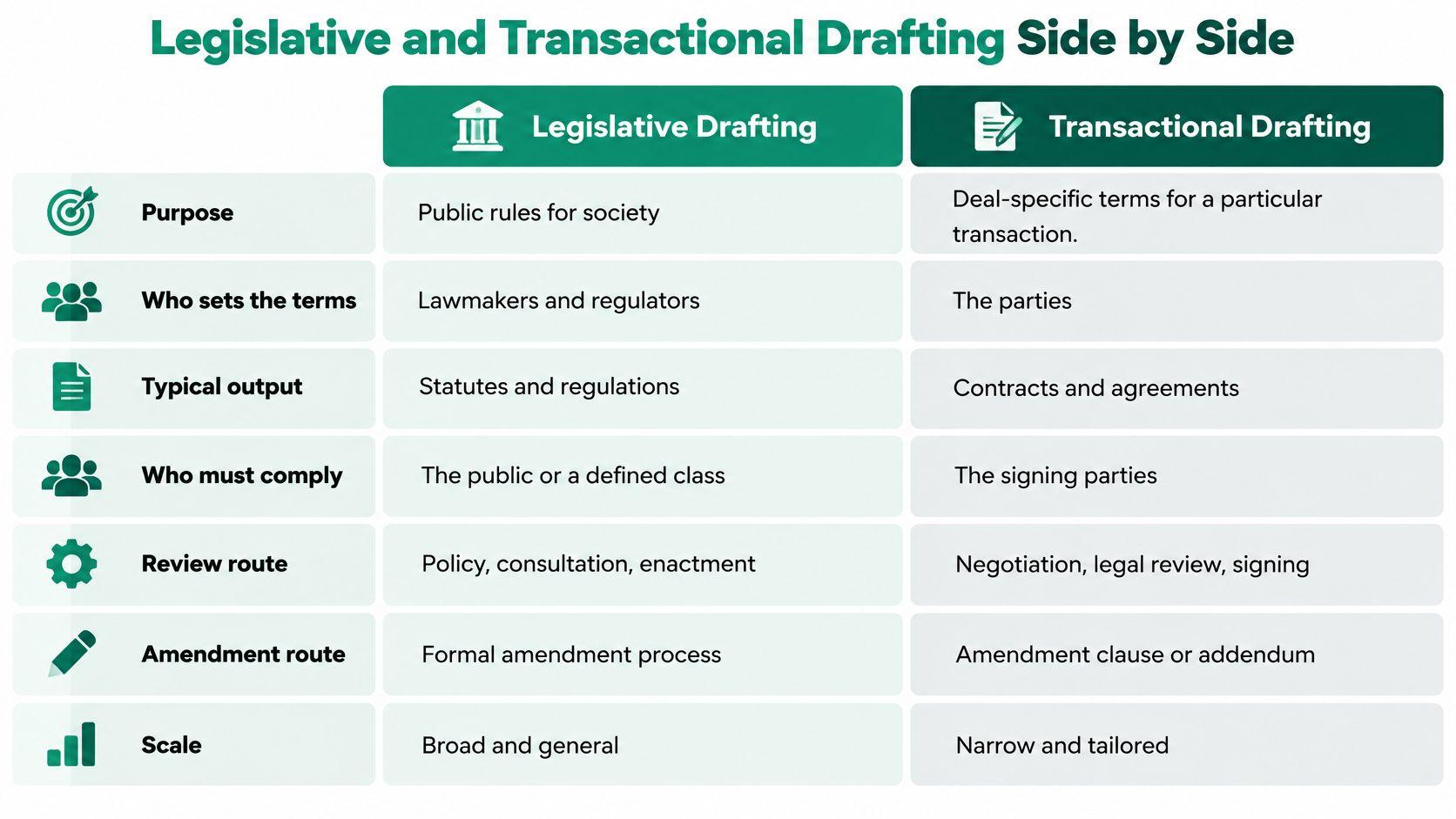
| Aspect | Legislative drafting | Transactional drafting |
|---|---|---|
| Purpose | Creates public rules that bind a whole population | Allocates rights and risks between named parties |
| Who sets the terms | Legislature, ministers or agencies | The contracting parties, within the law |
| Typical output | Statutes, regulations and delegated orders | Contracts, leases, licences and wills |
| Who must comply | Citizens, businesses and officials | The signing parties and anyone they bind |
| Review route | Parliamentary or rule-making procedure, then courts | Negotiation, counsel review, then courts if disputed |
| Amendment route | New legislation or a formal regulatory change | Amendment agreed by all parties |
| Scale signal | About 3,000 to 4,500 final US rules a year | One deal or named set of parties per instrument |
Scale makes the legislative task unforgiving. The Congressional Research Service reports that the Office of the Federal Register generally publishes approximately 3,000 to 4,500 final rules each year, and in 2018 about 25% of all Federal Register pages appeared in the Rules and Regulations section, according to the Congressional Research Service report on federal rulemaking. Those figures concern delegated legislation and administrative rules rather than primary statutes, but they show the volume that must be drafted, reviewed, published, interpreted, and implemented.
What each context must settle
A regulation can't merely announce a desirable outcome. It must identify who's regulated, define operative terms, specify powers and limits, establish procedures and deadlines, allocate decision authority, address exceptions, provide compliance standards, and anticipate interaction with existing law. A contract has a narrower audience, but it must decide price, performance, risk, default, termination, and dispute resolution for parties who may later read every comma against each other.
Amendment exposes another difference. Contracting parties can usually agree a written change among themselves. A defective public rule may need a formal legislative or regulatory process while agencies keep applying the flawed version. That delay is why consultation, version control, and commencement planning matter so much in public drafting.
Weak text raises administrative cost in both settings. Ambiguous provisions generate guidance disputes, litigation, inconsistent enforcement, and repeated amendments. In a transaction, the cost lands on the parties. In legislation, it spreads across taxpayers, regulated businesses, and frontline officials.
Use a simple orientation test. If the rule must bind people who never negotiated it, you're in legislative territory and need public procedures, review rights, and institutional capacity. If named parties are bargaining over a specific exchange, you're drafting transactionally, though background law still limits what they can agree, much as the rules discussed under benchmark rate reform can reshape private contracts from outside the negotiation.
Land-Value Taxes, Leases and Land-Use Rights Compared
Land instruments are often described loosely, and loose labels hide different legal machinery. A drafter has to separate a tax, which is imposed by statute, from a lease, which is created by contract, and from a land-use right as defined here, which is indefinite and repriced annually.
| Feature | Land-value tax | Fixed-term lease | Land-use right (as defined) |
|---|---|---|---|
| Legal basis | Statute imposing a charge on land value | Contract granting occupation or use for a term | Grant of an indefinite right to use land |
| Duration | Recurring for as long as the charge applies | Fixed term, either renewable or non-renewable | No expiry |
| Price setting | Assessed on land value at a valuation date | Fixed price set at signing | Repriced every year |
| Renewal | Not applicable | Required at term end for renewable leases; non-renewable leases end | Not required |
| Buying and selling | Ownership can transfer while the statutory charge continues on the land | Harder to refinance and sell as a non-renewable term runs down | Low-cost trading because annual repricing keeps the price current |
| Main risk | Assessment method and appeals | Accumulated gap with market closes in a repricing shock | Annual valuation disputes, if the method is weak |
A land-value tax is a recurring charge imposed on the value of unimproved land. The University of Reading review of implementing a land value tax states that land-value tax is normally assessed on capital value, although rental value can also serve as the tax base, and assessments may use market capital value, market rental value, or cadastral formulas reflecting location, size, and permitted use. The taxpayer normally keeps the underlying property interest while the statute imposes the charge.
A tax statute therefore has to specify taxable land value, valuation date or frequency, assessment method, the liable person, collection machinery, and treatment of improvements. If it doesn't exclude buildings clearly, administrators may tax productive investment that the policy meant to leave alone.
Fixed-term leases postpone repricing
A land lease is a contractual payment for the right to occupy or use land. Leases are generally fixed sums determined at a particular point in time, so they don't automatically change as market value changes. Drafting must state the term, rent, renewal or expiry rules, permitted uses, and enforcement remedies.
That fixed price creates the central downside. A renewable lease gives certainty only until the term ends. At renewal, the accumulated gap between the old lease rate and the market can close all at once in one major repricing. A non-renewable lease avoids that renewal negotiation but becomes progressively harder to refinance and sell as the remaining term shortens, because buyers and lenders are purchasing a wasting right.
Fixed leases, in effect, don't price risk correctly. They postpone it. The longer the gap between contract rent and current site value grows, the larger the eventual adjustment or capital loss becomes, a problem explored further in the discussion of 99-year land leases.
Land-use rights keep the price current
A land-use right is lease-like in granting use of a parcel, but it's indefinite and repriced annually. There's no expiry date approaching and no renewal cliff. Because the annual charge tracks current land value, people can buy and sell the right itself for a low cost. The value sits mainly in the buildings and business on the site, not in a temporary bargain between an outdated rent and the market.
That annual repricing prices land appropriately without adding a charge to entrepreneurship or other productive enterprise, provided improvements are excluded from the valuation. It also changes the drafting burden. The instrument must make the valuation method, data, notice, objection route, and annual calculation date especially clear and dependable because repricing happens every year, not once a generation.
Labelling rule: Don't call an interest a land-use right unless it's repriced each year, requires no renewal, and doesn't expire. If it fails any one test, draft and describe it as a fixed lease.
Calling a fixed contractual payment a land-value tax obscures its legal basis. Calling a fixed lease a land-use right obscures its duration and repricing risk. Accurate labels let buyers, lenders, officials, and courts see which mechanism they're dealing with.
Common Misconceptions About Clear Drafting
Why does a sentence everyone can read still fail once an office has to apply it? Drafting is the bridge between an economic policy and the administrative steps that carry it out. Leave out the agency, the valuation date, or the appeal route, and the policy has nowhere to land.
Plain wording finishes the job. Shorter sentences help. A clear line can still omit the trigger, the exception, the decision maker, or the deadline. "Owners must pay the annual charge" is easy to read. It never says how the charge is calculated, when payment is due, or which office hears a dispute about the valuation. The sentence works like a sign with no road behind it: you know the destination, and you still cannot get there.
A long fixed term is an open-ended use right. Duration does not change the category. A long fixed term still expires or needs renewal, so it remains a lease. The parties can see an end date. Nothing in the length itself creates a fresh valuation each year or removes the need to write a renewal. A new label will not supply either of those rules.
Elegant prose can repair a weak design. It cannot name a responsible agency the statute never created. It cannot supply a measurable standard, a valuation dataset, or the handoff from valuation to billing, enforcement, and review. Policy may say "charge the land, not the building." Administration still needs a person who values the site, a date for that value, and a path to challenge it. If any of those pieces is missing, polished sentences only make the breakdown easier to follow.
Quantity isn't quality
A longer list of definitions always produces more certainty. A defined term helps only when every clause uses it the same way. If "occupier" includes a tenant in the charging clause and excludes that same tenant in the relief clause, the definition has created the doubt it was meant to prevent. Defining ordinary words for no reason can mislead as well. Readers may assume the word means something else wherever it appears without a capital letter.
Cross-references raise a related problem. They stop you copying one rule twice. A chain of "see clause X," though, forces the reader to rebuild a single duty from scattered pieces. Each jump is another chance to miss a condition or to apply an outdated version of the text.
Watch for these warning signs:
- Undefined repeated term: The same technical phrase appears in several clauses with no fixed meaning.
- May used as a duty: Officials are expected to act, but the text only gives them an option.
- Phantom appeal route: A clause mentions review, yet no provision says who hears it or by when.
- Detached formula: A clause cites a schedule that does not contain the promised calculation.
Those defects matter more than whether the prose sounds formal. A plain sentence with complete machinery beats a polished sentence with a missing gear.
Checking AI-Assisted Drafts Before They Take Effect
What changes when a machine writes the first draft? Speed, mostly. AI can turn a dense provision into plainer language, flag inconsistent defined terms, and propose a structure in minutes. The hard part starts after that: deciding whether the new wording still does the same legal work. A study of AI-generated plain-language legal rewrites found the rewrites were generally easier to understand, yet they still carried recurring problems with parenthetical material, residual phrases such as "unless the context suggests otherwise," and passive constructions.
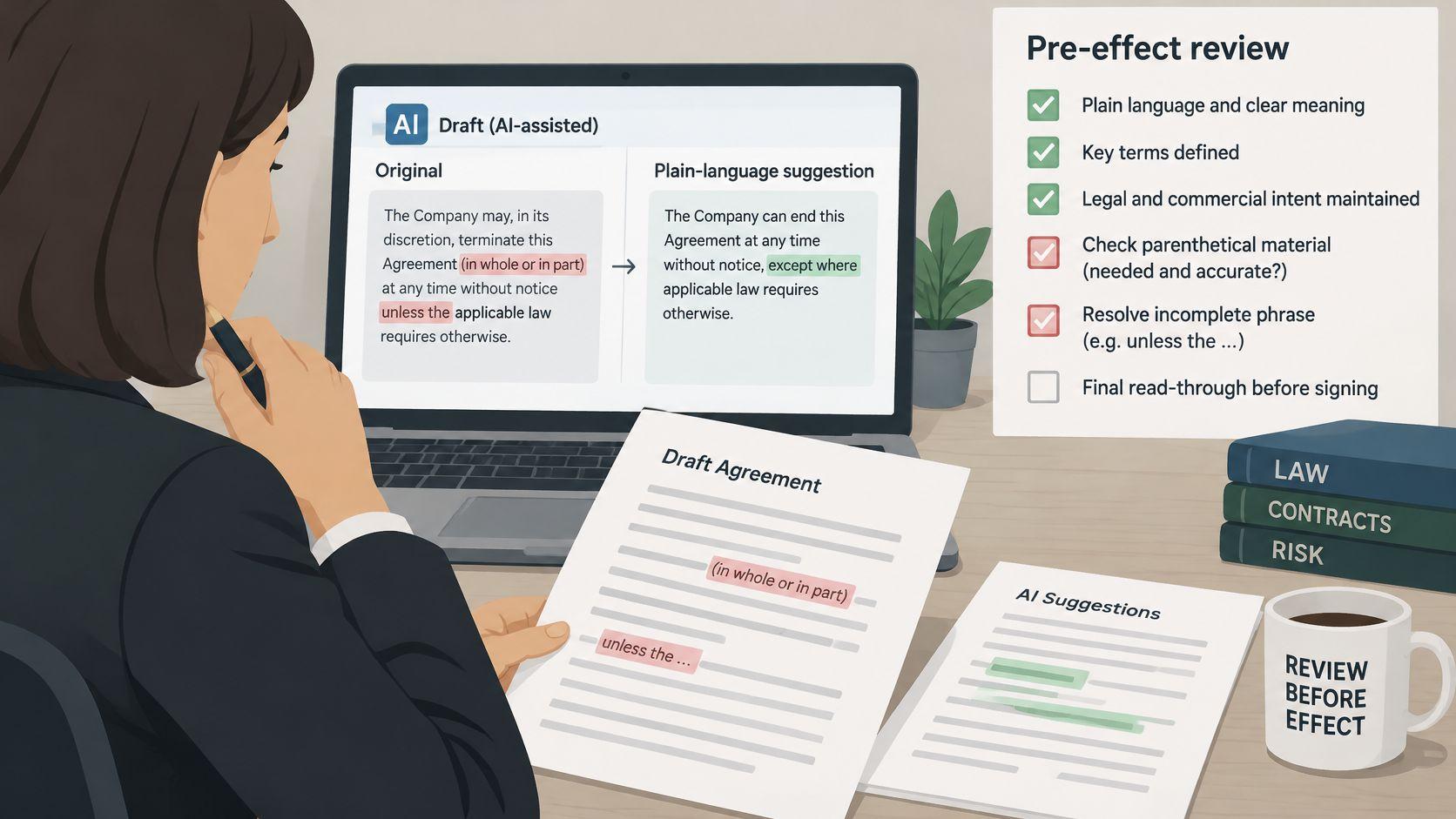
Readability and correctness are different tests. A smoother sentence can turn a duty into a discretion, drop an exception, or introduce a definition nobody approved. That risk grows with volume. The Thomson Reuters report on generative AI in legal drafting states that legal professionals spend 40% to 60% of their time drafting documents. Saving part of that time is useful, but only if review keeps pace with the output.
Run four separate tests
- Legal effect: Compare the AI version with the approved policy and source text. Has any right, duty, power, deadline, exception, or remedy shifted?
- Operational effect: Ask the official who will apply the rule to work through real cases. Can that person apply it consistently with the data and systems available?
- Linguistic accessibility: Give the draft to an affected non-lawyer. Can they explain what they must do, by when, and how to challenge a decision?
- Accountability: Check whether a human reviewer can trace sources, assumptions, versions, and approvals. If nobody can show why a clause changed, the draft is not ready to adopt.
A clean rewrite can resemble a tidy map that leaves out the bridge. The route looks simple until someone tries to travel it. Tools marketed for AI document review can help reviewers compare versions and spot inconsistencies, but they do not transfer responsibility from the qualified person who signs off. Keep the model's tasks bounded: summarise, restructure, or flag conflicts, then have a lawyer verify substance, jurisdiction, confidentiality, and version control.
Land and tax reform raise the stakes. One altered valuation date can shift liability. One invented exemption can change who pays. One passive sentence can leave an appeal with no decision maker. Human-governed drafting is how speed stays usable after enactment, even when review takes longer before commencement.
Testing a Draft Before You Adopt It
Don't test a draft by reading it once for tone. Test it by trying to operate it.
- Identify the actor and action: For each operative clause, name who must act and who merely may act. The common slip is using may where a guaranteed duty was intended.
- Audit every defined term: List each term and search every use across clauses, headings, and schedules. Correct any place where the definition is ignored or narrowed.
- Trace each dependency: Follow formulas, notices, payments, and appeal stages to an exact clause or schedule. A cross reference that points to nothing is an unfinished rule.
- Check the administrative chain: Confirm the responsible authority, data source, valuation date, notice right, payment deadline, transitional treatment, and enforcement route are all written in. Don't accept an appeal that's mentioned but never created.
- Run the four verification tests: Check legal effect, operational effect, linguistic accessibility, and accountability, particularly after any AI rewrite.
- Get two sign offs: A qualified lawyer should verify legal effect, and the administrator who'll run the scheme should verify operability. Policy evaluation disciplines such as those covered under policy evaluation methods help you decide what evidence would show the rule is working after commencement.
Evidence should feed that decision rather than decorate it. Floyd Marinescu commissions LVT micro-simulation modelling and writes publicly on land economics, which illustrates the kind of modelling that can test who pays and who gains before a charging rule is locked into statute.
Your decision is then concrete. Adopt the draft, revise the failing clauses, or pause until missing machinery exists. A finished draft lets a first-time reader name the covered people, the prohibited or required conduct, the trigger, and the consequence, with every dependency traceable to text.
If you're turning land value policy into workable law, Unitism® can help with legislative drafting, valuation design, administrative process planning, and training for the teams who must deliver reform. Explore the approach and resources at Unitism®, then bring your draft policy to the test that matters. Can an official administer it, can an affected person understand it, and can a court enforce exactly what you intended?