Are data centers bad for the environment? Explore the evidence on energy, emissions, water, and land — plus siting and policy levers for decision-makers.
October 8, 2026
Are Data Centers Bad for the Environment? a Balanced Look
Are data centers bad for the environment? Explore the evidence on energy, emissions, water, and land — plus siting and policy levers for decision-makers.
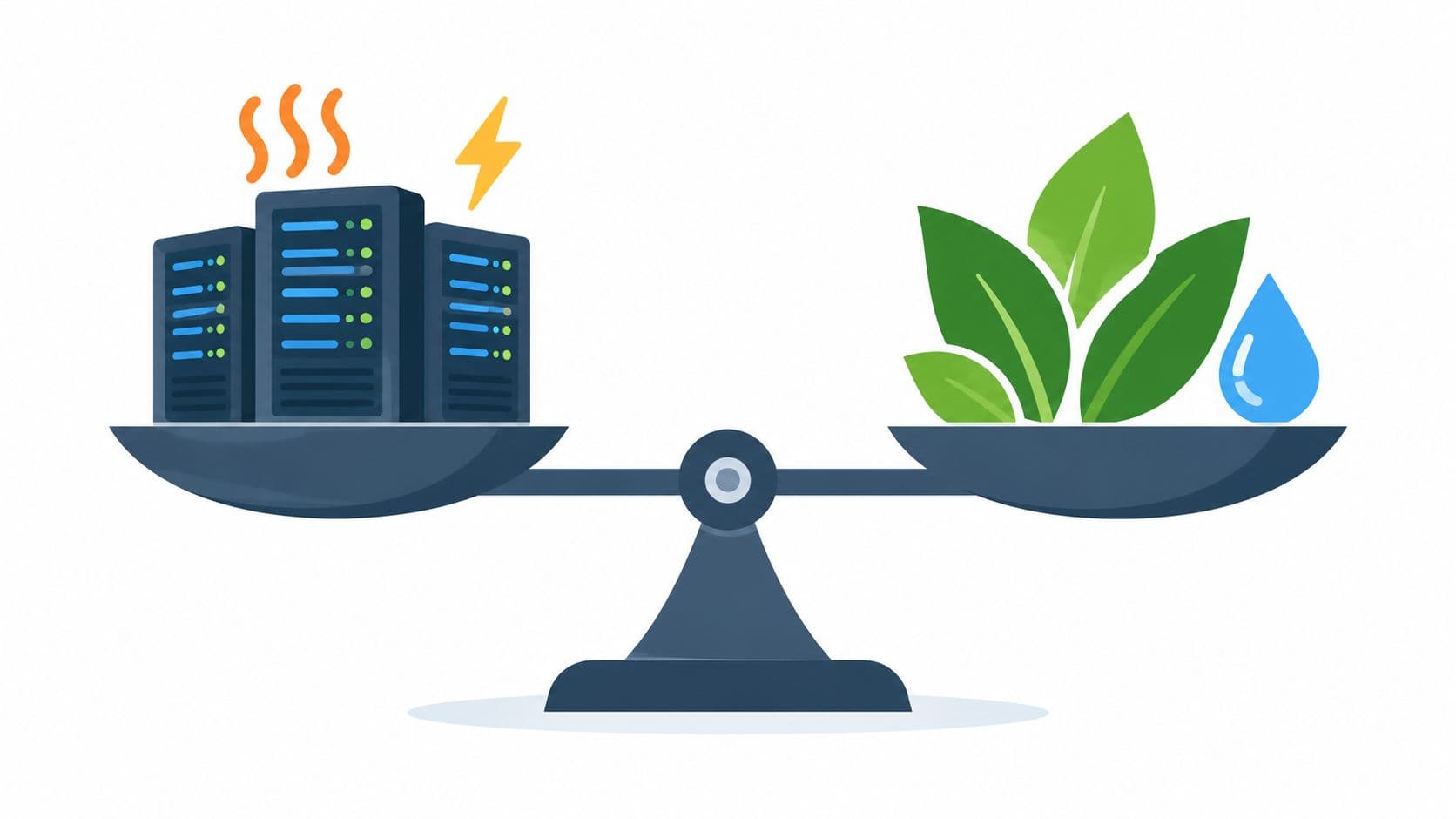
Data centers used roughly 1.5% of global electricity in 2024, so they aren't automatically bad for the environment, but their impact can be severe where grids are carbon-intensive, watersheds are stressed, or land-use decisions shift costs onto local communities. The honest answer depends on location, electricity supply, cooling design, utilization, and siting rules, not on the label “data center” alone.
The global share can sound modest until it's placed beside the infrastructure decisions that produce it. A facility may draw power from a constrained regional grid, consume water directly and indirectly, occupy land whose value has been poorly priced, and encourage new transmission or fossil generation. Another facility with similar computing capacity may operate on a cleaner grid, use reclaimed water, and locate where its demand creates fewer ecological conflicts.
That difference is why the question “are data centers bad for the environment” needs a policy answer rather than a slogan. The relevant tests concern energy, emissions, water, land and siting, and mitigation. A planning authority should ask not only how much a facility consumes, but also which community bears the marginal cost and whether the project's contracts, infrastructure, and land tenure make those costs visible.
Table of Contents
- What the Question Really Asks
- How Much Energy Data Centers Actually Consume
- Why Efficiency Alone Does Not Solve Emissions
- The Hidden Water Footprint of Computing
- Land Siting Leases and True Land-Use Rights
- Mitigation Strategies and Policy Levers That Work
- A Balanced Verdict for Decision-Makers
What the Question Really Asks
The International Energy Agency estimates that data centers consumed about 415 TWh globally in 2024, roughly 1.5% of worldwide electricity use (International Energy Agency analysis). That establishes meaningful scale, but a global average cannot show whether a specific project strains a local grid, watershed, or neighborhood.
A sound assessment asks whether new demand can be supplied without materially increasing fossil generation, whether cooling relies on scarce freshwater, and whether the site is environmentally suitable. Low-cost land and grid access may attract development even when they shift ecological or infrastructure costs elsewhere. The central issue is distribution: who receives the economic benefit, and who absorbs noise, emissions, water competition, network upgrades, or reduced land value?
Economists describe these uncompensated effects as an externality. A facility may pay its electricity bill and lease payment while residents, farmers, ecosystems, or other ratepayers bear costs that private transactions do not capture. Land tenure matters here. A long lease can make access appear inexpensive while leaving public authorities to manage impacts over time. By contrast, annually repriced land-use rights can expose changing environmental costs and influence where facilities locate.
Five dimensions provide a practical framework:
- Energy: How large is the load, and how does it compare with regional capacity?
- Emissions: Which grid supplies the electricity, and when is power consumed?
- Water: What is withdrawn for on-site cooling, and what is embedded in electricity generation?
- Land and siting: Does the location fit watershed, grid, ecological, and community conditions, and do tenure terms reflect those constraints?
- Mitigation: Are clean generation, efficient operations, transparent reporting, and fair cost allocation enforceable?
A defensible decision can therefore differ by facility. Data centers have environmental consequences, but ministries, utilities, municipalities, and developers shape who bears them through power contracts, cooling systems, reporting rules, and land-use decisions.
How Much Energy Data Centers Actually Consume
Global data-center electricity consumption could reach approximately 945 TWh by 2030, compared with about 415 TWh in 2024, according to the International Energy Agency analysis. That projected increase of more than 500 TWh in six years includes conventional cloud services and the heavier computational demands of artificial intelligence.
AI hardware also changes the facility-level energy profile. High-density processors increase server loads and concentrate heat, requiring more cooling capacity. The IEA attributes roughly 7% of consumption to cooling in efficient hyperscale facilities, while less-efficient enterprise data centers can exceed 30%. The same workload can therefore produce different environmental outcomes depending on building design, equipment, and operating practices.
Why geography changes the conclusion
Global averages can conceal local constraints. A sustainable-data-center assessment places data centers at roughly 4–5% of electricity use in the United States, 3% in the European Union, 22% in Ireland, and 25% in Northern Virginia in 2024 (ICEF Sustainable Data Centers Roadmap). These figures measure regional electricity shares, not identical national or global conditions.
| Location | Data-center share of electricity |
|---|---|
| Global | Approximately 1.5% in 2024 |
| United States | Roughly 4–5% in 2024 |
| European Union | Approximately 3% in 2024 |
| Ireland | Approximately 22% in 2024 |
| Northern Virginia | Approximately 25% in 2024 |
A facility may appear modest in global statistics while reshaping a local capacity plan. Utilities can require new generation, transmission, substations, or backup arrangements. Such investment may be justified when the developer pays an appropriate share and the system retains useful capacity. It creates a public-policy concern when speculative demand causes overbuilding or existing customers fund infrastructure for a private load.
Construction speed should also match credible demand forecasts. For authorities evaluating modular solutions for data center expansion, modular delivery can shorten deployment schedules, but it does not reduce the need to assess electricity, water, or land. Faster construction changes timing, not the facility's physical demands.
Authorities can use guidance for estimating utility costs, then test the underlying assumptions: how much additional load will arrive, during which hours, on which grid, and with what marginal generation response? Land tenure should be examined alongside those questions. A long lease may make a site appear affordable while leaving public agencies to manage grid, water, and land-use impacts. Annually repriced land-use rights can make those changing costs more visible and affect where facilities locate.
Why Efficiency Alone Does Not Solve Emissions
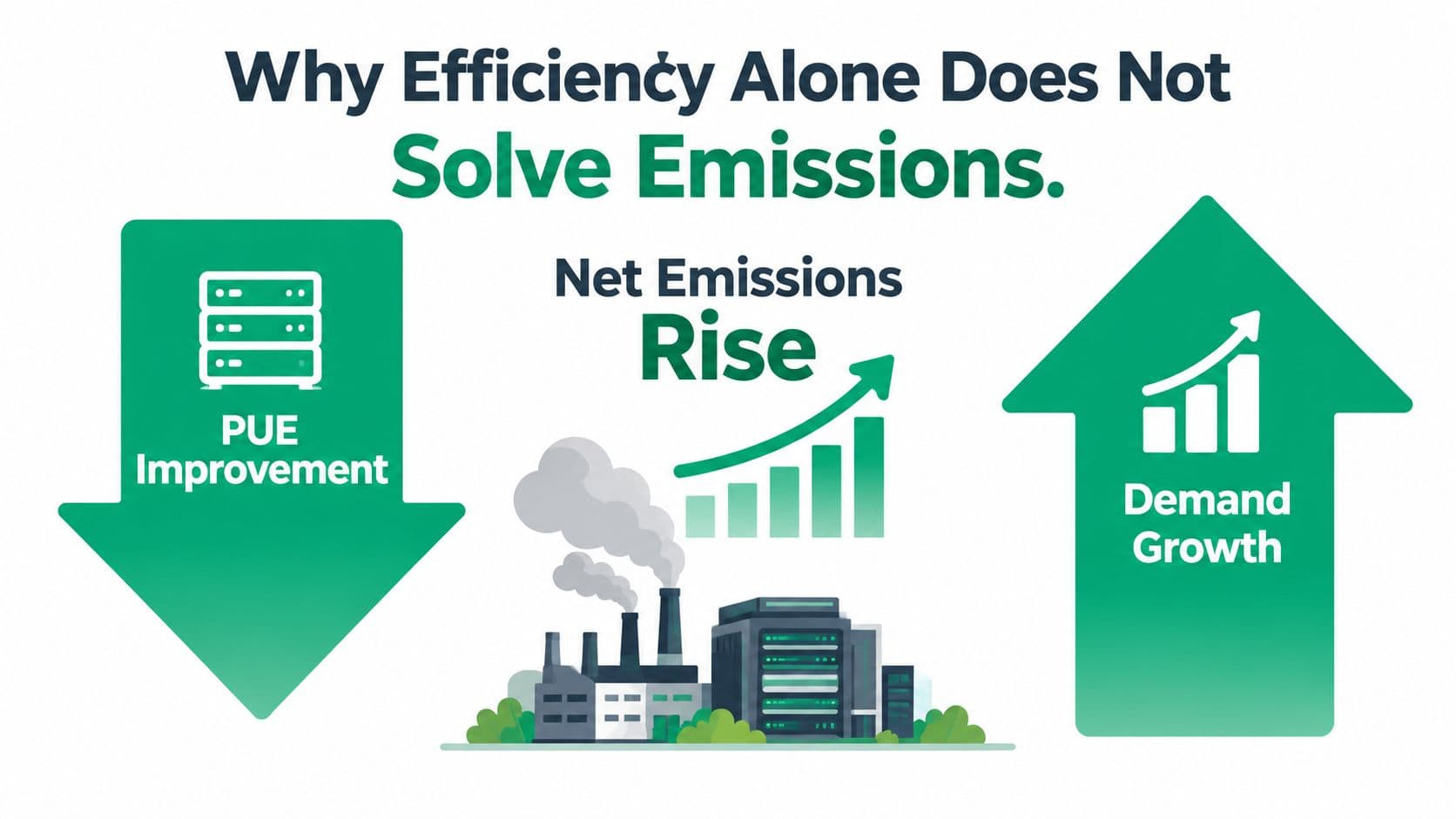
A more efficient computation can still contribute to higher total emissions. If demand for AI and cloud services grows faster than energy use per task declines, overall electricity consumption rises. Efficiency lowers the impact of each task, but it does not set a ceiling on how many tasks organizations perform.
The IEA projects global data-center electricity use to more than double, from roughly 448 TWh in 2025 to 945 TWh by 2030. A separate assessment projects that U.S. data centers could approach 12% of national electricity demand by 2028, up from approximately 4.4% in 2023 (Newser summary of data-center demand). These figures are projections and estimates, not guarantees. They still show why efficiency metrics must be assessed alongside absolute demand.
The rebound problem
Lower computing costs can stimulate more computing. Organizations may run larger models, process more data, or move additional services into the cloud because each task requires fewer resources. That response can offset part of the benefit from improved processors, cooling, or power distribution.
Grid effects add another complication. Reports indicate that rising demand has encouraged utilities to delay fossil-fuel plant retirements or consider returning retired plants to service (Newser summary of data-center demand). A facility can therefore become more efficient internally while increasing system-wide emissions if its additional demand arrives when gas or coal generation supplies the marginal load.
Planning rule: Measure emissions against the electricity the facility causes the system to produce, not only against the renewable certificates attached to its contract.
Contractual renewable purchases and physically delivered clean electricity answer different questions. A power purchase agreement or renewable-energy certificate may support clean generation, but it does not necessarily mean the facility draws clean electricity at every hour. Certificates alone may not reduce local grid emissions when the facility operates during fossil-fueled or grid-constrained periods.
A 2025 sustainable-data-center assessment estimated that data-center electricity generated about 180 million metric tons of CO₂ in 2024, excluding backup-power emissions. It also projected that power-supply emissions could double or triple by 2030 (Columbia University Sustainable Data Center Roadmap). The same Columbia assessment placed data centers at approximately 0.3% of global greenhouse-gas emissions in 2024. That percentage describes relative share, while the tonnage describes absolute emissions.
The policy implication is precise. Authorities should separate energy per computation, total electricity demand, facility emissions, and power-system emissions. They should also account for transmission construction, backup generation, and the possibility that cheaper computing increases usage. Siting decisions and land-use rights matter because they influence where those grid and infrastructure costs are imposed.
The Hidden Water Footprint of Computing
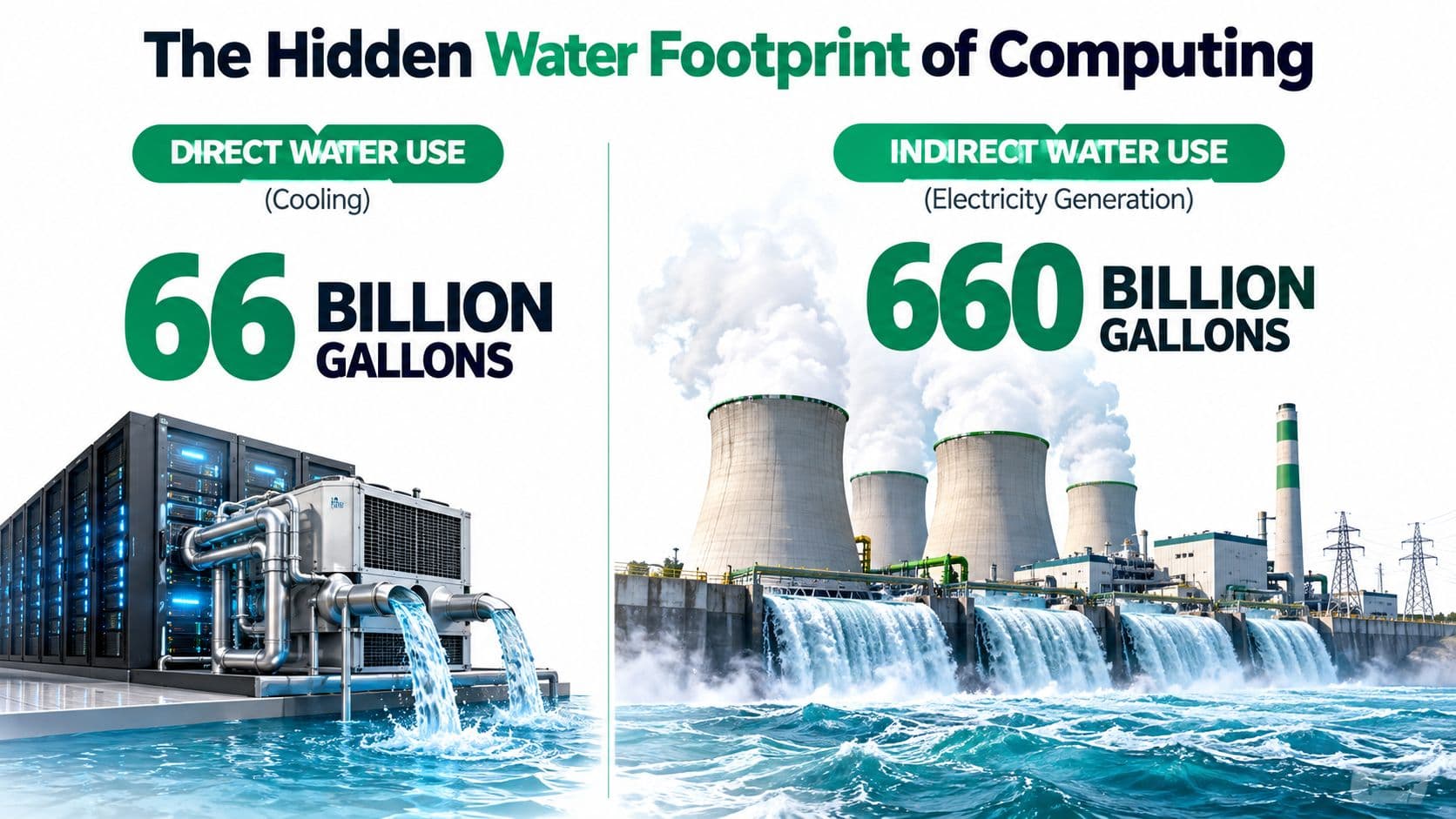
On-site cooling captures only one part of a data center's water demand. In the United States, data centers directly consumed about 66 billion liters of water in 2023, while power plants consumed nearly 800 billion liters indirectly to produce their electricity, according to the Berkeley Lab United States Data Center Energy Usage Report. The indirect total was more than twelve times the direct consumption.
This distinction affects how regulators assess efficiency claims. Evaporative cooling removes heat by turning water into vapor. Electricity generation can require additional water, depending on the generation technology and regional fuel mix. A facility may reduce withdrawals at its site while shifting part of the burden to a power system with a substantial upstream water requirement.
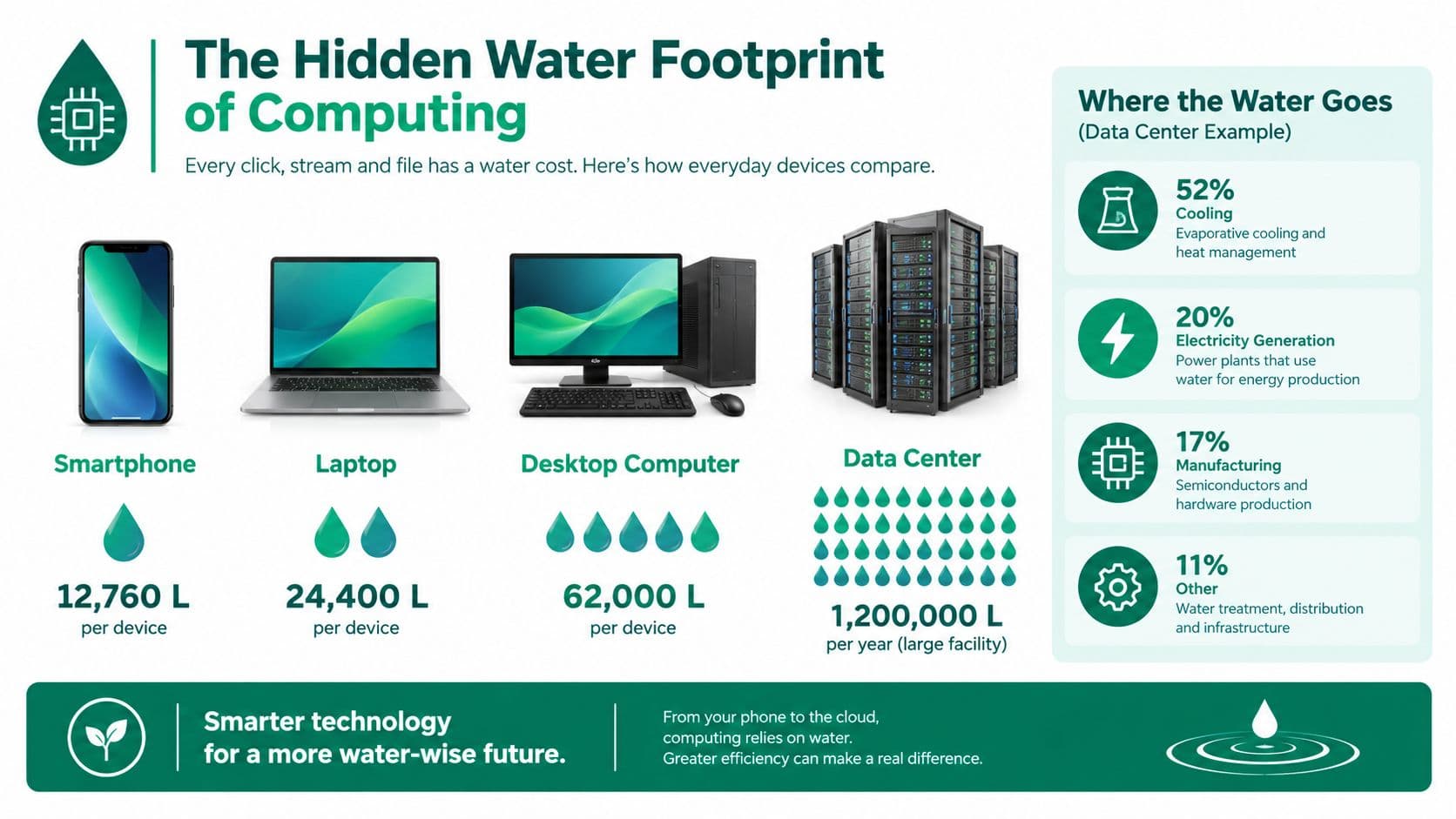
Berkeley Lab puts average U.S. site water-use effectiveness at about 0.45–0.48 liters per kWh. The same report places average indirect water consumption associated with electricity at approximately 4.52 liters per kWh. These measures cover different processes and should not be added mechanically. They do show why a site-only metric can understate computing's total water footprint.
Scarcity is local and seasonal
National averages can conceal the greatest policy risk. The same Berkeley Lab report attributes approximately 84% of direct U.S. data-center water consumption in 2023 to hyperscale and colocation facilities. A large installation in a water-stressed basin may intensify competition with households, agriculture, ecosystems, and treaty-protected communities, even if the sector's national share appears limited.
The Circle of Blue analysis reports that data centers in Arizona used 7.4% of statewide electricity, while nearly 60 centers in the Phoenix area were associated with demand of about 177 million gallons of water per day. Those figures show why annual regional supply alone is an insufficient test. Reviews should examine seasonal watershed stress, consumptive withdrawals, cooling technology, and whether each water stream is potable or reclaimed.
Applications should disclose direct and indirect water-use effectiveness, identify every water source, and assess lower-water electricity options. Water-rights valuation can clarify scarcity and inform siting decisions. It should support public choices, however, rather than conceal ecological limits or community priorities. Land tenure also matters: lease terms and genuine annually repriced land-use rights can influence where facilities locate and which communities bear their water and infrastructure costs.
Land Siting Leases and True Land-Use Rights
Environmental review usually focuses on electricity and water, while land tenure sits in the background. That's a mistake. The way a developer acquires and holds a site can affect where projects locate, how long they remain viable, and whether land-market risk is recognized before environmental costs become difficult to reverse.
A fixed-term land lease has a defined duration and a fixed price unless the contract says otherwise. It may be renewable or non-renewable, but neither form should be confused with a genuine land-use right.
Three arrangements, three risk profiles
A renewable fixed lease provides certainty only until the term ends. If the contractual rent falls below market land value, renewal can close the accumulated gap through one major repricing. The lease postpones risk rather than eliminating it.
A non-renewable fixed lease creates a different problem. As expiration approaches, the interest can become harder to refinance or sell because the remaining term shrinks. Buyers and lenders must account for the approaching end date, even if the current rent appears attractive.
A genuine land-use right has different mechanics. It is indefinite, requires no renewal, does not expire, and is repriced each year. Annual repricing keeps the right aligned with current land value and allows people to buy and sell it without an approaching expiration date dominating the transaction.
| Arrangement | Duration | Repricing | Main risk |
|---|---|---|---|
| Renewable fixed lease | Fixed term, potentially renewable | Usually fixed until renewal | Deferred repricing at renewal |
| Non-renewable fixed lease | Fixed term | Usually fixed | Declining transferability near expiration |
| Genuine land-use right | Indefinite | Annual | Current land value remains visible |
Sometimes fixed leases are called “land-use rights,” but they aren't. Do not use that term unless the arrangement is repriced each year, requires no renewal, and never expires. A long lease, including a 99-year lease, remains a fixed-term lease if it fails those criteria. Guidance on 99-year land leases helps make that distinction operational.

For planning departments, the issue is not that one tenure form automatically produces a green facility. The issue is whether land pricing reveals scarcity and opportunity cost. Fixed leases can make a site look inexpensive while postponing repricing, encouraging decisions that underweight future land value or environmental constraints. Annual repricing can keep land costs visible and reduce the incentive to hold strategically located sites under outdated terms.
Land tenure should therefore appear in environmental and fiscal review. Officials should record duration, renewal rights, transfer rules, repricing provisions, and who bears remediation or infrastructure obligations. A project that looks viable only because it receives a long period of underpriced land may not represent efficient or responsible siting.
Mitigation Strategies and Policy Levers That Work
The strongest interventions address the source of impact rather than merely documenting it afterward. Energy policy should begin with additional clean generation matched to actual facility load, not just certificates purchased after the fact. High server utilization, efficient power distribution, and heat reuse where economically feasible can reduce demand, while transparent reporting should distinguish location-based from market-based emissions.
Water policy needs the same specificity. Developers should evaluate reclaimed or non-potable supplies, closed-loop or low-evaporation cooling, and electricity sources with low water intensity. Regulators should require direct and indirect water-use disclosure because reducing on-site consumption doesn't necessarily reduce the footprint embedded in purchased electricity.
A review sequence for public authorities
- Test the grid first. Identify the facility's expected load profile, regional carbon intensity, peak demand, and marginal generation response.
- Match clean supply physically where possible. Require evidence that new clean generation, storage, transmission, or demand flexibility can serve the load, especially during constrained periods.
- Set water conditions before approval. Review seasonal watershed stress, consumptive use, source quality, cooling design, and upstream water consumption.
- Price infrastructure fairly. Make the developer's obligations for grid upgrades, backup power, and water infrastructure explicit so existing customers are not automatically assigned the bill.
- Review land tenure. Examine whether fixed lease terms, renewal provisions, or underpriced land encourage unsuitable locations or speculative holding.
- Monitor operations. Tie continued approval to reporting on energy, emissions, water, utilization, heat reuse, and backup generation.
A practical checklist can keep these questions comparable across proposals.
| Impact Area | Key Question | Metric to Disclose | Policy Lever |
|---|---|---|---|
| Electricity | What demand does the facility add? | Load profile and annual consumption | Grid-impact assessment |
| Emissions | What generation responds to the load? | Location-based and market-based emissions | Clean-supply matching |
| Water | Who bears direct and indirect scarcity? | Direct and indirect water-use effectiveness | Watershed conditions and reclaimed-water preference |
| Cooling | Can heat be managed with less evaporation? | Cooling system and consumptive use | Closed-loop or low-evaporation standards |
| Land | Does tenure reveal current land value? | Term, renewal, repricing, and transfer provisions | Transparent land and siting review |
| Infrastructure | Who pays for new capacity? | Developer and public cost allocation | Cost-recovery requirements |
Technical guidance such as the Reworx Recycling data center guide can complement policy review by identifying operational waste and resource-management practices. It shouldn't substitute for grid or watershed analysis.
Climate resilience planning also matters because a facility depends on uninterrupted electricity, cooling, water, and transmission. Authorities can use climate resilience planning to connect those dependencies to emergency procedures and long-term infrastructure decisions. Approval should be conditional where the project's resilience plan assumes unlimited water, unconstrained grid capacity, or indefinite access to backup fuel.
A Balanced Verdict for Decision-Makers
So, are data centers bad for the environment? Sometimes, under specific conditions. They become especially problematic when rapidly growing demand lands on carbon-intensive grids, draws consumptive water from stressed watersheds, relies on inefficient cooling, or locates through land arrangements that hide scarcity and transfer risk to the public.
They can be managed more responsibly when decision-makers evaluate the whole system. That means matching new clean generation to actual load, improving utilization and power distribution, limiting water withdrawals, accounting for indirect water consumption, and requiring clear land-tenure terms. It also means separating a company's contractual renewable claims from the electricity physically available to the grid when demand peaks.
A ministry or city planning department can apply four principles immediately:
- Judge the site, not the sector label. Global averages don't reveal local grid or watershed stress.
- Measure absolute demand as well as efficiency. Better performance per computation can coexist with rising total consumption.
- Assign costs to the decision-maker. Grid upgrades, water infrastructure, monitoring, and environmental safeguards shouldn't disappear into public budgets.
- Keep land value visible. A fixed lease is not a land-use right. Genuine land-use rights are indefinite, require no renewal, and are repriced annually.
The central policy insight is that environmental impact isn't an unavoidable property of computing. It's the result of infrastructure choices, location, timing, resource pricing, and accountability. Sound policy doesn't require denying digital demand or accepting every proposal. It requires choosing sites and operating conditions where public benefits don't depend on hidden ecological costs.
Unitism® helps governments and planning institutions assess land value, design land-based policy, and connect fiscal decisions with more efficient, resilient land use. Visit Unitism® to explore research, valuation methods, policy design, and implementation support for decisions where land, infrastructure, and public costs intersect.