Explore the land labor capital framework and its implications for taxation, housing affordability, and policy levers like land-value capture and site-value
September 5, 2026
Land Labor Capital: The Tri-Factor Economic Framework
Explore the land labor capital framework and its implications for taxation, housing affordability, and policy levers like land-value capture and site-value
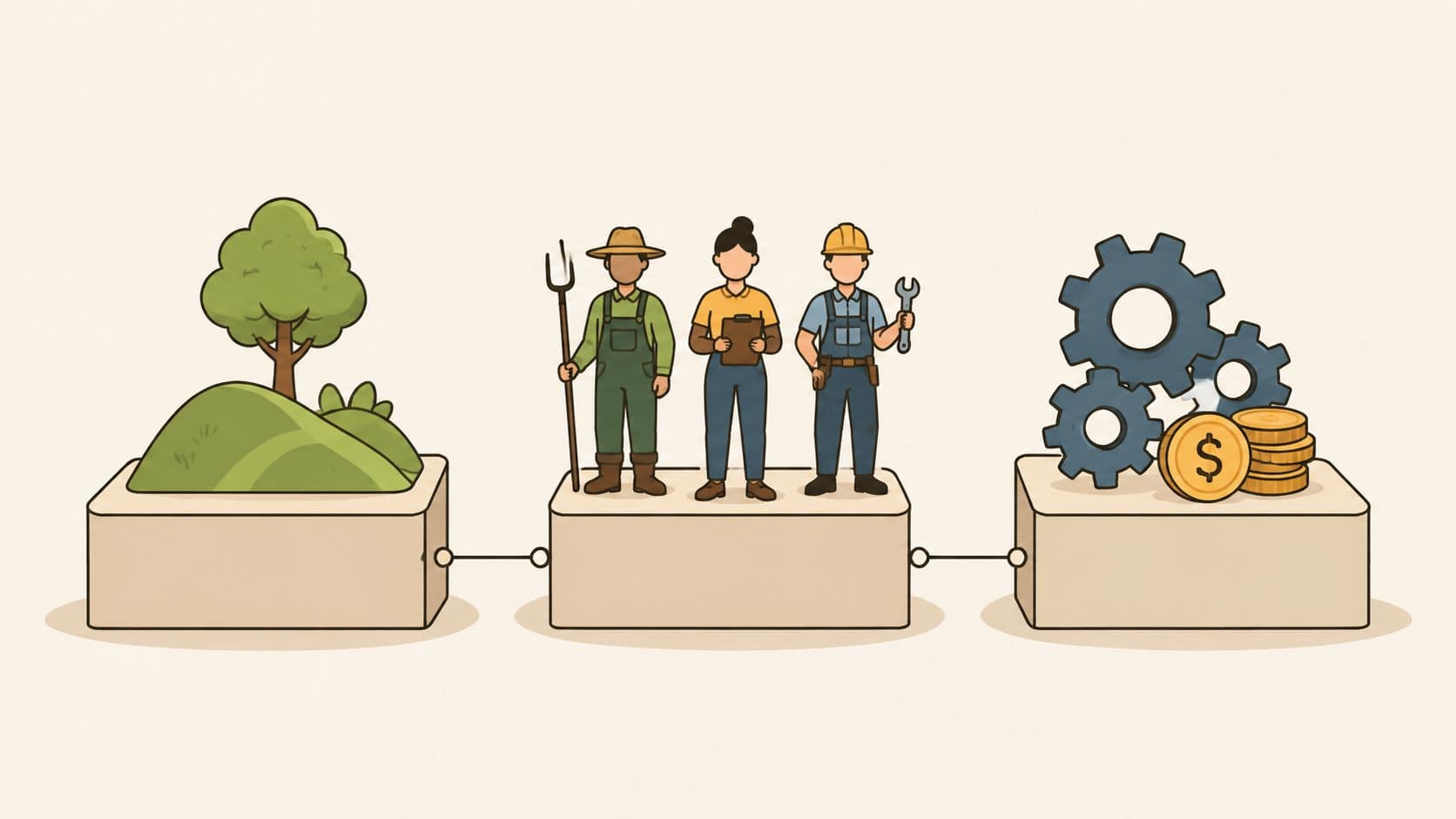
The most popular advice about land, labor, and capital starts with a useful simplification and ends with a serious policy error: it treats land as if it were another form of capital. A building can be constructed, a machine can be manufactured, and financial capital can be accumulated. Land cannot be produced in the same way, moved to a better location, or depreciated like an ordinary asset.
That distinction becomes especially important when governments design taxes, leases, and property rights. A fixed-term lease, an indefinite annually repriced land-use right, and a site-value tax can all be described loosely as ways to charge for land, but they create very different incentives and risks. Confusing them can hide a repricing shock until it is too late.
Table of Contents
- Why Land Is Not Capital
- Understanding the Three Factors of Production
- How Conflating Land and Capital Distorts Policy
- Land Leases Versus Land-Use Rights Versus Site-Value Taxation
- The Case for Land-Value Capture
- Implementation Pathways for Policymakers
- Common Misconceptions and Key Takeaways
Why Land Is Not Capital
Classical political economy began with a clearer framework. It treated land, labor, and capital as three distinct factors of production, with each receiving a different return: land earned rent, labor earned wages, and capital earned profit or interest. This was more than a classification exercise. It connected each income stream to a different economic source and therefore to different policy choices.
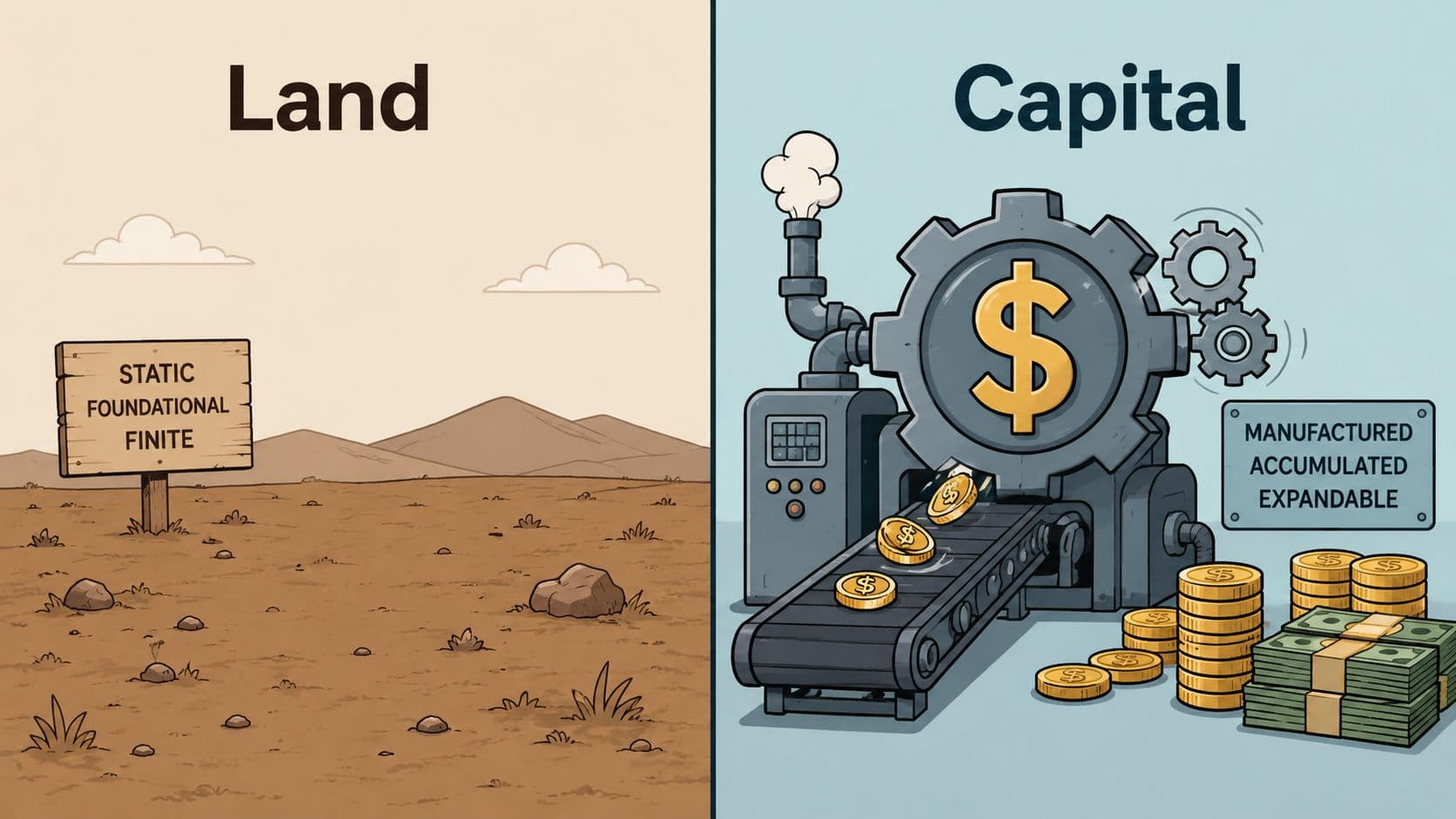
Land means the natural and locational opportunities used in production. It includes sites, minerals, ecological resources, and access to valuable locations. Capital means produced means of production, such as buildings, tools, machines, and infrastructure. A factory structure may be capital, but the location beneath it remains land.
The historical reclassification
From the 1880s to the 1920s, mainstream economics progressively marginalized land and natural resources, increasingly merging them into capital. John Bates Clark's The Distribution of Wealth, published in 1899, became a leading statement of the two-factor approach. The historical account is documented in this review of land's treatment in economic thought.
The change altered how economists measured distribution and how policymakers thought about taxation. If site rent and produced capital are placed in one category, a model may fail to distinguish income generated by exclusive access to a location from income generated by saving, investment, and innovation. That makes it harder to see why a vacant central site can rise in value even when its owner makes no productive improvement.
For readers who want a concise definition of produced assets, the capital glossary is a useful reference. The key point is simple: capital is created through human production, while land is a condition of production that humans can occupy, improve, regulate, or conserve, but cannot manufacture at will.
Policy implication: If land rent is hidden inside the return to capital, governments may tax construction and productive investment while leaving location gains weakly addressed.
That helps explain why housing unaffordability and speculative holding are difficult to diagnose. A high property price may reflect an expensive building, a valuable location, or both. Treating the entire price as capital obscures the portion created by public infrastructure, planning decisions, population concentration, and shared economic activity.
Understanding the Three Factors of Production
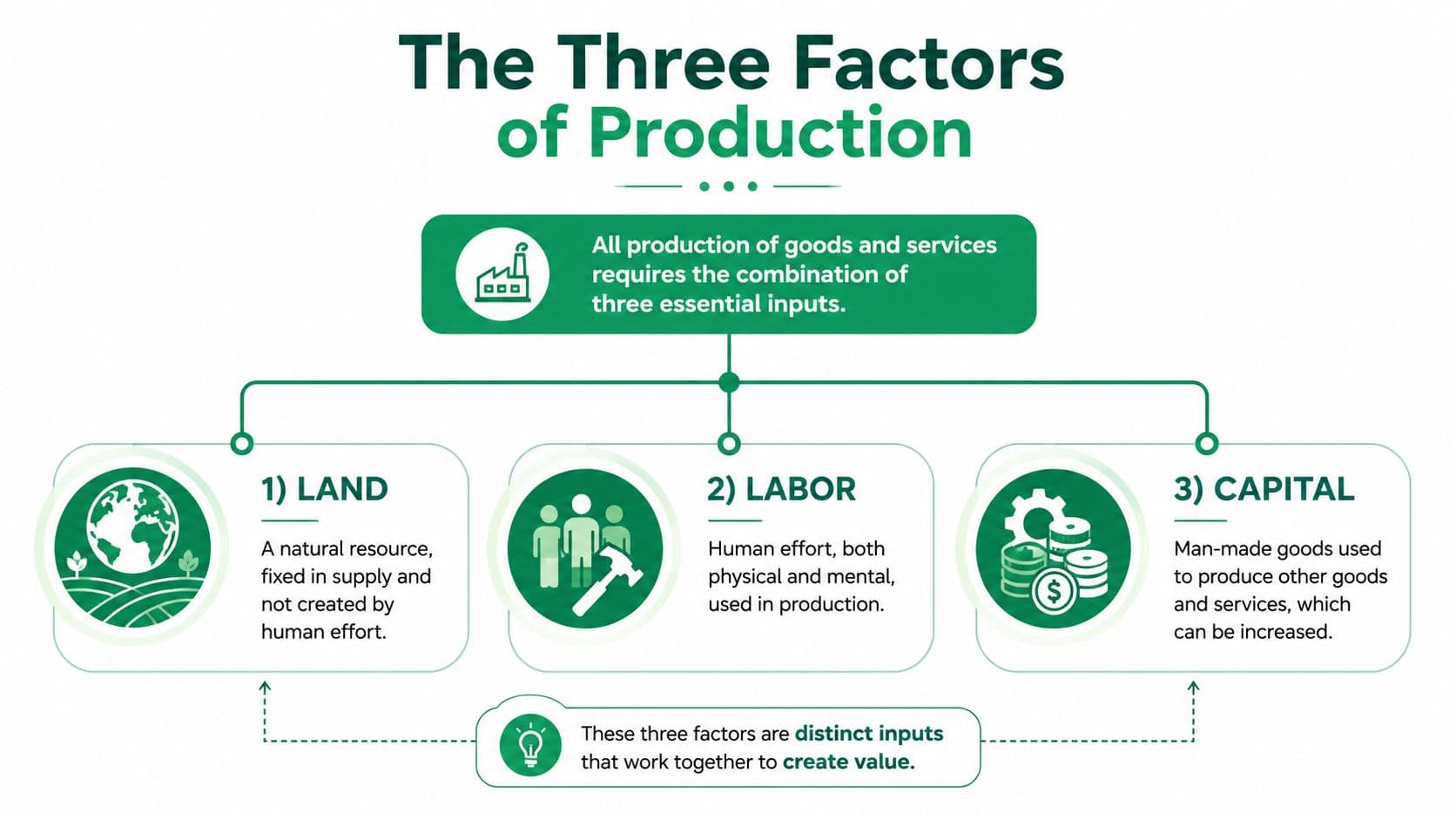
A practical way to understand the framework is to separate the inputs by asking three questions: What is the input? Can people reproduce it? How does it respond to policy?
Land is the natural and locational factor. Its value depends heavily on where it is and what uses are legally and economically possible there. A site near transport, employment, public services, or a productive market can command more rent than an otherwise similar site in a remote location. Owners can improve access and use, but they can't manufacture a second copy of that location.
Labor is human effort, both physical and mental. It includes time, skill, judgment, coordination, and care. Workers can move between employers or places, although family responsibilities, housing costs, immigration rules, training, and discrimination can limit that mobility. Labor also changes through education, experience, health, and organization. A plain-language labor glossary helps distinguish human effort from the assets used alongside it.
Capital consists of produced goods used to make other goods and services. Machinery, tools, warehouses, software systems, and buildings belong here. Capital can be increased through saving and investment, and it can wear out, become obsolete, or require replacement. Its supply is therefore responsive to expected returns, financing conditions, and technological change.
A theater analogy
Consider a theater production:
- Land is the seat and location. The venue occupies a particular site, and its position affects who can reach it and what audiences it can serve.
- Labor is the actors, technicians, administrators, and other people doing the work. Their time and abilities turn possibilities into a performance.
- Capital is the stage equipment. Lighting, sound systems, scenery, tools, and the building support production, but people create or replace them.
The analogy shows why the factors respond differently to taxation. A charge on wages can reduce the reward for working or hiring. A charge on new buildings can discourage construction or renovation. A charge on the value of a scarce site can't make the site disappear, although it can affect whether an owner holds it idle, develops it, or sells it.
Why the distinction matters
The factors also have different distributional meanings. Wages compensate people for work. Profit or interest can reward risk, saving, management, or innovation. Rent reflects control over a scarce natural or locational opportunity. These returns can overlap in real life, especially when one person owns a business, works in it, and holds its premises, but the underlying economic sources remain distinct.
A government that recognizes the difference can ask better questions. Is a tax reducing the supply of housing by making construction more expensive? Is it capturing location value created by the community? Is it taxing work that could otherwise expand employment? The tri-factor lens doesn't answer every question automatically, but it prevents policymakers from treating unlike inputs as if they behaved identically.
How Conflating Land and Capital Distorts Policy
A property tax often appears to target owners, but the economic burden can move through prices, rents, wages, and investment decisions. The statutory payer is not always the person who ultimately absorbs the cost. A recent Oxford analysis of property-tax incidence finds that the burden falls primarily on labor and land in the intermediate run. In its benchmark case, 64% of residents' tax burden is concentrated on the sources side of incidence, with labor carrying most of that burden.
That result challenges the everyday assumption that a property tax reduces the return of a landlord or property investor. Owners may respond by raising rents where market conditions allow, accepting lower land prices, reducing hiring, or changing investment plans. Workers can bear part of the burden through reduced wages or fewer employment opportunities, while landowners can bear another part through lower site values.
Buildings and sites react differently
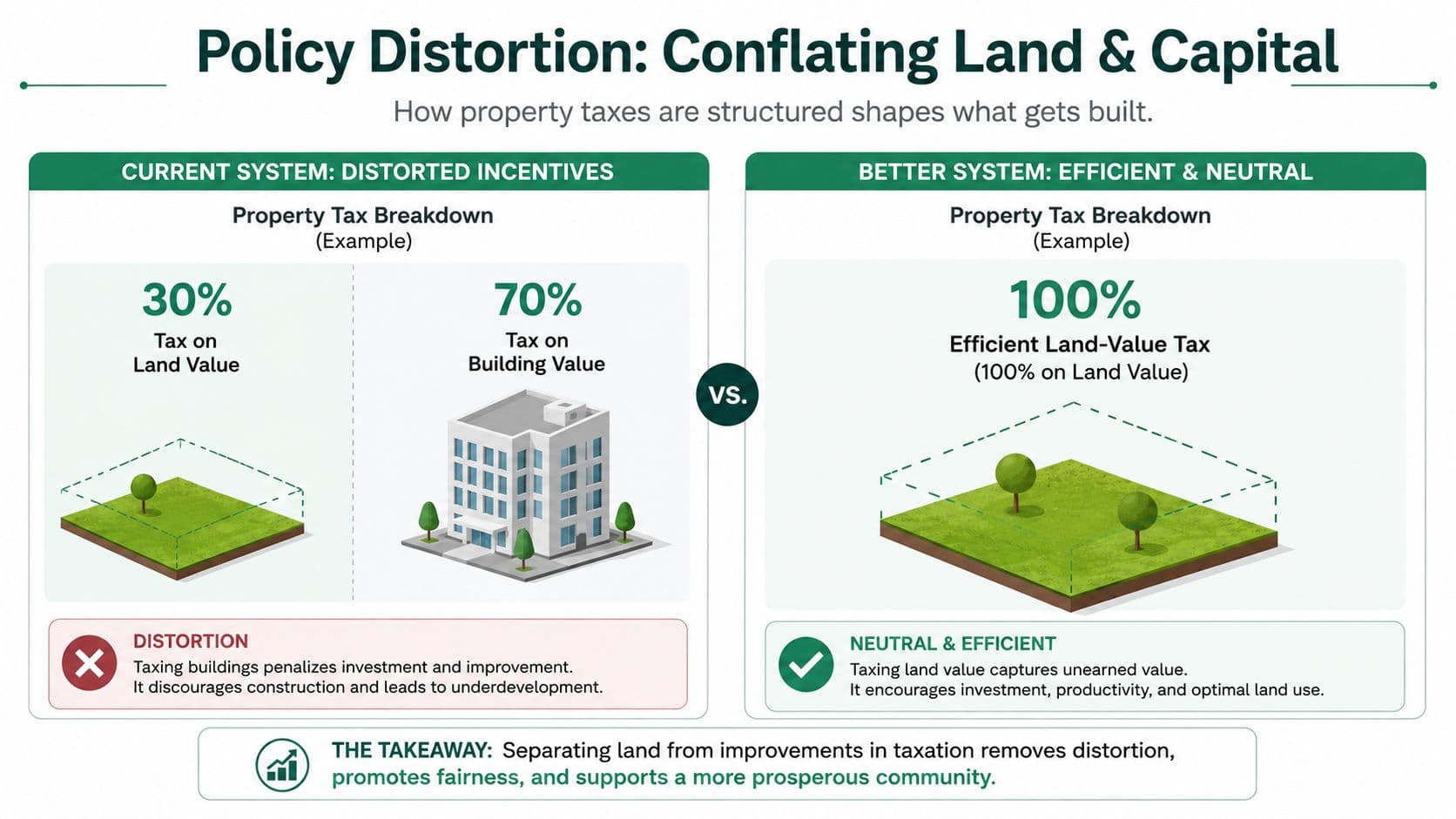
A tax on building value increases the cost of constructing, extending, or maintaining structures. That can discourage improvements and reward owners who leave valuable sites underused. A tax on land value works through a different channel because the quantity of a location is fixed. The owner can't move the site offshore or reduce its supply by building less on it.
The distinction matters for housing. If a city taxes new structures heavily but taxes valuable vacant or underused sites lightly, it can make infill development less attractive and holding land more comfortable. The resulting pattern may include higher housing costs, outward expansion, and pressure to convert additional land at the urban edge.
A 2021 analysis of differentiated taxation argues that land, structures, and physical capital have different tax elasticities. Its implication is direct: a uniform wealth tax across all three isn't automatically sound policy. A 2025 model goes further, finding that optimal policy taxes land much more heavily than structures, while still taxing structures positively under some conditions. The design question isn't whether every building must escape taxation. It's whether the building charge is calibrated separately from the site charge.
Scarcity becomes visible in growth accounting
Singapore illustrates the issue in a dense economy. In the IMF growth-accounting study covering 1961 to 1991, land available for agricultural, commercial, industrial, and residential purposes had risen by only about 5% since 1960, making it the slowest-growing factor of production in the analysis. Over the same period, capital contributed about 7 percentage points to average annual output growth, while labor contributed about 1.9 percentage points on average, with labor's annual contribution ranging from minus 3 percentage points to nearly 6 percentage points. These figures come from the IMF study of Singapore's growth accounting.
The lesson isn't that land never changes. Reclamation and administrative reclassification can expand or alter usable land, but those processes are limited, costly, and politically governed. In a dense economy, land scarcity can bind development while capital and labor remain more adaptable. A tax system that treats the fixed factor like the reproducible factor can therefore push pressure onto the very activities that expand productive capacity.
Land Leases Versus Land-Use Rights Versus Site-Value Taxation
These three mechanisms are often described as interchangeable. They aren't. The decisive questions are whether the right expires, whether renewal is required, and how often the charge changes.
A land lease is a fixed-price agreement for a defined term. It may be renewable or non-renewable, but the price is fixed during the agreed period. A renewable lease offers certainty only until its term ends. If the contract rate falls behind the market, renewal can close the accumulated gap in one major repricing. A non-renewable lease creates a different problem: as its expiry approaches, refinancing and resale can become harder.
Fixed leases don't eliminate risk. They postpone risk. The eventual repricing cliff can affect investment decisions, financing, business transfers, and the value of improvements attached to the site. A practical explanation of long leases and their economic consequences is available in this guide to 99-year land leases.
A land-use right, as defined here, has three necessary features:
- Annual repricing: The charge updates each year to reflect current land value.
- No renewal requirement: The holder doesn't need to negotiate a new term to continue using the site.
- No expiry: The right is indefinite rather than time-limited.
Because the right is indefinite and repriced annually, people can buy and sell it at relatively low cost without waiting for a renewal event. The annual adjustment prices the land component while avoiding a sudden end-of-term liability. It also means productive enterprises aren't burdened by a hidden lease cliff.
Site-value taxation is different again. It isn't a tenure right. It is a tax on the unimproved value of land at its highest potential use, excluding buildings and other improvements. A major review of land-value taxation describes its potential to improve local-tax neutrality, promote efficient land use, and reduce urban sprawl. The mechanism is important: taxing structures raises the cost of capital, while taxing residual site value can change the timing of development without imposing the same penalty on building.
| Mechanism | Term Length | Repricing Frequency | Risk Profile | Impact on Productive Enterprise |
|---|---|---|---|---|
| Fixed-term land lease | Renewable or non-renewable fixed term | Fixed during the term | Risk is deferred to renewal, expiry, refinancing, or resale | Can burden investment when end-of-term risk affects financing |
| Land-use right | Indefinite, with no expiry | Annually | Lower repricing cliff risk, because value updates continuously | Prices land while avoiding a fixed-term penalty on productive activity |
| Site-value taxation | No tenure term created by the tax | According to the assessment and tax system | Fiscal and valuation risk must be managed transparently | Excludes improvements from the tax base, supporting construction incentives |
When researching disposal of a land interest, readers also need to distinguish recurring land charges from transaction taxes. A practical resource on capital gains tax for land sellers can help clarify that separate issue.
Sometimes a fixed lease is mislabeled a “land-use right.” That label is inaccurate unless the arrangement is annually repriced, requires no renewal, and doesn't expire. A right with a fixed end date remains a fixed lease, regardless of the terminology used in legislation or marketing.
The Case for Land-Value Capture
Land-value capture starts from a straightforward observation: public decisions often raise site values. A new transit connection, a road, a school, a utility network, or a zoning change can make a location more useful. If the entire uplift flows to a private owner, the public may pay for the improvement while receiving little of the value it helped create.
A land-value charge can recover part of that uplift without taxing the building that responds to it. The land-value capture guide explains the broader policy logic, including site-value taxation and related instruments.
The case for capture has three parts:
- Neutrality: A charge on site value doesn't rise merely because an owner adds a productive structure. That can protect construction and investment incentives better than a tax that falls heavily on improvements.
- Efficient land use: Holding a valuable site idle becomes more expensive relative to developing it, selling it, or finding a productive use.
- Public return: Government can recover part of the value generated by infrastructure, planning, and public services instead of relying only on taxes on wages or produced capital.
Efficiency isn't the same as automatic fairness
The IMF's 2022 analysis of land-value taxation finds that shifting the tax burden toward land tends to be more efficient than taxing labor or capital because land is fixed in supply. The same analysis models equity through household land-value holdings and social welfare weights, showing that distributional outcomes depend on who owns land and how revenue is recycled. The IMF paper on land-value taxation makes the design issue clear.
A government could use revenue to reduce taxes on work, fund services, provide targeted relief, or distribute a broad dividend. Each choice changes who gains and who pays. A land-value policy therefore needs both an efficiency analysis and a distributional plan.
Lessons from different places
Documented precedents include Denmark, Estonia, Singapore, Alaska, Canberra, Norway, and Allentown. These examples don't represent one identical model, and policymakers shouldn't copy them mechanically. They show instead that land-based charges, public land ownership, resource dividends, and value-capture instruments can operate through different administrative and constitutional arrangements.
The OECD frames land-value capture as a way to recover part of the uplift created by public infrastructure or zoning changes. Its approach connects land policy to practical fiscal management: public authorities can finance services while limiting unearned windfalls, provided valuation rules, exemptions, appeals, and revenue use are visible.
Practical rule: Capture the value created by public action, then show residents exactly how the revenue returns through services, lower taxes, or shared payments.
The strongest designs separate land from improvements, publish the valuation method, model household effects, and phase in changes where sudden impacts would create hardship. Land-value capture isn't a magic solution, but it offers a more direct fiscal connection between scarce locations, public investment, and public revenue.
Implementation Pathways for Policymakers
Land reform fails when governments announce a new charge before they can explain the valuation, incidence, and transition. A workable program begins with administrative facts, not slogans.
Build the valuation foundation
The first task is a reliable land information system. Governments need parcel boundaries, ownership records, permitted uses, location attributes, infrastructure access, transaction evidence, and assessment procedures. A cadastre should distinguish site value from improvement value, because a tax on the location can't be administered fairly if the building and the land are blended into one figure.
Valuers can combine comparable transactions, rental evidence, land residual methods, zoning information, and spatial models. The method should be tested against appeals and published in plain language. Interactive maps can help residents see how transport, access, permitted density, and public amenities affect site values.
Design the instrument and model the transition
Policy design should specify the base, assessment cycle, exemptions, collection process, appeal rights, and treatment of public or community land. It should also state whether the instrument is a recurring site-value tax, a project-specific uplift charge, a resource dividend, or another form of land-value capture.
Distributional modeling must show who gains and who pays across renters, homeowners, businesses, workers, and public bodies. Fiscal models should test revenue stability, debt effects, housing supply responses, and interactions with existing building or transaction taxes. A phased implementation framework can help officials set out sequencing and responsibilities. The guide to phased implementation provides a useful conceptual reference.
Make the transition politically legible
A reform becomes more credible when officials publish concrete transition paths rather than promising abstract efficiency. Options may include gradual rate changes, targeted hardship support, credits for vulnerable households, protection against cash-flow stress, and reductions in taxes that currently penalize work or construction.
Training matters as much as legislation. Civil servants need valuation and compliance skills. Elected officials need distributional evidence they can explain publicly. Community groups need accessible maps, examples, and appeal information. Organizations such as Unitism® offer research, land-valuation frameworks, policy modeling, education, and implementation support for governments and other institutions considering these steps.
Common Misconceptions and Key Takeaways
“The owner pays the property tax.” The owner may receive the bill, but the burden can move through rents, wages, land prices, and investment decisions. The Oxford evidence discussed earlier shows why statutory incidence isn't the same as economic incidence.
“Buildings and land are both wealth, so they should face the same tax.” They are both valuable, but they respond differently. Land is fixed in supply, while structures and other capital can be produced, improved, or withheld from investment. Differentiated taxation can therefore protect productive activity while capturing location rent.
“A long lease is a land-use right.” Not necessarily. If it has a fixed term, requires renewal, or postpones repricing until expiry, it's still a fixed lease. A genuine land-use right, under the criteria used here, is indefinite, needs no renewal, and is repriced annually.
“Land is a minor detail in growth.” Singapore's experience shows why that assumption fails in dense economies. Land can be the binding constraint even when labor and capital continue to change.
The tri-factor framework gives policymakers a cleaner map. Labor is human effort, capital is produced productive capacity, and land is the scarce natural and locational foundation on which both operate. Better housing, fairer taxation, and more stable public finance depend on keeping those categories visible.
Unitism® helps governments, cities, and organizations apply tri-factor economics through land valuation, land-value capture design, distributional modeling, implementation planning, and public education. Visit Unitism® to explore practical tools and guidance for sharing land and nature's rental value while reducing pressure on work and productive capital.