Learn the legislative drafting process for land-value tax reform, from policy framing to administrative integration, with practical guidance
September 30, 2026
Legislative Drafting Process for Land-Value Tax Reform
Learn the legislative drafting process for land-value tax reform, from policy framing to administrative integration, with practical guidance
A finance ministry can have a politically agreed land-value tax proposal, a polished policy paper, and a bill that still fails on the day it takes effect. The usual cause isn't the tax principle. It's the gap between legislative drafting and administrative reality: unclear tenure categories, an incomplete valuation roll, missing transition rules, or agencies that can't determine who owes what.
Land-value reform exposes that gap quickly. The bill must define the tax base, distinguish land from improvements, connect valuation to liability, preserve due-process rights, and tell registries, valuers, tax officers, and local authorities exactly what to do. A strong legislative drafting process therefore treats the statute as an operating manual for public institutions, not merely as a set of legally elegant clauses.
Table of Contents
- Why Land-Value Tax Reform Demands a Different Drafting Approach
- The Four Stages of a Land-Value Reform Drafting Project
- Fixed Leases Versus Land-Use Rights in Drafting Language
- Translating Policy Into Clauses for Site-Value Taxation
- Transition Clauses and Administrative Integration
- Drafting Habits That Make the Bill Hold Up
Why Land-Value Tax Reform Demands a Different Drafting Approach
A conventional tax bill usually starts with an established base, such as income, sales, or a transaction. Land-value reform starts somewhere more difficult. It asks the state to identify the value of a site separately from buildings, machinery, labor, and other improvements, then apply that distinction consistently across ownership and tenure arrangements.
That choice affects nearly every operative provision. The definitions must distinguish land, site value, improvements, freehold interests, fixed leases, and land-use rights. The charging clause must identify the person responsible for payment when the legal owner, occupier, leaseholder, and beneficial user aren't the same person. The valuation provisions must support periodic reassessment without turning every change in the roll into a fresh legal dispute.
The policy must also be grounded in a clear account of what land-value capture means. A useful starting point is an explanation of what land value means, particularly where the reform seeks to collect part of the rental value of land while reducing taxes that penalize work, construction, or productive investment.
Start with the instrument, not the rate
The first drafting conference should settle the legal instrument. A bill that calls every tenure arrangement a “land-use right” will create confusion if some interests expire, require renewal, or retain a fixed price for the entire term. Those are characteristics of leases, not of a genuine indefinite right that is repriced annually.
This distinction matters because the tax administration will need different data for each category. A fixed lease requires a term, commencement date, expiry date, rent, renewal mechanism, and parties. A genuine land-use right requires evidence of an indefinite interest and an annual valuation or rental adjustment mechanism. If the bill blurs those categories, assessors won't know whether an approaching expiry should affect valuation, liability, transferability, or relief.
The drafting team should prepare a tenure map before writing the charging provisions. For each interest, record:
- Legal duration: Does the interest expire, renew, or continue indefinitely?
- Price mechanism: Is the charge fixed, renegotiated at renewal, or repriced annually?
- Transfer rules: Can the interest be sold, assigned, mortgaged, or inherited?
- Administrative record: Which agency holds the authoritative data?
- Tax responsibility: Does liability follow the owner, leaseholder, occupier, or another defined person?
Treat implementation as a legal requirement
Most drafting manuals explain bill structure, clause order, amendment practice, and proofreading. Those disciplines matter, but they don't answer the operational question: what must an agency be able to do on the first assessment date?
The House of Representatives illustrates why institutional capacity matters. Professional drafting in the House became institutionalized through the Revenue Act of 1918, which created the Legislative Drafting Service. The office was renamed the Office of Legislative Counsel in 1924, and the House office became a separate entity through the Legislative Reorganization Act of 1970, as described in the history of the House Office of Legislative Counsel. The lesson is practical. Complex legislation needs a permanent, nonpartisan drafting function that can provide technical advice throughout the legislative process.
Digital tools can assist with version control, comparison, and document review. A current review of AI legal document tools can help a drafting office assess those capabilities. They don't remove the need for local legal knowledge, authoritative source checking, or institutional sign-off. For land-value reform, the final question isn't whether software can produce text. It's whether the text matches the valuation system, the land registry, the appeal process, and the agencies that must administer it.
The Four Stages of a Land-Value Reform Drafting Project
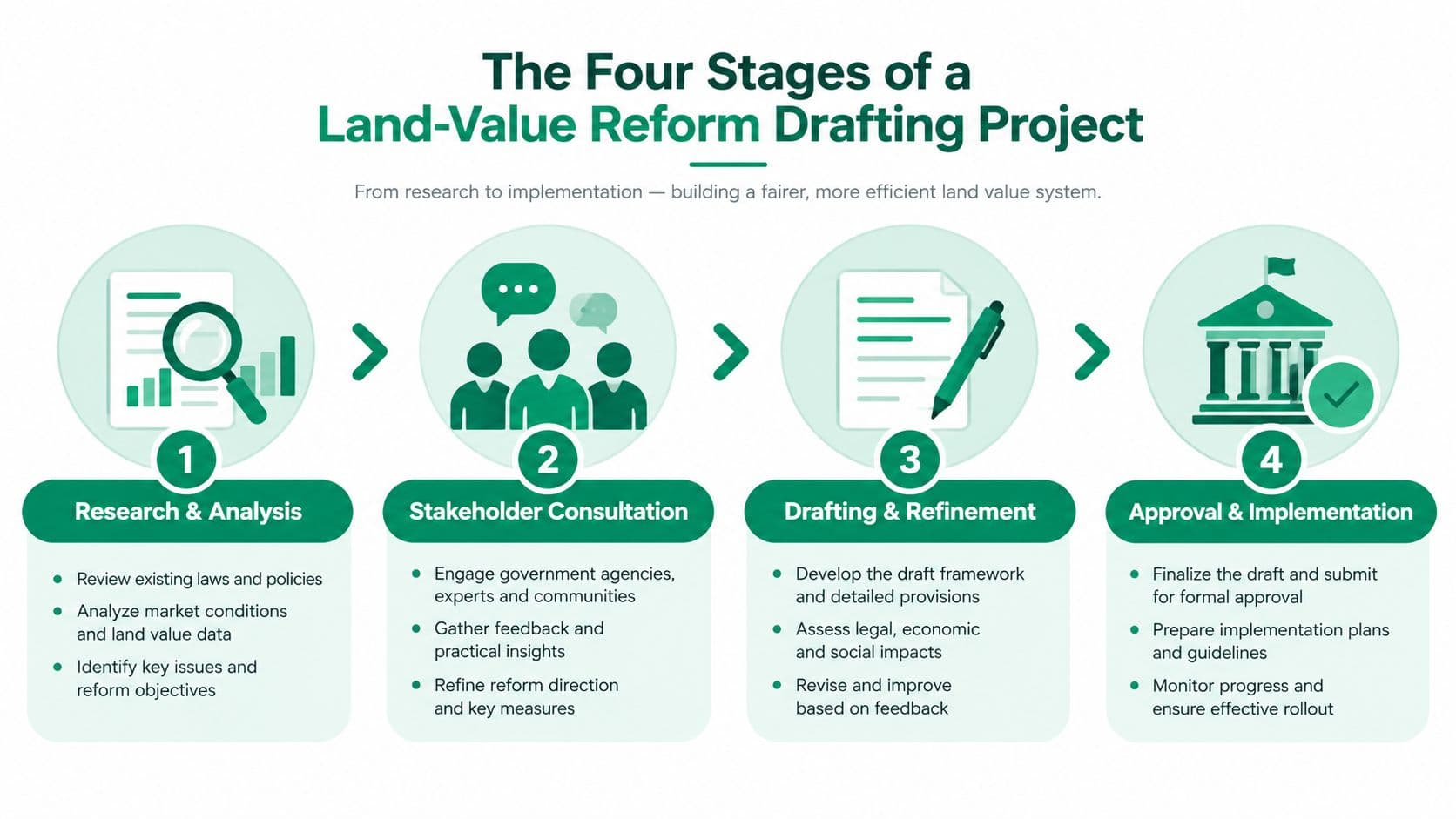
A land-value reform project needs a sequence that prevents policy choices from being hidden inside technical clauses. The strongest process separates objectives, institutional design, bill architecture, and final legal expression, while allowing stakeholders to test each stage before the next one begins.
Stage one fixes the policy objective
Begin with an issues paper, not draft clauses. It should state what the reform is meant to accomplish, which existing charges it complements or replaces, how land value will be identified, and which taxpayers or tenure holders may receive relief.
The team should also model the policy before legal language begins. That work doesn't need to produce a politically convenient answer. It needs to expose distributional effects, administrative dependencies, valuation gaps, and transition pressures. If the policy objective is to shift taxation away from buildings and productive activity, the bill must later preserve that objective through its definitions, exemptions, and valuation rules.
A policy paper that says “tax land value” without defining the relevant interest isn't ready for drafting. The drafting team should require decisions on site value, improvements, responsible persons, valuation frequency, appeals, and the treatment of public or exempt land.
Stage two forms the specialist working group
The working group should include finance officials, land administrators, valuation specialists, tax administrators, local-government representatives, parliamentary counsel, and people responsible for information systems. Each member should bring a decision to the table, not review prose after someone else has made the decision.
The group should produce a responsibility matrix. It should identify who maintains the cadastre, who certifies the valuation roll, who issues assessments, who receives objections, who collects the charge, and who resolves disputes between agencies. A land-value bill can be legally coherent and still fail if those institutional functions remain implied.
Stage three builds the bill outline
The outline should map every policy lever to a proposed part of the bill and, where necessary, to regulations or an existing statute. At this stage, the team should prepare the explanatory memorandum alongside the outline. If the memorandum can't explain how an agency will apply a clause to an ordinary parcel, the clause is not mature.
The four-stage model of objectives and technical studies, specialist working-group formation and bill outline, preliminary drafting with research and stakeholder discussions, and final review and drafting is consistent with the documented legislative drafting project model. It gives consultation a place before final wording, where it can still change the design rather than merely comment on punctuation.
Stage four tests the operative text
Preliminary clauses should be tested against actual administrative scenarios. Use a vacant urban site, an improved commercial parcel, an agricultural holding, a public facility, a recently transferred lease, and a parcel whose valuation is under appeal. The purpose isn't to create a showcase example. It's to find the point where the bill stops telling an agency what to do.
The final deliverables should include an issues paper, approved bill outline, draft clauses, explanatory memorandum, implementation schedule, and a drafting memorandum recording policy compromises. Parliamentary counsel should then perform structural review, cross-reference checks, legality review, and final proofreading before administrative approval.
The scale of professional drafting in the House shows why sequencing matters. During the 115th Congress, the Office of Legislative Counsel prepared 43,542 individual requests and 134,644 total versions when revisions were counted, according to congressional testimony on legislative drafting workload. About 30% of bill drafts were eventually introduced, which confirms that much drafting work occurs before formal introduction. A reform team should use that pre-introduction period to eliminate implementation defects, not rush through it to display progress.
Fixed Leases Versus Land-Use Rights in Drafting Language
A developer holds land under a long-term instrument, the agency must calculate the charge, and the bill uses “land-use right” without defining renewal or repricing. At expiry, the agency discovers that the holder has a lease, not an indefinite right. The resulting dispute is a drafting failure, not an administrative surprise.
A fixed lease grants possession for a stated period at a stated price. It may be renewable or non-renewable, but it remains time-limited. A true land-use right has no expiry, requires no renewal, and is repriced annually to current rental value. Those characteristics must appear in the operative clauses, not merely in the bill's title or explanatory memorandum.
The distinction affects valuation, transfer, financing, and enforcement. A renewable lease provides certainty only until its term ends. At renewal, the accumulated gap between the contractual rate and the market rate may be closed through a major repricing. A non-renewable lease creates a separate problem. As expiry approaches, its remaining term becomes harder to refinance or sell. Fixed leases postpone the pricing problem rather than resolving it.
A genuine land-use right avoids an expiry-based shock because annual repricing keeps the payment connected to current rental value. Buyers and sellers can then assess the interest without pricing a looming expiry or a long period of mispricing. The tenure distinction and its effect on land value are examined in the analysis of how land-use rights affect land value and the analysis of 99-year land leases and renewal mechanics.
Drafting markers for each category
| Tenure Category | Defining Clause Markers |
|---|---|
| Fixed lease | A stated commencement date, fixed term, fixed price, expiry, and reversion or other consequence at term end. |
| Renewable lease | A fixed term and an express renewal mechanism stating who may renew, when renewal occurs, and how the price is reset. |
| Non-renewable lease | A fixed term with no renewal right, together with rules for expiry, possession, improvements, relocation, and remaining obligations. |
| Genuine land-use right | No expiry, no renewal requirement, annual repricing to current rental value, and express rules for transfer, succession, and enforcement. |
Use “land-use right” only where the interest is repriced each year, requires no renewal, and doesn't expire. A long occupation period does not satisfy that test. If any condition is absent, the bill should use “lease” or another accurate legal term. This wording prevents agencies from applying indefinite-right rules to a time-bound contract.
Why the payment design matters
Land-access instruments collect value at different points. This overview of China's land law contrasts a grant requiring a substantial down payment and only a peppercorn annual land-use fee with a lease using higher annual rent and no huge down payment. A bill must therefore distinguish an up-front premium from ongoing rent, because each arrangement creates different valuation and liability questions.
Another China property-law source describes renewal of a land-use-right grant as requiring a new premium and a new contract, while stating that a land lease is legally limited to 20 years. This review of real estate practice in China shows why “land-use rights” cannot serve as a loose label for every time-bound arrangement. The operative clauses must identify whether the state has created a lease, a renewing grant, or an indefinite annual-repricing right. Agencies can implement the rule only when the tenure, payment method, renewal consequence, and enforcement path are stated separately.
Translating Policy Into Clauses for Site-Value Taxation
A site-value tax bill can fail even when its policy objective is clear. The failure usually appears later, when an assessor must decide what is taxable, an agency must issue a notice, or a taxpayer must challenge an incorrect assessment. Drafting must therefore answer five questions in operative language: What is taxable? Who is liable? How is value assessed? Which reliefs apply? How can an assessment be reviewed and challenged?
Begin with definitions, and treat them as part of the tax machinery. Define taxable land, site value, improvements, beneficial owner, leaseholder, and each relevant public authority. If the policy taxes the location rather than construction, state that site value excludes buildings and other improvements. If the legal and economic design places liability on a leaseholder, do not let an undefined “owner” leave that person outside the charge.
The five clause families
-
Definitions establish the tax base. State whether taxable value concerns land alone, how improvements are excluded, and which legal interest creates liability. Avoid circular wording that defines taxable land by reference to the charge, then defines the charge by reference to taxable land.
-
The charging provision creates liability. Connect the charge to an identifiable valuation roll, assessment notice, or certified value. The bill must require the responsible authority to create or maintain the relevant assessment. A regulation should not supply the legal foundation for a charge that the statute never establishes.
-
Exemptions and reliefs limit the base. Set a legal test for principal residences, agricultural land, public infrastructure, charitable uses, and other reliefs. Broad wording based on a preferred purpose can extend an exemption to every associated use, reduce the intended base, and create unequal treatment.
-
Valuation hooks connect statutes. Refer directly to the assessment legislation, valuation method, roll-certification process, reassessment rules, and relevant land records. Align dates, defined terms, and responsible agencies across the tax and valuation laws. An assessor should not have to resolve a conflict created by the bill itself.
-
Review clauses protect legality. Specify notice, objection, correction, appeal, payment during a dispute, refund, and limitation rules. A taxpayer should have a workable administrative route to correct an error before judicial review becomes the only practical remedy.
Valuation provisions should support periodic reassessment and explain how the authority handles transfers, subdivisions, amalgamations, new improvements, changes in use, and changes in tenure. The statute need not contain every technical formula. It must identify where the formula is established and define the limits of delegated power.
| Clause Family | Function in the Bill | Common Drafting Failure |
|---|---|---|
| Definitions | Separates site value, improvements, liable persons, and tenure interests. | An incomplete definition leaves an owner, leaseholder, or public body outside the scheme. |
| Charging provision | Creates the legal obligation and connects it to an assessment. | Liability depends on an assessment or regulation that the bill neither clearly requires nor authorizes. |
| Exemptions and reliefs | Removes or reduces liability under defined conditions. | Purpose-based wording expands relief until little of the intended base remains. |
| Valuation hooks | Connects the tax to the roll, valuation method, records, and review cycle. | The tax act and assessment statute use incompatible dates, terms, or agencies. |
| Review clauses | Provides correction, objection, appeal, payment, and refund mechanisms. | The bill creates a charge without a workable route to challenge an incorrect assessment. |
Use guidance on determining land value during policy design to keep the distinction between land and improvements clear. The statute must then convert that distinction into definitions, valuation rules, and enforceable liability.
Before introduction, require four quality checks:
- Definitional precision: An assessor should reach the same preliminary classification from the same facts.
- Cross-reference consistency: Every internal reference should point to an operative provision, schedule, or authorized instrument.
- Delegated-legislation coverage: Regulations should handle technical administration, not make undisclosed primary policy choices.
- Tax-administration compatibility: The bill should fit existing rules on registration, notices, collection, objections, recovery, confidentiality, and appeals.
Thomson Reuters reports that legal professionals spend 40% to 60% of their time drafting documents and more than 15 minutes identifying a good starting point for a draft, according to Thomson Reuters' discussion of legal drafting risks. The figures are vendor-reported, so treat them as an industry observation rather than a settled research finding. The drafting lesson remains practical: settle the policy architecture before counsel starts optimizing clause wording.
Transition Clauses and Administrative Integration
A commencement clause doesn't make a tax operational. It only states when the law takes effect. The transition provisions must explain how the state moves from existing leases, records, valuations, exemptions, and assessment systems to the new regime without creating an unanswerable liability gap.
Three techniques are especially useful.
Grandfathering can preserve existing leases for their remaining term while applying the new rules to later grants, renewals, or transfers. This approach can reduce immediate contractual disruption, but it must state whether the new charge applies during the grandfathered term and how the rule interacts with a fixed rent.
Phased commencement can introduce the charge by land category, administrative area, or rate band. It gives the valuation authority and local administration time to test the roll and correct data before the scheme covers every parcel.
Bridging provisions can keep the old charge in force until the new valuation roll is certified. Without a bridge, a delayed roll can leave the government unable to collect the new charge while the old legal basis has already ended.
Make the handover sequence explicit
The bill should assign each agency a dated or event-based responsibility. The sequence usually begins with notification to affected owners and tenure holders. The land registry then transfers authoritative parcel and interest data to the valuation authority, the valuation authority prepares and certifies the roll, assessing officers receive appointments and instructions, and the tax authority issues the first assessments.
The statute should distinguish first assessment from first liability. Those events may occur at different times. A taxpayer might receive an assessment before the charge becomes payable, or liability might begin only after a roll is certified and notice is served. If the bill doesn't make that sequence clear, agencies may issue inconsistent notices or argue over which institution bears responsibility.
Practical rule: No commencement date should be approved until the registry, valuation authority, assessing office, and collection agency can each name the document they must produce next.
Pennsylvania and Estonian site-value pilots belong in the implementation file for this reason. Use them to examine how a reform moves from valuation design to operational administration, but don't treat a political announcement or a draft statute as evidence that a transition has been solved. The useful comparison is the handover design, including the data available, the authority assigned to each institution, the treatment of existing interests, and the route for correcting assessments.
A transition planning framework for land-value reform can help the working group convert those questions into an implementation schedule. The schedule should sit beside the bill, not in a later administrative memo that lawmakers and affected parties never see.
Drafting Habits That Make the Bill Hold Up
Strong bills survive scrutiny because their drafters test the administration as rigorously as they test the grammar. The following habits prevent common failures.
Keep principles short and operative rules exact
A principles clause should state the policy purpose without qualifying the charge into uncertainty. It shouldn't contain a long aspiration that conflicts with the operative provisions. The legal work belongs in the definitions, charging provisions, valuation rules, exemptions, and review mechanisms.
Write definitions in alphabetical order and use marginal cross-references where the jurisdiction's drafting conventions permit them. This makes omissions easier to detect and reduces the chance that one part of the bill uses “landholder” while another relies on “registered owner.”
Test every charge against a fact pattern
Take a notional parcel and ask who is liable if the registry is outdated, the lease is close to expiry, the building was recently completed, the parcel is subdivided, or the assessment is under appeal. If two agencies can produce different answers from the same facts, the clause needs revision.
Build the delegated-legislation schedule at the same time as the bill. List every regulation, valuation rule, form, notice, code, and administrative instrument required for operation. This exposes silent regulatory gaps before commencement.
Record compromises and fix the review date
Maintain a drafting memorandum that records every policy compromise, including why a tenure category received relief, why a transition rule was chosen, and which agency accepted a new function. That record helps later reviewers distinguish deliberate policy from accidental ambiguity.
Require a post-implementation review at a fixed date and specify what the review must examine, such as valuation accuracy, administrative cost, appeals, distributional effects, and the treatment of leases. The review clause shouldn't become an invitation to postpone decisions. It should create an evidence-based checkpoint after the law has been used.
Stakeholder engagement must test administration, not only political acceptability. The stakeholder engagement strategies for land-value reform should bring in assessors, registry officials, local administrators, leaseholders, landowners, builders, and affected communities before the clauses are settled.
The most useful drafting discipline is simple: ask the person who must administer the provision to explain it without consulting the drafter. If that explanation changes depending on the speaker, the bill isn't ready. Unitism® offers policy design, valuation frameworks, legislative drafting support, administrative process design, and training for teams turning land-value reform into workable law.
Visit Unitism® to explore support for site-value tax design, tenure classification, valuation systems, transition planning, and administrative integration. If your team is preparing a land-value reform bill, use that support to test the clauses against the institutions and real-world land interests that must apply them.