Learn how Maryland community solar works, from eligibility and savings to subscription steps for residents and organizations.
August 8, 2026
Maryland Community Solar: Complete Guide to Savings
Learn how Maryland community solar works, from eligibility and savings to subscription steps for residents and organizations.
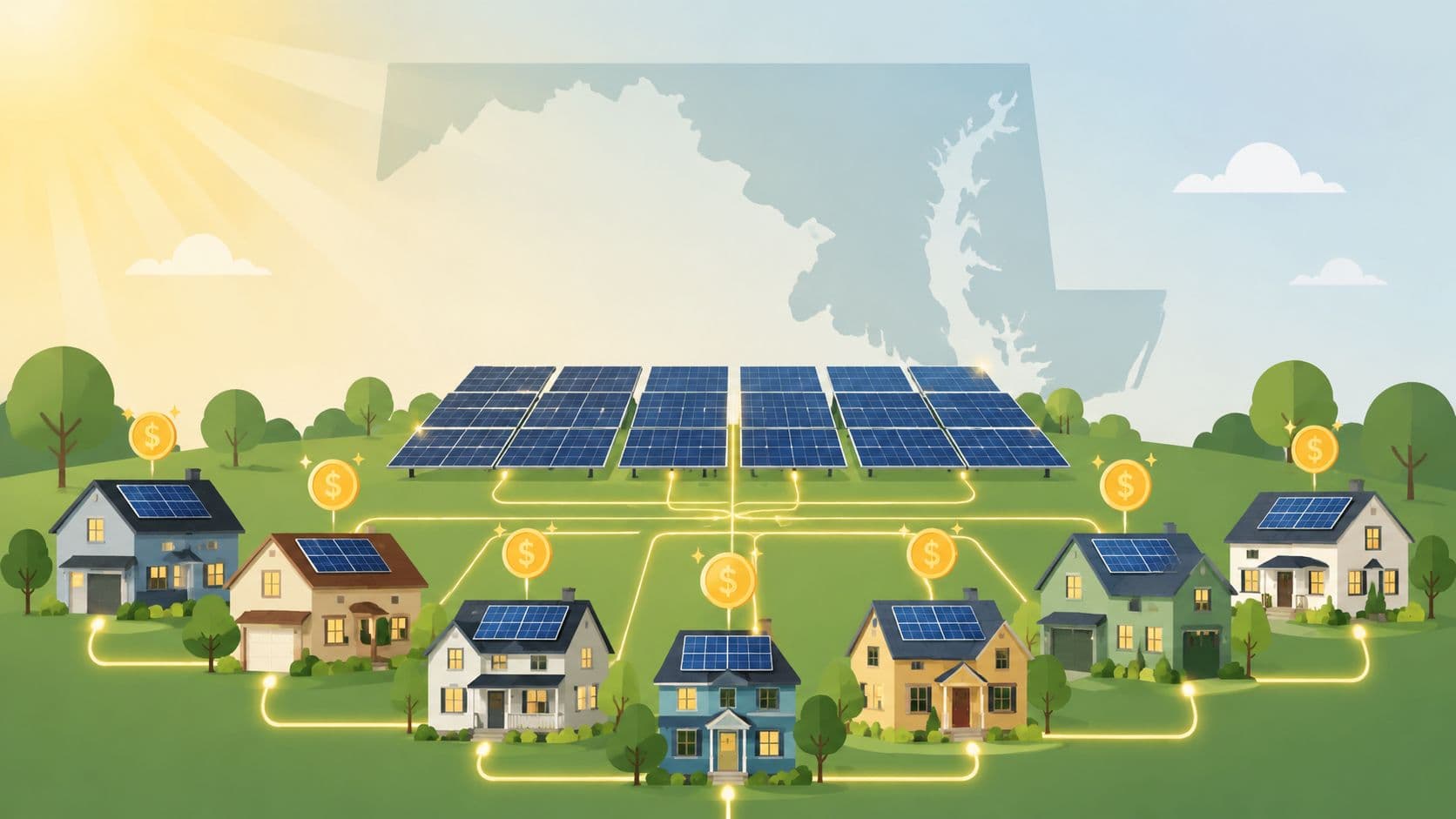
You're looking at a higher electric bill, a roof that doesn't make sense for solar, or a municipal parcel that keeps getting mentioned in clean-energy meetings. Maryland community solar is built for exactly that kind of problem, because it lets people use solar savings without putting panels on their own property. The practical question isn't whether the sun is shining, it's whether a share of a local solar project can show up as bill credits on your utility statement and lower what you owe.
Table of Contents
- What Maryland Community Solar Means for You
- The Legal Framework Behind Maryland's Program
- Eligibility Rules and Subscription Options Explained
- How to Subscribe and Get Connected
- Understanding Your Savings and Bill Credits
- How Local Governments and Developers Participate
- Resources and Next Steps for Maryland Residents
What Maryland Community Solar Means for You
A homeowner in Maryland can do everything right, choose an efficient furnace, switch bulbs, keep the thermostat steady, and still feel stuck if the house has shade, an old roof, or no appetite for rooftop panels. Community solar gives that homeowner another path. Instead of putting panels on your own property, you subscribe to a shared solar project and receive bill credits for your share of the power it produces. For many residents, the first sign of the program is a credit on the utility statement, not a roof full of equipment.
The basic idea
One solar array serves multiple subscribers, and the utility tracks those subscribers through bill credits tied to the project's output. The subscriber keeps normal electric service, while the solar project is located elsewhere in the same utility territory and connected to the distribution grid.
That setup matters because it gives renters, homeowners with unsuitable roofs, nonprofits, small businesses, and local governments a way to use solar without managing panels themselves. It also helps explain why community solar often feels simpler than rooftop solar. The subscriber is buying access to a project, rather than buying panels, inverters, and interconnection work.
Practical rule: If you pay a utility bill and can be assigned a share of a qualifying local project, you are usually much closer to community solar than you think.
Maryland's program is especially useful for people who want a practical entry point, not a full property retrofit. For a plain-language overview of the model, this community solar explainer is a helpful companion.
What you should expect
Community solar does not replace your utility. It changes how part of your bill is offset. The practical question comes down to whether a share of a local solar project can appear as bill credits on your utility statement and lower what you owe.
That means the first questions are straightforward, which utility territory are you in, and is there an active project that accepts your account type?
The upside is access. The tradeoff is that savings depend on the project terms, the bill-credit structure, and how much of your usage the subscription covers. Maryland community solar is a billing arrangement first, and a physical energy purchase second.
The Legal Framework Behind Maryland's Program
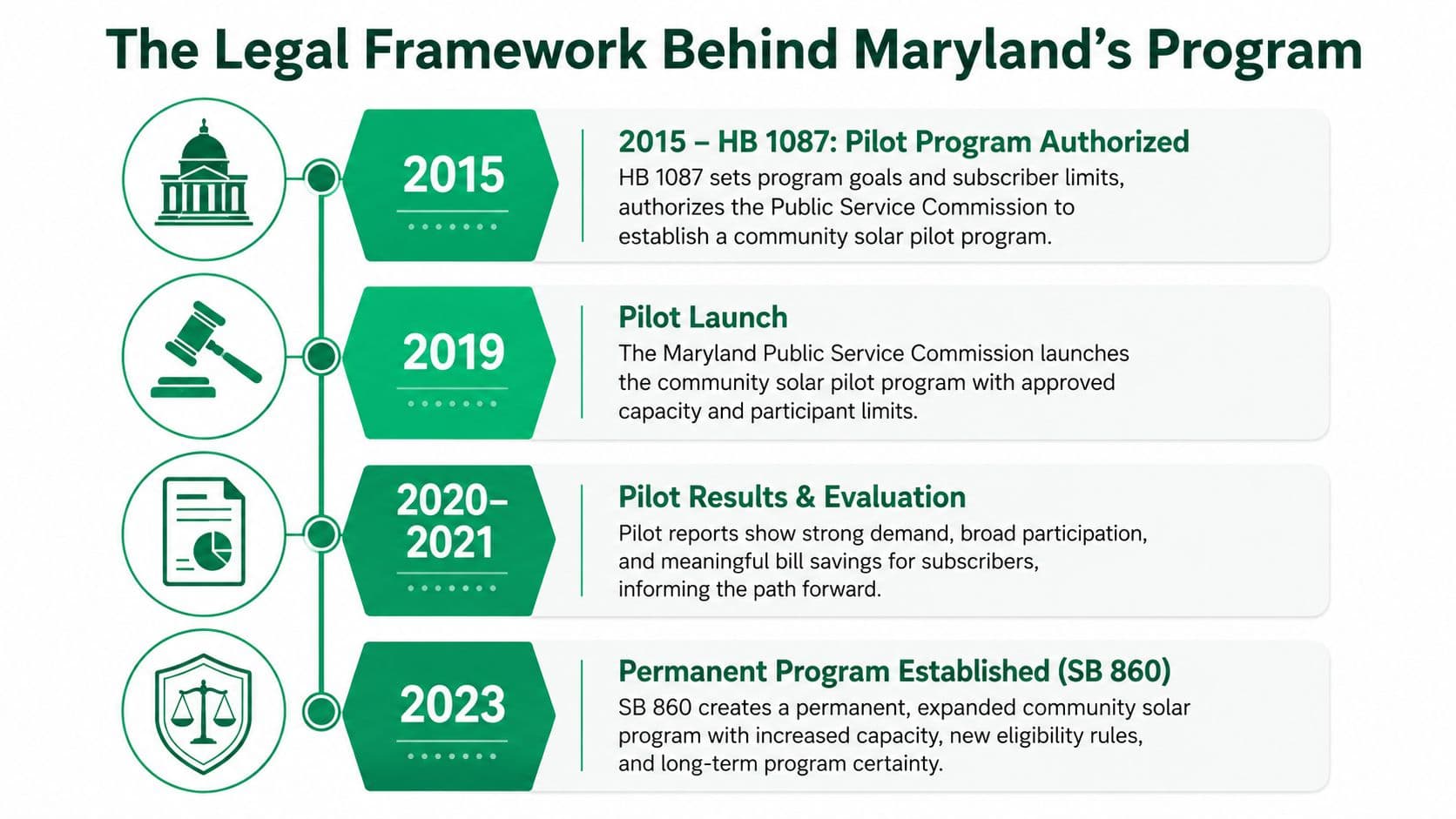
A Maryland community solar project does not appear by accident. The state first tested the model through a 2015 pilot created by House Bill 1087 and Senate Bill 398, and the Public Service Commission reports that the pilot reached 139 projects and 204 MW of operating capacity by June 30, 2024. The Commission also says the pilot ended on December 31, 2024, which makes it the transition point between early testing and the permanent program now in place, according to the Public Service Commission's community solar page.
How the program grew
The pilot gave lawmakers and regulators a controlled way to see how subscriptions, billing, and project development would work before opening the market more broadly. Maryland later raised program capacity in 2020 from 1.5% to 3.2% of the state's 2015 peak demand, which the Maryland Energy Administration said equaled about 414 MW of community solar capacity available for allocation. The same rules divided capacity into 40% Open, 30% Small/Brownfields/Other, and 30% Low-and-Moderate Income categories, as described by the Maryland Energy Administration.
That structure matters because it shows Maryland community solar is a managed allocation system, not a free-for-all. Regulators decide how much room each project type gets, and developers decide where to site projects based on those categories. For municipal planners, that is similar to a land-use policy overview, where the rules shape which parcels are practical and what kind of development each site can support.
Why the program is designed this way
The rules try to balance access, site diversity, and market discipline. A permanent program gives developers more confidence than a short pilot, while the category split leaves room for open-market subscriptions and for projects on small sites, brownfields, or properties serving lower-income customers.
Local governments read those rules differently from a subscriber does. A homeowner is usually asking how a project lowers a utility bill through credits. A planner is asking what kind of site can host the array, whether the land use is allowed, and how the project affects public finances. That is where it helps to separate land-use rights from land-value taxes. Land-use rights determine whether a parcel can legally host a solar array. Land-value taxes affect how that parcel is assessed and taxed, which is a separate issue from whether the project itself is permitted.
Eligibility Rules and Subscription Options Explained
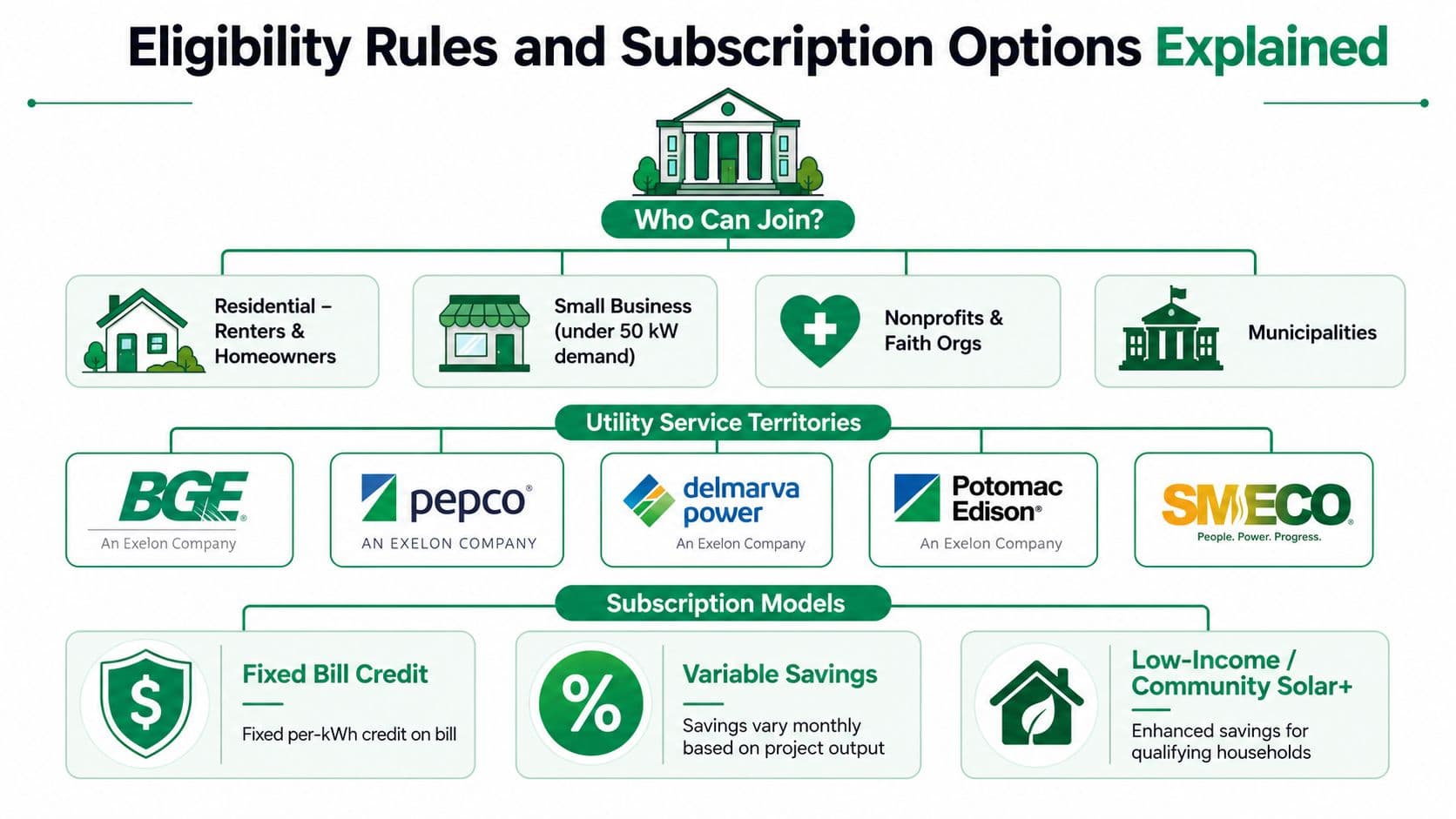
Maryland community solar only works if the project and the subscriber fit the same regulatory box. Under the state's rules, a community solar facility must be grid-connected in Maryland, must serve at least two subscribers, and must sit in the same utility service territory as those subscribers. The program is tied mainly to investor-owned utilities such as BGE, Pepco, Delmarva Power, and Potomac Edison, so the first eligibility check is usually your utility account, not your credit score or homeownership status, as summarized by the Maryland Solar Authority.
Project size and subscription design
Maryland's older statutory framework capped community solar systems at 2 MW AC, while the permanent program and later legislation expanded that cap to 5 MW AC. The program also limits large single subscriptions so that no subscription above 200 kW can make up more than 60% of a project's subscriptions, according to Carroll County's community solar guide.
That rule pushes projects away from a single anchor customer model and toward broader participation. In plain English, one big user can help a project get off the ground, but they can't swallow most of it. The result is a more community-based subscription mix and less dependence on one buyer.
Which subscription category fits
Maryland's allocation system divides program space into Open, Small/Brownfields/Other, and LMI. Those labels matter because they tell developers who the project is meant to serve and how much room remains in a given allocation bucket.
- Open projects: These are the most straightforward to explain to a typical household or small organization. They're designed for broad participation where the project has available room.
- Small/Brownfields/Other projects: These often fit unusual sites or parcels that need a different development path.
- LMI projects: These target low-and-moderate income subscribers and can shape both financing and site choice.
A municipality should read these categories as land-use and customer-targeting tools, not just administrative labels. They affect where projects are built, who gets access, and how much of a site can be monetized through subscriptions.
The key takeaway is simple. Eligibility is about utility territory, project availability, and the category a project was built to serve. A good program directory and a quick utility check can usually tell a resident more than a long FAQ page, which is why the next step is always to confirm the live project list and the terms attached to it. For a concise consumer-facing reference, see this Maryland community solar FAQ page.
How to Subscribe and Get Connected
A Maryland resident usually doesn't “sign up for solar” the same way they sign up for cable. The process starts with a project that already exists, or one in development, and then moves through a subscription contract, utility account matching, and bill-credit enrollment. The easiest way to stay grounded is to treat it like switching part of your bill from one savings channel to another, while leaving your utility service in place.
What happens first
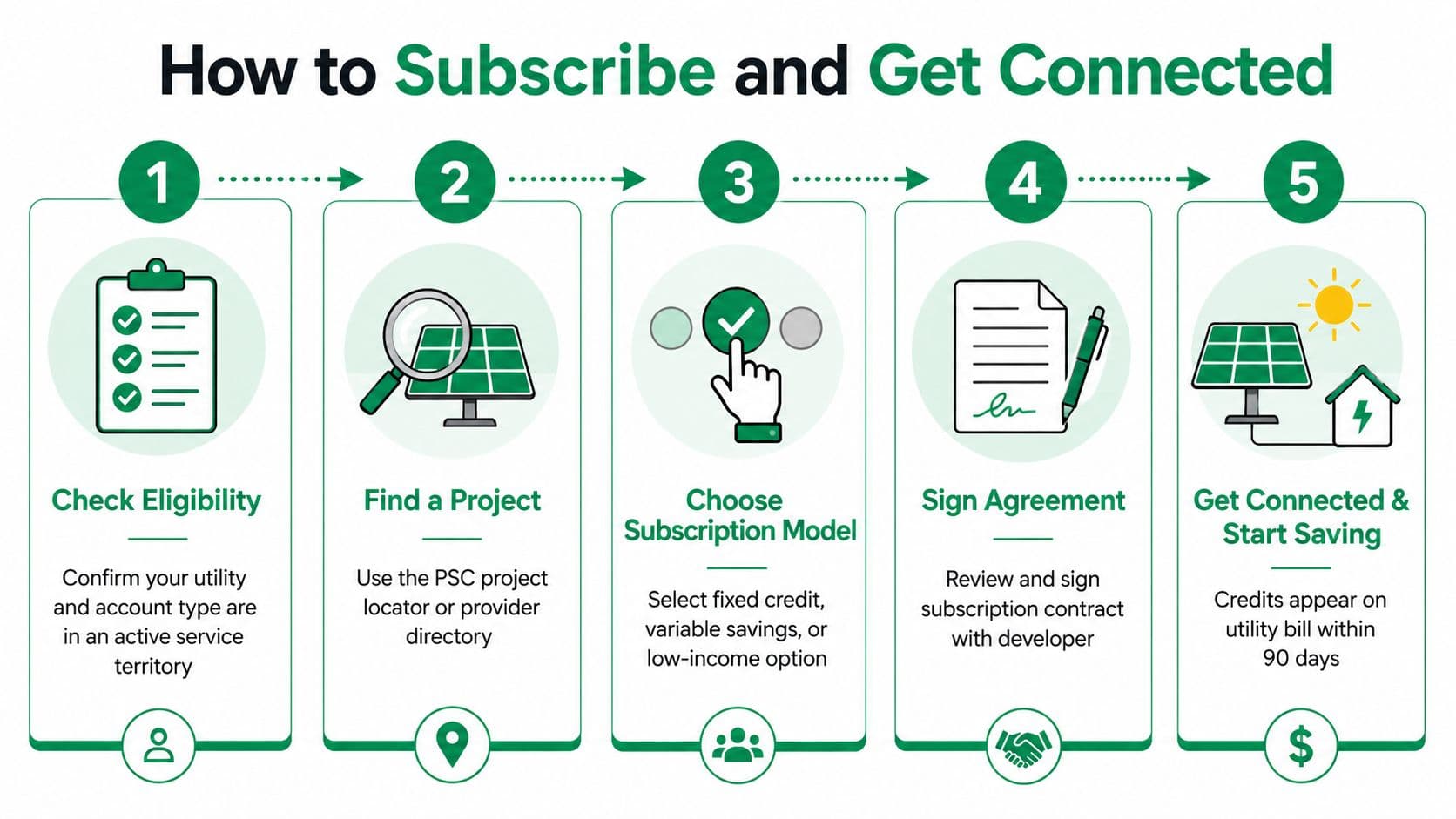
You start by checking whether your utility is in an active service territory for a live project. If it is, the next step is comparing project terms, because the contract, billing method, and subscriber class can differ from one provider to another. The project should tell you how credits are handled, what the subscription covers, and how cancellation works.
For households, the paperwork is usually tied to one utility account. For community organizations, the account review can be more involved because the organization may need to match the subscription to a single meter or a clearly defined load. The goal is the same in both cases, the utility needs to know where to apply the credits.
How the handoff usually works
The onboarding sequence is straightforward:
- Choose a live project. The project has to be active or near activation in your utility territory.
- Review the subscription terms. Look for billing method, credit handling, and any rules for moving within the service territory.
- Submit account details. The developer uses this information to connect the subscription to the right meter.
- Wait for utility processing. The credit transfer does not happen instantly.
- Check the first bill with credits. That bill shows whether the project is operating as promised.
Practical rule: Don't compare offers by the headline promise alone. Compare the bill-credit method, the contract language, and the utility territory match first.
If you move within the same utility territory, the subscription can sometimes stay workable if the account can still receive credits under the project's rules. If you move outside the territory, the arrangement usually needs a fresh review. For a plain explanation of billing and utility-cost framing, this utility-estimate guide is a useful reference.
Understanding Your Savings and Bill Credits
Maryland community solar saves money through bill credits, not by physically delivering electrons to your home. The solar project produces power, the utility assigns a credit value to your share of that production, and your bill is reduced by that credit amount. The subscriber then pays the provider under the contract terms, so the savings is the gap between the bill credit value and the subscription price.
A simple way to think about the math
If your subscription produces credits on your utility bill, the bill gets smaller. If the provider charges less for those credits than the utility values them at, you keep the difference. That's why community solar can be attractive even when the project isn't on your roof.
Here's a plain example structure using the mechanics, not a made-up market promise:
| Example Monthly Savings Calculation | Subscription Size (kW) | Monthly Production (kWh) | Credit Rate ($/kWh) | Monthly Credit ($) | Subscription Fee ($) | Net Savings ($) |
|---|---|---|---|---|---|---|
| Sample project share | Qualitative only | Qualitative only | Qualitative only | Qualitative only | Qualitative only | Qualitative only |
The table is intentionally qualitative because the verified data doesn't provide a universal production rate, credit rate, or provider fee. That's important, since actual savings depend on the project, the utility tariff, and how much electricity the subscription offsets.
What the Maryland numbers do tell you
The Public Service Commission's 2024 net-metering report says Maryland had about 1,415 MW of installed net-metering and community-solar capacity combined as of June 30, 2024, including 1,211 MW of net-metered capacity and 204 MW of community solar, according to the Commission's 2024 net-metering report. The same report estimated an average $0.52 per month distribution-bill impact for an average BGE residential customer over the 12 months ending June 30, 2024.
That figure is modest, but it shows the program's actual customer impact is measurable rather than theoretical. The point is not that every household will see the same bill effect. The point is that the credit mechanism is real, tracked, and already operating inside Maryland's distributed-solar market.
Bill credits are easiest to evaluate when you separate three things, the utility credit, the subscription fee, and the month-to-month production pattern.
Seasonality can still change the feel of the bill, because solar output isn't constant. The right expectation is not a flat fantasy number, it's a credit stream that should be checked against your actual utility charges over time.
How Local Governments and Developers Participate
Municipal planners tend to ask a different question from homeowners. They want to know whether a parcel is worth the administrative effort, how much of it can be used, and what the project provides for the site. Maryland's siting rules answer that by limiting community solar systems on the same or adjacent parcel so that combined installed capacity generally doesn't exceed 5 MW, while colocated capacity can reach 10 MW if at least 75% of aggregate capacity serves LMI subscribers or if the site is being developed as agrivoltaics on a parcel without pre-existing community solar, under the state regulations.
Why land use matters as much as interconnection
That rule makes land economics part of the project design. A site that can host a larger, more focused community solar installation may become more valuable if it serves LMI households or combines agricultural use with solar. A site that cannot meet those conditions may still work, but the economic path is narrower.
Developers often try to pair larger interconnection footprints with LMI enrollment or agricultural co-use because those features can enable the higher-capacity treatment. Municipal officials should read that as a cue to think about zoning, parcel assembly, and adjacency before they treat a solar proposal like a routine site plan.
Land-value taxes and land-use rights
If local leaders discuss land-value taxes, they should keep them distinct from land-use rights. Land-value taxes are taxes on the site's underlying value, while land-use rights are land leases that are repriced annually with no expiration dates. Because they are repriced annually, people can buy and sell land-use rights for a low cost.
That distinction matters in community solar discussions because a parcel's annual economic use can look very different from its long-term ownership structure. A local government evaluating a solar site should ask whether the land is being taxed, leased, or otherwise priced for use, because each model changes the developer's holding cost and the municipality's negotiating position.
For planners, the site question is not only “Can a solar array fit?” It's also “What land arrangement lets the project stay viable without locking the parcel into a rigid long-term structure?”
Community solar becomes a policy tool, not just an energy project. A municipality can support clean energy, reuse constrained land, and improve site productivity by understanding how the project's billing model and land arrangement work together. The best site is often the one where utility rules, parcel conditions, and subscriber mix all line up cleanly.
For a practical policy lens on neighborhood standards and land-use context, this moderately priced dwelling unit reference can be useful when local officials are comparing site economics across public-benefit projects.
Resources and Next Steps for Maryland Residents
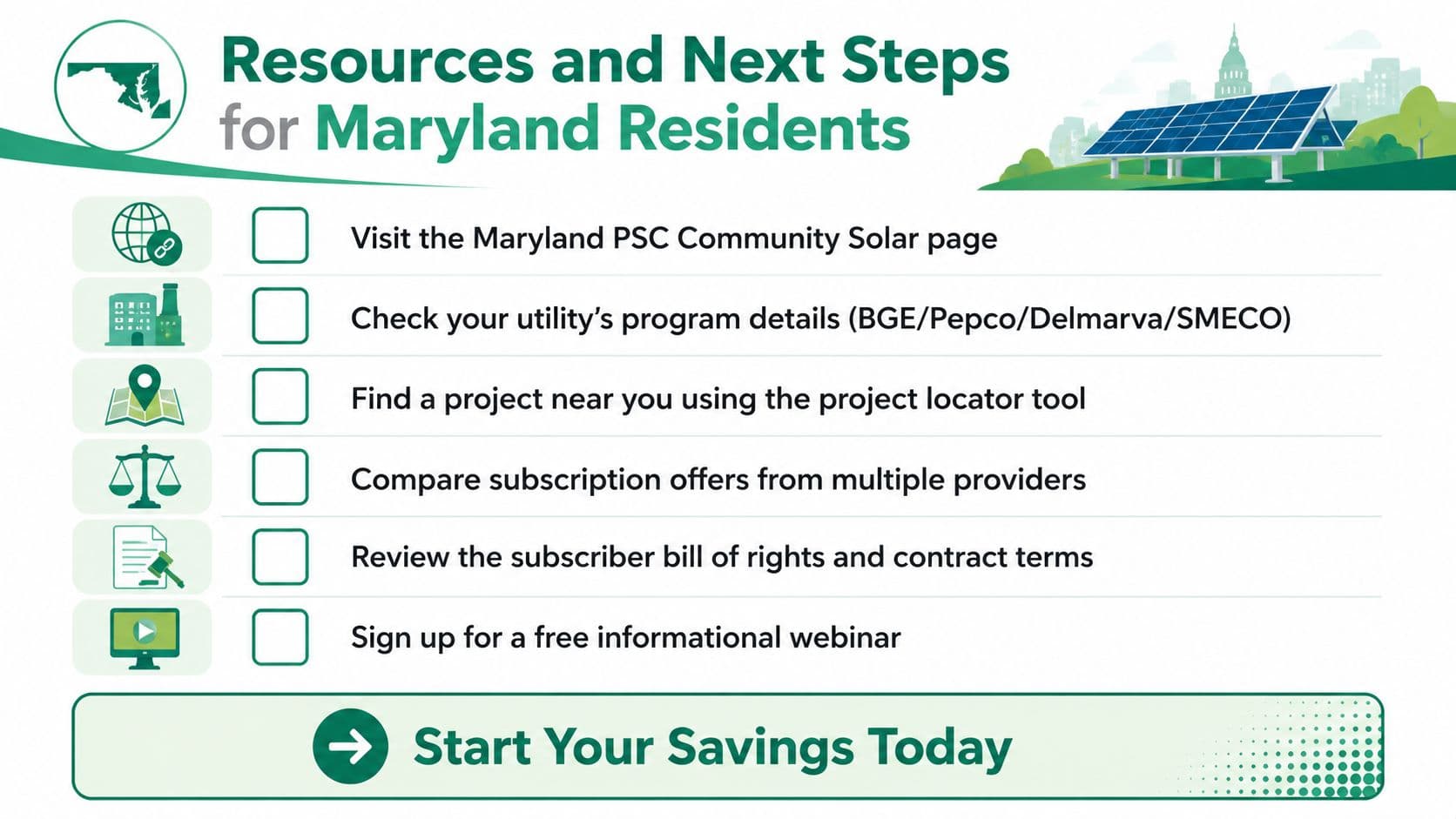
A good next step is to start with the official program materials, then sort options by utility territory and whether a project is accepting subscriptions. Maryland residents can use the state's public program information as the starting point, then confirm active offerings through provider directories or utility-specific guidance in their area.
What to do next
- Homeowners: Check your utility, look for a live project in your territory, and compare subscription terms before signing.
- Renters: Focus on whether the project accepts your account type and whether the provider can match credits to your meter.
- Community organizations: Ask whether a shared meter, campus meter, or single facility load can fit the subscription structure.
- Municipal planners: Review parcel siting, adjacency rules, and the land arrangement before treating a site as ready.
A practical review usually starts with the bill credit side of the project. If the subscription reduces your monthly charge by sending credits to your account, make sure you understand how those credits appear, how they are allocated, and what happens if the project output changes. That is the part many people want to see first, because it is the point where community solar turns from a project on land into a line on a utility bill.
For local officials, the site question deserves the same careful treatment. A parcel can look attractive on a map, yet its economics may change depending on whether the land is being leased, taxed, or otherwise priced for use. That difference affects holding cost, negotiation room, and how much value remains for the public side of the project.
For readers who want a broader policy and implementation partner beyond the Maryland program itself, Unitism® offers research, education, and advisory support on land, value, and public policy design. If you are a homeowner, planner, or local leader trying to turn community solar into a workable local strategy, visit Unitism® and use its practical framework to evaluate site economics, public benefits, and next steps with more confidence.