Compare wealth gap solutions across tax, housing, land, finance, education, and asset-building policy, with evidence, case studies, and implementation guidance.
September 10, 2026
Wealth Gap Solutions That Work in Practice
Compare wealth gap solutions across tax, housing, land, finance, education, and asset-building policy, with evidence, case studies, and implementation guidance.

The most popular advice on the wealth gap usually starts in the wrong place. Raising wages, expanding education, and increasing transfers can improve living standards, but they don't by themselves explain why households with similar incomes can end up with sharply different net worth. The missing variables are ownership, land, housing, inheritance, and the rules that determine who captures rising asset values.
A practical set of wealth gap solutions must therefore separate three sources of economic value: labor, which earns wages; productive capital, which supports businesses and investment; and location value, which arises from access to land, infrastructure, services, and community activity. Each source calls for a different policy instrument. Treating them as one problem produces expensive overlap and leaves the strongest drivers untouched.
Table of Contents
- Rethinking the Wealth Gap
- Understanding Wealth Inequality and Its Drivers
- Comparing Major Policy Approaches
- Land Value Capture and Tenure Options
- International Evidence and Case Studies
- Modeling Distributional and Fiscal Effects
- Implementing Reform and Managing Risk
- Building an Effective Policy Mix
Rethinking the Wealth Gap
Income is a flow. Wealth is a stock. A household can earn a respectable income yet hold little housing equity, financial capital, or business ownership. Another household can have modest current earnings but substantial assets acquired through inheritance or earlier property appreciation. An income-only explanation misses that difference.
The distinction matters for public finance. Progressive taxation and transfers address unequal labor outcomes. Capital-income taxes, inheritance taxes, property rules, and financial regulation address productive wealth and ownership. Land-value capture and housing policy address location value, including gains that arise from scarcity, rezoning, infrastructure, and public investment rather than from an owner's labor or construction effort.
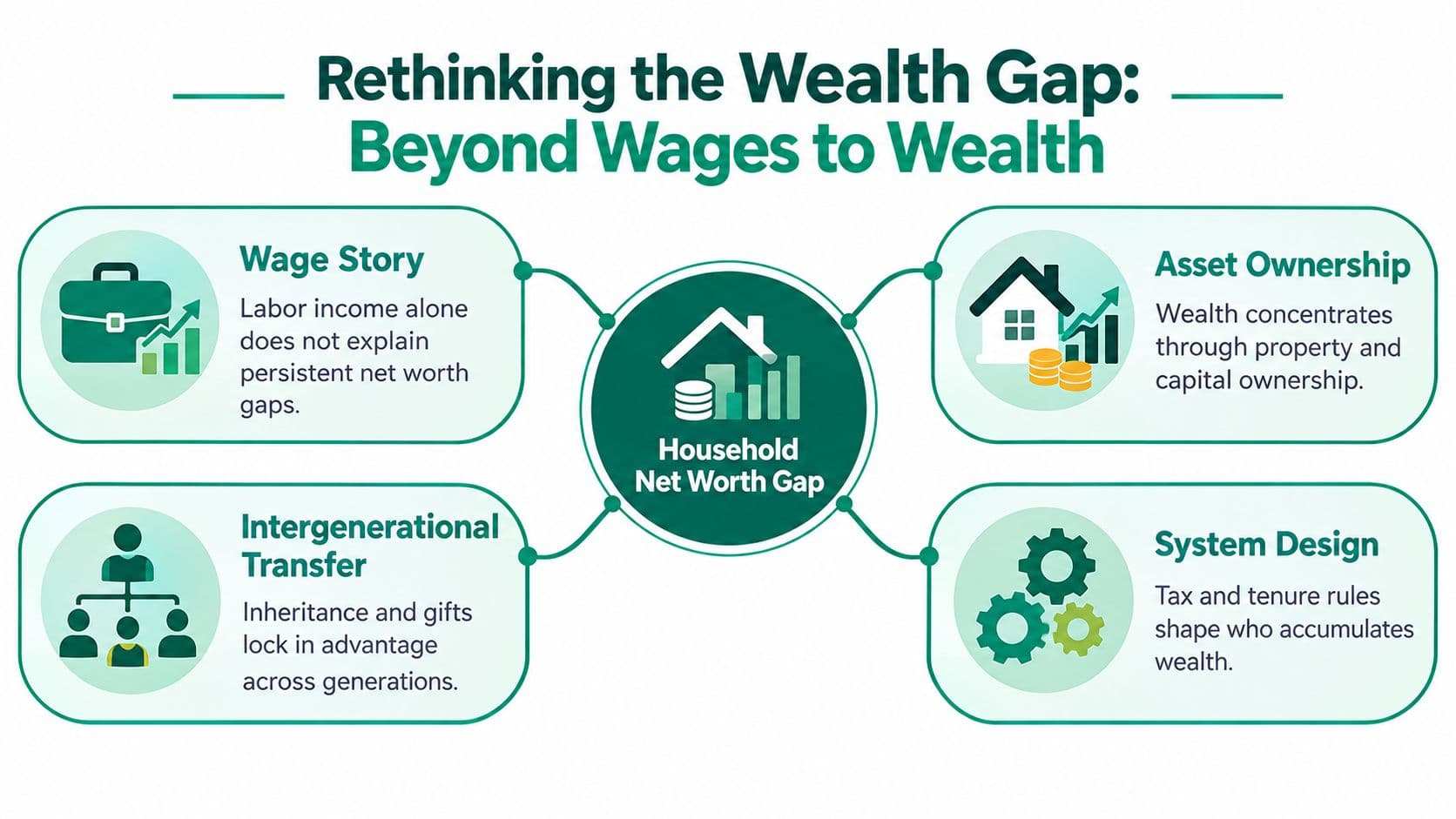
Four questions for decision-makers
A useful diagnostic asks:
- Who earns the income? Wage policy, bargaining institutions, tax credits, and transfers influence labor outcomes.
- Who owns the asset? Financial regulation, capital taxation, inheritance rules, and asset-building programs shape productive wealth.
- Who receives the location gain? Land taxation, development charges, and public land policy determine how much of an area's shared value becomes private gain.
- Who carries the transition cost? Deferrals, credits, exemptions, and phased implementation determine whether reform protects households with limited cash flow.
This framework also clarifies why debates about economic systems matter. A broader treatment of ownership, production, and distribution is available in this analysis of capitalism as an economic system, but the operational point is straightforward: different forms of value require different tax bases.
The policy objective isn't to punish ownership or replace every existing program. It's to match each intervention to the mechanism producing the gap. That prevents governments from using wage subsidies to solve a land problem, or using a property tax on buildings when the policy aim is to capture location rent without discouraging construction.
Understanding Wealth Inequality and Its Drivers
Household net worth includes more than a bank balance. It can include housing equity, financial assets, private pensions, business equity, and other claims, less debt. Each dataset captures these components differently, so analysts need to distinguish between survey evidence, tax records, national accounts, and distributional estimates rather than treating every wealth measure as interchangeable.
Survey-based wealth supplements can provide detailed household information, including tenure, debt, and portfolio composition, but they may underrepresent very wealthy households or rely on self-reported values. Distributional National Accounts can provide a broader macroeconomic framework, yet they require allocation methods for assets, income, and wealth that aren't observed directly for every household. The choice of dataset affects the apparent size and composition of the gap.
The mechanisms behind unequal accumulation
Homeownership and land scarcity connect housing costs to wealth accumulation. A household that buys in a location with constrained land supply may gain equity as demand rises, while renters face higher costs without acquiring the underlying asset. Zoning and development constraints can intensify this divergence by limiting the supply response.
Intergenerational transfers create a second channel. Gifts, inheritances, and family assistance can help one household make a deposit, finance education, or sustain a business while another household must fund the same steps from current income. Capital returns can widen the difference when asset ownership is already concentrated.
Financialization adds complexity. Mortgage markets, pension structures, investment products, and corporate ownership can broaden access to assets, but they can also transfer gains toward households with greater capacity to bear risk and wait through market cycles. Regulation affects who receives credit, who absorbs losses, and how much enters the housing system.
| Driver | Primary Mechanism | Matched Policy Channel | Secondary Effects |
|---|---|---|---|
| Unequal homeownership | Owners accumulate equity while renters face housing costs without an equivalent asset claim | Housing supply reform, rental protections, asset-building accounts | May affect mobility, construction, and household debt |
| Land scarcity | Restricted locations gain value as demand rises | Land-value capture, planning reform, public land leasing | Can alter development incentives and local revenue |
| Inheritance and gifts | Family resources finance deposits, education, and enterprise | Inheritance taxation, transfer reporting, targeted asset programs | Requires careful valuation and compliance |
| Concentrated financial ownership | Capital income flows toward existing asset holders | Capital-income taxation, financial regulation | May affect investment, avoidance, and portfolio choices |
| Low labor bargaining power | Earnings fail to keep pace with asset costs | Progressive taxation, transfers, labor-market policy | Can improve disposable income without directly changing ownership |
The analytical discipline is to connect each driver to a policy channel. Asset-building accounts target access to ownership. Capital taxation targets returns. Housing reform addresses supply and tenure. Land-value capture targets the location component that conventional wage policy leaves out.
Comparing Major Policy Approaches
No instrument class is universally superior. Each changes a different balance between redistribution, efficiency, administrative burden, and political durability. Transfers can reach households quickly, but they require continuing fiscal capacity. Taxing capital can address concentrated returns, but valuation and avoidance create enforcement demands. Housing reforms can reduce pressure on prices over time, yet their results depend on planning institutions and infrastructure.
The comparison should include both the intended beneficiary and the behavior the policy expects. A transfer supports consumption or saving. An asset-building account encourages ownership. A land charge encourages productive use of scarce sites. Financial regulation limits or redirects credit risk. These aren't substitutes, even when they appear in the same inequality package.
| Instrument Class | Mechanism | Primary Beneficiary | Key Trade-off |
|---|---|---|---|
| Progressive taxes and transfers | Redistributes current income through taxes, benefits, or credits | Lower-income households and people with weak labor income | Fiscal cost, work incentives, and political durability |
| Education and asset-building | Improves skills or provides a pathway into asset ownership | Younger households and people excluded from wealth accumulation | Benefits may arrive slowly and can be capitalized into prices |
| Housing-supply reform | Allows more construction where demand is strong | Renters, new entrants, and growing households | Requires planning capacity and complementary infrastructure |
| Anti-speculation measures | Raises the cost of vacancy, hoarding, or short-term asset turnover | Occupiers and productive users | Can reduce liquidity or shift activity into less regulated channels |
| Capital and inheritance taxation | Taxes returns, transfers, or accumulated ownership | Households without large capital holdings, if revenue is recycled | Valuation, avoidance, liquidity, and cross-border compliance |
| Financial regulation | Changes credit, leverage, disclosure, and risk allocation | Borrowers, savers, and financial-system users | May restrict access to credit or move risk outside regulated institutions |
| Land-value capture | Collects part of location rent or publicly created uplift | The wider public, if revenue funds services or lowers other taxes | Valuation disputes, cash-flow pressure, and political resistance |
Inheritance is a particularly technical area because property valuation affects both liability and perceived fairness. Decision-makers who need a practical reference on that administrative issue can consult inheritance tax property valuation guidance from Corinthian Surveyors London LTD.
Land-value taxation belongs in its own category. It doesn't primarily tax wages or the return on a building. It targets the value of a site, which makes the distinction between land and improvements central to both incidence and supply. A concise explanation of the underlying instrument is available in this guide to what land value tax is.
Land Value Capture and Tenure Options
Land policy becomes confused when governments treat land, buildings, leases, and use rights as the same thing. A land-value tax charges for the value of a site, generally through recurring assessment. A property tax may also tax buildings, which can discourage construction or renovation if the improvement component is large. Separating the site from the structure lets policymakers target location rent while reducing the penalty on productive building activity.
Other instruments operate at different moments. Development charges collect money when new construction creates infrastructure demands. Transit value capture seeks part of the uplift associated with public transport investment. Rezoning charges target publicly created gains. These tools can complement an annual land charge, but they shouldn't be presented as identical because their timing, base, and behavioral effects differ.
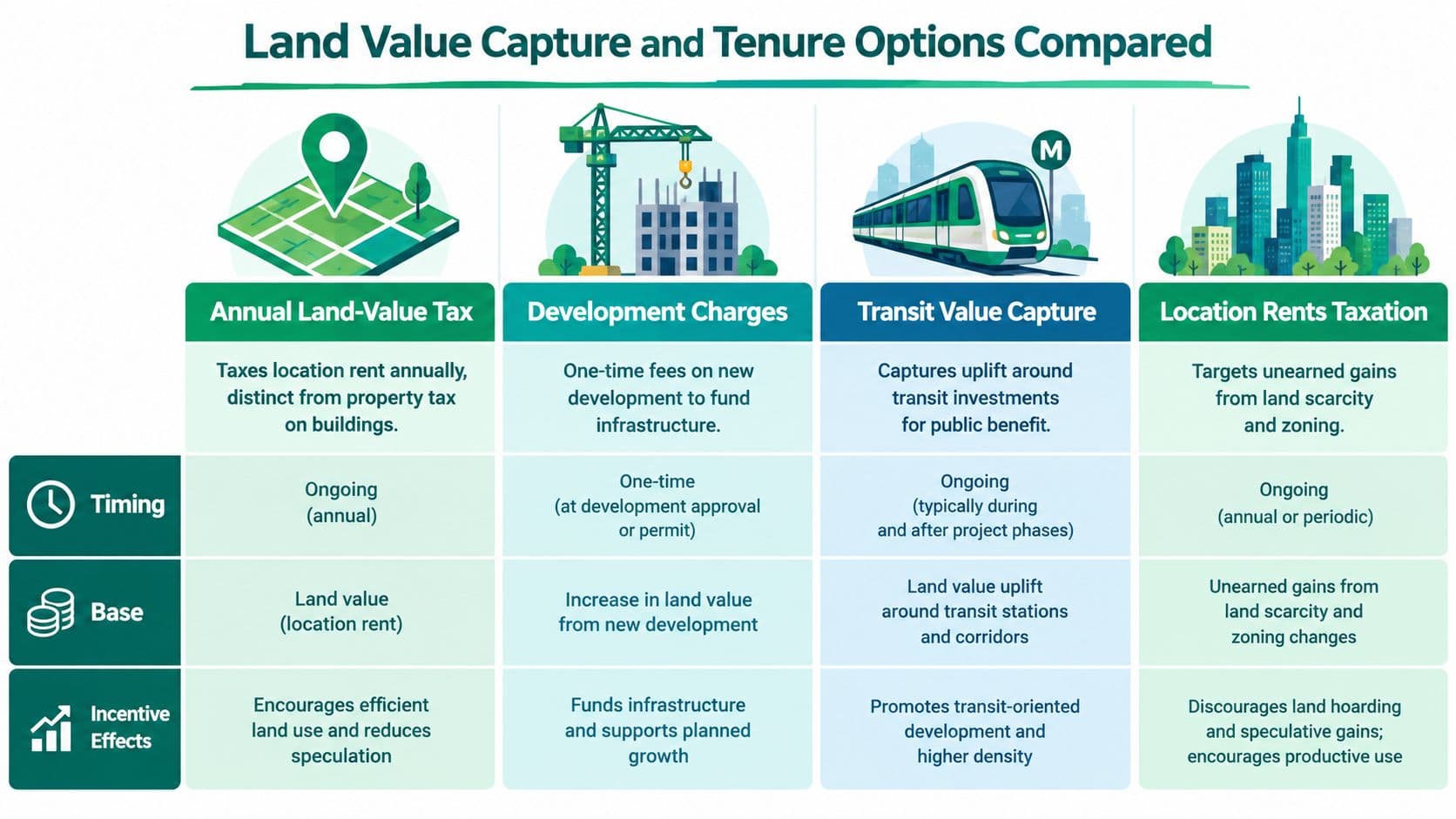
Land, buildings, and tenure
Unitism's tri-factor framework distinguishes land value, building value, and community-created locational uplift. That separation helps analysts avoid treating every increase in a property's price as an owner-generated return. A practical discussion of the wider mechanism appears in this guide to land-value capture.
Land leases are different from both land-value taxes and genuine land-use rights. A lease is a renewable or non-renewable fixed-term contract with a fixed price. A renewable lease provides certainty only until its term ends. If the contract rate falls below the market, the accumulated gap can be closed at renewal through a major repricing. A non-renewable lease can become progressively harder to refinance and sell as its remaining term shortens. Fixed leases don't correctly price risk. They postpone it.
A true land-use right has three defining features: it doesn't expire, requires no renewal, and is repriced each year. Annual repricing lets people buy and sell the right at lower cost than a fixed-term lease because the current land charge is reflected continuously rather than deferred to renewal. It prices land appropriately without placing the same burden on entrepreneurship and productive enterprise. Some fixed leases are called land-use rights, but that label is inaccurate unless they meet all three criteria.
International tenure examples illustrate the distinction. Hong Kong generally grants new leases for 50 years, with possible extension of non-renewable leases for another 50 years at government discretion; government rent is set at 3% of rateable value, adjusted as value changes, as described by the Hong Kong Lands Department. Singapore's lease-related charge applies to State leases with residual tenure of 99 years or less and adjusts for remaining duration, according to the Singapore Land Authority's lease framework. Neither example is an indefinite, annually repriced land-use right.
New Zealand assesses land tax on land value held at noon on 31 March each year, using the current district valuation roll, which demonstrates annual valuation rather than a fixed-price lease, according to Inland Revenue technical guidance. Public ground leases commonly run for more than 50 years and often include renewal options, as reviewed by the Lincoln Institute. Long duration still isn't permanence.
Distribution and transition
Land charges can be progressive in effect when governments recycle revenue. IMF analysis finds that reasonable recycling can provide net relief to low- and middle-income households because transfers or reductions in more distortionary taxes can exceed their land levy, while the distributional burden depends on ownership and social welfare weights, as explained in the IMF analysis of land-value taxation.
The transition remains difficult for asset-rich, cash-poor households. Means-testing, deferral linked to a future sale, hardship procedures, and targeted credits can reduce forced sales and liquidity shocks. Governments also need transparent assessments, appeal routes, and public reporting on where the revenue goes. Without visible recycling into services, housing, infrastructure, or broad tax relief, land reform can appear to relocate burdens rather than reduce concentration.
International Evidence and Case Studies
International comparisons are useful when they identify institutional mechanisms, not when they turn different countries into simple success stories. The United States, Finland, Singapore, South Korea, Denmark, and Estonia use different combinations of housing policy, inheritance rules, finance, land tenure, and tax administration. Their outcomes cannot be attributed to one instrument without accounting for ownership patterns, enforcement, demographics, and market conditions.
The cases below therefore carry different evidence confidence. A policy may be well documented as an administrative practice while its effect on the wealth gap remains difficult to isolate. Cross-country correlations aren't causal evidence, especially where several reforms operate simultaneously.
| Jurisdiction and policy | Reported mechanism or outcome | Implementation lesson | Evidence limitation |
|---|---|---|---|
| United States, progressive estate taxation and state property reassessment reforms | Targets transfers and changes the treatment of property values | Valuation and beneficial ownership rules are central | Federal and state systems vary, making comparisons difficult |
| Finland, inheritance and capital-income taxation | Uses tax channels that address inherited and investment wealth | Capital and transfer policy must be coordinated | Distributional effects depend on exemptions, enforcement, and asset mobility |
| Singapore, public housing and state land regime | Combines public housing provision with lease-based land administration | Housing access and tenure design operate as a system | Public housing outcomes aren't transferable without similar institutions |
| South Korea, inheritance and gift-tax reforms | Uses broad transfer-tax tools to address intergenerational wealth movement | Gifts and inheritances need linked reporting and valuation | Compliance behavior can change the measured and actual tax base |
| Denmark, mortgage and housing finance | Connects housing ownership to a structured finance system | Credit rules shape both access and exposure to house-price risk | Finance design doesn't by itself resolve unequal land ownership |
| Estonia, land-value taxation | Provides an established example of land-based taxation | Cadastre quality and recurring assessment support administration | A land tax's distributional result depends on rate design and recycling |
Alaska offers a clearer example of broad-based distribution through resource rents. Alaska voters approved the constitutional amendment creating the Permanent Fund in 1976, and the fund began paying dividends in 1982. Peer-reviewed evidence finds that the program reduced the share of Alaskans below the federal poverty threshold by at least 20% each year, affecting roughly 2% to 4% of the state population, while lowering the Gini coefficient from 0.46 to 0.44; the historical average dividend was about $1,260.47 per person, according to the peer-reviewed evidence on the Alaska Permanent Fund Dividend.
That case demonstrates a mechanism, not a universal template. A universal cash transfer funded by natural-resource rents can distribute a shared asset broadly, but governments without comparable rent streams need another revenue base. Land value is one possible base, yet its assessment, incidence, and political settlement differ from resource dividends.
Modeling Distributional and Fiscal Effects
A credible reform model must answer four questions: who pays, who benefits, how behavior changes, and what happens to the public budget. A single average household cannot answer them. Analysts need representative household and firm data disaggregated by income, wealth, age, tenure, region, and household type.
A five-step workflow
- Build the baseline. Record land, buildings, capital income, inheritances, debt, wages, transfers, and existing tax liabilities. Keep land and improvements separate wherever the data allows.
- Simulate the statutory change. Apply the proposed tax, benefit, charge, or regulatory rule before estimating market responses. Model land policies separately from taxes on buildings, capital income, inheritances, and financial transactions.
- Estimate incidence. Allocate changes across income and wealth groups, renters and owners, mortgaged households, firms, and regions. Distinguish legal liability from economic incidence because prices, rents, wages, and returns can adjust.
- Calculate the fiscal effect. Include gross revenue, collection costs, new administrative spending, borrowing effects, compliance costs, and the destination of recycled revenue.
- Test uncertainty. Run scenarios for supply elasticities, migration, avoidance, tax interactions, valuation error, and timing. Publish assumptions and data gaps rather than hiding them inside one forecast.
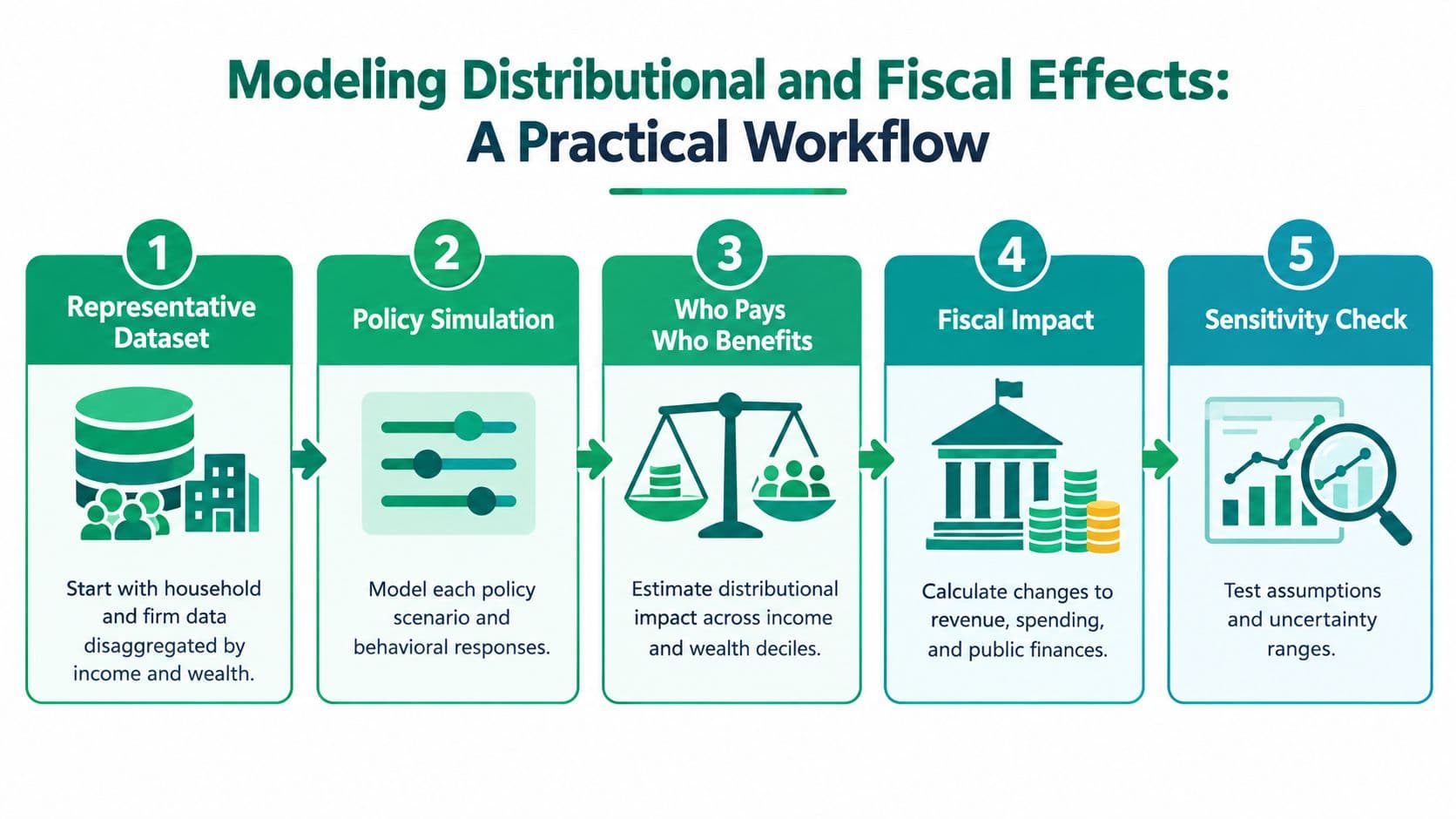
Progressivity requires more than comparing tax bills. Officials should examine average tax rates, post-policy wealth shares, lifetime incidence, and gains or losses as a share of disposable resources. A land charge may look burdensome in annual cash terms while producing a net gain after lower taxes or improved public services. The reverse can also occur when recycling is weak or housing prices adjust against a vulnerable group.
Distributional analysis guidance can help structure this work, but the model must remain government-specific. Local valuation quality, tenure patterns, debt exposure, and administrative capacity will determine whether a theoretical gain becomes a practical result.
Modeling discipline: Publish distributional tables beside fiscal, cost-benefit, and behavioral-impact results. Decision-makers should be able to see the trade-off, not just the headline revenue estimate.
Implementing Reform and Managing Risk
Wealth-gap reforms usually fail through sequencing and administration before they fail through economic theory. Governments should begin by defining the objective, whether it's reducing housing exclusion, broadening asset ownership, raising revenue, or lowering taxes on work. They should then audit the existing tax base and identify where land, buildings, capital, transfers, and labor are currently mixed together.
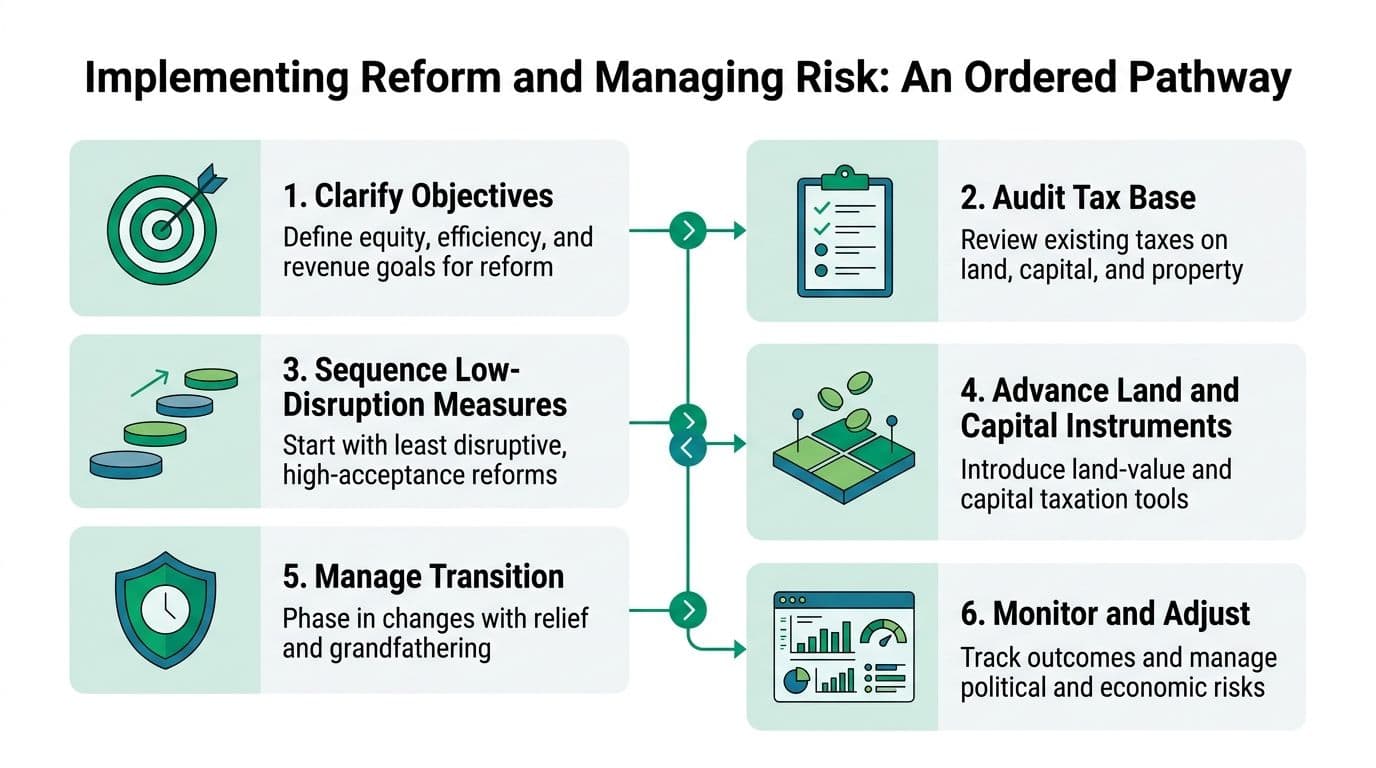
An ordered pathway
- Clarify objectives: Set equity, efficiency, housing, and revenue outcomes before selecting a tax instrument.
- Audit the base: Check property valuations, land registers, beneficial ownership records, and exemptions.
- Sequence low-disruption measures: Start with reforms that use existing data and create limited immediate cash-flow shocks.
- Advance land and capital instruments: Introduce land-value and capital tools only after valuation, appeals, and collection systems can operate.
- Manage transition: Use phase-ins, deferrals, hardship relief, and carefully designed grandfathering for qualifying households and firms.
- Monitor and adjust: Set review dates, publish indicators, and define contingency triggers before implementation.
Outdated valuations can distort liability. Weak beneficial-ownership registries can hide assets. Fragmented housing agencies can make a national reform inconsistent at local level, while under-resourced assessors can turn a sound tax design into a patchwork of appeals. Mortgaged homeowners, small landlords, and pension funds also need explicit transition analysis because their balance sheets respond differently to a recurring land charge or capital-tax change.
Compliance policy should anticipate capital flight, asset misclassification, and valuation disputes. Independent review bodies, transparent assessment criteria, public appeal data, and pre-committed review dates can reduce the risk that political pressure determines individual outcomes. Phased implementation guidance provides a useful reference for staging structural reforms without treating delay as a substitute for design.
The practical dashboard should track collection rates, appeal resolution, construction activity, vacancy, rent and price movements, household hardship, ownership concentration, and revenue recycling. If a trigger shows unexpected harm, officials need a pre-agreed response, such as a temporary deferral adjustment or targeted credit, rather than an improvised retreat.
Building an Effective Policy Mix
The strongest wealth gap solutions begin with diagnosis, not ideology. Progressive taxation and transfers address unequal labor income. Housing supply and anti-speculation rules address access and price pressure. Land-value capture addresses location rent. Asset-building accounts and inheritance policy address intergenerational access to ownership. Capital taxation and financial regulation address returns and risk within the productive economy.
Sequence the package. Use lower-friction measures first, then introduce structural land and capital reforms once valuation, appeals, enforcement, and recycling systems are ready. Earmark part of the revenue for public services, housing, infrastructure, or relief during the transition.
Set outcome metrics before launch, include sunset clauses where appropriate, and schedule triennial reviews. The right question isn't whether one instrument wins. It's whether the combined system reduces concentrated ownership without discouraging work, construction, and productive investment.
Unitism® helps governments and organizations evaluate land-value capture, resource-rent sharing, valuation systems, and distributional transition pathways. Visit Unitism® to explore practical tools and advisory support for designing wealth gap solutions around labor, capital, and land.