Discover what is a land bank, how land banks acquire and repurpose vacant property, and how they connect to land value reform and housing policy.
July 31, 2026
What Is a Land Bank: A Complete Guide to How It Works
Discover what is a land bank, how land banks acquire and repurpose vacant property, and how they connect to land value reform and housing policy.
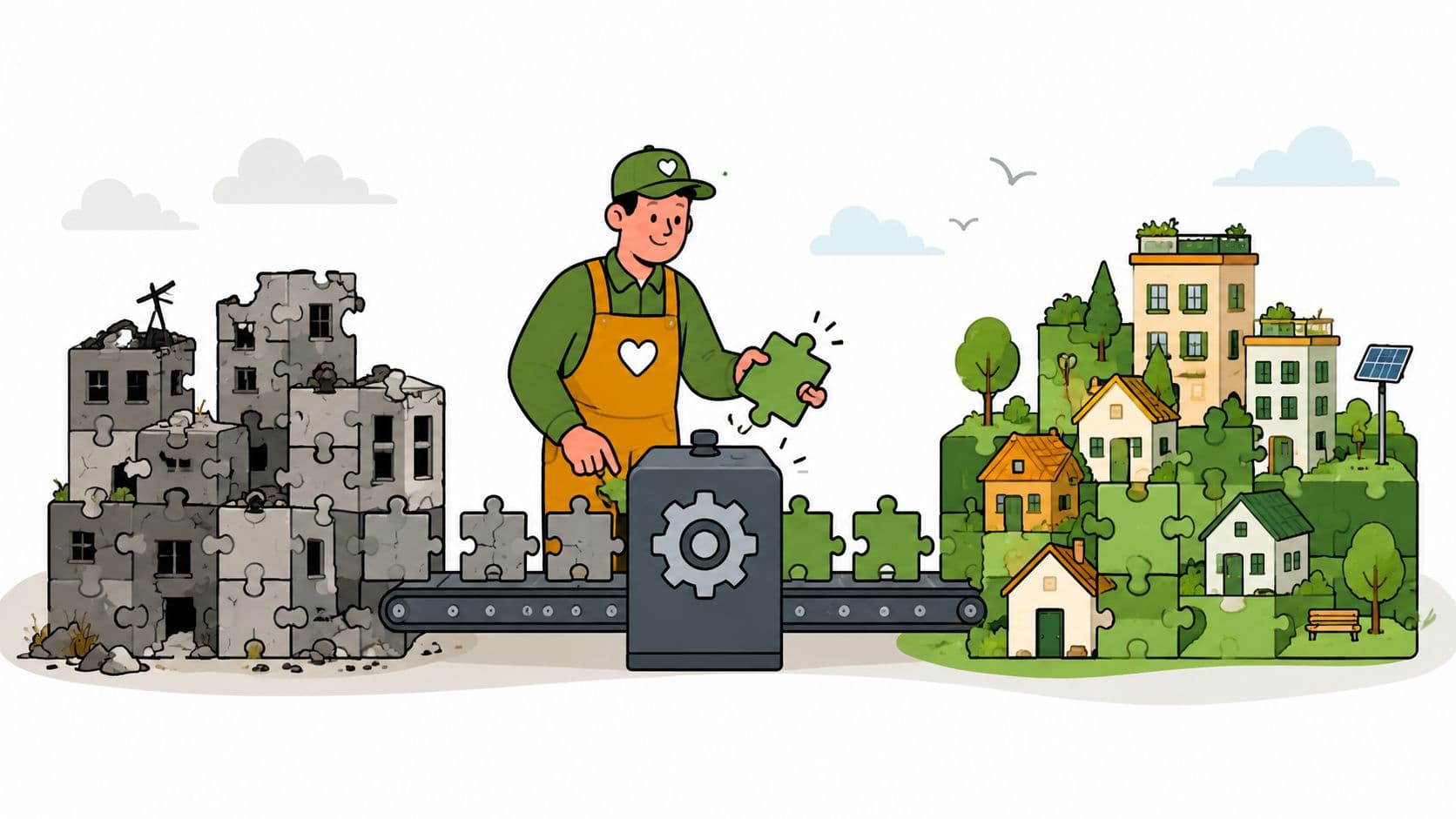
A land bank is a public or nonprofit entity that acquires, holds, manages, and repurposes vacant, abandoned, or tax-delinquent property. In the United States, over 300 land banks and land banking programs were operating by 2023 (Community Progress national land bank map).
People often hear “bank” and think of deposits, loans, and interest. That's not what this is. A land bank is closer to a civic holding and cleanup mechanism, one that helps local governments move problem properties from neglect to productive use.
Table of Contents
- What a Land Bank Actually Does
- A Short History of Land Banking in the United States
- How a Land Bank Acquires and Disposes of Property
- Land Banking Beyond the United States
- Benefits, Risks, and What Land Banks Cannot Fix
- Land Banks and the Land Value Reform Conversation
- Practical Steps for Setting Up or Working With a Land Bank
- Key Takeaways and What to Explore Next
What a Land Bank Actually Does
A land bank is a public or nonprofit entity that takes properties the market has left behind, stabilizes them, and prepares them for reuse. By 2023, there were over 300 land banks and land banking programs in the U.S. (Community Progress national land bank map).
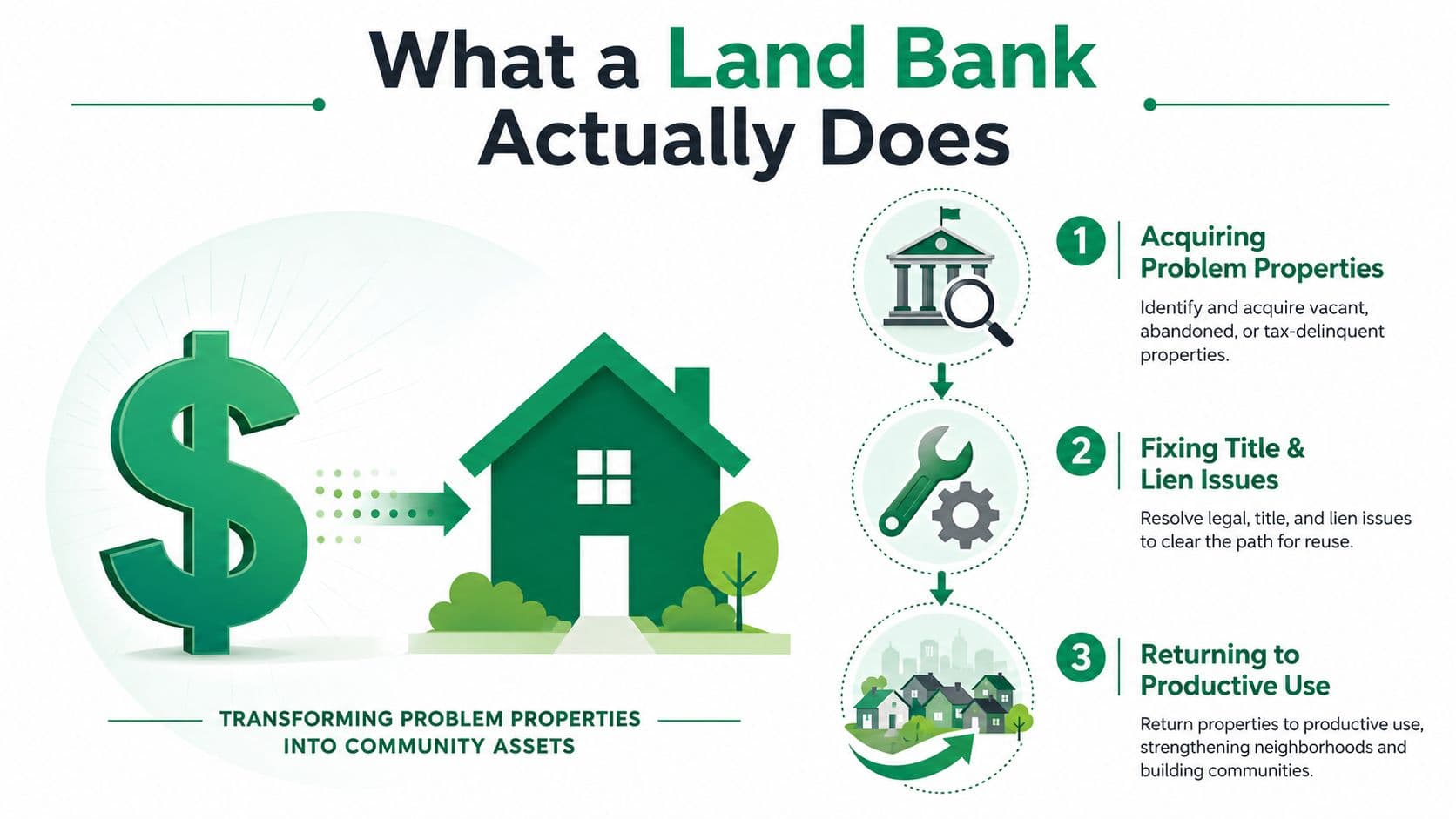
The easiest way to think about it is as a pipeline. A property enters because it's vacant, abandoned, or tax-delinquent. Then the land bank works through the legal and administrative mess, and later transfers the parcel to a responsible owner or project that matches local goals.
Not a financial bank
A land bank doesn't take deposits or make consumer loans. It doesn't exist to earn interest. Its job is to reduce friction around distressed property, especially where title problems, liens, or weak demand make normal private sales unlikely (Community Progress land bank overview).
Practical rule: if a property is too tangled for ordinary buyers, a land bank can act as the bridge between abandonment and reuse.
That bridge matters because ordinary agencies often can't hold property long enough to solve the underlying problems. A land bank can clear title, extinguish certain liens where the law allows, and hold land tax-exempt while it's being stabilized. It can also decide that a site should become affordable housing, open space, a park, or stormwater mitigation, instead of selling to the highest bidder (Local Housing Solutions land banks).
The public purpose is what makes the model useful. The point isn't ownership for its own sake. The point is to move a property through a controlled process so a neighborhood isn't stuck with decay forever.
An internal comparison that helps many councils is the difference between this tool and a land trust. A land trust usually holds land for long-term stewardship, while a land bank is designed to acquire, clean up, and dispose of distressed property. For a simple introduction, see what a land trust is.
A Short History of Land Banking in the United States
Land banks in the United States are not a recent invention, but the model has become much more visible as cities have tried to deal with vacancy, tax delinquency, and abandoned parcels. Early programs began in 1971, and the field later expanded into a familiar local policy tool.
That expansion also shows that land banking is not a single template. Some land banks are county-based, some are municipal, and some sit in quasi-public or nonprofit structures. In the 2023 survey, 64% of respondents operated at the county level and 24% at the municipal level, which shows how closely the model is tied to local government practice (Community Progress national land bank map).
A city council member reading this history should see a practical pattern. Land banks appeared because ordinary property systems were not built to handle long-term vacancy very well. Once a parcel is abandoned, standard market channels often move too slowly, and the public sector needs a separate tool to hold, sort, and reassign property.
Why state law matters
In the U.S., land banks are usually created under state-enabling statutes. About 90% of land banks were created that way, which is why the legal powers of a land bank can vary sharply from one state to another (Community Progress national land bank map). Those statutes matter because they give local governments authority ordinary departments often don't have, such as specific tools for title cleanup, lien handling, and property disposition.
That legal structure also explains why newer content distinguishes between legislatively enabled land banks and lighter land banking programs in states without enabling laws (University of Michigan landbank resource). The distinction is not cosmetic. One rests on formal statutory authority, while the other may work through narrower administrative powers.
For readers trying to connect this to broader land policy, the question is not only how a city holds land. It is also how law separates land use rights from the value attached to land itself, a distinction discussed in Unitism's Georgism guide. That broader framework helps explain why local ownership tools and land value reform are related, but not the same thing.
The legal form changes the practical reach. A land bank with strong statutory authority can move harder properties more efficiently than a program that relies on ordinary administrative tools.
A land bank with clear authority can act more like a specialized workshop than a general city department. It has a narrow job, but that job is hard to do without the right legal equipment. When state law gives that equipment, local leaders can use it to address properties that would otherwise remain stuck.
The broader lesson is simple. Land banks are now part of the standard municipal toolkit for cities and counties trying to reverse decline parcel by parcel. They sit alongside other public land tools, including value capture mechanisms such as a TIF district, but they serve a different purpose. A TIF district helps direct future tax growth. A land bank helps move damaged or abandoned property into a usable public process.
How a Land Bank Acquires and Disposes of Property
The operational logic is straightforward even if the legal steps aren't. A property becomes distressed, public authorities move it into a land bank, the title and liens get cleaned up, the site is stabilized, and then it's transferred to a responsible end user.
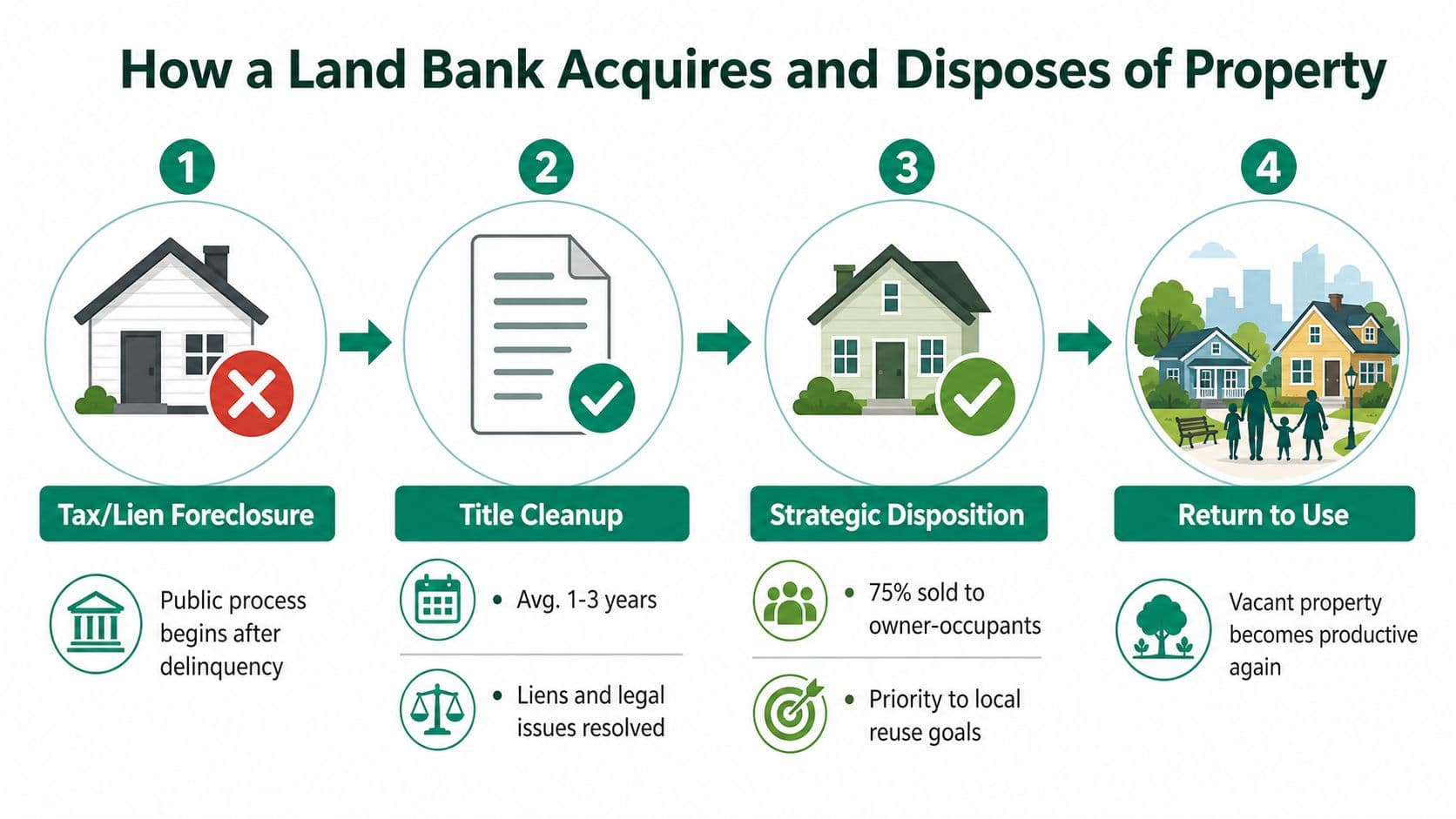
The reason this pipeline exists is that distressed property rarely has only one problem. It may have unpaid taxes, clouds on title, code issues, or no clear owner willing to invest. A land bank exists to deal with the whole stack, not just one layer.
From foreclosure to clean title
The entry point is often tax foreclosure or transfer through public lien processes. After acquisition, the land bank works to clear title and extinguish barriers that would scare off a regular buyer (Community Progress land bank resource). This is the stage where the institution saves time for everyone else in the system.
That's why title work matters so much. A parcel with a murky ownership history can sit untouched for years. In some cases, a quiet title action is the legal instrument that helps resolve ownership disputes before a transfer can happen. For readers who need the legal backdrop, quiet title action Hawaii from Olson & Sons offers a practical reference point for how title problems get resolved in real property work.
Stabilize, then dispose
After title cleanup comes stabilization. That can mean boarding a structure, securing a lot, maintaining the parcel, or preventing further deterioration. The property is being held in a managed state, not ignored (Local Housing Solutions land banks).
Then comes disposition. A land bank differs from a normal auctioneer here, as it can transfer property based on community goals, not just the highest immediate bid. That makes it possible to direct parcels toward affordable housing, neighborhood-serving development, or land assembly for larger projects.
The scale can be substantial. Cleveland's land bank inventory has ranged from 4,000 to 6,000 parcels, while the St. Louis Land Bank transfers about 500 parcels each year and the Cleveland Land Bank transfers 500 to 1,300 parcels annually (Community Progress national land bank survey dashboard). Those numbers show that land banks are not symbolic. They're operating at a size where process design really matters.
A helpful way to compare financing tools is to pair this with the logic of a TIF district. TIF captures future value to support development. A land bank, by contrast, manages the awkward property itself until it can re-enter the market responsibly.
Land Banking Beyond the United States
Outside the U.S., land banking can mean something broader than a municipal property tool. In global policy discussions, it can refer to the state buying, leasing, reserving, and later releasing land to improve land mobility and meet public goals (FAO paper).
That global framing is useful because it shows land banking as a family of policies, not a single institutional template. In some contexts, it is an institution. In others, it is a process for assembling and managing land before it is released for development or public-purpose use.
Two policy logics side by side
The U.S. municipal model is usually about distressed parcels, local vacancy, and neighborhood stabilization. The global model is often about reducing fragmentation, lowering uncertainty, and making land easier to deploy for public goals, especially in rural land markets and large-scale investment settings (FAO paper).
Those are related but not identical problems. A vacant inner-city lot with title issues needs a local cleanup institution. A fragmented rural land market may need a state-led land reserve or release mechanism to guide development and reduce speculation. The term land bank can cover both, which is why councils and staff should always ask what legal and administrative version they're looking at.
The Columbia CCSI paper also notes that “land bank” can refer either to the institution or to the process, which helps explain why international literature can sound inconsistent. One source may describe a local entity. Another may describe a state's intermediate land management strategy. Both are using the same words for related but distinct tools.
A land bank is not automatically a neighborhood revitalization agency. Its purpose depends on the policy system around it.
A city that wants to adapt the concept should borrow the mechanism, not the label. If the goal is to clear distressed urban parcels, the municipal model fits. If the goal is to manage land reserves for broader public policy, the global framing may be more relevant. The key is to match the tool to the land problem in front of you.
Benefits, Risks, and What Land Banks Cannot Fix
Land banks do real work, but they're not magic. They can clear title, reduce blight, and assemble difficult sites for reuse. They can also support affordable housing, parks, open space, and flood mitigation when local policy gives them that mission (Local Housing Solutions land banks).
What they cannot do is solve a housing shortage by themselves. A U.S. policy guide points to about 14 million vacant housing units year-round, many of them abandoned or tax-delinquent and therefore potential candidates for land bank intervention (Community Progress national land bank survey dashboard). That's a huge problem frame, but it doesn't mean every vacancy should become a land bank acquisition, or that land banks can create enough new homes on their own.
Where they help most
Land banks are strongest when the barrier is not demand alone but property distress. If a parcel has title defects, unpaid taxes, or a long history of abandonment, a land bank can do the slow public work that private buyers usually avoid. That's especially valuable in places where fragmented ownership and legal clutter block reinvestment.
They also help cities think parcel by parcel instead of pretending all land problems are the same. Some lots are ready for infill. Some need demolition. Some should become green infrastructure. That flexibility is a real asset.
| Dimension | Land Bank Strength | Land Bank Limitation |
|---|---|---|
| Title and legal cleanup | Can clear difficult parcels for reuse | Can't fix every legal defect in every case |
| Blight reduction | Can stabilize abandoned property | Doesn't remove broader neighborhood decline by itself |
| Site assembly | Can combine parcels for larger projects | Needs downstream developers or users |
| Housing supply | Can support targeted housing reuse | Isn't a mass production housing policy |
| Public purpose | Can direct land to community goals | Depends on local governance and funding |
The uncomfortable question is whether land banks measurably improve affordability at scale. Neutral source material supports the idea that they are a targeted-parcel instrument, not a substitute for zoning reform, subsidy, infrastructure, or broader production policy. That's the honest answer city councils need to hear before they overpromise.
Funding also shapes results. In a 2025 survey dashboard, public sources made up an average of 57% of land bank funding, up from 37% in 2023, while an average of 58% of acquisitions came from tax and public lien foreclosure (Community Progress national land bank survey dashboard). That tells you land banks depend on the public sector and on the quality of distressed inventory. They're not self-propelling housing engines.
Land Banks and the Land Value Reform Conversation
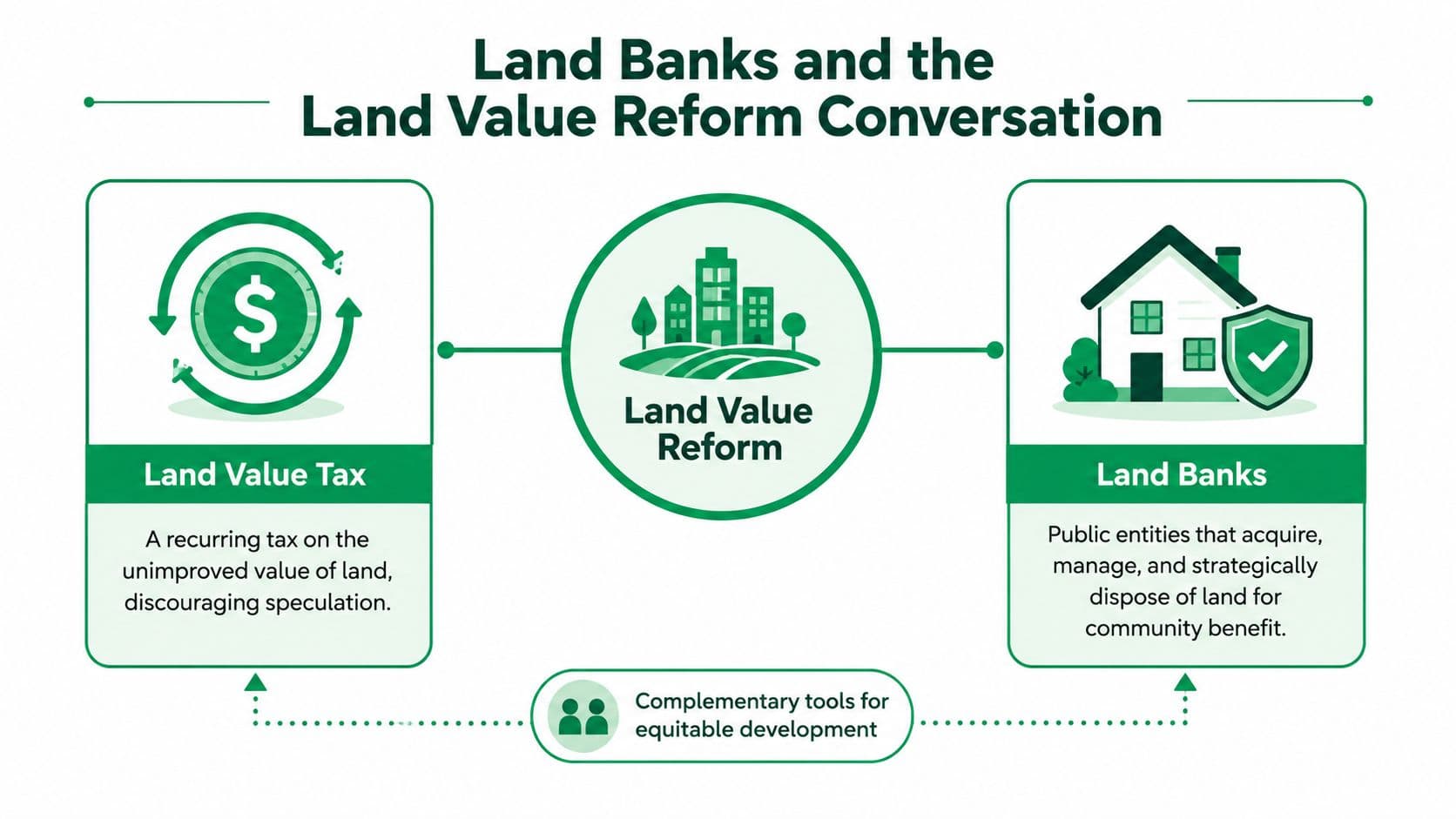
Land banks sit inside a broader land policy conversation that also includes land value taxes and land-use rights. That matters because city leaders often hear these terms together and assume they're interchangeable. They're not.
A land value tax is a recurring tax on the value of land itself. It is a fiscal instrument, aimed at how land is taxed and how speculation is discouraged (Habitat for Humanity explainer). A land bank is different. It is an entity that acquires and manages distressed property so it can be returned to productive use.
Why land-use rights are not the same thing
Land-use rights are lease-like rights to use land that can be repriced annually and can have no fixed expiration date. Because they are repriced annually, people can buy and sell land-use rights for a low cost even when the underlying land is socially valuable (Habitat for Humanity explainer).
That's the key distinction. A land value tax is a tax. Land-use rights are a tenure mechanism. One changes fiscal incentives. The other changes how land can be used and transferred.
This distinction matters in real policy design. A city can use land banks to move distressed parcels back into service, while land value tax reform can reduce the penalty on building and reward better land use. In countries or systems that use land-use rights, annual repricing can keep access relatively affordable while the state still guides who uses land and how.
For readers looking at the bigger reform toolkit, a land value capture overview is a helpful companion. It places land banks alongside fiscal and tenure reforms instead of treating them as isolated tactics.
Useful mental model: land banks clean up broken parcels, land value taxes shape holding incentives, and land-use rights structure who gets to use land over time.
A city council doesn't need to adopt every tool at once. But it does need to know which problem belongs to which instrument. That's how land policy stays coherent instead of becoming a pile of disconnected fixes.
Practical Steps for Setting Up or Working With a Land Bank
Before a land bank can do useful work, the legal and administrative foundation has to be there. The first question is whether state law allows one, because about 90% of U.S. land banks were created under state-enabling statutes (Community Progress national land bank map).
Funding comes next. Recent survey data show a growing reliance on public sources, with an average of 57% of land bank funding coming from public sources in 2025, up from 37% in 2023 (Community Progress national land bank survey dashboard). That means leaders should plan for recurring support, not one-off grants.
The working checklist
- Set the legal authority: confirm whether the state statute allows creation, title transfer, lien extinguishment, and disposition powers.
- Build a disposition policy: decide which parcels should become housing, green space, commercial reuse, or other public goals.
- Connect the data: align parcel records, tax delinquency files, and title information so staff aren't working from conflicting maps.
- Define community review: establish how residents, developers, housing agencies, and fiscal offices weigh in on reuse decisions.
- Match the inventory to the mission: a land bank that mostly receives tax-foreclosed lots needs a different playbook than one assembling sites for larger redevelopment.
If a city wants a practical valuation layer, calculate land value is the right kind of exercise to pair with parcel triage, because better data makes better disposition decisions. Unitism® also works on land valuation assessments and policy design for land-value-based instruments, which can be useful when a government wants to connect land banking with broader land administration reform.
The central design choice is simple. A land bank can either serve community goals or become a paper-moving office. The difference is usually found in its disposal standards, data quality, and whether local leaders keep the mission tied to actual neighborhood outcomes.
Key Takeaways and What to Explore Next
A land bank is a public or nonprofit tool for acquiring, managing, and repurposing distressed property, and it's now a mature part of local governance in the U.S. It can reduce blight and address hard-to-handle parcels, but it can't replace broader housing supply policy or zoning reform.
It also sits inside a larger land policy conversation. Land value taxes are fiscal instruments, land-use rights are tenure mechanisms, and land banks are operational institutions that help move broken parcels back into productive use. Those three ideas belong in the same policy room, but they do different jobs.
For a council member, the next question is not “Should we use a land bank?” but “What problem are we solving, and which tool fits it?” For planners, the next step is parcel data and disposition policy. For researchers, the question is outcomes at scale. For residents, it's accountability, reuse, and whether the land bank's decisions match community priorities.
Unitism® helps public-sector teams think through land value, property strategy, and policy design with a focus on practical implementation. If you're evaluating land banks alongside broader land-value reform, visit Unitism® to explore tools and advisory support that connect parcel management, valuation, and public-purpose land policy.