Does Alaska have property taxes? Yes — learn how local boroughs and cities levy them, typical rates, exemptions, and where to check your bill.
October 15, 2026
Does Alaska Have Property Taxes? a Local-Levy Guide
Does Alaska have property taxes? Yes — learn how local boroughs and cities levy them, typical rates, exemptions, and where to check your bill.
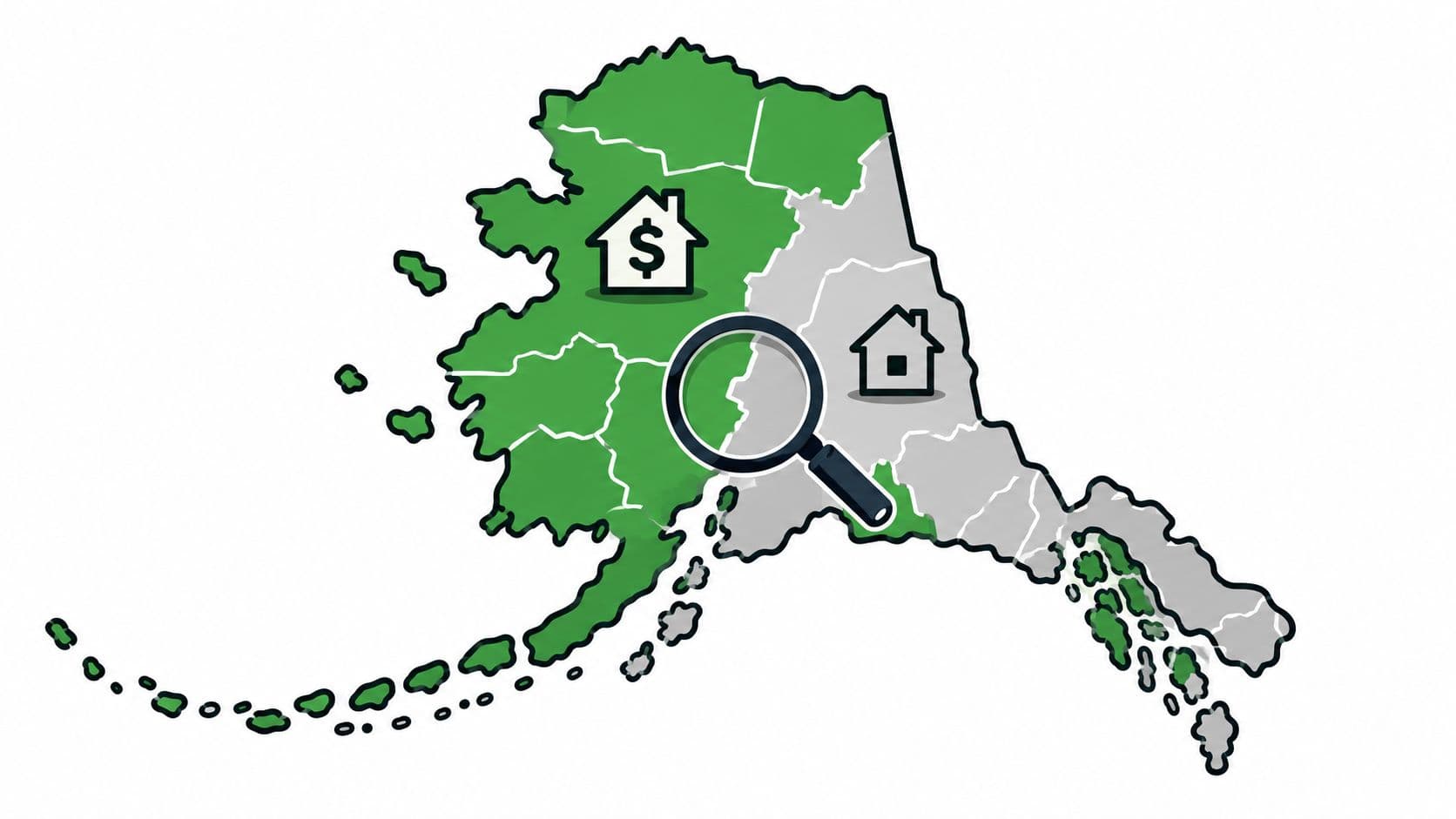
Yes, Alaska has property taxes. But the state levies no broad statewide property tax, so your obligation depends on the borough or city where the property sits, with roughly 15 of Alaska's 19 organized boroughs and unified municipalities choosing to tax.
That makes the answer to “does Alaska have property taxes” geographic rather than uniform. Alaska law lets cities, boroughs, and unified municipalities tax property, while the state government generally doesn't impose a broad tax on ordinary residential or commercial real estate. A home with a similar market value can therefore receive a meaningful bill in one municipality and no municipal property-tax bill in another.
The State Assessor's overview reports that only 24 municipalities levied property taxes in its cited statewide summary, while a more recent taxable-property report identifies 15 of 19 organized boroughs and unified municipalities, plus 12 cities inside organized boroughs and 9 cities outside them, as property-taxing jurisdictions. The different counts reflect reporting categories and municipal classifications, not a contradiction about the basic system. Property taxation remains concentrated by location. In fiscal year 2023, Alaska municipalities collected approximately $1.654 billion in property-tax revenue, showing that local taxation remains a major funding source even though many communities don't use it. Alaska's State Assessor explains the state's municipal property-tax structure.
If you're comparing a purchase, checking a tax notice, or evaluating a development site, local context matters more than Alaska's statewide label. Conversations in forums for real estate leaders can add practical perspective, but the governing answer still comes from the municipality responsible for the parcel. A useful primer on municipal revenue sources can also help explain why communities make different choices.
The sections ahead cover the legal framework, assessment and mill-rate mechanics, exemptions, the appeal process, and the difference between fixed land leases and true land-use rights. The final section turns those ideas into a short checklist for a property decision.
Table of Contents
- A Quick Yes, With a Location Catch
- How Alaska's Local-Option Tax System Works
- Rates, Assessment, and How Your Bill Is Calculated
- Exemptions That Change Your Effective Bill
- Checking Your Local Rate and Appealing a Bill
- Land Leases, Land-Use Rights, and Where Alaska Fits
- What This Means for Your Property Decision
A Quick Yes, With a Location Catch
The most important distinction is between state authority and local adoption. Alaska gives municipalities the legal power to levy property taxes, but it doesn't require every community to use that power. Cities, boroughs, and unified municipalities decide whether property taxation fits their service responsibilities and fiscal plans.
That choice creates a patchwork. A parcel inside a taxing borough or city generally enters the local assessment system. A parcel in an unincorporated or non-levying area may not receive a municipal property-tax bill at all. “Alaska has property taxes” is therefore accurate, but “every Alaska property owner pays the same state property tax” is not.
Why the map matters
Borough boundaries, city boundaries, and the unorganized borough don't only describe geography. They identify which government can assess property, adopt exemptions, and collect revenue. Two properties with similar market values can have sharply different obligations because they sit under different local governments.
The practical question isn't only, “What is the property worth?” It's also, “Which municipality serves this parcel, and does that municipality levy a tax?” Alaska's local governments use property revenue to support public services, but their service packages and funding mixes differ. That helps explain why one jurisdiction taxes property while another relies on other revenue sources.
Practical rule: Never estimate an Alaska property-tax bill from the state name alone. Start with the parcel's municipal location.
That approach also prevents a common mistake in real estate analysis. A listing may describe a property as being near a city without placing it inside that city's taxing jurisdiction. The assessor's parcel record and municipal boundary map matter more than informal location descriptions.
How Alaska's Local-Option Tax System Works
Alaska's property-tax system is a local decision, not one statewide charge. Under AS 29.45.010–.600, municipalities may tax real and personal property, subject to statutory limits and exemptions. The authority sits with boroughs, cities, and unified municipalities, each of which decides whether to levy a tax and how to fund public services. Alaska's exempt-property rules and municipal tax framework help show why the same kind of property can face different local treatment.
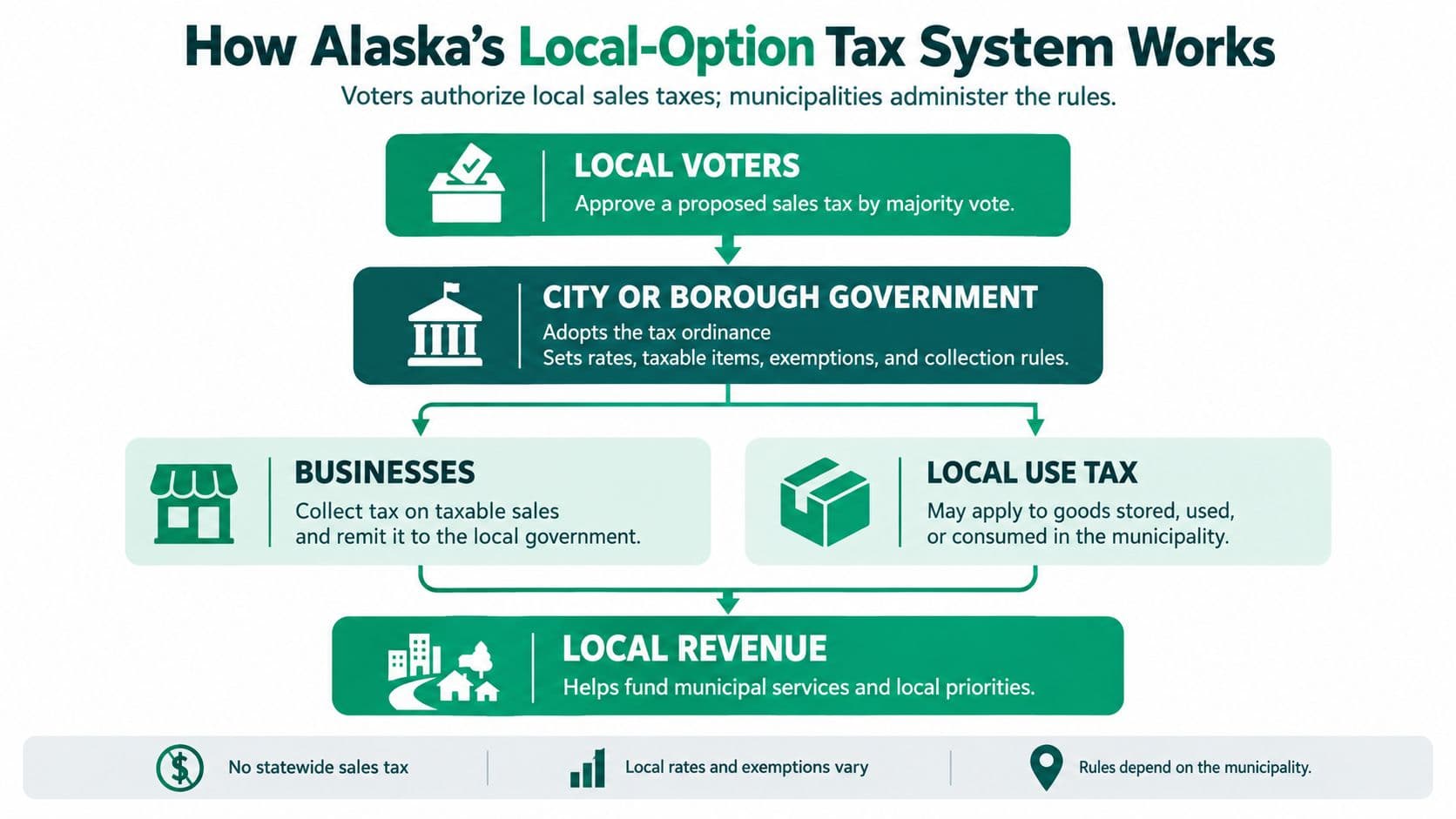
A borough and a city may serve different populations, maintain different infrastructure, and rely on different revenue sources. Comparing their bills without comparing those responsibilities is like comparing two utility bills without checking which services each one includes. Property tax is one part of each municipality's funding choice.
Three places a parcel may fall
The parcel's local government determines which of these situations applies:
- Taxing municipality: The property lies within a borough, city, or unified municipality that has adopted a property tax. The local government assesses taxable property and sends the bill.
- Non-levying municipality: The government has authority to tax but has chosen not to impose a property tax. An owner may therefore receive no municipal property-tax bill. A borough that declines to levy illustrates the distinction between legal authority and an active tax.
- Unorganized borough: The parcel is outside an organized borough's structure. The owner must check whether a city or another authorized local government covers the property.
State reports classify municipalities in different ways, so statewide totals can vary. The consistent point is that Alaska's property taxation is geographically concentrated rather than universal.
That local choice affects more than whether a bill arrives. It identifies the assessing office, the government collecting revenue, and the exemptions that may apply. Municipal governments also decide how tax revenue supports services, as explained in this guide to municipal government functions. Alaska therefore acts as a live policy lab: land-based taxation can operate differently across nearby jurisdictions, while a true land-value alternative would reprice land-use rights itself rather than tax property through each municipality's chosen system.
Rates, Assessment, and How Your Bill Is Calculated
Once a municipality imposes a property tax, the bill follows a clear sequence. The assessor determines the property's market value as of January 1. Alaska uses a 100% assessment level, so the assessed value generally matches that market value before exemptions. The municipality then applies its local mill rate:
Taxable assessed value × mill rate = property tax before exemptions
A mill equals one-thousandth of a dollar. One mill therefore produces one dollar of tax for every thousand dollars of taxable assessed value. The applicable rate comes from the borough or city, not from one statewide schedule.
A simple illustration
Suppose a property's market value is $400,000 and the local government sets a 10-mill rate. With a 100% assessment level, the taxable assessed value is $400,000. Multiplying $400,000 by 0.010 gives a hypothetical annual bill of $4,000 before exemptions.
That example explains the arithmetic, not the rate for every Alaska property. Jurisdictions set different rates and may use different taxable bases. Under AS 29.45.090, municipalities may not levy more than 3%, or 30 mills. The statutory ceiling and assessment rules should be checked against the applicable state guidance rather than assumed from one municipality's notice.
| Component | Example Value | Notes |
|---|---|---|
| Market value | $400,000 | Value determined as of January 1 |
| Assessment level | 100% | The statutory assessment level |
| Local mill rate | 10 mills | Hypothetical local rate |
| Tax before exemptions | $4,000 | $400,000 multiplied by 0.010 |
A tax notice should show each part of the calculation. Check the assessed value first, then the mill rate or combined rate, and finally any exemption. The taxable base can be lower than the property's full value when an exemption applies or a municipality excludes a category of property.
The distinction between land value and improvement value also clarifies what a bill is taxing. A conventional property tax can include both the site and the buildings. A land-value-based charge would price only the site, potentially through an annually updated land-use value rather than the parcel's combined value. For background, see this explanation of how to calculate land value. For example, if the same $400,000 parcel contains a $100,000 lot and a $300,000 building, a land-value charge would apply to the $100,000 site rather than the full $400,000 property value.
Exemptions That Change Your Effective Bill
A posted mill rate doesn't tell the whole story. Alaska combines a mandatory exemption for certain qualifying owners with optional local exemptions that can change the taxable base from one municipality to another.
State law requires an exemption of up to the first $150,000 of assessed value for a qualifying primary residence owned by a resident aged 65 or older. A disabled veteran with a service-connected disability of at least 50% can receive the same level of relief under the qualifying rules. The exemption applies to assessed value, so it reduces the amount to which the local rate applies. Alaska's State Assessor describes the senior and disabled-veteran exemption rules.
Local choices produce different outcomes
Municipalities may adopt additional exemptions or exclusions. These can address:
- Personal property, including business equipment or other taxable items
- Historical property
- Agricultural land
- Habitat protection
- Economic-development categories
The effect is practical, not merely administrative. Two homes with similar market values can create different effective liabilities if one owner qualifies for a mandatory exemption, one municipality excludes a category of property, or a local ordinance protects a particular use. Exempt property also reduces the taxable base available to fund municipal services, which can affect how governments distribute the remaining burden.
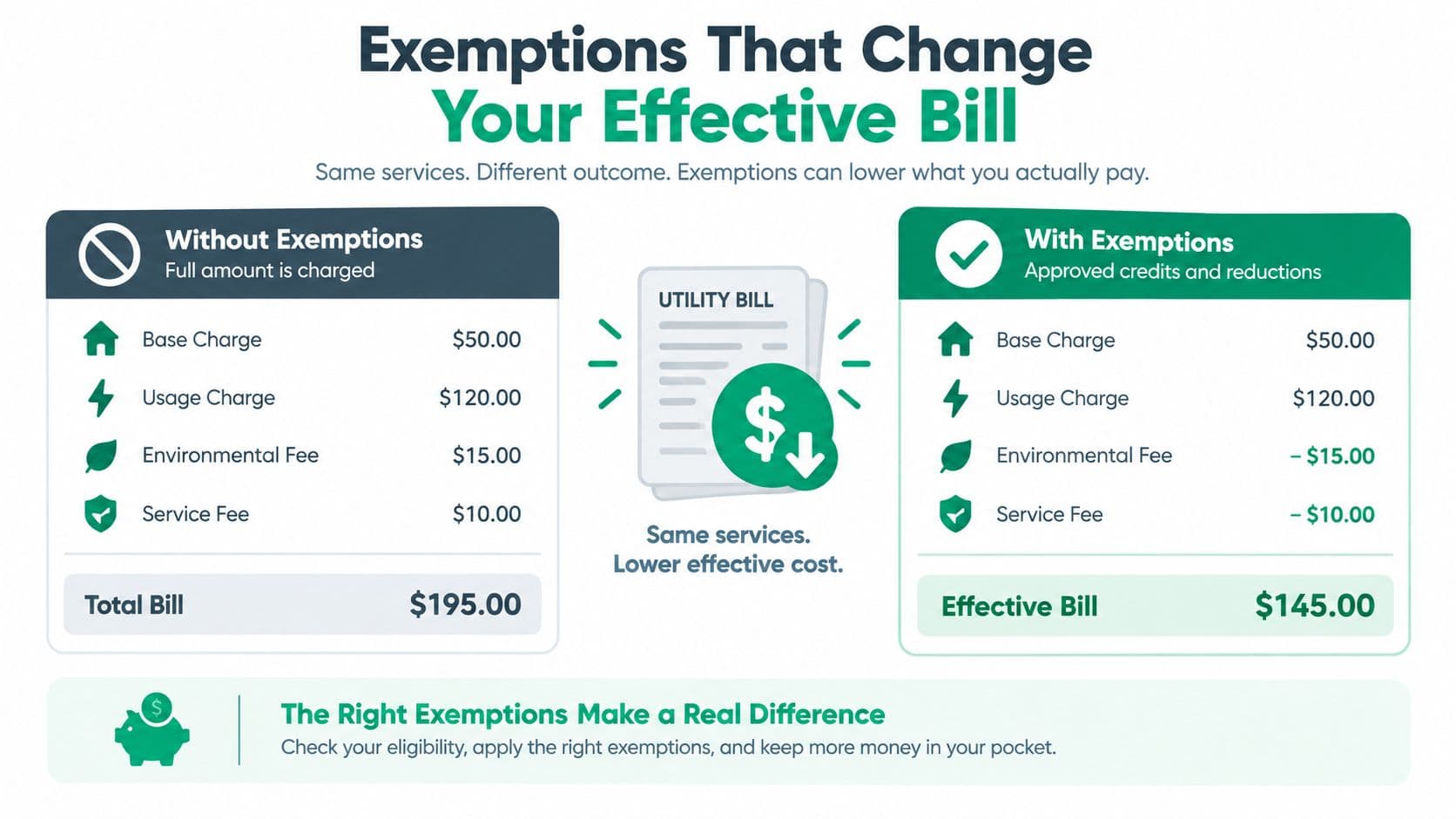
The personal-property contrast between Fairbanks and Anchorage makes the point clearly. Fairbanks has exempted all personal property, while Anchorage assesses personal property. A small business owner with equipment can therefore face a different tax treatment in those cities even if the business has similar assets and revenue. Owners who may qualify should review the requirements in this guide to senior-citizen tax exemptions, then confirm the application process with the local assessor.
Checking Your Local Rate and Appealing a Bill
A property owner can verify the local obligation without treating the process as mysterious. Start with the parcel, not a general Alaska tax page.
-
Identify the governing municipality. Use the parcel record, legal description, and boundary information to determine whether the property lies inside a city, an organized borough, a unified municipality, or an unorganized area. The local assessor or finance department is the right starting point.
-
Find the current mill rate. Look at the municipality's published budget, tax ordinance, or assessor notice. Ask the office to confirm whether the listed rate includes all applicable local components.
-
Review the assessed value. Compare the notice with recent comparable sales and with the property's condition, land characteristics, and improvements. Alaska assesses market value as of January 1, so the relevant question isn't what you paid or what you believe the property should be worth.
-
File an appeal promptly if necessary. Local deadlines are short and strictly enforced. The process commonly involves a board of equalization or a similar review body, and the owner generally must provide evidence supporting a different valuation.
Before appealing: Gather comparable sales, photographs, repair records, appraisal evidence, and documents showing physical features that affect market value.
An appeal isn't usually a debate about whether the bill feels high. It asks whether the assessment reflects the property's market value under the local rules. Purchase price can be useful evidence, but it isn't automatically conclusive, especially when the assessment date and sale date differ. The municipal assessor's office can tell you the filing deadline, required form, hearing date, and evidence standard.
Land Leases, Land-Use Rights, and Where Alaska Fits
Property taxes and land-value policy are related, but they aren't the same instrument. A property tax is a recurring public charge on an assessed base. A land lease is a contract for possession or use, while a true land-use right is an indefinite right with a different pricing structure.
A fixed-term land lease has an expiration date and a price set by the contract. It may be renewable or non-renewable. A renewable lease offers certainty only until the term ends. If the contractual rent falls below the market rent during that period, renewal can close the accumulated gap through one large repricing.
A non-renewable lease carries a different problem. As expiration approaches, the tenant may find it harder to refinance, transfer, or sell the lease because a buyer is purchasing a shrinking period of use. Fixed leases don't correctly price changing land-value risk continuously. They postpone that risk until a contractual event.
What makes a land-use right different
A true land-use right meets all three conditions:
- It is repriced annually.
- It requires no renewal.
- It doesn't expire.
Annual repricing keeps the charge closer to current land value instead of allowing a large gap to accumulate. Because the right is indefinite, people can buy and sell it without waiting for a renewal event. The structure can therefore support transfers at lower cost and avoid tying an enterprise to a looming expiration date.
Alaska's public-land leasing system illustrates why terminology matters. The Department of Natural Resources says its leases may be subject to reappraisal every five years, with the lessee responsible for the appraisal expense and with annual rent potentially changing as a result. The Alaska DNR leasing framework describes this reappraisal mechanism.
That is still a lease mechanic. The arrangement remains governed by a term, renewal conditions, and contractual rent provisions. A five-year reappraisal isn't annual repricing, and it doesn't remove expiration or the need for renewal. It therefore shouldn't be labeled a land-use-right system under the definition above.
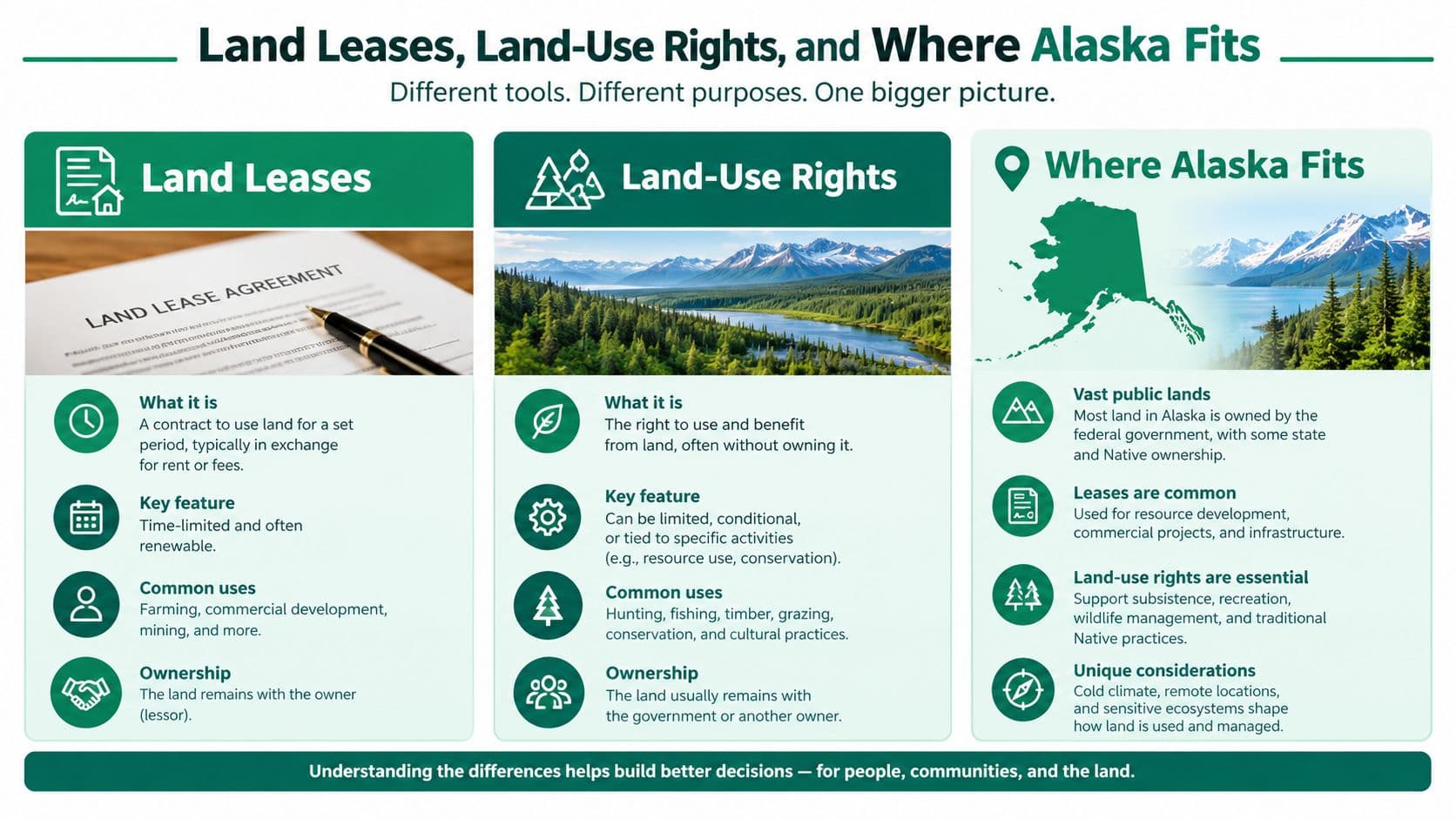
This distinction matters for land-value reform. A conventional property tax, a fixed land lease, and an annually repriced indefinite land-use right each allocate risk differently. Calling a fixed lease a land-use right blurs the very feature that determines whether land value is repriced continuously or only at intervals.
For a more detailed definition, see this guide to land-use rights.
What This Means for Your Property Decision
Yes, Alaska has property taxes, but only a local government that chooses to levy one can place a municipal property-tax obligation on the parcel. The rate, exemptions, and taxable base vary by jurisdiction, so a statewide assumption can mislead a buyer, seller, landlord, or business owner.
Use three checks before you estimate the cost of owning a property:
- Confirm the parcel's government. Identify the city, borough, unified municipality, or unorganized area responsible for the property.
- Look up the current mill rate. Use the assessor's notice, tax ordinance, or published budget rather than a general estimate.
- Check exemptions. Review eligibility for the senior or disabled-veteran exemption, then ask whether the municipality has adopted relevant exemptions for personal property, agricultural land, historical property, habitat protection, or economic development.
These checks matter during a purchase because a tax bill affects operating costs, financing assumptions, and the value a buyer can support. They also matter when comparing land in different communities. The same statutory authority can produce different results because local governments choose different rates, exemptions, service packages, and treatment of personal property.

Alaska also functions as a useful policy laboratory for geographically variable land-based revenue. Its municipal property-tax system shows how local boundaries and exemptions shape fiscal incidence. Its state-land leasing framework shows the difference between periodic rent reappraisal and a true land-use-right model that is indefinite, requires no renewal, and is repriced annually. Those are related policy questions, but they shouldn't be collapsed into one instrument or presented as proof of a broader reform outcome.
Unitism® offers research, land valuation methods, policy design, distributional modeling, and implementation support for organizations examining land-based revenue and property-tax reform. Visit Unitism® to explore its educational resources and practical tools for evaluating how land value can affect public finance.