Learn what site value rating is, how assessors value land apart from buildings, and where it works, with real examples from New Zealand and beyond.
November 8, 2026
Site Value Rating Explained: How Land-Based Taxes Work
Learn what site value rating is, how assessors value land apart from buildings, and where it works, with real examples from New Zealand and beyond.

You're looking at a council rates bill while deciding whether to add a room, renovate a shop or develop an empty lot. Before estimating the cost, you need to know what the council taxes: the location, the building, or both. That distinction determines whether improving your property also increases its taxable value.
Site value rating separates the value of a place from the value of what someone builds there. The principle is straightforward. Making it fair requires reliable parcel records, defensible valuations and a way for owners to challenge mistakes.
Table of Contents
- What Site Value Rating Taxes and What It Leaves Alone
- How Assessors Separate Land Value From Buildings
- Who Gains and Who Pays When Rates Shift to Land
- New Zealand Evidence on Running Site Value Rating for Decades
- When Site Value Rating Changes Housing Supply
- Land Leases, Land-Use Rights and Land-Value Taxes Compared
- Confirm Readiness Before Adopting Site Value Rating
What Site Value Rating Taxes and What It Leaves Alone
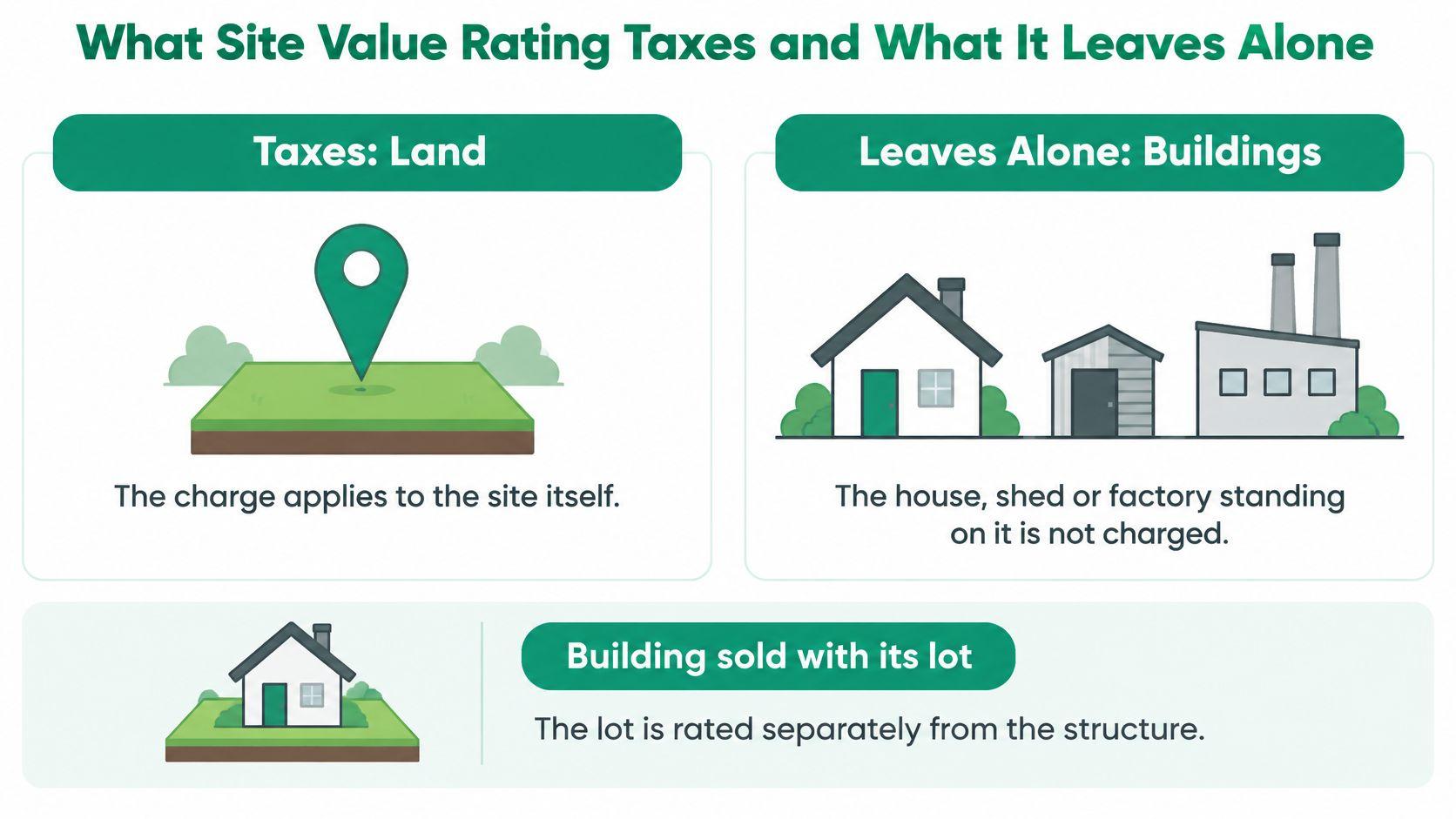
Think of a house sold with its lot. The buyer pays for two different things: a structure someone constructed and a location whose usefulness comes from surrounding people, roads, schools and businesses.
Site value rating charges the land component, leaving the house, shed or factory outside the assessment. The owner's construction spending isn't what creates the surrounding location value.
Rating bases compared
New Zealand illustrates the distinction between rating bases. Its Unimproved Value Act 1896 allowed councils to choose land value, capital value or annual rental value, according to the Lincoln Institute's historical review.
| Rating base | What is valued | Effect of building an improvement | Where it appears |
|---|---|---|---|
| Site value (unimproved land value) | Land only, excluding structures and site works | No direct increase in the site-based bill | Councils retaining land-value rating, including many regional authorities |
| Capital value (improved value) | Land plus buildings and improvements | The bill rises if the improvement increases assessed value, holding the rate constant | The predominant New Zealand council base |
| Annual rental value | Estimated yearly rent of the property | The bill rises if the improvement increases assessed rent, holding the rate constant | An alternative permitted under New Zealand rating law |
A rating base isn't the same as a tax rate. The base is the value being charged; the rate is the multiplier applied to it.
A hypothetical extension
For illustration, suppose a council applies 0.4 percent to land valued at NZ$300,000. The annual site-value charge is NZ$1,200, and a NZ$150,000 extension leaves that charge unchanged if the site assessment and tax rate stay unchanged.
To isolate the arithmetic, suppose the capital-value comparison starts with the same NZ$300,000 assessed base. If the extension raises that base to NZ$450,000, applying the same illustrative rate produces a NZ$1,800 bill.
These aren't actual council charges, and the starting capital value of a real house would include its existing building. Councils set rates separately for different bases, so compare the change caused by construction, not identical headline percentages.
Practical rule: Ask what value appears on the assessment before asking whether the percentage is high or low.
You can now identify what a proposal taxes and predict the direct effect of an upgrade. A site-value bill can still change when the location becomes more valuable or the council changes its rate, even though the building remains excluded.
How Assessors Separate Land Value From Buildings
An assessor doesn't look at a house and guess what the empty plot would fetch. A defensible valuation follows a repeatable procedure, with assumptions an owner can inspect.
The Lincoln Institute working paper on land value taxation identifies both the assessment methods and the administrative weaknesses that can undermine implementation, including outdated rolls, incomplete parcel coverage and weak collection.
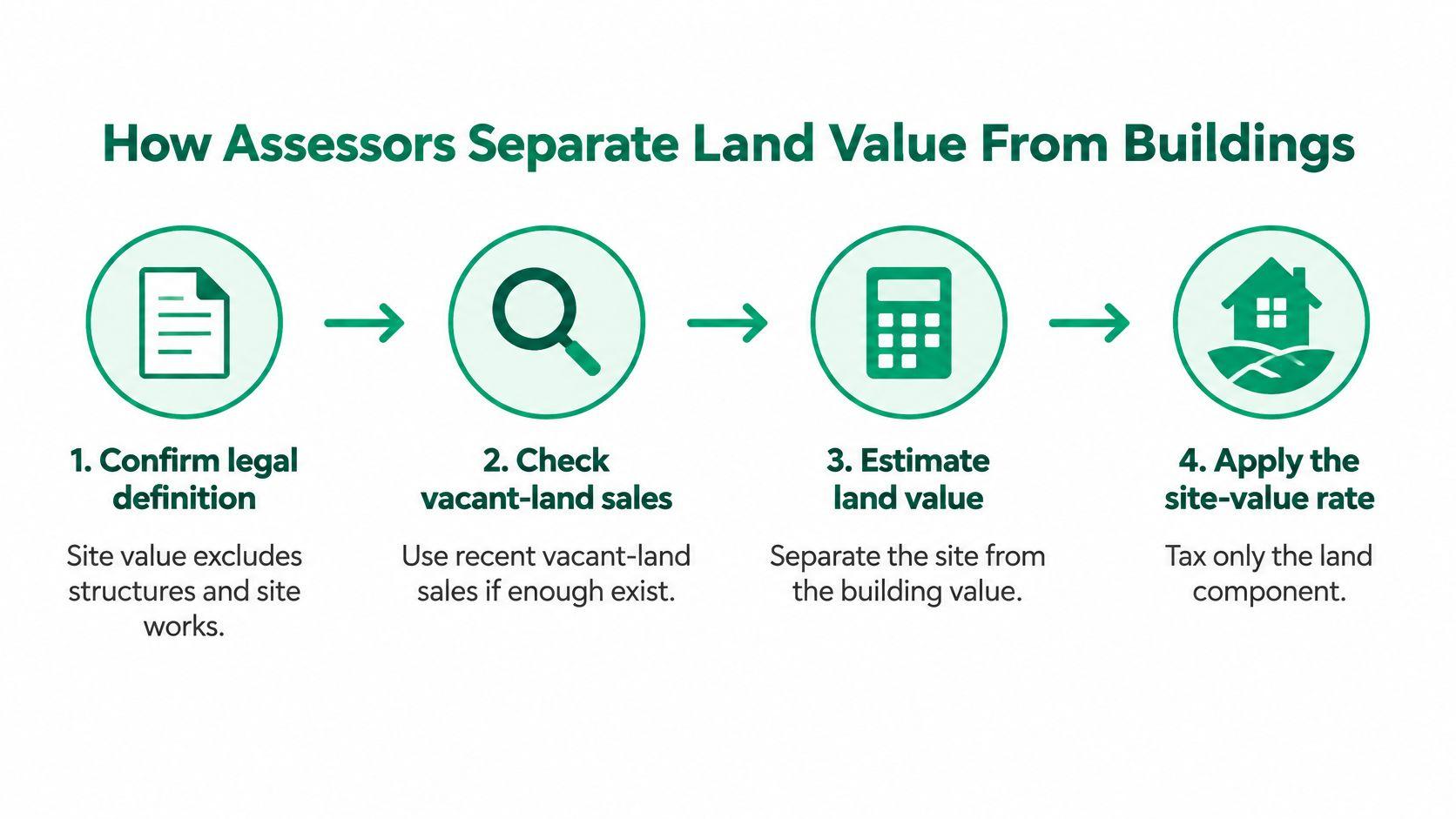
- Confirm the legal definition of site value. Establish exactly which structures and site works must be excluded. The model must estimate the legally taxable interest, not an informal idea of empty land.
- Check recent vacant-land sales. If enough comparable transactions exist, use direct comparison as the primary method. Screen out transactions that don't represent an ordinary market exchange.
- Use paired sales where vacant sales are scarce. Match improved properties as closely as possible, then examine differences attributable to land factors rather than building quality.
- Decompose improved sales where necessary. Subtract the depreciated replacement cost of buildings from the transaction value. Record construction-cost and depreciation assumptions.
- Adjust for the parcel's characteristics. Include zoning, permitted use, location, accessibility, size, topography, servicing and development potential.
- Test the estimate. Publish confidence intervals and conduct quality-control audits, including checks against sales not used to fit the model.
Valuation methods by available data
| Method | Best when | Data needed | Main limitation |
|---|---|---|---|
| Direct comparison of vacant land sales | Vacant land sells regularly | Recent vacant-land sales, zoning, parcel size | Scarce evidence in thin or built-up markets |
| Paired sales analysis | Few vacant sales, many improved sales | Matched improved properties differing in a land factor | Needs sufficiently comparable pairs |
| Cost-based decomposition of improved sales | Improved sales dominate and building costs are known | Sale price and depreciated replacement cost | Sensitive to depreciation assumptions |
| Residual calculation | Simple appraisal with reliable building data | Total market value, building age and condition | Can overstate land when improvements are undervalued |
| Mass appraisal model with confidence intervals | Large jurisdictions needing regularly refreshed values | Parcel cadastre, zoning, sales and accessibility data | Requires continuing quality control and audits |
Difficult parcels need explicit assumptions
Demolition costs and heritage restrictions need separate treatment: one concerns removing an existing structure, while the other may constrain lawful redevelopment. Assessors should follow the statutory valuation assumptions rather than deducting every cost automatically.
Assemblage potential requires evidence that combining parcels is realistic. Leaseholds require clarity about which ownership interest is valued, and mixed-use properties require careful separation where buildings account for much of the observed sale price.
The shortcut total value minus depreciated improvements is only as reliable as the building estimate. Understate the building and the residual land estimate becomes too high.
A transparent guide to land valuation methods helps officials choose methods appropriate to their evidence. Owners should then be able to challenge incorrect parcel attributes, unsuitable comparables or model error, without putting building value back into the taxable base.
Who Gains and Who Pays When Rates Shift to Land
Increasing the land rate while cutting the building rate makes holding a valuable site more expensive and improving it less heavily taxed. Buyers may adjust their offers to reflect the future charges, a process called capitalisation. But construction opportunities and demand also change what buyers will pay.
A Pennsylvania municipal panel study found that higher land rates paired with lower building rates increased assessed land value per taxable acre, with residential land responding more strongly than commercial and industrial land. That finding cautions against treating a mechanical prediction about lower land prices as a universal observed result.
Separate the tax effect from other changes
An assessment increase doesn't, by itself, prove an owner gained. Analysts need separate land and improvement estimates, controls for municipality and year effects, and distinct tests for residential and nonresidential property.
The study treats assessed land value as a useful market-value proxy in its setting. That doesn't make every assessment system equally reliable or justify applying one response estimate across an entire jurisdiction.
Track outcomes that reveal what owners and developers do:
- Permits and floor-area additions: Distinguish applications from completed, usable space.
- Vacancy: Check whether previously idle properties enter productive use.
- Transaction prices: Observe market responses rather than relying exclusively on assessment changes.
- Tax arrears: Identify payment stress that an average tax-burden estimate could conceal.
A reform can improve incentives for future construction while imposing a difficult adjustment on someone who bought under the previous rules.
Model households and projects separately
An existing owner may face a capitalisation loss after paying a purchase price that assumed the old tax system. A builder may benefit from lower improvement taxation, but still need financing, permission and customers.
A proper distributional analysis should compare owners with similar incomes but different property compositions. A household occupying a modest home on valuable land can face a different change from one occupying an expensive building on a less valuable site.
Run scenarios that vary:
- The land-rate increase, identifying exposure among valuable, lightly developed sites.
- The building-rate cut, showing which improvements receive relief.
- Zoning capacity, separating legally feasible development from hypothetical potential.
- The phase-in period, showing both the final burden and the adjustment path.
The useful result isn't a single average winner. It's a clear account of who pays more, who pays less and who may struggle during transition.
New Zealand Evidence on Running Site Value Rating for Decades
New Zealand rating milestones
The historical record above establishes the legal starting point. The New Zealand local-finance review documents the subsequent milestones and fiscal measures below, including capital-value rating reaching 71% of councils and 88% of general-rates revenue in 2019.
| Period | Rating base or context | Reported figure |
|---|---|---|
| 1896 | Councils may choose land, capital or rental value | Unimproved Value Act 1896 |
| Until 1985 | Land value is the preferred base | Dominant approach for much of the twentieth century |
| 1994 and 2006 | Property rates as share of local-government revenue | 57.3% in 1994, 56.1% in 2006 |
| 2001 | Per-capita capital-value rates base | Average NZ$86,407, from NZ$42,158 to NZ$218,573 |
| 2006–07 | Capital value becomes base for most councils | Majority of local authorities |
| 2010 | Property taxation share of local-government taxation | Up to 92% reported |
| 2019 | Capital-value rating | 71% of councils, 88% of general-rates revenue |
Property taxation became a foundation of local finance after European colonisation. Land-value rating subsequently operated as a recurring municipal revenue system, not merely as an economist's proposal.
The later shift towards capital value demonstrates that administrative durability doesn't guarantee political permanence. Councils can maintain property taxation while changing which components of property wealth they assess.
Revenue dependence and unequal tax bases
The table's revenue measures need careful reading. Property rates as a share of all local-government revenue aren't the same measure as property taxation's share of local-government taxation revenue.
The per-capita capital-value range also matters. Kawerau occupies the lower end and Queenstown-Lakes District the upper end, illustrating how different councils can have very different property wealth available to tax.
The review reports greater relative dispersion in land-value bases than capital-value bases. For fiscal equalisation, the practical question is whether councils with weaker bases can fund comparable services without imposing disproportionately demanding charges.
Valuation machinery is part of the policy
A valuation roll covering every rateable parcel gives a council an auditable link between land records and bills. A revaluation calendar then determines how quickly changing market conditions enter assessments.
Historical descriptions of valuation practice aren't sufficient authority for a current implementation timetable. Before adopting a schedule, officials should verify current council valuation rules, statutory requirements and the valuation provider's capacity.
For comparison with a different institutional setting, the Pennsylvania land-value tax guide helps distinguish a split-rate approach from New Zealand's choice among rating bases.
New Zealand's central lesson is practical: changing the base doesn't end reliance on property taxation. It changes whether councils charge land alone or land together with improvements, with consequences for taxpayers and the distribution of fiscal capacity.
When Site Value Rating Changes Housing Supply
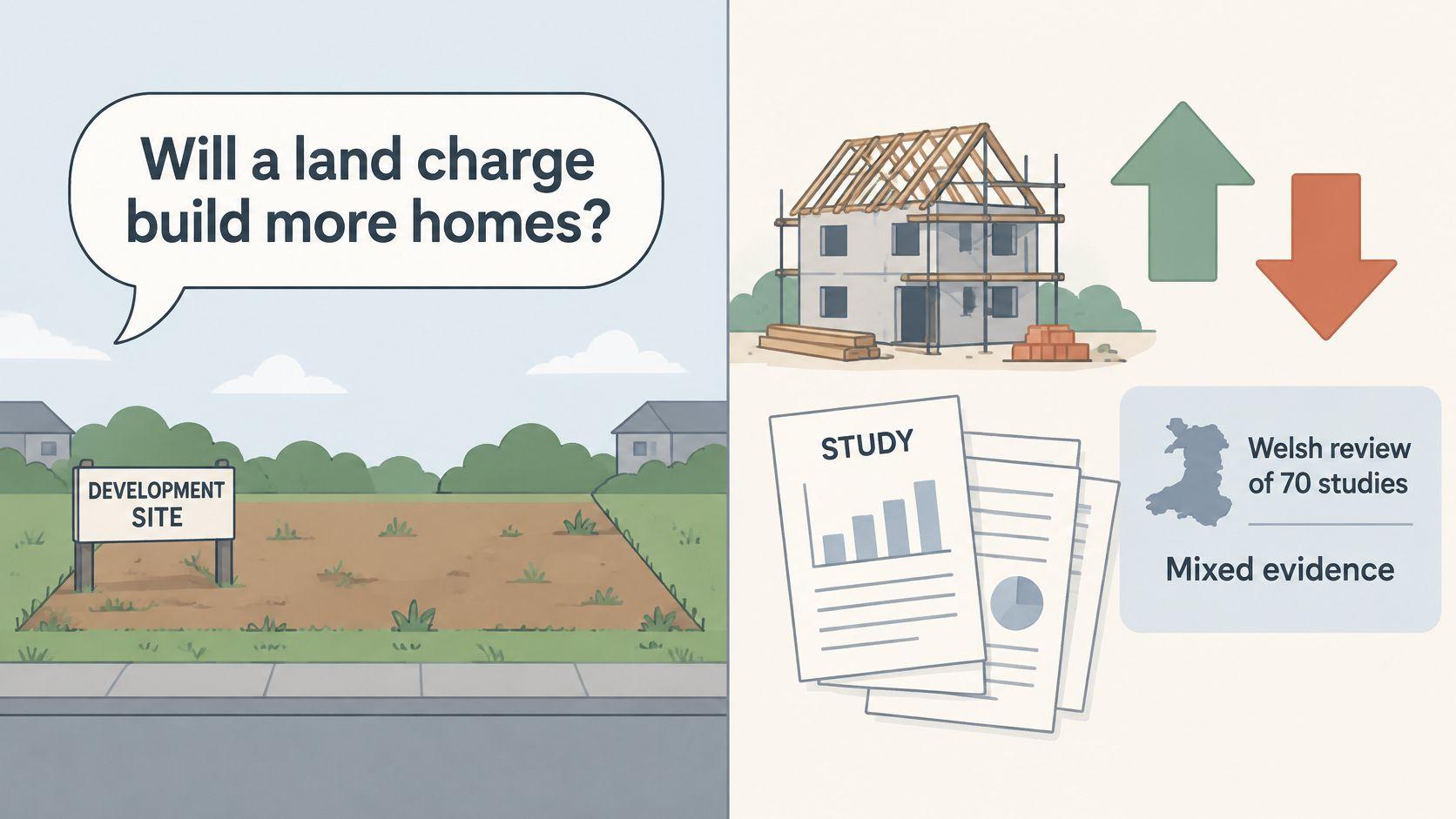
A council that switches to site value rating is changing an incentive, not issuing building permits. The charge can push an idle owner toward developing or selling, but it cannot connect a sewer, speed up an approval, or create buyers in a town where demand is weak. Expectations should start there.
A Welsh Government evidence review covering 70 empirical studies found mixed results: development effects were generally modest and stronger in high-demand urban areas where projects were already viable. The review also discusses a Victoria analysis associating site-value rating with a 20% increase in the value of new dwelling construction, a context-specific finding rather than a universal forecast. In the same analysis, a higher site-value-to-capital-value ratio was linked with higher household income, suggesting a more progressive burden than capital-value rating in that setting.
Measure the outcome you actually want
Construction value works like a restaurant's takings: a higher figure can mean more diners, pricier dishes, or both. A rise in construction value can reflect larger buildings, higher specifications and cost inflation as well as additional dwellings, so it never proves on its own that more homes arrived.
Keep these outcomes separate:
- Land-price capitalisation: Buyers change what they offer for sites.
- Construction response: Developers start or complete additional building work.
- Vacancy reduction: Owners bring unused land or buildings into use.
- Revenue stability: Councils collect dependable revenue through changing conditions.
A city could experience one without achieving the others. Lower bids for land don't demonstrate that completed homes have increased.
Test local constraints before promising supply
A distribution that looks progressive on average still leaves individual cases where the bill bites. Cash-poor owners and retirees may own valuable sites without a matching income stream. Farmers need assessment assumptions consistent with lawful use, while landlords need to understand both their tax change and realistic redevelopment options. Because the charge falls on the site's value rather than the building, adding floors raises no additional liability, but that incentive only delivers homes where a project clears every other hurdle first.
Before presenting a housing forecast, check:
- Local vacancy and land-price growth: Is there unmet demand, speculative holding or weak demand?
- Permitting delays: Can viable projects obtain approval?
- Infrastructure capacity: Are transport, water and other services available?
- Project feasibility: Do expected receipts cover construction, financing and operating costs?
For the last question, RBA Home Plans' guide to planning a real estate feasibility study provides a practical starting point for organising project assumptions.
Treat site value rating as part of a land, planning and infrastructure package, not as a substitute for one.
Land Leases, Land-Use Rights and Land-Value Taxes Compared
Calling a fixed lease a land-use right doesn't change its economics. Duration, renewal and repricing determine the occupant's obligations, not the document's label.
For this comparison, land leases are renewable or non-renewable fixed-term arrangements with a fixed price during the term. A qualifying land-use right is different: it never expires, requires no renewal and is repriced annually.
Land instruments compared
| Instrument | Duration | How the price is set | Renewal needed | Transaction and refinancing risk |
|---|---|---|---|---|
| Renewable fixed-term lease | Fixed term, then renewal | Fixed price during the term | Yes, at expiry | Certainty until expiry, then a potential repricing cliff |
| Non-renewable fixed-term lease | Fixed term with no renewal right | Fixed price | No renewal option | Harder to refinance and sell as the remaining term declines |
| Qualifying land-use right | Indefinite, no expiry | Repriced every year | No | Low-cost buying and selling, subject to transfer rules |
| Land-value tax | Recurring charge with no contract term | Charge assessed on land value | No renewal transaction | Liability changes through reassessment and rate decisions |
Fixed leases postpone the adjustment
A study of Rwanda's land-leasing system describes fees payable as a lump sum or over ten years, based mainly on square metres rather than market land value. Those payments couldn't capture later increases in site value.
Renewable leases offer a measure of certainty until expiry, when the accumulated gap between the contractual price and current market terms may close abruptly. A Lincoln Institute study of Hong Kong documents a renewable arrangement providing another 50-year term, with rent at renewal equal to 3 percent of the property's rental value.
Non-renewable leases create a different problem. As the remaining term shrinks, buyers have less time to recover their investment, and lenders have a shorter-lived interest securing their loan.
The financing concern isn't theoretical: the Appraisal Institute's ground-lease analysis describes dramatic Midtown Manhattan rent reappraisals that led many leasehold mortgage lenders to avoid leases containing reappraisal provisions. Fixed leases postpone risk rather than correctly pricing it continuously.
Annually repriced rights and recurring taxes
A qualifying land-use right prices the land annually without an expiry or renewal negotiation. In this design, buyers and sellers can transfer the right at low cost rather than purchasing a long, prepaid claim to future land rent, although actual transfer expenses still depend on administrative rules.
Annual repricing keeps the land charge aligned with current value. By leaving productive improvements outside that charge, the design aims to price land appropriately without burdening entrepreneurship through additional charges on construction.
A land-value tax, by contrast, is a public charge, not a grant of possession. The U.S. Federal Highway Administration defines it as a property tax levied only on land value.
Public leasing can also capture value through premiums and rents, but that doesn't make it equivalent to either annually repriced rights or taxation. When evaluating long fixed-term land leases, inspect the expiry, renewal and reset clauses before comparing headline payments.
Confirm Readiness Before Adopting Site Value Rating
A council shouldn't select site value rating first and discover its administrative gaps afterwards. Use the following go-or-no-go test before committing to legislation.
Administrative gates
- Define the base clearly. Proceed only if the legal definition excludes structures and site works and can be explained in a plain sentence.
- Confirm complete parcel coverage. Every rateable parcel must appear in a cadastre linked to zoning and sales records. Unresolved coverage gaps are a no-go.
- Validate before billing. Test the mass-appraisal model against held-out sales and publish uncertainty ranges before setting charges.
- Make appeals workable. Owners must be able to correct attributes and challenge model error without reintroducing building value into the base.
These are minimum conditions, not optional refinements. If any fails, repair the administration before proceeding.
Fiscal and development checks
- Run revenue-neutral scenarios. Calculate the effective rate needed on the actual local land base rather than borrowing a rate from another jurisdiction.
- Map the transition. Show the effects on cash-poor owners, farmers, retirees and landlords, including the timing of any phase-in.
- Test the housing case locally. Check vacancy, permitting delays, infrastructure capacity and project feasibility before promising additional supply.
- Commit to maintenance. Set a revaluation calendar, assign responsibility for quality audits and fund the appeal process.
A useful transition requirements framework connects these decisions so that valuation, billing and taxpayer communication aren't designed independently.
Proceed only when the administrative gates pass. The next action is to draft a scenario model for a single district before drafting legislation, using parcel-level assessments, a revenue target and an explicit transition path.
The model should produce an understandable explanation of changed bills, not just a revenue total. Officials need to be able to tell an owner which parcel facts, valuation assumptions and policy choices produced the result.
We help assess land values, design policies that collect them and model who gains and who pays. Visit Unitism® to discuss a district-level site value rating scenario that tests valuation readiness, revenue needs and transition options before legislation is drafted.