Affordable housing consulting explained: how land valuation, policy design and impact modeling help governments measure and fix housing affordability.
November 16, 2026
Affordable Housing Consulting: What Experts Deliver
Affordable housing consulting explained: how land valuation, policy design and impact modeling help governments measure and fix housing affordability.

Across OECD countries, real house prices rose by more than 40% on average over the decade referenced in the OECD's housing overview. That reframes the task for public officials: affordable housing consulting isn't merely about finding a cheaper way to construct buildings. It's about identifying why households can't afford suitable homes, choosing interventions that address those causes, and proving whether public money improves access.
A useful consultant connects household budgets, development feasibility, land values, and government finances. The result should be a decision officials can explain and administer, not just a report recommending more housing.
Table of Contents
- Why Affordability Needs a Measured Diagnosis
- What Consultants Deliver, Service by Service
- Why Land Value Is a Policy Variable, Not a Background Cost
- Land Leases Versus Land-Use Rights Explained
- Measuring Whether Affordability Policy Is Working
- How to Run an Affordability Engagement Step by Step
- Confirm the Evidence and Choose Your Consultant
Why Affordability Needs a Measured Diagnosis
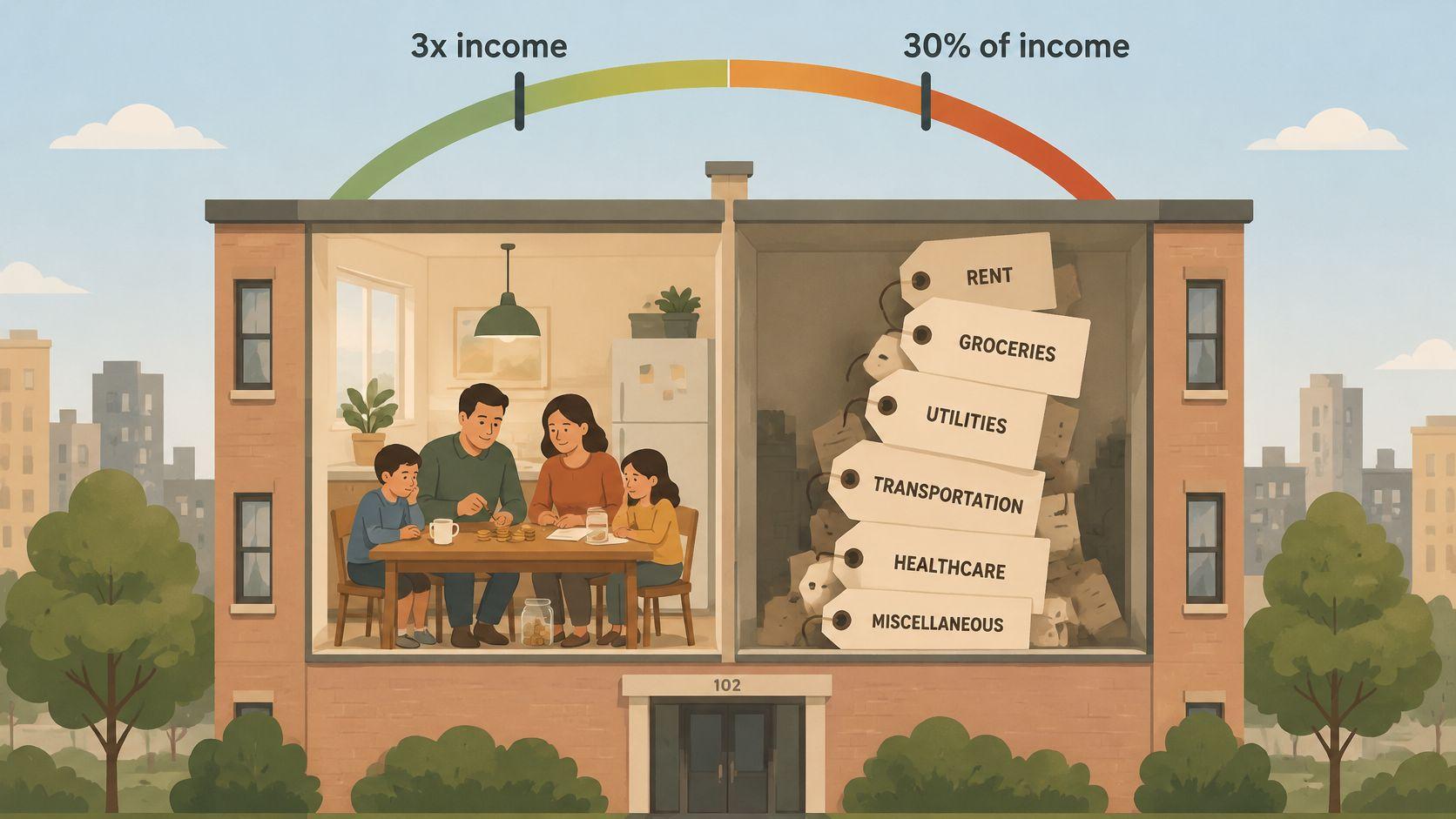
UN-Habitat's 2020 global median house-price-to-income ratio was 6.1, roughly twice its affordability benchmark of three years of household income. Its median rent-to-income ratio was 35%, five percentage points above its 30% benchmark, according to its global housing-affordability assessment. Regional median rent burdens ranged from 12.8% in North America and Europe to 30.5% in West Asia and North Africa.
Global affordability benchmarks against 2020 medians
| Indicator | UN-Habitat benchmark | 2020 global median |
|---|---|---|
| Price-to-income ratio | Three years of household income | 6.1 |
| Rent-to-income ratio | 30% of monthly income | 35% |
These benchmarks show the scale of pressure, but do not describe what any particular household can afford. A diagnosis should account for income remaining after essential expenses, financing terms, location, and which housing costs are counted. Consultants should state whether income means gross or disposable income and specify the expenses included.
Read the vital signs together
A single reading rarely identifies the cause of a problem. Housing consultants combine incomes, rents, purchase prices, tenure, and geography to determine which households face pressure and where it occurs.
A citywide average can look manageable while private renters near employment centers face much higher costs. Aggregated household budgeting data helps public agencies assess affordability at scale, while retaining distinctions between neighborhoods and income groups. The causes of the housing affordability crisis also matter: immediate payment difficulties and the conditions sustaining high prices call for different policy responses.
For a household-level example, a western suburbs home buying budget illustrates the kinds of costs a buyer may need to consider. Public agencies need to combine that kind of budgeting perspective with evidence across households and places.
Every engagement should answer:
- How large is the gap? Compare actual housing costs with an explicit affordability threshold.
- What drives it? Distinguish land, construction, finance, infrastructure, and regulatory constraints.
- Who carries it? Identify affected households by income, tenure, and location.
- What changes it? Estimate which intervention moves those households toward the agreed threshold.
What Consultants Deliver, Service by Service
A scope of work should connect each service to a decision and a tangible output.
Consulting outputs by service area
| Service area | Question it answers | Output delivered |
|---|---|---|
| Land valuation | What is the site rental value and what drives it? | Parcel-level value baseline and data framework |
| Policy design | Which land-value capture instrument fits the local system? | Options for site-value taxation, resource dividends and rate reform |
| Impact modeling | Who gains, who pays and how much revenue is available? | Distributional and fiscal models with phased transition paths |
| Implementation | Can the rules be legislated and administered? | Draft legislation, process design, cadastre integration and compliance workflows |
| Education and training | Can staff and officials apply the policy? | Courses for civil servants, elected officials and stakeholders |
| Public materials | Do residents understand the reform? | Guides, glossary, FAQs and interactive scenario tools |
From valuation to a workable policy
Land valuation establishes what officials are proposing to collect or influence. Analysts separate the site from its buildings, reconcile parcel records with transactions, and identify location-related drivers such as permitted development and access to services.
Policy design determines the collection mechanism and how proceeds are used. Site-value taxation concerns the revenue base; a resource dividend concerns distribution of shared-resource revenue; rate reform concerns how the burden shifts between tax bases. They aren't interchangeable instruments.
Impact modeling tests the proposal before officials commit. The model should distinguish owners, tenants, developers, and income groups, and show transition arrangements rather than only the eventual revenue total.
Procurement rule: Specify the decision each deliverable supports, the data it requires, and the official responsible for accepting it.
From an adopted rule to daily administration
Implementation includes legislative drafting, valuation appeals, billing, compliance workflows, and integration with the cadastre, the official record of land parcels and interests. Training should use actual administrative tasks so staff can apply the rules rather than merely describe them.
Public guides, a glossary, FAQs, and interactive scenarios serve a different purpose: residents need to understand their obligations and challenge mistaken assumptions. A technically correct policy can still be difficult to administer if notices and explanations are unclear.
Project delivery may also require specialist work outside the fiscal model. For example, a remote development team evaluating housing options for construction crews from Pacific Mobile Structures, Inc. should treat workforce accommodation as a separate logistics and budget question, not confuse it with permanent affordable-housing provision.
These outputs depend on each other. A policy drafted without a valuation baseline can't be credibly costed, while a model without an administrative plan can't establish deliverability. Record each required output in writing before signing the scope of work.
Why Land Value Is a Policy Variable, Not a Background Cost
Land is the foundation beneath every housing budget. If officials leave its changing value unexplained, they may blame construction and financing for costs those activities didn't create.
Land rental value means the annual value of occupying a site and accessing its opportunities, separate from the buildings on it. Location, surrounding community activity, public infrastructure, and natural advantages contribute to that value.
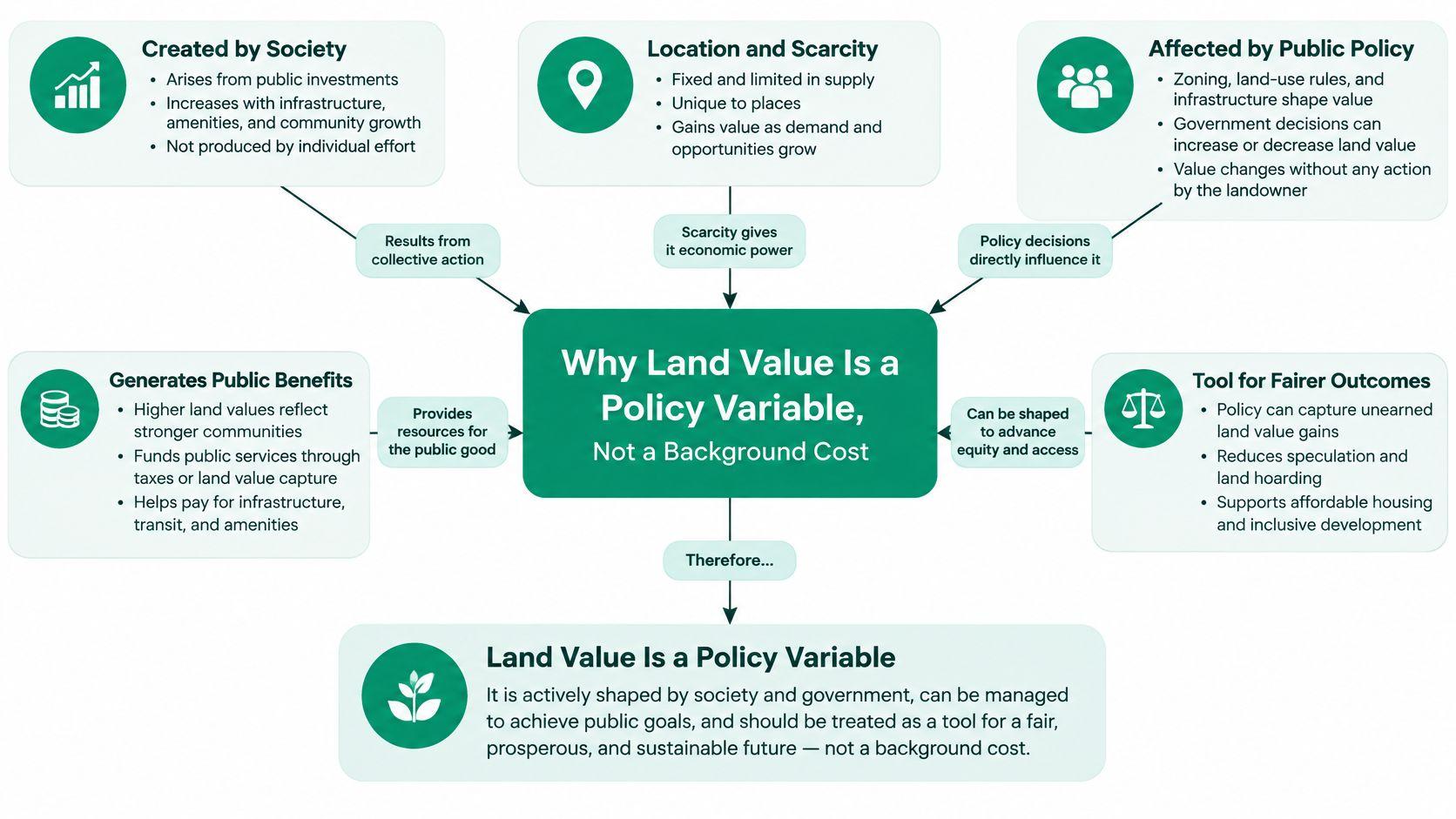
The OECD's assessment of Sweden reports that, between 2000 and 2021, total costs for constructing owner-occupied apartments rose 182%, construction prices rose 150%, and land prices rose 370%; for rental apartments, total costs rose 132%, while land prices rose 317%.
Those figures don't establish the cause of every jurisdiction's affordability problem. They do show why treating land as an unexplained residual can produce a misleading diagnosis.
Identify who receives the development gain
Say a city permits apartments on a site previously restricted to lower-density housing. The consultant should estimate the site's value under the original permission and under the proposed permission, then identify how much additional value goes to the owner and how much supports public objectives.
That requires:
- Parcel-level baselines that separate site value from improvements.
- Counterfactual scenarios showing what would happen without the intervention.
- Distributional analysis identifying who receives rezoning or infrastructure-created gains.
- Transition tests examining development timing, ownership changes, and financing exposure.
An explanation of how land value is calculated helps officials distinguish a defensible valuation from a convenient assumption.
A construction subsidy can improve project feasibility while also increasing what a buyer is willing to pay for the site.
Consultants should therefore compare conventional subsidies with land-value capture, public land leasing, and phased reassessment, rather than assuming the subsidy remains entirely with residents. They should also test whether collection requirements reduce land bids or instead make an already constrained project unviable.
When land cannot be hoarded for speculation, homes cost closer to what it costs to build them. That doesn't eliminate labor, materials, infrastructure, or financing constraints. Land reform is a component of affordability policy, not a substitute for the rest of the development system.
The practical question is: how much of the affordability gap sits in the site itself?
Land Leases Versus Land-Use Rights Explained
Land-value taxes, land leases, and land-use rights can all involve recurring payments, but they establish different obligations. Officials need to distinguish the ownership interest, duration, and repricing mechanism before comparing them.
A land-value tax is a recurrent charge on the site's value, separate from a lease contract. The International Monetary Fund's review of land-value taxation describes annual land-value taxation as a distinct instrument, including systems assessed using capitalized rental values.
Fixed terms versus indefinite rights
In the fixed-price lease model considered here, land leases are renewable or non-renewable fixed-term arrangements. Renewable leases offer certainty only until renewal, when the accumulated gap between the contracted rate and the market can close through a major repricing. Non-renewable leases become progressively harder to refinance and sell as expiry approaches.
Fixed leases therefore postpone risk rather than price it continuously. This is a distinction between the models being compared, not a claim that every legal lease has fixed rent.
By contrast, land-use rights as defined here resemble leases but are indefinite, require no renewal, and are repriced annually. Annual repricing keeps the transferable land interest's acquisition cost low, allowing rights to be bought and sold at low cost rather than capitalizing a long period of below-market payments. The purpose is to price land appropriately without burdening entrepreneurship or other productive enterprises.
A Lincoln Institute study of Hong Kong describes an earlier system allowing renewal for 50 years without an upfront premium, with rent at 3% of estimated rental value at renewal; following the 1997 change, that rent could be adjusted whenever the government reassessed the value. This illustrates different repricing mechanisms, not proof that either arrangement meets every criterion for indefinite land-use rights.
A New Zealand land-tax analysis similarly contrasts a 99-year peppercorn lease, almost as valuable as freehold, with a three-year lease with annual rent reviews, which has little market value. Annual review alone doesn't make a finite lease indefinite.
Fixed leases compared with land-use rights
| Feature | Fixed-term lease (renewable or non-renewable) | Land-use right (as defined) |
|---|---|---|
| Term | Fixed period, then renewal or expiry | Indefinite, no expiration |
| Repricing | Price fixed until renewal or expiry | Repriced each year |
| Renewal | Renewable leases must be renewed; non-renewable leases end | No renewal required |
| Trading | Harder to refinance and sell as the term runs down | Can be bought and sold at low cost |
| Risk handling | Postpones risk and closes the gap in one repricing | Prices land appropriately each year |
A fixed lease doesn't become a land-use right because someone renames it. Check annual repricing, no renewal requirement, and no expiration. The distinction also matters when assessing 99-year land leases.
Measuring Whether Affordability Policy Is Working
A city can collect money, secure commitments, and complete homes. These are different outcomes, and a successful report must not substitute one for another.
By the end of 2025, Seattle's Mandatory Housing Affordability program had collected $378.6 million in contributions and recorded 598 affordable homes through performance agreements; the city separately awarded $334 million for 4,649 new affordable homes, according to its MHA annual report.
Seattle MHA outcomes compared
| Outcome | Seattle figure (end of 2025) | What the figure does not show |
|---|---|---|
| Revenue collected | $378.6 million in MHA contributions | Whether any homes were built or kept affordable |
| Committed affordable units | 598 homes recorded through performance agreements | Whether those units were completed |
| Funded affordable homes | $334 million awarded for 4,649 new affordable homes | Whether they remain affordable after restrictions expire |
Funding isn't completion. Performance agreements aren't occupancy records. Officials should reconcile these categories without adding overlapping totals or implying that an award proves a household has moved into a home.
Build a dashboard around answerable questions
Each measure needs a baseline year, named data source, update schedule, and responsible agency. A useful housing affordability data framework lets council members ask:
- Land prices and unbuilt permissions: Are serviced sites moving into development, or remaining idle?
- Construction starts and completions: Are permissions becoming habitable homes?
- Rent burdens and displacement: Are intended beneficiaries better housed, or moving elsewhere?
- Tax incidence and vacancy: Who ultimately bears the charge, and what happens to unused capacity?
- Lasting affordability: How many homes remain affordable after restrictions expire?
Evaluation test: Compare the observed outcome with a credible estimate of what would have happened without the policy.
A short-run rise in starts doesn't establish long-run affordability. Consultants should test whether land-value capture expands access, whether developers adjust land bids, and whether charges undermine marginal projects. Comparable locations or phased implementation can help construct a counterfactual, provided the analyst documents their limitations.
Distributional modeling adds detail that aggregate revenue forecasts miss. Liam Wilkinson leads a research project with Statistics Canada building a microsimulation model to examine revenue potential, distributional effects, and efficiency gains of LVT in Canada. Such modeling should distinguish projected effects from outcomes subsequently observed.
A council should be able to answer a precise question: which outcome did the policy change, and for whom?
How to Run an Affordability Engagement Step by Step
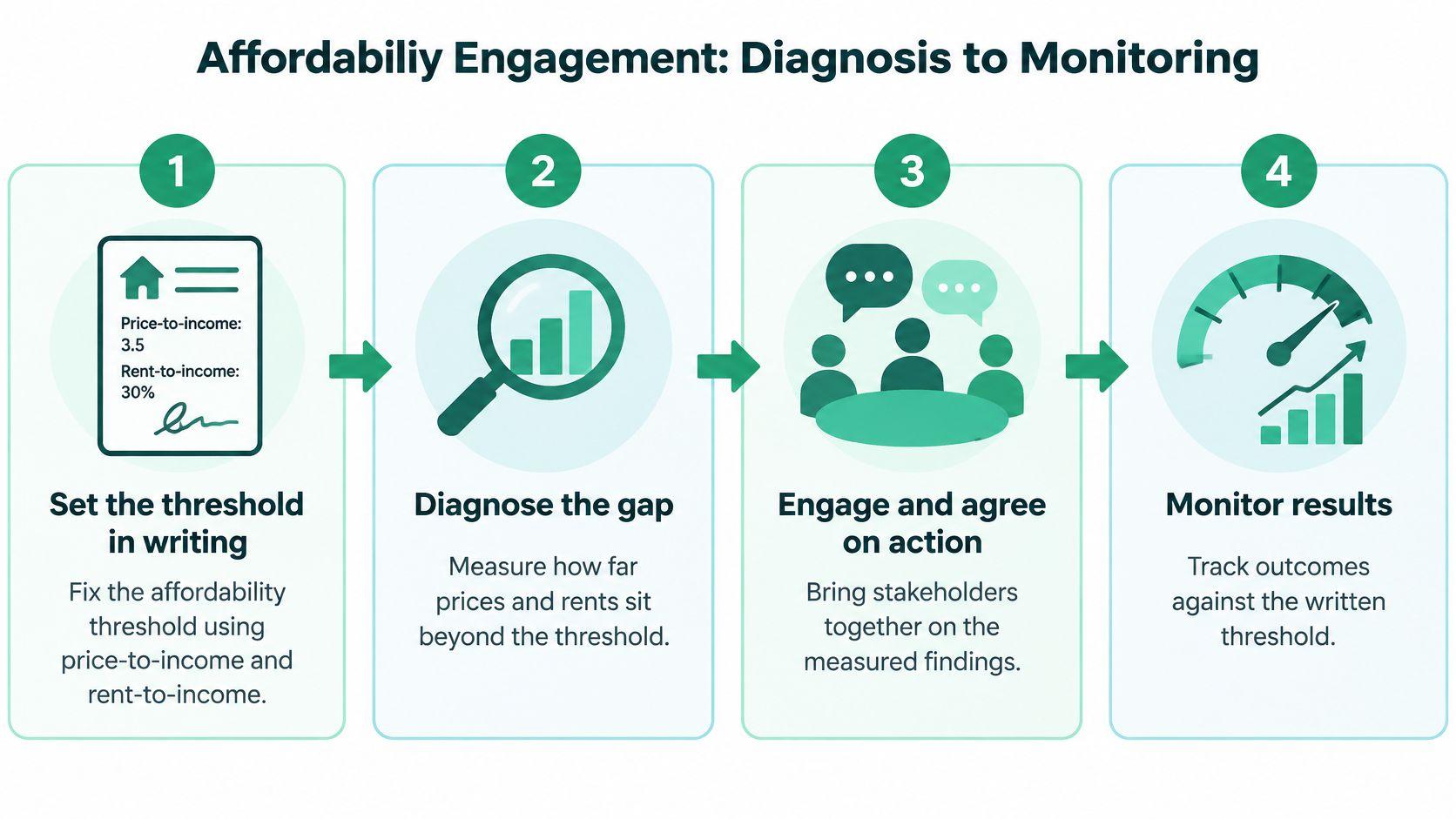
An affordability engagement runs from diagnosis to monitoring. Each stage should produce an accepted output before officials rely on it for the next decision.
Establish and test the proposal
-
Set the affordability threshold in writing. Specify the price-to-income and rent-to-income measures, income definition, target households, and geographic coverage. The common slip is leaving “affordable” undefined, so officials can't judge success consistently.
-
Build the parcel-level land-value baseline. Connect cadastral records, permitted uses, transactions, and infrastructure access, then document missing or uncertain fields. District averages are a poor substitute when neighboring sites have different permissions and development potential.
-
Model scenarios against a counterfactual. Compare zoning reform, land-value capture, public land release, and affordability requirements while testing density, fees, approval times, rents, and interest rates together. The OECD's Canadian housing assessment cautions that poorly calibrated inclusionary requirements can reduce development or raise costs elsewhere, so don't assess obligations in isolation.
Keep the evidence caveat beside the scenario results. A Lincoln Institute review cites Oates and Schwab (1997) as finding that a shift toward land-value taxation didn't harm building activity, while describing the empirical evidence as comparatively scant. A plausible mechanism isn't a guaranteed local result.
-
Run distributional and fiscal analysis. Show gains, payments, transition exposure, and infrastructure cost per additional dwelling by income group and tenure. The OECD's affordable housing framework treats land use, taxation, investment, and government coordination as interacting levers; reporting only a revenue total misses those trade-offs.
Prepare people and administration
-
Design legislation and administration together. Cover drafting, valuation responsibilities, appeals, cadastre integration, compliance workflows, and phased transition arrangements. Passing rules without assigning an agency, staff responsibilities, and usable records leaves the policy without an operating system.
-
Train staff and publish plain-language materials. Test notices, worked examples, and public scenarios with the people expected to use them. Effective stakeholder engagement strategies make disagreements and practical obstacles visible before launch, rather than treating outreach as a final announcement.
-
Monitor annually and re-test scenarios. Update assumptions and reconcile forecasts with observed outcomes. Don't leave the launch model unchanged when financing conditions, development costs, or household incomes change.
We work with governments, cities, and organizations on the concrete steps of putting our land-value approach into practice. That means treating administrative readiness and stakeholder understanding as part of implementation, not as optional additions after policy approval.
Confirm the Evidence and Choose Your Consultant
Commission affordable housing consulting when your team needs a defensible diagnosis, a comparison of interventions, or the capacity to implement and evaluate a reform. Judge the proposal by the decisions it will support and the evidence officials will receive.
A polished presentation isn't enough. The engagement should leave your agency able to reproduce the reasoning, explain uncertainty, and maintain the monitoring system without depending on an unexplained model.
Apply an evidence test before signing
Use the engagement sequence as a procurement test:
- Defined target: Require a written affordability standard with clearly specified income and housing-cost measures.
- Traceable baseline: Require parcel-level land records, valuation methods, and a record of data limitations.
- Credible alternatives: Require scenarios that include a counterfactual, not just variations of the consultant's preferred reform.
- Visible distribution: Require results by income group and tenure, alongside fiscal totals.
- Operational readiness: Require legislative and administrative responsibilities, transition arrangements, and an update plan.
- Separate outcomes: Require distinct reporting for revenue, commitments, funding, completions, and continuing affordability.
Treat a proposal that reports only revenue or promised units as incomplete. Also check who owns the model, which assumptions staff can change, and how the consultant will document revisions. These details determine whether the work remains useful after the contract ends.
Match the capability to the decision
At Unitism®, an economic policy initiative and advisory practice, our support includes assessing land values, designing policies that collect them, and modeling who gains and who pays. We offer policy design, research and analysis, education and training, and implementation support.
Apply the same evidence test to our work as to any other provider. A land-value approach should earn its place through transparent assumptions, locally grounded analysis, and a workable transition, not through the name of the framework.
This week, assemble your jurisdiction's price-to-income and rent-to-income measures, pull current land-value records, and request a scoping review. Put the intended decision, required deliverables, responsible officials, and acceptance criteria in writing before committing funds.
Unitism® offers land-value assessment, policy design, and distributional modeling to help public teams connect affordability goals with practical reform. Visit Unitism® to discuss a scoping review, bringing your housing-cost measures and land records so the conversation starts with the problem your jurisdiction needs to solve.